P a g e | 629 Copyright ⓒ 2019Authors
Studies in Indian Place Names
(UGC CARE Journal) ISSN: 2394-3114
Vol-40-Issue-75-March-2020
Women Enrolment In Higher Education-- Parents’ Perspective Of Safety
Aspect As A Determinant Of Enrolling Their Daughter In Colleges For
Higher Education In Rural Coimbatore
Nandini Jagannarayan
Assistant Professor, B.Com (B&I) Department, RJ College of Arts, Science & Commerce, Ghatkopar
(west), Mumbai
Dr. TA Jayachitra
Assistant Professor, Department of Economics, Avinashilingam University, Coimbatore
ABSTRACT
Women education and empowerment, today decides the progress and development of any nation!!!
Women in India, of late have very high aspirations in life. They aspire to be educated, empowered
socially, financially and also want to be a decision makers. The nation also is very supportive in
helping them achieve these goals. But, there are still some grey areas where education does not reach
the needy women. The government has taken a lot of efforts to bring girls into elementary education,
but now, the challenger lies in bringing them into secondary and higher education. A recent study,
‘Educating the Girl Child: Role of Incentiviation and other enablers and disablers’, done by CRY
(Child Rights and You) gives important leads on checking dropouts and tells you what keeps parents
from sending their daughters to school as they grow older.
Current study focusses on safety concerns raised by parents in sending their daughters to college which
requires some amount of travel. This factor proves to be a barrier for women from being enrolled in
colleges for their higher studies.
Keywords: Women empowerment, Higher education, women education, women safety
INTRODUCTION
Over the time, the literacy rate in India has increased among both males and females. However, the
gender gap in the literacy rate is still maintained. Literacy rate among males increased from 27.2 in
1951 to 80.9 in 2011 and among females it increased from 8.9 to 64.6 (Census, 1951 and 2011). The
enrolment in higher education was approximately 100 Lakhs among boys and approximately 60 lakhs
among girls (MHRD, 2008-09). The male and female ratio of enrolment in higher education was 0.85 in
2014-15 (Lal and Arora, 2016) that suggests that for per hundred males, 85 females got enrolled in
higher education. In 2015-16, number of females per hundred males were 111.6 in arts and social
science subjects, 89.1 in science subjects and 77.2 in IT/computer science and 38.7 in
engineering/technology courses. Also, among the females who were enrolled in higher education in
science only 13 were studying engineering, technology and computer science (MOSPI, 2018). The
recent survey conducted by MHRD (2018-10) depicts that the number of males and females enrolled in
academic and professional courses in private, government and government-aided institutions were
assessed. The number of females enrolled in under graduate professional courses was 36,82,736 as
compared to 54,47,784 males. In post graduate professional courses, 8,38,660 females and 9,78,690
males were enrolled.
Facilities Institutional environment and amenities available for female students play a pivotal role in the
enrolment. First among the facilities comes the proximity of colleges. In India, the average number of
colleges per lakh eligible population (age group 18-23 years) is 28 (AISHE, 2017-18). The number
varies state wise and in north India the average number of colleges is quite less as compared to other
parts. If the location of college is far, it reduces the interests of parents to send their girl child for
education (Yehualashet, 2010; Soylu, 2011). The distance from the home to school have more negative
effects on girls’ school participation than boys’ because parents are more concerned about girls’ safety
on the journey to school due to sexual harassment (Bamora, 2010; Ramchandran, 2010; Hebbalkar,
2014). Other facilities that affect the number of female students in colleges are limited school/classroom
space and lack of hygiene and sanitation. Environment Safety of their girls within college premise is
P a g e | 630 Copyright ⓒ 2019Authors
Studies in Indian Place Names
(UGC CARE Journal) ISSN: 2394-3114
Vol-40-Issue-75-March-2020
one of the major concerns for any parents. Presence of female teachers often reduces parental concern
about their daughters’ security. Out of total teachers in higher education institutions in India, about 59.4
are males and 40.6 are females. At all-India level there are 72 female teachers per 100 male teachers
(AISHE, 2017-18). In north Indian states this ratio is on lesser side. In co-educational technical
colleges, there is a shortage of female teachers (Kaaya and Waiganjao, 2015). The availability of female
teachers along with secure space for women students, provision of separate toilets and sanitation
facilities make a big difference for girls’ enrollment and retention in higher education (Belal, 2009;
Ramchandran, 2010; Hebbalkar, 2014).
The current study this field relating women safety and enrolment of women in higher education in a
safe area like Coimbatore will be the bench mark for policy makers to make further make
improvements in other cities in terms of improving the safety measures for women folk to rightfully
acquire their higher education.
REVIEW OF LITERATURE
Education will address the historical, socio-economic and political factors, which have acted to define
the poor in general, and poor women in particular. Education is a dynamic process of learning in which
women gain access to meaningful information, engage in critical reflection and act as a collective to
transform the material and social conditions of their existence in some way. Education enables people
to become more active participants. With education, individuals and societies have more responsibilities
and choices (Keller 1992).
Nalini Srivastava (2005) recommended women’s studies centres for enhancing the status of women.
Women’s participation in higher education has been improved and considerable progress has been
made. Provision of training, employment and income generation activities should be available to
women. Women should be allowed to enjoy rights and fundamental freedom on par with men in all
spheres.
Oksan et al., (2016), paper relates to “fear of crime” in public open spaces from the point of women
living in cities. Fear of crime, in general terms, can be described as a feeling of “fear” and “insecurity”
derived from a feeling of a person who senses his/her personal security to be under the threat. This fear
of crime is a fact which has a considerable impact of the daily lifes of urban dwellers directly or
indirectly by causing urban open spaces such as public parks, squares, plazas, streets not be used;
causing routes preferred to travel between working places and dwelling places be changed; and causing
roads and streets chosen for commerce be altered. The scientific researches, detected that elders and
women are more exposed to fear of crime in cities. Consequently, women have to prefer to stay closed
and safeguarded places and to avoid urban streets, parks, plazas, public transportation vehicles and
areas, especially in the evenings; they feel insecure while walking on the streets and even at their
homes; they restrict the right to freedom of movement of their children in the city; and they have to take
measures in public open spaces for the reason of this anxiety. This situation restrains the personal
involvements of women in public life of the city. To conclude, it is examined the reasons and degrees of
fear of crime; measures taken due to this fact; and handicaps which restrains the personal involvements
of women in public life of the city.
Silva (2017) attempted to understand how environmental factors affect University students' perceptions
of safety, which were quantified on the basis of their arousal, i.e. the calmness or stress felt, and
walking speeds. Data on arousal were captured in real-time by a technically-sound, low-cost device
assembled using free and open source software and hardware. The study could demarcate and rank the
areas perceived to be “safe” and “unsafe” by the University students in real-time using the assembled
device and identify which environmental factors have the most significant influence on their perception
of safety. This study introduces the chance to determine unconscious reactions of people by
triangulating data gathered by several measurement techniques that are directly measured in the field,
which can be served as useful inputs for urban planning. Furthermore, the study confirms the value of
the real-time sensing device as a tool beyond traditional methods in understanding feelings of safety in
environmental settings.
P a g e | 631 Copyright ⓒ 2019Authors
Studies in Indian Place Names
(UGC CARE Journal) ISSN: 2394-3114
Vol-40-Issue-75-March-2020
Akram et al.,(2018), evaluated women‫׳‬s communal life in terms of vitality measures within public
spaces. The commercial setting of Isfahan‫׳‬s traditional bazaar was selected as the study area. To
enhance the credibility of the results, several data collection methods, for example, semi-structured
individual interviews (n = 24), semi-structured focused group interviews (five groups including 28
middle-aged women), direct observation, snap photography, and unobtrusive behavioral observation of
women in communal life within the selected study area, were employed. To analyze the collected data,
qualitative content and descriptive analyses were used. The results indicate that by increasing the
vitality of a public space through its related measures, women‫׳‬s presence will grow, and through this
growth, the quality of their communal life would be enhanced.
Juliane Stark, Michael Meschik (2018) investigated frightening situations women face in their everyday
mobility. The focus is not on serious criminal offences but rather on all situations causing fear such as
harassment and the influence on the travel behaviour of women. Two surveys were conducted in
Austria in 2012 and 2013 to assess whether and how many women are affected and to get insights in
locations of the incidents and the circumstances. The personal security aspects of different modes of
transport are investigated. The results show that women who experienced frightening situations tend to
avoid certain destinations or routes and travel modes more than other women. The results also confirm
that women in general have constrained travel behaviour because of fear about their personal security.
When it is impossible to change route or travel time e.g. due to personal restraints, or when simply no
other transport mode is available, women are captives to use unwanted transport options, even when
they have to reckon with frightening situations. The conclusions summarize that women’s personal
security plays an important role in terms of travel behaviour and increased attention should be paid by
authorities as well as city- and transport planners striving for sustainable built environments. As the
share of affected women is high and it can be assumed that women are more often imperilled than men
the questions arises, if this can be assimilated to unequal mobility opportunities, finally resulting in a
social deficiency for women.
RESEARCH METHODOLOGY
This research follows a relative logical strategy and attempts to cover public spaces in Coimbatore city
in Tamil Nadu. Various categories of public places as a segment of public sphere include all functional
areas such as roads, streets, pathways, public toilets, stations, bus stops, bazaars, markets and malls,
highways, parks, restaurants, cinemas, public transport and their usage is examined in towns of
Coimbatore in relation to women’s demand for security and safety.
I. Area of study
Coimbatore District, Tamilnadu
II. Data collection
A purposive sampling method is obtained by conducting a primary survey among women in the city of
Coimbatore. Data collected was based on questionnaire surveys and a self administered questionnaire.
Questionnaires were distributed during weekends and filled in data’s were collected after 10 days. Out
of the total 100 surveys, some were incomplete and some were filled in an incorrect manner. Excluding
these flawed surveys, 90 complete surveys were available to conduct the analysis. Likewise, we opted
to differentiate relatively homogeneous areas, and to select independent samples in each of them. Upon
choosing the number of areas and their limits, certain criteria were followed, such as homogeneity of
the public space, functional organization of the neighbourhood, socio-demographic characteristics, and
structure of the area under study.
III. Period of data collection
February 1, 2020 to February 29, 2020
The data were collected from February 9,2020 to February 29, 2020
i. Questionnaire survey
The questionnaire was divided into three parts. Part A was allocated for questions aimed at getting some
information about the individual characteristics and to have an overview of people with different
P a g e | 632 Copyright ⓒ 2019Authors
Studies in Indian Place Names
(UGC CARE Journal) ISSN: 2394-3114
Vol-40-Issue-75-March-2020
characteristics and background. Part B is about awareness of environmental towards their habitant and
mobility welfare which portrayed images of different for perceived safety. Part C consisted of items
measuring the level of perceived safety among women students towards perceived safety in public
places factors. The last part was to explore whether the individual exposed to any crime before and
precautionary behaviours taken by individuals against fear of crime in public space. The design of the
questions was a combination of closed and open-ended questions and question with ‘Likert-scale’
responses was presented. The survey questionnaires contain questions were self-administered. These
questions will be tested against the demographic profile of respondents.
ii. Data analysis
To evaluate the data, analysis is carried out, to acquire the results, a descriptive technique is used and
inferential statistics such as Chi-Square test of association was employed. To infer the collected data in
the expressive form, factor analysis was conducted to find the underlying factors. It is essential to lessen
the variables to a few interpretable linear groups, for this purpose principal component analysis was
applied on the dependent and independent variables and along with it the statistical test of path analysis
model was carried out. Path analysis has been referred to as mediation analysis and has been used to
show causal analysis (Davis, 1985; MacKinnon, Krull, & Lockwood, 2000). Path analysis has been
considered to be informative because it provides the most information about relationships between
variables.
iii. Limitations of theStudy
The following are the limitations ofthe present study:
1. The study covers the limited geographical area of Coimbatore District only. So, the result of the
study may not be justified to other districts.
2. The targeted population of the study is only the parents whose daughters of the age group 18 to 32
years old.
3. The study does not cover the social and economic factors associated to the enrolment of higher
education as it is out of scope of the study.
Current study is focused on highlighting how secure parents feel to send their daughter to colleges
which are far away from their place of residence and what safety concerns they have, when it comes to
educating girls beyond schooling.
RESULTS AND DISCUSSION
Socio-Demographic Background
From the Table 1 analysis of data relating to age of respondent’s shows that, majority of the
respondents were in the age-group of 31-40 years. The respondents were focused more towards those
children who are entering into the higher education stages. Women of younger age group parent fear of
higher risk factor as compared with those of elder age group because elder parent’s children would have
crossed the educational age.
Table: 1
Characteristics Total Characteristics Total
Age Gender
31-40 61.8 Male 32
41-50 25.5 Female 86
51-60 10.8 Level of Education
Above 60 2.9 Illiterate 33.5
Type of Family Secondary 53.1
Nuclear 79.7 Higher secondary 9.4
Joint 19.8 UG 3.4
Extended family 0.5 PG 0.6
No of female children Employment Status
One 62 Employed 57
P a g e | 633 Copyright ⓒ 2019Authors
Studies in Indian Place Names
(UGC CARE Journal) ISSN: 2394-3114
Vol-40-Issue-75-March-2020
More than one 38 Unemployed 43
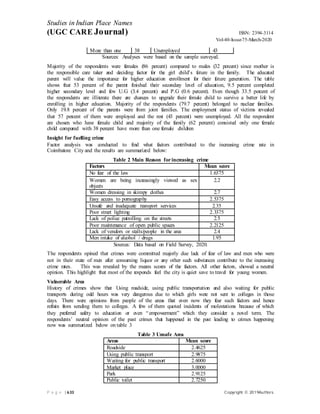
Sources: Analyses were based on the sample surveyed.
Majority of the respondents were females (86 percent) compared to males (32 percent) since mother is
the responsible care taker and deciding factor for the girl child’s future in the family. The educated
parent will value the importance for higher education enrollment for their future generation. The table
shows that 53 percent of the parent finished their secondary level of education, 9.5 percent completed
higher secondary level and few U.G (3.4 percent) and P.G (0.6 percent). Even though 33.5 percent of
the respondents are illiterate there are chances to upgrade their female child to survive a better life by
enrolling in higher education. Majority of the respondents (79.7 percent) belonged to nuclear families.
Only 19.8 percent of the parents were from joint families. The employment status of victims revealed
that 57 percent of them were employed and the rest (43 percent) were unemployed. All the respondent
are chosen who have female child and majority of the family (62 percent) consisted only one female
child compared with 38 percent have more than one female children
Insight for fuelling crime
Factor analysis was conducted to find what factors contributed to the increasing crime rate in
Coimbatore City and the results are summarized below:
Table 2 Main Reason forincreasing crime
Factors Mean score
No fear of the law 1.6375
Women are being increasingly viewed as sex
objects
2.2
Women dressing in skimpy clothes 2.7
Easy access to pornography 2.5375
Unsafe and inadequate transport services 2.35
Poor street lighting 2.3375
Lack of police patrolling on the streets 2.5
Poor maintenance of open public spaces 2.2125
Lack of vendors or stalls/people in the area 2.4
Men intake of alcohol / drugs 1.95
Sources: Data based on Field Survey, 2020.
The respondents opined that crimes were committed majorly due lack of fear of law and men who were
not in their state of men after consuming liquor or any other such substances contribute to the increasing
crime rates. This was revealed by the means scores of the factors. All other factors, showed a neutral
opinion. This highlight that most of the responds feel the city is quiet save to travel for young women.
Vulnerable Area
History of crimes show that Using roadside, using public transportation and also waiting for public
transports during odd hours was very dangerous due to which girls were not sent to colleges in those
days. There were opinions from people of the areas that even now they fear such factors and hence
refrain from sending them to colleges. A few of them quoted incidents of molestations because of which
they preferred safety to education or even “empowerment” which they consider a novel term. The
respondents’ neutral opinion of the past crimes that happened in the past leading to crimes happening
now was summarized below on table 3
Table 3 Unsafe Area
Areas Mean score
Roadside 2.4625
Using public transport 2.9875
Waiting for public transport 2.6000
Market place 3.0000
Park 2.9125
Public toilet 2.7250
P a g e | 634 Copyright ⓒ 2019Authors
Studies in Indian Place Names
(UGC CARE Journal) ISSN: 2394-3114
Vol-40-Issue-75-March-2020
Others 2.9500
Sources: Data based on Field Survey, 2020.
Global studies and surveys demonstrate that women feel less comfortable and secure in public places
even in developed countries and are afraid of violence and aggression. The mean score predicts that the
public places are neutral result of safety concern. To determine the appropriateness of applying factor
analysis the KMO and Bartlett‘s test measures were computed and the results are presented in table
above Bartlett’s test of sphericity and the Kaiser-Meyer-Olkin measure of sampling adequacy are both
tests that can be used to determine the factorability of the matrix as awhole.
Women feel that their surrounding places are threatening, more often they are inadequate in their
practice and ultimately, they avoid using the areas that they sense as insecure public places such as
highways, roads, public squares, neighborhood streets or public parks, which are more frequently used
by men than by women. This certainty contributes to the assumption that females are frightened while
moving in certain public places. It can be seen from the above table that these are still safety concerns
for women at the market places, public parks and when waiting for public transport. Past studies have
shown that transit passengers‟ fears and concerns about safety influence their travel decisions.
According to a survey done by the UK Department for Transport, an extra 10.5 % of journeys would be
generated if public felt more secure while travelling, particularly while waiting at the stations (Sideris
and Fink 2008). Similarly, another study shows that most women feel insecure while waiting at the bus
stop, when they are not comfortable with services, when there is no indication of security and when
they receive no information of the bus services (Sham, Omar and Amat 2013). Hence the city is not
fully safe for women, as opined by the respondents. Women safety is a concern in Coimbatore city
when they wait in a public place awaiting buses, auto rickshaws etc, they visit market places shopping
groceries, in public toilets, and in parks.
NATURE AND FREQUENCY OF CRIME
Perpetrators’ act of Risks
Respondents were asked to describe how harassers disturbing the women in public places. A frequency
illustration is given in table 4. The respondents judgment from mean score depicts that there are serious
level of aggravation on Eve teasing', Staring, Sexual assault or rape, and Robbery or having money or
possessions stolen. There is moderate level of harass on Sexual harassment and Murder in their places.
Women harassment and ferocity in public places reported by urban women in India is 79 %, in Thailand
− 85 %, and in Brazil − 89 % (Malik, 2017).
Table 4 Nature of Risk
Nature of torment Mean score
Sexual harassment 2.7250
Eve teasing' 2.3250
Staring 2.3375
Sexual assault or rape 2.3250
Robbery or having money or possessions stolen 2.4875
Murder 2.5875
Other 3.0000
Sources: Data based on Field Survey, 2020.
Personal reason to feel insecurity
There were also questions relating to womens’ personal reasons, as their perceptions for feeling
insecure. Their opinions are summarized in the table 5 below.
Table 5 Personal feeling of insecurity
Reasons for insecurity Mean score
Being a woman 2.1000
Being of a certain religion 2.8500
P a g e | 635 Copyright ⓒ 2019Authors
Studies in Indian Place Names
(UGC CARE Journal) ISSN: 2394-3114
Vol-40-Issue-75-March-2020
Being of a certain race 2.9375
Being from another state/region 2.9750
Being from another country 3.2625
Sexual Orientation 3.0125
Others 2.9500
None 3.1125
Sources: Data based on Field Survey, 2020.
The mean score states that they disagree of being insecure due to a certain religion, race, another
state/region or country. But the factor scores of above were all on disagreement or strongly disagree of
these factors. They are afraid of being women and that they are being observed as a sexual tool in the
society.
Remedies for Crime
Since crime in the society increases the respondents were enquired regarding the measures to be
adopted in general to control them. Majority of the respondents insisted on harash punishment (48
percent) and 26 percent insist on better parenting with sons being taught to respect women. Let’s
become a generation teaching for sons to respect women rather than teaching our girls to be careful.
Table 6 Most effective steps for crimes against women
Effective steps for crimes
Harsh punishment 47.5
Fast-track courts 7.5
Better patrolling 13.8
Better parenting with sons being taught to respect women 26.3
Sensitization of police 5
Source: Estimation based on Field survey
Impact Performance Matrix Analysis (IPMA)
Further investigation was carried out to analyse the relative priority of enrollment dimensions on safety
construct. The IPMA (Hock, Ringle, & Sarstedt, 2010; Rigdon, Ringle, Sarstedt, & Gudergan, 2011)
was carried by taking the performance of each exogenous latent variable into account. IPMA results in a
priority map for decision-oriented presentations. For assigning priorities to different aspects for their
improvement for a particular endogenous latent variables’ performance level in the future, actions
should have a relatively high impact (i.e. high path coefficient) and a relatively low performance (Hair
et al., 2013).
Table 7 Impact performance
latent variable Impact Performances
Area 2.92 48.06
Crime 2.54 38.52
Enroll 1.84 83.75
Reason 2.36 33.99
. Sources: Data based on Field Survey, 2020.
Table 8 shows the impact and performance of each exogenous variable towards enrollment the
endogenous variable. Figure 2 shows that to increase the women enrollment in higher education should
focus on the following safetiness in area dimensions in the descending order of priority, considering the
impact and performance: controlling of crime and safety environmental measures.
Figure 2 Importance-Performance Map
P a g e | 636 Copyright ⓒ 2019Authors
Studies in Indian Place Names
(UGC CARE Journal) ISSN: 2394-3114
Vol-40-Issue-75-March-2020
Sources: Data based on Field Survey, 2020.
Area safety scores high on both dimensions, that is, impact and performance. Therefore, a unit increase
in safety security in the public place performance from 48.06 to 49.8 would increase the performance of
enrollment of girls in higher education by 2.92 points from 83.75 to 86.67. Aspects related to constructs
decrease in instigation of crime and environment safety measures follows as a second and third priority.
Fear of victimization and crime is quite widespread among women. Almost every crime survey on
fears, reports that women are much more fearful of crime than men (Sideris and Fink 2008).The
importance-performance map environmental safety measure shows a relatively low performance of
33.99.
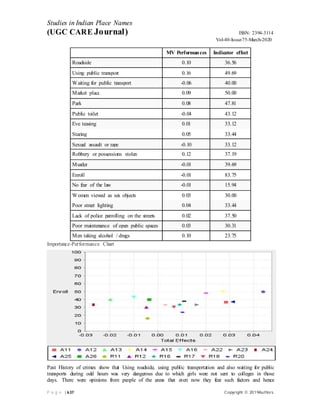
Figure 3 Impact Performance Analysis
Sources: Data based on Field Survey, 2019.
Importance-Performance Map [Enroll] (indicators, unstandardized effects) charts
MV Performances Indicator effect
P a g e | 637 Copyright ⓒ 2019Authors
Studies in Indian Place Names
(UGC CARE Journal) ISSN: 2394-3114
Vol-40-Issue-75-March-2020
MV Performances Indicator effect
Roadside 0.10 36.56
Using public transport 0.16 49.69
Waiting for public transport -0.06 40.00
Market place 0.09 50.00
Park 0.08 47.81
Public toilet -0.04 43.12
Eve teasing 0.01 33.12
Staring 0.05 33.44
Sexual assault or rape -0.10 33.12
Robbery or possessions stolen 0.12 37.19
Murder -0.01 39.69
Enroll -0.01 83.75
No fear of the law -0.01 15.94
Women viewed as sex objects 0.03 30.00
Poor street lighting 0.04 33.44
Lack of police patrolling on the streets 0.02 37.50
Poor maintenance of open public spaces 0.03 30.31
Men taking alcohol / drugs 0.10 23.75
Importance-Performance Chart
Past History of crimes show that Using roadside, using public transportation and also waiting for public
transports during odd hours was very dangerous due to which girls were not sent to colleges in those
days. There were opinions from people of the areas that even now they fear such factors and hence
P a g e | 638 Copyright ⓒ 2019Authors
Studies in Indian Place Names
(UGC CARE Journal) ISSN: 2394-3114
Vol-40-Issue-75-March-2020
refrain from sending them to colleges. A few of them quoted incidents of molestations because of which
they preferred safety to education oreven “empowerment” which they consider anovel term.
Those women, who have enrolled in colleges for higher education, have enrolled in colleges near their
place of residence as they fear travelling far for studies.
RECOMMENDATIONS FOR POLICY ACTION
 Security and use of public places are closely connected with enrolment of students in higher
education hence the security in public places should be ensured by providing open structures, mix
land uses, visual connectivity, appropriate signage and monitoring by security cameras.
 Public facilities should be easily accessible and legible for all college students.
 Demarcation of specially protected areas (i.e. female only bazaars) for females so they can utilize
these places with their potential and perspectives and are not exposed to men’s eyes and any other
kind of pestering.
 Women Development Department should launch a self-protection training program for women,
which would provide training in schools and universities.
 Being custodians of urban development plans and policies urban planners and architects should
integrate women needs such as adequate lighting and landscaping in public places, they must be
visible enough, safer traffic circulation, urban furniture, potential hiding spots, proper signage,
availability of security personnel, proximity to emergency services, and easy access to public
transport should be provided envisaged in urban master plans, building bye-laws, land use rules
and in design of safety and privacy concerns are addressed and adapted in local development plans.
 Provision of clean, safe and easily accessible females’toilets in public places.
 Launch awareness and orientation campaign for parents and students parents about PSCA App and
helpline for women safety..
 Launch awareness campaign “Women in Urban Streets” by introducing street arts which endorse
and signify women safety measures.
 Creation of Surveillance Group comprised on local community members, so they can monitor and
observe functions and the activities.
 Centrally connected streets and walkways of parks, which increase the legibility, and physical
access of the users.
The current study revealed that many parents from Coimbatore district feel that young girls are facing
issues in public places that include harassment at bus terminals, staring of harassers, stalking, touching,
obscene gestures, whistling, comments, etc.), which need to be sorted out. Government and local
authorities have started various initiatives to enhance security in public places, but the challenge is that
most of the females are unaware of it. This study delivers significant findings that give answers to key
questions posed concerning the issues of females’ safety in the public places of Coimbatore. After
literature studies and obtaining of results, researchers conclude and recommend that in order to ensure
safe city for females policies, strategies, and structured plans should be developed and other initiatives
must be taken in order to have a proper framework for designing safer cities.
REFERENCES
 Akram Khalili, Siyamak Nayyeri Fallah (2018), “Role of social indicators on vitality parameter to
enhance the quality of women‫׳‬s communal life within an urban public space (case: Isfahan‫׳‬s
traditional bazaar, Iran)”, Frontiers of Architectural Research, Volume 7, Issue 3, September 2018,
Pages 440-454.
 Allan Tyler, Antony C. Moss, Sharon Cox (2019), “Understanding women's feelings about safety
and hazards of street drinking in London through interpretative phenomenological analysis”,
Addictive BehaviorsVolume 99December 2019.
P a g e | 639 Copyright ⓒ 2019Authors
Studies in Indian Place Names
(UGC CARE Journal) ISSN: 2394-3114
Vol-40-Issue-75-March-2020
 Aneja, N. (2015). Women in Higher Education Management in India. Research Journal of
Educational Sciences, 3(8), 1-3.
 Bamora, F. N. (2010). Gender Inequality in Secondary Education in Ghana. Thesis (Ph.D.)
University of Hull, Yorkshire, England.
 Basavaraj, H. (2014). Women in Higher Education: A Comparative Sociological Study of
Gulbarga University and Karnataka State Women’s University, Bijapur. Gulbarga University,
 Belal, F. O. (2009). Gender Equality in Secondary Education: A Study of Girls’ Educational
Access and Participation in Jordan Between 2000 and 2005. Seton Hall University, New Jersey,
USA.
 C. S. De Silva, E. J. Warusavitharana, R. Ratnayake (2017), “An examination of the temporal
effects of environmental cues on pedestrians' feelings of safety”, Computers, Environment and
Urban Systems, Volume 64, July 2017, Pages 266-274.
 C. S. Souza, L. Bittencourt, P. W. G. Taco (2018) “Women’s perspective in pedestrian mobility
planning: the case of Brasília”, Transportation Research Procedia, Volume 33, 2018, Pages 131-
138.
 Chanana, K. (1993). Accessing higher education: the dilemma of schooling women, minorities,
Scheduled Castes and Scheduled Tribes in contemporary India. Higher Education, 26(1), 69-92.
 Chanana, K. (2004). Gender and Disciplinary Choices: Women in Higher Education in India.
Paper Prepared for the UNESCO Colloquium on Research and Higher Education Policy,
‘Knowledge, Access and Governance: Strategies for Change’ held at Paris from 01 December to
03 December, 2004.
 Chanana, K. (2007). Globalisation, Higher Education and Gender: Changing Subject Choices of
Indian Women Students. Economic Political Weekly, 42(7), 590-598.
 Educational Statistics at a Glance, Government of India. Retrieved from
https://mhrd.gov.in/sites/upload_files/mhrd/files/statistics-new/EAG2014.pdf on 5 May 2019. on 7
May 2019. Ministry of Human Resource Development (2009). Annual Report 2008-09,
 Gizem Akalp, Serpil Aytac, Nurettin Yamankaradeniz, Oguzhan Cankaya, Ulviye Tufekci (2015),
“Perceived Safety Culture and Occupational Risk Factors among women in Metal Industries: A
Study in Turkey”, Procedia Manufacturing, Volume 3, 2015, Pages 4956-4963.
 Gizem Akalp, Serpil Aytac, Nurettin Yamankaradeniz, Oguzhan Cankaya, Ulviye Tufekci (2015),
“Perceived Safety Culture and Occupational Risk Factors among women in Metal Industries: A
Study in Turkey”, Procedia Manufacturing, Volume 3, 2015, Pages 4956-4963.
 Government of India. Retrieved from
 Government of India. Retrieved from https://epsiindia.org/wp-content/uploads/2019/02/AISHE-
2017-18.pdf on 3 May 2019. Ministry of Human Resource Development (2014).
 Hebbalkar, M. P. (2014). Status of Higher Education of Women in Rural Area: An Indian
Perspective. Research Journal of Social Science & Management, 3(10), 203-210.
 Hooshmand Alizadeh (2007), “Changes conceptions of women’s public space in the Kurdish city”,
Cities, Volume 24, Issue 6, December 2007, Pages 410-421
 https://mhrd.gov.in/sites/upload_files/mhrd/files/document-reports/AR2008-09.pdf on 7 May
2019. Ministry of Statistics and Programme Implementation, Government of India (2018). Women
and Men in India-2018, 20th Issue, Chapter– 3. Retrieved
http://www.mospi.gov.in/sites/default/files/publication_reports on 23 June 2019
P a g e | 640 Copyright ⓒ 2019Authors
Studies in Indian Place Names
(UGC CARE Journal) ISSN: 2394-3114
Vol-40-Issue-75-March-2020
 Irene Gargiulo, Xavier Garcia, Marta Benages-Albert, Javier Martinez, Pere Vall-Casas (2020)
“Women’s safety perception assessment in an urban stream corridor: Developing a safety map
based on qualitative GIS”, Landscape and Urban PlanningVolume 19, 8 June 2020.
 Jagori (2010) Understanding Women’s Safety: Towards a Gender Inclusive City Research
Findings, Delhi, 2009-10, Jagori, New Delhi.
 Kaaya G.B. &Waiganjo E. (2015). Factors Affecting Women Enrollment in Technical Institutions
in Tanzania: A Case Study of Arusha Technical College. International Journal of Scientific &
Technology Research, 4(6), 12-14.
 Karnataka, India. Census of India (2011). Report on Post Enumeration Survey, Government of
India, New Delhi. Retrieved from http://www.censusindia.gov.in/2011Census/pes/Pesreport.pdf on
23 April 2019
 Kavya Gopal, Eun Jin Shin (2019) “The impacts of rail transit on the lives and travel experiences
of women in the developing world: Evidence from the Delhi Metro”, Cities, Volume 88, May
2019, Pages 66-75.
 Kira Krenichyn (2004), “Women and physical activity in an urban park: Enrichment and support
through an ethic of care”, Journal of Environmental Psychology, Volume 24, Issue 1, March 2004,
Pages 117-130.
 Kosha, A., Oriya, S., Nabi, T., Halim, S., Hofyani, S., Liwal, A., ... &Noormal, B. (2014). The
Resilience of Women in Higher Education in Afghanistan. Resilience in Education Settings (RES)-
Research Studies Series. World Bank.
 Lal, K. and Arora V. P. S. (2016). Women Enrollment: Existing Trends in Higher Education.
International Journal of Enterprise Computing and BusinessSystems. 6,(2). Retrieved June 10,
2019 from http://www.ijecbs.com/July2016/10.pdf.
 Lauren F. Cardoso, Susan B. Sorenson, Olivia Webb, Sara Landers (2019) “Recent and emerging
technologies: Implications for women's safety”, Technology in Society, Volume 58, August 2019,
Article 101108.
 Leonora C. Angeles, Jennifer Roberton(2020)”Empathy and inclusive public safety in the city:
Examining LGBTQ2+ voices and experiences of intersectional discrimination”,Women's Studies
International Forum, Volume 78, January–February 2020.
 Mahima Taneja (2019), “From Slutwalks to Nirbhaya: Shifts in the Indian women's movement”,
Women's Studies International Forum, Volume 74, May–June 2019, Pages 179-187.
 Malik, A. Urban Wire, 2017, December 19 [online]. Urban Institute [cited 1.09.2018].
https://www.urban.org/urban-wire/author/ammar-malik
 Ministry of Human Resource Development (2018). All India Survey on Higher Education 2017-
18,
 Niu, L. (2017). Family socioeconomic status and choice of STEM major in college: An analysis of
a national sample. College Student Journal, 51(2), 218-312. N
 North-East Network (2013): Towards a Safer City for Women – A Survey by North East Network
in Guwahati, 2012-13, Guwahati: NEN. Source:
http://www.northeastnetwork.org/resources/towards-safer-city-women, accessed on June 18, 2015.
 Oksan Tandogan, Bige Simsek Ilhan (2016) ‘Fear of Crime in Public Spaces: From the View of
Women Living in Cities’, Procedia Engineering, Volume 161, 2016, Pages 2011-2018.
 Onlin, 2007(1). Oxford Round Table. 406 West Florida Avenue, Urbana, IL 61801. Singh, C. K.
(2015). Women Literacy in India – Issues and Challenges. Global Journal of Interdisciplinary
Social Sciences, 4(4), 41-44.
P a g e | 641 Copyright ⓒ 2019Authors
Studies in Indian Place Names
(UGC CARE Journal) ISSN: 2394-3114
Vol-40-Issue-75-March-2020
 Parichiti and Jagori (2012): Women’s Safety Audit – A Report on the Safety Audits Conducted in
Dhakuria, Bagha Jatin and Ballygunge Stations, Kolkata, July – August 2012. Source:
http://www.jagori.org/sites/default/files/publication/Parichiti-Jagori-Womens-Safety-Audit-
Dec2012.pdf.
 Ramachandran, V. (2010). Gender issues in higher education. UNESCO, Retrieved May 15, 2019
from https://unesdoc.unesco.org/ark:/48223/pf0000189825.
 SAKHI Women’s Resource Centre, Anweshi, UN Women and Jagori (2011): Are Cities in Kerala
Safe for Women? Research Findings of the Study Conducted in Thiruvananthapuram 46 and
Koshikode Cities, Kerala, 2009-11, SAKHI Women’s Resource Centre, Thiruvananthapuram.
 Singh, N. (2007). Higher Education for Women in India-Choices and Challenges. Forum on Public
Policy
 Smith, L. B. (2000). The Socialization of Females with Regard to a Technology-Related Career:
Recommendations for Change. Meridian: 11/10/2019 EduTech - e Journal of Education and
Technology www.edutech.net.in/EduTechViewArticle.htm?Issue=1901&Article=ART00006 5/5
A Middle School Computer Technologies Journal, 3(2). Retrieved from
https://files.eric.ed.gov/fulltext/ED450213.pdf on 4 March 2019.
 Soylu, S. (2011). Gender Inequality in Turkish Education System and the Causes. Thesis (Master
of Education), Temple University, Philadelphia, USA.
 Suresha, R., & Mylarappa, B. C. (2012). Development of Indian Higher Education in the 21st
century. International Journal of Social Science & Interdisciplinary Research, 1(10), 70-82.
 Thasniya K.T. (2014). Girls’ Higher Education in the Era of Globalization: Issues of Access and
Quality, International Journal of Education and Psychological Research, 3(4), 18-21.
 Trauth, E. M., Quesenberry, J. L., & Morgan, A. J. (2004). Understanding the under representation
of women in IT: Toward a theory of individual differences. Proceedings of the 2004 ACM
SIGMIS CPR Conference, SIGMIS CPR 2004, 114-119.
 Wasim Akram, Mohit Jain , C. Sweetlin Hemalatha (2019), “Design of a Smart Safety Device for
Women using IoT”, Procedia Computer Science,Volume 165, 2019, Pages 656-662.
 wojiewho D.I. & Deebom, T. M. (2017). Gender Disparity towards Students Enrolment in
Technical Education in Rivers State: Causes, Effects and Strategies. International Journal of
Research-Granthalaya, 31(10), 1-10. Patel, I. (1998). The contemporary women's movement and
women's education in India. International Review of Education, 44(2-3), 155- 175.
 Yehualashet, YaredGettu (2010). Have Higher Education Institutions Mainstreamed Gender to
Contribute Towards gender Equality and Women Empowerment? A case Study of the Policies and
Practices of Two Tertiary Institutions in Ethiopia. Thesis (Master of Arts) University of South
Africa, Pretoria, South Africa.
 Zahedifar, E. (2012). Women in Higher Education in Iran: Student perceptions of career prosperity
in the labour market.Thesis (Master of Philosophy). University of Oslo, Oslo, Norway
Zare-ee, A. &Shekarey A. (2010). The Effect of Social, Familial, and Personal FactorsOn students’
course selection in Iranian Technical Schools, Procedia-Social and Behavioral Sciences, 9 295-

Research article

  • 1.
    P a ge | 629 Copyright ⓒ 2019Authors Studies in Indian Place Names (UGC CARE Journal) ISSN: 2394-3114 Vol-40-Issue-75-March-2020 Women Enrolment In Higher Education-- Parents’ Perspective Of Safety Aspect As A Determinant Of Enrolling Their Daughter In Colleges For Higher Education In Rural Coimbatore Nandini Jagannarayan Assistant Professor, B.Com (B&I) Department, RJ College of Arts, Science & Commerce, Ghatkopar (west), Mumbai Dr. TA Jayachitra Assistant Professor, Department of Economics, Avinashilingam University, Coimbatore ABSTRACT Women education and empowerment, today decides the progress and development of any nation!!! Women in India, of late have very high aspirations in life. They aspire to be educated, empowered socially, financially and also want to be a decision makers. The nation also is very supportive in helping them achieve these goals. But, there are still some grey areas where education does not reach the needy women. The government has taken a lot of efforts to bring girls into elementary education, but now, the challenger lies in bringing them into secondary and higher education. A recent study, ‘Educating the Girl Child: Role of Incentiviation and other enablers and disablers’, done by CRY (Child Rights and You) gives important leads on checking dropouts and tells you what keeps parents from sending their daughters to school as they grow older. Current study focusses on safety concerns raised by parents in sending their daughters to college which requires some amount of travel. This factor proves to be a barrier for women from being enrolled in colleges for their higher studies. Keywords: Women empowerment, Higher education, women education, women safety INTRODUCTION Over the time, the literacy rate in India has increased among both males and females. However, the gender gap in the literacy rate is still maintained. Literacy rate among males increased from 27.2 in 1951 to 80.9 in 2011 and among females it increased from 8.9 to 64.6 (Census, 1951 and 2011). The enrolment in higher education was approximately 100 Lakhs among boys and approximately 60 lakhs among girls (MHRD, 2008-09). The male and female ratio of enrolment in higher education was 0.85 in 2014-15 (Lal and Arora, 2016) that suggests that for per hundred males, 85 females got enrolled in higher education. In 2015-16, number of females per hundred males were 111.6 in arts and social science subjects, 89.1 in science subjects and 77.2 in IT/computer science and 38.7 in engineering/technology courses. Also, among the females who were enrolled in higher education in science only 13 were studying engineering, technology and computer science (MOSPI, 2018). The recent survey conducted by MHRD (2018-10) depicts that the number of males and females enrolled in academic and professional courses in private, government and government-aided institutions were assessed. The number of females enrolled in under graduate professional courses was 36,82,736 as compared to 54,47,784 males. In post graduate professional courses, 8,38,660 females and 9,78,690 males were enrolled. Facilities Institutional environment and amenities available for female students play a pivotal role in the enrolment. First among the facilities comes the proximity of colleges. In India, the average number of colleges per lakh eligible population (age group 18-23 years) is 28 (AISHE, 2017-18). The number varies state wise and in north India the average number of colleges is quite less as compared to other parts. If the location of college is far, it reduces the interests of parents to send their girl child for education (Yehualashet, 2010; Soylu, 2011). The distance from the home to school have more negative effects on girls’ school participation than boys’ because parents are more concerned about girls’ safety on the journey to school due to sexual harassment (Bamora, 2010; Ramchandran, 2010; Hebbalkar, 2014). Other facilities that affect the number of female students in colleges are limited school/classroom space and lack of hygiene and sanitation. Environment Safety of their girls within college premise is
  • 2.
    P a ge | 630 Copyright ⓒ 2019Authors Studies in Indian Place Names (UGC CARE Journal) ISSN: 2394-3114 Vol-40-Issue-75-March-2020 one of the major concerns for any parents. Presence of female teachers often reduces parental concern about their daughters’ security. Out of total teachers in higher education institutions in India, about 59.4 are males and 40.6 are females. At all-India level there are 72 female teachers per 100 male teachers (AISHE, 2017-18). In north Indian states this ratio is on lesser side. In co-educational technical colleges, there is a shortage of female teachers (Kaaya and Waiganjao, 2015). The availability of female teachers along with secure space for women students, provision of separate toilets and sanitation facilities make a big difference for girls’ enrollment and retention in higher education (Belal, 2009; Ramchandran, 2010; Hebbalkar, 2014). The current study this field relating women safety and enrolment of women in higher education in a safe area like Coimbatore will be the bench mark for policy makers to make further make improvements in other cities in terms of improving the safety measures for women folk to rightfully acquire their higher education. REVIEW OF LITERATURE Education will address the historical, socio-economic and political factors, which have acted to define the poor in general, and poor women in particular. Education is a dynamic process of learning in which women gain access to meaningful information, engage in critical reflection and act as a collective to transform the material and social conditions of their existence in some way. Education enables people to become more active participants. With education, individuals and societies have more responsibilities and choices (Keller 1992). Nalini Srivastava (2005) recommended women’s studies centres for enhancing the status of women. Women’s participation in higher education has been improved and considerable progress has been made. Provision of training, employment and income generation activities should be available to women. Women should be allowed to enjoy rights and fundamental freedom on par with men in all spheres. Oksan et al., (2016), paper relates to “fear of crime” in public open spaces from the point of women living in cities. Fear of crime, in general terms, can be described as a feeling of “fear” and “insecurity” derived from a feeling of a person who senses his/her personal security to be under the threat. This fear of crime is a fact which has a considerable impact of the daily lifes of urban dwellers directly or indirectly by causing urban open spaces such as public parks, squares, plazas, streets not be used; causing routes preferred to travel between working places and dwelling places be changed; and causing roads and streets chosen for commerce be altered. The scientific researches, detected that elders and women are more exposed to fear of crime in cities. Consequently, women have to prefer to stay closed and safeguarded places and to avoid urban streets, parks, plazas, public transportation vehicles and areas, especially in the evenings; they feel insecure while walking on the streets and even at their homes; they restrict the right to freedom of movement of their children in the city; and they have to take measures in public open spaces for the reason of this anxiety. This situation restrains the personal involvements of women in public life of the city. To conclude, it is examined the reasons and degrees of fear of crime; measures taken due to this fact; and handicaps which restrains the personal involvements of women in public life of the city. Silva (2017) attempted to understand how environmental factors affect University students' perceptions of safety, which were quantified on the basis of their arousal, i.e. the calmness or stress felt, and walking speeds. Data on arousal were captured in real-time by a technically-sound, low-cost device assembled using free and open source software and hardware. The study could demarcate and rank the areas perceived to be “safe” and “unsafe” by the University students in real-time using the assembled device and identify which environmental factors have the most significant influence on their perception of safety. This study introduces the chance to determine unconscious reactions of people by triangulating data gathered by several measurement techniques that are directly measured in the field, which can be served as useful inputs for urban planning. Furthermore, the study confirms the value of the real-time sensing device as a tool beyond traditional methods in understanding feelings of safety in environmental settings.
  • 3.
    P a ge | 631 Copyright ⓒ 2019Authors Studies in Indian Place Names (UGC CARE Journal) ISSN: 2394-3114 Vol-40-Issue-75-March-2020 Akram et al.,(2018), evaluated women‫׳‬s communal life in terms of vitality measures within public spaces. The commercial setting of Isfahan‫׳‬s traditional bazaar was selected as the study area. To enhance the credibility of the results, several data collection methods, for example, semi-structured individual interviews (n = 24), semi-structured focused group interviews (five groups including 28 middle-aged women), direct observation, snap photography, and unobtrusive behavioral observation of women in communal life within the selected study area, were employed. To analyze the collected data, qualitative content and descriptive analyses were used. The results indicate that by increasing the vitality of a public space through its related measures, women‫׳‬s presence will grow, and through this growth, the quality of their communal life would be enhanced. Juliane Stark, Michael Meschik (2018) investigated frightening situations women face in their everyday mobility. The focus is not on serious criminal offences but rather on all situations causing fear such as harassment and the influence on the travel behaviour of women. Two surveys were conducted in Austria in 2012 and 2013 to assess whether and how many women are affected and to get insights in locations of the incidents and the circumstances. The personal security aspects of different modes of transport are investigated. The results show that women who experienced frightening situations tend to avoid certain destinations or routes and travel modes more than other women. The results also confirm that women in general have constrained travel behaviour because of fear about their personal security. When it is impossible to change route or travel time e.g. due to personal restraints, or when simply no other transport mode is available, women are captives to use unwanted transport options, even when they have to reckon with frightening situations. The conclusions summarize that women’s personal security plays an important role in terms of travel behaviour and increased attention should be paid by authorities as well as city- and transport planners striving for sustainable built environments. As the share of affected women is high and it can be assumed that women are more often imperilled than men the questions arises, if this can be assimilated to unequal mobility opportunities, finally resulting in a social deficiency for women. RESEARCH METHODOLOGY This research follows a relative logical strategy and attempts to cover public spaces in Coimbatore city in Tamil Nadu. Various categories of public places as a segment of public sphere include all functional areas such as roads, streets, pathways, public toilets, stations, bus stops, bazaars, markets and malls, highways, parks, restaurants, cinemas, public transport and their usage is examined in towns of Coimbatore in relation to women’s demand for security and safety. I. Area of study Coimbatore District, Tamilnadu II. Data collection A purposive sampling method is obtained by conducting a primary survey among women in the city of Coimbatore. Data collected was based on questionnaire surveys and a self administered questionnaire. Questionnaires were distributed during weekends and filled in data’s were collected after 10 days. Out of the total 100 surveys, some were incomplete and some were filled in an incorrect manner. Excluding these flawed surveys, 90 complete surveys were available to conduct the analysis. Likewise, we opted to differentiate relatively homogeneous areas, and to select independent samples in each of them. Upon choosing the number of areas and their limits, certain criteria were followed, such as homogeneity of the public space, functional organization of the neighbourhood, socio-demographic characteristics, and structure of the area under study. III. Period of data collection February 1, 2020 to February 29, 2020 The data were collected from February 9,2020 to February 29, 2020 i. Questionnaire survey The questionnaire was divided into three parts. Part A was allocated for questions aimed at getting some information about the individual characteristics and to have an overview of people with different
  • 4.
    P a ge | 632 Copyright ⓒ 2019Authors Studies in Indian Place Names (UGC CARE Journal) ISSN: 2394-3114 Vol-40-Issue-75-March-2020 characteristics and background. Part B is about awareness of environmental towards their habitant and mobility welfare which portrayed images of different for perceived safety. Part C consisted of items measuring the level of perceived safety among women students towards perceived safety in public places factors. The last part was to explore whether the individual exposed to any crime before and precautionary behaviours taken by individuals against fear of crime in public space. The design of the questions was a combination of closed and open-ended questions and question with ‘Likert-scale’ responses was presented. The survey questionnaires contain questions were self-administered. These questions will be tested against the demographic profile of respondents. ii. Data analysis To evaluate the data, analysis is carried out, to acquire the results, a descriptive technique is used and inferential statistics such as Chi-Square test of association was employed. To infer the collected data in the expressive form, factor analysis was conducted to find the underlying factors. It is essential to lessen the variables to a few interpretable linear groups, for this purpose principal component analysis was applied on the dependent and independent variables and along with it the statistical test of path analysis model was carried out. Path analysis has been referred to as mediation analysis and has been used to show causal analysis (Davis, 1985; MacKinnon, Krull, & Lockwood, 2000). Path analysis has been considered to be informative because it provides the most information about relationships between variables. iii. Limitations of theStudy The following are the limitations ofthe present study: 1. The study covers the limited geographical area of Coimbatore District only. So, the result of the study may not be justified to other districts. 2. The targeted population of the study is only the parents whose daughters of the age group 18 to 32 years old. 3. The study does not cover the social and economic factors associated to the enrolment of higher education as it is out of scope of the study. Current study is focused on highlighting how secure parents feel to send their daughter to colleges which are far away from their place of residence and what safety concerns they have, when it comes to educating girls beyond schooling. RESULTS AND DISCUSSION Socio-Demographic Background From the Table 1 analysis of data relating to age of respondent’s shows that, majority of the respondents were in the age-group of 31-40 years. The respondents were focused more towards those children who are entering into the higher education stages. Women of younger age group parent fear of higher risk factor as compared with those of elder age group because elder parent’s children would have crossed the educational age. Table: 1 Characteristics Total Characteristics Total Age Gender 31-40 61.8 Male 32 41-50 25.5 Female 86 51-60 10.8 Level of Education Above 60 2.9 Illiterate 33.5 Type of Family Secondary 53.1 Nuclear 79.7 Higher secondary 9.4 Joint 19.8 UG 3.4 Extended family 0.5 PG 0.6 No of female children Employment Status One 62 Employed 57
  • 5.
    P a ge | 633 Copyright ⓒ 2019Authors Studies in Indian Place Names (UGC CARE Journal) ISSN: 2394-3114 Vol-40-Issue-75-March-2020 More than one 38 Unemployed 43 Sources: Analyses were based on the sample surveyed. Majority of the respondents were females (86 percent) compared to males (32 percent) since mother is the responsible care taker and deciding factor for the girl child’s future in the family. The educated parent will value the importance for higher education enrollment for their future generation. The table shows that 53 percent of the parent finished their secondary level of education, 9.5 percent completed higher secondary level and few U.G (3.4 percent) and P.G (0.6 percent). Even though 33.5 percent of the respondents are illiterate there are chances to upgrade their female child to survive a better life by enrolling in higher education. Majority of the respondents (79.7 percent) belonged to nuclear families. Only 19.8 percent of the parents were from joint families. The employment status of victims revealed that 57 percent of them were employed and the rest (43 percent) were unemployed. All the respondent are chosen who have female child and majority of the family (62 percent) consisted only one female child compared with 38 percent have more than one female children Insight for fuelling crime Factor analysis was conducted to find what factors contributed to the increasing crime rate in Coimbatore City and the results are summarized below: Table 2 Main Reason forincreasing crime Factors Mean score No fear of the law 1.6375 Women are being increasingly viewed as sex objects 2.2 Women dressing in skimpy clothes 2.7 Easy access to pornography 2.5375 Unsafe and inadequate transport services 2.35 Poor street lighting 2.3375 Lack of police patrolling on the streets 2.5 Poor maintenance of open public spaces 2.2125 Lack of vendors or stalls/people in the area 2.4 Men intake of alcohol / drugs 1.95 Sources: Data based on Field Survey, 2020. The respondents opined that crimes were committed majorly due lack of fear of law and men who were not in their state of men after consuming liquor or any other such substances contribute to the increasing crime rates. This was revealed by the means scores of the factors. All other factors, showed a neutral opinion. This highlight that most of the responds feel the city is quiet save to travel for young women. Vulnerable Area History of crimes show that Using roadside, using public transportation and also waiting for public transports during odd hours was very dangerous due to which girls were not sent to colleges in those days. There were opinions from people of the areas that even now they fear such factors and hence refrain from sending them to colleges. A few of them quoted incidents of molestations because of which they preferred safety to education or even “empowerment” which they consider a novel term. The respondents’ neutral opinion of the past crimes that happened in the past leading to crimes happening now was summarized below on table 3 Table 3 Unsafe Area Areas Mean score Roadside 2.4625 Using public transport 2.9875 Waiting for public transport 2.6000 Market place 3.0000 Park 2.9125 Public toilet 2.7250
  • 6.
    P a ge | 634 Copyright ⓒ 2019Authors Studies in Indian Place Names (UGC CARE Journal) ISSN: 2394-3114 Vol-40-Issue-75-March-2020 Others 2.9500 Sources: Data based on Field Survey, 2020. Global studies and surveys demonstrate that women feel less comfortable and secure in public places even in developed countries and are afraid of violence and aggression. The mean score predicts that the public places are neutral result of safety concern. To determine the appropriateness of applying factor analysis the KMO and Bartlett‘s test measures were computed and the results are presented in table above Bartlett’s test of sphericity and the Kaiser-Meyer-Olkin measure of sampling adequacy are both tests that can be used to determine the factorability of the matrix as awhole. Women feel that their surrounding places are threatening, more often they are inadequate in their practice and ultimately, they avoid using the areas that they sense as insecure public places such as highways, roads, public squares, neighborhood streets or public parks, which are more frequently used by men than by women. This certainty contributes to the assumption that females are frightened while moving in certain public places. It can be seen from the above table that these are still safety concerns for women at the market places, public parks and when waiting for public transport. Past studies have shown that transit passengers‟ fears and concerns about safety influence their travel decisions. According to a survey done by the UK Department for Transport, an extra 10.5 % of journeys would be generated if public felt more secure while travelling, particularly while waiting at the stations (Sideris and Fink 2008). Similarly, another study shows that most women feel insecure while waiting at the bus stop, when they are not comfortable with services, when there is no indication of security and when they receive no information of the bus services (Sham, Omar and Amat 2013). Hence the city is not fully safe for women, as opined by the respondents. Women safety is a concern in Coimbatore city when they wait in a public place awaiting buses, auto rickshaws etc, they visit market places shopping groceries, in public toilets, and in parks. NATURE AND FREQUENCY OF CRIME Perpetrators’ act of Risks Respondents were asked to describe how harassers disturbing the women in public places. A frequency illustration is given in table 4. The respondents judgment from mean score depicts that there are serious level of aggravation on Eve teasing', Staring, Sexual assault or rape, and Robbery or having money or possessions stolen. There is moderate level of harass on Sexual harassment and Murder in their places. Women harassment and ferocity in public places reported by urban women in India is 79 %, in Thailand − 85 %, and in Brazil − 89 % (Malik, 2017). Table 4 Nature of Risk Nature of torment Mean score Sexual harassment 2.7250 Eve teasing' 2.3250 Staring 2.3375 Sexual assault or rape 2.3250 Robbery or having money or possessions stolen 2.4875 Murder 2.5875 Other 3.0000 Sources: Data based on Field Survey, 2020. Personal reason to feel insecurity There were also questions relating to womens’ personal reasons, as their perceptions for feeling insecure. Their opinions are summarized in the table 5 below. Table 5 Personal feeling of insecurity Reasons for insecurity Mean score Being a woman 2.1000 Being of a certain religion 2.8500
  • 7.
    P a ge | 635 Copyright ⓒ 2019Authors Studies in Indian Place Names (UGC CARE Journal) ISSN: 2394-3114 Vol-40-Issue-75-March-2020 Being of a certain race 2.9375 Being from another state/region 2.9750 Being from another country 3.2625 Sexual Orientation 3.0125 Others 2.9500 None 3.1125 Sources: Data based on Field Survey, 2020. The mean score states that they disagree of being insecure due to a certain religion, race, another state/region or country. But the factor scores of above were all on disagreement or strongly disagree of these factors. They are afraid of being women and that they are being observed as a sexual tool in the society. Remedies for Crime Since crime in the society increases the respondents were enquired regarding the measures to be adopted in general to control them. Majority of the respondents insisted on harash punishment (48 percent) and 26 percent insist on better parenting with sons being taught to respect women. Let’s become a generation teaching for sons to respect women rather than teaching our girls to be careful. Table 6 Most effective steps for crimes against women Effective steps for crimes Harsh punishment 47.5 Fast-track courts 7.5 Better patrolling 13.8 Better parenting with sons being taught to respect women 26.3 Sensitization of police 5 Source: Estimation based on Field survey Impact Performance Matrix Analysis (IPMA) Further investigation was carried out to analyse the relative priority of enrollment dimensions on safety construct. The IPMA (Hock, Ringle, & Sarstedt, 2010; Rigdon, Ringle, Sarstedt, & Gudergan, 2011) was carried by taking the performance of each exogenous latent variable into account. IPMA results in a priority map for decision-oriented presentations. For assigning priorities to different aspects for their improvement for a particular endogenous latent variables’ performance level in the future, actions should have a relatively high impact (i.e. high path coefficient) and a relatively low performance (Hair et al., 2013). Table 7 Impact performance latent variable Impact Performances Area 2.92 48.06 Crime 2.54 38.52 Enroll 1.84 83.75 Reason 2.36 33.99 . Sources: Data based on Field Survey, 2020. Table 8 shows the impact and performance of each exogenous variable towards enrollment the endogenous variable. Figure 2 shows that to increase the women enrollment in higher education should focus on the following safetiness in area dimensions in the descending order of priority, considering the impact and performance: controlling of crime and safety environmental measures. Figure 2 Importance-Performance Map
  • 8.
    P a ge | 636 Copyright ⓒ 2019Authors Studies in Indian Place Names (UGC CARE Journal) ISSN: 2394-3114 Vol-40-Issue-75-March-2020 Sources: Data based on Field Survey, 2020. Area safety scores high on both dimensions, that is, impact and performance. Therefore, a unit increase in safety security in the public place performance from 48.06 to 49.8 would increase the performance of enrollment of girls in higher education by 2.92 points from 83.75 to 86.67. Aspects related to constructs decrease in instigation of crime and environment safety measures follows as a second and third priority. Fear of victimization and crime is quite widespread among women. Almost every crime survey on fears, reports that women are much more fearful of crime than men (Sideris and Fink 2008).The importance-performance map environmental safety measure shows a relatively low performance of 33.99. Figure 3 Impact Performance Analysis Sources: Data based on Field Survey, 2019. Importance-Performance Map [Enroll] (indicators, unstandardized effects) charts MV Performances Indicator effect
  • 9.
    P a ge | 637 Copyright ⓒ 2019Authors Studies in Indian Place Names (UGC CARE Journal) ISSN: 2394-3114 Vol-40-Issue-75-March-2020 MV Performances Indicator effect Roadside 0.10 36.56 Using public transport 0.16 49.69 Waiting for public transport -0.06 40.00 Market place 0.09 50.00 Park 0.08 47.81 Public toilet -0.04 43.12 Eve teasing 0.01 33.12 Staring 0.05 33.44 Sexual assault or rape -0.10 33.12 Robbery or possessions stolen 0.12 37.19 Murder -0.01 39.69 Enroll -0.01 83.75 No fear of the law -0.01 15.94 Women viewed as sex objects 0.03 30.00 Poor street lighting 0.04 33.44 Lack of police patrolling on the streets 0.02 37.50 Poor maintenance of open public spaces 0.03 30.31 Men taking alcohol / drugs 0.10 23.75 Importance-Performance Chart Past History of crimes show that Using roadside, using public transportation and also waiting for public transports during odd hours was very dangerous due to which girls were not sent to colleges in those days. There were opinions from people of the areas that even now they fear such factors and hence
  • 10.
    P a ge | 638 Copyright ⓒ 2019Authors Studies in Indian Place Names (UGC CARE Journal) ISSN: 2394-3114 Vol-40-Issue-75-March-2020 refrain from sending them to colleges. A few of them quoted incidents of molestations because of which they preferred safety to education oreven “empowerment” which they consider anovel term. Those women, who have enrolled in colleges for higher education, have enrolled in colleges near their place of residence as they fear travelling far for studies. RECOMMENDATIONS FOR POLICY ACTION  Security and use of public places are closely connected with enrolment of students in higher education hence the security in public places should be ensured by providing open structures, mix land uses, visual connectivity, appropriate signage and monitoring by security cameras.  Public facilities should be easily accessible and legible for all college students.  Demarcation of specially protected areas (i.e. female only bazaars) for females so they can utilize these places with their potential and perspectives and are not exposed to men’s eyes and any other kind of pestering.  Women Development Department should launch a self-protection training program for women, which would provide training in schools and universities.  Being custodians of urban development plans and policies urban planners and architects should integrate women needs such as adequate lighting and landscaping in public places, they must be visible enough, safer traffic circulation, urban furniture, potential hiding spots, proper signage, availability of security personnel, proximity to emergency services, and easy access to public transport should be provided envisaged in urban master plans, building bye-laws, land use rules and in design of safety and privacy concerns are addressed and adapted in local development plans.  Provision of clean, safe and easily accessible females’toilets in public places.  Launch awareness and orientation campaign for parents and students parents about PSCA App and helpline for women safety..  Launch awareness campaign “Women in Urban Streets” by introducing street arts which endorse and signify women safety measures.  Creation of Surveillance Group comprised on local community members, so they can monitor and observe functions and the activities.  Centrally connected streets and walkways of parks, which increase the legibility, and physical access of the users. The current study revealed that many parents from Coimbatore district feel that young girls are facing issues in public places that include harassment at bus terminals, staring of harassers, stalking, touching, obscene gestures, whistling, comments, etc.), which need to be sorted out. Government and local authorities have started various initiatives to enhance security in public places, but the challenge is that most of the females are unaware of it. This study delivers significant findings that give answers to key questions posed concerning the issues of females’ safety in the public places of Coimbatore. After literature studies and obtaining of results, researchers conclude and recommend that in order to ensure safe city for females policies, strategies, and structured plans should be developed and other initiatives must be taken in order to have a proper framework for designing safer cities. REFERENCES  Akram Khalili, Siyamak Nayyeri Fallah (2018), “Role of social indicators on vitality parameter to enhance the quality of women‫׳‬s communal life within an urban public space (case: Isfahan‫׳‬s traditional bazaar, Iran)”, Frontiers of Architectural Research, Volume 7, Issue 3, September 2018, Pages 440-454.  Allan Tyler, Antony C. Moss, Sharon Cox (2019), “Understanding women's feelings about safety and hazards of street drinking in London through interpretative phenomenological analysis”, Addictive BehaviorsVolume 99December 2019.
  • 11.
    P a ge | 639 Copyright ⓒ 2019Authors Studies in Indian Place Names (UGC CARE Journal) ISSN: 2394-3114 Vol-40-Issue-75-March-2020  Aneja, N. (2015). Women in Higher Education Management in India. Research Journal of Educational Sciences, 3(8), 1-3.  Bamora, F. N. (2010). Gender Inequality in Secondary Education in Ghana. Thesis (Ph.D.) University of Hull, Yorkshire, England.  Basavaraj, H. (2014). Women in Higher Education: A Comparative Sociological Study of Gulbarga University and Karnataka State Women’s University, Bijapur. Gulbarga University,  Belal, F. O. (2009). Gender Equality in Secondary Education: A Study of Girls’ Educational Access and Participation in Jordan Between 2000 and 2005. Seton Hall University, New Jersey, USA.  C. S. De Silva, E. J. Warusavitharana, R. Ratnayake (2017), “An examination of the temporal effects of environmental cues on pedestrians' feelings of safety”, Computers, Environment and Urban Systems, Volume 64, July 2017, Pages 266-274.  C. S. Souza, L. Bittencourt, P. W. G. Taco (2018) “Women’s perspective in pedestrian mobility planning: the case of Brasília”, Transportation Research Procedia, Volume 33, 2018, Pages 131- 138.  Chanana, K. (1993). Accessing higher education: the dilemma of schooling women, minorities, Scheduled Castes and Scheduled Tribes in contemporary India. Higher Education, 26(1), 69-92.  Chanana, K. (2004). Gender and Disciplinary Choices: Women in Higher Education in India. Paper Prepared for the UNESCO Colloquium on Research and Higher Education Policy, ‘Knowledge, Access and Governance: Strategies for Change’ held at Paris from 01 December to 03 December, 2004.  Chanana, K. (2007). Globalisation, Higher Education and Gender: Changing Subject Choices of Indian Women Students. Economic Political Weekly, 42(7), 590-598.  Educational Statistics at a Glance, Government of India. Retrieved from https://mhrd.gov.in/sites/upload_files/mhrd/files/statistics-new/EAG2014.pdf on 5 May 2019. on 7 May 2019. Ministry of Human Resource Development (2009). Annual Report 2008-09,  Gizem Akalp, Serpil Aytac, Nurettin Yamankaradeniz, Oguzhan Cankaya, Ulviye Tufekci (2015), “Perceived Safety Culture and Occupational Risk Factors among women in Metal Industries: A Study in Turkey”, Procedia Manufacturing, Volume 3, 2015, Pages 4956-4963.  Gizem Akalp, Serpil Aytac, Nurettin Yamankaradeniz, Oguzhan Cankaya, Ulviye Tufekci (2015), “Perceived Safety Culture and Occupational Risk Factors among women in Metal Industries: A Study in Turkey”, Procedia Manufacturing, Volume 3, 2015, Pages 4956-4963.  Government of India. Retrieved from  Government of India. Retrieved from https://epsiindia.org/wp-content/uploads/2019/02/AISHE- 2017-18.pdf on 3 May 2019. Ministry of Human Resource Development (2014).  Hebbalkar, M. P. (2014). Status of Higher Education of Women in Rural Area: An Indian Perspective. Research Journal of Social Science & Management, 3(10), 203-210.  Hooshmand Alizadeh (2007), “Changes conceptions of women’s public space in the Kurdish city”, Cities, Volume 24, Issue 6, December 2007, Pages 410-421  https://mhrd.gov.in/sites/upload_files/mhrd/files/document-reports/AR2008-09.pdf on 7 May 2019. Ministry of Statistics and Programme Implementation, Government of India (2018). Women and Men in India-2018, 20th Issue, Chapter– 3. Retrieved http://www.mospi.gov.in/sites/default/files/publication_reports on 23 June 2019
  • 12.
    P a ge | 640 Copyright ⓒ 2019Authors Studies in Indian Place Names (UGC CARE Journal) ISSN: 2394-3114 Vol-40-Issue-75-March-2020  Irene Gargiulo, Xavier Garcia, Marta Benages-Albert, Javier Martinez, Pere Vall-Casas (2020) “Women’s safety perception assessment in an urban stream corridor: Developing a safety map based on qualitative GIS”, Landscape and Urban PlanningVolume 19, 8 June 2020.  Jagori (2010) Understanding Women’s Safety: Towards a Gender Inclusive City Research Findings, Delhi, 2009-10, Jagori, New Delhi.  Kaaya G.B. &Waiganjo E. (2015). Factors Affecting Women Enrollment in Technical Institutions in Tanzania: A Case Study of Arusha Technical College. International Journal of Scientific & Technology Research, 4(6), 12-14.  Karnataka, India. Census of India (2011). Report on Post Enumeration Survey, Government of India, New Delhi. Retrieved from http://www.censusindia.gov.in/2011Census/pes/Pesreport.pdf on 23 April 2019  Kavya Gopal, Eun Jin Shin (2019) “The impacts of rail transit on the lives and travel experiences of women in the developing world: Evidence from the Delhi Metro”, Cities, Volume 88, May 2019, Pages 66-75.  Kira Krenichyn (2004), “Women and physical activity in an urban park: Enrichment and support through an ethic of care”, Journal of Environmental Psychology, Volume 24, Issue 1, March 2004, Pages 117-130.  Kosha, A., Oriya, S., Nabi, T., Halim, S., Hofyani, S., Liwal, A., ... &Noormal, B. (2014). The Resilience of Women in Higher Education in Afghanistan. Resilience in Education Settings (RES)- Research Studies Series. World Bank.  Lal, K. and Arora V. P. S. (2016). Women Enrollment: Existing Trends in Higher Education. International Journal of Enterprise Computing and BusinessSystems. 6,(2). Retrieved June 10, 2019 from http://www.ijecbs.com/July2016/10.pdf.  Lauren F. Cardoso, Susan B. Sorenson, Olivia Webb, Sara Landers (2019) “Recent and emerging technologies: Implications for women's safety”, Technology in Society, Volume 58, August 2019, Article 101108.  Leonora C. Angeles, Jennifer Roberton(2020)”Empathy and inclusive public safety in the city: Examining LGBTQ2+ voices and experiences of intersectional discrimination”,Women's Studies International Forum, Volume 78, January–February 2020.  Mahima Taneja (2019), “From Slutwalks to Nirbhaya: Shifts in the Indian women's movement”, Women's Studies International Forum, Volume 74, May–June 2019, Pages 179-187.  Malik, A. Urban Wire, 2017, December 19 [online]. Urban Institute [cited 1.09.2018]. https://www.urban.org/urban-wire/author/ammar-malik  Ministry of Human Resource Development (2018). All India Survey on Higher Education 2017- 18,  Niu, L. (2017). Family socioeconomic status and choice of STEM major in college: An analysis of a national sample. College Student Journal, 51(2), 218-312. N  North-East Network (2013): Towards a Safer City for Women – A Survey by North East Network in Guwahati, 2012-13, Guwahati: NEN. Source: http://www.northeastnetwork.org/resources/towards-safer-city-women, accessed on June 18, 2015.  Oksan Tandogan, Bige Simsek Ilhan (2016) ‘Fear of Crime in Public Spaces: From the View of Women Living in Cities’, Procedia Engineering, Volume 161, 2016, Pages 2011-2018.  Onlin, 2007(1). Oxford Round Table. 406 West Florida Avenue, Urbana, IL 61801. Singh, C. K. (2015). Women Literacy in India – Issues and Challenges. Global Journal of Interdisciplinary Social Sciences, 4(4), 41-44.
  • 13.
    P a ge | 641 Copyright ⓒ 2019Authors Studies in Indian Place Names (UGC CARE Journal) ISSN: 2394-3114 Vol-40-Issue-75-March-2020  Parichiti and Jagori (2012): Women’s Safety Audit – A Report on the Safety Audits Conducted in Dhakuria, Bagha Jatin and Ballygunge Stations, Kolkata, July – August 2012. Source: http://www.jagori.org/sites/default/files/publication/Parichiti-Jagori-Womens-Safety-Audit- Dec2012.pdf.  Ramachandran, V. (2010). Gender issues in higher education. UNESCO, Retrieved May 15, 2019 from https://unesdoc.unesco.org/ark:/48223/pf0000189825.  SAKHI Women’s Resource Centre, Anweshi, UN Women and Jagori (2011): Are Cities in Kerala Safe for Women? Research Findings of the Study Conducted in Thiruvananthapuram 46 and Koshikode Cities, Kerala, 2009-11, SAKHI Women’s Resource Centre, Thiruvananthapuram.  Singh, N. (2007). Higher Education for Women in India-Choices and Challenges. Forum on Public Policy  Smith, L. B. (2000). The Socialization of Females with Regard to a Technology-Related Career: Recommendations for Change. Meridian: 11/10/2019 EduTech - e Journal of Education and Technology www.edutech.net.in/EduTechViewArticle.htm?Issue=1901&Article=ART00006 5/5 A Middle School Computer Technologies Journal, 3(2). Retrieved from https://files.eric.ed.gov/fulltext/ED450213.pdf on 4 March 2019.  Soylu, S. (2011). Gender Inequality in Turkish Education System and the Causes. Thesis (Master of Education), Temple University, Philadelphia, USA.  Suresha, R., & Mylarappa, B. C. (2012). Development of Indian Higher Education in the 21st century. International Journal of Social Science & Interdisciplinary Research, 1(10), 70-82.  Thasniya K.T. (2014). Girls’ Higher Education in the Era of Globalization: Issues of Access and Quality, International Journal of Education and Psychological Research, 3(4), 18-21.  Trauth, E. M., Quesenberry, J. L., & Morgan, A. J. (2004). Understanding the under representation of women in IT: Toward a theory of individual differences. Proceedings of the 2004 ACM SIGMIS CPR Conference, SIGMIS CPR 2004, 114-119.  Wasim Akram, Mohit Jain , C. Sweetlin Hemalatha (2019), “Design of a Smart Safety Device for Women using IoT”, Procedia Computer Science,Volume 165, 2019, Pages 656-662.  wojiewho D.I. & Deebom, T. M. (2017). Gender Disparity towards Students Enrolment in Technical Education in Rivers State: Causes, Effects and Strategies. International Journal of Research-Granthalaya, 31(10), 1-10. Patel, I. (1998). The contemporary women's movement and women's education in India. International Review of Education, 44(2-3), 155- 175.  Yehualashet, YaredGettu (2010). Have Higher Education Institutions Mainstreamed Gender to Contribute Towards gender Equality and Women Empowerment? A case Study of the Policies and Practices of Two Tertiary Institutions in Ethiopia. Thesis (Master of Arts) University of South Africa, Pretoria, South Africa.  Zahedifar, E. (2012). Women in Higher Education in Iran: Student perceptions of career prosperity in the labour market.Thesis (Master of Philosophy). University of Oslo, Oslo, Norway Zare-ee, A. &Shekarey A. (2010). The Effect of Social, Familial, and Personal FactorsOn students’ course selection in Iranian Technical Schools, Procedia-Social and Behavioral Sciences, 9 295-