Software Requirements Distinguishes between  Customer  " needs "  --  AND   Customer's  " wants "  --
How do we gather data to determine a Project’s Requirements? Observation - Watch Interview - Listen Research - Learn
Interview Determine who are the project’s  stakeholders ! Talk to customers Talk to users Talk to other stakeholders
The Interview Process   How many persons should attend an interview?
The Interview Process   not everything spoken is the truth sometimes people lie or forget facts most often they speak from their own ignorance or point of view interview  many  people to gather balanced information evaluate what you are hearing watch body language
What happens after the interview? Immediately write down interview results.  Research show that even in a life-and-death situations:  50% of what took place is forgotten within 30 minutes .  Follow-up Memo
Observation:  Watch, Who, Where, Why? Watch  the way it is done: Go to the customer’s site, spend time in the users real-world environment! Who  does the job? Where  is it done? Why  is it done in this particular way? Learn everything you can about the way the process is done. At this stage it doesn’t matter if it is done by hand or by computer.
Research and Observation How do we get what we need?  Obtain copies of ALL operating documents Assess existing documents  Assess current procedures Focus on identifying what’s visible Observe current procedures  Cross “fertilization”
Research Study documentation provided by the customer. Collect materials generated by the existing system, even if such materials are paper-and-pencil versions Examine the input and output currently generated
Data Gathering for Software Requirements Analysis: Takes practice  Demands Prioritization  Means Identifying  Goals
Prioritization users are likely to ask for the moon if there are no limits. beauty should not outweigh functionality. help customer be realistic about expectations. useful to identify enhancements for future work once basic product is developed.
Prioritization: Guides team in allocating effort May be needed to schedule incremental development Enables determination of what is really important  Avoid "gold-plated" software
Analysis    Specification The goal: understanding the customer's requirements for a software system.  involves technical staff working with customers  involves all the  stakeholders  in the system
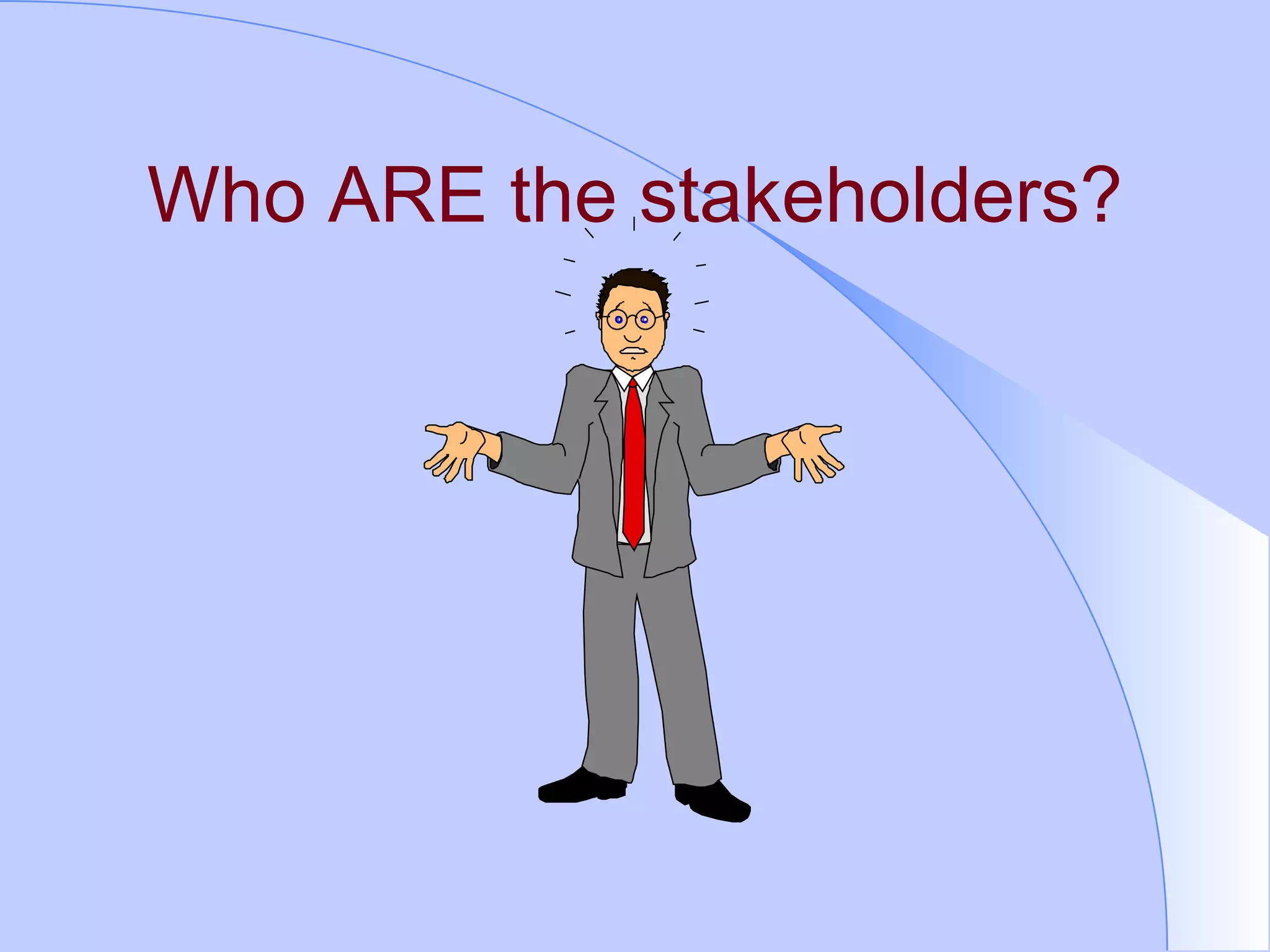
Who ARE the stakeholders?
What are the problems associated with the Requirements phase?
Requirements gathering problems? Stakeholders don't really know what they want Stakeholders express their requirements in their own terms
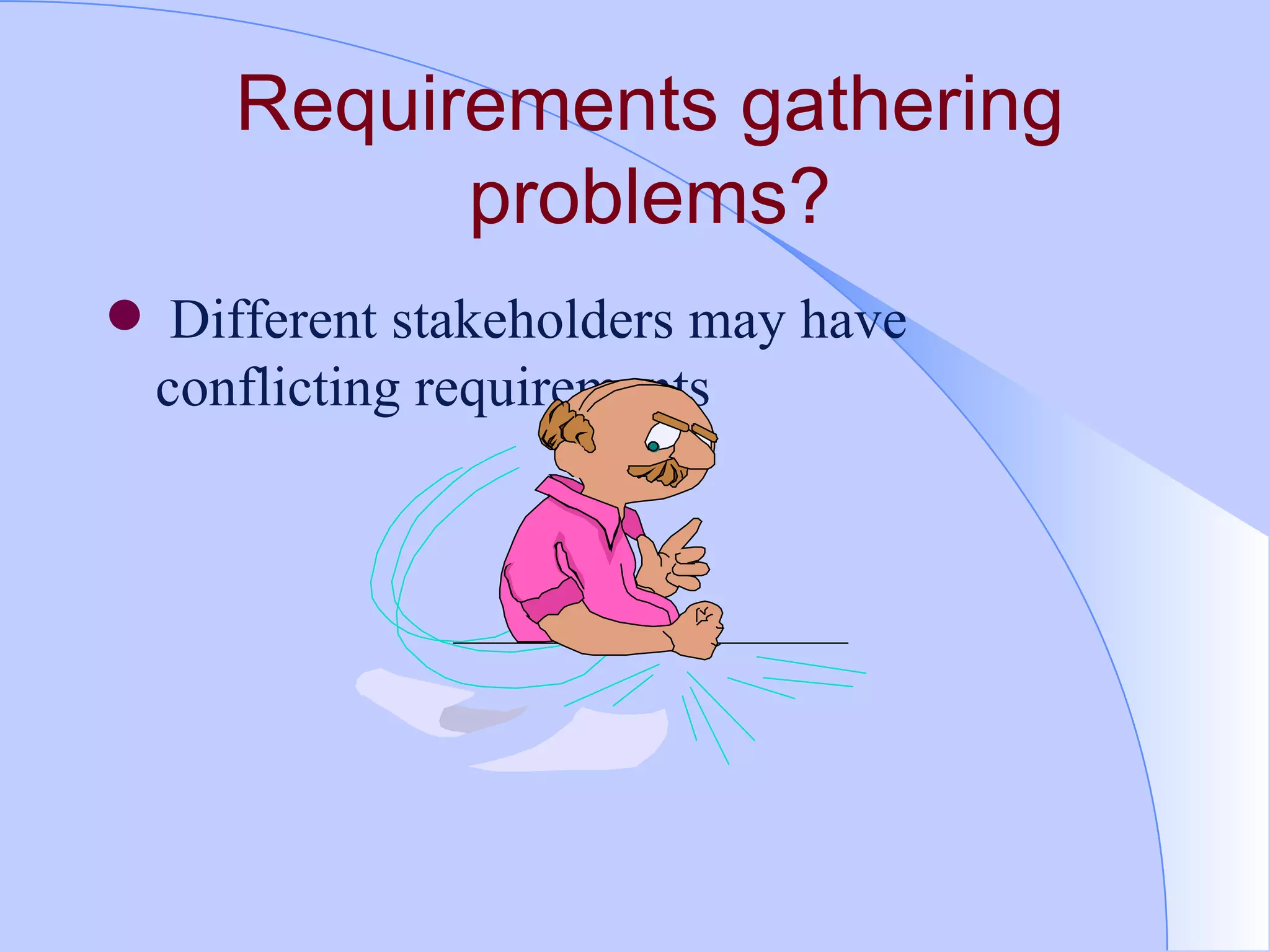
Requirements gathering problems? Different stakeholders may have conflicting requirements
Requirements gathering problems?  The requirements may change during the process New stakeholders may emerge on the scene
Requirements gathering problems? Stakeholders don't really know what they want Stakeholders express their requirements in their own terms
Analysis Viewpoints: Partitioning :  Identifies the structural  relationships between components Abstraction : Identifies generalities among components Projection : Identifies different ways of looking at a problem
Social and Organizational factors  effect  all systems!
Software systems are used within a social and organizational context.
Social and organizational factors CAN  dominate  system requirements.
Software Viewpoints:
Software is not designed in a vacuum!  There is no single “correct” viewpoint.  Effective software involves combining all viewpoints.
Good analysts must be very sensitive to different views. There is no systematic way to factor them into the analysis process.

Requirements

  • 1.
    Software Requirements Distinguishesbetween Customer " needs " -- AND Customer's " wants " --
  • 2.
    How do wegather data to determine a Project’s Requirements? Observation - Watch Interview - Listen Research - Learn
  • 3.
    Interview Determine whoare the project’s stakeholders ! Talk to customers Talk to users Talk to other stakeholders
  • 4.
    The Interview Process How many persons should attend an interview?
  • 5.
    The Interview Process not everything spoken is the truth sometimes people lie or forget facts most often they speak from their own ignorance or point of view interview many people to gather balanced information evaluate what you are hearing watch body language
  • 6.
    What happens afterthe interview? Immediately write down interview results. Research show that even in a life-and-death situations: 50% of what took place is forgotten within 30 minutes . Follow-up Memo
  • 7.
    Observation: Watch,Who, Where, Why? Watch the way it is done: Go to the customer’s site, spend time in the users real-world environment! Who does the job? Where is it done? Why is it done in this particular way? Learn everything you can about the way the process is done. At this stage it doesn’t matter if it is done by hand or by computer.
  • 8.
    Research and ObservationHow do we get what we need? Obtain copies of ALL operating documents Assess existing documents Assess current procedures Focus on identifying what’s visible Observe current procedures Cross “fertilization”
  • 9.
    Research Study documentationprovided by the customer. Collect materials generated by the existing system, even if such materials are paper-and-pencil versions Examine the input and output currently generated
  • 10.
    Data Gathering forSoftware Requirements Analysis: Takes practice Demands Prioritization Means Identifying Goals
  • 11.
    Prioritization users arelikely to ask for the moon if there are no limits. beauty should not outweigh functionality. help customer be realistic about expectations. useful to identify enhancements for future work once basic product is developed.
  • 12.
    Prioritization: Guides teamin allocating effort May be needed to schedule incremental development Enables determination of what is really important Avoid "gold-plated" software
  • 13.
    Analysis  Specification The goal: understanding the customer's requirements for a software system. involves technical staff working with customers involves all the stakeholders in the system
  • 14.
    Who ARE thestakeholders?
  • 15.
    What are theproblems associated with the Requirements phase?
  • 16.
    Requirements gathering problems?Stakeholders don't really know what they want Stakeholders express their requirements in their own terms
  • 17.
    Requirements gathering problems?Different stakeholders may have conflicting requirements
  • 18.
    Requirements gathering problems? The requirements may change during the process New stakeholders may emerge on the scene
  • 19.
    Requirements gathering problems?Stakeholders don't really know what they want Stakeholders express their requirements in their own terms
  • 20.
    Analysis Viewpoints: Partitioning: Identifies the structural relationships between components Abstraction : Identifies generalities among components Projection : Identifies different ways of looking at a problem
  • 21.
    Social and Organizationalfactors effect all systems!
  • 22.
    Software systems areused within a social and organizational context.
  • 23.
    Social and organizationalfactors CAN dominate system requirements.
  • 24.
  • 25.
    Software is notdesigned in a vacuum! There is no single “correct” viewpoint. Effective software involves combining all viewpoints.
  • 26.
    Good analysts mustbe very sensitive to different views. There is no systematic way to factor them into the analysis process.