Understanding Requirements
Abdus Sattar
Senior Lecturer
Department of Computer Science and Engineering
Daffodil International University
Email: abdus.cse@diu.edu.bd
Chapter-5
RequirementsEngineering
 Requirements are statements of what the system must do,
how it must behave, the properties it must exhibit, the
qualities it must possess, and the constraints that the system
and its development must satisfy.
 Requirements engineering emphasizes the use of systematic
and repeatable techniques that ensure the completeness,
consistency, and relevance of the system requirements
[Sommerville 1997a].
 It encompasses seven distinct tasks: inception, elicitation,
elaboration, negotiation, specification, validation and
management.
2
RequirementsEngineering
3
1. Inception—ask a set of questions that establish …
 basic understanding of the problem
 the people who want a solution
 the nature of the solution that is desired, and
 the effectiveness of preliminary communication and
collaboration between the customer and the developer
2. Elicitation—elicit requirements from all stakeholders
3. Elaboration—create an analysis model that identifies data,
function and behavioral requirements
4. Negotiation—agree on a deliverable system that is
realistic for developers and customers
RequirementsEngineering
4
5. Specification—can be any one (or more) of the following:
• A written document
• A set of models
• A formal mathematical
• A collection of user scenarios (use-cases)
• A prototype
6. Validation—a review mechanism that looks for
• errors in content or interpretation
• areas where clarification may be required
• missing information
• inconsistencies (a major problem when large products or
systems are engineered)
• conflicting or unrealistic (unachievable) requirements.
7. Requirements management
Inception
5
 Identify stakeholders
 “who else do you think I should talk to?”
 Recognize multiple points of view
 Work toward collaboration
 The first questions
 Who is behind the request for this work?
 Who will use the solution?
 What will be the economic benefit of a
successful solution
 Is there another source for the solution that
you need?
Eliciting Requirements
6
 meetings are conducted and attended by both software
engineers and customers
 rules for preparation and participation are established
 an agenda is suggested
 a "facilitator" (can be a customer, a developer, or an
outsider) controls the meeting
 a "definition mechanism" (can be work sheets, flip charts, or
wall stickers or an electronic bulletin board, chat room or
virtual forum) is used
 the goal is
 to identify the problem
 propose elements of the solution
 negotiate different approaches, and
 specify a preliminary set of solution requirements
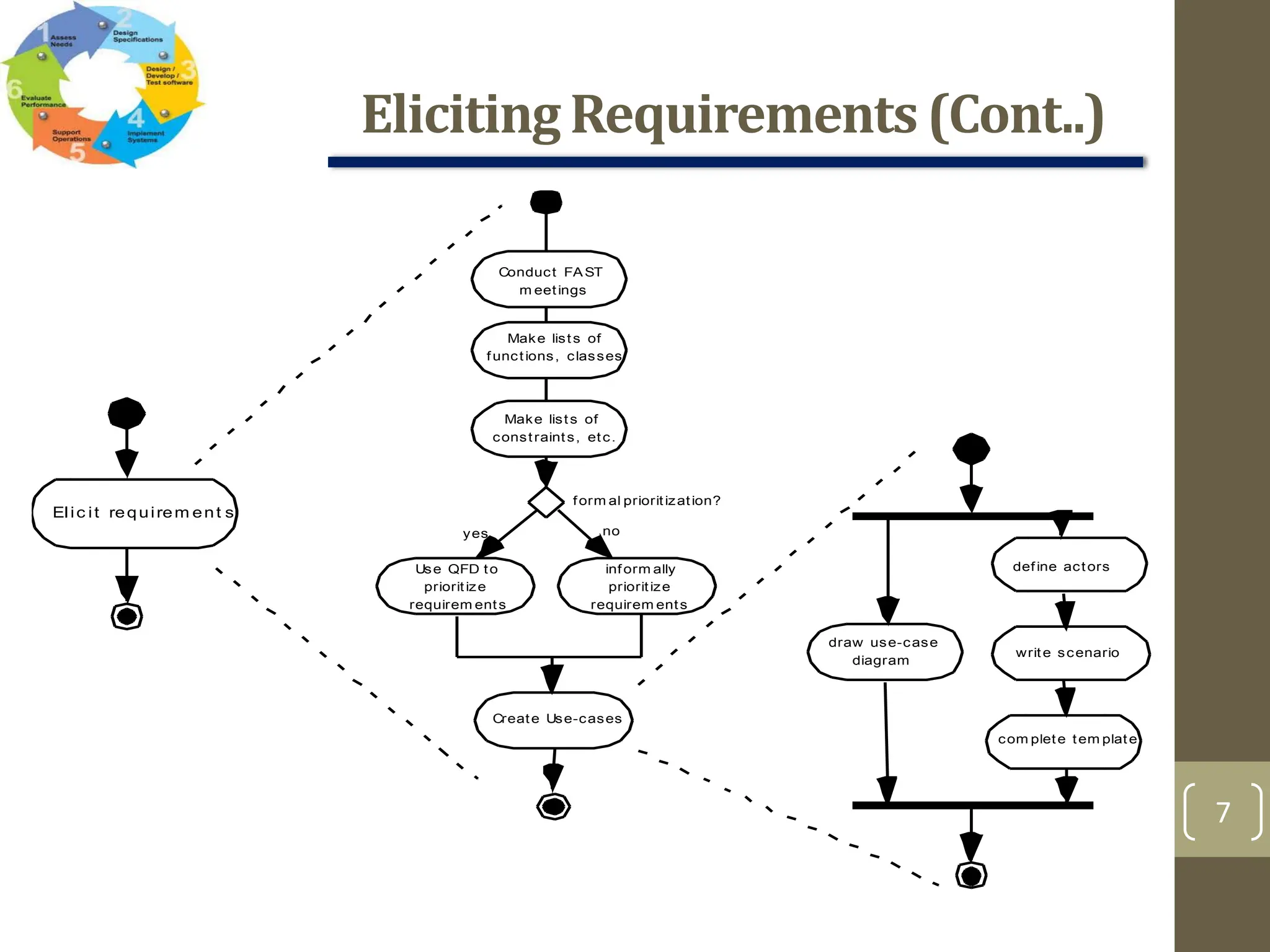
Eliciting Requirements(Cont..)
7
Use QFD to
prioritize
requirem ents
inform ally
prioritize
requirem ents
form al prioritization?
Create Use-cases
yes no
Elic it requirem ent s
write scenario
define actors
com plete tem plate
draw use-case
diagram
Conduct FA ST
m eetings
Make lists of
functions, classes
Make lists of
constraints, etc.
QualityFunction Deployment
8
 Function deployment determines the “value” (as
perceived by the customer) of each function
required of the system
 Information deployment identifies data objects and
events
 Task deployment examines the behavior of the
system
 Value analysis determines the relative priority of
requirements
ElicitationWorkProducts
9
 a statement of need and feasibility.
 a bounded statement of scope for the system or product.
 a list of customers, users, and other stakeholders who
participated in requirements elicitation
 a description of the system’s technical environment.
 a list of requirements (preferably organized by function) and
the domain constraints that apply to each.
 a set of usage scenarios that provide insight into the use of
the system or product under different operating conditions.
 any prototypes developed to better define requirements
Building the AnalysisModel
10
 Elements of the analysis model
 Scenario-based elements
 Functional—processing narratives for software
functions
 Use-case—descriptions of the interaction
between an “actor” and the system
 Class-based elements
 Implied by scenarios
 Behavioral elements
 State diagram
 Flow-oriented elements
 Data flow diagram
Use-Cases
11
 A collection of user scenarios that describe the thread of usage of a
system
 Each scenario is described from the point-of-view of an “actor”—a
person or device that interacts with the software in some way
 Each scenario answers the following questions:
 Who is the primary actor, the secondary actor (s)?
 What are the actor’s goals?
 What preconditions should exist before the story begins?
 What main tasks or functions are performed by the actor?
 What extensions might be considered as the story is described?
 What variations in the actor’s interaction are possible?
 What system information will the actor acquire, produce, or change?
 Will the actor have to inform the system about changes in the external
environment?
 What information does the actor desire from the system?
 Does the actor wish to be informed about unexpected changes?
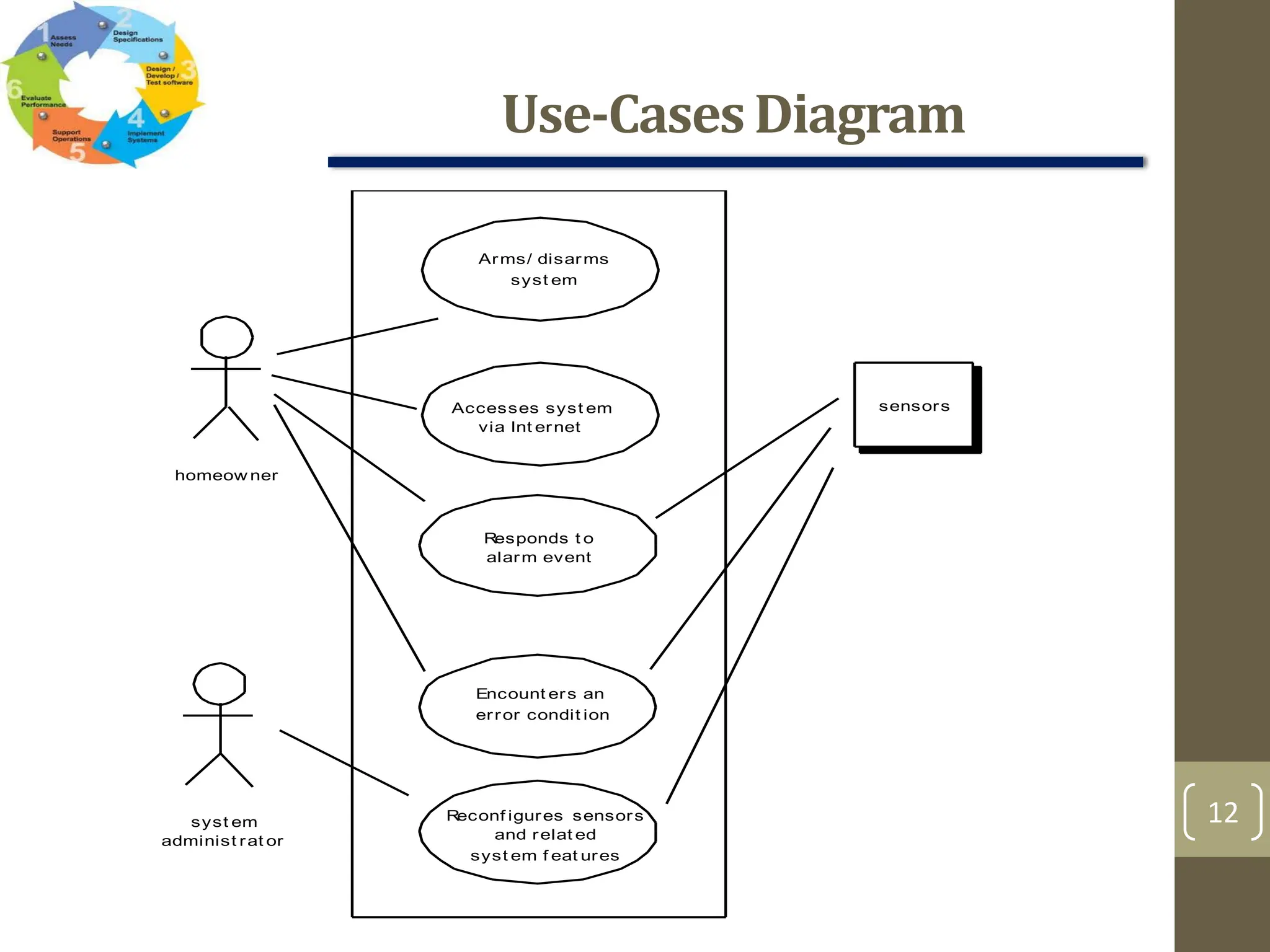
Use-CasesDiagram
12
homeow ner
Arms/ disarms
syst em
Accesses syst em
via Int ernet
Reconf igures sensors
and relat ed
syst em f eat ures
Responds t o
alarm event
Encount ers an
error condit ion
syst em
administ rat or
sensors
ClassDiagram
13
From the SafeHome system …
Sensor
name/id
type
location
area
characteristics
identify()
enable()
disable()
reconfigure ()
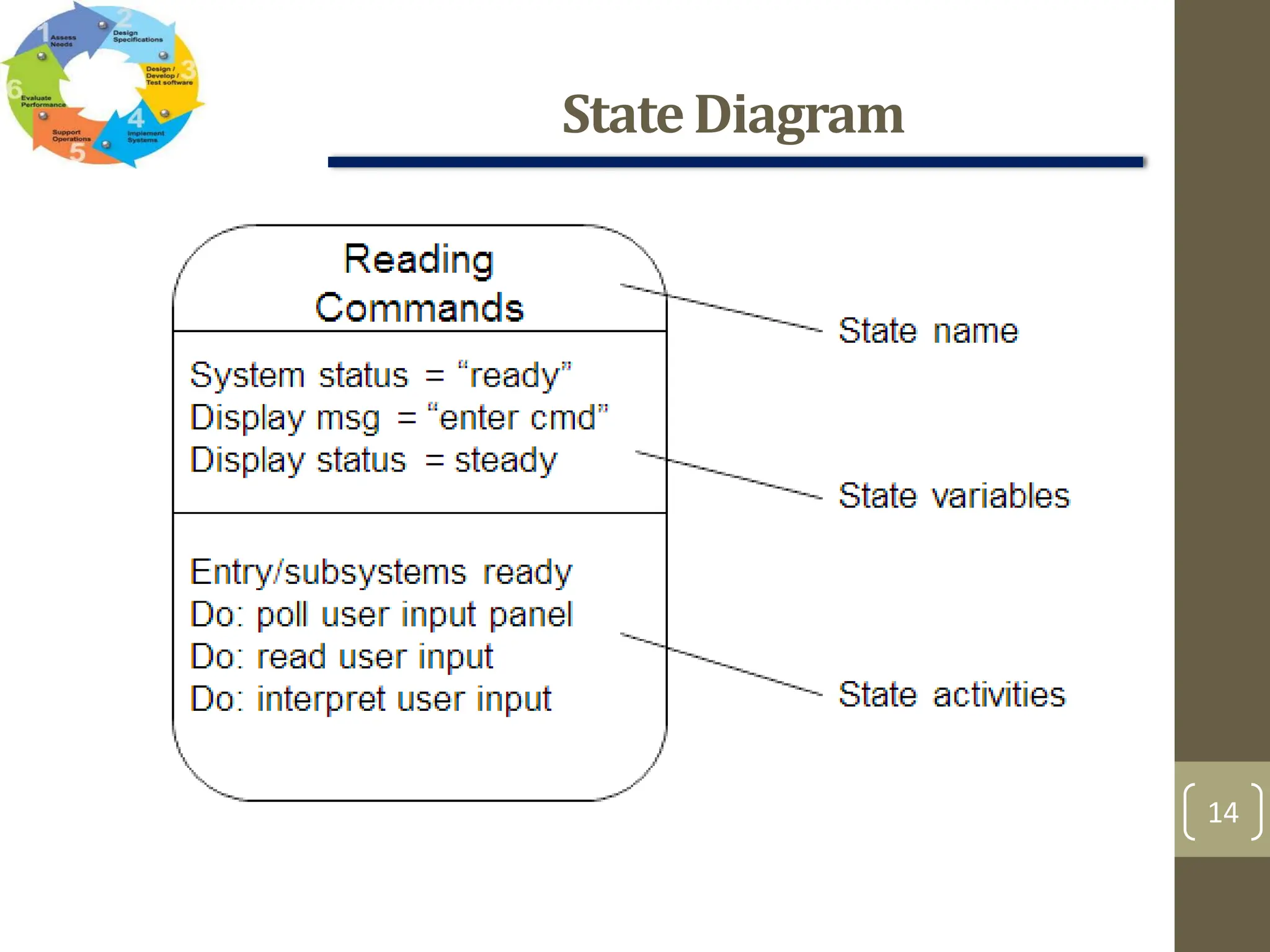
StateDiagram
14
AnalysisPatterns
15
 Pattern name: A descriptor that captures the essence of the pattern.
 Intent: Describes what the pattern accomplishes or represents
 Motivation: A scenario that illustrates how the pattern can be used to address
the problem.
 Forces and context: A description of external issues (forces) that can affect how
the pattern is used and also the external issues that will be resolved when the
pattern is applied.
 Solution: A description of how the pattern is applied to solve the problem with
an emphasis on structural and behavioral issues.
 Consequences: Addresses what happens when the pattern is applied and what
trade-offs exist during its application.
 Design: Discusses how the analysis pattern can be achieved through the use of
known design patterns.
 Known uses: Examples of uses within actual systems.
 Related patterns: On e or more analysis patterns that are related to the named
pattern because (1) it is commonly used with the named pattern; (2) it is
structurally similar to the named pattern; (3) it is a variation of the named
pattern.
 Software analysis patterns or analysis patterns in software
engineering are conceptual models, which capture an abstraction
of a situation that can often be encountered in modelling
NegotiatingRequirements
16
 Identify the key stakeholders
 These are the people who will be involved in the
negotiation
 Determine each of the stakeholders “win conditions”
 Win conditions are not always obvious
 Negotiate
 Work toward a set of requirements that lead to “win-
win”
ValidatingRequirements
17
 Is each requirement consistent with the overall objective
for the system/product?
 Have all requirements been specified at the proper level of
abstraction? That is, do some requirements provide a level
of technical detail that is inappropriate at this stage?
 Is the requirement really necessary or does it represent an
add-on feature that may not be essential to the objective of
the system?
 Is each requirement bounded and unambiguous?
 Does each requirement have attribution? That is, is a
source (generally, a specific individual) noted for each
requirement?
 Do any requirements conflict with other requirements?
ValidatingRequirements(Cont..)
18
 Is each requirement achievable in the technical
environment that will house the system or product?
 Is each requirement testable, once implemented?
 Does the requirements model properly reflect the
information, function and behavior of the system to be
built.
 Has the requirements model been “partitioned” in a way
that exposes progressively more detailed information
about the system.
 Have requirements patterns been used to simplify the
requirements model. Have all patterns been properly
validated? Are all patterns consistent with customer
requirements?
19
References:
1. Software Engineering A practitioner’s
Approach
by Roger S. Pressman, 7th edition, McGraw Hill, 2010.
2. Software Engineering by Ian Sommerville,
9th edition, Addison-Wesley, 2011

6-180117160306. software engineering concepts

  • 1.
    Understanding Requirements Abdus Sattar SeniorLecturer Department of Computer Science and Engineering Daffodil International University Email: abdus.cse@diu.edu.bd Chapter-5
  • 2.
    RequirementsEngineering  Requirements arestatements of what the system must do, how it must behave, the properties it must exhibit, the qualities it must possess, and the constraints that the system and its development must satisfy.  Requirements engineering emphasizes the use of systematic and repeatable techniques that ensure the completeness, consistency, and relevance of the system requirements [Sommerville 1997a].  It encompasses seven distinct tasks: inception, elicitation, elaboration, negotiation, specification, validation and management. 2
  • 3.
    RequirementsEngineering 3 1. Inception—ask aset of questions that establish …  basic understanding of the problem  the people who want a solution  the nature of the solution that is desired, and  the effectiveness of preliminary communication and collaboration between the customer and the developer 2. Elicitation—elicit requirements from all stakeholders 3. Elaboration—create an analysis model that identifies data, function and behavioral requirements 4. Negotiation—agree on a deliverable system that is realistic for developers and customers
  • 4.
    RequirementsEngineering 4 5. Specification—can beany one (or more) of the following: • A written document • A set of models • A formal mathematical • A collection of user scenarios (use-cases) • A prototype 6. Validation—a review mechanism that looks for • errors in content or interpretation • areas where clarification may be required • missing information • inconsistencies (a major problem when large products or systems are engineered) • conflicting or unrealistic (unachievable) requirements. 7. Requirements management
  • 5.
    Inception 5  Identify stakeholders “who else do you think I should talk to?”  Recognize multiple points of view  Work toward collaboration  The first questions  Who is behind the request for this work?  Who will use the solution?  What will be the economic benefit of a successful solution  Is there another source for the solution that you need?
  • 6.
    Eliciting Requirements 6  meetingsare conducted and attended by both software engineers and customers  rules for preparation and participation are established  an agenda is suggested  a "facilitator" (can be a customer, a developer, or an outsider) controls the meeting  a "definition mechanism" (can be work sheets, flip charts, or wall stickers or an electronic bulletin board, chat room or virtual forum) is used  the goal is  to identify the problem  propose elements of the solution  negotiate different approaches, and  specify a preliminary set of solution requirements
  • 7.
    Eliciting Requirements(Cont..) 7 Use QFDto prioritize requirem ents inform ally prioritize requirem ents form al prioritization? Create Use-cases yes no Elic it requirem ent s write scenario define actors com plete tem plate draw use-case diagram Conduct FA ST m eetings Make lists of functions, classes Make lists of constraints, etc.
  • 8.
    QualityFunction Deployment 8  Functiondeployment determines the “value” (as perceived by the customer) of each function required of the system  Information deployment identifies data objects and events  Task deployment examines the behavior of the system  Value analysis determines the relative priority of requirements
  • 9.
    ElicitationWorkProducts 9  a statementof need and feasibility.  a bounded statement of scope for the system or product.  a list of customers, users, and other stakeholders who participated in requirements elicitation  a description of the system’s technical environment.  a list of requirements (preferably organized by function) and the domain constraints that apply to each.  a set of usage scenarios that provide insight into the use of the system or product under different operating conditions.  any prototypes developed to better define requirements
  • 10.
    Building the AnalysisModel 10 Elements of the analysis model  Scenario-based elements  Functional—processing narratives for software functions  Use-case—descriptions of the interaction between an “actor” and the system  Class-based elements  Implied by scenarios  Behavioral elements  State diagram  Flow-oriented elements  Data flow diagram
  • 11.
    Use-Cases 11  A collectionof user scenarios that describe the thread of usage of a system  Each scenario is described from the point-of-view of an “actor”—a person or device that interacts with the software in some way  Each scenario answers the following questions:  Who is the primary actor, the secondary actor (s)?  What are the actor’s goals?  What preconditions should exist before the story begins?  What main tasks or functions are performed by the actor?  What extensions might be considered as the story is described?  What variations in the actor’s interaction are possible?  What system information will the actor acquire, produce, or change?  Will the actor have to inform the system about changes in the external environment?  What information does the actor desire from the system?  Does the actor wish to be informed about unexpected changes?
  • 12.
    Use-CasesDiagram 12 homeow ner Arms/ disarms system Accesses syst em via Int ernet Reconf igures sensors and relat ed syst em f eat ures Responds t o alarm event Encount ers an error condit ion syst em administ rat or sensors
  • 13.
    ClassDiagram 13 From the SafeHomesystem … Sensor name/id type location area characteristics identify() enable() disable() reconfigure ()
  • 14.
  • 15.
    AnalysisPatterns 15  Pattern name:A descriptor that captures the essence of the pattern.  Intent: Describes what the pattern accomplishes or represents  Motivation: A scenario that illustrates how the pattern can be used to address the problem.  Forces and context: A description of external issues (forces) that can affect how the pattern is used and also the external issues that will be resolved when the pattern is applied.  Solution: A description of how the pattern is applied to solve the problem with an emphasis on structural and behavioral issues.  Consequences: Addresses what happens when the pattern is applied and what trade-offs exist during its application.  Design: Discusses how the analysis pattern can be achieved through the use of known design patterns.  Known uses: Examples of uses within actual systems.  Related patterns: On e or more analysis patterns that are related to the named pattern because (1) it is commonly used with the named pattern; (2) it is structurally similar to the named pattern; (3) it is a variation of the named pattern.  Software analysis patterns or analysis patterns in software engineering are conceptual models, which capture an abstraction of a situation that can often be encountered in modelling
  • 16.
    NegotiatingRequirements 16  Identify thekey stakeholders  These are the people who will be involved in the negotiation  Determine each of the stakeholders “win conditions”  Win conditions are not always obvious  Negotiate  Work toward a set of requirements that lead to “win- win”
  • 17.
    ValidatingRequirements 17  Is eachrequirement consistent with the overall objective for the system/product?  Have all requirements been specified at the proper level of abstraction? That is, do some requirements provide a level of technical detail that is inappropriate at this stage?  Is the requirement really necessary or does it represent an add-on feature that may not be essential to the objective of the system?  Is each requirement bounded and unambiguous?  Does each requirement have attribution? That is, is a source (generally, a specific individual) noted for each requirement?  Do any requirements conflict with other requirements?
  • 18.
    ValidatingRequirements(Cont..) 18  Is eachrequirement achievable in the technical environment that will house the system or product?  Is each requirement testable, once implemented?  Does the requirements model properly reflect the information, function and behavior of the system to be built.  Has the requirements model been “partitioned” in a way that exposes progressively more detailed information about the system.  Have requirements patterns been used to simplify the requirements model. Have all patterns been properly validated? Are all patterns consistent with customer requirements?
  • 19.
    19 References: 1. Software EngineeringA practitioner’s Approach by Roger S. Pressman, 7th edition, McGraw Hill, 2010. 2. Software Engineering by Ian Sommerville, 9th edition, Addison-Wesley, 2011