Teddy Gray
VARIOUS REPTILES
CARE SHEET
Caging: A small 10 gallon tank will work
for a young corn snake, though they will
need an upgrade to at least a 20 gallon.
Temperature: There should be a warm
side of around 85F and a cool side of
room temp. (low 70s)
Decoration: Provide one hide on the cool
end and one on the warm end. Climbing
sticks and branches are always good, as
well as a basking area. Make sure the
hides are just the right size that the
snake can fit in it comfortably. A shallow
water bowl that is large enough for the
snake to soak in is NEEDED.
Feeding: An approximant sized f/t
mouse/rat should be offered twice a
week to babies and once a week to
adults. The food should be no larger than
the thickest part of their body aside
from their head.
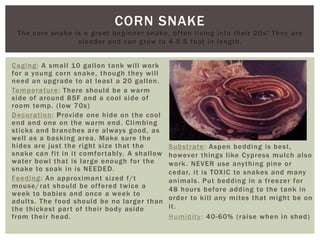
CORN SNAKE
Substrate: Aspen bedding is best,
however things like Cypress mulch also
work. NEVER use anything pine or
cedar, it is TOXIC to snakes and many
animals. Put bedding in a freezer for
48 hours before adding to the tank in
order to kill any mites that might be on
it.
Humidity: 40-60% (raise when in shed)
The corn snake is a great beginner snake, often living into their 20s! They are
slender and can grow to 4-5.5 foot in length.
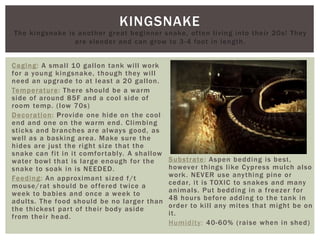
KINGSNAKE
Caging: A small 10 gallon tank will work
for a young kingsnake, though they will
need an upgrade to at least a 20 gallon.
Temperature: There should be a warm
side of around 85F and a cool side of
room temp. (low 70s)
Decoration: Provide one hide on the cool
end and one on the warm end. Climbing
sticks and branches are always good, as
well as a basking area. Make sure the
hides are just the right size that the
snake can fit in it comfortably. A shallow
water bowl that is large enough for the
snake to soak in is NEEDED.
Feeding: An approximant sized f/t
mouse/rat should be offered twice a
week to babies and once a week to
adults. The food should be no larger than
the thickest part of their body aside
from their head.
Substrate: Aspen bedding is best,
however things like Cypress mulch also
work. NEVER use anything pine or
cedar, it is TOXIC to snakes and many
animals. Put bedding in a freezer for
48 hours before adding to the tank in
order to kill any mites that might be on
it.
Humidity: 40-60% (raise when in shed)
The kingsnake is another great beginner snake, often living into their 20s! They
are slender and can grow to 3-4 foot in length.
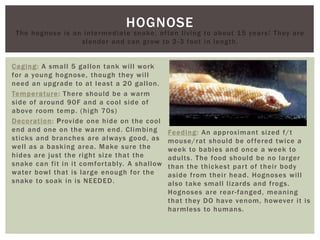
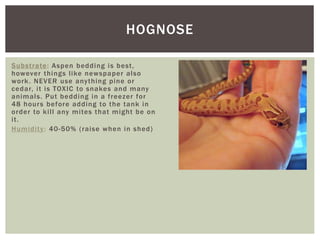
HOGNOSE
The hognose is an intermediate snake, often living to about 15 years! They are
slender and can grow to 2-3 foot in length.
Caging: A small 5 gallon tank will work
for a young hognose, though they will
need an upgrade to at least a 20 gallon.
Temperature: There should be a warm
side of around 90F and a cool side of
above room temp. (high 70s)
Decoration: Provide one hide on the cool
end and one on the warm end. Climbing
sticks and branches are always good, as
well as a basking area. Make sure the
hides are just the right size that the
snake can fit in it comfortably. A shallow
water bowl that is large enough for the
snake to soak in is NEEDED.
Feeding: An approximant sized f/t
mouse/rat should be offered twice a
week to babies and once a week to
adults. The food should be no larger
than the thickest part of their body
aside from their head. Hognoses will
also take small lizards and frogs.
Hognoses are rear-fanged, meaning
that they DO have venom, however it is
harmless to humans.
HOGNOSE
Substrate: Aspen bedding is best,
however things like newspaper also
work. NEVER use anything pine or
cedar, it is TOXIC to snakes and many
animals. Put bedding in a freezer for
48 hours before adding to the tank in
order to kill any mites that might be on
it.
Humidity: 40-50% (raise when in shed)
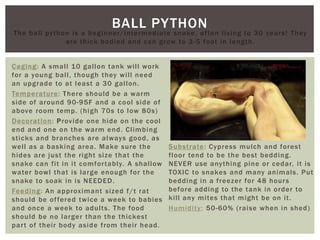
BALL PYTHON
Caging: A small 10 gallon tank will work
for a young ball, though they will need
an upgrade to at least a 30 gallon.
Temperature: There should be a warm
side of around 90-95F and a cool side of
above room temp. (high 70s to low 80s)
Decoration: Provide one hide on the cool
end and one on the warm end. Climbing
sticks and branches are always good, as
well as a basking area. Make sure the
hides are just the right size that the
snake can fit in it comfortably. A shallow
water bowl that is large enough for the
snake to soak in is NEEDED.
Feeding: An approximant sized f/t rat
should be offered twice a week to babies
and once a week to adults. The food
should be no larger than the thickest
part of their body aside from their head.
Substrate: Cypress mulch and forest
floor tend to be the best bedding.
NEVER use anything pine or cedar, it is
TOXIC to snakes and many animals. Put
bedding in a freezer for 48 hours
before adding to the tank in order to
kill any mites that might be on it.
Humidity: 50-60% (raise when in shed)
The ball python is a beginner/intermediate snake, often living to 30 years! They
are thick bodied and can grow to 3-5 foot in length.
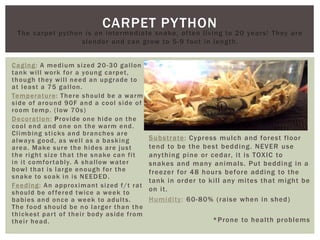
CARPET PYTHON
Caging: A medium sized 20-30 gallon
tank will work for a young carpet,
though they will need an upgrade to
at least a 75 gallon.
Temperature: There should be a warm
side of around 90F and a cool side of
room temp. (low 70s)
Decoration: Provide one hide on the
cool end and one on the warm end.
Climbing sticks and branches are
always good, as well as a basking
area. Make sure the hides are just
the right size that the snake can fit
in it comfortably. A shallow water
bowl that is large enough for the
snake to soak in is NEEDED.
Feeding: An approximant sized f/t rat
should be offered twice a week to
babies and once a week to adults.
The food should be no larger than the
thickest part of their body aside from
their head.
Substrate: Cypress mulch and forest floor
tend to be the best bedding. NEVER use
anything pine or cedar, it is TOXIC to
snakes and many animals. Put bedding in a
freezer for 48 hours before adding to the
tank in order to kill any mites that might be
on it.
Humidity: 60-80% (raise when in shed)
*Prone to health problems
The carpet python is an intermediate snake, often living to 20 years! They are
slender and can grow to 5-9 foot in length.
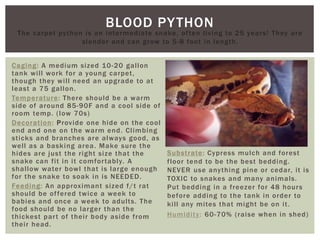
BLOOD PYTHON
Caging: A medium sized 10-20 gallon
tank will work for a young blood, though
they will need an upgrade to at least a
75 gallon.
Temperature: There should be a warm
side of around 85-90F and a cool side of
room temp. (low 70s)
Decoration: Provide one hide on the cool
end and one on the warm end. Climbing
sticks and branches are always good, as
well as a basking area. Make sure the
hides are just the right size that the
snake can fit in it comfortably. A
shallow water bowl that is large enough
for the snake to soak in is NEEDED.
Feeding: An approximant sized f/t rat
should be offered twice a week to
babies and once a week to adults. The
food should be no larger than the
thickest part of their body aside from
their head.
Substrate: Cypress mulch and forest
floor tend to be the best bedding.
NEVER use anything pine or cedar, it is
TOXIC to snakes and many animals.
Put bedding in a freezer for 48 hours
before adding to the tank in order to
kill any mites that might be on it.
Humidity: 60-70% (raise when in shed)
The carpet python is an intermediate snake, often living to 25 years! They are
slender and can grow to 5-8 foot in length.
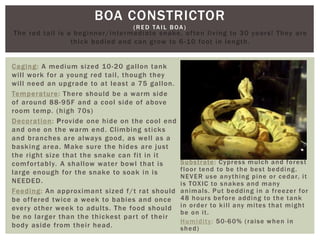
BOA CONSTRICTOR
(RED TAIL BOA)
The red tail is a beginner/intermediate snake, often living to 30 years! They are
thick bodied and can grow to 6-10 foot in length.
Caging: A medium sized 10-20 gallon tank
will work for a young red tail, though they
will need an upgrade to at least a 75 gallon.
Temperature: There should be a warm side
of around 88-95F and a cool side of above
room temp. (high 70s)
Decoration: Provide one hide on the cool end
and one on the warm end. Climbing sticks
and branches are always good, as well as a
basking area. Make sure the hides are just
the right size that the snake can fit in it
comfortably. A shallow water bowl that is
large enough for the snake to soak in is
NEEDED.
Feeding: An approximant sized f/t rat should
be offered twice a week to babies and once
every other week to adults. The food should
be no larger than the thickest part of their
body aside from their head.
Substrate: Cypress mulch and forest
floor tend to be the best bedding.
NEVER use anything pine or cedar, it
is TOXIC to snakes and many
animals. Put bedding in a freezer for
48 hours before adding to the tank
in order to kill any mites that might
be on it.
Humidity: 50-60% (raise when in
shed)
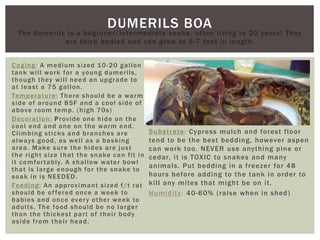
DUMERILS BOA
The dumerils is a beginner/intermediate snake, often living to 20 years! They
are thick bodied and can grow to 5-7 foot in length.
Caging: A medium sized 10-20 gallon
tank will work for a young dumerils,
though they will need an upgrade to
at least a 75 gallon.
Temperature: There should be a warm
side of around 85F and a cool side of
above room temp. (high 70s)
Decoration: Provide one hide on the
cool end and one on the warm end.
Climbing sticks and branches are
always good, as well as a basking
area. Make sure the hides are just
the right size that the snake can fit in
it comfortably. A shallow water bowl
that is large enough for the snake to
soak in is NEEDED.
Feeding: An approximant sized f/t rat
should be offered once a week to
babies and once every other week to
adults. The food should be no larger
than the thickest part of their body
aside from their head.
Substrate: Cypress mulch and forest floor
tend to be the best bedding, however aspen
can work too. NEVER use anything pine or
cedar, it is TOXIC to snakes and many
animals. Put bedding in a freezer for 48
hours before adding to the tank in order to
kill any mites that might be on it.
Humidity: 40-60% (raise when in shed)
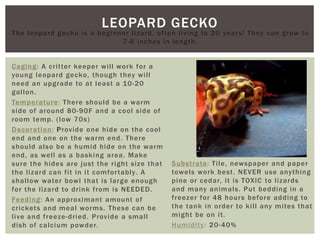
LEOPARD GECKO
The leopard gecko is a beginner lizard, often living to 20 years! They can grow to
7-8 inches in length.
Caging: A critter keeper will work for a
young leopard gecko, though they will
need an upgrade to at least a 10-20
gallon.
Temperature: There should be a warm
side of around 80-90F and a cool side of
room temp. (low 70s)
Decoration: Provide one hide on the cool
end and one on the warm end. There
should also be a humid hide on the warm
end, as well as a basking area. Make
sure the hides are just the right size that
the lizard can fit in it comfortably. A
shallow water bowl that is large enough
for the lizard to drink from is NEEDED.
Feeding: An approximant amount of
crickets and meal worms. These can be
live and freeze-dried. Provide a small
dish of calcium powder.
Substrate: Tile, newspaper and paper
towels work best. NEVER use anything
pine or cedar, it is TOXIC to lizards
and many animals. Put bedding in a
freezer for 48 hours before adding to
the tank in order to kill any mites that
might be on it.
Humidity: 20-40%
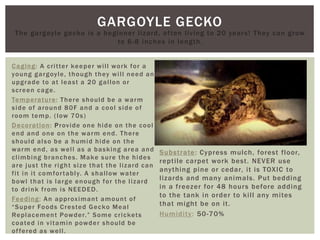
GARGOYLE GECKO
The gargoyle gecko is a beginner lizard, often living to 20 years! They can grow
to 6-8 inches in length.
Caging: A critter keeper will work for a
young gargoyle, though they will need an
upgrade to at least a 20 gallon or
screen cage.
Temperature: There should be a warm
side of around 80F and a cool side of
room temp. (low 70s)
Decoration: Provide one hide on the cool
end and one on the warm end. There
should also be a humid hide on the
warm end, as well as a basking area and
climbing branches. Make sure the hides
are just the right size that the lizard can
fit in it comfortably. A shallow water
bowl that is large enough for the lizard
to drink from is NEEDED.
Feeding: An approximant amount of
“Super Foods Crested Gecko Meal
Replacement Powder.” Some crickets
coated in vitamin powder should be
offered as well.
Substrate: Cypress mulch, forest floor,
reptile carpet work best. NEVER use
anything pine or cedar, it is TOXIC to
lizards and many animals. Put bedding
in a freezer for 48 hours before adding
to the tank in order to kill any mites
that might be on it.
Humidity: 50-70%
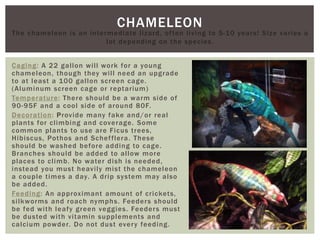
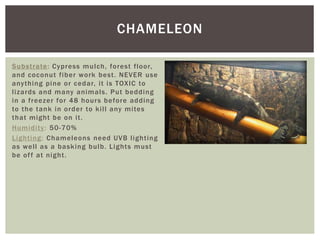
CHAMELEON
The chameleon is an intermediate lizard, often living to 5-10 years! Size varies a
lot depending on the species.
Caging: A 22 gallon will work for a young
chameleon, though they will need an upgrade
to at least a 100 gallon screen cage.
(Aluminum screen cage or reptarium)
Temperature: There should be a warm side of
90-95F and a cool side of around 80F.
Decoration: Provide many fake and/or real
plants for climbing and coverage. Some
common plants to use are Ficus trees,
Hibiscus, Pothos and Schefflera. These
should be washed before adding to cage.
Branches should be added to allow more
places to climb. No water dish is needed,
instead you must heavily mist the chameleon
a couple times a day. A drip system may also
be added.
Feeding: An approximant amount of crickets,
silkworms and roach nymphs. Feeders should
be fed with leafy green veggies. Feeders must
be dusted with vitamin supplements and
calcium powder. Do not dust every feeding.
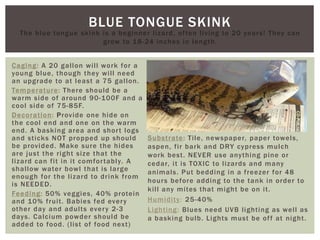
CHAMELEON
Substrate: Cypress mulch, forest floor,
and coconut fiber work best. NEVER use
anything pine or cedar, it is TOXIC to
lizards and many animals. Put bedding
in a freezer for 48 hours before adding
to the tank in order to kill any mites
that might be on it.
Humidity: 50-70%
Lighting: Chameleons need UVB lighting
as well as a basking bulb. Lights must
be off at night.
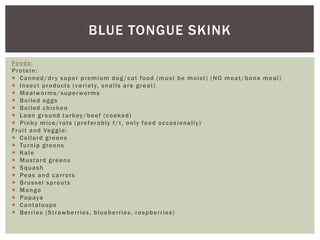
BLUE TONGUE SKINK
The blue tongue skink is a beginner lizard, often living to 20 years! They can
grow to 18-24 inches in length.
Caging: A 20 gallon will work for a
young blue, though they will need
an upgrade to at least a 75 gallon.
Temperature: There should be a
warm side of around 90-100F and a
cool side of 75-85F.
Decoration: Provide one hide on
the cool end and one on the warm
end. A basking area and short logs
and sticks NOT propped up should
be provided. Make sure the hides
are just the right size that the
lizard can fit in it comfortably. A
shallow water bowl that is large
enough for the lizard to drink from
is NEEDED.
Feeding: 50% veggies, 40% protein
and 10% fruit. Babies fed every
other day and adults every 2-3
days. Calcium powder should be
added to food. (list of food next)
Substrate: Tile, newspaper, paper towels,
aspen, fir bark and DRY cypress mulch
work best. NEVER use anything pine or
cedar, it is TOXIC to lizards and many
animals. Put bedding in a freezer for 48
hours before adding to the tank in order to
kill any mites that might be on it.
Humidity: 25-40%
Lighting: Blues need UVB lighting as well as
a basking bulb. Lights must be off at night.
BLUE TONGUE SKINK
Foods:
Protein:
 Canned/dry super premium dog/cat food (must be moist) (NO meat/bone meal)
 Insect products (variety, snails are great)
 Mealworms/superworms
 Boiled eggs
 Boiled chicken
 Lean ground turkey/beef (cooked)
 Pinky mice/rats (preferably f/t, only feed occasionally)
Fruit and Veggie:
 Collard greens
 Turnip greens
 Kale
 Mustard greens
 Squash
 Peas and carrots
 Brussel sprouts
 Mango
 Papaya
 Cantaloupe
 Berries (Strawberries, blueberries, raspberries)
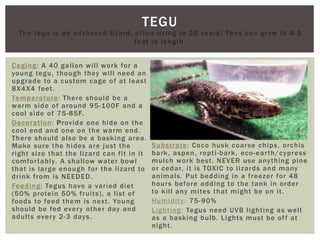
TEGU
Caging: A 40 gallon will work for a
young tegu, though they will need an
upgrade to a custom cage of at least
8X4X4 feet.
Temperature: There should be a
warm side of around 95-100F and a
cool side of 75-85F.
Decoration: Provide one hide on the
cool end and one on the warm end.
There should also be a basking area.
Make sure the hides are just the
right size that the lizard can fit in it
comfortably. A shallow water bowl
that is large enough for the lizard to
drink from is NEEDED.
Feeding: Tegus have a varied diet
(50% protein 50% fruits), a list of
foods to feed them is next. Young
should be fed every other day and
adults every 2-3 days.
Substrate: Coco husk coarse chips, orchis
bark, aspen, repti-bark, eco-earth/cypress
mulch work best. NEVER use anything pine
or cedar, it is TOXIC to lizards and many
animals. Put bedding in a freezer for 48
hours before adding to the tank in order
to kill any mites that might be on it.
Humidity: 75-90%
Lighting: Tegus need UVB lighting as well
as a basking bulb. Lights must be off at
night.
The tegu is an advanced lizard, often living to 20 years! They can grow to 4-5
feet in length.
TEGU
Foods:
Protein:
 Crickets, meal worms
 Raw ground turkey with calcium powder
 Eggs (boiled or scrambled)
 Pinkie-medium mice/pinkie-small rats
 Fresh fish
 Mazuri tortoise diet grounded up and mixed with ground turkey
Fruit and Veggie:
 Berries (blueberries, strawberries, grapes)
 Melon
 Tomato
 Bananas (in moderation)
 Squash
 Carrots
 Radish
 Zucchini
 Bell peppers
 Mustard greens/dandelion greens/collard greens/turnip greens
 Peas, leeks, prickly pear cactus
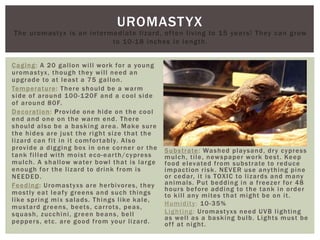
UROMASTYX
The uromastyx is an intermediate lizard, often living to 15 years! They can grow
to 10-18 inches in length.
Caging: A 20 gallon will work for a young
uromastyx, though they will need an
upgrade to at least a 75 gallon.
Temperature: There should be a warm
side of around 100-120F and a cool side
of around 80F.
Decoration: Provide one hide on the cool
end and one on the warm end. There
should also be a basking area. Make sure
the hides are just the right size that the
lizard can fit in it comfortably. Also
provide a digging box in one corner or the
tank filled with moist eco-earth/cypress
mulch. A shallow water bowl that is large
enough for the lizard to drink from is
NEEDED.
Feeding: Uromastyxs are herbivores, they
mostly eat leafy greens and such things
like spring mix salads. Things like kale,
mustard greens, beets, carrots, peas,
squash, zucchini, green beans, bell
peppers, etc. are good from your lizard.
Substrate: Washed playsand, dry cypress
mulch, tile, newspaper work best. Keep
food elevated from substrate to reduce
impaction risk. NEVER use anything pine
or cedar, it is TOXIC to lizards and many
animals. Put bedding in a freezer for 48
hours before adding to the tank in order
to kill any mites that might be on it.
Humidity: 10-35%
Lighting: Uromastyxs need UVB lighting
as well as a basking bulb. Lights must be
off at night.
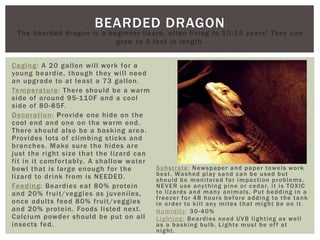
BEARDED DRAGON
Caging: A 20 gallon will work for a
young beardie, though they will need
an upgrade to at least a 75 gallon.
Temperature: There should be a warm
side of around 95-110F and a cool
side of 80-85F.
Decoration: Provide one hide on the
cool end and one on the warm end.
There should also be a basking area.
Provides lots of climbing sticks and
branches. Make sure the hides are
just the right size that the lizard can
fit in it comfortably. A shallow water
bowl that is large enough for the
lizard to drink from is NEEDED.
Feeding: Beardies eat 80% protein
and 20% fruit/veggies as juveniles,
once adults feed 80% fruit/veggies
and 20% protein. Foods listed next.
Calcium powder should be put on all
insects fed.
Substrate: Newspaper and paper towels work
best. Washed play sand can be used but
should be monitored for impaction problems.
NEVER use anything pine or cedar, it is TOXIC
to lizards and many animals. Put bedding in a
freezer for 48 hours before adding to the tank
in order to kill any mites that might be on it.
Humidity: 30-40%
Lighting: Beardies need UVB lighting as well
as a basking bulb. Lights must be off at
night.
The bearded dragon is a beginner lizard, often living to 10-15 years! They can
grow to 2 feet in length.
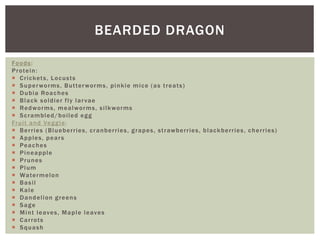
BEARDED DRAGON
Foods:
Protein:
 Crickets, Locusts
 Superworms, Butterworms, pinkie mice (as treats)
 Dubia Roaches
 Black soldier fly larvae
 Redworms, mealworms, silkworms
 Scrambled/boiled egg
Fruit and Veggie:
 Berries (Blueberries, cranberries, grapes, strawberries, blackberries, cherries)
 Apples, pears
 Peaches
 Pineapple
 Prunes
 Plum
 Watermelon
 Basil
 Kale
 Dandelion greens
 Sage
 Mint leaves, Maple leaves
 Carrots
 Squash

Reptile Care Sheet

  • 1.
  • 2.
    Caging: A small10 gallon tank will work for a young corn snake, though they will need an upgrade to at least a 20 gallon. Temperature: There should be a warm side of around 85F and a cool side of room temp. (low 70s) Decoration: Provide one hide on the cool end and one on the warm end. Climbing sticks and branches are always good, as well as a basking area. Make sure the hides are just the right size that the snake can fit in it comfortably. A shallow water bowl that is large enough for the snake to soak in is NEEDED. Feeding: An approximant sized f/t mouse/rat should be offered twice a week to babies and once a week to adults. The food should be no larger than the thickest part of their body aside from their head. CORN SNAKE Substrate: Aspen bedding is best, however things like Cypress mulch also work. NEVER use anything pine or cedar, it is TOXIC to snakes and many animals. Put bedding in a freezer for 48 hours before adding to the tank in order to kill any mites that might be on it. Humidity: 40-60% (raise when in shed) The corn snake is a great beginner snake, often living into their 20s! They are slender and can grow to 4-5.5 foot in length.
  • 3.
    KINGSNAKE Caging: A small10 gallon tank will work for a young kingsnake, though they will need an upgrade to at least a 20 gallon. Temperature: There should be a warm side of around 85F and a cool side of room temp. (low 70s) Decoration: Provide one hide on the cool end and one on the warm end. Climbing sticks and branches are always good, as well as a basking area. Make sure the hides are just the right size that the snake can fit in it comfortably. A shallow water bowl that is large enough for the snake to soak in is NEEDED. Feeding: An approximant sized f/t mouse/rat should be offered twice a week to babies and once a week to adults. The food should be no larger than the thickest part of their body aside from their head. Substrate: Aspen bedding is best, however things like Cypress mulch also work. NEVER use anything pine or cedar, it is TOXIC to snakes and many animals. Put bedding in a freezer for 48 hours before adding to the tank in order to kill any mites that might be on it. Humidity: 40-60% (raise when in shed) The kingsnake is another great beginner snake, often living into their 20s! They are slender and can grow to 3-4 foot in length.
  • 4.
    HOGNOSE The hognose isan intermediate snake, often living to about 15 years! They are slender and can grow to 2-3 foot in length. Caging: A small 5 gallon tank will work for a young hognose, though they will need an upgrade to at least a 20 gallon. Temperature: There should be a warm side of around 90F and a cool side of above room temp. (high 70s) Decoration: Provide one hide on the cool end and one on the warm end. Climbing sticks and branches are always good, as well as a basking area. Make sure the hides are just the right size that the snake can fit in it comfortably. A shallow water bowl that is large enough for the snake to soak in is NEEDED. Feeding: An approximant sized f/t mouse/rat should be offered twice a week to babies and once a week to adults. The food should be no larger than the thickest part of their body aside from their head. Hognoses will also take small lizards and frogs. Hognoses are rear-fanged, meaning that they DO have venom, however it is harmless to humans.
  • 5.
    HOGNOSE Substrate: Aspen beddingis best, however things like newspaper also work. NEVER use anything pine or cedar, it is TOXIC to snakes and many animals. Put bedding in a freezer for 48 hours before adding to the tank in order to kill any mites that might be on it. Humidity: 40-50% (raise when in shed)
  • 6.
    BALL PYTHON Caging: Asmall 10 gallon tank will work for a young ball, though they will need an upgrade to at least a 30 gallon. Temperature: There should be a warm side of around 90-95F and a cool side of above room temp. (high 70s to low 80s) Decoration: Provide one hide on the cool end and one on the warm end. Climbing sticks and branches are always good, as well as a basking area. Make sure the hides are just the right size that the snake can fit in it comfortably. A shallow water bowl that is large enough for the snake to soak in is NEEDED. Feeding: An approximant sized f/t rat should be offered twice a week to babies and once a week to adults. The food should be no larger than the thickest part of their body aside from their head. Substrate: Cypress mulch and forest floor tend to be the best bedding. NEVER use anything pine or cedar, it is TOXIC to snakes and many animals. Put bedding in a freezer for 48 hours before adding to the tank in order to kill any mites that might be on it. Humidity: 50-60% (raise when in shed) The ball python is a beginner/intermediate snake, often living to 30 years! They are thick bodied and can grow to 3-5 foot in length.
  • 7.
    CARPET PYTHON Caging: Amedium sized 20-30 gallon tank will work for a young carpet, though they will need an upgrade to at least a 75 gallon. Temperature: There should be a warm side of around 90F and a cool side of room temp. (low 70s) Decoration: Provide one hide on the cool end and one on the warm end. Climbing sticks and branches are always good, as well as a basking area. Make sure the hides are just the right size that the snake can fit in it comfortably. A shallow water bowl that is large enough for the snake to soak in is NEEDED. Feeding: An approximant sized f/t rat should be offered twice a week to babies and once a week to adults. The food should be no larger than the thickest part of their body aside from their head. Substrate: Cypress mulch and forest floor tend to be the best bedding. NEVER use anything pine or cedar, it is TOXIC to snakes and many animals. Put bedding in a freezer for 48 hours before adding to the tank in order to kill any mites that might be on it. Humidity: 60-80% (raise when in shed) *Prone to health problems The carpet python is an intermediate snake, often living to 20 years! They are slender and can grow to 5-9 foot in length.
  • 8.
    BLOOD PYTHON Caging: Amedium sized 10-20 gallon tank will work for a young blood, though they will need an upgrade to at least a 75 gallon. Temperature: There should be a warm side of around 85-90F and a cool side of room temp. (low 70s) Decoration: Provide one hide on the cool end and one on the warm end. Climbing sticks and branches are always good, as well as a basking area. Make sure the hides are just the right size that the snake can fit in it comfortably. A shallow water bowl that is large enough for the snake to soak in is NEEDED. Feeding: An approximant sized f/t rat should be offered twice a week to babies and once a week to adults. The food should be no larger than the thickest part of their body aside from their head. Substrate: Cypress mulch and forest floor tend to be the best bedding. NEVER use anything pine or cedar, it is TOXIC to snakes and many animals. Put bedding in a freezer for 48 hours before adding to the tank in order to kill any mites that might be on it. Humidity: 60-70% (raise when in shed) The carpet python is an intermediate snake, often living to 25 years! They are slender and can grow to 5-8 foot in length.
  • 9.
    BOA CONSTRICTOR (RED TAILBOA) The red tail is a beginner/intermediate snake, often living to 30 years! They are thick bodied and can grow to 6-10 foot in length. Caging: A medium sized 10-20 gallon tank will work for a young red tail, though they will need an upgrade to at least a 75 gallon. Temperature: There should be a warm side of around 88-95F and a cool side of above room temp. (high 70s) Decoration: Provide one hide on the cool end and one on the warm end. Climbing sticks and branches are always good, as well as a basking area. Make sure the hides are just the right size that the snake can fit in it comfortably. A shallow water bowl that is large enough for the snake to soak in is NEEDED. Feeding: An approximant sized f/t rat should be offered twice a week to babies and once every other week to adults. The food should be no larger than the thickest part of their body aside from their head. Substrate: Cypress mulch and forest floor tend to be the best bedding. NEVER use anything pine or cedar, it is TOXIC to snakes and many animals. Put bedding in a freezer for 48 hours before adding to the tank in order to kill any mites that might be on it. Humidity: 50-60% (raise when in shed)
  • 10.
    DUMERILS BOA The dumerilsis a beginner/intermediate snake, often living to 20 years! They are thick bodied and can grow to 5-7 foot in length. Caging: A medium sized 10-20 gallon tank will work for a young dumerils, though they will need an upgrade to at least a 75 gallon. Temperature: There should be a warm side of around 85F and a cool side of above room temp. (high 70s) Decoration: Provide one hide on the cool end and one on the warm end. Climbing sticks and branches are always good, as well as a basking area. Make sure the hides are just the right size that the snake can fit in it comfortably. A shallow water bowl that is large enough for the snake to soak in is NEEDED. Feeding: An approximant sized f/t rat should be offered once a week to babies and once every other week to adults. The food should be no larger than the thickest part of their body aside from their head. Substrate: Cypress mulch and forest floor tend to be the best bedding, however aspen can work too. NEVER use anything pine or cedar, it is TOXIC to snakes and many animals. Put bedding in a freezer for 48 hours before adding to the tank in order to kill any mites that might be on it. Humidity: 40-60% (raise when in shed)
  • 11.
    LEOPARD GECKO The leopardgecko is a beginner lizard, often living to 20 years! They can grow to 7-8 inches in length. Caging: A critter keeper will work for a young leopard gecko, though they will need an upgrade to at least a 10-20 gallon. Temperature: There should be a warm side of around 80-90F and a cool side of room temp. (low 70s) Decoration: Provide one hide on the cool end and one on the warm end. There should also be a humid hide on the warm end, as well as a basking area. Make sure the hides are just the right size that the lizard can fit in it comfortably. A shallow water bowl that is large enough for the lizard to drink from is NEEDED. Feeding: An approximant amount of crickets and meal worms. These can be live and freeze-dried. Provide a small dish of calcium powder. Substrate: Tile, newspaper and paper towels work best. NEVER use anything pine or cedar, it is TOXIC to lizards and many animals. Put bedding in a freezer for 48 hours before adding to the tank in order to kill any mites that might be on it. Humidity: 20-40%
  • 12.
    GARGOYLE GECKO The gargoylegecko is a beginner lizard, often living to 20 years! They can grow to 6-8 inches in length. Caging: A critter keeper will work for a young gargoyle, though they will need an upgrade to at least a 20 gallon or screen cage. Temperature: There should be a warm side of around 80F and a cool side of room temp. (low 70s) Decoration: Provide one hide on the cool end and one on the warm end. There should also be a humid hide on the warm end, as well as a basking area and climbing branches. Make sure the hides are just the right size that the lizard can fit in it comfortably. A shallow water bowl that is large enough for the lizard to drink from is NEEDED. Feeding: An approximant amount of “Super Foods Crested Gecko Meal Replacement Powder.” Some crickets coated in vitamin powder should be offered as well. Substrate: Cypress mulch, forest floor, reptile carpet work best. NEVER use anything pine or cedar, it is TOXIC to lizards and many animals. Put bedding in a freezer for 48 hours before adding to the tank in order to kill any mites that might be on it. Humidity: 50-70%
  • 13.
    CHAMELEON The chameleon isan intermediate lizard, often living to 5-10 years! Size varies a lot depending on the species. Caging: A 22 gallon will work for a young chameleon, though they will need an upgrade to at least a 100 gallon screen cage. (Aluminum screen cage or reptarium) Temperature: There should be a warm side of 90-95F and a cool side of around 80F. Decoration: Provide many fake and/or real plants for climbing and coverage. Some common plants to use are Ficus trees, Hibiscus, Pothos and Schefflera. These should be washed before adding to cage. Branches should be added to allow more places to climb. No water dish is needed, instead you must heavily mist the chameleon a couple times a day. A drip system may also be added. Feeding: An approximant amount of crickets, silkworms and roach nymphs. Feeders should be fed with leafy green veggies. Feeders must be dusted with vitamin supplements and calcium powder. Do not dust every feeding.
  • 14.
    CHAMELEON Substrate: Cypress mulch,forest floor, and coconut fiber work best. NEVER use anything pine or cedar, it is TOXIC to lizards and many animals. Put bedding in a freezer for 48 hours before adding to the tank in order to kill any mites that might be on it. Humidity: 50-70% Lighting: Chameleons need UVB lighting as well as a basking bulb. Lights must be off at night.
  • 15.
    BLUE TONGUE SKINK Theblue tongue skink is a beginner lizard, often living to 20 years! They can grow to 18-24 inches in length. Caging: A 20 gallon will work for a young blue, though they will need an upgrade to at least a 75 gallon. Temperature: There should be a warm side of around 90-100F and a cool side of 75-85F. Decoration: Provide one hide on the cool end and one on the warm end. A basking area and short logs and sticks NOT propped up should be provided. Make sure the hides are just the right size that the lizard can fit in it comfortably. A shallow water bowl that is large enough for the lizard to drink from is NEEDED. Feeding: 50% veggies, 40% protein and 10% fruit. Babies fed every other day and adults every 2-3 days. Calcium powder should be added to food. (list of food next) Substrate: Tile, newspaper, paper towels, aspen, fir bark and DRY cypress mulch work best. NEVER use anything pine or cedar, it is TOXIC to lizards and many animals. Put bedding in a freezer for 48 hours before adding to the tank in order to kill any mites that might be on it. Humidity: 25-40% Lighting: Blues need UVB lighting as well as a basking bulb. Lights must be off at night.
  • 16.
    BLUE TONGUE SKINK Foods: Protein: Canned/dry super premium dog/cat food (must be moist) (NO meat/bone meal)  Insect products (variety, snails are great)  Mealworms/superworms  Boiled eggs  Boiled chicken  Lean ground turkey/beef (cooked)  Pinky mice/rats (preferably f/t, only feed occasionally) Fruit and Veggie:  Collard greens  Turnip greens  Kale  Mustard greens  Squash  Peas and carrots  Brussel sprouts  Mango  Papaya  Cantaloupe  Berries (Strawberries, blueberries, raspberries)
  • 17.
    TEGU Caging: A 40gallon will work for a young tegu, though they will need an upgrade to a custom cage of at least 8X4X4 feet. Temperature: There should be a warm side of around 95-100F and a cool side of 75-85F. Decoration: Provide one hide on the cool end and one on the warm end. There should also be a basking area. Make sure the hides are just the right size that the lizard can fit in it comfortably. A shallow water bowl that is large enough for the lizard to drink from is NEEDED. Feeding: Tegus have a varied diet (50% protein 50% fruits), a list of foods to feed them is next. Young should be fed every other day and adults every 2-3 days. Substrate: Coco husk coarse chips, orchis bark, aspen, repti-bark, eco-earth/cypress mulch work best. NEVER use anything pine or cedar, it is TOXIC to lizards and many animals. Put bedding in a freezer for 48 hours before adding to the tank in order to kill any mites that might be on it. Humidity: 75-90% Lighting: Tegus need UVB lighting as well as a basking bulb. Lights must be off at night. The tegu is an advanced lizard, often living to 20 years! They can grow to 4-5 feet in length.
  • 18.
    TEGU Foods: Protein:  Crickets, mealworms  Raw ground turkey with calcium powder  Eggs (boiled or scrambled)  Pinkie-medium mice/pinkie-small rats  Fresh fish  Mazuri tortoise diet grounded up and mixed with ground turkey Fruit and Veggie:  Berries (blueberries, strawberries, grapes)  Melon  Tomato  Bananas (in moderation)  Squash  Carrots  Radish  Zucchini  Bell peppers  Mustard greens/dandelion greens/collard greens/turnip greens  Peas, leeks, prickly pear cactus
  • 19.
    UROMASTYX The uromastyx isan intermediate lizard, often living to 15 years! They can grow to 10-18 inches in length. Caging: A 20 gallon will work for a young uromastyx, though they will need an upgrade to at least a 75 gallon. Temperature: There should be a warm side of around 100-120F and a cool side of around 80F. Decoration: Provide one hide on the cool end and one on the warm end. There should also be a basking area. Make sure the hides are just the right size that the lizard can fit in it comfortably. Also provide a digging box in one corner or the tank filled with moist eco-earth/cypress mulch. A shallow water bowl that is large enough for the lizard to drink from is NEEDED. Feeding: Uromastyxs are herbivores, they mostly eat leafy greens and such things like spring mix salads. Things like kale, mustard greens, beets, carrots, peas, squash, zucchini, green beans, bell peppers, etc. are good from your lizard. Substrate: Washed playsand, dry cypress mulch, tile, newspaper work best. Keep food elevated from substrate to reduce impaction risk. NEVER use anything pine or cedar, it is TOXIC to lizards and many animals. Put bedding in a freezer for 48 hours before adding to the tank in order to kill any mites that might be on it. Humidity: 10-35% Lighting: Uromastyxs need UVB lighting as well as a basking bulb. Lights must be off at night.
  • 20.
    BEARDED DRAGON Caging: A20 gallon will work for a young beardie, though they will need an upgrade to at least a 75 gallon. Temperature: There should be a warm side of around 95-110F and a cool side of 80-85F. Decoration: Provide one hide on the cool end and one on the warm end. There should also be a basking area. Provides lots of climbing sticks and branches. Make sure the hides are just the right size that the lizard can fit in it comfortably. A shallow water bowl that is large enough for the lizard to drink from is NEEDED. Feeding: Beardies eat 80% protein and 20% fruit/veggies as juveniles, once adults feed 80% fruit/veggies and 20% protein. Foods listed next. Calcium powder should be put on all insects fed. Substrate: Newspaper and paper towels work best. Washed play sand can be used but should be monitored for impaction problems. NEVER use anything pine or cedar, it is TOXIC to lizards and many animals. Put bedding in a freezer for 48 hours before adding to the tank in order to kill any mites that might be on it. Humidity: 30-40% Lighting: Beardies need UVB lighting as well as a basking bulb. Lights must be off at night. The bearded dragon is a beginner lizard, often living to 10-15 years! They can grow to 2 feet in length.
  • 21.
    BEARDED DRAGON Foods: Protein:  Crickets,Locusts  Superworms, Butterworms, pinkie mice (as treats)  Dubia Roaches  Black soldier fly larvae  Redworms, mealworms, silkworms  Scrambled/boiled egg Fruit and Veggie:  Berries (Blueberries, cranberries, grapes, strawberries, blackberries, cherries)  Apples, pears  Peaches  Pineapple  Prunes  Plum  Watermelon  Basil  Kale  Dandelion greens  Sage  Mint leaves, Maple leaves  Carrots  Squash