













The Affordable Care ActReporting Requirements: A Step-by-Step Guide to Forms 1095-B and 1094-B
1
These slides were last updated on August 7, 2015.
2
First things first, this is not a basic guide.
3
This guide assumes you know how the Employer Mandate
basically works under the Affordable Care Act.
4
Which brings me to a very important point. The reporting
requirements are their own separate, free-standing requirement
under the Affordable Care Act.
5
You might be asking yourself what makes me an authority on the
subject.
6
That is a great question and a question that does not get asked
enough by people researching the ACA.
7
I’ve helped hundreds of employers since the Affordable Care Act
was signed on March 23, 2010.
8
I’ve written scholarly articles for peer-reviewed legal journals on
the Affordable Care Act.
9
I’ve written three editions of a comprehensive guide on the
Affordable Care Act called The Employer Mandate Handbook. The
third edition will be out in mid-August 2015.
10
When I wrote my articles and books, I tried to cite as many as my
claims as possible.
11
I have spent years working on this stuff every day.
12
I have been quoted in the Houston Chronicle, Forbes, and have
been interviewed by the New York Times.
13
But even after all of that, I don’t know everything, and you should
run (very fast) from anyone that claims they do.
14
What I do know is that as far as these reporting requirements are
concerned, it is irrelevant how many employees you had during
2015. All that matters here is whether your medical benefits were
self-insured.
15
Again, the only thing that matters is whether you are self-funding
or self-insuring your employees’ health insurance.
16
If you do not know the answer to the last slide . . .
17
Stop.
Investigate.
Then Come Back.
18
Welcome back.
19
If you made it to this point, I am assuming you are self-insured or
self-funded. If you are neither, please leave.
20
Otherwise, you might be wondering what is the ultimate goal of
all of this reporting.
21
Fair question.
22
Under the Individual Mandate, the IRS has to identify which
Americans have medical benefits and which do not. Those that do
not, and don’t have an authorized excuse, will pay a financial
penalty.
23
Incredibly, the IRS is not just going to take people’s word for it.
They want proof that non-exempt people had insurance when
they claim they have it to avoid paying individual mandate
penalties.
24
Under the Employer Mandate, the IRS has to identify whether
Applicable Large Employer Members offered insurance, or the
right kind of insurance, to full-time employees in assessing
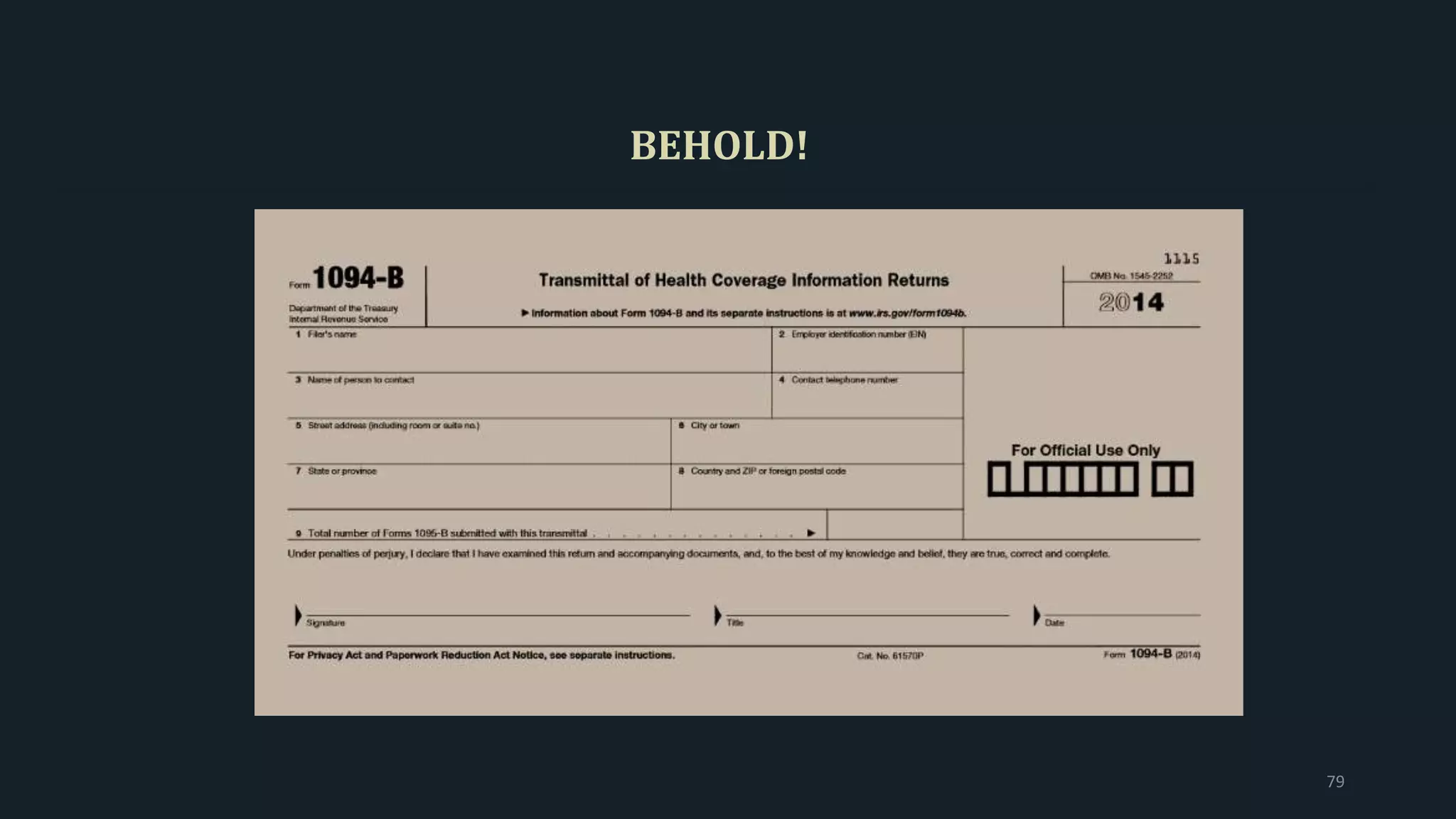
financial penalties for those employers.
25
This is where Form 1095-B comes in.
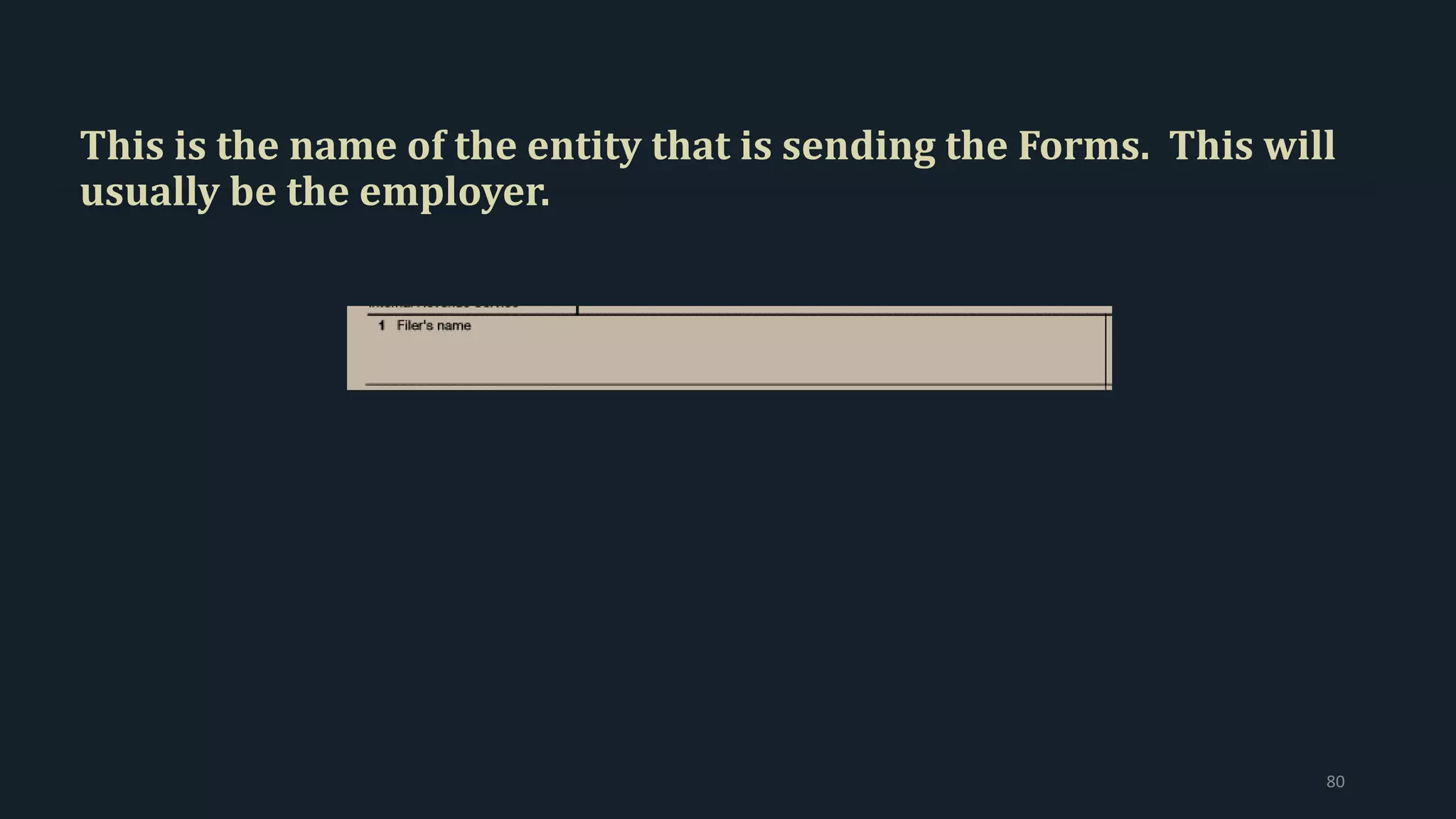
26
Form 1095-B is the proof against which individual claims will be
verified.
27
For example, Lennifer Jopez works for Remix Inc. Remix Inc.
offers Lennifer self-insured, self-funded benefits during 2014. In
April 2015, when Lennifer is completing her personal income
taxes, she gets to the line that asks her if she had insurance
during 2014. Lennifer claims to have insurance in 2014.
28
The IRS has no way of verifying Lennifer’s claim. Because there is
no insurance company to ask (because Remix is a self-insured,
self-funded employer), the IRS has to get a report from Remix
verifying Lennifer’s coverage.
29
That is the entire point of Form 1095-B
30
You can download Form 1095-B directly from the IRS here:
Form 1095-B
31
Always ensure you have the most up-to-date form by going
straight to the IRS website. Try to avoid the common pitfall of
printing 100 of them, putting them in a drawer, and then pulling
them from the drawer. Sooner or later, you will have outdated
forms if you do it this way.
32
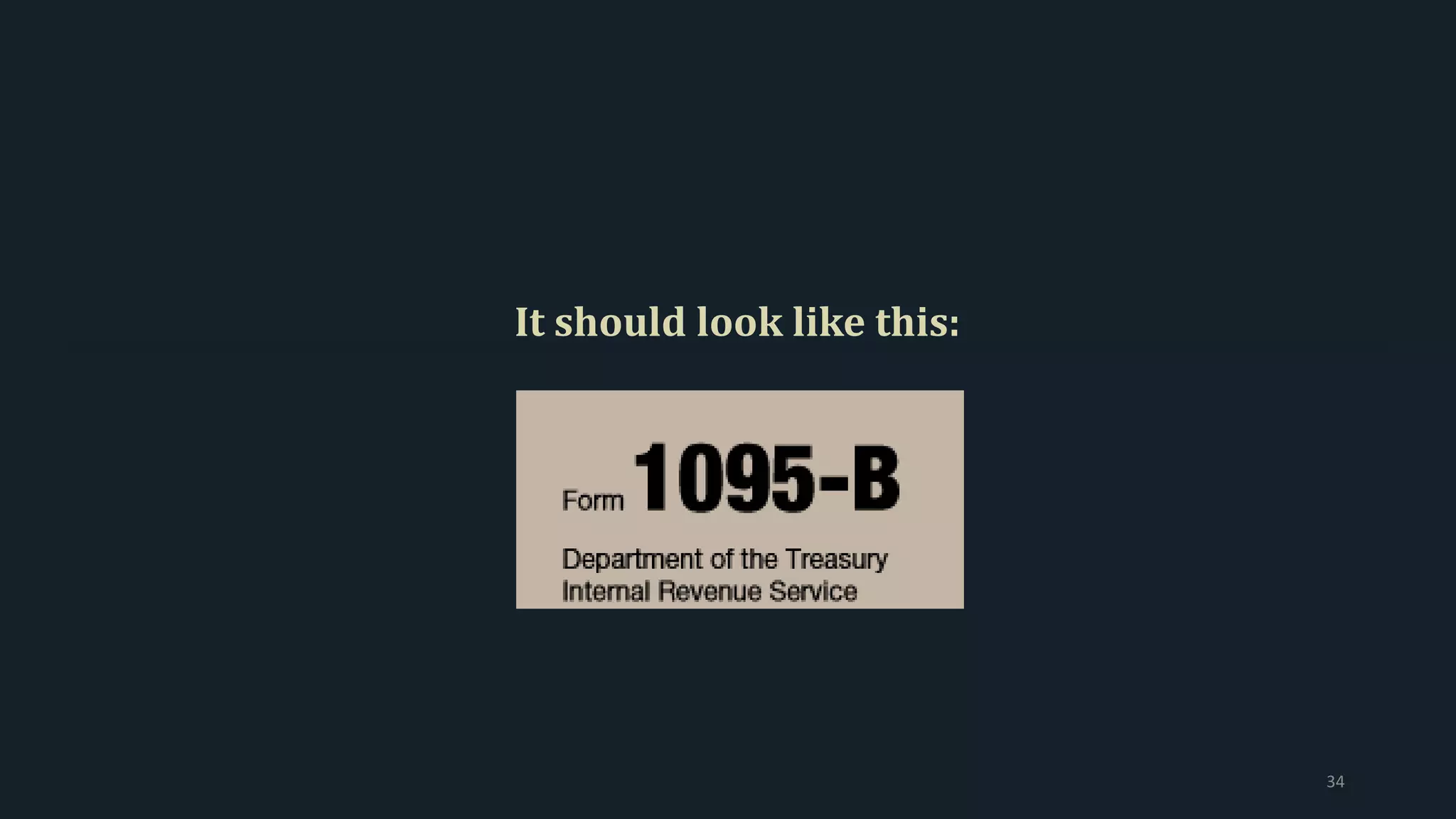
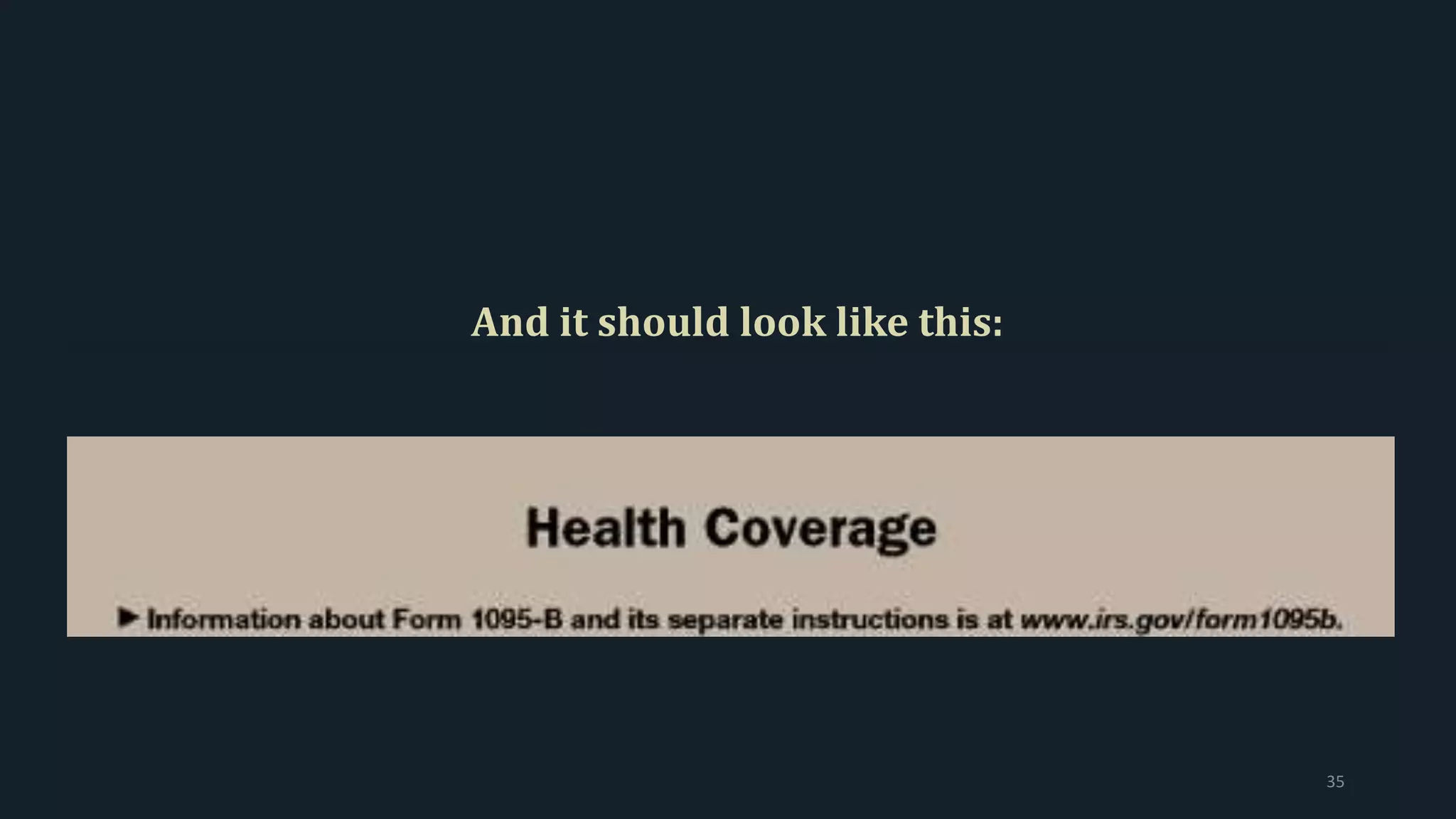
Ensure you have the correct form by checking the top-left corner
of the form in front of you.
33
It should look like this:
34
And it should look like this:
35
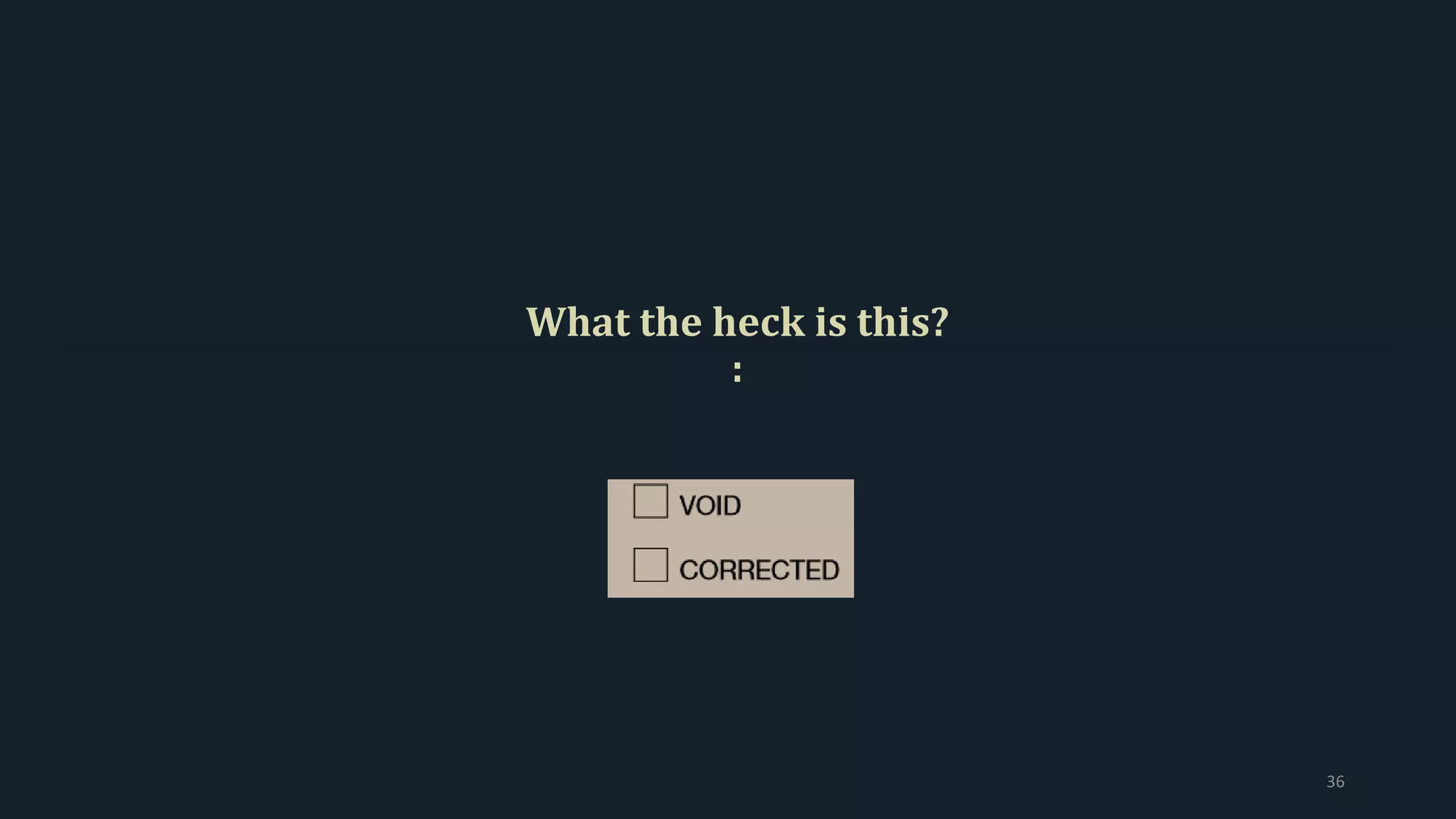
What the heck is this?
:
36
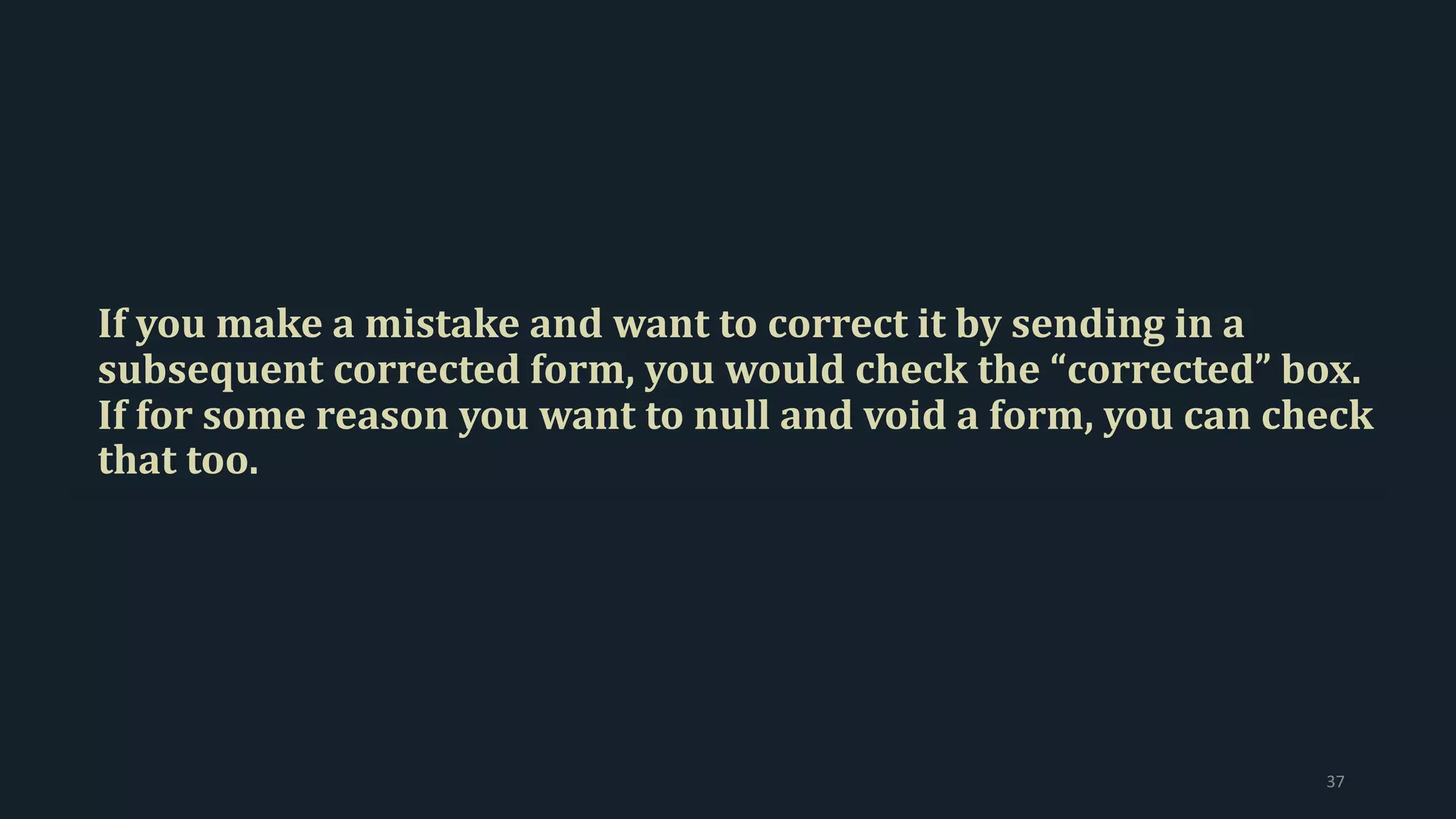
If you make a mistake and want to correct it by sending in a
subsequent corrected form, you would check the “corrected” box.
If for some reason you want to null and void a form, you can check
that too.
37
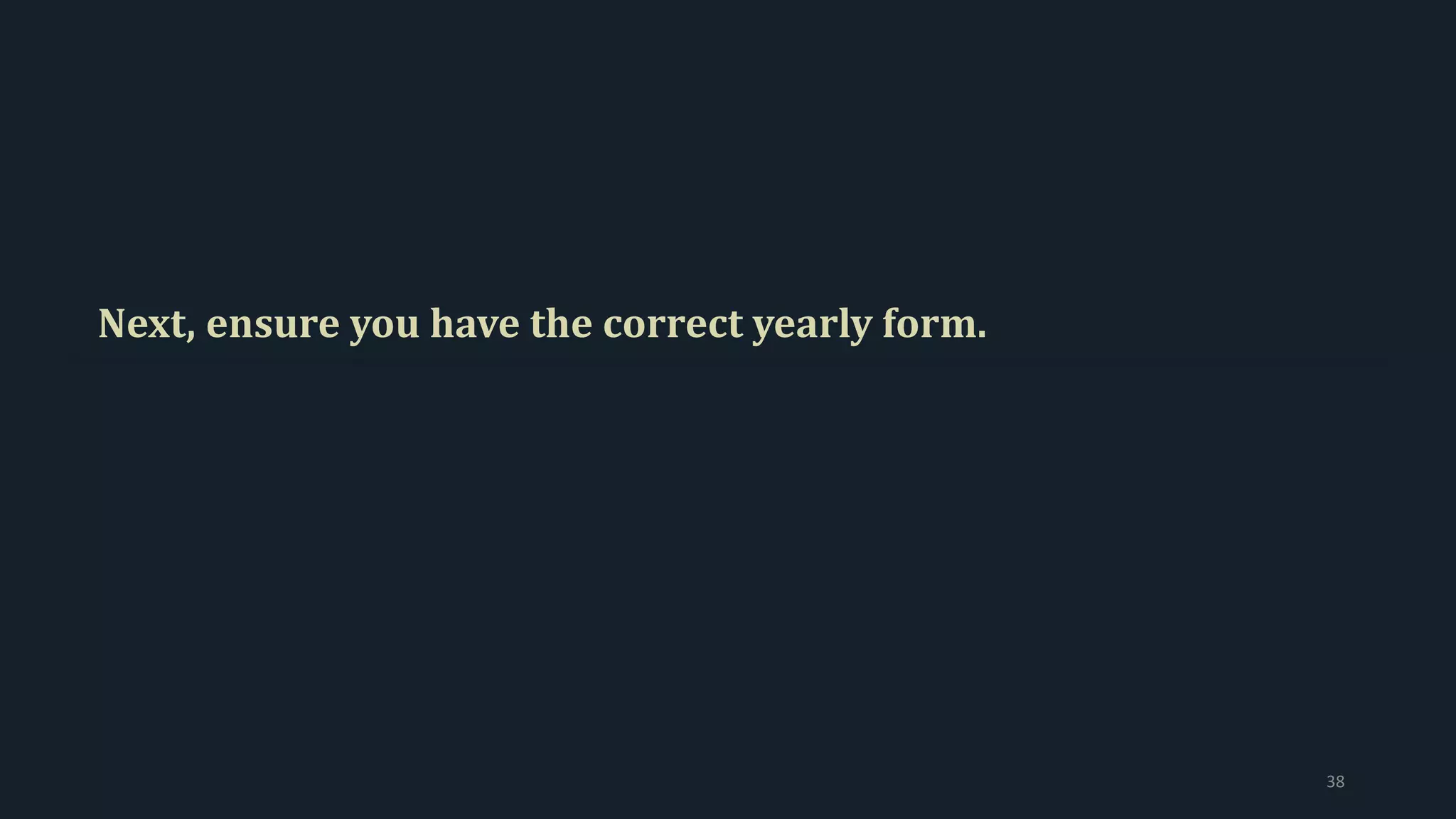
Next, ensure you have the correct yearly form.
38
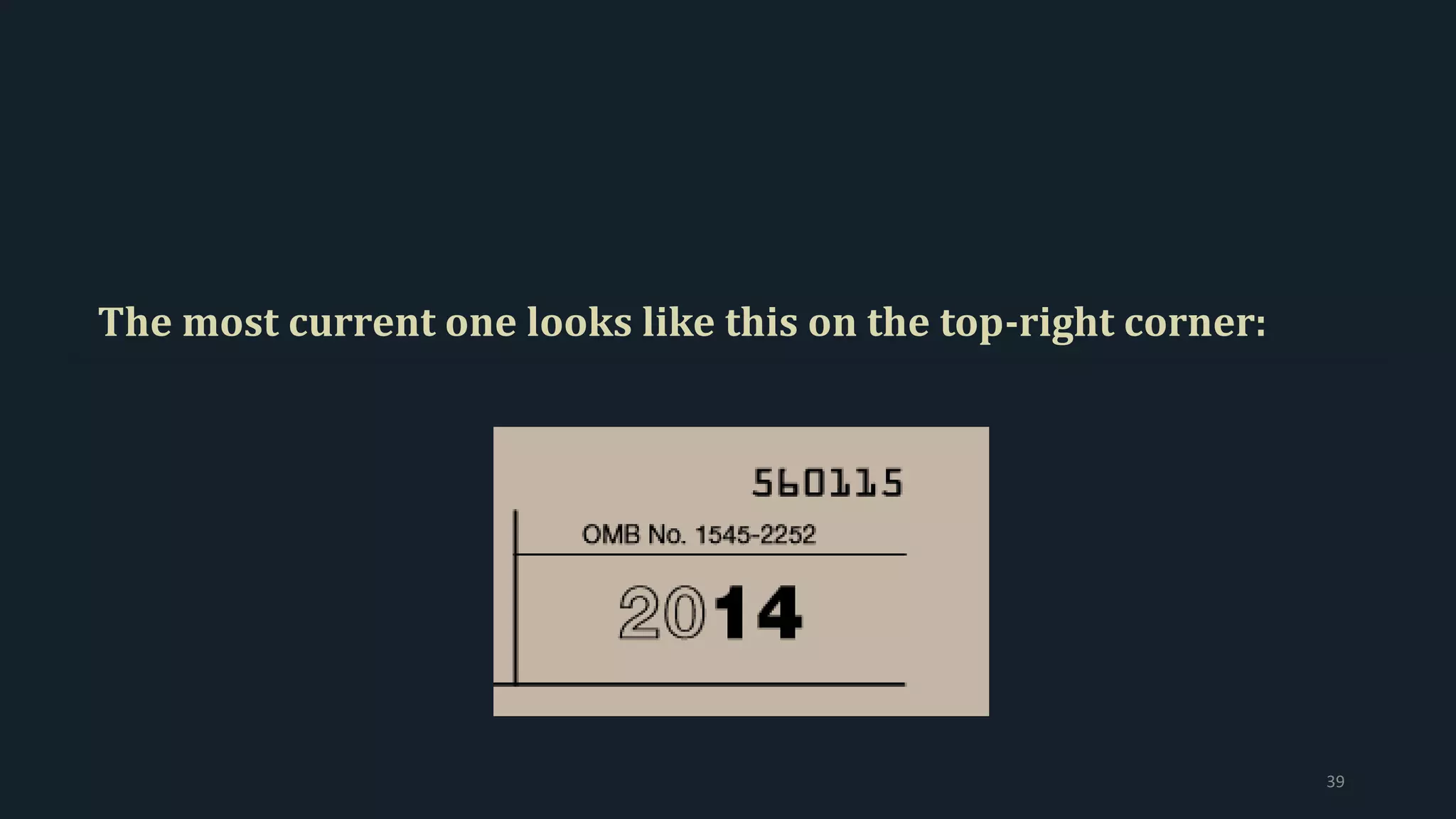
The most current one looks like this on the top-right corner:
39
Mario, that says 2014?!?!
40
That is the most current form. This is why it is important to
ensure you have the right form every time you sit down. As of July
24, 2015, that is the most current form.
41
We checked the form number.
We checked the form name.
We checked the year.
42
Now we can get to the heart of the matter.
43
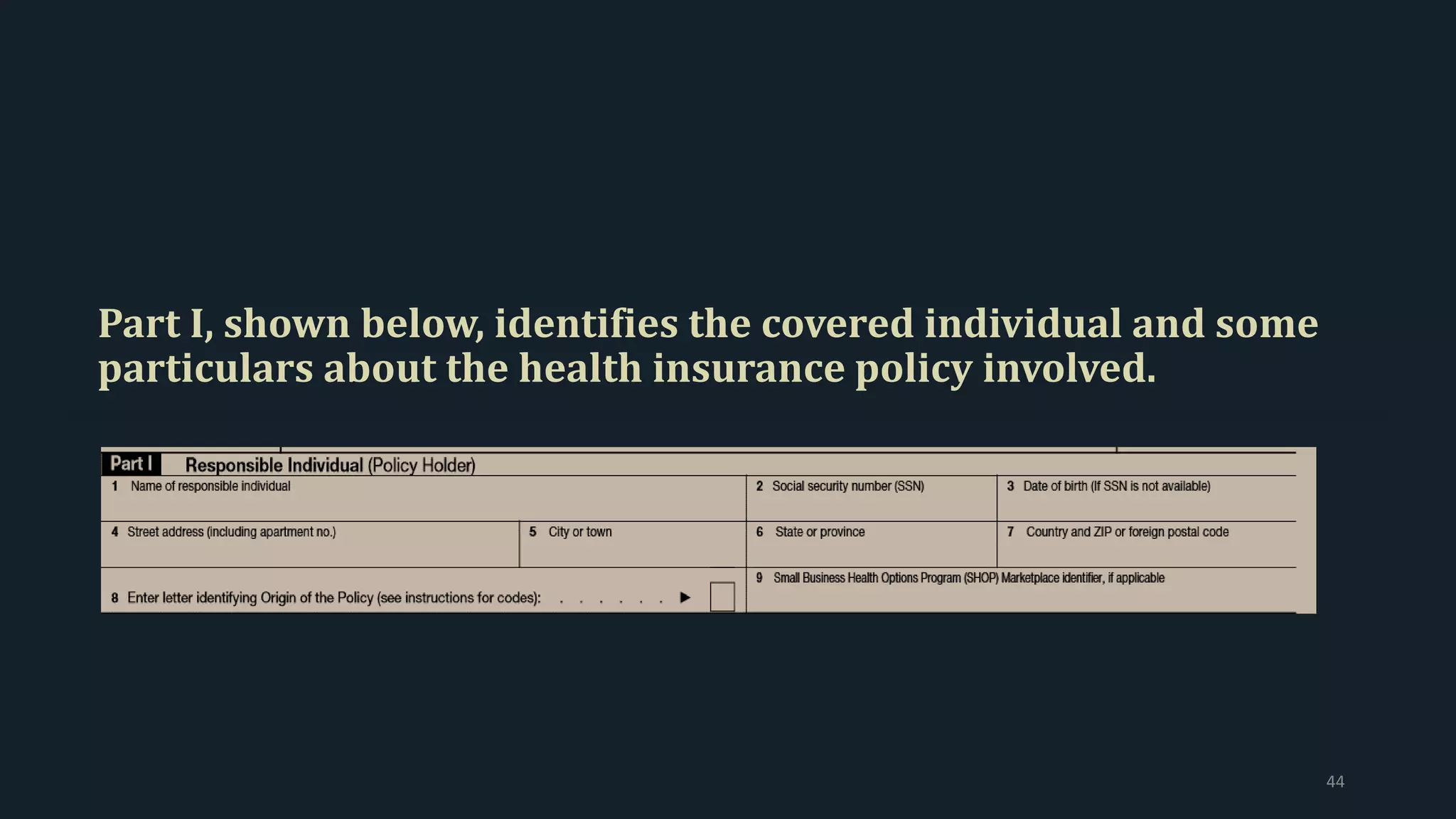
Part I, shown below, identifies the covered individual and some
particulars about the health insurance policy involved.
44
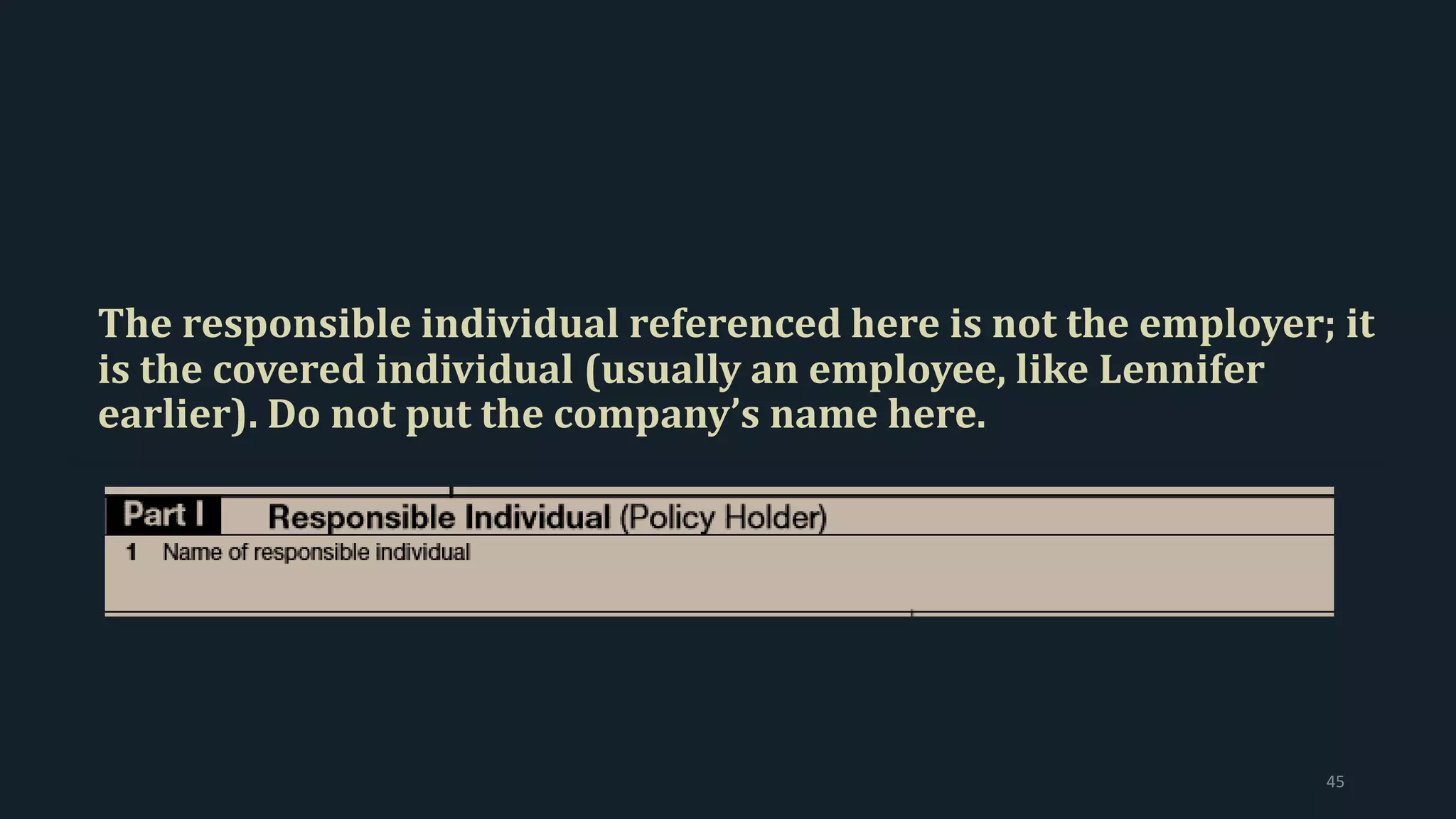
The responsible individual referenced here is not the employer; it
is the covered individual (usually an employee, like Lennifer
earlier). Do not put the company’s name here.
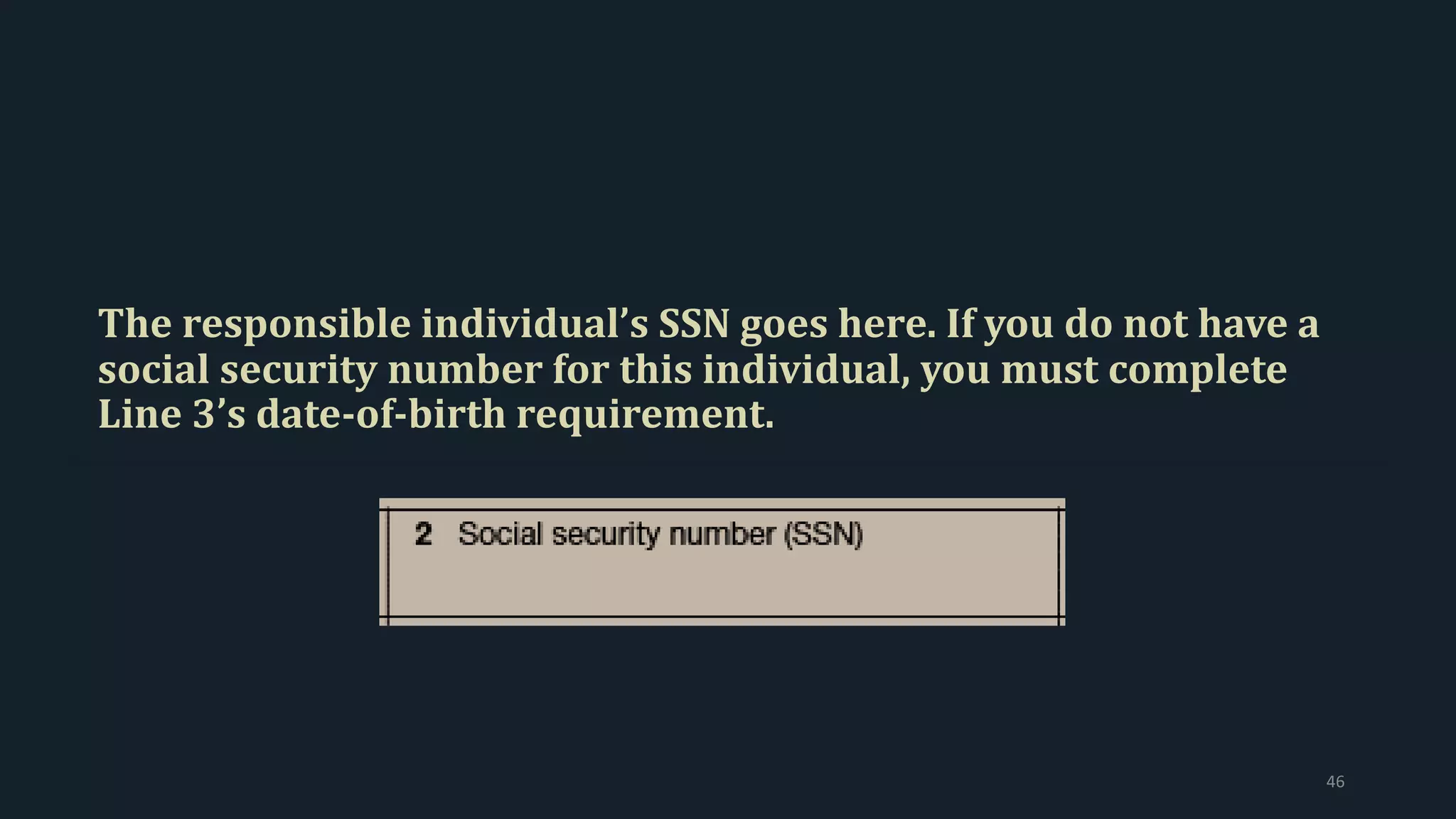
45
The responsible individual’s SSN goes here. If you do not have a
social security number for this individual, you must complete
Line 3’s date-of-birth requirement.
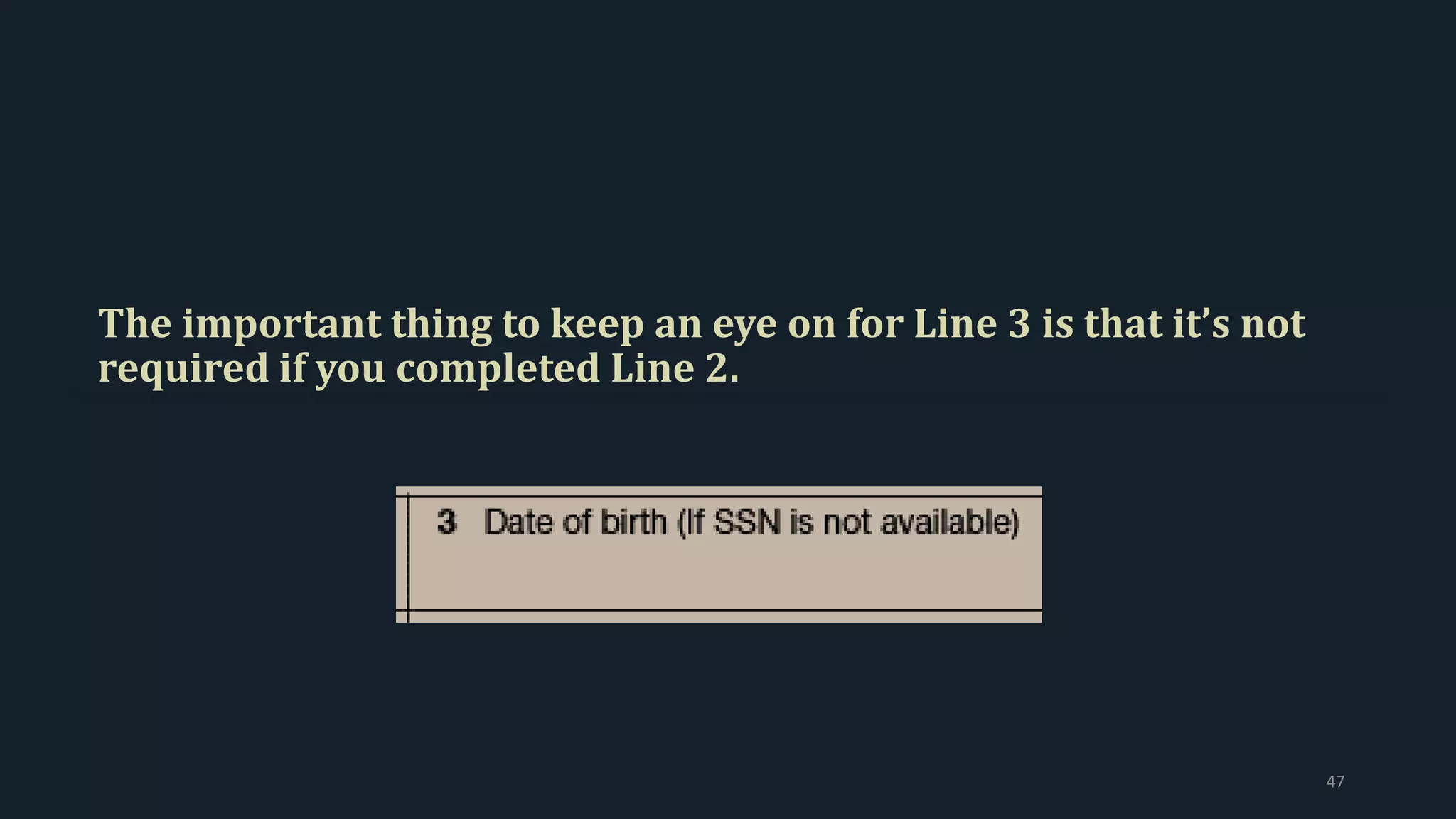
46
The important thing to keep an eye on for Line 3 is that it’s not
required if you completed Line 2.
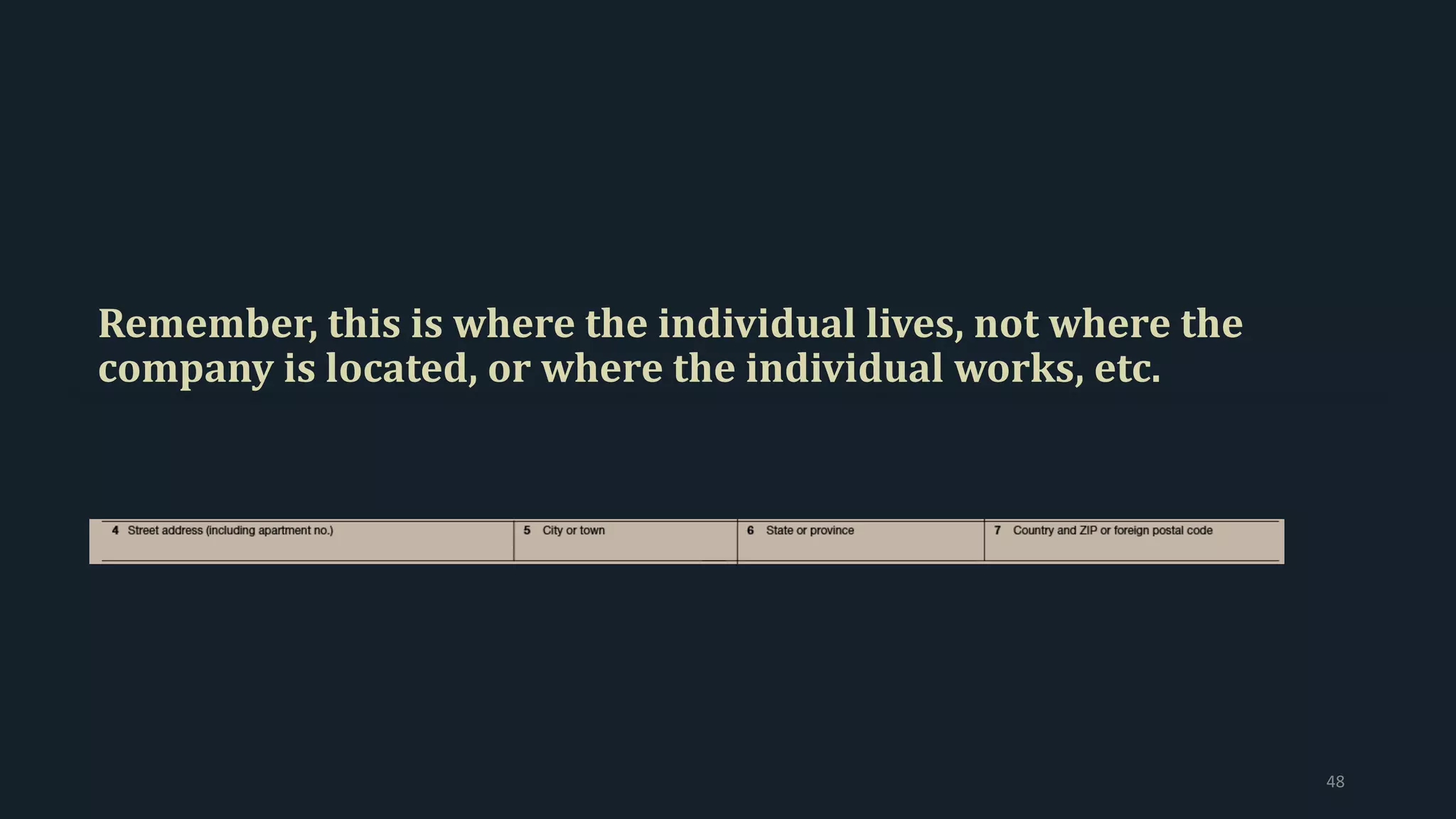
47
Remember, this is where the individual lives, not where the
company is located, or where the individual works, etc.
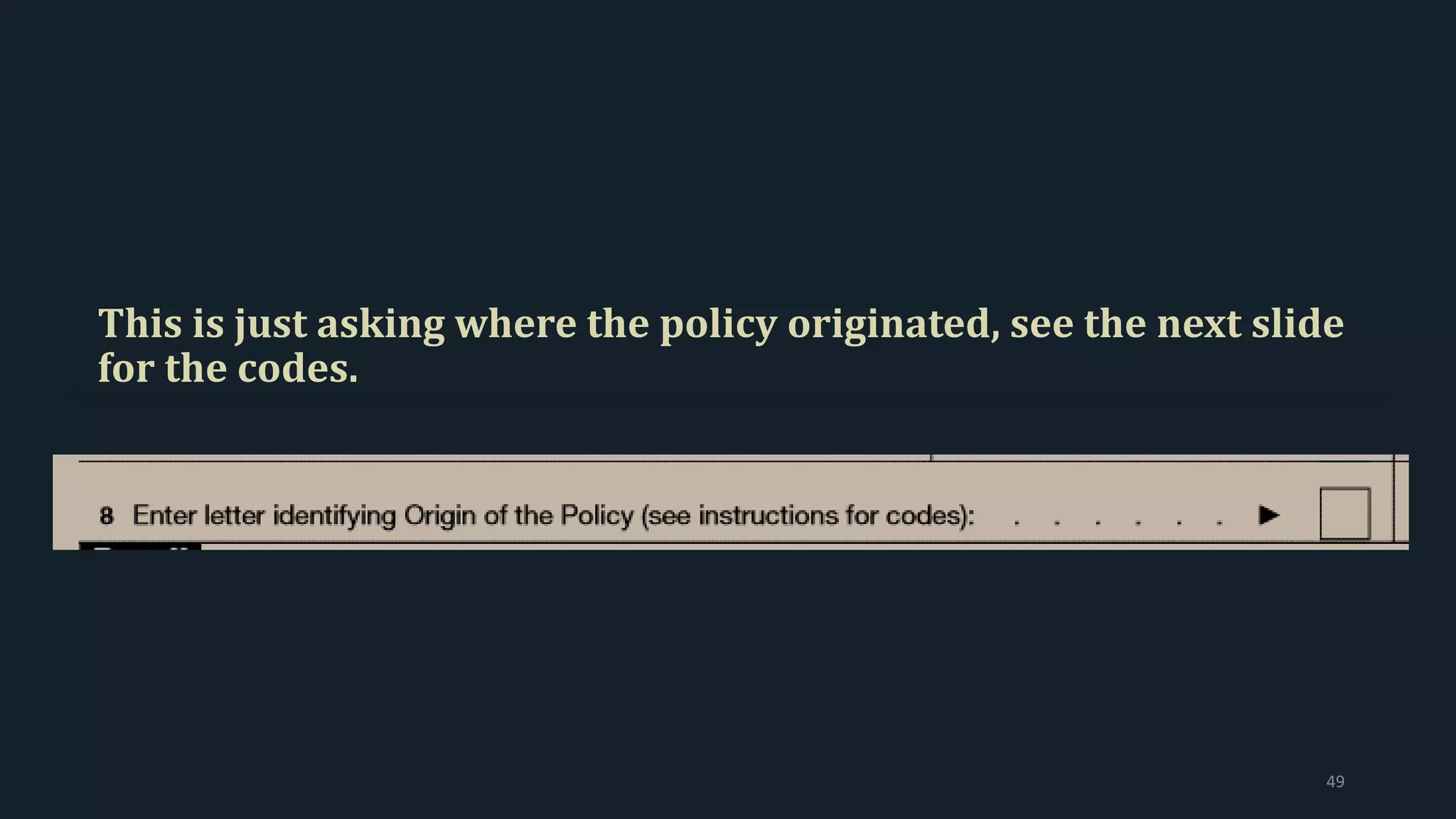
48
This is just asking where the policy originated, see the next slide
for the codes.
49
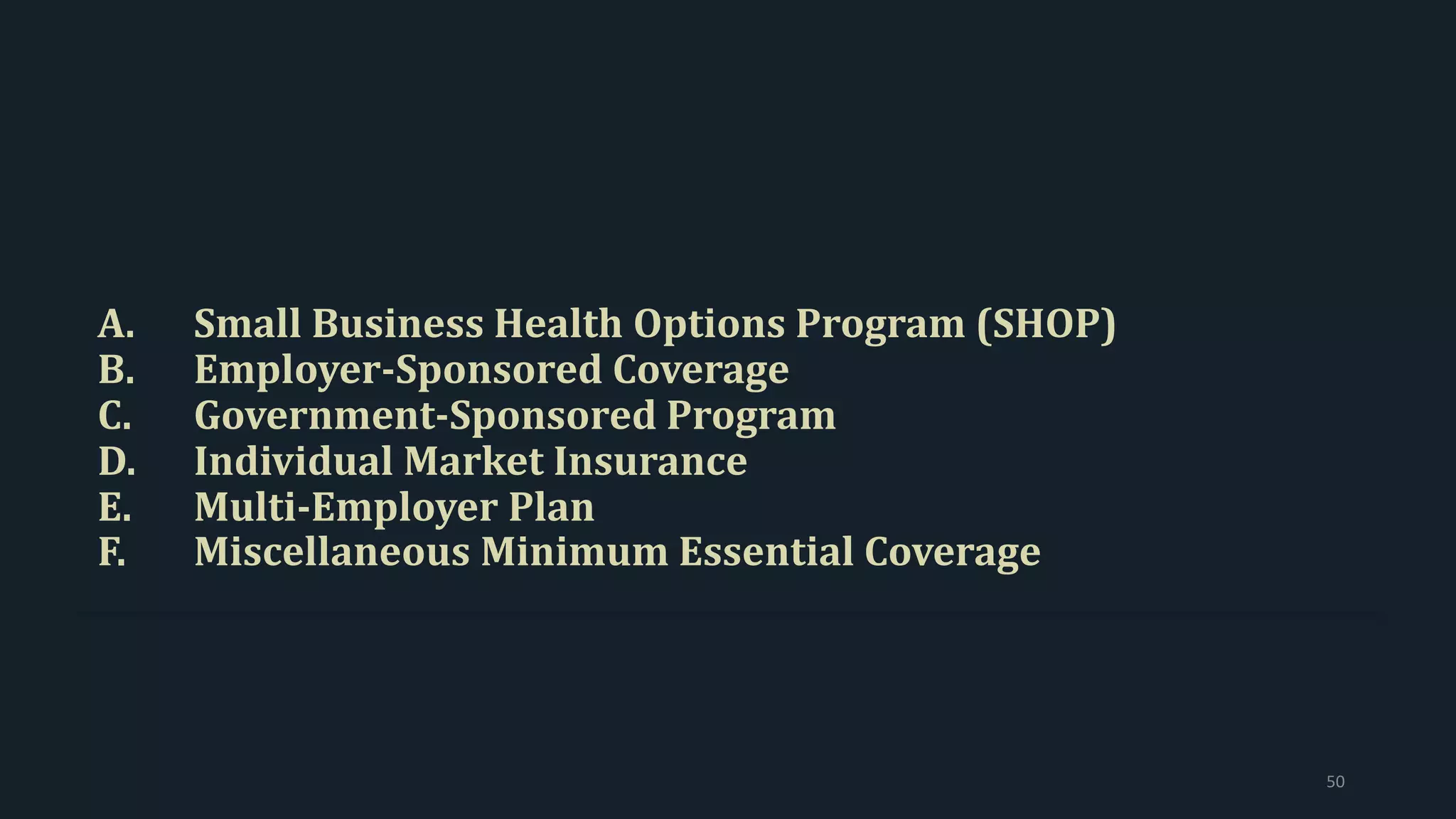
A. Small Business Health Options Program (SHOP)
B. Employer-Sponsored Coverage
C. Government-Sponsored Program
D. Individual Market Insurance
E. Multi-Employer Plan
F. Miscellaneous Minimum Essential Coverage
50
Dear IRS:
Cool list . . . What the heck do any of those six categories mean in
plain English?
Love,
Humankind
51
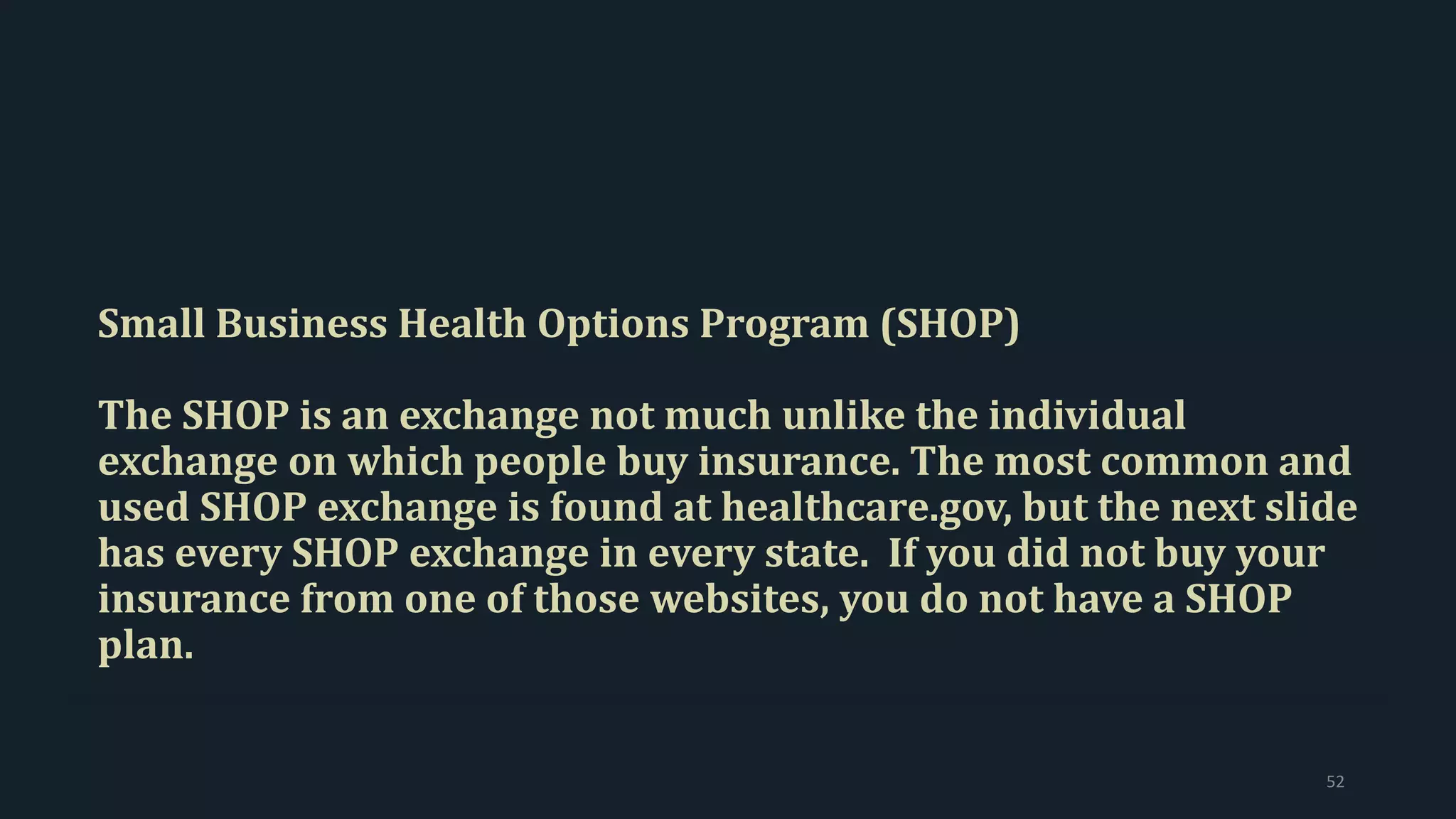
Small Business Health Options Program (SHOP)
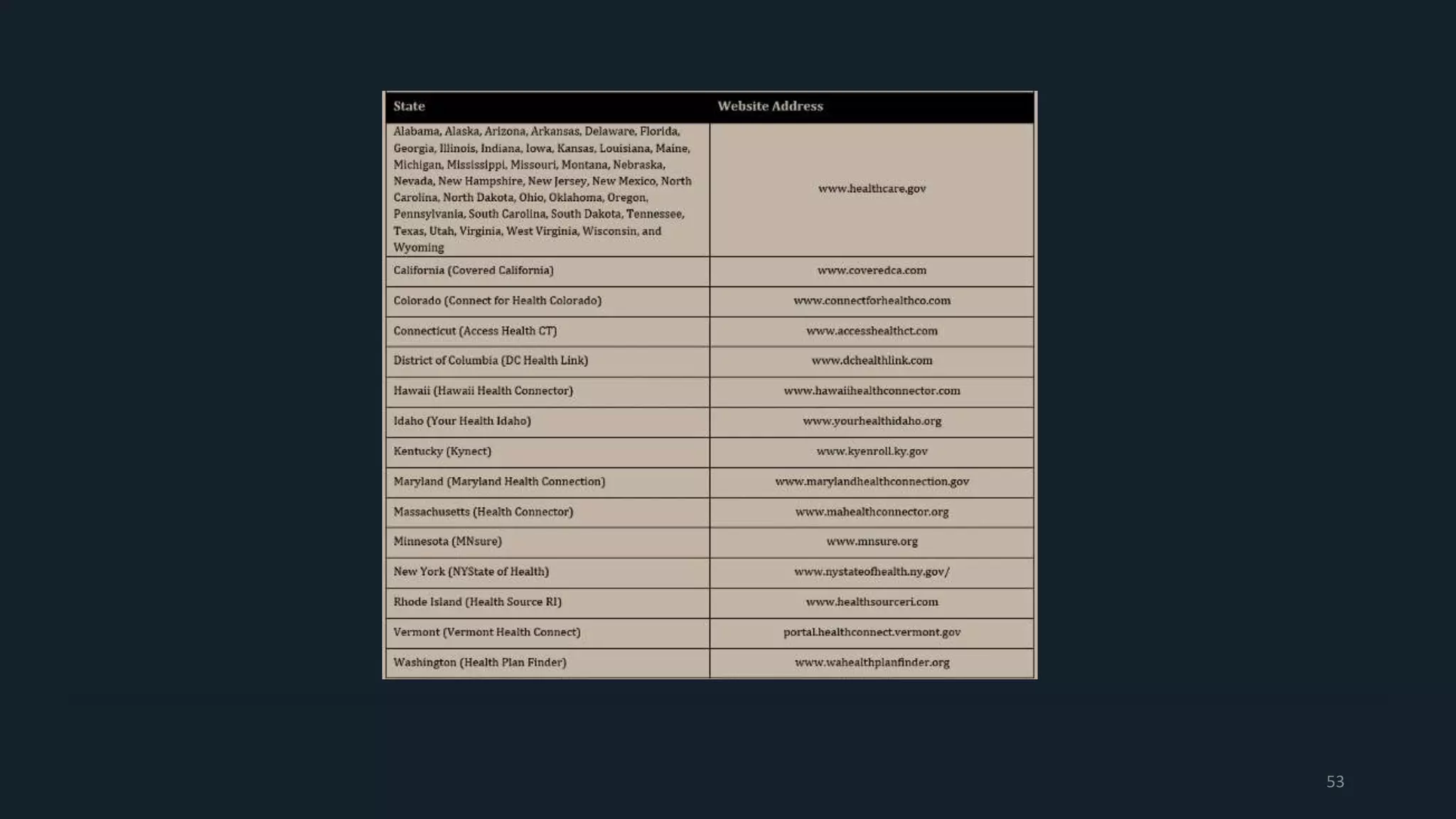
The SHOP is an exchange not much unlike the individual
exchange on which people buy insurance. The most common and
used SHOP exchange is found at healthcare.gov, but the next slide
has every SHOP exchange in every state. If you did not buy your
insurance from one of those websites, you do not have a SHOP
plan.
52
53
Employer-Sponsored Coverage
Any insurance coverage whereby the employer self-insures or
self-funds the insurance benefits provided to Employees qualifies
as Employer-Sponsored Coverage.
54
Government-Sponsored Coverage
Any insurance coverage whereby the provider is a government
entity. If you are not a government employer, this does not apply
to you.
55
Individual Market Insurance
This will typically be insurance sold through an individual
exchange or marketplace like www.healthcare.gov.
56
Multiemployer Plan
Are you a union providing healthcare to union members? No? Do
not worry about this then.
57
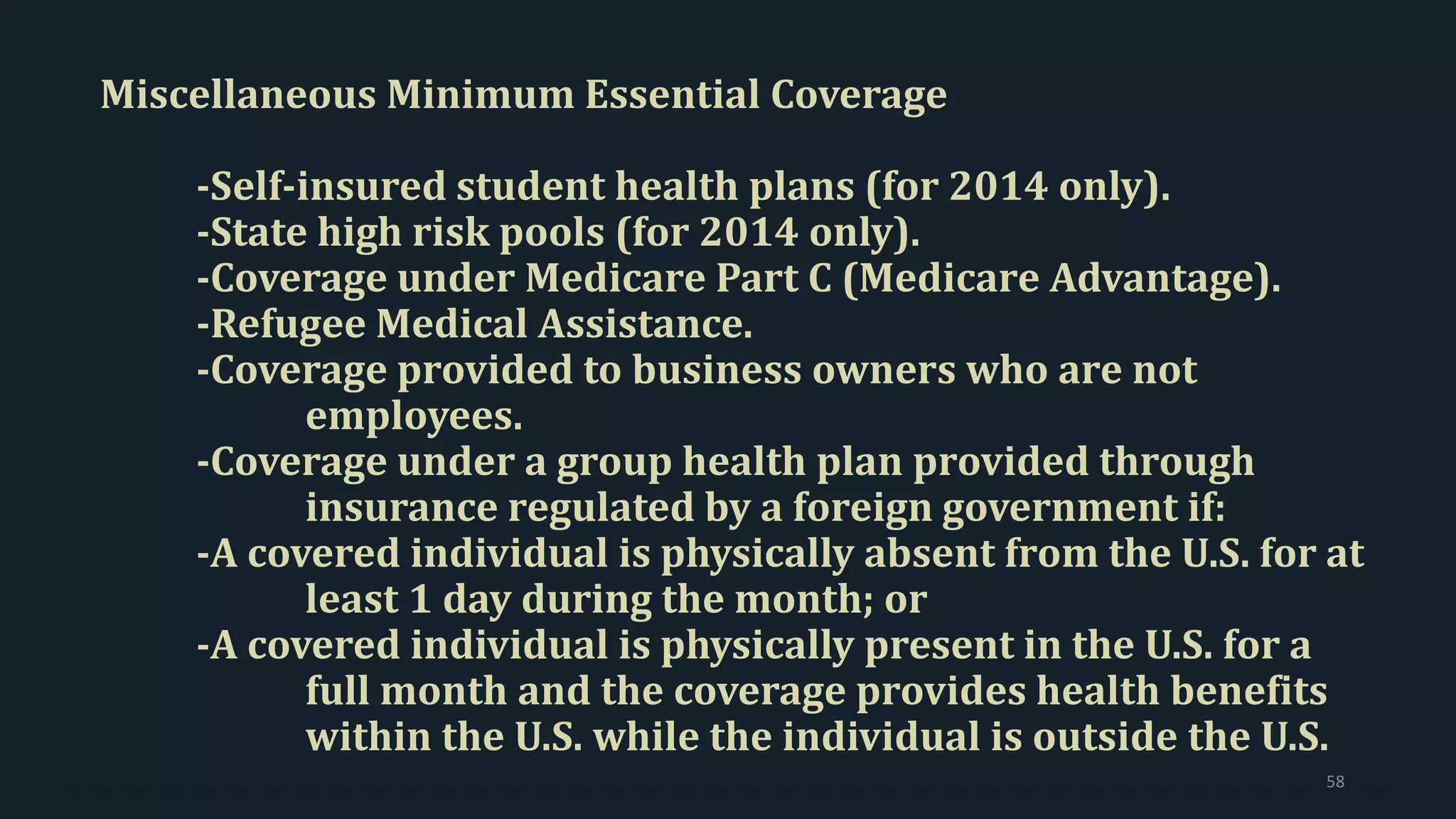
Miscellaneous Minimum Essential Coverage
-Self-insured student health plans (for 2014 only).
-State high risk pools (for 2014 only).
-Coverage under Medicare Part C (Medicare Advantage).
-Refugee Medical Assistance.
-Coverage provided to business owners who are not
employees.
-Coverage under a group health plan provided through
insurance regulated by a foreign government if:
-A covered individual is physically absent from the U.S. for at
least 1 day during the month; or
-A covered individual is physically present in the U.S. for a
full month and the coverage provides health benefits
within the U.S. while the individual is outside the U.S.
58
Spoiler Alert:
Most employers will complete Line 8 with “B” (Employer-
Sponsored Coverage), and the few that do not will probably enter
“A” (SHOP).
59
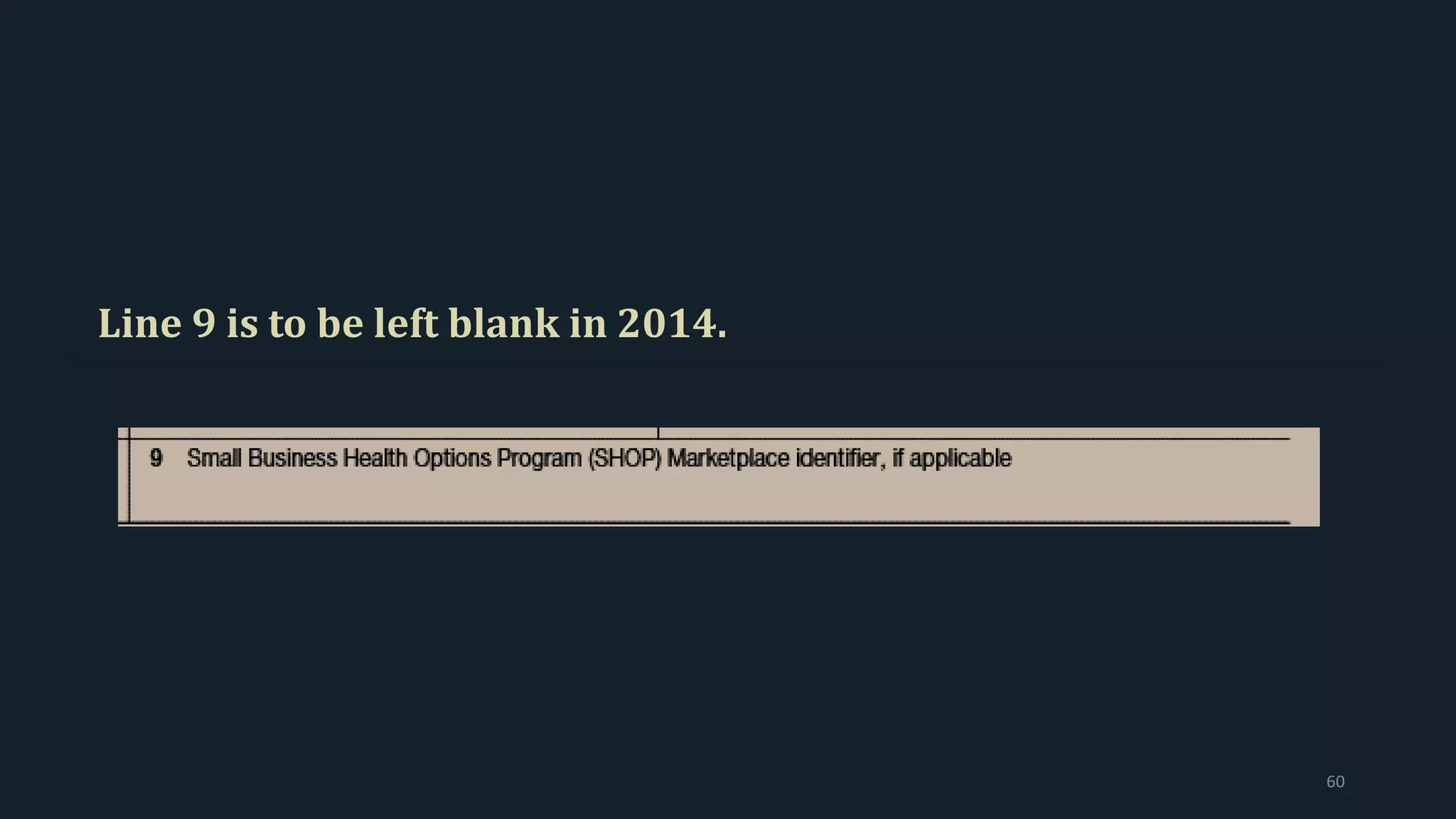
Line 9 is to be left blank in 2014.
60
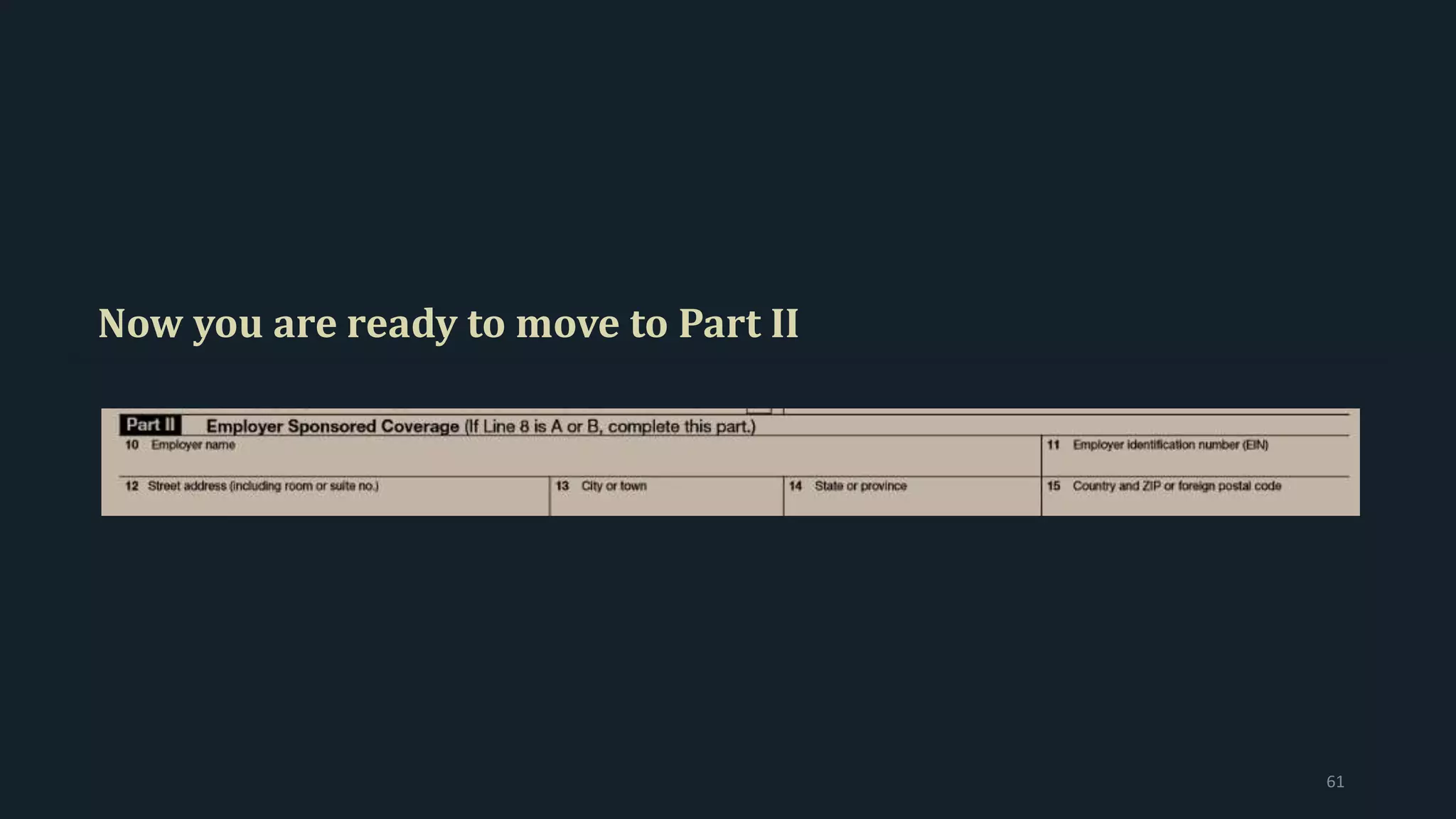
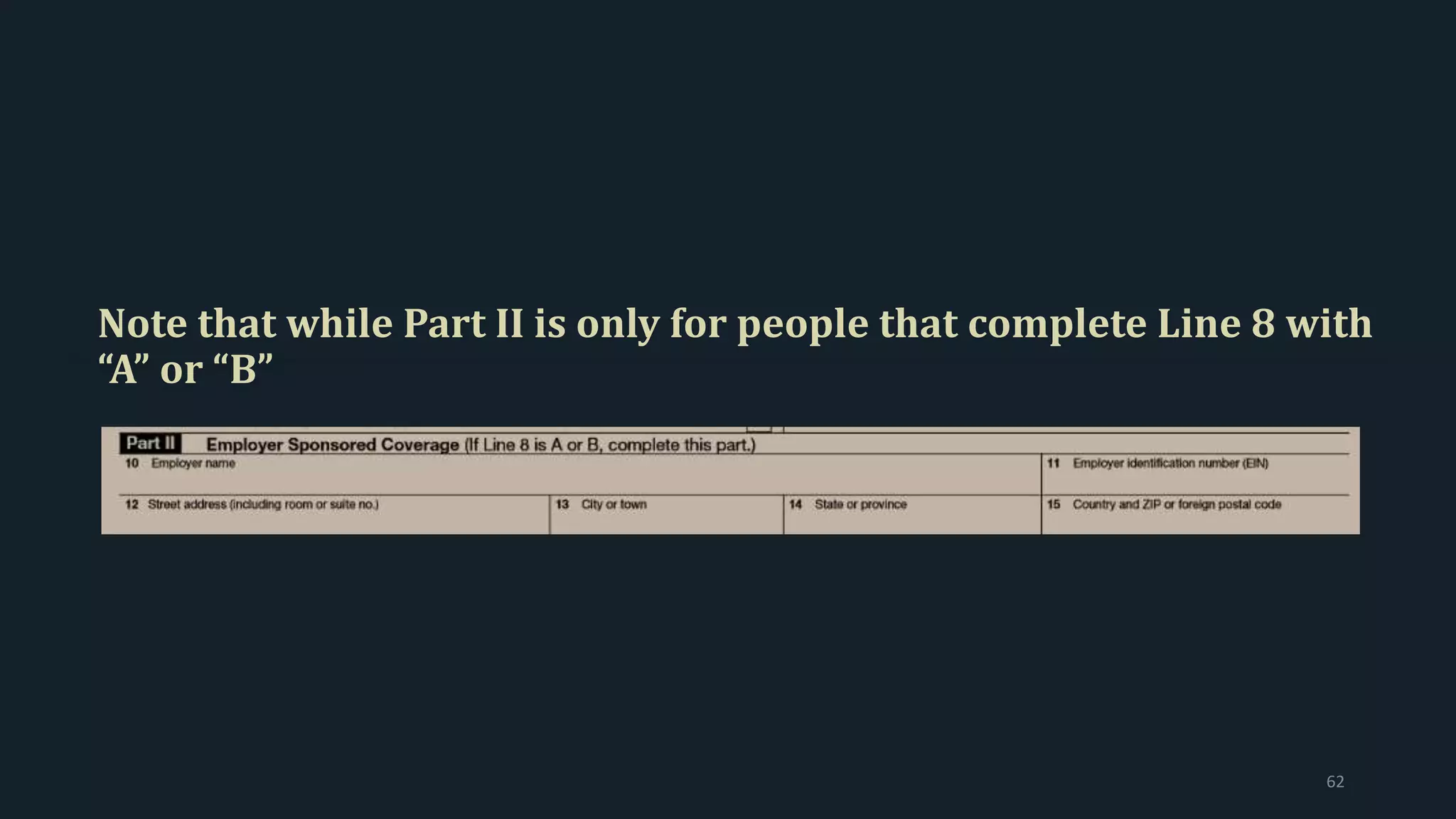
Now you are ready to move to Part II
61
Note that while Part II is only for people that complete Line 8 with
“A” or “B”
62
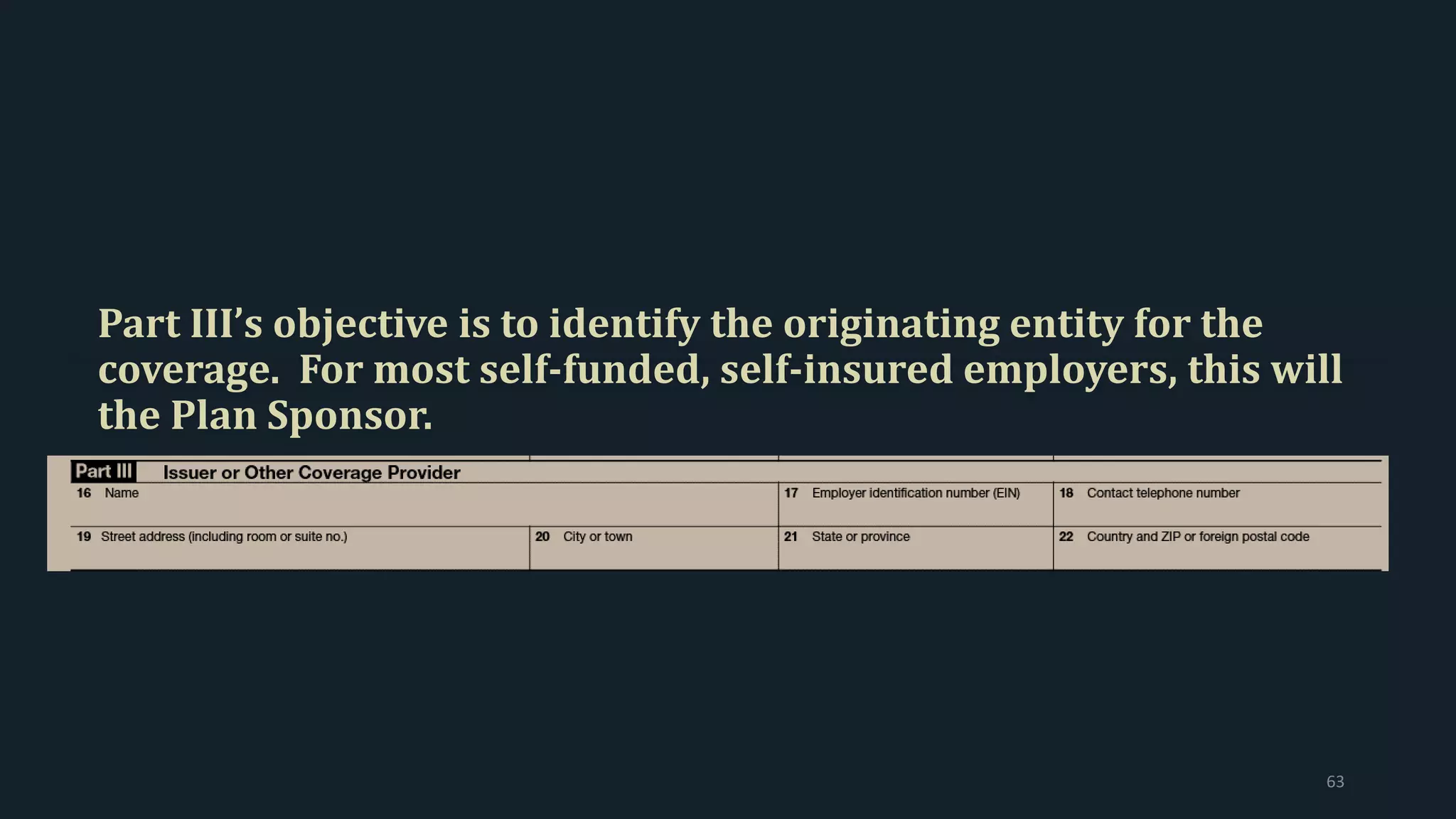
Part III’s objective is to identify the originating entity for the
coverage. For most self-funded, self-insured employers, this will
the Plan Sponsor.
63
Line 16:
This is the entity that is ultimately providing the insurance to the
individual in question. For self-insured employers, this will be
the Plan Sponsor’s information.
64
Line 17:
What do I do if I do not have an EIN? Can I use some other
number?
65
No. If you do not have an EIN number you need to go get one
because you cannot file this form without such a number.
66
Stop.
Investigate.
Then Come Back.
67
Welcome Back.
68
Line 18:
Whose contact information do I put on Line 18?
69
The contact information for the person that is comfortable
answering questions about the Plan Sponsor, not necessarily an
employer’s representative.
70
Line 19-22:
Just basic address information.
71
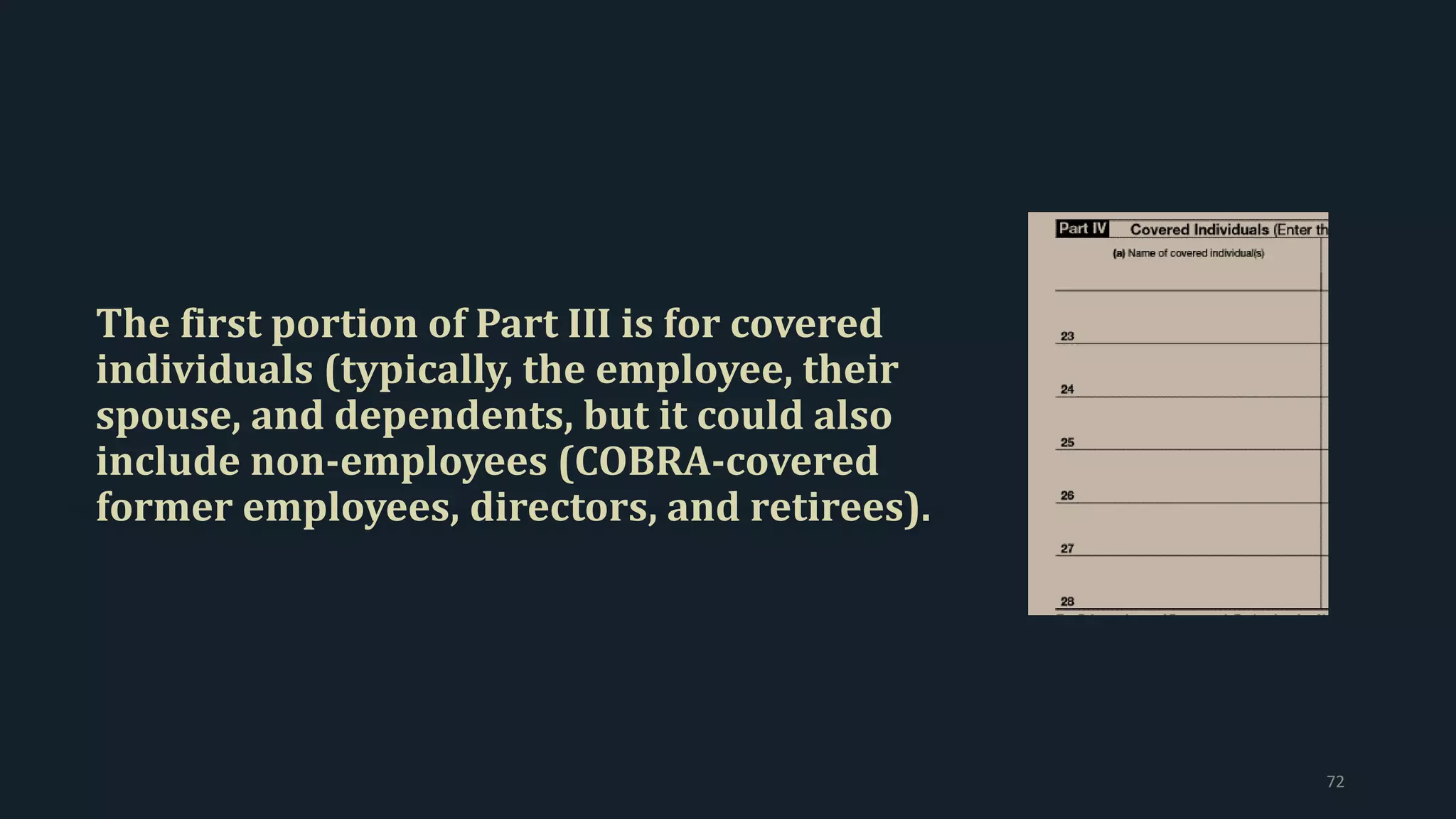
The first portion of Part III is for covered
individuals (typically, the employee, their
spouse, and dependents, but it could also
include non-employees (COBRA-covered
former employees, directors, and retirees).
72
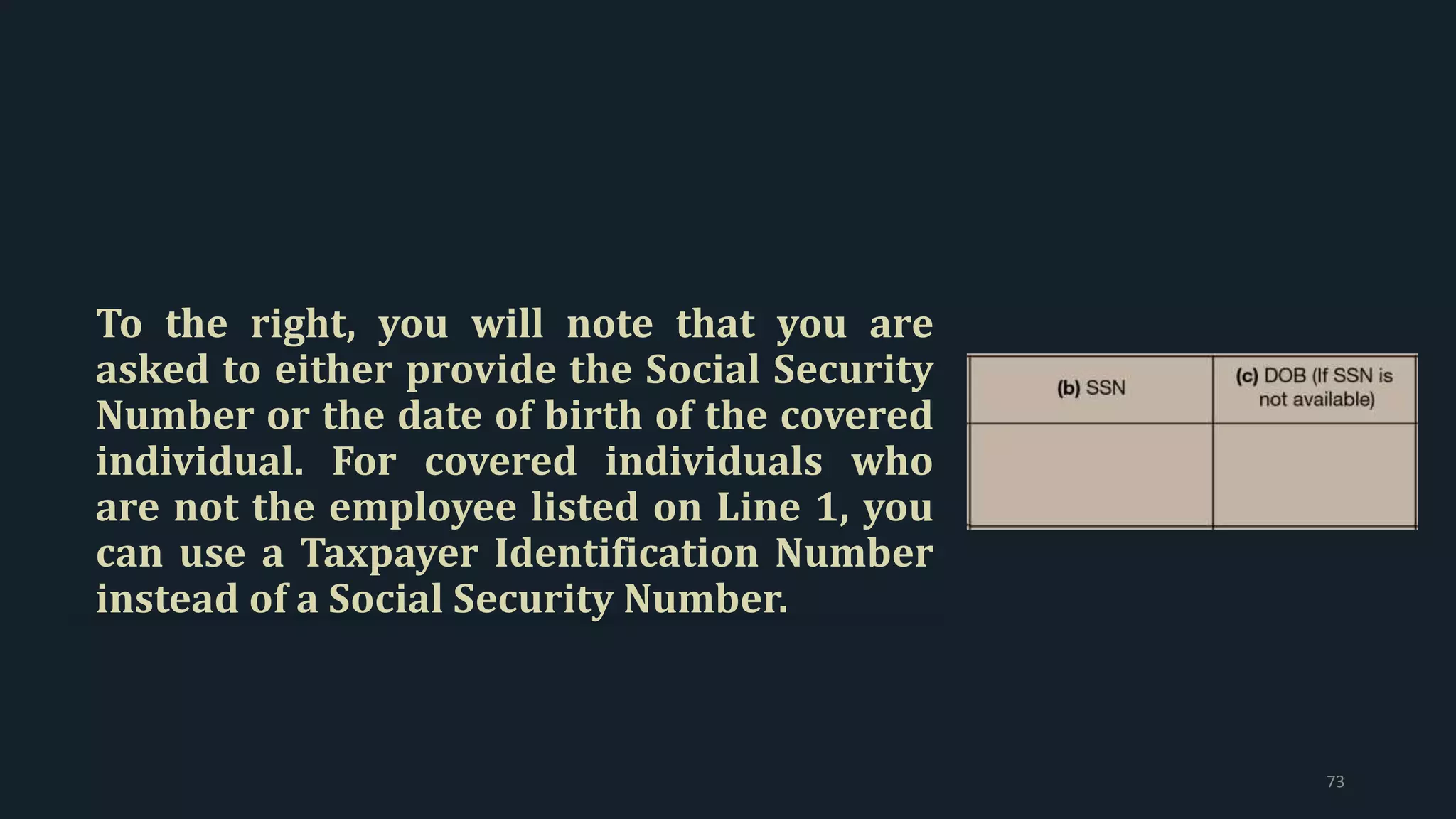
To the right, you will note that you are
asked to either provide the Social Security
Number or the date of birth of the covered
individual. For covered individuals who
are not the employee listed on Line 1, you
can use a Taxpayer Identification Number
instead of a Social Security Number.
73
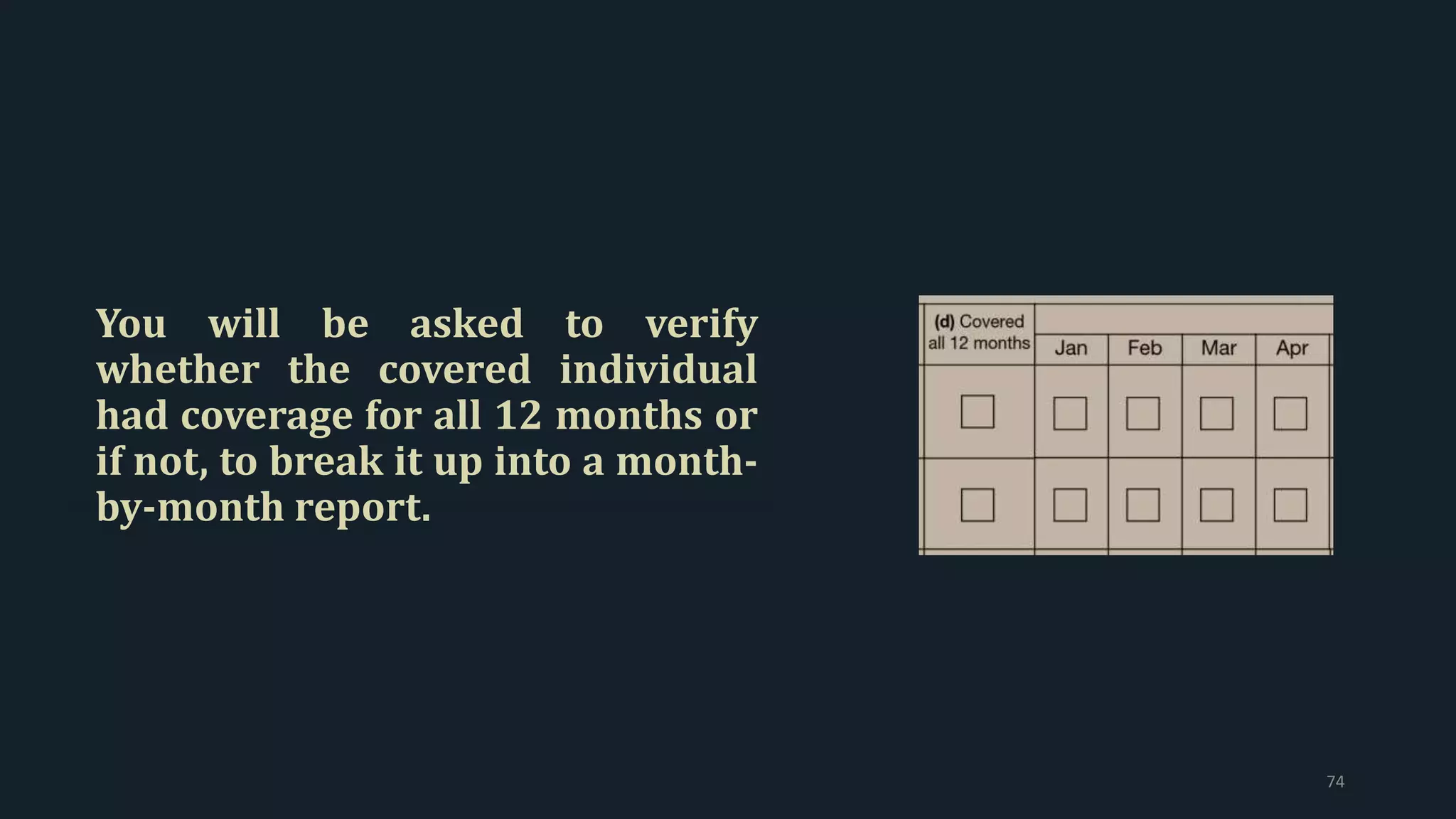
You will be asked to verify
whether the covered individual
had coverage for all 12 months or
if not, to break it up into a month-
by-month report.
74
That’s it for Form 1095-B
Note that of the New Reporting Requirement Forms for
Individuals, Form 1095-B is probably the easiest of the bunch.
75
Note that Form 1095-B goes to the responsible individuals
themselves (by January 31, 2016), but must also be sent
electronically to the IRS by March 31, 2016.
76
Form 1095-Bs must be accompanied by a corresponding
transmittal sheet (Form 1094-B). A transmittal sheet is a fancy
reference to a basic coversheet.
77
That’s right, Form 1094-B is a coversheet!
78
BEHOLD!
79
This is the name of the entity that is sending the Forms. This will
usually be the employer.
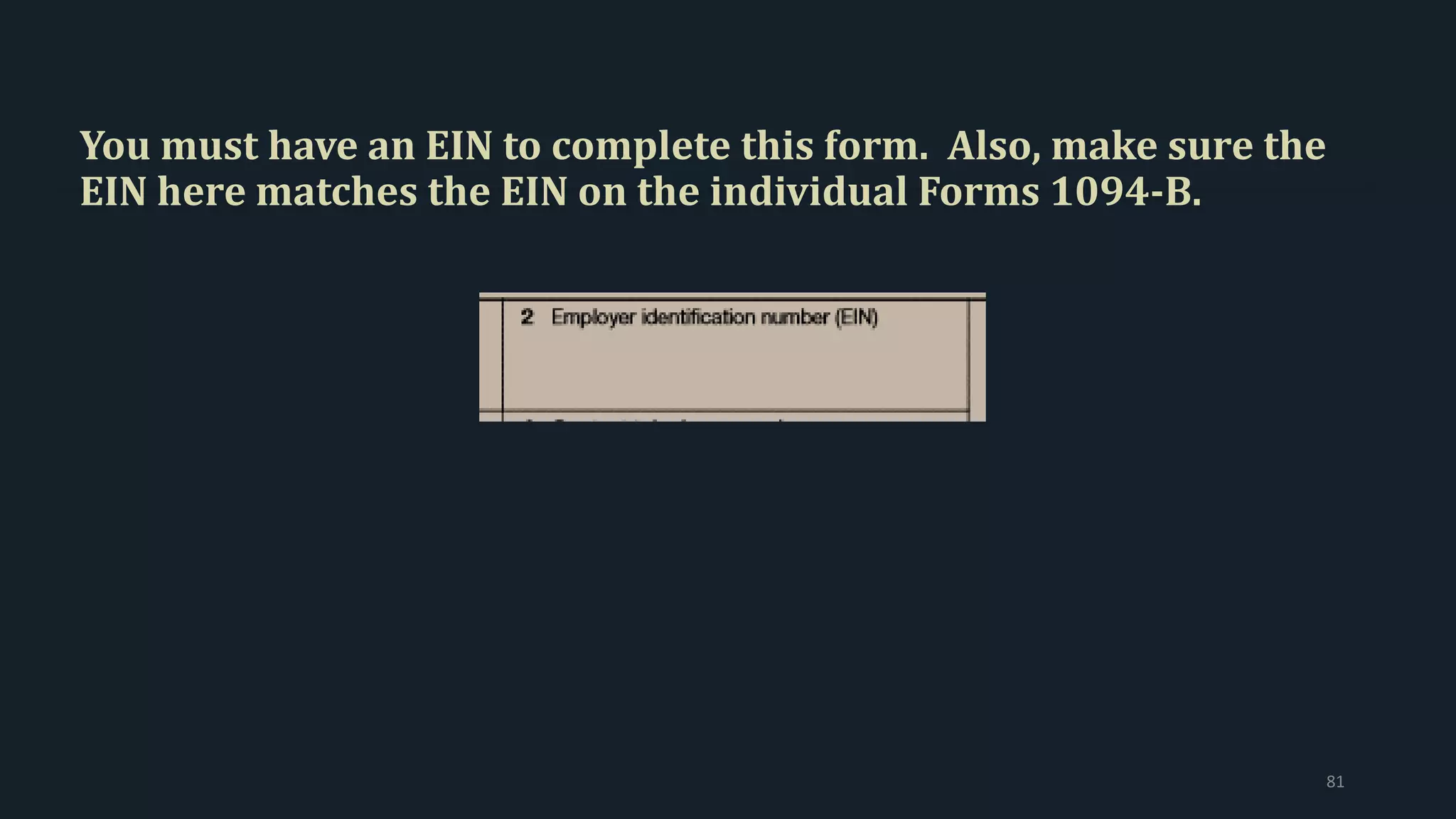
80
You must have an EIN to complete this form. Also, make sure the
EIN here matches the EIN on the individual Forms 1094-B.
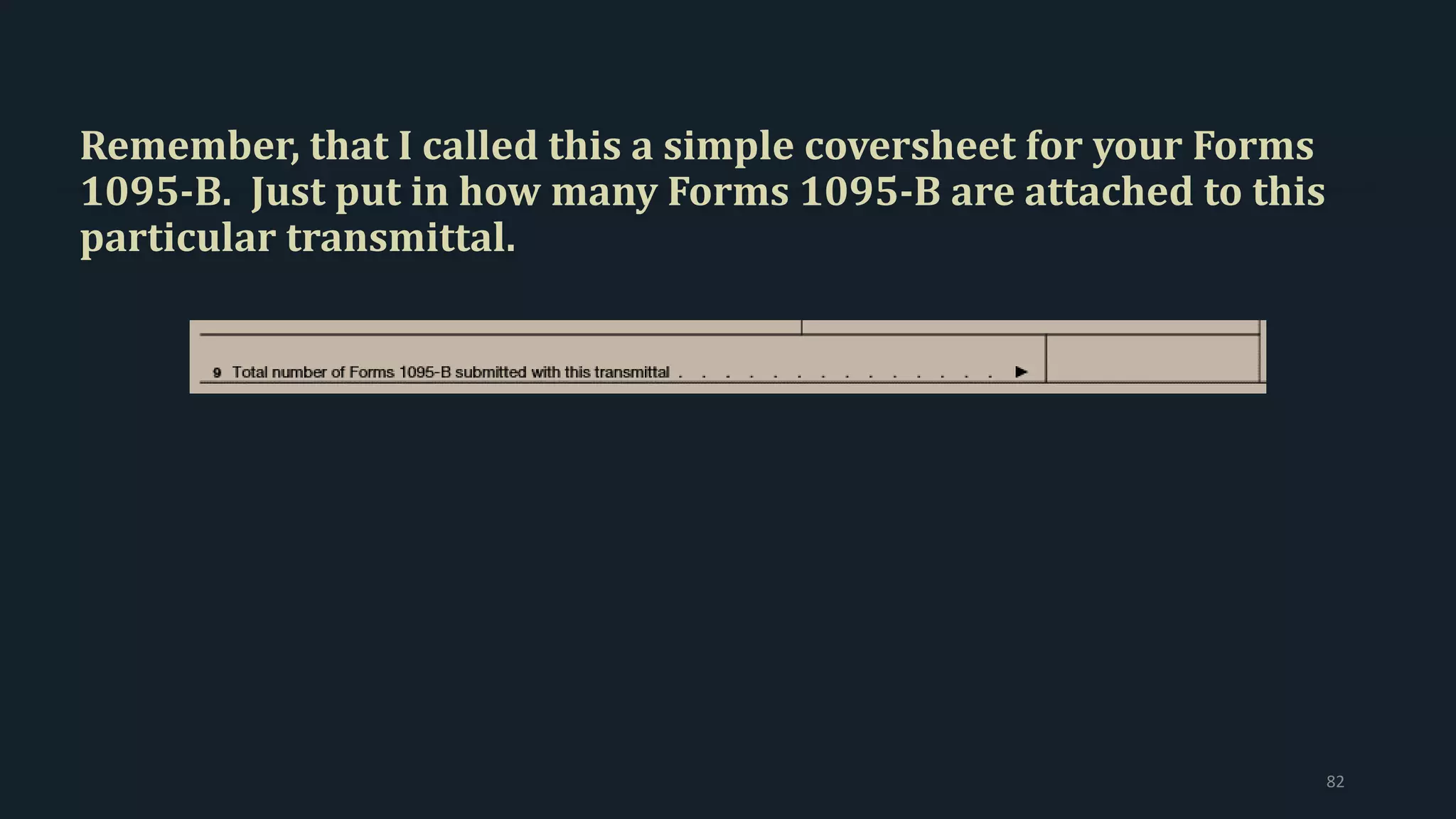
81
Remember, that I called this a simple coversheet for your Forms
1095-B. Just put in how many Forms 1095-B are attached to this
particular transmittal.
82
The End.
83
Note: I tried my best to ensure that these slides are as accurate
and informative as possible. If I made a mistake, please send
corrections to my email address which appears on the last slide.
84
Extra credit for those folks that send corrections with supporting
authority.
85
Thanks for sitting through this slide deck.
86
These slides have received thousands of views. I have also
received many emails from folks thanking me for putting them up
online (you’re welcome!).
These slides are supplementary materials to the third edition of
my book, The Employer Mandate Handbook. If you benefited
from these slides, please consider purchasing the book that led to
their creation while helping me pay off my massive student loans.
87
ABOUT MARIO. Mario K. Castillo is the General Counsel of the Lone Star College System in Houston, Texas. Prior to
joining the System, he was a labor, employment, and benefits partner at the law firm of Monty & Ramirez LLP in
Houston, Texas, where he helped employers avoid or minimize liability and defended them when litigation was
necessary. Mario also completed a four-year term as briefing attorney to the Honorable Felix Recio of the Southern
District of Texas prior to joining Monty & Ramirez. Mario received a Juris Doctorate from the Maurer School of Law at
Indiana University—Bloomington. Prior to attending law school, Mario received a Bachelor of Arts in Government
from the University of Texas in Austin.
DISCLAIMER. This presentation is for informational purposes only and provides general information concerning
the Affordable Care Act to help you identify when you may need additional advice. It is not an exhaustive treatment of
the statutes, case law or regulations that are involved with the subject. Please recognize that the law is developing
rapidly in this area and you will want to obtain current legal advice on your specific situation before taking action.
88
Comments and questions should be sent to me via email at the
following email address: Mario.K.Castillo@lonestar.edu
Copyright © 2015. All Rights Reserved.
89

1094-B & 1095-B: Reporting Requirements: A Step-by-Step Guide

  • 1.
    The Affordable CareActReporting Requirements: A Step-by-Step Guide to Forms 1095-B and 1094-B 1
  • 2.
    These slides werelast updated on August 7, 2015. 2
  • 3.
    First things first,this is not a basic guide. 3
  • 4.
    This guide assumesyou know how the Employer Mandate basically works under the Affordable Care Act. 4
  • 5.
    Which brings meto a very important point. The reporting requirements are their own separate, free-standing requirement under the Affordable Care Act. 5
  • 6.
    You might beasking yourself what makes me an authority on the subject. 6
  • 7.
    That is agreat question and a question that does not get asked enough by people researching the ACA. 7
  • 8.
    I’ve helped hundredsof employers since the Affordable Care Act was signed on March 23, 2010. 8
  • 9.
    I’ve written scholarlyarticles for peer-reviewed legal journals on the Affordable Care Act. 9
  • 10.
    I’ve written threeeditions of a comprehensive guide on the Affordable Care Act called The Employer Mandate Handbook. The third edition will be out in mid-August 2015. 10
  • 11.
    When I wrotemy articles and books, I tried to cite as many as my claims as possible. 11
  • 12.
    I have spentyears working on this stuff every day. 12
  • 13.
    I have beenquoted in the Houston Chronicle, Forbes, and have been interviewed by the New York Times. 13
  • 14.
    But even afterall of that, I don’t know everything, and you should run (very fast) from anyone that claims they do. 14
  • 15.
    What I doknow is that as far as these reporting requirements are concerned, it is irrelevant how many employees you had during 2015. All that matters here is whether your medical benefits were self-insured. 15
  • 16.
    Again, the onlything that matters is whether you are self-funding or self-insuring your employees’ health insurance. 16
  • 17.
    If you donot know the answer to the last slide . . . 17
  • 18.
  • 19.
  • 20.
    If you madeit to this point, I am assuming you are self-insured or self-funded. If you are neither, please leave. 20
  • 21.
    Otherwise, you mightbe wondering what is the ultimate goal of all of this reporting. 21
  • 22.
  • 23.
    Under the IndividualMandate, the IRS has to identify which Americans have medical benefits and which do not. Those that do not, and don’t have an authorized excuse, will pay a financial penalty. 23
  • 24.
    Incredibly, the IRSis not just going to take people’s word for it. They want proof that non-exempt people had insurance when they claim they have it to avoid paying individual mandate penalties. 24
  • 25.
    Under the EmployerMandate, the IRS has to identify whether Applicable Large Employer Members offered insurance, or the right kind of insurance, to full-time employees in assessing financial penalties for those employers. 25
  • 26.
    This is whereForm 1095-B comes in. 26
  • 27.
    Form 1095-B isthe proof against which individual claims will be verified. 27
  • 28.
    For example, LenniferJopez works for Remix Inc. Remix Inc. offers Lennifer self-insured, self-funded benefits during 2014. In April 2015, when Lennifer is completing her personal income taxes, she gets to the line that asks her if she had insurance during 2014. Lennifer claims to have insurance in 2014. 28
  • 29.
    The IRS hasno way of verifying Lennifer’s claim. Because there is no insurance company to ask (because Remix is a self-insured, self-funded employer), the IRS has to get a report from Remix verifying Lennifer’s coverage. 29
  • 30.
    That is theentire point of Form 1095-B 30
  • 31.
    You can downloadForm 1095-B directly from the IRS here: Form 1095-B 31
  • 32.
    Always ensure youhave the most up-to-date form by going straight to the IRS website. Try to avoid the common pitfall of printing 100 of them, putting them in a drawer, and then pulling them from the drawer. Sooner or later, you will have outdated forms if you do it this way. 32
  • 33.
    Ensure you havethe correct form by checking the top-left corner of the form in front of you. 33
  • 34.
    It should looklike this: 34
  • 35.
    And it shouldlook like this: 35
  • 36.
    What the heckis this? : 36
  • 37.
    If you makea mistake and want to correct it by sending in a subsequent corrected form, you would check the “corrected” box. If for some reason you want to null and void a form, you can check that too. 37
  • 38.
    Next, ensure youhave the correct yearly form. 38
  • 39.
    The most currentone looks like this on the top-right corner: 39
  • 40.
    Mario, that says2014?!?! 40
  • 41.
    That is themost current form. This is why it is important to ensure you have the right form every time you sit down. As of July 24, 2015, that is the most current form. 41
  • 42.
    We checked theform number. We checked the form name. We checked the year. 42
  • 43.
    Now we canget to the heart of the matter. 43
  • 44.
    Part I, shownbelow, identifies the covered individual and some particulars about the health insurance policy involved. 44
  • 45.
    The responsible individualreferenced here is not the employer; it is the covered individual (usually an employee, like Lennifer earlier). Do not put the company’s name here. 45
  • 46.
    The responsible individual’sSSN goes here. If you do not have a social security number for this individual, you must complete Line 3’s date-of-birth requirement. 46
  • 47.
    The important thingto keep an eye on for Line 3 is that it’s not required if you completed Line 2. 47
  • 48.
    Remember, this iswhere the individual lives, not where the company is located, or where the individual works, etc. 48
  • 49.
    This is justasking where the policy originated, see the next slide for the codes. 49
  • 50.
    A. Small BusinessHealth Options Program (SHOP) B. Employer-Sponsored Coverage C. Government-Sponsored Program D. Individual Market Insurance E. Multi-Employer Plan F. Miscellaneous Minimum Essential Coverage 50
  • 51.
    Dear IRS: Cool list. . . What the heck do any of those six categories mean in plain English? Love, Humankind 51
  • 52.
    Small Business HealthOptions Program (SHOP) The SHOP is an exchange not much unlike the individual exchange on which people buy insurance. The most common and used SHOP exchange is found at healthcare.gov, but the next slide has every SHOP exchange in every state. If you did not buy your insurance from one of those websites, you do not have a SHOP plan. 52
  • 53.
  • 54.
    Employer-Sponsored Coverage Any insurancecoverage whereby the employer self-insures or self-funds the insurance benefits provided to Employees qualifies as Employer-Sponsored Coverage. 54
  • 55.
    Government-Sponsored Coverage Any insurancecoverage whereby the provider is a government entity. If you are not a government employer, this does not apply to you. 55
  • 56.
    Individual Market Insurance Thiswill typically be insurance sold through an individual exchange or marketplace like www.healthcare.gov. 56
  • 57.
    Multiemployer Plan Are youa union providing healthcare to union members? No? Do not worry about this then. 57
  • 58.
    Miscellaneous Minimum EssentialCoverage -Self-insured student health plans (for 2014 only). -State high risk pools (for 2014 only). -Coverage under Medicare Part C (Medicare Advantage). -Refugee Medical Assistance. -Coverage provided to business owners who are not employees. -Coverage under a group health plan provided through insurance regulated by a foreign government if: -A covered individual is physically absent from the U.S. for at least 1 day during the month; or -A covered individual is physically present in the U.S. for a full month and the coverage provides health benefits within the U.S. while the individual is outside the U.S. 58
  • 59.
    Spoiler Alert: Most employerswill complete Line 8 with “B” (Employer- Sponsored Coverage), and the few that do not will probably enter “A” (SHOP). 59
  • 60.
    Line 9 isto be left blank in 2014. 60
  • 61.
    Now you areready to move to Part II 61
  • 62.
    Note that whilePart II is only for people that complete Line 8 with “A” or “B” 62
  • 63.
    Part III’s objectiveis to identify the originating entity for the coverage. For most self-funded, self-insured employers, this will the Plan Sponsor. 63
  • 64.
    Line 16: This isthe entity that is ultimately providing the insurance to the individual in question. For self-insured employers, this will be the Plan Sponsor’s information. 64
  • 65.
    Line 17: What doI do if I do not have an EIN? Can I use some other number? 65
  • 66.
    No. If youdo not have an EIN number you need to go get one because you cannot file this form without such a number. 66
  • 67.
  • 68.
  • 69.
    Line 18: Whose contactinformation do I put on Line 18? 69
  • 70.
    The contact informationfor the person that is comfortable answering questions about the Plan Sponsor, not necessarily an employer’s representative. 70
  • 71.
    Line 19-22: Just basicaddress information. 71
  • 72.
    The first portionof Part III is for covered individuals (typically, the employee, their spouse, and dependents, but it could also include non-employees (COBRA-covered former employees, directors, and retirees). 72
  • 73.
    To the right,you will note that you are asked to either provide the Social Security Number or the date of birth of the covered individual. For covered individuals who are not the employee listed on Line 1, you can use a Taxpayer Identification Number instead of a Social Security Number. 73
  • 74.
    You will beasked to verify whether the covered individual had coverage for all 12 months or if not, to break it up into a month- by-month report. 74
  • 75.
    That’s it forForm 1095-B Note that of the New Reporting Requirement Forms for Individuals, Form 1095-B is probably the easiest of the bunch. 75
  • 76.
    Note that Form1095-B goes to the responsible individuals themselves (by January 31, 2016), but must also be sent electronically to the IRS by March 31, 2016. 76
  • 77.
    Form 1095-Bs mustbe accompanied by a corresponding transmittal sheet (Form 1094-B). A transmittal sheet is a fancy reference to a basic coversheet. 77
  • 78.
    That’s right, Form1094-B is a coversheet! 78
  • 79.
  • 80.
    This is thename of the entity that is sending the Forms. This will usually be the employer. 80
  • 81.
    You must havean EIN to complete this form. Also, make sure the EIN here matches the EIN on the individual Forms 1094-B. 81
  • 82.
    Remember, that Icalled this a simple coversheet for your Forms 1095-B. Just put in how many Forms 1095-B are attached to this particular transmittal. 82
  • 83.
  • 84.
    Note: I triedmy best to ensure that these slides are as accurate and informative as possible. If I made a mistake, please send corrections to my email address which appears on the last slide. 84
  • 85.
    Extra credit forthose folks that send corrections with supporting authority. 85
  • 86.
    Thanks for sittingthrough this slide deck. 86
  • 87.
    These slides havereceived thousands of views. I have also received many emails from folks thanking me for putting them up online (you’re welcome!). These slides are supplementary materials to the third edition of my book, The Employer Mandate Handbook. If you benefited from these slides, please consider purchasing the book that led to their creation while helping me pay off my massive student loans. 87
  • 88.
    ABOUT MARIO. MarioK. Castillo is the General Counsel of the Lone Star College System in Houston, Texas. Prior to joining the System, he was a labor, employment, and benefits partner at the law firm of Monty & Ramirez LLP in Houston, Texas, where he helped employers avoid or minimize liability and defended them when litigation was necessary. Mario also completed a four-year term as briefing attorney to the Honorable Felix Recio of the Southern District of Texas prior to joining Monty & Ramirez. Mario received a Juris Doctorate from the Maurer School of Law at Indiana University—Bloomington. Prior to attending law school, Mario received a Bachelor of Arts in Government from the University of Texas in Austin. DISCLAIMER. This presentation is for informational purposes only and provides general information concerning the Affordable Care Act to help you identify when you may need additional advice. It is not an exhaustive treatment of the statutes, case law or regulations that are involved with the subject. Please recognize that the law is developing rapidly in this area and you will want to obtain current legal advice on your specific situation before taking action. 88
  • 89.
    Comments and questionsshould be sent to me via email at the following email address: Mario.K.Castillo@lonestar.edu Copyright © 2015. All Rights Reserved. 89