ACA 6055/6056 Reporting Requirements
Webinar
SterlingRisk – Employee Benefits
Stacy Barrow – Proskauer
Hosted by:
Presented by:
February 11, 2015
ACA Update and Tackling the ACA’s
Reporting Requirements
© 2015 Proskauer. All Rights Reserved.
SterlingRisk
Stacy H. Barrow
(617) 526-9648
sbarrow@proskauer.com
Agenda
• Recent Developments
• ACA Reporting Requirements
3 © 2015 Proskauer. All Rights Reserved.
4
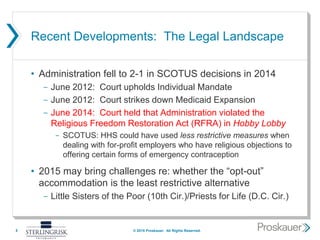
Recent Developments: The Legal Landscape
• Administration fell to 2-1 in SCOTUS decisions in 2014
- June 2012: Court upholds Individual Mandate
- June 2012: Court strikes down Medicaid Expansion
- June 2014: Court held that Administration violated the
Religious Freedom Restoration Act (RFRA) in Hobby Lobby
- SCOTUS: HHS could have used less restrictive measures when
dealing with for-profit employers who have religious objections to
offering certain forms of emergency contraception
• 2015 may bring challenges re: whether the “opt-out”
accommodation is the least restrictive alternative
- Little Sisters of the Poor (10th Cir.)/Priests for Life (D.C. Cir.)
5 © 2015 Proskauer. All Rights Reserved.
Recent Developments: The Legal Landscape
• SCOTUS will hear King v. Burwell in 2015
• Issue: Does ACA provide for subsidies in states with a
federal Exchange?
• On its face, the ACA only provides subsidies for insurance
purchased in state Exchanges
- Majority of states have federal Exchanges
• This case can go either way
- Does the Administration want to chance going down 3-1?
- Will the Administration and Congress work together to fashion
a legislative fix?
6 © 2015 Proskauer. All Rights Reserved.
Recent Developments: EEOC & Health Risk
Assessments
• Wellness is an important component of ACA
• Someone neglected to tell the EEOC
• DOL has blessed conditioning eligibility and amount of
premium on completion of Health Risk Assessment (HRA),
as long as not results-oriented
• EEOC sees involuntary HRA requirement as violation of
ADA
• Three High Profile Cases Filed in 2014
• Will 2015 See More?
• Will Seff v. Broward County help?
7 © 2015 Proskauer. All Rights Reserved.
Recent Developments: Employer “Opt-Out
Credit”
• On 11/6/14 the Federal Regulators released FAQ XXII:
Reiterates position on “premium reimbursement” and states
that arrangements where employers pay an employee more
to drop or not take coverage violates ERISA
• Focus was on high claims targeting strategy
• Impact is greater:
• Service Contract Act employers who offer cash in lieu of
benefits (based on rates in SCA contract)
• Employment contracts in which employees opt out for higher
pay
8 © 2015 Proskauer. All Rights Reserved.
Recent Developments: Wellness Programs
• Wellness Programs: Employers may treat all employees
as non-smokers for “affordability” purposes
• For example, if an employer charges tobacco users $150
per month and non-tobacco users $100 per month, then
$100 is the required employee contribution for affordability
purposes, even if some employees pay $150
9 © 2015 Proskauer. All Rights Reserved.
10
ACA Employer and Provider Reporting
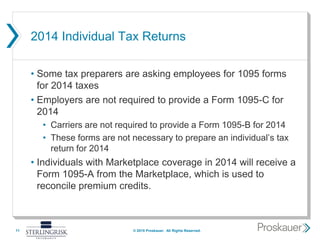
2014 Individual Tax Returns
• Some tax preparers are asking employees for 1095 forms
for 2014 taxes
• Employers are not required to provide a Form 1095-C for
2014
• Carriers are not required to provide a Form 1095-B for 2014
• These forms are not necessary to prepare an individual’s tax
return for 2014
• Individuals with Marketplace coverage in 2014 will receive a
Form 1095-A from the Marketplace, which is used to
reconcile premium credits.
11 © 2015 Proskauer. All Rights Reserved.
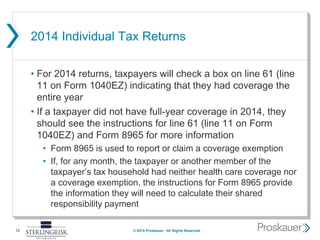
2014 Individual Tax Returns
• For 2014 returns, taxpayers will check a box on line 61 (line
11 on Form 1040EZ) indicating that they had coverage the
entire year
• If a taxpayer did not have full-year coverage in 2014, they
should see the instructions for line 61 (line 11 on Form
1040EZ) and Form 8965 for more information
• Form 8965 is used to report or claim a coverage exemption
• If, for any month, the taxpayer or another member of the
taxpayer’s tax household had neither health care coverage nor
a coverage exemption, the instructions for Form 8965 provide
the information they will need to calculate their shared
responsibility payment
12 © 2015 Proskauer. All Rights Reserved.
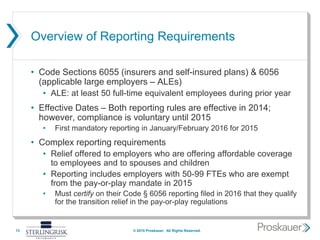
Overview of Reporting Requirements
• Code Sections 6055 (insurers and self-insured plans) & 6056
(applicable large employers – ALEs)
• ALE: at least 50 full-time equivalent employees during prior year
• Effective Dates – Both reporting rules are effective in 2014;
however, compliance is voluntary until 2015
• First mandatory reporting in January/February 2016 for 2015
• Complex reporting requirements
• Relief offered to employers who are offering affordable coverage
to employees and to spouses and children
• Reporting includes employers with 50-99 FTEs who are exempt
from the pay-or-play mandate in 2015
• Must certify on their Code § 6056 reporting filed in 2016 that they qualify
for the transition relief in the pay-or-play regulations
13 © 2015 Proskauer. All Rights Reserved.
Overview of Reporting Requirements
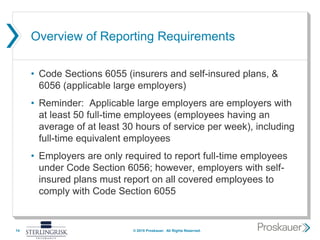
• Code Sections 6055 (insurers and self-insured plans, &
6056 (applicable large employers)
• Reminder: Applicable large employers are employers with
at least 50 full-time employees (employees having an
average of at least 30 hours of service per week), including
full-time equivalent employees
• Employers are only required to report full-time employees
under Code Section 6056; however, employers with self-
insured plans must report on all covered employees to
comply with Code Section 6055
14 © 2015 Proskauer. All Rights Reserved.
Overview of Reporting Requirements
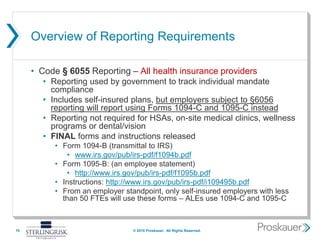
• Code § 6055 Reporting – All health insurance providers
• Reporting used by government to track individual mandate
compliance
• Includes self-insured plans, but employers subject to §6056
reporting will report using Forms 1094-C and 1095-C instead
• Reporting not required for HSAs, on-site medical clinics, wellness
programs or dental/vision
• FINAL forms and instructions released
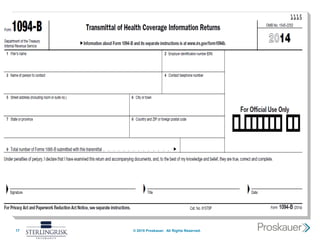
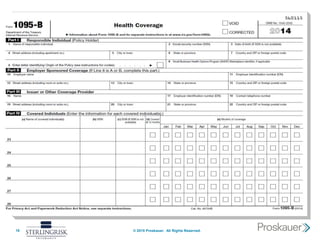
• Form 1094-B (transmittal to IRS)
• www.irs.gov/pub/irs-pdf/f1094b.pdf
• Form 1095-B: (an employee statement)
• http://www.irs.gov/pub/irs-pdf/f1095b.pdf
• Instructions: http://www.irs.gov/pub/irs-pdf/i109495b.pdf
• From an employer standpoint, only self-insured employers with less
than 50 FTEs will use these forms – ALEs use 1094-C and 1095-C
15 © 2015 Proskauer. All Rights Reserved.
Overview of Reporting Requirements
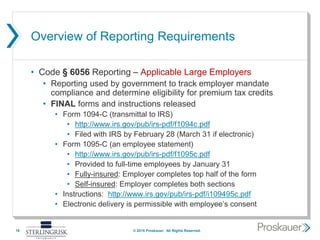
• Code § 6056 Reporting – Applicable Large Employers
• Reporting used by government to track employer mandate
compliance and determine eligibility for premium tax credits
• FINAL forms and instructions released
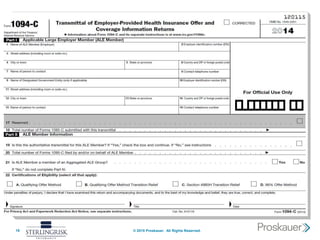
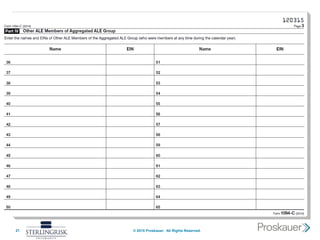
• Form 1094-C (transmittal to IRS)
• http://www.irs.gov/pub/irs-pdf/f1094c.pdf
• Filed with IRS by February 28 (March 31 if electronic)
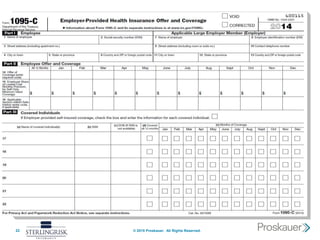
• Form 1095-C (an employee statement)
• http://www.irs.gov/pub/irs-pdf/f1095c.pdf
• Provided to full-time employees by January 31
• Fully-insured: Employer completes top half of the form
• Self-insured: Employer completes both sections
• Instructions: http://www.irs.gov/pub/irs-pdf/i109495c.pdf
• Electronic delivery is permissible with employee’s consent
16 © 2015 Proskauer. All Rights Reserved.
17 © 2015 Proskauer. All Rights Reserved.
18 © 2015 Proskauer. All Rights Reserved.
19 © 2015 Proskauer. All Rights Reserved.
20 © 2015 Proskauer. All Rights Reserved.
21 © 2015 Proskauer. All Rights Reserved.
22 © 2015 Proskauer. All Rights Reserved.
Employer ACA Reporting
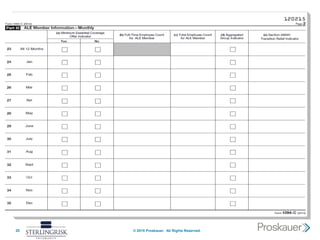
• General Reporting Method
• Full Reporting for all full-time employees
• Reporting on a month-by-month basis
• Lowest cost monthly premium for self-only coverage
• To whom was coverage offered (employee, spouse, dependents?)
• Did the coverage provide minimum value?
• Indicator codes will be used to report certain other information
• Employers filing 250 or more Forms 1095-C must file the
forms electronically (including Form 1094-C)
23 © 2015 Proskauer. All Rights Reserved.
24
Employer ACA Reporting
• Code § 6056 – “General Reporting”
• Applicable large employers must report with respect to
each full-time employee
• Each return must show—
1. Employer name, address, and Tax ID
2. Name and phone number of
employer’s contact person
3. Calendar year for which the
information is reported
4. Whether employer provided MEC to
full-time EEs and their dependents
5. Months minimum essential coverage
was available
6. Each FT EE’s monthly cost for
EE-only, minimum value plan
7. # of FT EEs for each month
8. Name, address, and tax ID of
each FT EE during the year and
the months EE was covered
9. Any other information specified
in forms, instructions, or
published guidance
© 2015 Proskauer. All Rights Reserved.
Employer ACA Reporting – Limited Non-
Assessment Period (LNAP)
• An employer need not file a Form 1095-C for an individual
who for each month of a calendar year is either not an
employee of the employer or is an employee in an LNAP
- Examples of LNAP’s include waiting periods and initial
measurement periods
- Note that for the months in which the employee was an
employee of the employer, such an employee would be
included in the total employee count reported on Form 1094-C,
Part III, Column (c)
25 © 2015 Proskauer. All Rights Reserved.
Employer ACA Reporting – Plans offering
coverage to Non-Employees
• Employers that have non-employees who enroll in the
employer’s self-insured group health plan coverage may
use Forms 1094-B and 1095-B, rather than Form 1095-C,
Part III, to report coverage for those individuals and other
family members
• Form 1095-C has indicator codes for an employer to use
when reporting on non-employees covered under a self-
insured plan (e.g., non-employee directors, retirees (after
year of retirement), or former employees on COBRA (after
year of termination)
26 © 2015 Proskauer. All Rights Reserved.
Employer ACA Reporting – Plans offering
Spousal Coverage
• For reporting purposes, an offer to a spouse includes an
offer to a spouse that is subject to a reasonable, objective
condition, regardless of whether the spouse meets the
reasonable, objective condition
• For example, an offer of coverage that is available to a
spouse only if the spouse certifies that the spouse does not
have access to health coverage from another employer is
treated as an offer of coverage to the spouse for reporting
purposes
27 © 2015 Proskauer. All Rights Reserved.
Employer ACA Reporting – Qualifying Offer
• Code § 6056 – Simplified Method #1 – “Qualifying Offers”
• Qualifying offer is an offer of minimum value coverage to
the employee that costs the employee no more than 9.5%
of the FPL (~$1,100 in 2014) for single coverage
- Offer must include offer of MEC to spouse and children
• Employers making a qualifying offer will only need to report
names, addresses, and tax IDs for employees who receive
qualifying offers
28 © 2015 Proskauer. All Rights Reserved.
Employer ACA Reporting – Qualifying Offer
• Employer reporting for employees who receive a qualifying offer for
the entire calendar year is “simplified”
- Form 1095-C – indicator code to show qualifying offer was made
- Employees receive Form 1095-C or an alternative statement informing
them that the family is ineligible for a premium credit that year
- Alternative statement method not available for employees covered under a self-
insured plan or employees not covered by a qualifying offer for entire year
- An employer may report that it made a qualifying offer to an employee in certain
months, even if the employee did not receive one for the entire year
- For 2015, employers making a qualifying offer to 95% of their FT employees
(including spouses and children) may use the alternative statement method for
all employees, even those who did not receive a qualifying offer for the entire
year
- Statement must indicate that an employee who did not receive a qualifying
offer (or received no offer) may be entitled to the premium tax credit for one
or more months of 2015
- Statement must direct the employee to see Pub. 974 for more information
on eligibility for the premium tax credit
29 © 2015 Proskauer. All Rights Reserved.
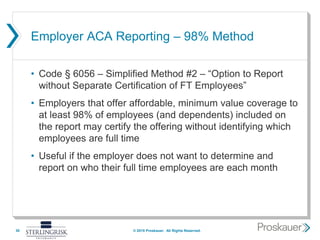
Employer ACA Reporting – 98% Method
• Code § 6056 – Simplified Method #2 – “Option to Report
without Separate Certification of FT Employees”
• Employers that offer affordable, minimum value coverage to
at least 98% of employees (and dependents) included on
the report may certify the offering without identifying which
employees are full time
• Useful if the employer does not want to determine and
report on who their full time employees are each month
30 © 2015 Proskauer. All Rights Reserved.
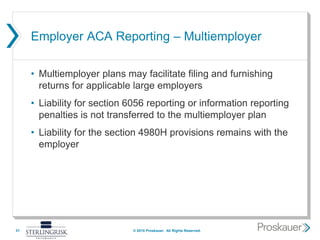
Employer ACA Reporting – Multiemployer
• Multiemployer plans may facilitate filing and furnishing
returns for applicable large employers
• Liability for section 6056 reporting or information reporting
penalties is not transferred to the multiemployer plan
• Liability for the section 4980H provisions remains with the
employer
31 © 2015 Proskauer. All Rights Reserved.
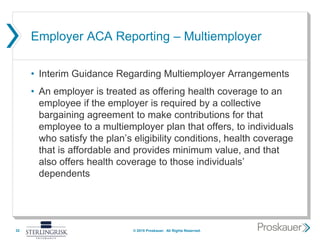
Employer ACA Reporting – Multiemployer
• Interim Guidance Regarding Multiemployer Arrangements
• An employer is treated as offering health coverage to an
employee if the employer is required by a collective
bargaining agreement to make contributions for that
employee to a multiemployer plan that offers, to individuals
who satisfy the plan’s eligibility conditions, health coverage
that is affordable and provides minimum value, and that
also offers health coverage to those individuals’
dependents
32 © 2015 Proskauer. All Rights Reserved.
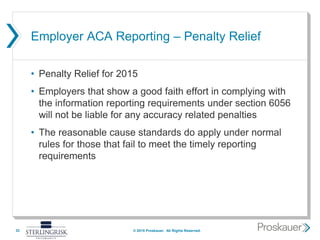
Employer ACA Reporting – Penalty Relief
• Penalty Relief for 2015
• Employers that show a good faith effort in complying with
the information reporting requirements under section 6056
will not be liable for any accuracy related penalties
• The reasonable cause standards do apply under normal
rules for those that fail to meet the timely reporting
requirements
33 © 2015 Proskauer. All Rights Reserved.
Questions?
• Join Proskauer’s ERISA blog at:
http://www.erisapracticecenter.com/
• Order the 5th Edition of Proskauer’s Health Care Reform
Book: www.thompson.com/hcrln05
34
The information provided in this slide presentation is not, is not intended to be, and shall not be construed to be, either the provision of legal advice or an offer to provide legal services, nor does it
necessarily reflect the opinions of the firm, our lawyers or our clients. No client-lawyer relationship between you and the firm is or may be created by your access to or use of this presentation or any
information contained on them. Rather, the content is intended as a general overview of the subject matter covered. Proskauer Rose LLP (Proskauer) is not obligated to provide updates on the
information presented herein. Those viewing this presentation are encouraged to seek direct counsel on legal questions. © Proskauer Rose LLP. All Rights Reserved.
© 2015 Proskauer. All Rights Reserved.

SterlingRisk - Tackling ACA Reporting Feb 2014

  • 1.
    ACA 6055/6056 ReportingRequirements Webinar SterlingRisk – Employee Benefits Stacy Barrow – Proskauer Hosted by: Presented by: February 11, 2015
  • 2.
    ACA Update andTackling the ACA’s Reporting Requirements © 2015 Proskauer. All Rights Reserved. SterlingRisk Stacy H. Barrow (617) 526-9648 sbarrow@proskauer.com
  • 3.
    Agenda • Recent Developments •ACA Reporting Requirements 3 © 2015 Proskauer. All Rights Reserved.
  • 4.
  • 5.
    Recent Developments: TheLegal Landscape • Administration fell to 2-1 in SCOTUS decisions in 2014 - June 2012: Court upholds Individual Mandate - June 2012: Court strikes down Medicaid Expansion - June 2014: Court held that Administration violated the Religious Freedom Restoration Act (RFRA) in Hobby Lobby - SCOTUS: HHS could have used less restrictive measures when dealing with for-profit employers who have religious objections to offering certain forms of emergency contraception • 2015 may bring challenges re: whether the “opt-out” accommodation is the least restrictive alternative - Little Sisters of the Poor (10th Cir.)/Priests for Life (D.C. Cir.) 5 © 2015 Proskauer. All Rights Reserved.
  • 6.
    Recent Developments: TheLegal Landscape • SCOTUS will hear King v. Burwell in 2015 • Issue: Does ACA provide for subsidies in states with a federal Exchange? • On its face, the ACA only provides subsidies for insurance purchased in state Exchanges - Majority of states have federal Exchanges • This case can go either way - Does the Administration want to chance going down 3-1? - Will the Administration and Congress work together to fashion a legislative fix? 6 © 2015 Proskauer. All Rights Reserved.
  • 7.
    Recent Developments: EEOC& Health Risk Assessments • Wellness is an important component of ACA • Someone neglected to tell the EEOC • DOL has blessed conditioning eligibility and amount of premium on completion of Health Risk Assessment (HRA), as long as not results-oriented • EEOC sees involuntary HRA requirement as violation of ADA • Three High Profile Cases Filed in 2014 • Will 2015 See More? • Will Seff v. Broward County help? 7 © 2015 Proskauer. All Rights Reserved.
  • 8.
    Recent Developments: Employer“Opt-Out Credit” • On 11/6/14 the Federal Regulators released FAQ XXII: Reiterates position on “premium reimbursement” and states that arrangements where employers pay an employee more to drop or not take coverage violates ERISA • Focus was on high claims targeting strategy • Impact is greater: • Service Contract Act employers who offer cash in lieu of benefits (based on rates in SCA contract) • Employment contracts in which employees opt out for higher pay 8 © 2015 Proskauer. All Rights Reserved.
  • 9.
    Recent Developments: WellnessPrograms • Wellness Programs: Employers may treat all employees as non-smokers for “affordability” purposes • For example, if an employer charges tobacco users $150 per month and non-tobacco users $100 per month, then $100 is the required employee contribution for affordability purposes, even if some employees pay $150 9 © 2015 Proskauer. All Rights Reserved.
  • 10.
    10 ACA Employer andProvider Reporting
  • 11.
    2014 Individual TaxReturns • Some tax preparers are asking employees for 1095 forms for 2014 taxes • Employers are not required to provide a Form 1095-C for 2014 • Carriers are not required to provide a Form 1095-B for 2014 • These forms are not necessary to prepare an individual’s tax return for 2014 • Individuals with Marketplace coverage in 2014 will receive a Form 1095-A from the Marketplace, which is used to reconcile premium credits. 11 © 2015 Proskauer. All Rights Reserved.
  • 12.
    2014 Individual TaxReturns • For 2014 returns, taxpayers will check a box on line 61 (line 11 on Form 1040EZ) indicating that they had coverage the entire year • If a taxpayer did not have full-year coverage in 2014, they should see the instructions for line 61 (line 11 on Form 1040EZ) and Form 8965 for more information • Form 8965 is used to report or claim a coverage exemption • If, for any month, the taxpayer or another member of the taxpayer’s tax household had neither health care coverage nor a coverage exemption, the instructions for Form 8965 provide the information they will need to calculate their shared responsibility payment 12 © 2015 Proskauer. All Rights Reserved.
  • 13.
    Overview of ReportingRequirements • Code Sections 6055 (insurers and self-insured plans) & 6056 (applicable large employers – ALEs) • ALE: at least 50 full-time equivalent employees during prior year • Effective Dates – Both reporting rules are effective in 2014; however, compliance is voluntary until 2015 • First mandatory reporting in January/February 2016 for 2015 • Complex reporting requirements • Relief offered to employers who are offering affordable coverage to employees and to spouses and children • Reporting includes employers with 50-99 FTEs who are exempt from the pay-or-play mandate in 2015 • Must certify on their Code § 6056 reporting filed in 2016 that they qualify for the transition relief in the pay-or-play regulations 13 © 2015 Proskauer. All Rights Reserved.
  • 14.
    Overview of ReportingRequirements • Code Sections 6055 (insurers and self-insured plans, & 6056 (applicable large employers) • Reminder: Applicable large employers are employers with at least 50 full-time employees (employees having an average of at least 30 hours of service per week), including full-time equivalent employees • Employers are only required to report full-time employees under Code Section 6056; however, employers with self- insured plans must report on all covered employees to comply with Code Section 6055 14 © 2015 Proskauer. All Rights Reserved.
  • 15.
    Overview of ReportingRequirements • Code § 6055 Reporting – All health insurance providers • Reporting used by government to track individual mandate compliance • Includes self-insured plans, but employers subject to §6056 reporting will report using Forms 1094-C and 1095-C instead • Reporting not required for HSAs, on-site medical clinics, wellness programs or dental/vision • FINAL forms and instructions released • Form 1094-B (transmittal to IRS) • www.irs.gov/pub/irs-pdf/f1094b.pdf • Form 1095-B: (an employee statement) • http://www.irs.gov/pub/irs-pdf/f1095b.pdf • Instructions: http://www.irs.gov/pub/irs-pdf/i109495b.pdf • From an employer standpoint, only self-insured employers with less than 50 FTEs will use these forms – ALEs use 1094-C and 1095-C 15 © 2015 Proskauer. All Rights Reserved.
  • 16.
    Overview of ReportingRequirements • Code § 6056 Reporting – Applicable Large Employers • Reporting used by government to track employer mandate compliance and determine eligibility for premium tax credits • FINAL forms and instructions released • Form 1094-C (transmittal to IRS) • http://www.irs.gov/pub/irs-pdf/f1094c.pdf • Filed with IRS by February 28 (March 31 if electronic) • Form 1095-C (an employee statement) • http://www.irs.gov/pub/irs-pdf/f1095c.pdf • Provided to full-time employees by January 31 • Fully-insured: Employer completes top half of the form • Self-insured: Employer completes both sections • Instructions: http://www.irs.gov/pub/irs-pdf/i109495c.pdf • Electronic delivery is permissible with employee’s consent 16 © 2015 Proskauer. All Rights Reserved.
  • 17.
    17 © 2015Proskauer. All Rights Reserved.
  • 18.
    18 © 2015Proskauer. All Rights Reserved.
  • 19.
    19 © 2015Proskauer. All Rights Reserved.
  • 20.
    20 © 2015Proskauer. All Rights Reserved.
  • 21.
    21 © 2015Proskauer. All Rights Reserved.
  • 22.
    22 © 2015Proskauer. All Rights Reserved.
  • 23.
    Employer ACA Reporting •General Reporting Method • Full Reporting for all full-time employees • Reporting on a month-by-month basis • Lowest cost monthly premium for self-only coverage • To whom was coverage offered (employee, spouse, dependents?) • Did the coverage provide minimum value? • Indicator codes will be used to report certain other information • Employers filing 250 or more Forms 1095-C must file the forms electronically (including Form 1094-C) 23 © 2015 Proskauer. All Rights Reserved.
  • 24.
    24 Employer ACA Reporting •Code § 6056 – “General Reporting” • Applicable large employers must report with respect to each full-time employee • Each return must show— 1. Employer name, address, and Tax ID 2. Name and phone number of employer’s contact person 3. Calendar year for which the information is reported 4. Whether employer provided MEC to full-time EEs and their dependents 5. Months minimum essential coverage was available 6. Each FT EE’s monthly cost for EE-only, minimum value plan 7. # of FT EEs for each month 8. Name, address, and tax ID of each FT EE during the year and the months EE was covered 9. Any other information specified in forms, instructions, or published guidance © 2015 Proskauer. All Rights Reserved.
  • 25.
    Employer ACA Reporting– Limited Non- Assessment Period (LNAP) • An employer need not file a Form 1095-C for an individual who for each month of a calendar year is either not an employee of the employer or is an employee in an LNAP - Examples of LNAP’s include waiting periods and initial measurement periods - Note that for the months in which the employee was an employee of the employer, such an employee would be included in the total employee count reported on Form 1094-C, Part III, Column (c) 25 © 2015 Proskauer. All Rights Reserved.
  • 26.
    Employer ACA Reporting– Plans offering coverage to Non-Employees • Employers that have non-employees who enroll in the employer’s self-insured group health plan coverage may use Forms 1094-B and 1095-B, rather than Form 1095-C, Part III, to report coverage for those individuals and other family members • Form 1095-C has indicator codes for an employer to use when reporting on non-employees covered under a self- insured plan (e.g., non-employee directors, retirees (after year of retirement), or former employees on COBRA (after year of termination) 26 © 2015 Proskauer. All Rights Reserved.
  • 27.
    Employer ACA Reporting– Plans offering Spousal Coverage • For reporting purposes, an offer to a spouse includes an offer to a spouse that is subject to a reasonable, objective condition, regardless of whether the spouse meets the reasonable, objective condition • For example, an offer of coverage that is available to a spouse only if the spouse certifies that the spouse does not have access to health coverage from another employer is treated as an offer of coverage to the spouse for reporting purposes 27 © 2015 Proskauer. All Rights Reserved.
  • 28.
    Employer ACA Reporting– Qualifying Offer • Code § 6056 – Simplified Method #1 – “Qualifying Offers” • Qualifying offer is an offer of minimum value coverage to the employee that costs the employee no more than 9.5% of the FPL (~$1,100 in 2014) for single coverage - Offer must include offer of MEC to spouse and children • Employers making a qualifying offer will only need to report names, addresses, and tax IDs for employees who receive qualifying offers 28 © 2015 Proskauer. All Rights Reserved.
  • 29.
    Employer ACA Reporting– Qualifying Offer • Employer reporting for employees who receive a qualifying offer for the entire calendar year is “simplified” - Form 1095-C – indicator code to show qualifying offer was made - Employees receive Form 1095-C or an alternative statement informing them that the family is ineligible for a premium credit that year - Alternative statement method not available for employees covered under a self- insured plan or employees not covered by a qualifying offer for entire year - An employer may report that it made a qualifying offer to an employee in certain months, even if the employee did not receive one for the entire year - For 2015, employers making a qualifying offer to 95% of their FT employees (including spouses and children) may use the alternative statement method for all employees, even those who did not receive a qualifying offer for the entire year - Statement must indicate that an employee who did not receive a qualifying offer (or received no offer) may be entitled to the premium tax credit for one or more months of 2015 - Statement must direct the employee to see Pub. 974 for more information on eligibility for the premium tax credit 29 © 2015 Proskauer. All Rights Reserved.
  • 30.
    Employer ACA Reporting– 98% Method • Code § 6056 – Simplified Method #2 – “Option to Report without Separate Certification of FT Employees” • Employers that offer affordable, minimum value coverage to at least 98% of employees (and dependents) included on the report may certify the offering without identifying which employees are full time • Useful if the employer does not want to determine and report on who their full time employees are each month 30 © 2015 Proskauer. All Rights Reserved.
  • 31.
    Employer ACA Reporting– Multiemployer • Multiemployer plans may facilitate filing and furnishing returns for applicable large employers • Liability for section 6056 reporting or information reporting penalties is not transferred to the multiemployer plan • Liability for the section 4980H provisions remains with the employer 31 © 2015 Proskauer. All Rights Reserved.
  • 32.
    Employer ACA Reporting– Multiemployer • Interim Guidance Regarding Multiemployer Arrangements • An employer is treated as offering health coverage to an employee if the employer is required by a collective bargaining agreement to make contributions for that employee to a multiemployer plan that offers, to individuals who satisfy the plan’s eligibility conditions, health coverage that is affordable and provides minimum value, and that also offers health coverage to those individuals’ dependents 32 © 2015 Proskauer. All Rights Reserved.
  • 33.
    Employer ACA Reporting– Penalty Relief • Penalty Relief for 2015 • Employers that show a good faith effort in complying with the information reporting requirements under section 6056 will not be liable for any accuracy related penalties • The reasonable cause standards do apply under normal rules for those that fail to meet the timely reporting requirements 33 © 2015 Proskauer. All Rights Reserved.
  • 34.
    Questions? • Join Proskauer’sERISA blog at: http://www.erisapracticecenter.com/ • Order the 5th Edition of Proskauer’s Health Care Reform Book: www.thompson.com/hcrln05 34 The information provided in this slide presentation is not, is not intended to be, and shall not be construed to be, either the provision of legal advice or an offer to provide legal services, nor does it necessarily reflect the opinions of the firm, our lawyers or our clients. No client-lawyer relationship between you and the firm is or may be created by your access to or use of this presentation or any information contained on them. Rather, the content is intended as a general overview of the subject matter covered. Proskauer Rose LLP (Proskauer) is not obligated to provide updates on the information presented herein. Those viewing this presentation are encouraged to seek direct counsel on legal questions. © Proskauer Rose LLP. All Rights Reserved. © 2015 Proskauer. All Rights Reserved.