23. Reported speech
Objectives
On completion of this unit you will be able to
• Learn what reported speech is
• Report something spoken by others
Introduction
Reported speech means reporting something spoken by
others. In other words, we report a speaker’s words to
someone else. Speech may include one or many sentences.
Sometimes, we report a speaker’s Words immediately and
at other times it may take any amount of time. It may take
days, months or years.
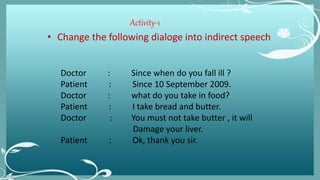
Activity-1
• Change the following dialoge into indirect speech
Doctor : Since when do you fall ill ?
Patient : Since 10 September 2009.
Doctor : what do you take in food?
Patient : I take bread and butter.
Doctor : You must not take butter , it will
Damage your liver.
Patient : Ok, thank you sir.
Additional information
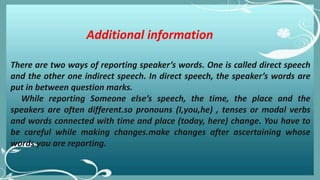
There are two ways of reporting speaker’s words. One is called direct speech
and the other one indirect speech. In direct speech, the speaker’s words are
put in between question marks.
While reporting Someone else’s speech, the time, the place and the
speakers are often different.so pronouns (I,you,he) , tenses or modal verbs
and words connected with time and place (today, here) change. You have to
be careful while making changes.make changes after ascertaining whose
words you are reporting.
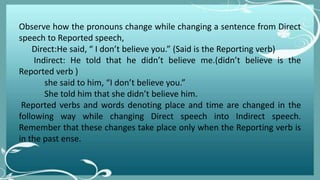
Observe how the pronouns change while changing a sentence from Direct
speech to Reported speech,
Direct:He said, “ I don’t believe you.” (Said is the Reporting verb)
Indirect: He told that he didn’t believe me.(didn’t believe is the
Reported verb )
she said to him, “I don’t believe you.”
She told him that she didn’t believe him.
Reported verbs and words denoting place and time are changed in the
following way while changing Direct speech into Indirect speech.
Remember that these changes take place only when the Reporting verb is
in the past ense.
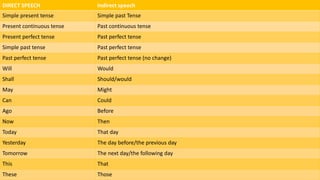
DIRECT SPEECH Indirect speech
Simple present tense Simple past Tense
Present continuous tense Past continuous tense
Present perfect tense Past perfect tense
Simple past tense Past perfect tense
Past perfect tense Past perfect tense (no change)
Will Would
Shall Should/would
May Might
Can Could
Ago Before
Now Then
Today That day
Yesterday The day before/the previous day
Tomorrow The next day/the following day
This That
These Those
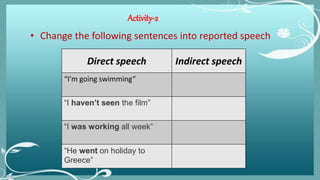
Direct speech Indirect speech
“I’m going swimming”
“I haven’t seen the film”
“I was working all week”
“He went on holiday to
Greece”
Activity-2
• Change the following sentences into reported speech
Additional information
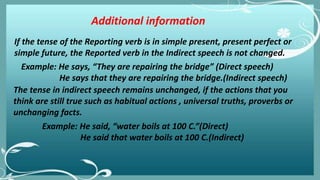
If the tense of the Reporting verb is in simple present, present perfect or
simple future, the Reported verb in the Indirect speech is not changed.
Example: He says, “They are repairing the bridge” (Direct speech)
He says that they are repairing the bridge.(Indirect speech)
The tense in indirect speech remains unchanged, if the actions that you
think are still true such as habitual actions , universal truths, proverbs or
unchanging facts.
Example: He said, “water boils at 100 C.”(Direct)
He said that water boils at 100 C.(Indirect)
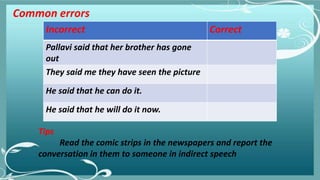
Common errors
Incorrect Correct
Pallavi said that her brother has gone
out
They said me they have seen the picture
He said that he can do it.
He said that he will do it now.
Tips
Read the comic strips in the newspapers and report the
conversation in them to someone in indirect speech
Gopi
Sravani
SampathVenky
Durga
Silar
Kiran
Prasanna
Done by:

23rd lesson.pptx

  • 2.
    23. Reported speech Objectives Oncompletion of this unit you will be able to • Learn what reported speech is • Report something spoken by others
  • 3.
    Introduction Reported speech meansreporting something spoken by others. In other words, we report a speaker’s words to someone else. Speech may include one or many sentences. Sometimes, we report a speaker’s Words immediately and at other times it may take any amount of time. It may take days, months or years.
  • 4.
    Activity-1 • Change thefollowing dialoge into indirect speech Doctor : Since when do you fall ill ? Patient : Since 10 September 2009. Doctor : what do you take in food? Patient : I take bread and butter. Doctor : You must not take butter , it will Damage your liver. Patient : Ok, thank you sir.
  • 5.
    Additional information There aretwo ways of reporting speaker’s words. One is called direct speech and the other one indirect speech. In direct speech, the speaker’s words are put in between question marks. While reporting Someone else’s speech, the time, the place and the speakers are often different.so pronouns (I,you,he) , tenses or modal verbs and words connected with time and place (today, here) change. You have to be careful while making changes.make changes after ascertaining whose words you are reporting.
  • 6.
    Observe how thepronouns change while changing a sentence from Direct speech to Reported speech, Direct:He said, “ I don’t believe you.” (Said is the Reporting verb) Indirect: He told that he didn’t believe me.(didn’t believe is the Reported verb ) she said to him, “I don’t believe you.” She told him that she didn’t believe him. Reported verbs and words denoting place and time are changed in the following way while changing Direct speech into Indirect speech. Remember that these changes take place only when the Reporting verb is in the past ense.
  • 7.
    DIRECT SPEECH Indirectspeech Simple present tense Simple past Tense Present continuous tense Past continuous tense Present perfect tense Past perfect tense Simple past tense Past perfect tense Past perfect tense Past perfect tense (no change) Will Would Shall Should/would May Might Can Could Ago Before Now Then Today That day Yesterday The day before/the previous day Tomorrow The next day/the following day This That These Those
  • 8.
    Direct speech Indirectspeech “I’m going swimming” “I haven’t seen the film” “I was working all week” “He went on holiday to Greece” Activity-2 • Change the following sentences into reported speech
  • 9.
    Additional information If thetense of the Reporting verb is in simple present, present perfect or simple future, the Reported verb in the Indirect speech is not changed. Example: He says, “They are repairing the bridge” (Direct speech) He says that they are repairing the bridge.(Indirect speech) The tense in indirect speech remains unchanged, if the actions that you think are still true such as habitual actions , universal truths, proverbs or unchanging facts. Example: He said, “water boils at 100 C.”(Direct) He said that water boils at 100 C.(Indirect)
  • 10.
    Common errors Incorrect Correct Pallavisaid that her brother has gone out They said me they have seen the picture He said that he can do it. He said that he will do it now. Tips Read the comic strips in the newspapers and report the conversation in them to someone in indirect speech
  • 12.