Making AJAX crawlable Katharina Probst Engineer, Google Bruce Johnson Engineering Manager, Google in collaboration with: Arup Mukherjee, Erik van der Poel, Li Xiao , Google
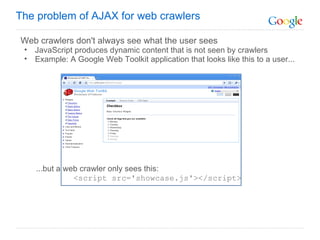
Web crawlers don't always see what the user sees JavaScript produces dynamic content that is not seen by crawlers Example: A Google Web Toolkit application that looks like this to a user...              ...but a web crawler only sees this:            <script src='showcase.js'></script> The problem of AJAX for web crawlers
Web 2.0: More content on the web is created dynamically (~69%) Over time, this hurts search Developers are discouraged from building dynamic apps Not solving AJAX crawlability holds back progress on the web! Why does this problem need to be solved?
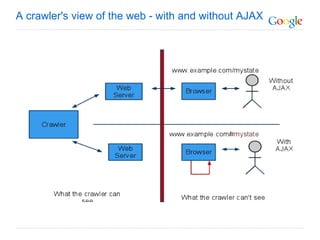
A crawler's view of the web - with and without AJAX
Crawling and indexing AJAX is needed for users and developers Problem: Which AJAX states can be indexed? Explicit opt-in needed by the web server Problem: Don't want to cloak Users and search engine crawlers need to see the same content Problem: How could the logistics work? That's the remainder of the presentation Goal: crawl and index AJAX
Crawlers execute all the web's JavaScript This is expensive and time-consuming  Only major search engines would even be able to do this, and probably only partially Indexes would be more stale, resulting in worse search results Web servers execute their own JavaScript at crawl time Avoids above problems Gives more control to webmasters  Can be done automatically Does not require ongoing maintenance Possible solutions
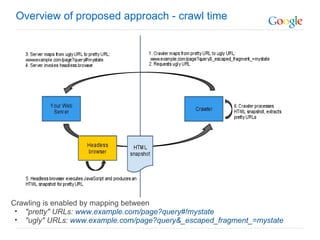
Overview of proposed approach - crawl time Crawling is enabled by mapping between    &quot;pretty&quot; URLs:   www.example.com/page?query#!mystate &quot;ugly&quot; URLs:  www.example.com/page?query&_escaped_fragment_=mystate
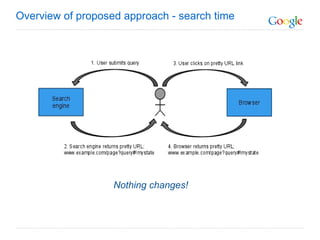
Overview of proposed approach - search time Nothing changes!
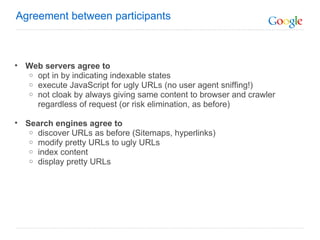
Web servers agree to opt in by indicating indexable states  execute JavaScript for ugly URLs (no user agent sniffing!)   not cloak by always giving same content to browser and crawler regardless of request (or risk elimination, as before)   Search engines agree to  discover URLs as before (Sitemaps, hyperlinks)  modify pretty URLs to ugly URLs index content display pretty URLs Agreement between participants
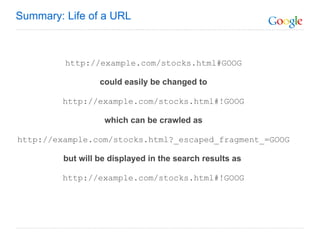
http://example.com/stocks.html#GOOG could easily be changed to   http://example.com/stocks.html#!GOOG   which can be crawled as   http://example.com/stocks.html?_escaped_fragment_=GOOG   but will be displayed in the search results as   http://example.com/stocks.html#!GOOG Summary: Life of a URL
We are currently working on a proposal and prototype implementation Check out the blog post on the Google Webmaster Central Blog:  http://googlewebmastercentral.blogspot.com We welcome feedback from the community at the Google Webmaster Help Forum (link is posted in the blog entry) Feedback is welcome

rendre AJAX crawlable par les moteurs

  • 1.
    Making AJAX crawlableKatharina Probst Engineer, Google Bruce Johnson Engineering Manager, Google in collaboration with: Arup Mukherjee, Erik van der Poel, Li Xiao , Google
  • 2.
    Web crawlers don'talways see what the user sees JavaScript produces dynamic content that is not seen by crawlers Example: A Google Web Toolkit application that looks like this to a user...             ...but a web crawler only sees this:            <script src='showcase.js'></script> The problem of AJAX for web crawlers
  • 3.
    Web 2.0: Morecontent on the web is created dynamically (~69%) Over time, this hurts search Developers are discouraged from building dynamic apps Not solving AJAX crawlability holds back progress on the web! Why does this problem need to be solved?
  • 4.
    A crawler's viewof the web - with and without AJAX
  • 5.
    Crawling and indexingAJAX is needed for users and developers Problem: Which AJAX states can be indexed? Explicit opt-in needed by the web server Problem: Don't want to cloak Users and search engine crawlers need to see the same content Problem: How could the logistics work? That's the remainder of the presentation Goal: crawl and index AJAX
  • 6.
    Crawlers execute allthe web's JavaScript This is expensive and time-consuming Only major search engines would even be able to do this, and probably only partially Indexes would be more stale, resulting in worse search results Web servers execute their own JavaScript at crawl time Avoids above problems Gives more control to webmasters Can be done automatically Does not require ongoing maintenance Possible solutions
  • 7.
    Overview of proposedapproach - crawl time Crawling is enabled by mapping between   &quot;pretty&quot; URLs: www.example.com/page?query#!mystate &quot;ugly&quot; URLs: www.example.com/page?query&_escaped_fragment_=mystate
  • 8.
    Overview of proposedapproach - search time Nothing changes!
  • 9.
    Web servers agreeto opt in by indicating indexable states  execute JavaScript for ugly URLs (no user agent sniffing!)  not cloak by always giving same content to browser and crawler regardless of request (or risk elimination, as before)   Search engines agree to discover URLs as before (Sitemaps, hyperlinks) modify pretty URLs to ugly URLs index content display pretty URLs Agreement between participants
  • 10.
    http://example.com/stocks.html#GOOG could easilybe changed to   http://example.com/stocks.html#!GOOG   which can be crawled as   http://example.com/stocks.html?_escaped_fragment_=GOOG   but will be displayed in the search results as http://example.com/stocks.html#!GOOG Summary: Life of a URL
  • 11.
    We are currentlyworking on a proposal and prototype implementation Check out the blog post on the Google Webmaster Central Blog: http://googlewebmastercentral.blogspot.com We welcome feedback from the community at the Google Webmaster Help Forum (link is posted in the blog entry) Feedback is welcome