What	is	Angular?
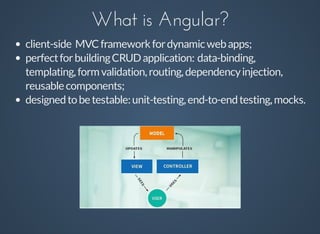
client-side		MVC	framework	for	dynamic	web	apps;
perfect	for	building	CRUD	application:	data-binding,
templating,	form	validation,	routing,	dependency	injection,
reusable	components;
designed	to	be	testable:	unit-testing,	end-to-end	testing,	mocks.
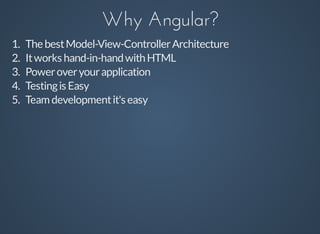
Why	Angular?
1.	 The	best	Model-View-Controller	Architecture
2.	 It	works	hand-in-hand	with	HTML
3.	 Power	over	your	application
4.	 Testing	is	Easy
5.	 Team	development	it's	easy
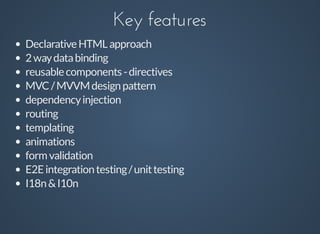
Key	features
Declarative	HTML	approach
2	way	data	binding
reusable	components	-	directives
MVC	/	MVVM	design	pattern
dependency	injection
routing
templating
animations
form	validation
E2E	integration	testing	/	unit	testing
I18n	&	I10n
How	it	works?
<!DOCTYPE	html>
<html	ng-app="myApp">
<head>
			<title>Angular	app</title>
			<script	src="bower_components/angular/angular.js">
{{name}}
angular
			.module('myApp',	[])
			.controller('MyCtrl',	function($scope){
						$scope.name	=	'World';
			});
Plunker	Example
How	it	works?
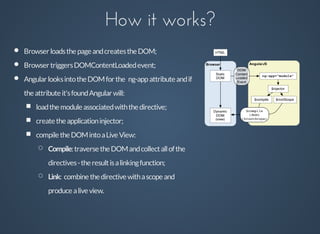
Browser	loads	the	page	and	creates	the	DOM; 	
Browser	triggers	DOMContentLoaded	event;
Angular	looks	into	the	DOM	for	the	 ng-app	attribute	and	if
the	attribute	it's	found	Angular	will:
load	the	module	associated	with	the	directive;
create	the	application	injector;
compile	the	DOM	into	a	Live	View:
:	traverse	the	DOM	and	collect	all	of	the
directives	-	the	result	is	a	linking	function;
:		combine	the	directive	with	a	scope	and
produce	a	live	view.
Data	Binding
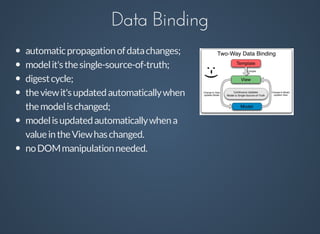
automatic	propagation	of	data	changes;
model	it's	the	single-source-of-truth;
digest	cycle;
the	view	it's	updated	automatically	when
the	model	is	changed;
model	is	updated	automatically	when	a
value	in	the	View	has	changed.
no	DOM	manipulation	needed.
$watch,	$apply	&	$digest
Angular	uses	some	main	components	to	implement	2	way	data
binding:
$watch;
$apply;
$digest;
dirty-checking;
Implement	your	own	data	binding	mechanism
$watch
Angular	extends	the	browser	events-loop	and	creates	the
angular-context;
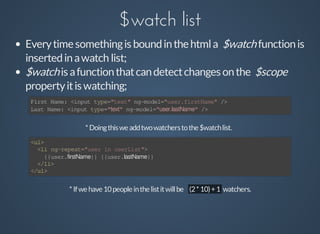
Every	time	something	is	bound	in	the	html	a	 watcher	is	inserted
in	a	watch	list;
a	watcher	consist	of:
a	watch	function	that	returns	the	current	value	of
the	property	it	is	watching;
a	listener	function	that	will	be	triggered	if	a	change
happened.
the	last	value	returned	by	the	watch	function;
$watch
*	Doing	this	two	watchers	are	registered.
*	For	10	people	in	the	list	it	will	be	 	(2	*	10)	+	1	watchers	registered.
First	Name:	<input	type="text"	ng-model="user.firstName"	/>
Last	Name:	<input	type="text"	ng-model="user.lastName"	/>
<ul>
		<li	ng-repeat="user	in	userList">
				{{user.firstName}}	{{user.lastName}}
		</li>
</ul>
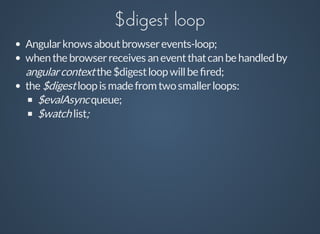
$digest	loop
Angular	knows	about	browser	events-loop;
when	the	browser	receives	an	event	that	can	be	handled	by
angular-context	the	$digest	loop	will	be	fired;
the	$digest	loop	is	made	from	two	smaller	loops:
$evalAsync	queue;
$watch	list;
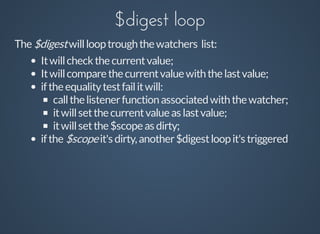
$digest	loop
The	$digest	will	loop	trough	the	watchers	list:
It	will	check	the	current	value	returned	by	the	watch	function;
It	will	compare	the	current	value	with	the	last	value;
if	the	equality	test	fails,	it	will:
call	the	listener	function	associated	with	that	watcher;
it	will	set	the	current	value	as	last	value;
it	will	set	the	$scope	as	dirty;
If	the	$scope	is	dirty,	another	$digest	loop	is	triggered.
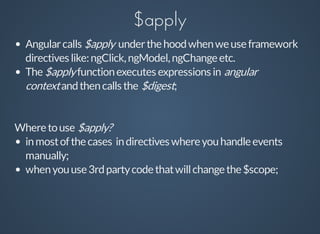
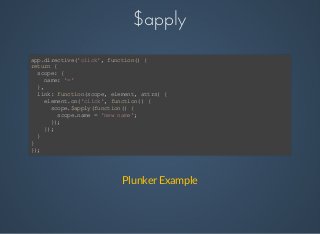
$apply
Angular	calls	$apply		under	the	hood	when	we	use	framework
directives	like:	ngClick,	ngModel,	ngChange	etc.
The	$apply	function	executes	expressions	in	angular
context	and	then	calls	the	$digest;
Where	to	use	$apply?
in	most	of	the	cases		in	directives	where	you	handle	events
manually;
when	you	use	3rd	party	code	that	will	change	the	$scope;
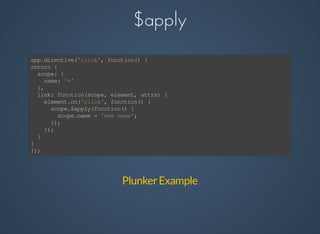
$apply
app.directive('click',	function()	{
return	{
		scope:	{
				name:	'='
		},
		link:	function(scope,	element,	attrs)	{
				element.on('click',	function()	{
						scope.$apply(function()	{
								scope.name	=	'new	name';
						});
				});
		}
}
});
Plunker	Example

AngularJS - introduction & how it works?