Renault-Nissan
The Challenge of Sustaining
Strategic Change
Presented By:
Abhishek Rajvanshi
Chitranshu Shukla
14.12.2017 Strategy Implementation & Control
s
Introduction to Nissan Renault
14.12.2017 Strategy Implementation & Control
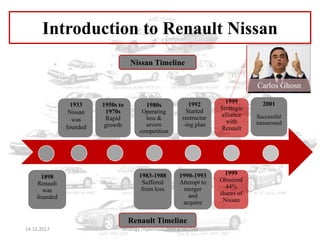
Introduction to Renault Nissan
1999
Strategic
alliance
with
Renault
Nissan Timeline
Renault Timeline
1933
Nissan
was
founded
1950s to
1970s
Rapid
growth
1980s
Operating
loss &
severe
competition
1992
Started
restructur
-ing plan
2001
Successful
turnaround
1898
Renault
was
founded
1999
Obtained
44%
shares of
Nissan
Carlos Ghosn
1983-1988
Suffered
from loss
1990-1993
Attempt to
merger
and
acquire
14.12.2017 Strategy Implementation & Control
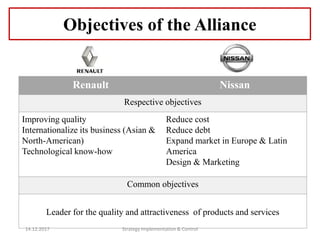
Renault Nissan
Respective objectives
Improving quality
Internationalize its business (Asian &
North-American)
Technological know-how
Reduce cost
Reduce debt
Expand market in Europe & Latin
America
Design & Marketing
Common objectives
Leader for the quality and attractiveness of products and services
Objectives of the Alliance
14.12.2017 Strategy Implementation & Control
Japanese Culture
14.12.2017 Strategy Implementation & Control
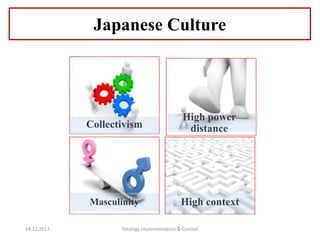
Japanese Culture
Collectivism
High power
distance
Masculinity High context
14.12.2017 Strategy Implementation & Control
Collectivism culture: value harmony, fitting in and politeness,
“saving face”
Decision were made by people having similar thoughts
• The “Kereitsu” – affect purchasing in terms of cost and
quality
• Debates and conflicts are not valued or are seen as offense
• Decisions were made by people with similar thoughts
• Stress on consensus and compromise  prolonged decision
making process
• Spent too much time apologizing for service failures
Collectivism
14.12.2017 Strategy Implementation & Control
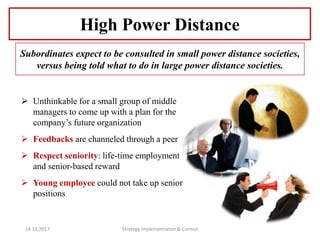
Subordinates expect to be consulted in small power distance societies,
versus being told what to do in large power distance societies.
 Unthinkable for a small group of middle
managers to come up with a plan for the
company’s future organization
 Feedbacks are channeled through a peer
 Respect seniority: life-time employment
and senior-based reward
 Young employee could not take up senior
positions
High Power Distance
14.12.2017 Strategy Implementation & Control
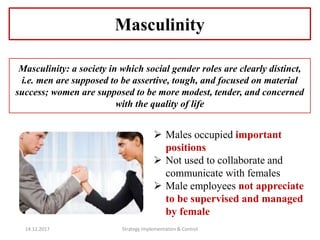
Masculinity: a society in which social gender roles are clearly distinct,
i.e. men are supposed to be assertive, tough, and focused on material
success; women are supposed to be more modest, tender, and concerned
with the quality of life
 Males occupied important
positions
 Not used to collaborate and
communicate with females
 Male employees not appreciate
to be supervised and managed
by female
Masculinity
14.12.2017 Strategy Implementation & Control
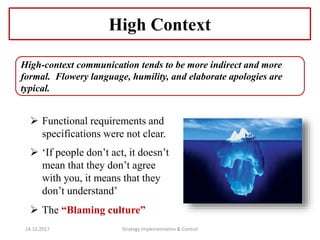
High-context communication tends to be more indirect and more
formal. Flowery language, humility, and elaborate apologies are
typical.
 Functional requirements and
specifications were not clear.
 ‘If people don’t act, it doesn’t
mean that they don’t agree
with you, it means that they
don’t understand’
 The “Blaming culture”
High Context
14.12.2017 Strategy Implementation & Control
Turnaround by Carlos Ghosn
14.12.2017 Strategy Implementation & Control
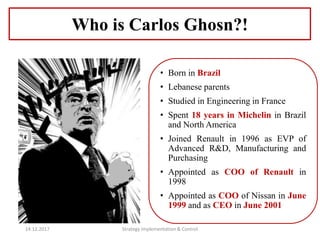
• Born in Brazil
• Lebanese parents
• Studied in Engineering in France
• Spent 18 years in Michelin in Brazil
and North America
• Joined Renault in 1996 as EVP of
Advanced R&D, Manufacturing and
Purchasing
• Appointed as COO of Renault in
1998
• Appointed as COO of Nissan in June
1999 and as CEO in June 2001
Who is Carlos Ghosn?!
14.12.2017 Strategy Implementation & Control
• On October 18, 1999, Nissan
introduced a three-year plan to
revive the company.
• The Nissan Revival Plan (NRP)
is a bold, sweeping program
with a goal of nothing less than
recreating the organization.
• NRP sets the stage for the
creation of lasting, profitable
growth.
Nissan Revival Plan (NRP)
14.12.2017 Strategy Implementation & Control
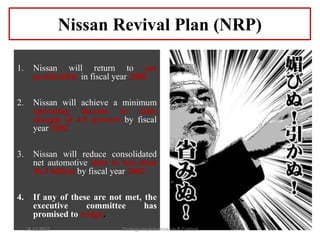
1. Nissan will return to net
profitability in fiscal year 2000
2. Nissan will achieve a minimum
operating income to sales
margin of 4.5 percent by fiscal
year 2002
3. Nissan will reduce consolidated
net automotive debt to less than
$6.3 billion by fiscal year 2002
4. If any of these are not met, the
executive committee has
promised to resign.
Nissan Revival Plan (NRP)
14.12.2017 Strategy Implementation & Control
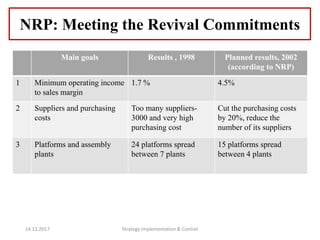
NRP: Meeting the Revival Commitments
Main goals Results , 1998 Planned results, 2002
(according to NRP)
1 Minimum operating income
to sales margin
1.7 % 4.5%
2 Suppliers and purchasing
costs
Too many suppliers-
3000 and very high
purchasing cost
Cut the purchasing costs
by 20%, reduce the
number of its suppliers
3 Platforms and assembly
plants
24 platforms spread
between 7 plants
15 platforms spread
between 4 plants
14.12.2017 Strategy Implementation & Control
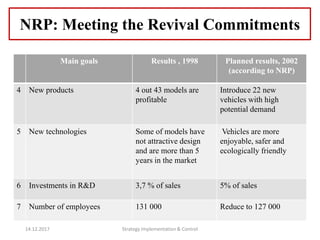
Main goals Results , 1998 Planned results, 2002
(according to NRP)
4 New products 4 out 43 models are
profitable
Introduce 22 new
vehicles with high
potential demand
5 New technologies Some of models have
not attractive design
and are more than 5
years in the market
Vehicles are more
enjoyable, safer and
ecologically friendly
6 Investments in R&D 3,7 % of sales 5% of sales
7 Number of employees 131 000 Reduce to 127 000
NRP: Meeting the Revival Commitments
14.12.2017 Strategy Implementation & Control
Measures taken by Carlos Ghosn
• Business Process
• Corporate culture
14.12.2017 Strategy Implementation & Control
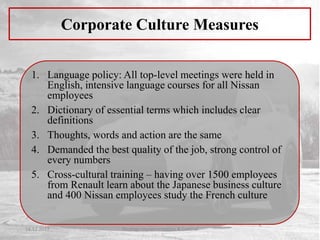
1. Language policy: All top-level meetings were held in
English, intensive language courses for all Nissan
employees
2. Dictionary of essential terms which includes clear
definitions
3. Thoughts, words and action are the same
4. Demanded the best quality of the job, strong control of
every numbers
5. Cross-cultural training – having over 1500 employees
from Renault learn about the Japanese business culture
and 400 Nissan employees study the French culture
Corporate Culture Measures
14.12.2017 Strategy Implementation & Control
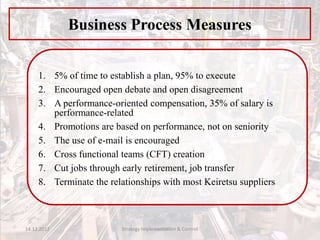
1. 5% of time to establish a plan, 95% to execute
2. Encouraged open debate and open disagreement
3. A performance-oriented compensation, 35% of salary is
performance-related
4. Promotions are based on performance, not on seniority
5. The use of e-mail is encouraged
6. Cross functional teams (CFT) creation
7. Cut jobs through early retirement, job transfer
8. Terminate the relationships with most Keiretsu suppliers
Business Process Measures
14.12.2017 Strategy Implementation & Control
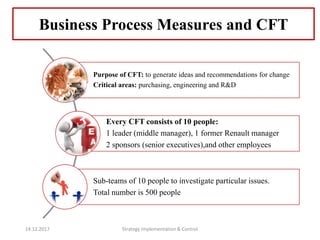
Purpose of CFT: to generate ideas and recommendations for change
Critical areas: purchasing, engineering and R&D
Every CFT consists of 10 people:
1 leader (middle manager), 1 former Renault manager
2 sponsors (senior executives),and other employees
Sub-teams of 10 people to investigate particular issues.
Total number is 500 people
Business Process Measures and CFT
14.12.2017 Strategy Implementation & Control
The Role of Leadership in Successful
International Merger & Acquisitions
14.12.2017STRATEGY IMPLEMENTATION & CONTROL
Leadership in Mergers & Acquisitions
• Successful post-M&A integration depends on a sound
leadership style that enables organizational and cultural
adaptation.
• During the period M&A integration, if employees believe that
their leaders care about them, they develop a positive attitude
toward the change and commit to greater involvement in the
integration.
•Transformational and Transactional leadership styles can
improve employee engagement.
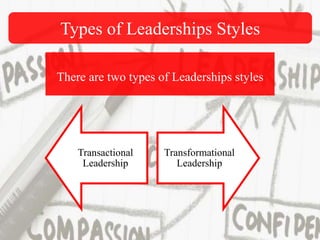
Types of Leaderships Styles
Transactional
Leadership
Transformational
Leadership
There are two types of Leaderships styles
Transactional Leadership
• It is a style of leadership in which the leader promotes
compliance of his followers through both rewards and
punishments.
• Also known as managerial leadership, focuses on the role
of supervision, organization, and group performance.
• Leaders using the transactional approach are not looking to
change the future, they are looking to merely keep things
the same
Transformational Style
•A transformational leader is a person who inspires
(transform) followers to achieve extraordinary outcomes.
• Able to arouse, excite and inspire followers to put out extra
effort to achieve group goals.
•Pay attention to the concern and developmental needs of
individual followers
•Change followers’ awareness of issues by helping them to
look at old problems in a new way.
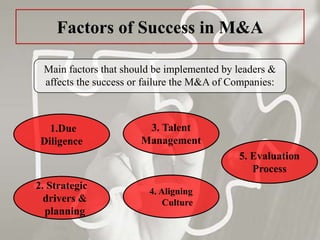
Factors of Success in M&A
Main factors that should be implemented by leaders &
affects the success or failure the M&A of Companies:
4. Aligning
Culture
3. Talent
Management
2. Strategic
drivers &
planning
1.Due
Diligence
5. Evaluation
Process
Due Diligence
• Due diligence is the series of exploratory activities used
in evaluating a company prior to finalization of the M&A.
• The traditional approach to due diligence focuses on
several key areas: financial, legal and regulatory, and
accounting and tax.
• When everything in the examination process checks out
from a financial, legal, and regulatory standpoint, the
merger partners typically move forward.
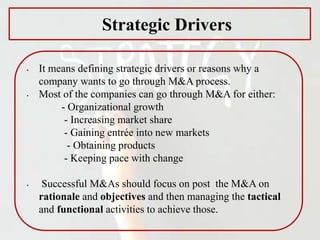
Strategic Drivers
• It means defining strategic drivers or reasons why a
company wants to go through M&A process.
• Most of the companies can go through M&A for either:
- Organizational growth
- Increasing market share
- Gaining entrée into new markets
- Obtaining products
- Keeping pace with change
• Successful M&As should focus on post the M&A on
rationale and objectives and then managing the tactical
and functional activities to achieve those.
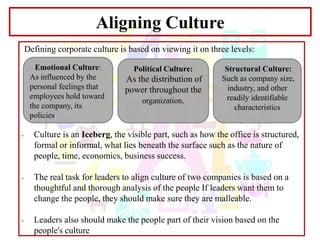
Aligning Culture
Defining corporate culture is based on viewing it on three levels:
• Culture is an Iceberg, the visible part, such as how the office is structured,
formal or informal, what lies beneath the surface such as the nature of
people, time, economics, business success.
• The real task for leaders to align culture of two companies is based on a
thoughtful and thorough analysis of the people If leaders want them to
change the people, they should make sure they are malleable.
• Leaders also should make the people part of their vision based on the
people's culture
Political Culture:
As the distribution of
power throughout the
organization.
Emotional Culture:
As influenced by the
personal feelings that
employees hold toward
the company, its
policies.
Structural Culture:
Such as company size,
industry, and other
readily identifiable
characteristics
Talent Management
• When organizations go through M&A, they need to determine whether or not
there is a need for a retention incentive plan.

• If so, they have to decide who should participate, how people will awarded, the
timing and structure of the plan and finally how much the overall plan cost
•Team of Renault engineer & production employee
visited Nisaan and vice versa to share their expertise.
•Nissan design team was relocated from engineering
group to marketing group.
•Top executives were stationed in major markets.
•A global marketing team was created to coordinate
Nissan’s activities across globe.
•By 2002,30% of all purchasing was jointly done.
Global structure were establish, along with GSAM.
Initiative taken by Mr. Carlos
Ghosn.
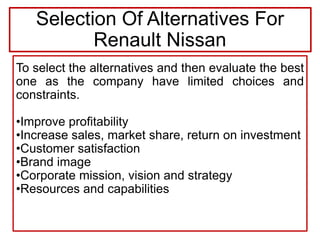
To select the alternatives and then evaluate the best
one as the company have limited choices and
constraints.
•Improve profitability
•Increase sales, market share, return on investment
•Customer satisfaction
•Brand image
•Corporate mission, vision and strategy
•Resources and capabilities
Selection Of Alternatives For
Renault Nissan
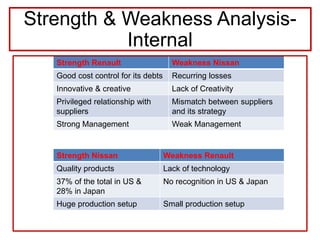
Strength & Weakness Analysis-
Internal
Strength Renault Weakness Nissan
Good cost control for its debts Recurring losses
Innovative & creative Lack of Creativity
Privileged relationship with
suppliers
Mismatch between suppliers
and its strategy
Strong Management Weak Management
Strength Nissan Weakness Renault
Quality products Lack of technology
37% of the total in US &
28% in Japan
No recognition in US & Japan
Huge production setup Small production setup
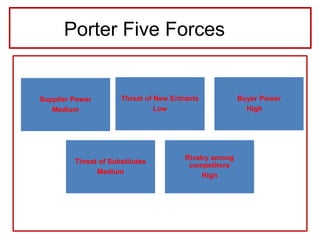
Porter Five Forces
Supplier Power
Medium
Threat of New Entrants
Low
Buyer Power
High
Threat of Substitutes
Medium
Rivalry among
competitors
High
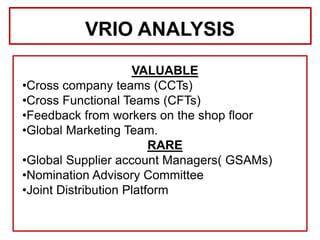
VRIO ANALYSIS
VALUABLE
•Cross company teams (CCTs)
•Cross Functional Teams (CFTs)
•Feedback from workers on the shop floor
•Global Marketing Team.
RARE
•Global Supplier account Managers( GSAMs)
•Nomination Advisory Committee
•Joint Distribution Platform
VRIO ANALYSIS
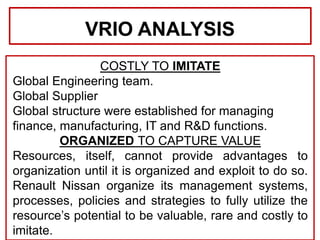
COSTLY TO IMITATE
Global Engineering team.
Global Supplier
Global structure were established for managing
finance, manufacturing, IT and R&D functions.
ORGANIZED TO CAPTURE VALUE
Resources, itself, cannot provide advantages to
organization until it is organized and exploit to do so.
Renault Nissan organize its management systems,
processes, policies and strategies to fully utilize the
resource’s potential to be valuable, rare and costly to
imitate.
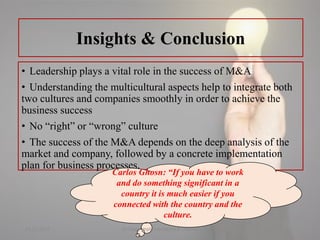
• Leadership plays a vital role in the success of M&A
• Understanding the multicultural aspects help to integrate both
two cultures and companies smoothly in order to achieve the
business success
• No “right” or “wrong” culture
• The success of the M&A depends on the deep analysis of the
market and company, followed by a concrete implementation
plan for business processes.
Insights & Conclusion
Carlos Ghosn: “If you have to work
and do something significant in a
country it is much easier if you
connected with the country and the
culture.
14.12.2017 Strategy Implementation & Control
Thank You For Patience
14.12.2017 Strategy Implementation & Control

Renault nissan new

  • 1.
    Renault-Nissan The Challenge ofSustaining Strategic Change Presented By: Abhishek Rajvanshi Chitranshu Shukla 14.12.2017 Strategy Implementation & Control
  • 2.
    s Introduction to NissanRenault 14.12.2017 Strategy Implementation & Control
  • 3.
    Introduction to RenaultNissan 1999 Strategic alliance with Renault Nissan Timeline Renault Timeline 1933 Nissan was founded 1950s to 1970s Rapid growth 1980s Operating loss & severe competition 1992 Started restructur -ing plan 2001 Successful turnaround 1898 Renault was founded 1999 Obtained 44% shares of Nissan Carlos Ghosn 1983-1988 Suffered from loss 1990-1993 Attempt to merger and acquire 14.12.2017 Strategy Implementation & Control
  • 4.
    Renault Nissan Respective objectives Improvingquality Internationalize its business (Asian & North-American) Technological know-how Reduce cost Reduce debt Expand market in Europe & Latin America Design & Marketing Common objectives Leader for the quality and attractiveness of products and services Objectives of the Alliance 14.12.2017 Strategy Implementation & Control
  • 5.
    Japanese Culture 14.12.2017 StrategyImplementation & Control
  • 6.
    Japanese Culture Collectivism High power distance MasculinityHigh context 14.12.2017 Strategy Implementation & Control
  • 7.
    Collectivism culture: valueharmony, fitting in and politeness, “saving face” Decision were made by people having similar thoughts • The “Kereitsu” – affect purchasing in terms of cost and quality • Debates and conflicts are not valued or are seen as offense • Decisions were made by people with similar thoughts • Stress on consensus and compromise  prolonged decision making process • Spent too much time apologizing for service failures Collectivism 14.12.2017 Strategy Implementation & Control
  • 8.
    Subordinates expect tobe consulted in small power distance societies, versus being told what to do in large power distance societies.  Unthinkable for a small group of middle managers to come up with a plan for the company’s future organization  Feedbacks are channeled through a peer  Respect seniority: life-time employment and senior-based reward  Young employee could not take up senior positions High Power Distance 14.12.2017 Strategy Implementation & Control
  • 9.
    Masculinity: a societyin which social gender roles are clearly distinct, i.e. men are supposed to be assertive, tough, and focused on material success; women are supposed to be more modest, tender, and concerned with the quality of life  Males occupied important positions  Not used to collaborate and communicate with females  Male employees not appreciate to be supervised and managed by female Masculinity 14.12.2017 Strategy Implementation & Control
  • 10.
    High-context communication tendsto be more indirect and more formal. Flowery language, humility, and elaborate apologies are typical.  Functional requirements and specifications were not clear.  ‘If people don’t act, it doesn’t mean that they don’t agree with you, it means that they don’t understand’  The “Blaming culture” High Context 14.12.2017 Strategy Implementation & Control
  • 11.
    Turnaround by CarlosGhosn 14.12.2017 Strategy Implementation & Control
  • 12.
    • Born inBrazil • Lebanese parents • Studied in Engineering in France • Spent 18 years in Michelin in Brazil and North America • Joined Renault in 1996 as EVP of Advanced R&D, Manufacturing and Purchasing • Appointed as COO of Renault in 1998 • Appointed as COO of Nissan in June 1999 and as CEO in June 2001 Who is Carlos Ghosn?! 14.12.2017 Strategy Implementation & Control
  • 13.
    • On October18, 1999, Nissan introduced a three-year plan to revive the company. • The Nissan Revival Plan (NRP) is a bold, sweeping program with a goal of nothing less than recreating the organization. • NRP sets the stage for the creation of lasting, profitable growth. Nissan Revival Plan (NRP) 14.12.2017 Strategy Implementation & Control
  • 14.
    1. Nissan willreturn to net profitability in fiscal year 2000 2. Nissan will achieve a minimum operating income to sales margin of 4.5 percent by fiscal year 2002 3. Nissan will reduce consolidated net automotive debt to less than $6.3 billion by fiscal year 2002 4. If any of these are not met, the executive committee has promised to resign. Nissan Revival Plan (NRP) 14.12.2017 Strategy Implementation & Control
  • 15.
    NRP: Meeting theRevival Commitments Main goals Results , 1998 Planned results, 2002 (according to NRP) 1 Minimum operating income to sales margin 1.7 % 4.5% 2 Suppliers and purchasing costs Too many suppliers- 3000 and very high purchasing cost Cut the purchasing costs by 20%, reduce the number of its suppliers 3 Platforms and assembly plants 24 platforms spread between 7 plants 15 platforms spread between 4 plants 14.12.2017 Strategy Implementation & Control
  • 16.
    Main goals Results, 1998 Planned results, 2002 (according to NRP) 4 New products 4 out 43 models are profitable Introduce 22 new vehicles with high potential demand 5 New technologies Some of models have not attractive design and are more than 5 years in the market Vehicles are more enjoyable, safer and ecologically friendly 6 Investments in R&D 3,7 % of sales 5% of sales 7 Number of employees 131 000 Reduce to 127 000 NRP: Meeting the Revival Commitments 14.12.2017 Strategy Implementation & Control
  • 17.
    Measures taken byCarlos Ghosn • Business Process • Corporate culture 14.12.2017 Strategy Implementation & Control
  • 18.
    1. Language policy:All top-level meetings were held in English, intensive language courses for all Nissan employees 2. Dictionary of essential terms which includes clear definitions 3. Thoughts, words and action are the same 4. Demanded the best quality of the job, strong control of every numbers 5. Cross-cultural training – having over 1500 employees from Renault learn about the Japanese business culture and 400 Nissan employees study the French culture Corporate Culture Measures 14.12.2017 Strategy Implementation & Control
  • 19.
    1. 5% oftime to establish a plan, 95% to execute 2. Encouraged open debate and open disagreement 3. A performance-oriented compensation, 35% of salary is performance-related 4. Promotions are based on performance, not on seniority 5. The use of e-mail is encouraged 6. Cross functional teams (CFT) creation 7. Cut jobs through early retirement, job transfer 8. Terminate the relationships with most Keiretsu suppliers Business Process Measures 14.12.2017 Strategy Implementation & Control
  • 20.
    Purpose of CFT:to generate ideas and recommendations for change Critical areas: purchasing, engineering and R&D Every CFT consists of 10 people: 1 leader (middle manager), 1 former Renault manager 2 sponsors (senior executives),and other employees Sub-teams of 10 people to investigate particular issues. Total number is 500 people Business Process Measures and CFT 14.12.2017 Strategy Implementation & Control
  • 21.
    The Role ofLeadership in Successful International Merger & Acquisitions 14.12.2017STRATEGY IMPLEMENTATION & CONTROL
  • 22.
    Leadership in Mergers& Acquisitions • Successful post-M&A integration depends on a sound leadership style that enables organizational and cultural adaptation. • During the period M&A integration, if employees believe that their leaders care about them, they develop a positive attitude toward the change and commit to greater involvement in the integration. •Transformational and Transactional leadership styles can improve employee engagement.
  • 23.
    Types of LeadershipsStyles Transactional Leadership Transformational Leadership There are two types of Leaderships styles
  • 24.
    Transactional Leadership • Itis a style of leadership in which the leader promotes compliance of his followers through both rewards and punishments. • Also known as managerial leadership, focuses on the role of supervision, organization, and group performance. • Leaders using the transactional approach are not looking to change the future, they are looking to merely keep things the same
  • 25.
    Transformational Style •A transformationalleader is a person who inspires (transform) followers to achieve extraordinary outcomes. • Able to arouse, excite and inspire followers to put out extra effort to achieve group goals. •Pay attention to the concern and developmental needs of individual followers •Change followers’ awareness of issues by helping them to look at old problems in a new way.
  • 26.
    Factors of Successin M&A Main factors that should be implemented by leaders & affects the success or failure the M&A of Companies: 4. Aligning Culture 3. Talent Management 2. Strategic drivers & planning 1.Due Diligence 5. Evaluation Process
  • 27.
    Due Diligence • Duediligence is the series of exploratory activities used in evaluating a company prior to finalization of the M&A. • The traditional approach to due diligence focuses on several key areas: financial, legal and regulatory, and accounting and tax. • When everything in the examination process checks out from a financial, legal, and regulatory standpoint, the merger partners typically move forward.
  • 28.
    Strategic Drivers • Itmeans defining strategic drivers or reasons why a company wants to go through M&A process. • Most of the companies can go through M&A for either: - Organizational growth - Increasing market share - Gaining entrée into new markets - Obtaining products - Keeping pace with change • Successful M&As should focus on post the M&A on rationale and objectives and then managing the tactical and functional activities to achieve those.
  • 29.
    Aligning Culture Defining corporateculture is based on viewing it on three levels: • Culture is an Iceberg, the visible part, such as how the office is structured, formal or informal, what lies beneath the surface such as the nature of people, time, economics, business success. • The real task for leaders to align culture of two companies is based on a thoughtful and thorough analysis of the people If leaders want them to change the people, they should make sure they are malleable. • Leaders also should make the people part of their vision based on the people's culture Political Culture: As the distribution of power throughout the organization. Emotional Culture: As influenced by the personal feelings that employees hold toward the company, its policies. Structural Culture: Such as company size, industry, and other readily identifiable characteristics
  • 30.
    Talent Management • Whenorganizations go through M&A, they need to determine whether or not there is a need for a retention incentive plan. • If so, they have to decide who should participate, how people will awarded, the timing and structure of the plan and finally how much the overall plan cost
  • 31.
    •Team of Renaultengineer & production employee visited Nisaan and vice versa to share their expertise. •Nissan design team was relocated from engineering group to marketing group. •Top executives were stationed in major markets. •A global marketing team was created to coordinate Nissan’s activities across globe. •By 2002,30% of all purchasing was jointly done. Global structure were establish, along with GSAM. Initiative taken by Mr. Carlos Ghosn.
  • 32.
    To select thealternatives and then evaluate the best one as the company have limited choices and constraints. •Improve profitability •Increase sales, market share, return on investment •Customer satisfaction •Brand image •Corporate mission, vision and strategy •Resources and capabilities Selection Of Alternatives For Renault Nissan
  • 33.
    Strength & WeaknessAnalysis- Internal Strength Renault Weakness Nissan Good cost control for its debts Recurring losses Innovative & creative Lack of Creativity Privileged relationship with suppliers Mismatch between suppliers and its strategy Strong Management Weak Management Strength Nissan Weakness Renault Quality products Lack of technology 37% of the total in US & 28% in Japan No recognition in US & Japan Huge production setup Small production setup
  • 34.
    Porter Five Forces SupplierPower Medium Threat of New Entrants Low Buyer Power High Threat of Substitutes Medium Rivalry among competitors High
  • 35.
    VRIO ANALYSIS VALUABLE •Cross companyteams (CCTs) •Cross Functional Teams (CFTs) •Feedback from workers on the shop floor •Global Marketing Team. RARE •Global Supplier account Managers( GSAMs) •Nomination Advisory Committee •Joint Distribution Platform
  • 36.
    VRIO ANALYSIS COSTLY TOIMITATE Global Engineering team. Global Supplier Global structure were established for managing finance, manufacturing, IT and R&D functions. ORGANIZED TO CAPTURE VALUE Resources, itself, cannot provide advantages to organization until it is organized and exploit to do so. Renault Nissan organize its management systems, processes, policies and strategies to fully utilize the resource’s potential to be valuable, rare and costly to imitate.
  • 37.
    • Leadership playsa vital role in the success of M&A • Understanding the multicultural aspects help to integrate both two cultures and companies smoothly in order to achieve the business success • No “right” or “wrong” culture • The success of the M&A depends on the deep analysis of the market and company, followed by a concrete implementation plan for business processes. Insights & Conclusion Carlos Ghosn: “If you have to work and do something significant in a country it is much easier if you connected with the country and the culture. 14.12.2017 Strategy Implementation & Control
  • 38.
    Thank You ForPatience 14.12.2017 Strategy Implementation & Control