Sumitro Dutta
EPGDBM-04
NMIMS BANGLORE
Strategic Alliance
• Definition
  – Agreement for cooperation among two or more
    independen firms to work together towards
    common objectives
  – Companies in a strategic alliance do not form a
    new identity to reach their aims but cooperate
    while remaining apart and distinct.
Rationale-Nissan
• Japan’s economy was under recession.
• Nissan net debts amounted to 2.1 trillion(Yen) in
  1997.
• Nissan was facing acute liquidity crunch.
• Nissan couldn’t raise money by floating bonds
  as it was classified to junk status.
• Hence seeking alliance with foreign carmaker was
  the only option left.
• Talks failed with Ford and Daimler Chrysler
Rationale-Renault
• Renault’s total global market share was
  around 4%.
• Renault was confined to European market.
• In order to gain access to global market,
  Renault started looking out for strategic tie
  ups.
• Talks failed with AMC and Volvo. Finally
  Renault zeroed onto Nissan
Nissan-Renault
• Nissan could provide Renault access to Asian
• & U.S market.
• Renault would push Nissan out from the point
  of bankruptcy.
• Neither Nissan nor Renault where top global
  players, but in combination would become a
  top world player.
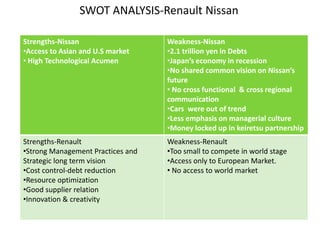
SWOT ANALYSIS-Renault Nissan

Strengths-Nissan                   Weakness-Nissan
•Access to Asian and U.S market    •2.1 trillion yen in Debts
• High Technological Acumen        •Japan’s economy in recession
                                   •No shared common vision on Nissan’s
                                   future
                                   • No cross functional & cross regional
                                   communication
                                   •Cars were out of trend
                                   •Less emphasis on managerial culture
                                   •Money locked up in keiretsu partnership
Strengths-Renault                  Weakness-Renault
•Strong Management Practices and   •Too small to compete in world stage
Strategic long term vision         •Access only to European Market.
•Cost control-debt reduction       • No access to world market
•Resource optimization
•Good supplier relation
•Innovation & creativity
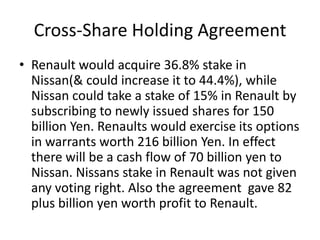
Cross-Share Holding Agreement
• Renault would acquire 36.8% stake in
  Nissan(& could increase it to 44.4%), while
  Nissan could take a stake of 15% in Renault by
  subscribing to newly issued shares for 150
  billion Yen. Renaults would exercise its options
  in warrants worth 216 billion Yen. In effect
  there will be a cash flow of 70 billion yen to
  Nissan. Nissans stake in Renault was not given
  any voting right. Also the agreement gave 82
  plus billion yen worth profit to Renault.
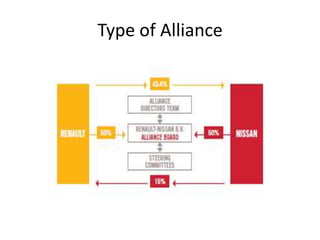
Type of Alliance
Strategic Value for Renault
1.Acceleration of international deployment
2.Economies of scale (purchasing, common
  engines & platforms, co-development)
3.Sharing of best practices (quality, industrial &
  engineering)
4.Optimization of capacity utilization
5.Contribution to net result & dividend flow
6.Cooperation on leading technologies
Strategic value for Nissan
1.Initial financial input from Renault
2.New performance orientated culture
3.Cost and vehicle project management
4.Re-invention of a « product policy »
5.Turn-around in Europe
6.Development of captive finance business

Renault nissan

  • 1.
  • 2.
    Strategic Alliance • Definition – Agreement for cooperation among two or more independen firms to work together towards common objectives – Companies in a strategic alliance do not form a new identity to reach their aims but cooperate while remaining apart and distinct.
  • 3.
    Rationale-Nissan • Japan’s economywas under recession. • Nissan net debts amounted to 2.1 trillion(Yen) in 1997. • Nissan was facing acute liquidity crunch. • Nissan couldn’t raise money by floating bonds as it was classified to junk status. • Hence seeking alliance with foreign carmaker was the only option left. • Talks failed with Ford and Daimler Chrysler
  • 4.
    Rationale-Renault • Renault’s totalglobal market share was around 4%. • Renault was confined to European market. • In order to gain access to global market, Renault started looking out for strategic tie ups. • Talks failed with AMC and Volvo. Finally Renault zeroed onto Nissan
  • 5.
    Nissan-Renault • Nissan couldprovide Renault access to Asian • & U.S market. • Renault would push Nissan out from the point of bankruptcy. • Neither Nissan nor Renault where top global players, but in combination would become a top world player.
  • 6.
    SWOT ANALYSIS-Renault Nissan Strengths-Nissan Weakness-Nissan •Access to Asian and U.S market •2.1 trillion yen in Debts • High Technological Acumen •Japan’s economy in recession •No shared common vision on Nissan’s future • No cross functional & cross regional communication •Cars were out of trend •Less emphasis on managerial culture •Money locked up in keiretsu partnership Strengths-Renault Weakness-Renault •Strong Management Practices and •Too small to compete in world stage Strategic long term vision •Access only to European Market. •Cost control-debt reduction • No access to world market •Resource optimization •Good supplier relation •Innovation & creativity
  • 7.
    Cross-Share Holding Agreement •Renault would acquire 36.8% stake in Nissan(& could increase it to 44.4%), while Nissan could take a stake of 15% in Renault by subscribing to newly issued shares for 150 billion Yen. Renaults would exercise its options in warrants worth 216 billion Yen. In effect there will be a cash flow of 70 billion yen to Nissan. Nissans stake in Renault was not given any voting right. Also the agreement gave 82 plus billion yen worth profit to Renault.
  • 8.
  • 9.
    Strategic Value forRenault 1.Acceleration of international deployment 2.Economies of scale (purchasing, common engines & platforms, co-development) 3.Sharing of best practices (quality, industrial & engineering) 4.Optimization of capacity utilization 5.Contribution to net result & dividend flow 6.Cooperation on leading technologies
  • 10.
    Strategic value forNissan 1.Initial financial input from Renault 2.New performance orientated culture 3.Cost and vehicle project management 4.Re-invention of a « product policy » 5.Turn-around in Europe 6.Development of captive finance business

Editor's Notes