
Leadership :  The ability to influence the thinking, attitudes, and behaviour of people toward achievement of  goals.
Some Leadership Styles Autocratic Leadership Bureaucratic Leadership Charismatic Leadership/Transformational Leadership Democratic Leadership or Participative Leadership People-Oriented Leadership Task-Oriented Leadership Situational Leadership Laissez-Faire Leadership – leave it be.
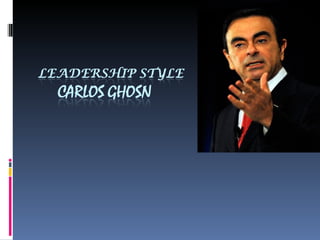
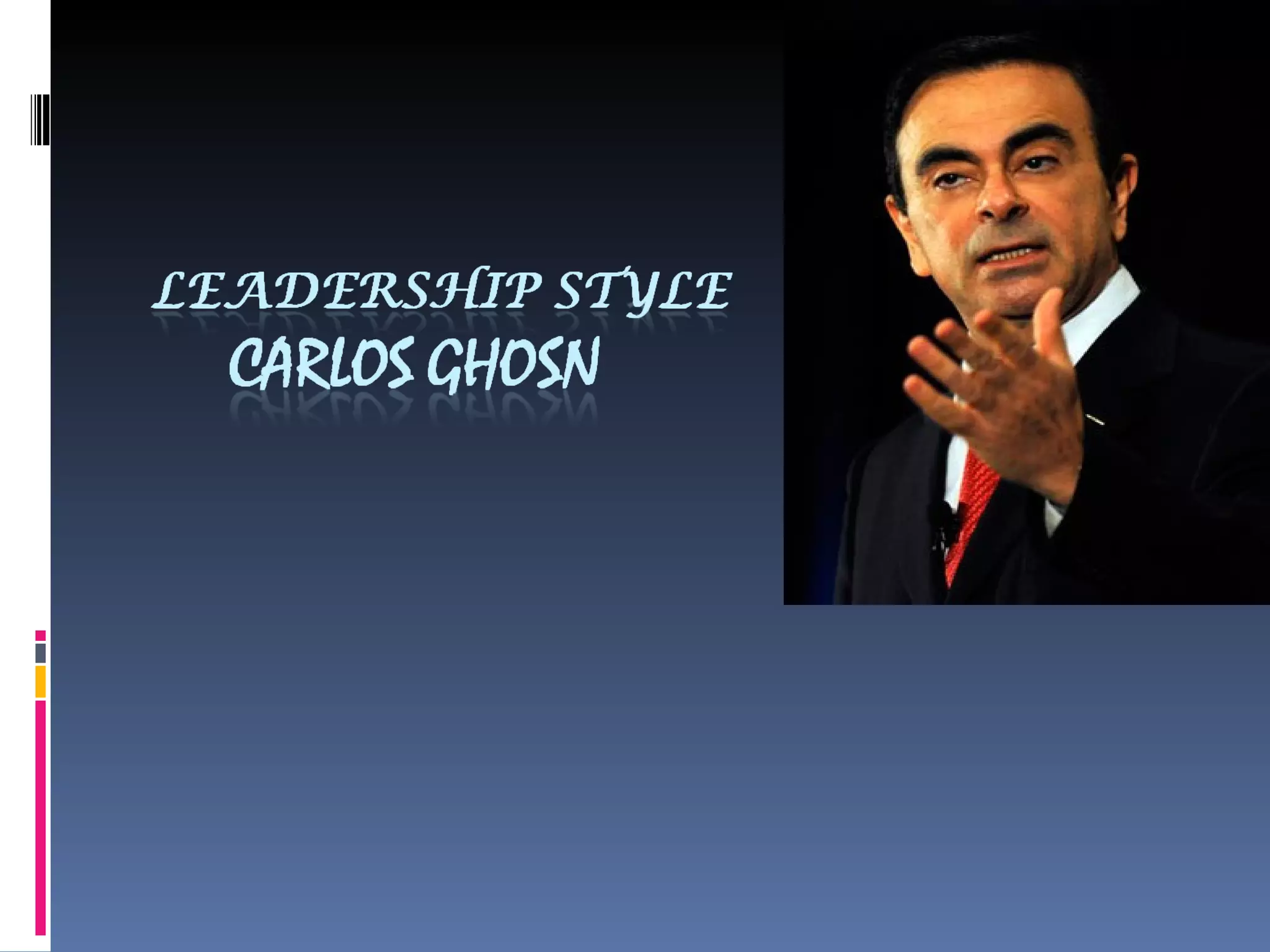
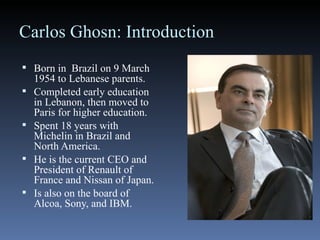
Carlos Ghosn: Introduction Born in  Brazil on 9 March 1954 to Lebanese parents. Completed early education in Lebanon, then moved to Paris for higher education. Spent 18 years with Michelin in Brazil and North America. He is the current CEO and President of Renault of France and Nissan of Japan. Is also on the board of Alcoa, Sony, and IBM.
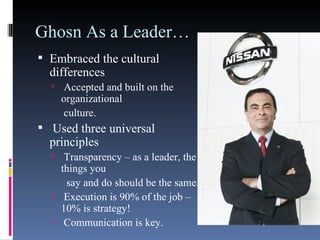
Ghosn As a Leader… Embraced the cultural differences Accepted and built on the organizational   culture. Used three universal principles Transparency – as a leader, the things you   say and do should be the same. Execution is 90% of the job – 10% is strategy! Communication is key.
Ghosn As a Leader Charismatic/Transformational  Democratic He empowered his teams to choose the means  to achieve targets. Always  welcomes suggestions from  subordinates. Made sure to walk around and listen to all the teams and then form an overall opinion.
Ghosn As a Leader… Laissez-Faire Leadership Let his colleagues to get on with their work but monitored them closely. Situational “  You have to adapt your strategy to fit your circumstances.” Is  culturally sensitive and knows to
People Oriented He did not want to set himself apart from his co-workers. They were not going to change Japan but to help Nissan. They would be the ones adapting to Japan and not vice versa. He believed a leader must make sure that the workforce knows how much they have contributed to the goals.
Epitome of cultural diversity He understood that you cannot apply the same business mentality and operation in Brazil as you would in France. Cross func-tional teams are a key to his method. When you’re in a company that doesn’t work cross functionally, everyone feels satisfied with his own performance and assumes that bad results are someone else’s fault’ .
Leaders are not born, they are developed by other leaders He believes that every CEO has a responsibility to create the leaders of tomorrow by identifying potential competent individuals who are ambitious, and thus sending them to challenging places where their work is difficult, risky but very promising. He wants to shape the leader through letting him or her deal with adversity and challenges, to take responsibility and not by ‘giving them books to read or by having them follow some training course.’
Thank You

Leadership Style

  • 1.
  • 2.
    Leadership : The ability to influence the thinking, attitudes, and behaviour of people toward achievement of goals.
  • 3.
    Some Leadership StylesAutocratic Leadership Bureaucratic Leadership Charismatic Leadership/Transformational Leadership Democratic Leadership or Participative Leadership People-Oriented Leadership Task-Oriented Leadership Situational Leadership Laissez-Faire Leadership – leave it be.
  • 4.
    Carlos Ghosn: IntroductionBorn in Brazil on 9 March 1954 to Lebanese parents. Completed early education in Lebanon, then moved to Paris for higher education. Spent 18 years with Michelin in Brazil and North America. He is the current CEO and President of Renault of France and Nissan of Japan. Is also on the board of Alcoa, Sony, and IBM.
  • 5.
    Ghosn As aLeader… Embraced the cultural differences Accepted and built on the organizational culture. Used three universal principles Transparency – as a leader, the things you say and do should be the same. Execution is 90% of the job – 10% is strategy! Communication is key.
  • 6.
    Ghosn As aLeader Charismatic/Transformational Democratic He empowered his teams to choose the means to achieve targets. Always welcomes suggestions from subordinates. Made sure to walk around and listen to all the teams and then form an overall opinion.
  • 7.
    Ghosn As aLeader… Laissez-Faire Leadership Let his colleagues to get on with their work but monitored them closely. Situational “ You have to adapt your strategy to fit your circumstances.” Is culturally sensitive and knows to
  • 8.
    People Oriented Hedid not want to set himself apart from his co-workers. They were not going to change Japan but to help Nissan. They would be the ones adapting to Japan and not vice versa. He believed a leader must make sure that the workforce knows how much they have contributed to the goals.
  • 9.
    Epitome of culturaldiversity He understood that you cannot apply the same business mentality and operation in Brazil as you would in France. Cross func-tional teams are a key to his method. When you’re in a company that doesn’t work cross functionally, everyone feels satisfied with his own performance and assumes that bad results are someone else’s fault’ .
  • 10.
    Leaders are notborn, they are developed by other leaders He believes that every CEO has a responsibility to create the leaders of tomorrow by identifying potential competent individuals who are ambitious, and thus sending them to challenging places where their work is difficult, risky but very promising. He wants to shape the leader through letting him or her deal with adversity and challenges, to take responsibility and not by ‘giving them books to read or by having them follow some training course.’
  • 11.