Renal function and
tests of renal function
Dr Akeem Oyeyemi Lawal
MBBS (Ilorin), MPH (Manchester), MWACP (LM), FMCPath (Chemical Pathology)
Department of Chemical Pathology
National Hospital Abuja
Lecturer I, Department of Chemical Pathology
College of Health Sciences
University of Abuja
Visiting Consultant Chemical Pathologist
Federal Medical Centre, Jabi
2
Pre-test 1…
Which of the following is NOT regarded as a function of the kidney?
A. Fluid balance
B. Synthesis of thrombopoitein
C. Excretion of acid
D. Urine formation
E. Clearance
3
Pre-test 2…
Which of the following is most accurate in assessing glomerular
function?
A. Creatinine
B. Cystatin C
C. Para-amino hippuric acid
D. Inulin
E. Iohexol
4
Pre-test 3…
Which of the following kidney functions can be inferred from plasma
Calcium assay?
A. Storage function
B. Endocrine function
C. Synthetic function
D. Excretory function
E. Regulatory function
5
Pre-test 4…
‘Electrolyte/urea/creatinine’ is one of the commonly requested
biochemical investigations. What category of kidney function tests can
it be classified?
A. Homeostatic function
B. Synthetic function
C. Excretory function
D. Homeostatic and synthetic function
E. Homeostatic and excretory function
6
Learning objectives
• To appreciate the functional anatomy of the kidneys
• To understand the physiological roles of the kidneys
• To understand the categories of tests of renal function including
tests of glomerular and tubular function
• To appreciate the application of renal function tests in clinical
practice
7
Outline
• Introduction
• Functional anatomy
• Physiology
• Tests of kidney function
• Clinical applications of renal function tests
• Conclusion
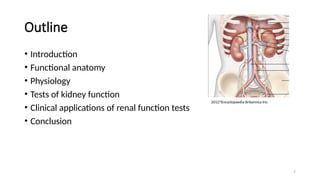
2012©
Encyclopaedia Britannica Inc.
8
Introduction…
OUTLINE
• Introduction
• Functional anatomy
• Physiology
• Tests of kidney function
• Clinical applications of renal
function tests
• Conclusion
9
Introduction
• Renal system: kidneys, ureters, urinary bladder and urethra; accompanying
neurovasculature
• Latter play essentially storage or conduit roles hence renal function is largely
synonymous with kidney function
• Kidneys play a wide array of critical functions including excretory, homeostatic,
synthetic and endocrine functions
• Defects in renal function therefore life-threatening
• Kidney function tests rank most requested biochemical investigations in clinical practice
10
Functional anatomy…
OUTLINE
• Introduction
• Functional anatomy
• Physiology
• Tests of kidney function
• Clinical applications of renal
function tests
• Conclusion
11
Functional anatomy
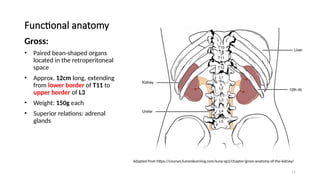
Gross:
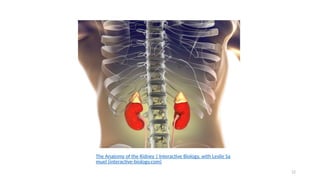
• Paired bean-shaped organs
located in the retroperitoneal
space
• Approx. 12cm long, extending
from lower border of T11 to
upper border of L3
• Weight: 150g each
• Superior relations: adrenal
glands
Adapted from https://courses.lumenlearning.com/suny-ap2/chapter/gross-anatomy-of-the-kidney/
12
The Anatomy of the Kidney | Interactive Biology, with Leslie Sa
muel (interactive-biology.com)
13
Functional anatomy:
Gross cont’d
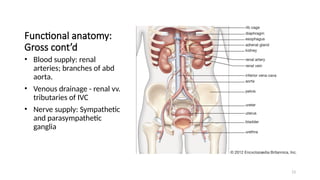
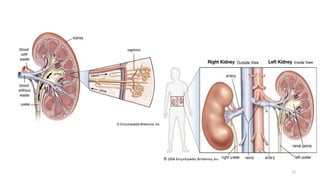
• Blood supply: renal
arteries; branches of abd
aorta.
• Venous drainage - renal vv.
tributaries of IVC
• Nerve supply: Sympathetic
and parasympathetic
ganglia
14
Histology:
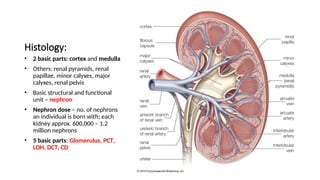
• 2 basic parts: cortex and medulla
• Others: renal pyramids, renal
papillae, minor calyxes, major
calyxes, renal pelvis
• Basic structural and functional
unit – nephron
• Nephron dose – no. of nephrons
an individual is born with; each
kidney approx. 600,000 – 1.2
million nephrons
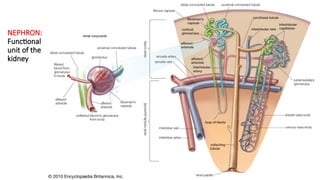
• 5 basic parts: Glomerulus, PCT,
LOH, DCT, CD
15
16
NEPHRON:
Functional
unit of the
kidney
17
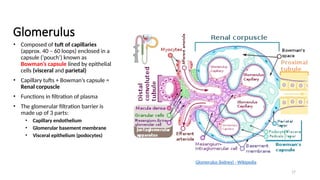
Glomerulus
• Composed of tuft of capillaries
(approx. 40 – 60 loops) enclosed in a
capsule (‘pouch’) known as
Bowman’s capsule lined by epithelial
cells (visceral and parietal)
• Capillary tufts + Bowman’s capsule =
Renal corpuscle
• Functions in filtration of plasma
• The glomerular filtration barrier is
made up of 3 parts:
• Capillary endothelium
• Glomerular basement membrane
• Visceral epithelium (podocytes)
Glomerulus (kidney) - Wikipedia
18
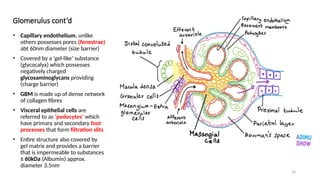
Glomerulus cont’d
• Capillary endothelium, unlike
others possesses pores (fenestrae)
abt 60nm diameter (size barrier)
• Covered by a ‘gel-like’ substance
(glycocalyx) which possesses
negatively charged
glycosaminoglycans providing
(charge barrier)
• GBM is made up of dense network
of collagen fibres
• Visceral epithelial cells are
referred to as ‘podocytes’ which
have primary and secondary foot
processes that form filtration slits
• Entire structure also covered by
gel matrix and provides a barrier
that is impermeable to substances
≥ 60kDa (Albumin) approx.
diameter 3.5nm
19
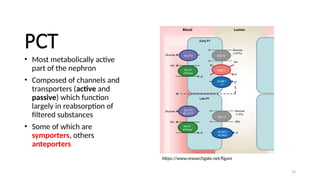
PCT
• Most metabolically active
part of the nephron
• Composed of channels and
transporters (active and
passive) which function
largely in reabsorption of
filtered substances
• Some of which are
symporters, others
anteporters
https://www.researchgate.net/figure
20
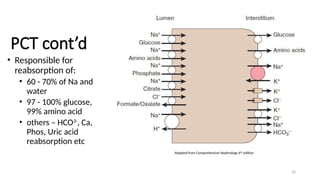
PCT cont’d
• Responsible for
reabsorption of:
• 60 - 70% of Na and
water
• 97 - 100% glucose,
99% amino acid
• others – HCO3-
, Ca,
Phos, Uric acid
reabsorption etc
Adapted from Comprehensive Nephrology 6th
edition
21
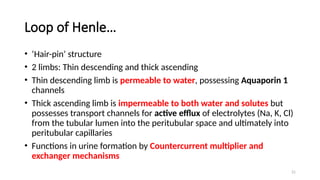
Loop of Henle…
• ‘Hair-pin’ structure
• 2 limbs: Thin descending and thick ascending
• Thin descending limb is permeable to water, possessing Aquaporin 1
channels
• Thick ascending limb is impermeable to both water and solutes but
possesses transport channels for active efflux of electrolytes (Na, K, Cl)
from the tubular lumen into the peritubular space and ultimately into
peritubular capillaries
• Functions in urine formation by Countercurrent multiplier and
exchanger mechanisms
22
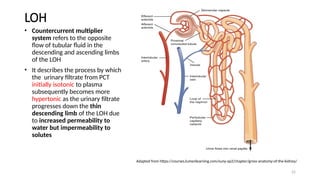
LOH
• Countercurrent multiplier
system refers to the opposite
flow of tubular fluid in the
descending and ascending limbs
of the LOH
• It describes the process by which
the urinary filtrate from PCT
initially isotonic to plasma
subsequently becomes more
hypertonic as the urinary filtrate
progresses down the thin
descending limb of the LOH due
to increased permeability to
water but impermeability to
solutes
Adapted from https://courses.lumenlearning.com/suny-ap2/chapter/gross-anatomy-of-the-kidney/
23
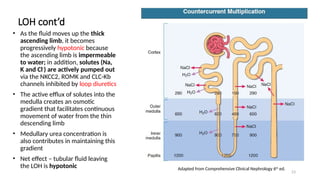
LOH cont’d
• As the fluid moves up the thick
ascending limb, it becomes
progressively hypotonic because
the ascending limb is impermeable
to water; in addition, solutes (Na,
K and Cl-
) are actively pumped out
via the NKCC2, ROMK and CLC-Kb
channels inhibited by loop diuretics
• The active efflux of solutes into the
medulla creates an osmotic
gradient that facilitates continuous
movement of water from the thin
descending limb
• Medullary urea concentration is
also contributes in maintaining this
gradient
• Net effect – tubular fluid leaving
the LOH is hypotonic Adapted from Comprehensive Clinical Nephrology 6th
ed.
24
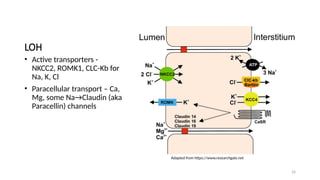
LOH
• Active transporters -
NKCC2, ROMK1, CLC-Kb for
Na, K, Cl
• Paracellular transport – Ca,
Mg, some Na→Claudin (aka
Paracellin) channels
Adapted from https://www.researchgate.net
25
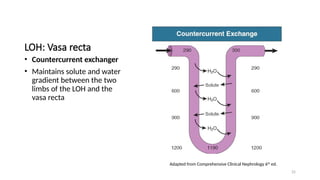
LOH: Vasa recta
• Countercurrent exchanger
• Maintains solute and water
gradient between the two
limbs of the LOH and the
vasa recta
Adapted from Comprehensive Clinical Nephrology 6th
ed.
26
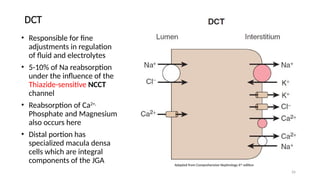
DCT
• Responsible for fine
adjustments in regulation
of fluid and electrolytes
• 5-10% of Na reabsorption
under the influence of the
Thiazide-sensitive NCCT
channel
• Reabsorption of Ca2+,
Phosphate and Magnesium
also occurs here
• Distal portion has
specialized macula densa
cells which are integral
components of the JGA Adapted from Comprehensive Nephrology 6th
edition
27
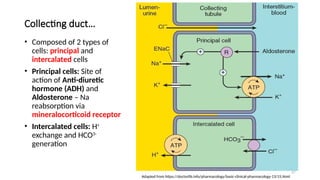
Collecting duct…
• Composed of 2 types of
cells: principal and
intercalated cells
• Principal cells: Site of
action of Anti-diuretic
hormone (ADH) and
Aldosterone – Na
reabsorption via
mineralocorticoid receptor
• Intercalated cells: H+
exchange and HCO3-
generation
Adapted from https://doctorlib.info/pharmacology/basic-clinical-pharmacology-13/15.html
28
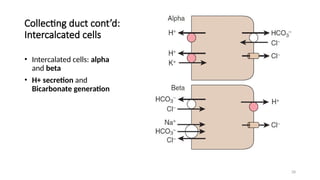
Collecting duct cont’d:
Intercalcated cells
• Intercalated cells: alpha
and beta
• H+ secretion and
Bicarbonate generation
29
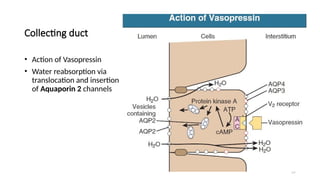
Collecting duct
• Action of Vasopressin
• Water reabsorption via
translocation and insertion
of Aquaporin 2 channels
30
Physiology…
OUTLINE
• Introduction
• Functional anatomy
• Physiology
• Tests of kidney function
• Clinical applications of renal
function tests
• Conclusion
31
Functions of the kidney…
1. Homeostatic function: Fluid and electrolyte
balance; Acid-base balance
2. Urine formation
3. Excretory function
4. Endocrine function
5. Synthetic function
32
Homeostatic function…
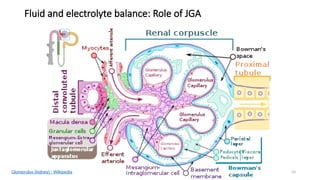
A. Fluid and electrolyte balance:
• Accomplished via the renin-angiotensin-aldosterone system
• Involves the JGA composed of:
• Juxtaglomerular (granular) cells
• Macula densa
• Extra-glomerular mesangial cells of Lacis
• Baroreceptors in the JGA, carotid sinus and aortic arch,
chemoreceptors in the macula densa and osmoreceptors in the
hypothalamus
33
Fluid and electrolyte balance: Role of JGA
Glomerulus (kidney) - Wikipedia
34
Fluid and electrolyte balance cont’d:
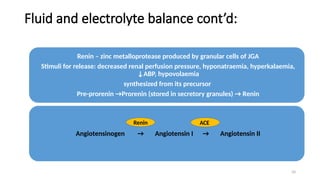
Renin – zinc metalloprotease produced by granular cells of JGA
Stimuli for release: decreased renal perfusion pressure, hyponatraemia, hyperkalaemia,
↓ABP, hypovolaemia
synthesized from its precursor
Pre-prorenin →Prorenin (stored in secretory granules) → Renin
Angiotensinogen → Angiotensin I → Angiotensin II
Renin ACE
35
Fluid and electrolyte balance cont’d:
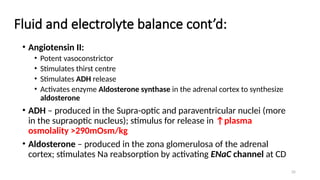
• Angiotensin II:
• Potent vasoconstrictor
• Stimulates thirst centre
• Stimulates ADH release
• Activates enzyme Aldosterone synthase in the adrenal cortex to synthesize
aldosterone
• ADH – produced in the Supra-optic and paraventricular nuclei (more
in the supraoptic nucleus); stimulus for release in ↑plasma
osmolality >290mOsm/kg
• Aldosterone – produced in the zona glomerulosa of the adrenal
cortex; stimulates Na reabsorption by activating ENaC channel at CD
36
Homeostatic function…
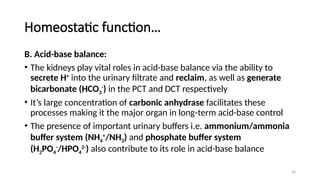
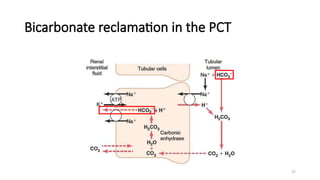
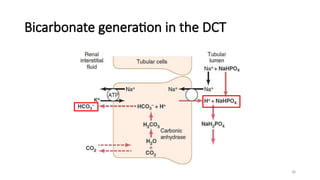
B. Acid-base balance:
• The kidneys play vital roles in acid-base balance via the ability to
secrete H+
into the urinary filtrate and reclaim, as well as generate
bicarbonate (HCO3
-
) in the PCT and DCT respectively
• It’s large concentration of carbonic anhydrase facilitates these
processes making it the major organ in long-term acid-base control
• The presence of important urinary buffers i.e. ammonium/ammonia
buffer system (NH4
+
/NH3) and phosphate buffer system
(H2PO4
-
/HPO4
2-
) also contribute to its role in acid-base balance
37
Bicarbonate reclamation in the PCT
38
Bicarbonate generation in the DCT
39
Role of
Ammonium/Ammonia
buffer system
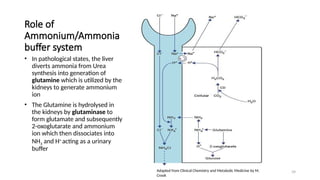
• In pathological states, the liver
diverts ammonia from Urea
synthesis into generation of
glutamine which is utilized by the
kidneys to generate ammonium
ion
• The Glutamine is hydrolysed in
the kidneys by glutaminase to
form glutamate and subsequently
2-oxoglutarate and ammonium
ion which then dissociates into
NH3 and H+
acting as a urinary
buffer
Adapted from Clinical Chemistry and Metabolic Medicine by M.
Crook
40
Urine formation
• The kidneys are involved in urine formation via the Countercurrent
multiplier and exchanger systems
• Also requires the influence of ADH and Aldosterone
41
Excretory function
• Excretion of metabolic wastes and nitrogenous compounds e.g. Urea,
Creatinine, uric acid, water soluble drugs etc
42
Endocrine function
• Renin
• 1,25-(OH)2vitamin D - 1α hydroxylase enzyme
• Erythropoietin
• Thrombopoietin
• Prostaglandins
43
Synthetic function
• Gluconeogenesis
• Bicarbonate generation
44
Tests of kidney function…
OUTLINE
• Introduction
• Functional anatomy
• Physiology
• Tests of kidney function
• Clinical applications of renal
function tests
• Conclusion
45
Assessment of glomerular function
• Glomerular filtration rate (GFR)
• Concept of clearance
• Markers for clearance studies
• Estimated GFR (eGFR)
46
Glomerular filtration rate
• The kidneys receive 25% of cardiac output
• About 125mL of blood is filtered across the glomerulus per minute
(125mL/min ≡ 180L/day)
• Filtration is dependent on a balance of forces
• Also affected by:
• Renal blood flow
• Renal perfusion pressure
47
Glomerular filtration rate cont’d
• GFR is considered the most reliable measure of functional capacity of
the kidneys
• Reflection of number of functioning nephrons and most sensitive and
specific marker of overall changes in renal function
• Implicated in major classification systems of Acute kidney injury (AKI)
and Chronic kidney disease (CKD) ie. RIFLE/AKIN criteria and CKD-
EPI/KDIGO classification respectively
48
Concept of clearance
• Definition: volume of plasma from which a substance is completely
cleared (removed) per unit time
• Is an index for measurement of GFR
• Requirements for an ideal marker for clearance:
• Stable concentration in plasma – no extra-renal elimination
• Physiologically inert – negligible plasma protein binding
• Freely filtered
• Not reabsorbed
• Not secreted
• Not synthesized
• Not metabolized
49
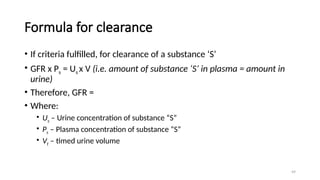
Formula for clearance
• If criteria fulfilled, for clearance of a substance ‘S’
• GFR x Ps = Us x V (i.e. amount of substance ‘S’ in plasma = amount in
urine)
• Therefore, GFR =
• Where:
• Us – Urine concentration of substance “S”
• Ps – Plasma concentration of substance “S”
• Vt – timed urine volume
50
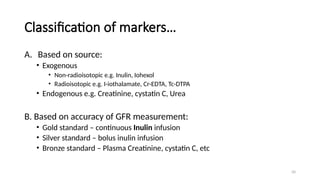
Classification of markers…
A. Based on source:
• Exogenous
• Non-radioisotopic e.g. Inulin, Iohexol
• Radioisotopic e.g. I-iothalamate, Cr-EDTA, Tc-DTPA
• Endogenous e.g. Creatinine, cystatin C, Urea
B. Based on accuracy of GFR measurement:
• Gold standard – continuous Inulin infusion
• Silver standard – bolus inulin infusion
• Bronze standard – Plasma Creatinine, cystatin C, etc
51
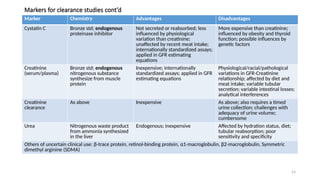
Markers for clearance studies
Marker Chemistry Advantages Disadvantages
1. Exogenous
Continuous inulin infusion
(aka sinistrin)
Polymer of fructose Gold std; closest known ideal
marker
Exogenous, prone to
anaphylactic reactions;
time-consuming; laborious;
requires urethral
catheterization; prone to
errors due to incomplete
bladder emptying; complex
laboratory analysis
Inulin (bolus) Polymer of fructose Silver std; acceptable
agreement with gold std
As above; also some
extrarenal clearance
I-Iothalamate continuous
infusion
Labeled with Iodine
radioisotope
Silver std; simple
measurement with
radioactive detector;
acceptable agreement with
gold std
Exogenous; risk of ionizing
radiation; time consuming,
laborious procedure;
anaphylactic reactions;
positive bias with gold std
probably due to secretion
I-Iothalamate (bolus) Labeled with Iodine
radioisotope
As above As above
52
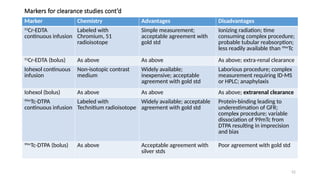
Markers for clearance studies cont’d
Marker Chemistry Advantages Disadvantages
51
Cr-EDTA
continuous infusion
Labeled with
Chromium, 51
radioisotope
Simple measurement;
acceptable agreement with
gold std
Ionizing radiation; time
consuming complex procedure;
probable tubular reabsorption;
less readily available than 99m
Tc
51
Cr-EDTA (bolus) As above As above As above; extra-renal clearance
Iohexol continuous
infusion
Non-isotopic contrast
medium
Widely available;
inexpensive; acceptable
agreement with gold std
Laborious procedure; complex
measurement requiring ID-MS
or HPLC; anaphylaxis
Iohexol (bolus) As above As above As above; extrarenal clearance
99m
Tc-DTPA
continuous infusion
Labeled with
Technitium radioisotope
Widely available; acceptable
agreement with gold std
Protein-binding leading to
underestimation of GFR;
complex procedure; variable
dissociation of 99mTc from
DTPA resulting in imprecision
and bias
99m
Tc-DTPA (bolus) As above Acceptable agreement with
silver stds
Poor agreement with gold std
53
Markers for clearance studies cont’d
Marker Chemistry Advantages Disadvantages
Cystatin C Bronze std; endogenous
proteinase inhibitor
Not secreted or reabsorbed; less
influenced by physiological
variation than creatinine;
unaffected by recent meat intake;
internationally standardized assays;
applied in GFR estimating
equations
More expensive than creatinine;
influenced by obesity and thyroid
function; possible influences by
genetic factors
Creatinine
(serum/plasma)
Bronze std; endogenous
nitrogenous substance
synthesize from muscle
protein
Inexpensive; internationally
standardized assays; applied in GFR
estimating equations
Physiological/racial/pathological
variations in GFR-Creatinine
relationship; affected by diet and
meat intake; variable tubular
secretion; variable intestinal losses;
analytical interferences
Creatinine
clearance
As above Inexpensive As above; also requires a timed
urine collection; challenges with
adequacy of urine volume;
cumbersome
Urea Nitrogenous waste product
from ammonia synthesized
in the liver
Endogenous; inexpensive Affected by hydration status, diet;
tubular reabsorption; poor
sensitivity and specificity
Others of uncertain clinical use: β-trace protein, retinol-binding protein, α1-macroglobulin, β2-macroglobulin, Symmetric
dimethyl arginine (SDMA)
54
Creatinine
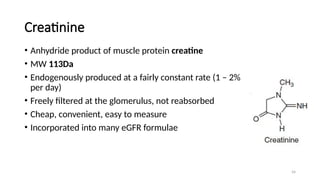
• Anhydride product of muscle protein creatine
• MW 113Da
• Endogenously produced at a fairly constant rate (1 – 2%
per day)
• Freely filtered at the glomerulus, not reabsorbed
• Cheap, convenient, easy to measure
• Incorporated into many eGFR formulae
55
Creatinine
• However affected by age, gender, race, muscle mass, nutritional
status, other preanalytical and analytical factors
• Secreted by renal tubules
• Some extrarenal clearance in GIT
• Wide intraindividual variation
56
Cystatin C
• Low MW (12.8kDa) protein synthesized by all nucleated cells
• Functions as a cysteine protease inhibitor
• Endogenously produced at a fairly constant rate
• Freely filtered at the glomerulus, completely reabsorbed and
catabolized by renal tubules hence can also be used as a marker of
tubular function
• Not affected by muscle mass
• However affected by age, gender, weight, height, obesity, thyroid
hormone concentration
57
Urea
• Nitrogenous waste product of protein catabolism
• Synthesized exclusively in the liver
• CO(NH2)2
• Freely filtered at the glomerulus
• Significant tubular “back-diffusion” (passive reabsorption) about 40 –
70% from the tubules into renal interstitium and ultimately into
plasma
• Back-diffusion is reduced in high-flow states e.g. pregnancy due to
increased GFR; reduced in low flow states e.g pre-renal AKI
58
Urea
• Back-diffusion limits its use as a marker of GFR→ underestimation
• Also significantly affected by protein diet, hydration status, increased
protein catabolism, GI haemorrhage which leads to reabsorption of
blood proteins and treatment with cortisol (or its synthetic
analogues)
• Overall has poor sensitivity and specificity as a marker for GFR and
thus no longer used
59
Urea
• May however find utility in the urea-creatinine ratio to crudely
differentiate pre-renal from intrinsic AKI
• Normal urea-creatinine ratio in a normal individual with normal
dietary intake = 49 – 81 mmol Urea/mmol Creatinine (12 – 20
mg/mg)
• Ratio >81 mmol/mmol said to be suggestive of pre-renal AKI
• Also useful in assessing adequacy of dialysis using the urea reduction
rate ((pre dialysis urea – post dialysis urea)/pre dialysis urea x 100%)
60
Tests of tubular function
• Involves evaluation of proximal tubular function (i.e. tubular handling
of sodium, glucose, phosphate, calcium, bicarbonate and amino acids)
and distal tubular function (urinary acidification and concentration)
• Increased levels in urine indicate tubular dysfunction
• Examples:
• Urinary β2-macroglobulin
• Urinary N-acetyl-β-D-glucosaminidase
• Urinary Cystatin C
61
Estimated glomerular filtration rate (eGFR)
• Developed due to limitations of collection of timed urine specimen for
clearance studies
• Estimate of GFR using mathematical formulae derived from
comparison with clearance studies
62
Estimated glomerular filtration rate (eGFR)
• Cockcroft-Gault equation
• Modification of diet in renal disease (MDRD)
• CKD-EPI Creatinine (2009)
• CKD-EPI Cystatin C (2012)
• CKD-EPI Creatinine-Cystatin C (2012)
• CKD-EPI Creatinine (2021)
• Schwartz formula (children)
63
Cockcroft-Gault equation
• Oldest equation
• Estimates GFR using weight, age, serum creatinine
• Cohort used did not include women
• Requirement of weight made utility cumbersome
• Was derived using creatinine clearance rather than a reference
method for creatinine
• Did not account for body surface area (BSA)
64
Cockcroft-Gault equation
• Formula: males…
[(140 - age) x weight x 1.23]/serum creatinine (in µmol/L)
OR [(140 - age) x weight/72 x serum creatinine (in mg/dL)]
• Multiply by a factor of 0.85 in females
65
MDRD
• Modification of diet in renal disease
• Does not require weight
• Also adjusts eGFR with BSA
• Original formula used age, race, gender, serum creatinine, urea and
albumin values
• Modified formula eliminates urea and albumin
• However underestimated eGFR when ≥ 60mL/min/1.73m2
66
CKD-EPI Creatinine
• Developed in 2009 by the Chronic Kidney Disease Epidemiology
Collaboration (CKD-EPI)
• Does not require weight
• Developed against standardized reference assay for creatinine
• Better estimate of GFR than MDRD
• Requires use of age, race and serum creatinine
• Modified formula in 2021 removed race
67
CKD-EPI cystatin C/CKD-EPI Creatinine-cystatin C
• Developed in 2012 by CKD-EPI
• Incorporates cystatin C to overcome or obviate limitations of
creatinine
68
Modified Schwartz formula
• Utilized in individuals ≤ 18 years
• Requires height and serum creatinine
69
Novel biomarkers of kidney disease
• Newer markers to detect early kidney damage
• Neutrophil gelatinase associated lipocalin (NGAL)
• Kidney injury molecule 1 (KIM-1)
• Interleukin 18 (IL-18)
• Liver fatty acid binding protein (L-FABP)
70
Clinical application of renal
function tests…
OUTLINE
• Introduction
• Functional anatomy
• Physiology
• Tests of kidney function
• Clinical applications of renal
function tests
• Conclusion
71
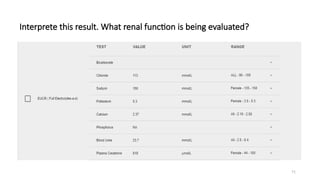
Interprete this result. What renal function is being evaluated?
72
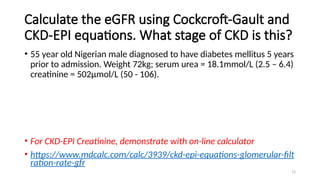
Calculate the eGFR using Cockcroft-Gault and
CKD-EPI equations. What stage of CKD is this?
• 55 year old Nigerian male diagnosed to have diabetes mellitus 5 years
prior to admission. Weight 72kg; serum urea = 18.1mmol/L (2.5 – 6.4)
creatinine = 502µmol/L (50 - 106).
• For CKD-EPI Creatinine, demonstrate with on-line calculator
• https://www.mdcalc.com/calc/3939/ckd-epi-equations-glomerular-filt
ration-rate-gfr
73
Review of learning objectives…
• To appreciate the functional anatomy of the kidneys
• To understand the physiological roles of the kidneys
• To understand the categories of tests of renal function including tests
of glomerular and tubular function
• To appreciate the application of renal function tests in clinical practice
74
Conclusion…
OUTLINE
• Introduction
• Functional anatomy
• Physiology
• Tests of kidney function
• Clinical applications of renal
function tests
• Conclusion
75
Conclusion…
• The kidneys are vital organs which play a myriad of clinical functions
• Defects in normal function of the kidneys have debilitating effects
• Kidney disease is quite common, being a complication of many prevalent non-communicable and
communicable diseases i.e diabetes mellitus, hypertension, sepsis/infections, drugs and toxins etc
• Laboratory investigation of kidney function requires comprehensive understanding of renal physiology
• Assessment of glomerular function is an invaluable index of overall kidney function through GFR and
clearance studies
• Understanding categories of tests of kidney function will guide clinicians in prompt and appropriate
management of kidney disease
KEY
MESSAGES
76
Pre-test 1…
Which of the following is NOT regarded as a function of the kidney?
A. Fluid balance
B. Synthesis of thrombopoitein
C. Excretion of acid
D. Urine formation
E. Clearance
77
Pre-test 2…
Which of the following is most accurate in assessing glomerular
function?
A. Creatinine
B. Cystatin C
C. Para-amino hippuric acid
D. Inulin
E. Iohexol
78
Pre-test 3…
Which of the following kidney functions can be inferred from plasma
Calcium assay?
A. Storage function
B. Endocrine function
C. Synthetic function
D. Excretory function
E. Regulatory function
79
Pre-test 4…
‘Electrolyte/urea/creatinine’ is one of the commonly requested
biochemical investigations. What category of kidney function tests can
it be classified?
A. Homeostatic function
B. Synthetic function
C. Excretory function
D. Homeostatic and synthetic function
E. Homeostatic and excretory function
80
References
• Tietz textbook of Clinical Chemistry and Molecular diagnostics
• Comprehensive clinical nephrology
• Wikipedia
• Encyclopaedia Britannica
• www.researchgate.net
81
Thanks for listening!

Renal function and tests of renal function 3.pptx

  • 1.
    Renal function and testsof renal function Dr Akeem Oyeyemi Lawal MBBS (Ilorin), MPH (Manchester), MWACP (LM), FMCPath (Chemical Pathology) Department of Chemical Pathology National Hospital Abuja Lecturer I, Department of Chemical Pathology College of Health Sciences University of Abuja Visiting Consultant Chemical Pathologist Federal Medical Centre, Jabi
  • 2.
    2 Pre-test 1… Which ofthe following is NOT regarded as a function of the kidney? A. Fluid balance B. Synthesis of thrombopoitein C. Excretion of acid D. Urine formation E. Clearance
  • 3.
    3 Pre-test 2… Which ofthe following is most accurate in assessing glomerular function? A. Creatinine B. Cystatin C C. Para-amino hippuric acid D. Inulin E. Iohexol
  • 4.
    4 Pre-test 3… Which ofthe following kidney functions can be inferred from plasma Calcium assay? A. Storage function B. Endocrine function C. Synthetic function D. Excretory function E. Regulatory function
  • 5.
    5 Pre-test 4… ‘Electrolyte/urea/creatinine’ isone of the commonly requested biochemical investigations. What category of kidney function tests can it be classified? A. Homeostatic function B. Synthetic function C. Excretory function D. Homeostatic and synthetic function E. Homeostatic and excretory function
  • 6.
    6 Learning objectives • Toappreciate the functional anatomy of the kidneys • To understand the physiological roles of the kidneys • To understand the categories of tests of renal function including tests of glomerular and tubular function • To appreciate the application of renal function tests in clinical practice
  • 7.
    7 Outline • Introduction • Functionalanatomy • Physiology • Tests of kidney function • Clinical applications of renal function tests • Conclusion 2012© Encyclopaedia Britannica Inc.
  • 8.
    8 Introduction… OUTLINE • Introduction • Functionalanatomy • Physiology • Tests of kidney function • Clinical applications of renal function tests • Conclusion
  • 9.
    9 Introduction • Renal system:kidneys, ureters, urinary bladder and urethra; accompanying neurovasculature • Latter play essentially storage or conduit roles hence renal function is largely synonymous with kidney function • Kidneys play a wide array of critical functions including excretory, homeostatic, synthetic and endocrine functions • Defects in renal function therefore life-threatening • Kidney function tests rank most requested biochemical investigations in clinical practice
  • 10.
    10 Functional anatomy… OUTLINE • Introduction •Functional anatomy • Physiology • Tests of kidney function • Clinical applications of renal function tests • Conclusion
  • 11.
    11 Functional anatomy Gross: • Pairedbean-shaped organs located in the retroperitoneal space • Approx. 12cm long, extending from lower border of T11 to upper border of L3 • Weight: 150g each • Superior relations: adrenal glands Adapted from https://courses.lumenlearning.com/suny-ap2/chapter/gross-anatomy-of-the-kidney/
  • 12.
    12 The Anatomy ofthe Kidney | Interactive Biology, with Leslie Sa muel (interactive-biology.com)
  • 13.
    13 Functional anatomy: Gross cont’d •Blood supply: renal arteries; branches of abd aorta. • Venous drainage - renal vv. tributaries of IVC • Nerve supply: Sympathetic and parasympathetic ganglia
  • 14.
    14 Histology: • 2 basicparts: cortex and medulla • Others: renal pyramids, renal papillae, minor calyxes, major calyxes, renal pelvis • Basic structural and functional unit – nephron • Nephron dose – no. of nephrons an individual is born with; each kidney approx. 600,000 – 1.2 million nephrons • 5 basic parts: Glomerulus, PCT, LOH, DCT, CD
  • 15.
  • 16.
  • 17.
    17 Glomerulus • Composed oftuft of capillaries (approx. 40 – 60 loops) enclosed in a capsule (‘pouch’) known as Bowman’s capsule lined by epithelial cells (visceral and parietal) • Capillary tufts + Bowman’s capsule = Renal corpuscle • Functions in filtration of plasma • The glomerular filtration barrier is made up of 3 parts: • Capillary endothelium • Glomerular basement membrane • Visceral epithelium (podocytes) Glomerulus (kidney) - Wikipedia
  • 18.
    18 Glomerulus cont’d • Capillaryendothelium, unlike others possesses pores (fenestrae) abt 60nm diameter (size barrier) • Covered by a ‘gel-like’ substance (glycocalyx) which possesses negatively charged glycosaminoglycans providing (charge barrier) • GBM is made up of dense network of collagen fibres • Visceral epithelial cells are referred to as ‘podocytes’ which have primary and secondary foot processes that form filtration slits • Entire structure also covered by gel matrix and provides a barrier that is impermeable to substances ≥ 60kDa (Albumin) approx. diameter 3.5nm
  • 19.
    19 PCT • Most metabolicallyactive part of the nephron • Composed of channels and transporters (active and passive) which function largely in reabsorption of filtered substances • Some of which are symporters, others anteporters https://www.researchgate.net/figure
  • 20.
    20 PCT cont’d • Responsiblefor reabsorption of: • 60 - 70% of Na and water • 97 - 100% glucose, 99% amino acid • others – HCO3- , Ca, Phos, Uric acid reabsorption etc Adapted from Comprehensive Nephrology 6th edition
  • 21.
    21 Loop of Henle… •‘Hair-pin’ structure • 2 limbs: Thin descending and thick ascending • Thin descending limb is permeable to water, possessing Aquaporin 1 channels • Thick ascending limb is impermeable to both water and solutes but possesses transport channels for active efflux of electrolytes (Na, K, Cl) from the tubular lumen into the peritubular space and ultimately into peritubular capillaries • Functions in urine formation by Countercurrent multiplier and exchanger mechanisms
  • 22.
    22 LOH • Countercurrent multiplier systemrefers to the opposite flow of tubular fluid in the descending and ascending limbs of the LOH • It describes the process by which the urinary filtrate from PCT initially isotonic to plasma subsequently becomes more hypertonic as the urinary filtrate progresses down the thin descending limb of the LOH due to increased permeability to water but impermeability to solutes Adapted from https://courses.lumenlearning.com/suny-ap2/chapter/gross-anatomy-of-the-kidney/
  • 23.
    23 LOH cont’d • Asthe fluid moves up the thick ascending limb, it becomes progressively hypotonic because the ascending limb is impermeable to water; in addition, solutes (Na, K and Cl- ) are actively pumped out via the NKCC2, ROMK and CLC-Kb channels inhibited by loop diuretics • The active efflux of solutes into the medulla creates an osmotic gradient that facilitates continuous movement of water from the thin descending limb • Medullary urea concentration is also contributes in maintaining this gradient • Net effect – tubular fluid leaving the LOH is hypotonic Adapted from Comprehensive Clinical Nephrology 6th ed.
  • 24.
    24 LOH • Active transporters- NKCC2, ROMK1, CLC-Kb for Na, K, Cl • Paracellular transport – Ca, Mg, some Na→Claudin (aka Paracellin) channels Adapted from https://www.researchgate.net
  • 25.
    25 LOH: Vasa recta •Countercurrent exchanger • Maintains solute and water gradient between the two limbs of the LOH and the vasa recta Adapted from Comprehensive Clinical Nephrology 6th ed.
  • 26.
    26 DCT • Responsible forfine adjustments in regulation of fluid and electrolytes • 5-10% of Na reabsorption under the influence of the Thiazide-sensitive NCCT channel • Reabsorption of Ca2+, Phosphate and Magnesium also occurs here • Distal portion has specialized macula densa cells which are integral components of the JGA Adapted from Comprehensive Nephrology 6th edition
  • 27.
    27 Collecting duct… • Composedof 2 types of cells: principal and intercalated cells • Principal cells: Site of action of Anti-diuretic hormone (ADH) and Aldosterone – Na reabsorption via mineralocorticoid receptor • Intercalated cells: H+ exchange and HCO3- generation Adapted from https://doctorlib.info/pharmacology/basic-clinical-pharmacology-13/15.html
  • 28.
    28 Collecting duct cont’d: Intercalcatedcells • Intercalated cells: alpha and beta • H+ secretion and Bicarbonate generation
  • 29.
    29 Collecting duct • Actionof Vasopressin • Water reabsorption via translocation and insertion of Aquaporin 2 channels
  • 30.
    30 Physiology… OUTLINE • Introduction • Functionalanatomy • Physiology • Tests of kidney function • Clinical applications of renal function tests • Conclusion
  • 31.
    31 Functions of thekidney… 1. Homeostatic function: Fluid and electrolyte balance; Acid-base balance 2. Urine formation 3. Excretory function 4. Endocrine function 5. Synthetic function
  • 32.
    32 Homeostatic function… A. Fluidand electrolyte balance: • Accomplished via the renin-angiotensin-aldosterone system • Involves the JGA composed of: • Juxtaglomerular (granular) cells • Macula densa • Extra-glomerular mesangial cells of Lacis • Baroreceptors in the JGA, carotid sinus and aortic arch, chemoreceptors in the macula densa and osmoreceptors in the hypothalamus
  • 33.
    33 Fluid and electrolytebalance: Role of JGA Glomerulus (kidney) - Wikipedia
  • 34.
    34 Fluid and electrolytebalance cont’d: Renin – zinc metalloprotease produced by granular cells of JGA Stimuli for release: decreased renal perfusion pressure, hyponatraemia, hyperkalaemia, ↓ABP, hypovolaemia synthesized from its precursor Pre-prorenin →Prorenin (stored in secretory granules) → Renin Angiotensinogen → Angiotensin I → Angiotensin II Renin ACE
  • 35.
    35 Fluid and electrolytebalance cont’d: • Angiotensin II: • Potent vasoconstrictor • Stimulates thirst centre • Stimulates ADH release • Activates enzyme Aldosterone synthase in the adrenal cortex to synthesize aldosterone • ADH – produced in the Supra-optic and paraventricular nuclei (more in the supraoptic nucleus); stimulus for release in ↑plasma osmolality >290mOsm/kg • Aldosterone – produced in the zona glomerulosa of the adrenal cortex; stimulates Na reabsorption by activating ENaC channel at CD
  • 36.
    36 Homeostatic function… B. Acid-basebalance: • The kidneys play vital roles in acid-base balance via the ability to secrete H+ into the urinary filtrate and reclaim, as well as generate bicarbonate (HCO3 - ) in the PCT and DCT respectively • It’s large concentration of carbonic anhydrase facilitates these processes making it the major organ in long-term acid-base control • The presence of important urinary buffers i.e. ammonium/ammonia buffer system (NH4 + /NH3) and phosphate buffer system (H2PO4 - /HPO4 2- ) also contribute to its role in acid-base balance
  • 37.
  • 38.
  • 39.
    39 Role of Ammonium/Ammonia buffer system •In pathological states, the liver diverts ammonia from Urea synthesis into generation of glutamine which is utilized by the kidneys to generate ammonium ion • The Glutamine is hydrolysed in the kidneys by glutaminase to form glutamate and subsequently 2-oxoglutarate and ammonium ion which then dissociates into NH3 and H+ acting as a urinary buffer Adapted from Clinical Chemistry and Metabolic Medicine by M. Crook
  • 40.
    40 Urine formation • Thekidneys are involved in urine formation via the Countercurrent multiplier and exchanger systems • Also requires the influence of ADH and Aldosterone
  • 41.
    41 Excretory function • Excretionof metabolic wastes and nitrogenous compounds e.g. Urea, Creatinine, uric acid, water soluble drugs etc
  • 42.
    42 Endocrine function • Renin •1,25-(OH)2vitamin D - 1α hydroxylase enzyme • Erythropoietin • Thrombopoietin • Prostaglandins
  • 43.
  • 44.
    44 Tests of kidneyfunction… OUTLINE • Introduction • Functional anatomy • Physiology • Tests of kidney function • Clinical applications of renal function tests • Conclusion
  • 45.
    45 Assessment of glomerularfunction • Glomerular filtration rate (GFR) • Concept of clearance • Markers for clearance studies • Estimated GFR (eGFR)
  • 46.
    46 Glomerular filtration rate •The kidneys receive 25% of cardiac output • About 125mL of blood is filtered across the glomerulus per minute (125mL/min ≡ 180L/day) • Filtration is dependent on a balance of forces • Also affected by: • Renal blood flow • Renal perfusion pressure
  • 47.
    47 Glomerular filtration ratecont’d • GFR is considered the most reliable measure of functional capacity of the kidneys • Reflection of number of functioning nephrons and most sensitive and specific marker of overall changes in renal function • Implicated in major classification systems of Acute kidney injury (AKI) and Chronic kidney disease (CKD) ie. RIFLE/AKIN criteria and CKD- EPI/KDIGO classification respectively
  • 48.
    48 Concept of clearance •Definition: volume of plasma from which a substance is completely cleared (removed) per unit time • Is an index for measurement of GFR • Requirements for an ideal marker for clearance: • Stable concentration in plasma – no extra-renal elimination • Physiologically inert – negligible plasma protein binding • Freely filtered • Not reabsorbed • Not secreted • Not synthesized • Not metabolized
  • 49.
    49 Formula for clearance •If criteria fulfilled, for clearance of a substance ‘S’ • GFR x Ps = Us x V (i.e. amount of substance ‘S’ in plasma = amount in urine) • Therefore, GFR = • Where: • Us – Urine concentration of substance “S” • Ps – Plasma concentration of substance “S” • Vt – timed urine volume
  • 50.
    50 Classification of markers… A.Based on source: • Exogenous • Non-radioisotopic e.g. Inulin, Iohexol • Radioisotopic e.g. I-iothalamate, Cr-EDTA, Tc-DTPA • Endogenous e.g. Creatinine, cystatin C, Urea B. Based on accuracy of GFR measurement: • Gold standard – continuous Inulin infusion • Silver standard – bolus inulin infusion • Bronze standard – Plasma Creatinine, cystatin C, etc
  • 51.
    51 Markers for clearancestudies Marker Chemistry Advantages Disadvantages 1. Exogenous Continuous inulin infusion (aka sinistrin) Polymer of fructose Gold std; closest known ideal marker Exogenous, prone to anaphylactic reactions; time-consuming; laborious; requires urethral catheterization; prone to errors due to incomplete bladder emptying; complex laboratory analysis Inulin (bolus) Polymer of fructose Silver std; acceptable agreement with gold std As above; also some extrarenal clearance I-Iothalamate continuous infusion Labeled with Iodine radioisotope Silver std; simple measurement with radioactive detector; acceptable agreement with gold std Exogenous; risk of ionizing radiation; time consuming, laborious procedure; anaphylactic reactions; positive bias with gold std probably due to secretion I-Iothalamate (bolus) Labeled with Iodine radioisotope As above As above
  • 52.
    52 Markers for clearancestudies cont’d Marker Chemistry Advantages Disadvantages 51 Cr-EDTA continuous infusion Labeled with Chromium, 51 radioisotope Simple measurement; acceptable agreement with gold std Ionizing radiation; time consuming complex procedure; probable tubular reabsorption; less readily available than 99m Tc 51 Cr-EDTA (bolus) As above As above As above; extra-renal clearance Iohexol continuous infusion Non-isotopic contrast medium Widely available; inexpensive; acceptable agreement with gold std Laborious procedure; complex measurement requiring ID-MS or HPLC; anaphylaxis Iohexol (bolus) As above As above As above; extrarenal clearance 99m Tc-DTPA continuous infusion Labeled with Technitium radioisotope Widely available; acceptable agreement with gold std Protein-binding leading to underestimation of GFR; complex procedure; variable dissociation of 99mTc from DTPA resulting in imprecision and bias 99m Tc-DTPA (bolus) As above Acceptable agreement with silver stds Poor agreement with gold std
  • 53.
    53 Markers for clearancestudies cont’d Marker Chemistry Advantages Disadvantages Cystatin C Bronze std; endogenous proteinase inhibitor Not secreted or reabsorbed; less influenced by physiological variation than creatinine; unaffected by recent meat intake; internationally standardized assays; applied in GFR estimating equations More expensive than creatinine; influenced by obesity and thyroid function; possible influences by genetic factors Creatinine (serum/plasma) Bronze std; endogenous nitrogenous substance synthesize from muscle protein Inexpensive; internationally standardized assays; applied in GFR estimating equations Physiological/racial/pathological variations in GFR-Creatinine relationship; affected by diet and meat intake; variable tubular secretion; variable intestinal losses; analytical interferences Creatinine clearance As above Inexpensive As above; also requires a timed urine collection; challenges with adequacy of urine volume; cumbersome Urea Nitrogenous waste product from ammonia synthesized in the liver Endogenous; inexpensive Affected by hydration status, diet; tubular reabsorption; poor sensitivity and specificity Others of uncertain clinical use: β-trace protein, retinol-binding protein, α1-macroglobulin, β2-macroglobulin, Symmetric dimethyl arginine (SDMA)
  • 54.
    54 Creatinine • Anhydride productof muscle protein creatine • MW 113Da • Endogenously produced at a fairly constant rate (1 – 2% per day) • Freely filtered at the glomerulus, not reabsorbed • Cheap, convenient, easy to measure • Incorporated into many eGFR formulae
  • 55.
    55 Creatinine • However affectedby age, gender, race, muscle mass, nutritional status, other preanalytical and analytical factors • Secreted by renal tubules • Some extrarenal clearance in GIT • Wide intraindividual variation
  • 56.
    56 Cystatin C • LowMW (12.8kDa) protein synthesized by all nucleated cells • Functions as a cysteine protease inhibitor • Endogenously produced at a fairly constant rate • Freely filtered at the glomerulus, completely reabsorbed and catabolized by renal tubules hence can also be used as a marker of tubular function • Not affected by muscle mass • However affected by age, gender, weight, height, obesity, thyroid hormone concentration
  • 57.
    57 Urea • Nitrogenous wasteproduct of protein catabolism • Synthesized exclusively in the liver • CO(NH2)2 • Freely filtered at the glomerulus • Significant tubular “back-diffusion” (passive reabsorption) about 40 – 70% from the tubules into renal interstitium and ultimately into plasma • Back-diffusion is reduced in high-flow states e.g. pregnancy due to increased GFR; reduced in low flow states e.g pre-renal AKI
  • 58.
    58 Urea • Back-diffusion limitsits use as a marker of GFR→ underestimation • Also significantly affected by protein diet, hydration status, increased protein catabolism, GI haemorrhage which leads to reabsorption of blood proteins and treatment with cortisol (or its synthetic analogues) • Overall has poor sensitivity and specificity as a marker for GFR and thus no longer used
  • 59.
    59 Urea • May howeverfind utility in the urea-creatinine ratio to crudely differentiate pre-renal from intrinsic AKI • Normal urea-creatinine ratio in a normal individual with normal dietary intake = 49 – 81 mmol Urea/mmol Creatinine (12 – 20 mg/mg) • Ratio >81 mmol/mmol said to be suggestive of pre-renal AKI • Also useful in assessing adequacy of dialysis using the urea reduction rate ((pre dialysis urea – post dialysis urea)/pre dialysis urea x 100%)
  • 60.
    60 Tests of tubularfunction • Involves evaluation of proximal tubular function (i.e. tubular handling of sodium, glucose, phosphate, calcium, bicarbonate and amino acids) and distal tubular function (urinary acidification and concentration) • Increased levels in urine indicate tubular dysfunction • Examples: • Urinary β2-macroglobulin • Urinary N-acetyl-β-D-glucosaminidase • Urinary Cystatin C
  • 61.
    61 Estimated glomerular filtrationrate (eGFR) • Developed due to limitations of collection of timed urine specimen for clearance studies • Estimate of GFR using mathematical formulae derived from comparison with clearance studies
  • 62.
    62 Estimated glomerular filtrationrate (eGFR) • Cockcroft-Gault equation • Modification of diet in renal disease (MDRD) • CKD-EPI Creatinine (2009) • CKD-EPI Cystatin C (2012) • CKD-EPI Creatinine-Cystatin C (2012) • CKD-EPI Creatinine (2021) • Schwartz formula (children)
  • 63.
    63 Cockcroft-Gault equation • Oldestequation • Estimates GFR using weight, age, serum creatinine • Cohort used did not include women • Requirement of weight made utility cumbersome • Was derived using creatinine clearance rather than a reference method for creatinine • Did not account for body surface area (BSA)
  • 64.
    64 Cockcroft-Gault equation • Formula:males… [(140 - age) x weight x 1.23]/serum creatinine (in µmol/L) OR [(140 - age) x weight/72 x serum creatinine (in mg/dL)] • Multiply by a factor of 0.85 in females
  • 65.
    65 MDRD • Modification ofdiet in renal disease • Does not require weight • Also adjusts eGFR with BSA • Original formula used age, race, gender, serum creatinine, urea and albumin values • Modified formula eliminates urea and albumin • However underestimated eGFR when ≥ 60mL/min/1.73m2
  • 66.
    66 CKD-EPI Creatinine • Developedin 2009 by the Chronic Kidney Disease Epidemiology Collaboration (CKD-EPI) • Does not require weight • Developed against standardized reference assay for creatinine • Better estimate of GFR than MDRD • Requires use of age, race and serum creatinine • Modified formula in 2021 removed race
  • 67.
    67 CKD-EPI cystatin C/CKD-EPICreatinine-cystatin C • Developed in 2012 by CKD-EPI • Incorporates cystatin C to overcome or obviate limitations of creatinine
  • 68.
    68 Modified Schwartz formula •Utilized in individuals ≤ 18 years • Requires height and serum creatinine
  • 69.
    69 Novel biomarkers ofkidney disease • Newer markers to detect early kidney damage • Neutrophil gelatinase associated lipocalin (NGAL) • Kidney injury molecule 1 (KIM-1) • Interleukin 18 (IL-18) • Liver fatty acid binding protein (L-FABP)
  • 70.
    70 Clinical application ofrenal function tests… OUTLINE • Introduction • Functional anatomy • Physiology • Tests of kidney function • Clinical applications of renal function tests • Conclusion
  • 71.
    71 Interprete this result.What renal function is being evaluated?
  • 72.
    72 Calculate the eGFRusing Cockcroft-Gault and CKD-EPI equations. What stage of CKD is this? • 55 year old Nigerian male diagnosed to have diabetes mellitus 5 years prior to admission. Weight 72kg; serum urea = 18.1mmol/L (2.5 – 6.4) creatinine = 502µmol/L (50 - 106). • For CKD-EPI Creatinine, demonstrate with on-line calculator • https://www.mdcalc.com/calc/3939/ckd-epi-equations-glomerular-filt ration-rate-gfr
  • 73.
    73 Review of learningobjectives… • To appreciate the functional anatomy of the kidneys • To understand the physiological roles of the kidneys • To understand the categories of tests of renal function including tests of glomerular and tubular function • To appreciate the application of renal function tests in clinical practice
  • 74.
    74 Conclusion… OUTLINE • Introduction • Functionalanatomy • Physiology • Tests of kidney function • Clinical applications of renal function tests • Conclusion
  • 75.
    75 Conclusion… • The kidneysare vital organs which play a myriad of clinical functions • Defects in normal function of the kidneys have debilitating effects • Kidney disease is quite common, being a complication of many prevalent non-communicable and communicable diseases i.e diabetes mellitus, hypertension, sepsis/infections, drugs and toxins etc • Laboratory investigation of kidney function requires comprehensive understanding of renal physiology • Assessment of glomerular function is an invaluable index of overall kidney function through GFR and clearance studies • Understanding categories of tests of kidney function will guide clinicians in prompt and appropriate management of kidney disease KEY MESSAGES
  • 76.
    76 Pre-test 1… Which ofthe following is NOT regarded as a function of the kidney? A. Fluid balance B. Synthesis of thrombopoitein C. Excretion of acid D. Urine formation E. Clearance
  • 77.
    77 Pre-test 2… Which ofthe following is most accurate in assessing glomerular function? A. Creatinine B. Cystatin C C. Para-amino hippuric acid D. Inulin E. Iohexol
  • 78.
    78 Pre-test 3… Which ofthe following kidney functions can be inferred from plasma Calcium assay? A. Storage function B. Endocrine function C. Synthetic function D. Excretory function E. Regulatory function
  • 79.
    79 Pre-test 4… ‘Electrolyte/urea/creatinine’ isone of the commonly requested biochemical investigations. What category of kidney function tests can it be classified? A. Homeostatic function B. Synthetic function C. Excretory function D. Homeostatic and synthetic function E. Homeostatic and excretory function
  • 80.
    80 References • Tietz textbookof Clinical Chemistry and Molecular diagnostics • Comprehensive clinical nephrology • Wikipedia • Encyclopaedia Britannica • www.researchgate.net
  • 81.

Editor's Notes

  • #11 IVC – inferior vena cava
  • #14 PCT – Proximal convoluted tubule LOH – Loop of Henle DCT – Distal convoluted tubule CD – Collecting duct
  • #17 JGA – Juxtaglomerular apparatus
  • #18 GBM – Glomerular basement membrane kDa – kilodalton Mesangial cells – have contractile properties acting like smooth muscle cells in regulation of renal blood flow
  • #22 The thick ascending limb of the LOH is also referred to as the diluting segment *Single osmotic effect vs countercurrent multiplication*
  • #23 This medullary concentration gradient is important in concentration of urine. Urea reabsorption and active efflux of Na, Cl and K contribute to this gradient Individuals with psychogenic polydipsia abolish the formation of this concentration gradient and thus present with polyuria. The thick ascending limb of the LOH is impermeable to urea. The collecting duct however has active UT-A1 and UT-A3 channels which result in active reabsorption of urea. This urea is recycled into the nephron at the thin descending and ascending limbs which are permeable to urea. The UT channels are influenced by ADH.
  • #25 Equilibration of the hypertonic interstitium with the isotonic capillary blood does not occur in the renal medulla despite the osmotic gradient The U-shaped arrangement of vasa recta supplying the renal medulla ensures that solute entry and water loss in the descending vasa recta are offset by solute loss and water entry in the ascending vasa recta. This process is entirely passive and is referred to as the Countercurrent exchanger
  • #29 Collecting ducts empty into the minor and major calyces and subsequently into the renal pelvis and ultimately through the ureters to the urinary bladder and urethra for excretion
  • #36 PCT – proximal convoluted tubule DCT – distal convoluted tubule
  • #39 In pathological states, the liver diverts ammonia from Urea synthesis into generation of glutamine which is utilized by the kidneys to generate ammonium ion The Glutamine is hydrolysed in the kidneys by glutaminase to form glutamate and subsequently α-ketoglutarate and ammonium ion which then dissociates into NH3 and H+ acting as a urinary buffer
  • #47 R – Risk I – Injury F – Failure L – Loss E – End stage kidney disease AKIN – Acute kidney injury network CKD-EPI – Chronic kidney disease epidemiological consortium KDIGO – Kidney disease improving global outcomes
  • #48 Inulin- polymer of fructose, continuous infusion – ‘Gold standard’
  • #50 Inulin – carbohydrate polymer of fructose; closed to ideal marker for clearance
  • #51 Gold std – Urinary inulin clearance; i.e continuous inulin infusion
  • #52 51Cr-EDTA is widely available in Europe but not available in United States
  • #54 Creatine is synthesized in kidney, liver and pancreas from arginine and glycine via transamidation (forming guanidinoacetic acid) and methylation steps
  • #55 Traceability – IDMS SRM 914a/ SRM 967
  • #56 Positive association of Cystatin C with DM, cigarette smoking, CRP and WCC; inverse relationship with albumin Method of assay – immunmetric e.g. particle-enhanced turbidimetric or nephelometric immune assay (PETIA or PENIA), ELISA Traceability – ERM-DA 471/IFCC cystatin C in human serum developed by IFCC and listed in JCTLM database Reference interval young adults (23 – 50yrs) = 0.6 – 1.1mg/L
  • #58 Treatment with cortisol results in protein breakdown
  • #63 Traceability of creatinine assay was not defined
  • #66 CKD-EPI Chronic Kidney Disease Epidemiological Consortium vs Chronic Kidney Disease Epidemiology Collaboration