RELIANCE
By: Vishwesh Agrawal
INSTITUTE OF DEVELOPMENT AND RESEARCH IN BANKING TECHNOLOGY,HYDERABAD
• Reliance Industries Ltd., incorporated in the year 1973, is a Large Cap
company (having a market cap of Rs 903877.95 Crore) operating in
Diversified sector.
• Reliance Industries Ltd. key Products/Revenue Segments include Refinery
which contributed Rs 246036.00 Crore to Sales Value (63.92 % of Total
Sales), Petrochemicals which contributed Rs 135516.00 Crore to Sales
Value (35.20 % of Total Sales), Oil & Gas which contributed Rs 1992.00
Crore to Sales Value (0.51 % of Total Sales), Other Services which
contributed Rs 789.00 Crore to Sales Value (0.20 % of Total Sales), Others
which contributed Rs 571.00 Crore to Sales Value (0.14 % of Total Sales)for
the year ending 31-Mar-2019.
• For the quarter ended 31-12-2019, the company has reported a
Consolidated sales of Rs 152939.00 Crore, up 2.97 % from last quarter Sales
of Rs 148526.00 Crore and down -2.21 % from last year same quarter Sales
of Rs 156397.00 Crore Company has reported net profit after tax of Rs
11784.00 Crore in latest quarter.
• Ambani would spend hours educating the guardians of the License Raj.
"Bureaucrats needed to be convinced by numbers and details. Ambani and
his team never went to Delhi without these," says B. N. Umyal who used to
run his two publications, the Sunday Observer and the Business and Political
Observer. "They would gather the latest status reports on what was
happening in different parts of the world in their area of interest and
distribute copies of these among influential politicians and bureaucrats.
• In February 1966, Ambani built a spanking new mill at Naroda, twenty
kilometers from Ahmedabad. It was spinning mills and produced roughly
the Indian Rayon.
• Dhirubhai took a loan and started the Reliance Commercial Corporation, a
trading firm, with a capital of Rs 15,000, operating out of a corner in a
borrowed office in Bharat Bazaar
History
• "Reliance Commercial Corporation was an export house which dealt basically
in commodities like ginger, cardamom, pepper, turmeric, cashew nut etc. We
had a lot of connections in Aden and they exploited these connections to
export a wide range of commodities. Aden being a free port had tremendous
demand for a range of commodities.“ Not only they were exporting spices, but
also exporting sugar, ghee, and, soil.
• Ambani registered Reliance Textile Industries with a paid-up capital of Rs
150,000 not as a composite mill but as a power loom unit. “They got the license
for power loom because the regulation was that you could not make 100 per
cent filament synthetics except on licensed power looms”.
• Dhirubhai's request for a Rs 400,000 loan from Viren Shah for
manufacturing. In the first year itself, Seventy workers manning four
warp-knitting machines and a small dyeing section notched up sales
of Rs 90m and a profit of Rs 1.3m. By 1977, the year Dhirubhai went
public, the mill was earning a tidy profit of Rs 43.3m from revenues of
Rs 700m.
• Ambani shared his view that when buying machinery, it must be the
latest and the best. "Play on the frontiers of technology”.
• In 1975 a World Bank team visited twenty-four leading textile mills
and reported that 'judged in relation to developed country standards,
only one mill,Reliance, could be described as excellent'
• The High Unit Value Scheme which the government introduced in
1971, through which polyester filament yarn could be imported
against the exports of nylon fabrics. Reliance Commercial
Corporation accounted for over 60 per cent of exports under the
scheme.
• This scheme remained in force for eight years. Reliance used to hold
fashion shows in Russia and in Poland and exported their fabrics. They
took planeloads [of fabrics] to Zambia, Uganda and even Saud Arabia.
• Ambani was exporting rayon fabrics and importing nylon fibre and
supplying it to mills. The profits were between 15 per cent and 25 per
cent net.
• When the scheme ended in 1978, Ambani turned to the domestic
market. Their first priority was to establish their Vimal brand name.
• Billboards, radio, print, and television--once a distribution network
had been established—blazoned the mill's message, ONLY VIMAL and
the baseline, "A woman expresses herself in many languages--Vimal is
one of them.“
• Ambani started opening his own showrooms also started offering
franchises to shareholders and promise to provide financial and
advertising support to who agreed for him and had the shop spaces.
• In his drive to achieve high volumes, Ambani spotted an entirely new
market--the non-metro urban segment--and opened it up.
• For three years, between 1977 and 1980, almost daily new and
exclusive Vimal retail outlet would open its doors to business. "In fact,
on a single day in 1980 they opened as many as one hundred Vimal
showrooms.“
• By 1980, Reliance fabrics were available all over India through twenty
company owned retail outlets, over 1,000 franchised outlets and over
20,000 regular retail stores.
• By 1980, sales were Rs 2.1bn and growing, but Reliance's production
couldn't meet demand. Ambani stretched the mill's production
capacity to its outer limits, continuously upgrading the technology
and replacing slower looms with faster ones.
• Sales doubled every two years from Rs 49m in 1970, to Rs 127m
(1972), Rs 302m (1974), Rs 628m (1976), Rs 1,201m (1978) and Rs
2,097m (1980).
• In 1979, Reliance needed money to finance a worsted (wool-blended)
spinning mill and Dhirubhai picked up a forgotten financial
instrument, the partly convertible debenture and he found it difficult
to get permission from the controller of capital issues.
• Dhirubhai relentlessly lobbied the government until it accepted the
concept. Investors liked the idea so much that the 1979 issue was
oversubscribed six times and convertible debentures (both partly
convertible and fully convertible) became the instrument of choice for
managements and investors.
• Between 1979 and 1982, Reliance made four successful debenture
issues. The 1979 issue (for the worsted mill) was quickly followed by
one in 1980 (for modernizing its textile mill), 1981 (to finance PFY
manufacture) and a record Rs 500m one in 1982 at the time of the
attack by the infamous bear syndicate which had forced the closure of
the BSE and made Ambani a national figure.
• Ambani's Reliance Textile Industries which fell from Rs 131 to Rs 121
as 350,000 of its shares hit the market. Using the technique of short
selling--where a speculator believes that prices. will fall, sells shares
he doesn't have, and covers the sale by buying them at lower prices
later bear syndicate sold 1.1 million Reliance shares worth over Rs
160m.
• The moment they unloaded Reliance's shares on March 18, Ambani
brokers stepped into action, collared every share in sight and pushed
the price to Rs 125 before the day was out. They continued buying
the next day, and the next, forcing the script to rise giddily. In India,
technically managements cannot buy their own companies' shares, so
a brand new organization, the "Friends of Reliance Association',
emerged which bought 857,000 of the bears' 1.1 million shares.
• Ambani's opportunity to break into PF manufacturing came when the
Indira Gandhi administration threw open the doors of this business to
the private sector in early 1980. Reliance applied immediately for a
license.
• It showed that it linked the government's decision with Dhirubhai's
formidable political contacts. In addition, Pranab Mukherjee's parting
gift to Dhirubhai included a license to expand capacity to 15,000 tpa.“
• Dhirubhai had already built up a reputation for quick project
implementation. Earlier, he had set up a worsted spinning plant
within eight months of getting a license. At Patalganga, where
Reliance acquired an area twenty times larger than necessary for the
polyester filament yarn project which came up in eighteen months.
• In selecting technology for the plant, father and son honed in on
USA’s Du Pont de Nemours. To get Du Pont to sell him their
technology, Dhirubhai promised everything but not partnership.
• Dhirubhai had already absorbed and adopted the two key strategies
of self-reliance and speed. In implementing the PFY project, Ambani
adopted two other co-related strategies: size and sales. He would use
this set of four values over and over to drive Reliance's spectacular
growth.
• Ambani built a 10,000 tpa plant with a built in provision for a further
15,000 tpa expansion. According to H.T. Parekh, who as head of ICICI
sanctioned Reliance's first institutional loan.
• "Dhirubhai would systematically remove the barriers that were
constraining demand." In the case of PYF, Ambani felt that there was
tremendous latent demand, but that it was curbed because at the
time the government reserved PYF for small-scale weavers in the 'art-
silk’ industry. The big mills had to use cotton. This was the key barrier
to consumption and a limited market.
• To get round this problem and stimulate demand, Ambani launched a
‘buy back' scheme where Reliance sold its "Recron' brand of yarn to
small power looms who then sold the grey cloth back to the company
for finishing and eventual sale under the Vimal brand name
• By 1983, PFY had replaced textiles as the major revenue earner in
Reliance's portfolio. Ambani kept adding to capacity, upgrading
technology and modernizing. "This continuing growth allowed
Reliance to emerge as the lowest cost polyester producer in the
world”.
• They follow the dictum: coordinate [operations] horizontally, when in
trouble go vertical. That dictum--both parts of it mare also vital for
speed.“
• In keeping with his core philosophy of backward integration, he
started with PTA (purified terephthalic acid), one of the
petrochemicals from which PFY and PSF can be made.
• Over time, he integrated sideways into LAB (linear alkyl benzene, used
by detergent manufacturers), into thermoplastics such as PVC poly
vinyl chloride), HDPE (high density polyethylene), LDPE (low density
polyethylene, used by plastics processors), and then worked his way
backwards through intermediates such as MEG mono ethylene
glycol), para xylene and n-paraffin, to' the basic raw material,
ethylene and ultimately the source of petrochemicals, oil. Work is in
full swing on an ethylene gas cracker and an oil refinery.
• Work on the PTA plant started immediately Dhirubhai got the license
in 1984.
• Ambani was always a panoramic thinker, and the PSF plant
represented his incredible capacity to take risks. At the 1st time
Ambani applied for permission to make PS F(1984), it was in short
supply. Mills preferred to use PSF because it was cheaper than PFY
largely due to higher excise levies on PFY. Local PSF production was
37,000 tonnes and another 10,000 tonnes was being imported.
Ambani applied for a 45,000 tonne capacity, knowing full well that
half a dozen PSF licenses, albeit smaller ones, had been awarded to
other industrialists.
• Reliance had paid zero taxes on corporate earnings.
• Four times over the past five years Reliance had issued partly
convertible debentures collectively worth Rs 930m. The convertible
parts, worth around Rs 230m, had already been converted into equity
shares. The non-convertible parts were quoting at a discount ranging
from 15 to 18 per cent. Ambani April 1984 offered to exchange every
Rs 100 worth of debentures for 1.4 shares. The then market price for
a debenture was Rs 84, that of a share, Rs 115. For debenture
holders, it was an attractive offer.
• In Reliance's balance sheet, a huge Rs 700m debt would disappear (as
accountants regard debentures as borrowings),share capital would go
up by about Rs 100m, and it would look healthy enough for the next
round of fund-raising.
• The new administration led by Rajiv Gandhi was prompt in granting
permission for Reliance's application for a PSF plant. In fact, according
to Anil, 'the first letter of intent to be cleared by Rajiv Gandhi at the
first cabinet meeting was for Reliance. It was the Rs 460 crore
polyester fibre plant. Later it approved a number of our projects and
schemes like the PVC and foreign exchange financing schemes. That
year, Reliance made a record profit of Rs 710m.
• From May 27 to 29, 1985, the Bombay branches of Standard
Chartered Bank, State Bank of India, Canara Bank and Banque
lndoSuez worked furiously to issue almost a dozen letters of credit
worth a stupendous Rs 1.1bn..
• From May 16 to 18, 1986 on a loans-for-shares scheme which Ambani
had developed in June 1985 and which the paper dubbed the
"Reliance Loan Mela”.
• Ten or more banks had lent over Rs 600m as overdrafts to a
bewildering assortment of sixty investment companies without any
track record against the security of Reliance shares and debentures.
• There appeared to be nothing illegal in Ambani's scheme, nor did it
flout any RBI guidelines.
• In August 1991 to announce the merger of the group's two big
companies, Reliance Industries and Reliance Petrochemicals.
• 1987 - Three letters of intent were converted into industrial licenses.
Subsequent to 30th June, all these industrial licenses were transferred to
Reliance Petrochemicals, Ltd., a company incorporated as a subsidiary of
the company
• 1989 - During the year approval was received under the board branding
scheme for the manufacture of 15,000 tonnes per annum of PFY under the
description PSF/PFY with in the licensed capacity PSF.
• 1990 - During the year pursuant to the policy announced by Govt.
regarding minimum economic scale, the company embarked upon
expansion of PTA capacity from 1,00,000 tonnes to 2,00,000 tonnes per
annum.
• 1992 - With effect from 1st March Reliance Petrochemicals Ltd. was
merged with the Co. As per the scheme of amalgamation, 1 equity shares
of RIL was issued against 10 equity shares held in Reliance Petro
Chemicals Ltd.
• In 1995-96, it entered the telecom industry through a joint venture
with Nynex, US. RIL is India's largest private sector enterprise, is a
major player in the Indian petrochemicals sector.
• Reliance Telecom has struck a deal with US-based
telecommunications giant Motorola to set up the cellular network in
the secured circles. A letter of intent had been singed by both the
companies in October.
• Reliance Industries Ltd. (RIL) has successfully commissioned its third
30,000 tonnes per annum (tpa) polyester filament yarn (PFY) plant at
Hazira in Gujarat
• 1998 - For the first time Reliance Industries is entering the health-
care sector with an initial investment of Rs.100 crore. It has become
joint trustees of Sir Hurkisondas Nurrotumdas Hospital at Charni Road
in Mumbai.
• RIL had entered into a 50:50 joint venture with Hoechst Fibres (a part
of Hoechst AG, Germany) to manufacture wide range of polyester
technical fibres.
• 1999 - The Company undertook the commissioning of its Jamnagar
petrochemicals complex.
• The un-incorporated joint venture between Reliance Industries, Oil
and Natural Gas Corporation (ONGC) and the US-based multinational
Enron Oil and Gas has submitted a proposal with the union petroleum
ministry for a four-fold increase in its gas production from five
million tonnes a day to 22 million tonnes a day.
• 2000 - Reliance has been ranked the second largest producer of POY
and PSF in the world, and the largest polyester manufacturer in
India, with a marketshare of 51 %. Reliance Industries Ltd. and Jet
Airways have signed an agreement in principle to work together on
planned airport privatisation projects.
• Credit rating agency Crisil has assigned the highest safety rating of `AAA' to
the Rs 500 crore non-convertible debenture issue of the company.
• Reliance commissions the world's largest grassroots refinery in a record
36 months: the Jamnagar petrochemicals and integrated refinery complex.
With the development of the associated green belt, the desert surrounding
Jamnagar becomes home to another man-made wonder – Asia’s largest
mango orchard!
2002
• In one of the largest gas discoveries in the world, Reliance discovers gas
deposits at the Krishna Godavari basin, which is a first for a private sector
company in India. The in-place volume of natural gas is found to be in
excess of 7 trillion cubic feet, equivalent to about 1.2 billion barrels of
crude oil.
• 2004
• Reliance emerges as the first and only private Indian organization to
be listed in the Fortune Global 500 list.
• 2005 and 2006
• The company reorganises its business into power generation and
distribution, financial services and telecommunication services.
• 2006
• Reliance launches 'Reliance Fresh' and enters the organised retail
market in India
• By 2008 end, Reliance Retail had 600 stores across 57 cities. That very
year, Reliance Industries becomes India's first private sector
enterprise to cross $2 billion profit mark.
• 2009
• Reliance Industries issues 1:1 bonus shares to its shareholders.
• Reliance commences production of hydrocarbons in its KGD6 block -
against all odds - in just over two years of its discovery, making it the
world’s fastest green-field deepwater oil development project. With
this development, Reliance completes an unprecedented backward
integration journey.
• 2010
• Reliance acquires Infotel Broadband Services Limited and enters the
broadband services market.
• Reliance and BP plc enter a partnership in the oil and gas business. BP
plc takes a 30 per cent stake in 23 oil and gas production sharing
contracts that Reliance operated in India, including the KG-D6 block
for $7.2 billion. Reliance also forms a 50:50 joint venture with BP plc
for sourcing and marketing of gas in India.
• 2013
Reliance Retail reports to have more than 1,400 stores across India.
The business is largest with brands like Reliance Footprint, Reliance
Trends, Reliance Digital, Reliance Kitchen and others.
• 2014
• Reliance Retail becomes the largest retailer by revenue in 2014,
fulfilling the aspirations of millions across the country and bringing
international experiences at affordable prices to every corner of India.
• 2016
• Reliance Jio becomes a major market disruptor with data plans
priced at 1/10th of the market rates.
• 2017
• Jio reports a total of 100 million user base at the end of one year of
its launch
• 2018
At its 41st annual general meeting (AGM), Reliance Industries Ltd (RIL)
chairman Mukesh Ambani announces the launch of JioGigaFiber
broadband services and JioPhone 2.
• 2018
• Shares of Reliance Industries Ltd (RIL) escalate and its market
capitalization touches $100 billion.
• 2019
• Reliance becomes the first Indian company to cross ₹10 trillion
market capitalisation.”
Petroleum Refining & Marketing
• The Jamnagar manufacturing division is the world's largest refining
hub. It has transformed India from being a net importer of petroleum
products to a net exporter, thereby ensuring the nation's energy
security.
• It has crude processing capacity of 1.24 million Barrels Per Stream
Day (BPSD).
• Fuels from Jamnagar refinery are exported to several countries across
the world. Reliance also has another refinery – the sixth largest in the
world – in the Special Economic Zone at Jamnagar. This refinery has a
capacity for processing 580,000 BPD of crude.
Key Components of the R&M Business Model
• Reliance's technical, operational and logistic strengths act as the
fulcrum to leverage its refineries' asset utilization and optimization,
the key components of the R&M business model.
• These strengths, coupled with their highly integrated plants and
automated processes, augment our R&M business's operating
efficiencies.
• Moreover, their refineries are strategically located on the west coast
of India, offering the benefits of low transportation costs for
feedstock and proximity to high-growth markets.
• The goal of R&M business is to deliver industry leading returns and be a
source of medium-term growth, while focusing on health, safety and
environment.
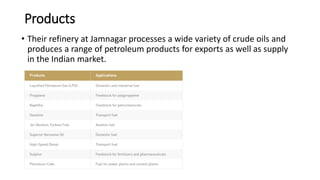
Products
• Their refinery at Jamnagar processes a wide variety of crude oils and
produces a range of petroleum products for exports as well as supply
in the Indian market.
Infrastructure
• Jamnagar site has complexity index of 21.1
• 68.3 MMT crude throughput
• Crude Processing Capacity 1.24 mbpd
REACH:
• Managing 650 million transactions annually across fuel retail network
• Every 3.5 minutes, RIL fuels a plane & every 9th diesel engine is fuelled by
RIL, in India
• RIL processing 1.5% of global transportation fuel
• Fuel retail network serves 500 districts & cover ~2,90,000 kms of National
and State Highways
Illustration:
• Propane – Surging growth story Outcome
• Action: Undertook detailed assessment to identify potential
industries and benefits vis-à-vis substitutes of High Speed Diesel
(HSD) and partnered with customers to provide know-how on
installation and usage
• Outcome : Action RIL has become the preferred propane supplier to
auto ancillary, ceramic and steel industry.
• Growth in monthly sales 400%
Petrochemicals:
• 37.7 MMT Highest petrochemical production
• Illustration:
• Catalysing waste reduction, increasing sustainability in fashion
• Fashion industry has a large carbon footprint due to the complexities
involved in the long value chains for raw material sourcing, manufacturing,
product processing, dyeing and colouration, shipping, retail, consumer use
and post-use disposal.
• Action:
• Reliance Petrochemicals launched 'Fashion-for-Earth', an overarching
initiative that provides a thrust to usage of materials in a sustainable
manner, inculcates circularity in the fashion industry and inspires like-
minded partners and the downstream industry to adopt waste reduction,
thereby contributing to the enhancement of the quality of life of our future
generations.
• Scale of Impact: Reliance launched a number of nation-wide initiatives
such as #earthtee, Circular Design Challenge and #EOOTD under the
Fashion-for-Earth initiative. More than 75 million consumer impressions
were achieved.
• Outcome:
• Several industry leaders, designers, celebrities and social influencers
were involved in raising environmental awareness. Each initiative was
covered by the leading newspapers, magazines and television
channels, leading to a multiplier effect.
Oils and gas:
• Illustration:
Effective use of thermal imaging camera for real-time detection of
minor / major gas leaks
• Action:
Portable infrared thermographic cameras being used which can operate
in wavelengths as long as 14,000 nano metres to detect minor
hydrocarbon gas leaks as low as 0.35g/hr.
• Scale of Impact:
Undetected gas leaks at more than 20 locations were identified in the
plant and rectified.
• Outcomes:
Enhanced workplace safety, and reduced emissions and maintenance
costs.
Retail:
• Reliance Retail serves over 100,000 customers every hour, and has
the patronage of more than 117 million registered customers. Their
customer experience was powered by their state-of-the-art
technology and seamless supply-chain infrastructure.
• The operating model is based on customer centricity, while leveraging
common centres of excellence in technology, business processes and
supply chain.
• Reliance Retail operates over 11,300 stores pan India with ~26 million
square feet of retail space and is growing rapidly.
Media and Entertainment:
PRODUCT FLOW CHART
A diverse set of products and end applicationsProduct flow design:
KEY PERFORMANCE INDICATORS:
SWOT Analysis of Reliance Industries
Strengths of Reliance Industries
• Distribution and Reach: Reliance Industries has a large number of outlets in almost every
state, supported by a strong distribution network that makes sure that its products are
available easily to a large number of customers in a timely manner.
• Cost Structure: Reliance Industries' low cost structure helps it produce at a low cost and
sell its products at a low price, making it affordable for its customers.
• Dealer Community: Reliance Industries has a strong relationship with its dealers that
not only provide them with supplies but also focus on promoting the company's products
and training.
• Financial Position: Reliance Industries has a strong financial position with consecutive
profits in the past 5 years, along with accumulated profit reserves that can be used to
finance future capital expenditures.
• Automation: of various stages of production has allowed the more efficient use of
resources and reducing costs. It also allows for consistency in quality of its products and
provides the ability to scale up and scale down production as per the demand in the
market.
• Product Portfolio: Reliance Industries has a large product portfolio where it
provides products in a large range of categories. It has a number of unique
product offerings that are not provided by competitors.
• Reliance Industries has a well-established IT system that ensures efficiency in its
internal and external operations.
• Reliance Industries owns a number of intellectual property rights that include
trademarks and patents. These allow it exclusivity over its products and
competitors cannot copy or reverse engineer them.
• Reliance Industries is a brand that has been in the market for years, and people
are aware of it. This makes its brand awareness high.
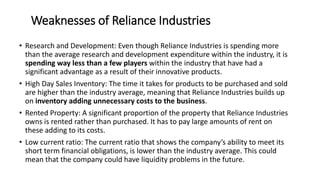
Weaknesses of Reliance Industries
• Research and Development: Even though Reliance Industries is spending more
than the average research and development expenditure within the industry, it is
spending way less than a few players within the industry that have had a
significant advantage as a result of their innovative products.
• High Day Sales Inventory: The time it takes for products to be purchased and sold
are higher than the industry average, meaning that Reliance Industries builds up
on inventory adding unnecessary costs to the business.
• Rented Property: A significant proportion of the property that Reliance Industries
owns is rented rather than purchased. It has to pay large amounts of rent on
these adding to its costs.
• Low current ratio: The current ratio that shows the company’s ability to meet its
short term financial obligations, is lower than the industry average. This could
mean that the company could have liquidity problems in the future.
• Quality Control: Reliance Industries has a lower budget for its quality
control department than competitors. This leads to lack of
consistency and the possibility of damage to quality across its various
outlets.
• Competition and qualified employees have been leaving the
organization in recent years, which could mean a shortage of good
talent for the company in the upcoming years.
• The decision making is highly centralized, and decisions by teams
need to be approved by certain officials.
• The performance appraisal is not in a systematic manner. People are
often not appraised for their performance. This leads to lower work
morale and lack of promotion opportunities for employees.
Opportunities of Reliance Industries
• Internet: There has been an increase in the number of internet users all over the
world. This means that there is an opportunity for Reliance Industries to expand
their presence online; by using the internet to interact with its customers.
• E-commerce: There has been a new trend and a growth in sales of the e-
commerce industry. This means that a lot of people are now making purchases
online. Reliance Industries can earn revenue by opening online stores and
making sales through these.
• Social Media: There has been an increase in the number of social media users
worldwide.Reliance Industries can use social media to promote its products,
interact with customers and collect feedback from them.
• A number of new niche markets have opened up that are growing.
Reliance Industries can sell products in these markets and take
advantage.
• Globalization: Increased globalization does not restrict Reliance
Industries to its own country. It can extend its operations to other
countries, entering into these markets and making use of the
opportunities that lie in these markets.
• Trade barriers have been reduced on the import of goods. This will
reduce the costs incurred on inputs for production.
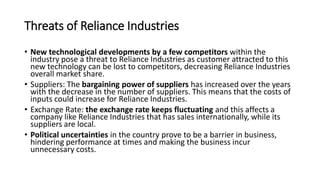
Threats of Reliance Industries
• New technological developments by a few competitors within the
industry pose a threat to Reliance Industries as customer attracted to this
new technology can be lost to competitors, decreasing Reliance Industries
overall market share.
• Suppliers: The bargaining power of suppliers has increased over the years
with the decrease in the number of suppliers. This means that the costs of
inputs could increase for Reliance Industries.
• Exchange Rate: the exchange rate keeps fluctuating and this affects a
company like Reliance Industries that has sales internationally, while its
suppliers are local.
• Political uncertainties in the country prove to be a barrier in business,
hindering performance at times and making the business incur
unnecessary costs.
• Consumer tastes are changing, and this puts pressure on companies
to constantly change their products to meet the needs of these
customers.
• Increased promotions by competitors have been a threat for Reliance
Industries. On most media, there is more clutter than ever, and
customers are bombarded with multiple messages. This reduces the
effectiveness of promotional messages by Reliance Industries.
• Constant technological developments require the workforce to be
trained accordingly as the inability to keep up with these changes can
lead to loss of business for Reliance Industries.
THANK YOU

Reliance Business Model

  • 1.
    RELIANCE By: Vishwesh Agrawal INSTITUTEOF DEVELOPMENT AND RESEARCH IN BANKING TECHNOLOGY,HYDERABAD
  • 2.
    • Reliance IndustriesLtd., incorporated in the year 1973, is a Large Cap company (having a market cap of Rs 903877.95 Crore) operating in Diversified sector. • Reliance Industries Ltd. key Products/Revenue Segments include Refinery which contributed Rs 246036.00 Crore to Sales Value (63.92 % of Total Sales), Petrochemicals which contributed Rs 135516.00 Crore to Sales Value (35.20 % of Total Sales), Oil & Gas which contributed Rs 1992.00 Crore to Sales Value (0.51 % of Total Sales), Other Services which contributed Rs 789.00 Crore to Sales Value (0.20 % of Total Sales), Others which contributed Rs 571.00 Crore to Sales Value (0.14 % of Total Sales)for the year ending 31-Mar-2019. • For the quarter ended 31-12-2019, the company has reported a Consolidated sales of Rs 152939.00 Crore, up 2.97 % from last quarter Sales of Rs 148526.00 Crore and down -2.21 % from last year same quarter Sales of Rs 156397.00 Crore Company has reported net profit after tax of Rs 11784.00 Crore in latest quarter.
  • 3.
    • Ambani wouldspend hours educating the guardians of the License Raj. "Bureaucrats needed to be convinced by numbers and details. Ambani and his team never went to Delhi without these," says B. N. Umyal who used to run his two publications, the Sunday Observer and the Business and Political Observer. "They would gather the latest status reports on what was happening in different parts of the world in their area of interest and distribute copies of these among influential politicians and bureaucrats. • In February 1966, Ambani built a spanking new mill at Naroda, twenty kilometers from Ahmedabad. It was spinning mills and produced roughly the Indian Rayon. • Dhirubhai took a loan and started the Reliance Commercial Corporation, a trading firm, with a capital of Rs 15,000, operating out of a corner in a borrowed office in Bharat Bazaar History
  • 4.
    • "Reliance CommercialCorporation was an export house which dealt basically in commodities like ginger, cardamom, pepper, turmeric, cashew nut etc. We had a lot of connections in Aden and they exploited these connections to export a wide range of commodities. Aden being a free port had tremendous demand for a range of commodities.“ Not only they were exporting spices, but also exporting sugar, ghee, and, soil. • Ambani registered Reliance Textile Industries with a paid-up capital of Rs 150,000 not as a composite mill but as a power loom unit. “They got the license for power loom because the regulation was that you could not make 100 per cent filament synthetics except on licensed power looms”.
  • 5.
    • Dhirubhai's requestfor a Rs 400,000 loan from Viren Shah for manufacturing. In the first year itself, Seventy workers manning four warp-knitting machines and a small dyeing section notched up sales of Rs 90m and a profit of Rs 1.3m. By 1977, the year Dhirubhai went public, the mill was earning a tidy profit of Rs 43.3m from revenues of Rs 700m. • Ambani shared his view that when buying machinery, it must be the latest and the best. "Play on the frontiers of technology”. • In 1975 a World Bank team visited twenty-four leading textile mills and reported that 'judged in relation to developed country standards, only one mill,Reliance, could be described as excellent'
  • 6.
    • The HighUnit Value Scheme which the government introduced in 1971, through which polyester filament yarn could be imported against the exports of nylon fabrics. Reliance Commercial Corporation accounted for over 60 per cent of exports under the scheme. • This scheme remained in force for eight years. Reliance used to hold fashion shows in Russia and in Poland and exported their fabrics. They took planeloads [of fabrics] to Zambia, Uganda and even Saud Arabia. • Ambani was exporting rayon fabrics and importing nylon fibre and supplying it to mills. The profits were between 15 per cent and 25 per cent net.
  • 7.
    • When thescheme ended in 1978, Ambani turned to the domestic market. Their first priority was to establish their Vimal brand name. • Billboards, radio, print, and television--once a distribution network had been established—blazoned the mill's message, ONLY VIMAL and the baseline, "A woman expresses herself in many languages--Vimal is one of them.“ • Ambani started opening his own showrooms also started offering franchises to shareholders and promise to provide financial and advertising support to who agreed for him and had the shop spaces. • In his drive to achieve high volumes, Ambani spotted an entirely new market--the non-metro urban segment--and opened it up.
  • 8.
    • For threeyears, between 1977 and 1980, almost daily new and exclusive Vimal retail outlet would open its doors to business. "In fact, on a single day in 1980 they opened as many as one hundred Vimal showrooms.“ • By 1980, Reliance fabrics were available all over India through twenty company owned retail outlets, over 1,000 franchised outlets and over 20,000 regular retail stores. • By 1980, sales were Rs 2.1bn and growing, but Reliance's production couldn't meet demand. Ambani stretched the mill's production capacity to its outer limits, continuously upgrading the technology and replacing slower looms with faster ones.
  • 9.
    • Sales doubledevery two years from Rs 49m in 1970, to Rs 127m (1972), Rs 302m (1974), Rs 628m (1976), Rs 1,201m (1978) and Rs 2,097m (1980). • In 1979, Reliance needed money to finance a worsted (wool-blended) spinning mill and Dhirubhai picked up a forgotten financial instrument, the partly convertible debenture and he found it difficult to get permission from the controller of capital issues. • Dhirubhai relentlessly lobbied the government until it accepted the concept. Investors liked the idea so much that the 1979 issue was oversubscribed six times and convertible debentures (both partly convertible and fully convertible) became the instrument of choice for managements and investors.
  • 10.
    • Between 1979and 1982, Reliance made four successful debenture issues. The 1979 issue (for the worsted mill) was quickly followed by one in 1980 (for modernizing its textile mill), 1981 (to finance PFY manufacture) and a record Rs 500m one in 1982 at the time of the attack by the infamous bear syndicate which had forced the closure of the BSE and made Ambani a national figure. • Ambani's Reliance Textile Industries which fell from Rs 131 to Rs 121 as 350,000 of its shares hit the market. Using the technique of short selling--where a speculator believes that prices. will fall, sells shares he doesn't have, and covers the sale by buying them at lower prices later bear syndicate sold 1.1 million Reliance shares worth over Rs 160m.
  • 11.
    • The momentthey unloaded Reliance's shares on March 18, Ambani brokers stepped into action, collared every share in sight and pushed the price to Rs 125 before the day was out. They continued buying the next day, and the next, forcing the script to rise giddily. In India, technically managements cannot buy their own companies' shares, so a brand new organization, the "Friends of Reliance Association', emerged which bought 857,000 of the bears' 1.1 million shares. • Ambani's opportunity to break into PF manufacturing came when the Indira Gandhi administration threw open the doors of this business to the private sector in early 1980. Reliance applied immediately for a license.
  • 12.
    • It showedthat it linked the government's decision with Dhirubhai's formidable political contacts. In addition, Pranab Mukherjee's parting gift to Dhirubhai included a license to expand capacity to 15,000 tpa.“ • Dhirubhai had already built up a reputation for quick project implementation. Earlier, he had set up a worsted spinning plant within eight months of getting a license. At Patalganga, where Reliance acquired an area twenty times larger than necessary for the polyester filament yarn project which came up in eighteen months. • In selecting technology for the plant, father and son honed in on USA’s Du Pont de Nemours. To get Du Pont to sell him their technology, Dhirubhai promised everything but not partnership.
  • 13.
    • Dhirubhai hadalready absorbed and adopted the two key strategies of self-reliance and speed. In implementing the PFY project, Ambani adopted two other co-related strategies: size and sales. He would use this set of four values over and over to drive Reliance's spectacular growth. • Ambani built a 10,000 tpa plant with a built in provision for a further 15,000 tpa expansion. According to H.T. Parekh, who as head of ICICI sanctioned Reliance's first institutional loan.
  • 14.
    • "Dhirubhai wouldsystematically remove the barriers that were constraining demand." In the case of PYF, Ambani felt that there was tremendous latent demand, but that it was curbed because at the time the government reserved PYF for small-scale weavers in the 'art- silk’ industry. The big mills had to use cotton. This was the key barrier to consumption and a limited market. • To get round this problem and stimulate demand, Ambani launched a ‘buy back' scheme where Reliance sold its "Recron' brand of yarn to small power looms who then sold the grey cloth back to the company for finishing and eventual sale under the Vimal brand name
  • 15.
    • By 1983,PFY had replaced textiles as the major revenue earner in Reliance's portfolio. Ambani kept adding to capacity, upgrading technology and modernizing. "This continuing growth allowed Reliance to emerge as the lowest cost polyester producer in the world”. • They follow the dictum: coordinate [operations] horizontally, when in trouble go vertical. That dictum--both parts of it mare also vital for speed.“ • In keeping with his core philosophy of backward integration, he started with PTA (purified terephthalic acid), one of the petrochemicals from which PFY and PSF can be made.
  • 16.
    • Over time,he integrated sideways into LAB (linear alkyl benzene, used by detergent manufacturers), into thermoplastics such as PVC poly vinyl chloride), HDPE (high density polyethylene), LDPE (low density polyethylene, used by plastics processors), and then worked his way backwards through intermediates such as MEG mono ethylene glycol), para xylene and n-paraffin, to' the basic raw material, ethylene and ultimately the source of petrochemicals, oil. Work is in full swing on an ethylene gas cracker and an oil refinery. • Work on the PTA plant started immediately Dhirubhai got the license in 1984.
  • 17.
    • Ambani wasalways a panoramic thinker, and the PSF plant represented his incredible capacity to take risks. At the 1st time Ambani applied for permission to make PS F(1984), it was in short supply. Mills preferred to use PSF because it was cheaper than PFY largely due to higher excise levies on PFY. Local PSF production was 37,000 tonnes and another 10,000 tonnes was being imported. Ambani applied for a 45,000 tonne capacity, knowing full well that half a dozen PSF licenses, albeit smaller ones, had been awarded to other industrialists. • Reliance had paid zero taxes on corporate earnings.
  • 18.
    • Four timesover the past five years Reliance had issued partly convertible debentures collectively worth Rs 930m. The convertible parts, worth around Rs 230m, had already been converted into equity shares. The non-convertible parts were quoting at a discount ranging from 15 to 18 per cent. Ambani April 1984 offered to exchange every Rs 100 worth of debentures for 1.4 shares. The then market price for a debenture was Rs 84, that of a share, Rs 115. For debenture holders, it was an attractive offer. • In Reliance's balance sheet, a huge Rs 700m debt would disappear (as accountants regard debentures as borrowings),share capital would go up by about Rs 100m, and it would look healthy enough for the next round of fund-raising.
  • 19.
    • The newadministration led by Rajiv Gandhi was prompt in granting permission for Reliance's application for a PSF plant. In fact, according to Anil, 'the first letter of intent to be cleared by Rajiv Gandhi at the first cabinet meeting was for Reliance. It was the Rs 460 crore polyester fibre plant. Later it approved a number of our projects and schemes like the PVC and foreign exchange financing schemes. That year, Reliance made a record profit of Rs 710m. • From May 27 to 29, 1985, the Bombay branches of Standard Chartered Bank, State Bank of India, Canara Bank and Banque lndoSuez worked furiously to issue almost a dozen letters of credit worth a stupendous Rs 1.1bn..
  • 20.
    • From May16 to 18, 1986 on a loans-for-shares scheme which Ambani had developed in June 1985 and which the paper dubbed the "Reliance Loan Mela”. • Ten or more banks had lent over Rs 600m as overdrafts to a bewildering assortment of sixty investment companies without any track record against the security of Reliance shares and debentures. • There appeared to be nothing illegal in Ambani's scheme, nor did it flout any RBI guidelines. • In August 1991 to announce the merger of the group's two big companies, Reliance Industries and Reliance Petrochemicals.
  • 21.
    • 1987 -Three letters of intent were converted into industrial licenses. Subsequent to 30th June, all these industrial licenses were transferred to Reliance Petrochemicals, Ltd., a company incorporated as a subsidiary of the company • 1989 - During the year approval was received under the board branding scheme for the manufacture of 15,000 tonnes per annum of PFY under the description PSF/PFY with in the licensed capacity PSF. • 1990 - During the year pursuant to the policy announced by Govt. regarding minimum economic scale, the company embarked upon expansion of PTA capacity from 1,00,000 tonnes to 2,00,000 tonnes per annum. • 1992 - With effect from 1st March Reliance Petrochemicals Ltd. was merged with the Co. As per the scheme of amalgamation, 1 equity shares of RIL was issued against 10 equity shares held in Reliance Petro Chemicals Ltd.
  • 22.
    • In 1995-96,it entered the telecom industry through a joint venture with Nynex, US. RIL is India's largest private sector enterprise, is a major player in the Indian petrochemicals sector. • Reliance Telecom has struck a deal with US-based telecommunications giant Motorola to set up the cellular network in the secured circles. A letter of intent had been singed by both the companies in October. • Reliance Industries Ltd. (RIL) has successfully commissioned its third 30,000 tonnes per annum (tpa) polyester filament yarn (PFY) plant at Hazira in Gujarat
  • 23.
    • 1998 -For the first time Reliance Industries is entering the health- care sector with an initial investment of Rs.100 crore. It has become joint trustees of Sir Hurkisondas Nurrotumdas Hospital at Charni Road in Mumbai. • RIL had entered into a 50:50 joint venture with Hoechst Fibres (a part of Hoechst AG, Germany) to manufacture wide range of polyester technical fibres. • 1999 - The Company undertook the commissioning of its Jamnagar petrochemicals complex.
  • 24.
    • The un-incorporatedjoint venture between Reliance Industries, Oil and Natural Gas Corporation (ONGC) and the US-based multinational Enron Oil and Gas has submitted a proposal with the union petroleum ministry for a four-fold increase in its gas production from five million tonnes a day to 22 million tonnes a day. • 2000 - Reliance has been ranked the second largest producer of POY and PSF in the world, and the largest polyester manufacturer in India, with a marketshare of 51 %. Reliance Industries Ltd. and Jet Airways have signed an agreement in principle to work together on planned airport privatisation projects.
  • 25.
    • Credit ratingagency Crisil has assigned the highest safety rating of `AAA' to the Rs 500 crore non-convertible debenture issue of the company. • Reliance commissions the world's largest grassroots refinery in a record 36 months: the Jamnagar petrochemicals and integrated refinery complex. With the development of the associated green belt, the desert surrounding Jamnagar becomes home to another man-made wonder – Asia’s largest mango orchard! 2002 • In one of the largest gas discoveries in the world, Reliance discovers gas deposits at the Krishna Godavari basin, which is a first for a private sector company in India. The in-place volume of natural gas is found to be in excess of 7 trillion cubic feet, equivalent to about 1.2 billion barrels of crude oil.
  • 26.
    • 2004 • Relianceemerges as the first and only private Indian organization to be listed in the Fortune Global 500 list. • 2005 and 2006 • The company reorganises its business into power generation and distribution, financial services and telecommunication services. • 2006 • Reliance launches 'Reliance Fresh' and enters the organised retail market in India
  • 27.
    • By 2008end, Reliance Retail had 600 stores across 57 cities. That very year, Reliance Industries becomes India's first private sector enterprise to cross $2 billion profit mark. • 2009 • Reliance Industries issues 1:1 bonus shares to its shareholders. • Reliance commences production of hydrocarbons in its KGD6 block - against all odds - in just over two years of its discovery, making it the world’s fastest green-field deepwater oil development project. With this development, Reliance completes an unprecedented backward integration journey.
  • 28.
    • 2010 • Relianceacquires Infotel Broadband Services Limited and enters the broadband services market. • Reliance and BP plc enter a partnership in the oil and gas business. BP plc takes a 30 per cent stake in 23 oil and gas production sharing contracts that Reliance operated in India, including the KG-D6 block for $7.2 billion. Reliance also forms a 50:50 joint venture with BP plc for sourcing and marketing of gas in India. • 2013 Reliance Retail reports to have more than 1,400 stores across India. The business is largest with brands like Reliance Footprint, Reliance Trends, Reliance Digital, Reliance Kitchen and others.
  • 29.
    • 2014 • RelianceRetail becomes the largest retailer by revenue in 2014, fulfilling the aspirations of millions across the country and bringing international experiences at affordable prices to every corner of India. • 2016 • Reliance Jio becomes a major market disruptor with data plans priced at 1/10th of the market rates. • 2017 • Jio reports a total of 100 million user base at the end of one year of its launch
  • 30.
    • 2018 At its41st annual general meeting (AGM), Reliance Industries Ltd (RIL) chairman Mukesh Ambani announces the launch of JioGigaFiber broadband services and JioPhone 2. • 2018 • Shares of Reliance Industries Ltd (RIL) escalate and its market capitalization touches $100 billion. • 2019 • Reliance becomes the first Indian company to cross ₹10 trillion market capitalisation.”
  • 32.
    Petroleum Refining &Marketing • The Jamnagar manufacturing division is the world's largest refining hub. It has transformed India from being a net importer of petroleum products to a net exporter, thereby ensuring the nation's energy security. • It has crude processing capacity of 1.24 million Barrels Per Stream Day (BPSD). • Fuels from Jamnagar refinery are exported to several countries across the world. Reliance also has another refinery – the sixth largest in the world – in the Special Economic Zone at Jamnagar. This refinery has a capacity for processing 580,000 BPD of crude.
  • 33.
    Key Components ofthe R&M Business Model • Reliance's technical, operational and logistic strengths act as the fulcrum to leverage its refineries' asset utilization and optimization, the key components of the R&M business model. • These strengths, coupled with their highly integrated plants and automated processes, augment our R&M business's operating efficiencies. • Moreover, their refineries are strategically located on the west coast of India, offering the benefits of low transportation costs for feedstock and proximity to high-growth markets.
  • 34.
    • The goalof R&M business is to deliver industry leading returns and be a source of medium-term growth, while focusing on health, safety and environment.
  • 35.
    Products • Their refineryat Jamnagar processes a wide variety of crude oils and produces a range of petroleum products for exports as well as supply in the Indian market.
  • 36.
    Infrastructure • Jamnagar sitehas complexity index of 21.1 • 68.3 MMT crude throughput • Crude Processing Capacity 1.24 mbpd REACH: • Managing 650 million transactions annually across fuel retail network • Every 3.5 minutes, RIL fuels a plane & every 9th diesel engine is fuelled by RIL, in India • RIL processing 1.5% of global transportation fuel • Fuel retail network serves 500 districts & cover ~2,90,000 kms of National and State Highways
  • 38.
    Illustration: • Propane –Surging growth story Outcome • Action: Undertook detailed assessment to identify potential industries and benefits vis-à-vis substitutes of High Speed Diesel (HSD) and partnered with customers to provide know-how on installation and usage • Outcome : Action RIL has become the preferred propane supplier to auto ancillary, ceramic and steel industry. • Growth in monthly sales 400%
  • 40.
    Petrochemicals: • 37.7 MMTHighest petrochemical production
  • 42.
    • Illustration: • Catalysingwaste reduction, increasing sustainability in fashion • Fashion industry has a large carbon footprint due to the complexities involved in the long value chains for raw material sourcing, manufacturing, product processing, dyeing and colouration, shipping, retail, consumer use and post-use disposal. • Action: • Reliance Petrochemicals launched 'Fashion-for-Earth', an overarching initiative that provides a thrust to usage of materials in a sustainable manner, inculcates circularity in the fashion industry and inspires like- minded partners and the downstream industry to adopt waste reduction, thereby contributing to the enhancement of the quality of life of our future generations. • Scale of Impact: Reliance launched a number of nation-wide initiatives such as #earthtee, Circular Design Challenge and #EOOTD under the Fashion-for-Earth initiative. More than 75 million consumer impressions were achieved.
  • 43.
    • Outcome: • Severalindustry leaders, designers, celebrities and social influencers were involved in raising environmental awareness. Each initiative was covered by the leading newspapers, magazines and television channels, leading to a multiplier effect.
  • 44.
  • 45.
    • Illustration: Effective useof thermal imaging camera for real-time detection of minor / major gas leaks • Action: Portable infrared thermographic cameras being used which can operate in wavelengths as long as 14,000 nano metres to detect minor hydrocarbon gas leaks as low as 0.35g/hr. • Scale of Impact: Undetected gas leaks at more than 20 locations were identified in the plant and rectified. • Outcomes: Enhanced workplace safety, and reduced emissions and maintenance costs.
  • 46.
    Retail: • Reliance Retailserves over 100,000 customers every hour, and has the patronage of more than 117 million registered customers. Their customer experience was powered by their state-of-the-art technology and seamless supply-chain infrastructure. • The operating model is based on customer centricity, while leveraging common centres of excellence in technology, business processes and supply chain. • Reliance Retail operates over 11,300 stores pan India with ~26 million square feet of retail space and is growing rapidly.
  • 50.
  • 54.
    PRODUCT FLOW CHART Adiverse set of products and end applicationsProduct flow design:
  • 57.
  • 60.
    SWOT Analysis ofReliance Industries Strengths of Reliance Industries • Distribution and Reach: Reliance Industries has a large number of outlets in almost every state, supported by a strong distribution network that makes sure that its products are available easily to a large number of customers in a timely manner. • Cost Structure: Reliance Industries' low cost structure helps it produce at a low cost and sell its products at a low price, making it affordable for its customers. • Dealer Community: Reliance Industries has a strong relationship with its dealers that not only provide them with supplies but also focus on promoting the company's products and training. • Financial Position: Reliance Industries has a strong financial position with consecutive profits in the past 5 years, along with accumulated profit reserves that can be used to finance future capital expenditures. • Automation: of various stages of production has allowed the more efficient use of resources and reducing costs. It also allows for consistency in quality of its products and provides the ability to scale up and scale down production as per the demand in the market.
  • 61.
    • Product Portfolio:Reliance Industries has a large product portfolio where it provides products in a large range of categories. It has a number of unique product offerings that are not provided by competitors. • Reliance Industries has a well-established IT system that ensures efficiency in its internal and external operations. • Reliance Industries owns a number of intellectual property rights that include trademarks and patents. These allow it exclusivity over its products and competitors cannot copy or reverse engineer them. • Reliance Industries is a brand that has been in the market for years, and people are aware of it. This makes its brand awareness high.
  • 62.
    Weaknesses of RelianceIndustries • Research and Development: Even though Reliance Industries is spending more than the average research and development expenditure within the industry, it is spending way less than a few players within the industry that have had a significant advantage as a result of their innovative products. • High Day Sales Inventory: The time it takes for products to be purchased and sold are higher than the industry average, meaning that Reliance Industries builds up on inventory adding unnecessary costs to the business. • Rented Property: A significant proportion of the property that Reliance Industries owns is rented rather than purchased. It has to pay large amounts of rent on these adding to its costs. • Low current ratio: The current ratio that shows the company’s ability to meet its short term financial obligations, is lower than the industry average. This could mean that the company could have liquidity problems in the future.
  • 63.
    • Quality Control:Reliance Industries has a lower budget for its quality control department than competitors. This leads to lack of consistency and the possibility of damage to quality across its various outlets. • Competition and qualified employees have been leaving the organization in recent years, which could mean a shortage of good talent for the company in the upcoming years. • The decision making is highly centralized, and decisions by teams need to be approved by certain officials. • The performance appraisal is not in a systematic manner. People are often not appraised for their performance. This leads to lower work morale and lack of promotion opportunities for employees.
  • 64.
    Opportunities of RelianceIndustries • Internet: There has been an increase in the number of internet users all over the world. This means that there is an opportunity for Reliance Industries to expand their presence online; by using the internet to interact with its customers. • E-commerce: There has been a new trend and a growth in sales of the e- commerce industry. This means that a lot of people are now making purchases online. Reliance Industries can earn revenue by opening online stores and making sales through these. • Social Media: There has been an increase in the number of social media users worldwide.Reliance Industries can use social media to promote its products, interact with customers and collect feedback from them.
  • 65.
    • A numberof new niche markets have opened up that are growing. Reliance Industries can sell products in these markets and take advantage. • Globalization: Increased globalization does not restrict Reliance Industries to its own country. It can extend its operations to other countries, entering into these markets and making use of the opportunities that lie in these markets. • Trade barriers have been reduced on the import of goods. This will reduce the costs incurred on inputs for production.
  • 66.
    Threats of RelianceIndustries • New technological developments by a few competitors within the industry pose a threat to Reliance Industries as customer attracted to this new technology can be lost to competitors, decreasing Reliance Industries overall market share. • Suppliers: The bargaining power of suppliers has increased over the years with the decrease in the number of suppliers. This means that the costs of inputs could increase for Reliance Industries. • Exchange Rate: the exchange rate keeps fluctuating and this affects a company like Reliance Industries that has sales internationally, while its suppliers are local. • Political uncertainties in the country prove to be a barrier in business, hindering performance at times and making the business incur unnecessary costs.
  • 67.
    • Consumer tastesare changing, and this puts pressure on companies to constantly change their products to meet the needs of these customers. • Increased promotions by competitors have been a threat for Reliance Industries. On most media, there is more clutter than ever, and customers are bombarded with multiple messages. This reduces the effectiveness of promotional messages by Reliance Industries. • Constant technological developments require the workforce to be trained accordingly as the inability to keep up with these changes can lead to loss of business for Reliance Industries.
  • 68.