A CASE STUDY ON
DHIRUBHAI AMBANI AND
RELIANCE
INTRODUCTION OF
THE TEAM MEMBERS
 SAI KUMAR CHINTHA
 DEBOJYOTI CHATTOPADHYAY
 DIPAYAN GOSWAMI
 BHASKAR
 ABHISHEK DUBEY
 AISHWARYA
 ASHOK
 DINESH PRABHU
 BASAVARAJ
 VAMSI
 B.MD. SHAHID
 JAGADISH
 ANSAR
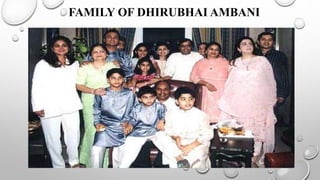
FAMILY OF DHIRUBHAI AMBANI
INTRODUCTION
Dhirubhai Ambani was born on December 28, 1932, to Hirachand
Govardhandas Ambani and Jamunaben Hirachand Ambani. He was
middle of five children, three boys and two girls. He passed his
matriculation in1949, Dhirubhai left for Aden (Yemen) at age of
seventeen. His first job was to collect money at a Shell Petrol Station,
earning three hundred per month. After a few years, he rose to the
position of Sales Manager in the same company. After working eight
years in Yemen, he decided to come back to India and on December
31, 1958, he came back to Mumbai and he started the RELIANCE
COMMERCIAL CORPORATION (RCC) with a borrowed capital of
Rs.15000. RCC mainly involved into the export of ginger, pepper,
turmeric, cashewnut etc. using his connections in Yemen, he
exported the materials to the same place.
BUILDING OF RELIANCE
• Dhirubhai Ambani, a successful businessman, was born on December 28, 1932
to his father Hirachand Govardhandas and his mother Jamunaben Hirachand
Ambani.
• After his matriculation in 1949, Dhirubhai left India and he got his steps at
Yemen where he used fill gas at a named gas station ‘SHELL’ petrol station. This
job was very beginning for the great businessman.
• He earned only an amount of Rs.300 per month. But his devotion to the
complete job soon rose him up to the position of Sales Manager in the same
company.
• Going through and crossing all the huddles of the life in Yemen, Dhirubhai
Ambani now wanted to return to India and start something of his own.
• On December 31, 1958, he came back to Mumbai and incorporated the Reliance
Commercial Corporation which is abbreviated as RCC.
• This company was incorporated with a capital of Rs.15000 which was also a
borrowed capital.
• This company was mainly associated with exporting the commodities like
ginger, cardamom, pepper, turmeric and cashewnut. He also initiated the wide
range of exports and mainly to Yemen because he had a lots of connections to
that place.
• Yemen was a center of attractions for the exports because of Yemen being the
free port. Under the export promotion schemes that were laid down by Indian
Government also helped RCC to start the trade in Rayon Fabrics.
• Such a scheme by the Indian Government attracted the attention of the growing
businessman.
• He then switched from the spices to textiles.
• In the year of 1966, he started a spinning mill at Naroda, Ahmedabad with a
borrowed capital of Rs.2,80,000 and named it as Reliance Textile Industries.
• The scheme of Government of India, benefited RCC the most and its export
constituted 60% of the exports under this scheme.
• There were rumors that the scheme was totally designed and initiated for
Dhirubhai Ambani and to support his companies. But to protect this hoax,
Dhirubhai came as a shield who stated that no one can blame that Reliance was
only the company which was benefited by the scheme, there were many
competitors who shut their eyes and were sitting those days.
• The High Unit Value Scheme ended in 1978. For this Dhirubhai laid his focus to
the domestic market.
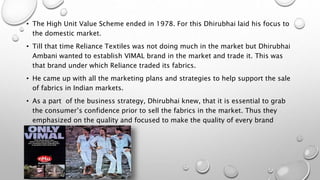
• Till that time Reliance Textiles was not doing much in the market but Dhirubhai
Ambani wanted to establish VIMAL brand in the market and trade it. This was
that brand under which Reliance traded its fabrics.
• He came up with all the marketing plans and strategies to help support the sale
of fabrics in Indian markets.
• As a part of the business strategy, Dhirubhai knew, that it is essential to grab
the consumer’s confidence prior to sell the fabrics in the market. Thus they
emphasized on the quality and focused to make the quality of every brand
superior.
• As the part of the marketing strategies, he framed the distribution channels as
the existing marketing channels were inefficient and inadequate.
• It was not easy for Reliance to grab the market. It faced a lot of competition
from the traditional merchants also.
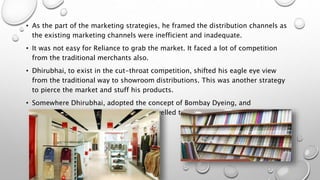
• Dhirubhai, to exist in the cut-throat competition, shifted his eagle eye view
from the traditional way to showroom distributions. This was another strategy
to pierce the market and stuff his products.
• Somewhere Dhirubhai, adopted the concept of Bombay Dyeing, and
implemented it on his business. He travelled the entire country to offer the
franchises to share holders.
• This searching resulted in the discovery of non-metro urban segment.
• By 1980, Reliance fabrics were almost available throughout India.
• 20 companies owned retail outlets, 1000 franchised outlets, and over 20,000
retail stores.
• Thus the overall market for the Reliance started too boom. The advertisements
styles, marketing strategies have also changed since the period of Dhirubhai
Ambani.
• This was a step that the biggest businessman took to make his business
flourish all over the world.
• He has made a sensation of building Entrepreneurs until today’s dynamic
scenario. He has helped in the increments of Indian economy as his business
contributed 5% to Gross Domestic Product (GDP).
THE ADVERTISEMENT FOR VIMAL
BACKGROUND INTEGRATION
• To strengthen his position further, Dhirubhai decided to integrate
backwards and produce fibers.
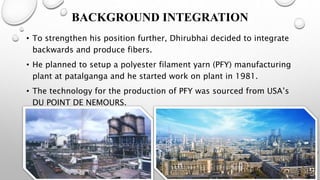
• He planned to setup a polyester filament yarn (PFY) manufacturing
plant at patalganga and he started work on plant in 1981.
• The technology for the production of PFY was sourced from USA’s
DU POINT DE NEMOURS.
• In 1984, Dhirubhai got license to manufacture purified
terephthalic acid (PTA).
• In 1991, Dhirubhai embarked on his most cherished project at
Hazira (Gujarat)-to build the largest single multi-feed ethylene
cracker plant in the world.
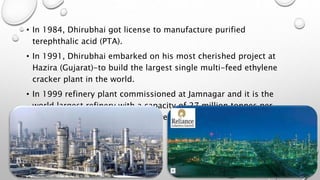
• In 1999 refinery plant commissioned at Jamnagar and it is the
world largest refinery with a capacity of 27 million tonnes per
annum, was the Single largest investment ever made at a single
location in India.
STOCK MARKET ADVENTURE
• Dhirubhai’s biggest contribution to the nation was the
development of an equity culture.
• Reliance went public in1977 and had its first A.G.M in 1977
• In the first seven public share issues, minimum subscription level
was exceeded.
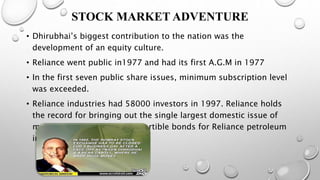
• Reliance industries had 58000 investors in 1997. Reliance holds
the record for bringing out the single largest domestic issue of
more than Rs.21 billion convertible bonds for Reliance petroleum
in 1993.
• The market capitalization of Reliance was 1.2 billion in 1995
making Dhirubhai richest men in the world.
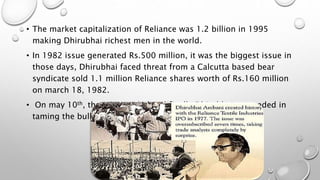
• In 1982 issue generated Rs.500 million, it was the biggest issue in
those days, Dhirubhai faced threat from a Calcutta based bear
syndicate sold 1.1 million Reliance shares worth of Rs.160 million
on march 18, 1982.
• On may 10th, the crisis ended and finally Dhirubhai succeeded in
taming the bulls.
CORPORATE BATTLES OF DHIRUBHAI AMBANI
• The fight between Nusli wadia, the Bombay dyeing chief and
Dhirubhai is well known in business circles.
• During the Janata party rule (1977-1979), Nusli wadia obtain
permission to build a 60000 tpa di-methyl terephthalate (DMT)
plant. However, before his letter converted in to license, GOVT was
changed and his license was delayed.
• At that time Dhirubhai obtain license and also contemplating on
building a paraxylene facility this infuriated Nusli wadia and
marked the beginning of one of the major battles in history of
Indian business.
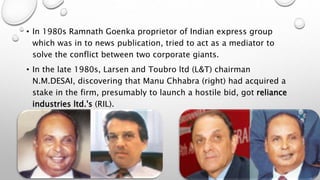
• In 1980s Ramnath Goenka proprietor of Indian express group
which was in to news publication, tried to act as a mediator to
solve the conflict between two corporate giants.
• In the late 1980s, Larsen and Toubro ltd (L&T) chairman
N.M.DESAI, discovering that Manu Chhabra (right) had acquired a
stake in the firm, presumably to launch a hostile bid, got reliance
industries ltd.'s (RIL).
POLITICAL BATTLES OF DHIRUBHAI AMBANI
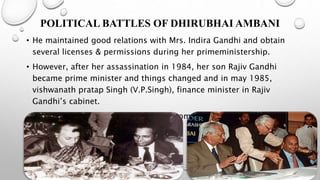
• He maintained good relations with Mrs. Indira Gandhi and obtain
several licenses & permissions during her primeministership.
• However, after her assassination in 1984, her son Rajiv Gandhi
became prime minister and things changed and in may 1985,
vishwanath pratap Singh (V.P.Singh), finance minister in Rajiv
Gandhi’s cabinet.
• They decided to shift P.T.A imports from OGL category to limited
permissible list.
• This could be new problem for Reliance and by sniffed the news
about the imminent change Dhirubhai moved very fast and on
between may 27th-29th he tied up with a host banks like S.B.I,
canara bank etc.,
• To issue LCs for all most a year supply of PTA of APX 60000
tonnes worth of 1.1 billion and last LC was opened just before the
GOVT announced the change in the policy.
• In 1986 quite favorable to Reliance and a secret meeting held
between Rajiv and Dhirubhai and cleared all pending licenses &
customs on PTA Rs.3 per KG was abolished.
DEATH OF AN ICON
• Dhirubhai Ambhani was admitted to the breach candy hospital on 24th
June 2002 after he suffered a major stroke, this was his second stroke.
First one had occurred in February 1986 and had kept his right hand
paralyzed. state of coma for more than a week.
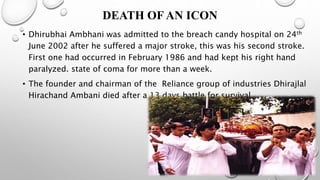
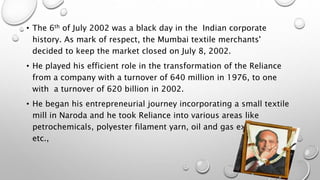
• The founder and chairman of the Reliance group of industries Dhirajlal
Hirachand Ambani died after a 13 days battle for survival
• The 6th of July 2002 was a black day in the Indian corporate
history. As mark of respect, the Mumbai textile merchants'
decided to keep the market closed on July 8, 2002.
• He played his efficient role in the transformation of the Reliance
from a company with a turnover of 640 million in 1976, to one
with a turnover of 620 billion in 2002.
• He began his entrepreneurial journey incorporating a small textile
mill in Naroda and he took Reliance into various areas like
petrochemicals, polyester filament yarn, oil and gas exploration
etc.,
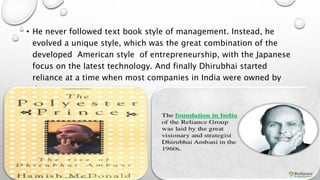
• He never followed text book style of management. Instead, he
evolved a unique style, which was the great combination of the
developed American style of entrepreneurship, with the Japanese
focus on the latest technology. And finally Dhirubhai started
reliance at a time when most companies in India were owned by
the government.
RELIANCE WITH OUT DHIRUBHAI
• After the death of Dhirubhai on 6th July 2002 , the Reliance group
was take over by Mukesh and Anil Ambani with a turnover ofRs.620
billion , assets worth Rs.564.85 billion, and work force of over
85,000 people accounted for 5% of total revenue of GOVT &
contribute 3% of GDP, 5% of total exports & 25% of India's total
private sectors profit.
• By 2004, it plans to take over more than 35% of global market and
this would make Reliance the 11th largest polymer producer and in
2016 2nd largest polymer producer in the world.
• According to the global fortune 500 ranking Reliance ranks 158
with revenue of 62 billion in 2015.
• Dhirubhai provided to his sons with a strategic vision and his sons
always considered themselves as co-builders rather than
inheritors of Reliance after his demise, Mukesh was appointed as
chairman and MD of the Reliance group while Anil become the
vise-chairman.
• In 2004, Mukesh Ambani, admitted to having difference with his
brother Anil over ‘ownership issues’.
• On June 2005, Kokilaben Ambani (mother of Mukesh & Anil)
announced the settlement through a press release.
• Reliance empire was split between the Ambani brothers for
Mukesh: RIL, IPCL and Anil :Reliance capital, Reliance energy and
Reliance infocomm.
• Mukesh become 1st Trillionaire of India and richest man in Asia
with a Net Worth of 22.9 USD billion as per Forbes and recently on
5th sept 2016 he launched Reliance JIO which is subsidiary of RIL.
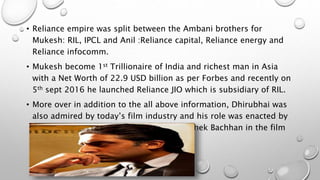
• More over in addition to the all above information, Dhirubhai was
also admired by today’s film industry and his role was enacted by
famous Aishwarya Rai Bachhan and Abhishek Bachhan in the film
‘GURU’.
CONCLUSION
• “For those who dare to dream there is a whole world to win.”
• As Dhirubhai Ambani returned from Yemen to India and started “Majin” in
partnership with Damini, his cousin.
• He started to import polyester yarn and export spices and sugar products to
Yemen.
• He started his first office of reliance commercial corporation was set up at
Narsinatha street in masjid bunder.
• Ambani’s great achievement was he showed Indians what was possible.
• With no Oxford Or Yele degree and no family support, no capital.
A SMALL VIDEO ON DHIRUBHAI AMBANI
THANK YOU
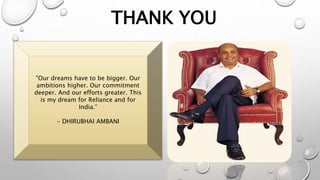
"Our dreams have to be bigger. Our
ambitions higher. Our commitment
deeper. And our efforts greater. This
is my dream for Reliance and for
India.“
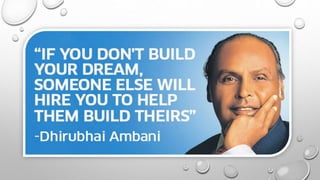
- DHIRUBHAI AMBANI