6th
Successful Run in Asia!
RELIABILITY ENGINEERING
15 – 19 AUGUST 2016, KUALA LUMPUR, MALAYSIA
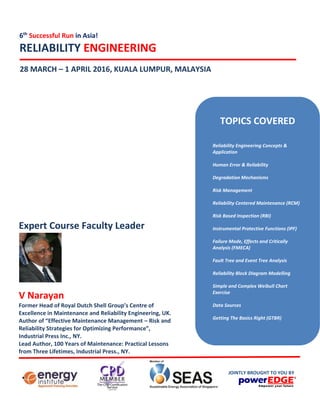
Expert Course Faculty Leader
TOPICS COVERED
Reliability Engineering Concepts &
Application
Human Error & Reliability
Degradation Mechanisms
Risk Management
Reliability Centered Maintenance (RCM)
Risk Based Inspection (RBI)
Instrumental Protective Functions (IPF)
Failure Mode, Effects and Critically
Analysis (FMECA)
Fault Tree and Event Tree Analysis
Reliability Block Diagram Modelling
Simple and Complex Weibull Chart
Exercise
Data Sources
Getting The Basics Right (GTBR)
JOINTLY BROUGHT TO YOU BY
V Narayan
Former Head of Royal Dutch Shell Group’s Centre of
Excellence in Maintenance and Reliability Engineering, UK.
Author of “Effective Maintenance Management – Risk and
Reliability Strategies for Optimizing Performance”,
Industrial Press Inc., NY.
Lead Author, 100 Years of Maintenance: Practical Lessons
from Three Lifetimes, Industrial Press., NY.
RELIABILITY ENGINEERING
15 – 19 AUGUST 2016, Kuala Lumpur, Malaysia
www.poweredgeasia.com
About the Reliability Engineering Course
Who will benefit from this training?
This training course has a limited attendance for up to 20 participants only.
Sessions commence at 9am on all days, with short intervals at 10.30am and 3.30pm respectively.
Refreshments will be provided in the short intervals.
Lunch will be provided at 12:30pm for 1 hour. Sessions will end at 5pm on all days.
The reliability of a Plant or Facility determines its performance – process safety, environmental and cost performance all depend on
it. It is thus a pivotal driver, which we can use to make significant business gains. Unfortunately it is often seen as a black art, best left
to mathematicians or other specialists.
This practical training course will show you that it is easy to understand and explains how to use data from operating and maintenance
records and get the results.
Engineers from industries including Oil & Gas (Upstream and Downstream), Power Generation, Chemicals, Pharmaceuticals and
Manufacturing can apply the learning to their advantage. They can be from Production, Maintenance, Projects, Design and Inventory
Management teams.
For optimal results, a University degree in Science or Engineering is desirable, as some mathematical background knowledge is
necessary. Managers, supervisors or support staffs from different disciplines are all suitable.
The American Society of Mechanical Engineers conducts two courses every year on Risk & Reliability Strategies based entirely on the
book “Effective Maintenance Management: Risk and Reliability Strategies for Optimal Performance” by V. Narayan.
A copy of this book will be issued free to all participants at this course and will be utilised during the training conducted by the author.
Learning Outcome
The links between maintenance and reliability, and the effect of Reliability on Process & Environmental Safety, Production volume
and maintenance costs will become clear.
By attending this 5 day training course, you will acquire the following:
 Learn reliability terms, their definitions and its use.
 Practice exercises to determine e.g., MTBF, MTTR, Scale and Shape factors etc. and learn how to use these to determine
maintenance strategies and operating philosophies.
 Find out how Plant availability depends on reliability and see how configuration affects the outcome.
 Study different failure distributions and see why these matter. Exercises on spares holdings will show them how to optimize
these to meet service level and cost considerations.
A number of tools including RCM, RBI, FMECA, IPF, RBD, FTA, ETA, and Modelling will be covered briefly, so that you know what to
use where. Failure analysis using RCA will be discussed. The Business Process to manage Reliability Improvement and a roadmap to
achieve high performance will be included.
RELIABILITY ENGINEERING
15 – 19 AUGUST 2016, Kuala Lumpur, Malaysia
www.poweredgeasia.com
DAY 1
0830hr Welcome, Introduction & Safety Issues
 Objectives
 Expectations from delegates
 Discussion – how good is your facility reliability?
0910hr Reliability Engineering Concepts
 Terminology and definitions
 Probability and Likelihood of Failure
 Understanding basic statistical concepts:
-Mean, Median, Mode, Standard Deviation, Normal
Distribution
 Failure Histograms
 Class room exercise
 Failure distributions; simple analyses
0950hr Morning Refreshment Break
1010hr Reliability Engineering Concepts (Cont’)
 Probability Density Function, Hazard Rates
 Class room exercise
 Different Distributions
 Class room exercise
 Metrics – MTTF, MTBF, MTTR
 Relationship between Reliability, Availability &
Maintainability
 The Bathtub Curve
 How to use reliability information for maintenance
1230hr Lunch
1315hr Reliability Engineering Application
 Tools overview; RBDs, Reliability Modelling, FTA/ETA,
FMECA, RCM, RBI, RCA
 Computing value added, performance metrics
 Making a Business Case
1500hr Afternoon Refreshment Break
1520hr Human Error & Reliability
 People, Process and Plant; Reliability Tripod
 Human Error major contributor to unreliability
 Understanding Human Error
 Physiological ^ Psychological Stress
 Rule, Skill and Knowledge based errors
 Error prone situations
 Managing Error
1640hr Homework & Close of Day 1
Day 2
0830hr Review of Day 1 & Homework
0850hr Degradation Mechanisms
 Wear, Corrosion, Fatigue, Creep, Erosion
 Physical process – tyres & potholes, crack propagation
 What do we understand by the term Maintenance?
 Failure Patterns
 Age-related and non age-related failures
 Managing Degradation – Appropriate Tasks
1000hr Morning Refreshment Break
1020hr Risk Management
 What is Risk?
 Quantitative Risk
 ALARP and Residual Risk
 Qualitative Risk
 Decision Making
 Selling ideas
1115hr Introduction to Reliability Centred Maintenance
(RCM)
 Maintenance in context (includes video presentation)
 Why RCM is different
 The seven RCM questions
 The Operating Context
 Failure Mode and Effect Analysis
 Simple RCM Exercise – Kettle
 Where to use RCM
 RCM in Oil & Gas and Process Industry
1200hr Introduction to Risk Based Inspection (RBI)
 Corrosion Circuits
 Corrosion Rates; Design & Actual
 Probability of failure, Susceptibility to failure
 Consequences; HSE, Production loss, Asset damage
 Process steps, Criticality, Confidence Rating, Inspection
Interval factor, Remnant life, Next Inspection Interval
 Non Age-Related failures
 Strategy based tasks
 Where to use RBI
1230hr Lunch
5 Days Course Outline
RELIABILITY ENGINEERING
15 – 19 AUGUST 2016, Kuala Lumpur, Malaysia
www.poweredgeasia.com
1315hr Introduction to Instrumental Protective
Functions (IPF)
 IPF vs. Process Control
 Cause-Consequence charts
 Process Demand Categories
 Consequences; HSE, Production loss, Asset damage
 Safety Integrity Levels
 Implementation
 Spurious Trips/Alarms; Safe Failures
 Testing, Coverage Factor and Maintenance
 Where to use IPF
1345hr Introduction to Failure Mode, Effects and
Critically Analysis (FMECA)
 Failure Mode and Effect Analysis
 Probability and its ranking
 Detectability of Failure and its ranking
 Consequence and its ranking
 Risk Priority Number – Criticality
 Where to use FMECA
1415hr Introduction to Fault Tree And Event Tree
Analysis
 Terminology, Symbols, and Notation
 Logic Diagrams
 Assigning probabilities
 Incorporating Human Error
 Where to use FTA, ETA
1445hr Recap of RCM, RBI, IPF, FMECA, FTA, ETA
1515hr Afternoon Refreshment Break
1535hr Introduction to Reliability Block Diagrams,
Modelling
 System Reliability
 Series RBDs
 Parallel RBDs
 Complex RBDs, Nested RBDs
 Bridge RBDs
 System Analysis
 System Analysis and Modeling ¬
 Analytical and Simulation Models
1640hr Homework & Close of Day 2
DAY 3
0830hr Review of Day 2 & Homework
 Histograms
 Probability Density Function
0845hr Revision of Topics To Help Us In Exercises
 Histograms
 Probability Density Function
 Cumulative Failure Function, Reliability Function, Hazard
Rate
 Different Distributions
 Reliability Block Diagrams; Series, parallel. Bridge
 Analytical and Simulation Modelling
0915h Exercises
 Histogram plotting
 Normalizing Histograms
 Probability Density Function, computing F(t), R(t), z(t)
1000hr Morning Refreshment break
1020h Exercises – Simple Weibull Chart
 Arranging the data set
 Distribution of rank order, Benard’s approximation
 Median ranks
 Plotting the data points, best-fit line
 Outputs: Shape and scale factors, B10, B1, B .1,B .01
 Computing the pdf chart values
 Forecasting failures
 Weibull Video
1230hr Lunch
1315hr Exercises – Reliability Block Diagrams
 Series RBD example
 Parallel RBF example
 Bridge RBD example
 Laboratory Ovens
 Nested RBDs
1500hr Afternoon Refreshment Break
RELIABILITY ENGINEERING
15 – 19 AUGUST 2016, Kuala Lumpur, Malaysia
www.poweredgeasia.com
1520hr Exercises – More Complex Weibull Charts
 Suspended data points
 Censoring, Effect on ranks
 The effect of preventive maintenance
 Applying Benards approximation to get median ranks
 Plotting Weibull chart points
 Plotting the data points, best-fit line
1610hr Data Sources
 Run length data; run meters, DCS, operating logs
 CMMS; failure data, history text
 Operators and Maintainers as sources
 Publicly available sources, OREDA, IEEE
 Errors in data sources, Independent & Identical
conditions
1625hr Summary & Questions
1640hr Homework & Close of Day 3
DAY 4
0830hr Review of Day 3 & Homework
0845hr The Reliability Improvement Process
 An important business process
 Pre-requisites, Elements and Structure
0915hr Pre-Requisites
 Asset Register, Audits
 Data required for Reliability Improvements
1000hr Morning Refreshment Break
1020hr Managing Human Reliability
 Competence
 Motivation
 Behaviour
1040hr Getting The Basics Right (GTBR)
 OEE & TPM
 Lubrication
 Joint Tightness
 Alignment
 Balancing
 Failure Elimination Culture
1230hr Lunch
1315hr Planning
 Reliability – Planning objective
 Tools and Techniques
 Top Performers and Planning
1400hr Scheduling
 Scheduling objectives
 Minimizing Production Losses
 Maximizing Productivity
 Managing Work Period Timing effectively
 Managing Effective Communications
1440hr Work Preparation
 The Follow-Through matters
 Infrastructure and Logistics
 Work Permits
 Equipment Readlines
1505hr Afternoon Refreshment Break
1525hr Condition Based Maintenance
 Technical and Business case
 Process Steps
 Application Examples
 Effectiveness & Measurement
1620hr Compliance
 Definition
 Availability and Compliance
1640hr Homework & Close of Day 4
DAY 5
0830hr Review of Day 4 & Homework
0845hr Implementation of Reliability Improvements
 When & Where to apply – Selection of Projects
 Preparing the ground
0855hr Project Selection
 Knowledge of current performance
 Identify Critical Systems
 Identify Poor Performers
 Set Objectives
 Sponsor, Terms of Reference, Budget
 Socratic Method
RELIABILITY ENGINEERING
15 – 19 AUGUST 2016, Kuala Lumpur, Malaysia
www.poweredgeasia.com
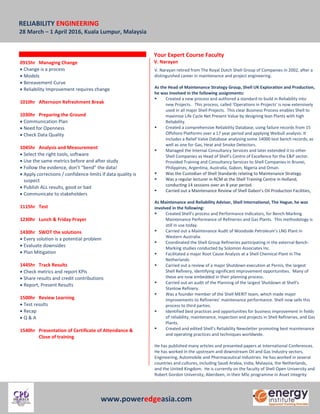
Your Expert Course Faculty
V. Narayan0915hr Managing Change
 Change is a process
 Models
 Bereavement Curve
 Reliability Improvement requires change
1010hr Afternoon Refreshment Break
1030hr Preparing the Ground
 Communication Plan
 Need for Openness
 Check Data Quality
1045hr Analysis and Measurement
 Select the right tools, software
 Use the same metrics before and after study
 Follow the evidence, don’t “bend” the data!
 Apply corrections / confidence limits if data quality is
suspect
 Publish ALL results, good or bad
 Communicate to stakeholders
1115hr Test
1230hr Lunch & Friday Prayer
1430hr SWOT the solutions
 Every solution is a potential problem
 Evaluate downsides
 Plan Mitigation
1445hr Track Results
 Check metrics and report KPIs
 Share results and credit contributions
 Report, Present Results
1500hr Review Learning
 Test results
 Recap
 Q & A
1540hr Presentation of Certificate of Attendance &
Close of training
V. Narayan retired from The Royal Dutch Shell Group of Companies in 2002, after a
distinguished career in maintenance and project engineering.
As the Head of Maintenance Strategy Group, Shell UK Exploration and Production,
he was involved in the following assignments:
 Created a new process and authored a standard to build in Reliability into
new Projects. This process, called ‘Operations in Projects’ is now extensively
used in all major Shell Projects. This clear Business Process enables Shell to
maximise Life Cycle Net Present Value by designing lean Plants with high
Reliability.
 Created a comprehensive Reliability Database, using failure records from 15
Offshore Platforms over a 17 year period and applying Weibull analysis. It
includes a Relief Valve Database analysing some 14000 test bench records, as
well as one for Gas, Heat and Smoke Detectors.
 Managed the Internal Consultancy Services and later extended it to other
Shell Companies as Head of Shell’s Centre of Excellence for the E&P sector.
Provided Training and Consultancy Services to Shell Companies in Brunei,
Philippines, Argentina, Australia, Gabon, Nigeria and Oman.
 Was the Custodian of Shell Standards relating to Maintenance Strategy.
 Was a regular lecturer in RCM at the Shell Training Centre in Holland,
conducting 14 sessions over an 8 year period.
 Carried out a Maintenance Review of Shell Gabon’s Oil Production Facilities,
As Maintenance and Reliability Adviser, Shell International, The Hague, he was
involved in the following:
 Created Shell’s process and Performance Indicators, for Bench-Marking
Maintenance Performance of Refineries and Gas Plants. This methodology is
still in use today.
 Carried out a Maintenance Audit of Woodside Petroleum’s LNG Plant in
Western Australia.
 Coordinated the Shell Group Refineries participating in the external Bench-
Marking studies conducted by Solomon Associates Inc.
 Facilitated a major Root Cause Analysis at a Shell Chemical Plant in The
Netherlands.
 Carried out a review of a major Shutdown execution at Pernis, the largest
Shell Refinery, identifying significant improvement opportunities. Many of
these are now embedded in their planning process.
 Carried out an audit of the Planning of the largest Shutdown at Shell’s
Stanlow Refinery.
 Was a founder member of the Shell MERIT team, which made major
improvements to Refineries’ maintenance performance. Shell now sells this
process to third parties.
 Identified best practices and opportunities for business improvement in fields
of reliability, maintenance, inspection and projects in Shell Refineries, and Gas
Plants.
 Created and edited Shell’s Reliability Newsletter promoting best maintenance
and operating practices and techniques worldwide.
He has published many articles and presented papers at International Conferences.
He has worked in the upstream and downstream Oil and Gas Industry sectors,
Engineering, Automobile and Pharmaceutical Industries. He has worked in several
countries and cultures, including Saudi Arabia, India, Malaysia, the Netherlands,
and the United Kingdom. He is currently on the faculty of Shell Open University and
Robert Gordon University, Aberdeen, in their MSc programme in Asset Integrity
Management.
RELIABILITY ENGINEERING
15 – 19 AUGUST 2016, Kuala Lumpur, Malaysia
www.poweredgeasia.com
4 Pillars of Transformer Condition
Advanced Project Finance for Power
Advanced Technical Report Writing & Presentation Skills
Advanced Turnaround Shutdown & Outage Management
Ancillary Services in Competitive Electricity
Asset Management for the Power Industry
Best Practice Renewable Energy Capital & Project Management
Biomass Power Generation
CFB Combustion for Boiler Operations
Clean Development Mechanism and Carbon Markets
Coal Contracts
Combined Cycle Power Plants Operation
Combined Heat & Power (CHP) and Co-Generation Plant Operations
Competency Management System for the Power Industry
Design & Operations of Circulating Fluidized Bed Boiler
Developing & Structuring Public-Private Partnership (PPP) for Infrastructure
Effective Tender Process Management for Power & Utilities
Electrical Hazop (eHazop) Studies for the Power Industry
Electricity Demand-Side Management
Electricity Industry Design
Electricity Network Planning
Electricity Retail Contracts
Electricity Theft
Electricity Trading Essentials
Energy Efficiency
EPC Contract Management for Power & Utilities
Essentials of Coal Markets and Trading
Essentials of Power Trading
Excitation Systems
Feed-In Tariffs for PV Systems
Finance for Non-Finance Professionals in Power & Utilities
Financial Modelling for Project Finance in Power & Utilities
Fitness-For-Service AP1 579 & High Energy Piping Life Management
Fundamentals of Geothermal Energy
Fundamentals of Power Generation
Gas & LNG Contract Negotiation
Gas Turbine Generator Selection, Operation & Maintenance
Gas Turbine Hot Gas Paths, Rotors & Failure Analysis
Gas Turbine Major Inspection & Overhaul
GE Gas Turbine Operations Simulation Based
HRSG Design, Operations & Understanding, Controlling of HRSG Damage
Mechanisms
HV Substation Design & Construction
IEC for Utilities
Integration of Distributed Generation
Introduction to Carbon Capture & Storage
Introduction to Clean Coal Technology
Introduction to Power Systems
Keeping Electrical Switchgear Safe
Leadership & Team Dynamics for Power & Utilities
LNG Fundamentals
LNG Markets & SPOT Trading
Maintenance Planning & Scheduling
Making IPP & Renewable Energy Projects Contract
Frameworks Bankable
Managing Complex Projects for Power and Utilities
Professionals
Medium Voltage & High Voltage Switchgear
Metallurgy for Engineers
Mechanical Engineering for Non-Mechanical Engineers
Mini Hydro Project Analysis
MKV Speedtronic Control System
MK VI Speedtronic Control System
Nuclear Energy Project Planning & Economics
Nuclear Power
Offshore Platforms Electrical Systems Design &
Illustrations
Operations of Coal Fired Power Plants
Power Generation Commissioning, Operations &
Maintenance
Power Generation Operation, Protection & Excitation
Control
Power Plant Chemistry for Chemist & Chemical Engineers
Power Purchase Agreements
Process Control Methods
Programmatic CDM
Project Management for Power and Utilities
Relay Protection in Power Systems
Reliability Centered Maintenance Masterclass
Reliability Engineering
Renewable Energy Development & Investment
Renewable Energy Integration
Risk Based Inspection
Risk Management in Power Markets
Root Cause Analysis
Rotating Equipment Maintenance & Reliability
Excellence
SCADA & Power Systems
Smart Grid
Solar Energy & Photovoltaic Power
Spare Parts Optimisation
Supercritical and Ultra-Supercritical Coal-Fired Power
Plant
Technical Report Writing & Presentation Skills for Power
& Utilities Professionals
Ultra Low NOx Gas Turbine Combustion
Uninterruptible Power Supply
Vibration Analysis & Condition Monitoring
Waste to Energy Plant Operations
Water Treatment and Corrosion Control for Steam
Generation and Power Production
Writing Effective Standard Operating Procedures (SOP)
for Power & Utilities Professionals & Engineers
OTHER AVAILABLE COURSES
RELIABILITY ENGINEERING
15 – 19 AUGUST 2016, Kuala Lumpur, Malaysia
www.poweredgeasia.com
1. Does PowerEdge have other programmes than those
listed?
We have more than 200 programmes that we are capable of
running. All we need is for you to contact us and request for the
preferred programme and we will able to develop it.
2. Where is PowerEdge based?
PowerEDGE is headquartered in Singapore but we run our
training programmes in different venues around Asia.
3. What does PowerEdge do?
We are a Power & Utilities Training Specialist.
4. Can this course be done in our city?
It absolutely can. Get in touch with us to request for a training
programme to be carried out in your city.
5. Can you reduce the price of our preferred course?
While our price has been reduced before it is even launched, we
are always happy to help you with further discounts.
6. Can you change the dates of the course?
If you have a special requested date, let us know and we will
arrange another session for you.
7. Who are the companies that will be participating?
This varies from a diversity of Power Operators, Regulators,
Financiers, to Vendors in the Power & Utilities industry.
8. Where is the venue for the course?
We usually engage a 4 to 5 star hotel meeting room to ensure
the comfort of our participants.
9. How many delegates should we expect for each course?
This varies from 15 to 20 participants. Class sizes are kept small
to allow trainers to focus better on each participant.
10. What are the different payment modes?
We accept Visa/MasterCard, cheques, bank transfers and cash
on site.
11. Is accommodation included when I sign up for a course?
Accommodation is not included in the course fee but we are
always happy to advise on available accommodations.
12. Can I get a cheaper accommodation through PowerEdge?
We will be pleased to help you negotiate a better rate with
hotels.
13. Is lunch provided during the course?
We provide lunch and 2 tea breaks every day during our
training programmes.
14. Are the training materials included once I have signed up
for a course?
Yes, training and course materials are included in the course
fee.
15. Will there be a certificate for the course?
Yes, there will be a certificate of participation upon completion
of a course.
16. Who are PowerEdge trainers?
They are expert consultants and practitioners with many years
of experience in the subject matter that they deliver on.
17. Are PowerEdge trainers competent?
We have received numerous favourable feedbacks on our
trainers from past participants.
18. Can PowerEdge assist with Visa travel applications?
We can assist in advising you on the relevant procedure(s) and
embassies/consulates that provide Visa for travel purposes.
19. Can we purchase training materials without attending a
course?
Unfortunately this option is not available as training materials
are specially developed for courses.
20. Can course content be tweaked to cater to our needs?
Of course! Just let us know your request and we will get the
trainer to assist in carrying it out.
Frequently Asked Questions (FAQs)
RELIABILITY ENGINEERING
15 – 19 AUGUST 2016, Kuala Lumpur, Malaysia
www.poweredgeasia.com
Name .................................................................................................. Job title .....................................................................................................
Tel ......................................... Department .............................................................. Email ...................................................................................
Name .................................................................................................. Job title .....................................................................................................
Tel ......................................... Department .............................................................. Email ...................................................................................
Name .................................................................................................. Job title .....................................................................................................
Tel ......................................... Department .............................................................. Email ...................................................................................
Name .................................................................................................. Job title .....................................................................................................
Tel ......................................... Department .............................................................. Email ...................................................................................
Name .................................................................................................. Job title .....................................................................................................
Tel ......................................... Department .............................................................. Email ...................................................................................
Organisation name ...............................................................................Industry...................................................................................................
Address .................................................................................................................................................................................................................
Postcode............................................................................................... Country...................................................................................................
Tel ..........................................................................................................Fax.........................................................................................................
NORMAL PRICE
EARLY BIRD
ENDS 31 July 2016
GROUP OF 3 or More
5 Day
Programme
SGD 5,250
Per Participant
SGD 5,050
Per Participant
SGD 4,750
Per Participant
 Keeping Electrical
Switchgear Safe
 Introduction to Power
Systems
 Excitation Systems
 Fundamentals of Power
Generation
ATTENDEE DETAILS
COMPANY DETAILS
PAYMENT METHODS
By Cheque/ Bank Draft: Make Payable to PowerEdge Pte Ltd.
By Telegraphic Transfer: Please quote AE1 with the remittance advise
Account Name: PowerEdge Pte. Ltd.
Bank Code: 7339 Branch code: 686 Account Number: 686-253386-001 Swift Code: OCBCSGSG
Bank Address: 65 Chulia Street OCBC Centre, Singapore 049513
All bank charges and payment in Singapore dollars (SGD) to be borne by payer. Please ensure that PowerEdge Pte Ltd receive the full invoiced amount.
PAYMENT POLICY
Payment is due in full at the time of registration. Full payment is mandatory for event attendance. I agree to PowerEdge Pte Ltd. payment terms
* GST- Exclusive price is only applicable for overseas corporate customers subject to qualifying conditions.
CANCELLATIONS & SUBSTITUTIONS
You may substitute delegates at any time. POWEREDGE PTE LTD does not provide refunds for cancellations. For cancellations received in writing more than seven (7) days prior to the training course you will receive a 100% credit to be used
at another POWEREDGE PTE LTD training course for up to one year from the date of issuance. For cancellations received seven (7) days or less prior to an event (including day 7), no credits will be issued. In the event that POWEREDGE PTE
LTD cancels an event, delegate payments at the date of cancellation will be credited to a future POWEREDGE PTE LTD event. This credit will be available for up to one year from the date of issuance. In the event that POWEREDGE PTE LTD
postpones an event, delegate payments at the postponement date will be credited towards the rescheduled date. If the delegate is unable to attend the rescheduled event, the delegate will receive a 100% credit
ON SITE TRAINING
Can’t make it for the Course?
We’ll make the course come to
you!!
Simply let us know your
preferred time and dates and
we will meet you at your
schedule and venue.
With a host of highly trained
experts, we will be happy to
customize your programme
with your needs 100% fulfilled.
Contact us today at
info@poweredgeasia.com
 (65) 6741 9927
RELATED TRAINING
 Online Web Registration
 info@poweredgeasia.com
 (65) 6741 9927
(65) 67478737
REGISTER

Reliability Engineering

  • 1.
    6th Successful Run inAsia! RELIABILITY ENGINEERING 15 – 19 AUGUST 2016, KUALA LUMPUR, MALAYSIA Expert Course Faculty Leader TOPICS COVERED Reliability Engineering Concepts & Application Human Error & Reliability Degradation Mechanisms Risk Management Reliability Centered Maintenance (RCM) Risk Based Inspection (RBI) Instrumental Protective Functions (IPF) Failure Mode, Effects and Critically Analysis (FMECA) Fault Tree and Event Tree Analysis Reliability Block Diagram Modelling Simple and Complex Weibull Chart Exercise Data Sources Getting The Basics Right (GTBR) JOINTLY BROUGHT TO YOU BY V Narayan Former Head of Royal Dutch Shell Group’s Centre of Excellence in Maintenance and Reliability Engineering, UK. Author of “Effective Maintenance Management – Risk and Reliability Strategies for Optimizing Performance”, Industrial Press Inc., NY. Lead Author, 100 Years of Maintenance: Practical Lessons from Three Lifetimes, Industrial Press., NY.
  • 2.
    RELIABILITY ENGINEERING 15 –19 AUGUST 2016, Kuala Lumpur, Malaysia www.poweredgeasia.com About the Reliability Engineering Course Who will benefit from this training? This training course has a limited attendance for up to 20 participants only. Sessions commence at 9am on all days, with short intervals at 10.30am and 3.30pm respectively. Refreshments will be provided in the short intervals. Lunch will be provided at 12:30pm for 1 hour. Sessions will end at 5pm on all days. The reliability of a Plant or Facility determines its performance – process safety, environmental and cost performance all depend on it. It is thus a pivotal driver, which we can use to make significant business gains. Unfortunately it is often seen as a black art, best left to mathematicians or other specialists. This practical training course will show you that it is easy to understand and explains how to use data from operating and maintenance records and get the results. Engineers from industries including Oil & Gas (Upstream and Downstream), Power Generation, Chemicals, Pharmaceuticals and Manufacturing can apply the learning to their advantage. They can be from Production, Maintenance, Projects, Design and Inventory Management teams. For optimal results, a University degree in Science or Engineering is desirable, as some mathematical background knowledge is necessary. Managers, supervisors or support staffs from different disciplines are all suitable. The American Society of Mechanical Engineers conducts two courses every year on Risk & Reliability Strategies based entirely on the book “Effective Maintenance Management: Risk and Reliability Strategies for Optimal Performance” by V. Narayan. A copy of this book will be issued free to all participants at this course and will be utilised during the training conducted by the author. Learning Outcome The links between maintenance and reliability, and the effect of Reliability on Process & Environmental Safety, Production volume and maintenance costs will become clear. By attending this 5 day training course, you will acquire the following:  Learn reliability terms, their definitions and its use.  Practice exercises to determine e.g., MTBF, MTTR, Scale and Shape factors etc. and learn how to use these to determine maintenance strategies and operating philosophies.  Find out how Plant availability depends on reliability and see how configuration affects the outcome.  Study different failure distributions and see why these matter. Exercises on spares holdings will show them how to optimize these to meet service level and cost considerations. A number of tools including RCM, RBI, FMECA, IPF, RBD, FTA, ETA, and Modelling will be covered briefly, so that you know what to use where. Failure analysis using RCA will be discussed. The Business Process to manage Reliability Improvement and a roadmap to achieve high performance will be included.
  • 3.
    RELIABILITY ENGINEERING 15 –19 AUGUST 2016, Kuala Lumpur, Malaysia www.poweredgeasia.com DAY 1 0830hr Welcome, Introduction & Safety Issues  Objectives  Expectations from delegates  Discussion – how good is your facility reliability? 0910hr Reliability Engineering Concepts  Terminology and definitions  Probability and Likelihood of Failure  Understanding basic statistical concepts: -Mean, Median, Mode, Standard Deviation, Normal Distribution  Failure Histograms  Class room exercise  Failure distributions; simple analyses 0950hr Morning Refreshment Break 1010hr Reliability Engineering Concepts (Cont’)  Probability Density Function, Hazard Rates  Class room exercise  Different Distributions  Class room exercise  Metrics – MTTF, MTBF, MTTR  Relationship between Reliability, Availability & Maintainability  The Bathtub Curve  How to use reliability information for maintenance 1230hr Lunch 1315hr Reliability Engineering Application  Tools overview; RBDs, Reliability Modelling, FTA/ETA, FMECA, RCM, RBI, RCA  Computing value added, performance metrics  Making a Business Case 1500hr Afternoon Refreshment Break 1520hr Human Error & Reliability  People, Process and Plant; Reliability Tripod  Human Error major contributor to unreliability  Understanding Human Error  Physiological ^ Psychological Stress  Rule, Skill and Knowledge based errors  Error prone situations  Managing Error 1640hr Homework & Close of Day 1 Day 2 0830hr Review of Day 1 & Homework 0850hr Degradation Mechanisms  Wear, Corrosion, Fatigue, Creep, Erosion  Physical process – tyres & potholes, crack propagation  What do we understand by the term Maintenance?  Failure Patterns  Age-related and non age-related failures  Managing Degradation – Appropriate Tasks 1000hr Morning Refreshment Break 1020hr Risk Management  What is Risk?  Quantitative Risk  ALARP and Residual Risk  Qualitative Risk  Decision Making  Selling ideas 1115hr Introduction to Reliability Centred Maintenance (RCM)  Maintenance in context (includes video presentation)  Why RCM is different  The seven RCM questions  The Operating Context  Failure Mode and Effect Analysis  Simple RCM Exercise – Kettle  Where to use RCM  RCM in Oil & Gas and Process Industry 1200hr Introduction to Risk Based Inspection (RBI)  Corrosion Circuits  Corrosion Rates; Design & Actual  Probability of failure, Susceptibility to failure  Consequences; HSE, Production loss, Asset damage  Process steps, Criticality, Confidence Rating, Inspection Interval factor, Remnant life, Next Inspection Interval  Non Age-Related failures  Strategy based tasks  Where to use RBI 1230hr Lunch 5 Days Course Outline
  • 4.
    RELIABILITY ENGINEERING 15 –19 AUGUST 2016, Kuala Lumpur, Malaysia www.poweredgeasia.com 1315hr Introduction to Instrumental Protective Functions (IPF)  IPF vs. Process Control  Cause-Consequence charts  Process Demand Categories  Consequences; HSE, Production loss, Asset damage  Safety Integrity Levels  Implementation  Spurious Trips/Alarms; Safe Failures  Testing, Coverage Factor and Maintenance  Where to use IPF 1345hr Introduction to Failure Mode, Effects and Critically Analysis (FMECA)  Failure Mode and Effect Analysis  Probability and its ranking  Detectability of Failure and its ranking  Consequence and its ranking  Risk Priority Number – Criticality  Where to use FMECA 1415hr Introduction to Fault Tree And Event Tree Analysis  Terminology, Symbols, and Notation  Logic Diagrams  Assigning probabilities  Incorporating Human Error  Where to use FTA, ETA 1445hr Recap of RCM, RBI, IPF, FMECA, FTA, ETA 1515hr Afternoon Refreshment Break 1535hr Introduction to Reliability Block Diagrams, Modelling  System Reliability  Series RBDs  Parallel RBDs  Complex RBDs, Nested RBDs  Bridge RBDs  System Analysis  System Analysis and Modeling ¬  Analytical and Simulation Models 1640hr Homework & Close of Day 2 DAY 3 0830hr Review of Day 2 & Homework  Histograms  Probability Density Function 0845hr Revision of Topics To Help Us In Exercises  Histograms  Probability Density Function  Cumulative Failure Function, Reliability Function, Hazard Rate  Different Distributions  Reliability Block Diagrams; Series, parallel. Bridge  Analytical and Simulation Modelling 0915h Exercises  Histogram plotting  Normalizing Histograms  Probability Density Function, computing F(t), R(t), z(t) 1000hr Morning Refreshment break 1020h Exercises – Simple Weibull Chart  Arranging the data set  Distribution of rank order, Benard’s approximation  Median ranks  Plotting the data points, best-fit line  Outputs: Shape and scale factors, B10, B1, B .1,B .01  Computing the pdf chart values  Forecasting failures  Weibull Video 1230hr Lunch 1315hr Exercises – Reliability Block Diagrams  Series RBD example  Parallel RBF example  Bridge RBD example  Laboratory Ovens  Nested RBDs 1500hr Afternoon Refreshment Break
  • 5.
    RELIABILITY ENGINEERING 15 –19 AUGUST 2016, Kuala Lumpur, Malaysia www.poweredgeasia.com 1520hr Exercises – More Complex Weibull Charts  Suspended data points  Censoring, Effect on ranks  The effect of preventive maintenance  Applying Benards approximation to get median ranks  Plotting Weibull chart points  Plotting the data points, best-fit line 1610hr Data Sources  Run length data; run meters, DCS, operating logs  CMMS; failure data, history text  Operators and Maintainers as sources  Publicly available sources, OREDA, IEEE  Errors in data sources, Independent & Identical conditions 1625hr Summary & Questions 1640hr Homework & Close of Day 3 DAY 4 0830hr Review of Day 3 & Homework 0845hr The Reliability Improvement Process  An important business process  Pre-requisites, Elements and Structure 0915hr Pre-Requisites  Asset Register, Audits  Data required for Reliability Improvements 1000hr Morning Refreshment Break 1020hr Managing Human Reliability  Competence  Motivation  Behaviour 1040hr Getting The Basics Right (GTBR)  OEE & TPM  Lubrication  Joint Tightness  Alignment  Balancing  Failure Elimination Culture 1230hr Lunch 1315hr Planning  Reliability – Planning objective  Tools and Techniques  Top Performers and Planning 1400hr Scheduling  Scheduling objectives  Minimizing Production Losses  Maximizing Productivity  Managing Work Period Timing effectively  Managing Effective Communications 1440hr Work Preparation  The Follow-Through matters  Infrastructure and Logistics  Work Permits  Equipment Readlines 1505hr Afternoon Refreshment Break 1525hr Condition Based Maintenance  Technical and Business case  Process Steps  Application Examples  Effectiveness & Measurement 1620hr Compliance  Definition  Availability and Compliance 1640hr Homework & Close of Day 4 DAY 5 0830hr Review of Day 4 & Homework 0845hr Implementation of Reliability Improvements  When & Where to apply – Selection of Projects  Preparing the ground 0855hr Project Selection  Knowledge of current performance  Identify Critical Systems  Identify Poor Performers  Set Objectives  Sponsor, Terms of Reference, Budget  Socratic Method
  • 6.
    RELIABILITY ENGINEERING 15 –19 AUGUST 2016, Kuala Lumpur, Malaysia www.poweredgeasia.com Your Expert Course Faculty V. Narayan0915hr Managing Change  Change is a process  Models  Bereavement Curve  Reliability Improvement requires change 1010hr Afternoon Refreshment Break 1030hr Preparing the Ground  Communication Plan  Need for Openness  Check Data Quality 1045hr Analysis and Measurement  Select the right tools, software  Use the same metrics before and after study  Follow the evidence, don’t “bend” the data!  Apply corrections / confidence limits if data quality is suspect  Publish ALL results, good or bad  Communicate to stakeholders 1115hr Test 1230hr Lunch & Friday Prayer 1430hr SWOT the solutions  Every solution is a potential problem  Evaluate downsides  Plan Mitigation 1445hr Track Results  Check metrics and report KPIs  Share results and credit contributions  Report, Present Results 1500hr Review Learning  Test results  Recap  Q & A 1540hr Presentation of Certificate of Attendance & Close of training V. Narayan retired from The Royal Dutch Shell Group of Companies in 2002, after a distinguished career in maintenance and project engineering. As the Head of Maintenance Strategy Group, Shell UK Exploration and Production, he was involved in the following assignments:  Created a new process and authored a standard to build in Reliability into new Projects. This process, called ‘Operations in Projects’ is now extensively used in all major Shell Projects. This clear Business Process enables Shell to maximise Life Cycle Net Present Value by designing lean Plants with high Reliability.  Created a comprehensive Reliability Database, using failure records from 15 Offshore Platforms over a 17 year period and applying Weibull analysis. It includes a Relief Valve Database analysing some 14000 test bench records, as well as one for Gas, Heat and Smoke Detectors.  Managed the Internal Consultancy Services and later extended it to other Shell Companies as Head of Shell’s Centre of Excellence for the E&P sector. Provided Training and Consultancy Services to Shell Companies in Brunei, Philippines, Argentina, Australia, Gabon, Nigeria and Oman.  Was the Custodian of Shell Standards relating to Maintenance Strategy.  Was a regular lecturer in RCM at the Shell Training Centre in Holland, conducting 14 sessions over an 8 year period.  Carried out a Maintenance Review of Shell Gabon’s Oil Production Facilities, As Maintenance and Reliability Adviser, Shell International, The Hague, he was involved in the following:  Created Shell’s process and Performance Indicators, for Bench-Marking Maintenance Performance of Refineries and Gas Plants. This methodology is still in use today.  Carried out a Maintenance Audit of Woodside Petroleum’s LNG Plant in Western Australia.  Coordinated the Shell Group Refineries participating in the external Bench- Marking studies conducted by Solomon Associates Inc.  Facilitated a major Root Cause Analysis at a Shell Chemical Plant in The Netherlands.  Carried out a review of a major Shutdown execution at Pernis, the largest Shell Refinery, identifying significant improvement opportunities. Many of these are now embedded in their planning process.  Carried out an audit of the Planning of the largest Shutdown at Shell’s Stanlow Refinery.  Was a founder member of the Shell MERIT team, which made major improvements to Refineries’ maintenance performance. Shell now sells this process to third parties.  Identified best practices and opportunities for business improvement in fields of reliability, maintenance, inspection and projects in Shell Refineries, and Gas Plants.  Created and edited Shell’s Reliability Newsletter promoting best maintenance and operating practices and techniques worldwide. He has published many articles and presented papers at International Conferences. He has worked in the upstream and downstream Oil and Gas Industry sectors, Engineering, Automobile and Pharmaceutical Industries. He has worked in several countries and cultures, including Saudi Arabia, India, Malaysia, the Netherlands, and the United Kingdom. He is currently on the faculty of Shell Open University and Robert Gordon University, Aberdeen, in their MSc programme in Asset Integrity Management.
  • 7.
    RELIABILITY ENGINEERING 15 –19 AUGUST 2016, Kuala Lumpur, Malaysia www.poweredgeasia.com 4 Pillars of Transformer Condition Advanced Project Finance for Power Advanced Technical Report Writing & Presentation Skills Advanced Turnaround Shutdown & Outage Management Ancillary Services in Competitive Electricity Asset Management for the Power Industry Best Practice Renewable Energy Capital & Project Management Biomass Power Generation CFB Combustion for Boiler Operations Clean Development Mechanism and Carbon Markets Coal Contracts Combined Cycle Power Plants Operation Combined Heat & Power (CHP) and Co-Generation Plant Operations Competency Management System for the Power Industry Design & Operations of Circulating Fluidized Bed Boiler Developing & Structuring Public-Private Partnership (PPP) for Infrastructure Effective Tender Process Management for Power & Utilities Electrical Hazop (eHazop) Studies for the Power Industry Electricity Demand-Side Management Electricity Industry Design Electricity Network Planning Electricity Retail Contracts Electricity Theft Electricity Trading Essentials Energy Efficiency EPC Contract Management for Power & Utilities Essentials of Coal Markets and Trading Essentials of Power Trading Excitation Systems Feed-In Tariffs for PV Systems Finance for Non-Finance Professionals in Power & Utilities Financial Modelling for Project Finance in Power & Utilities Fitness-For-Service AP1 579 & High Energy Piping Life Management Fundamentals of Geothermal Energy Fundamentals of Power Generation Gas & LNG Contract Negotiation Gas Turbine Generator Selection, Operation & Maintenance Gas Turbine Hot Gas Paths, Rotors & Failure Analysis Gas Turbine Major Inspection & Overhaul GE Gas Turbine Operations Simulation Based HRSG Design, Operations & Understanding, Controlling of HRSG Damage Mechanisms HV Substation Design & Construction IEC for Utilities Integration of Distributed Generation Introduction to Carbon Capture & Storage Introduction to Clean Coal Technology Introduction to Power Systems Keeping Electrical Switchgear Safe Leadership & Team Dynamics for Power & Utilities LNG Fundamentals LNG Markets & SPOT Trading Maintenance Planning & Scheduling Making IPP & Renewable Energy Projects Contract Frameworks Bankable Managing Complex Projects for Power and Utilities Professionals Medium Voltage & High Voltage Switchgear Metallurgy for Engineers Mechanical Engineering for Non-Mechanical Engineers Mini Hydro Project Analysis MKV Speedtronic Control System MK VI Speedtronic Control System Nuclear Energy Project Planning & Economics Nuclear Power Offshore Platforms Electrical Systems Design & Illustrations Operations of Coal Fired Power Plants Power Generation Commissioning, Operations & Maintenance Power Generation Operation, Protection & Excitation Control Power Plant Chemistry for Chemist & Chemical Engineers Power Purchase Agreements Process Control Methods Programmatic CDM Project Management for Power and Utilities Relay Protection in Power Systems Reliability Centered Maintenance Masterclass Reliability Engineering Renewable Energy Development & Investment Renewable Energy Integration Risk Based Inspection Risk Management in Power Markets Root Cause Analysis Rotating Equipment Maintenance & Reliability Excellence SCADA & Power Systems Smart Grid Solar Energy & Photovoltaic Power Spare Parts Optimisation Supercritical and Ultra-Supercritical Coal-Fired Power Plant Technical Report Writing & Presentation Skills for Power & Utilities Professionals Ultra Low NOx Gas Turbine Combustion Uninterruptible Power Supply Vibration Analysis & Condition Monitoring Waste to Energy Plant Operations Water Treatment and Corrosion Control for Steam Generation and Power Production Writing Effective Standard Operating Procedures (SOP) for Power & Utilities Professionals & Engineers OTHER AVAILABLE COURSES
  • 8.
    RELIABILITY ENGINEERING 15 –19 AUGUST 2016, Kuala Lumpur, Malaysia www.poweredgeasia.com 1. Does PowerEdge have other programmes than those listed? We have more than 200 programmes that we are capable of running. All we need is for you to contact us and request for the preferred programme and we will able to develop it. 2. Where is PowerEdge based? PowerEDGE is headquartered in Singapore but we run our training programmes in different venues around Asia. 3. What does PowerEdge do? We are a Power & Utilities Training Specialist. 4. Can this course be done in our city? It absolutely can. Get in touch with us to request for a training programme to be carried out in your city. 5. Can you reduce the price of our preferred course? While our price has been reduced before it is even launched, we are always happy to help you with further discounts. 6. Can you change the dates of the course? If you have a special requested date, let us know and we will arrange another session for you. 7. Who are the companies that will be participating? This varies from a diversity of Power Operators, Regulators, Financiers, to Vendors in the Power & Utilities industry. 8. Where is the venue for the course? We usually engage a 4 to 5 star hotel meeting room to ensure the comfort of our participants. 9. How many delegates should we expect for each course? This varies from 15 to 20 participants. Class sizes are kept small to allow trainers to focus better on each participant. 10. What are the different payment modes? We accept Visa/MasterCard, cheques, bank transfers and cash on site. 11. Is accommodation included when I sign up for a course? Accommodation is not included in the course fee but we are always happy to advise on available accommodations. 12. Can I get a cheaper accommodation through PowerEdge? We will be pleased to help you negotiate a better rate with hotels. 13. Is lunch provided during the course? We provide lunch and 2 tea breaks every day during our training programmes. 14. Are the training materials included once I have signed up for a course? Yes, training and course materials are included in the course fee. 15. Will there be a certificate for the course? Yes, there will be a certificate of participation upon completion of a course. 16. Who are PowerEdge trainers? They are expert consultants and practitioners with many years of experience in the subject matter that they deliver on. 17. Are PowerEdge trainers competent? We have received numerous favourable feedbacks on our trainers from past participants. 18. Can PowerEdge assist with Visa travel applications? We can assist in advising you on the relevant procedure(s) and embassies/consulates that provide Visa for travel purposes. 19. Can we purchase training materials without attending a course? Unfortunately this option is not available as training materials are specially developed for courses. 20. Can course content be tweaked to cater to our needs? Of course! Just let us know your request and we will get the trainer to assist in carrying it out. Frequently Asked Questions (FAQs)
  • 9.
    RELIABILITY ENGINEERING 15 –19 AUGUST 2016, Kuala Lumpur, Malaysia www.poweredgeasia.com Name .................................................................................................. Job title ..................................................................................................... Tel ......................................... Department .............................................................. Email ................................................................................... Name .................................................................................................. Job title ..................................................................................................... Tel ......................................... Department .............................................................. Email ................................................................................... Name .................................................................................................. Job title ..................................................................................................... Tel ......................................... Department .............................................................. Email ................................................................................... Name .................................................................................................. Job title ..................................................................................................... Tel ......................................... Department .............................................................. Email ................................................................................... Name .................................................................................................. Job title ..................................................................................................... Tel ......................................... Department .............................................................. Email ................................................................................... Organisation name ...............................................................................Industry................................................................................................... Address ................................................................................................................................................................................................................. Postcode............................................................................................... Country................................................................................................... Tel ..........................................................................................................Fax......................................................................................................... NORMAL PRICE EARLY BIRD ENDS 31 July 2016 GROUP OF 3 or More 5 Day Programme SGD 5,250 Per Participant SGD 5,050 Per Participant SGD 4,750 Per Participant  Keeping Electrical Switchgear Safe  Introduction to Power Systems  Excitation Systems  Fundamentals of Power Generation ATTENDEE DETAILS COMPANY DETAILS PAYMENT METHODS By Cheque/ Bank Draft: Make Payable to PowerEdge Pte Ltd. By Telegraphic Transfer: Please quote AE1 with the remittance advise Account Name: PowerEdge Pte. Ltd. Bank Code: 7339 Branch code: 686 Account Number: 686-253386-001 Swift Code: OCBCSGSG Bank Address: 65 Chulia Street OCBC Centre, Singapore 049513 All bank charges and payment in Singapore dollars (SGD) to be borne by payer. Please ensure that PowerEdge Pte Ltd receive the full invoiced amount. PAYMENT POLICY Payment is due in full at the time of registration. Full payment is mandatory for event attendance. I agree to PowerEdge Pte Ltd. payment terms * GST- Exclusive price is only applicable for overseas corporate customers subject to qualifying conditions. CANCELLATIONS & SUBSTITUTIONS You may substitute delegates at any time. POWEREDGE PTE LTD does not provide refunds for cancellations. For cancellations received in writing more than seven (7) days prior to the training course you will receive a 100% credit to be used at another POWEREDGE PTE LTD training course for up to one year from the date of issuance. For cancellations received seven (7) days or less prior to an event (including day 7), no credits will be issued. In the event that POWEREDGE PTE LTD cancels an event, delegate payments at the date of cancellation will be credited to a future POWEREDGE PTE LTD event. This credit will be available for up to one year from the date of issuance. In the event that POWEREDGE PTE LTD postpones an event, delegate payments at the postponement date will be credited towards the rescheduled date. If the delegate is unable to attend the rescheduled event, the delegate will receive a 100% credit ON SITE TRAINING Can’t make it for the Course? We’ll make the course come to you!! Simply let us know your preferred time and dates and we will meet you at your schedule and venue. With a host of highly trained experts, we will be happy to customize your programme with your needs 100% fulfilled. Contact us today at info@poweredgeasia.com  (65) 6741 9927 RELATED TRAINING  Online Web Registration  info@poweredgeasia.com  (65) 6741 9927 (65) 67478737 REGISTER