Week 12 - Presentation
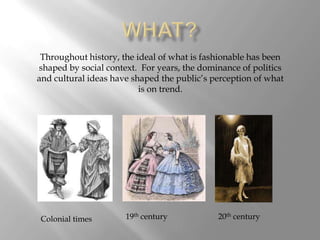
What?Throughout history, the ideal of what is fashionable has been shaped by social context.  For years, the dominance of politics and cultural ideas have shaped the public’s perception of what is on trend.19th century20th centuryColonial times
Each century has had distinctive style icons1980’s1990’s1960’s
Until now!Current media culture is rapidly expanding, and as a result has become complicated and confusing.  Exposure to mass media (TV, movies, magazines, internet) inundates young people with mixed messages of what is sexy or cool, making it difficult to choose a role model.AlexaLady GagaRihannaJordan
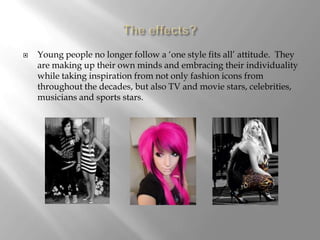
The effects?Young people no longer follow a ‘one style fits all’ attitude.  They are making up their own minds and embracing their individuality while taking inspiration from not only fashion icons from throughout the decades, but also TV and movie stars, celebrities, musicians and sports stars.
HOW?Fashion illustration is the communication of fashion that originates with illustration drawing and painting.  The illustrations are usually more stylised than a traditional portrait.  There are three catagories for the artists of fashion illustration.  These are the Sensualists, Gamines and Sophisticates and Technocrats.
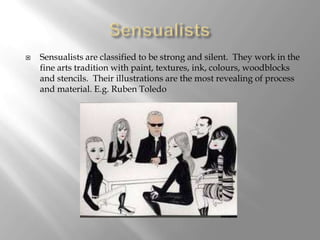
SensualistsSensualists are classified to be strong and silent.  They work in the fine arts tradition with paint, textures, ink, colours, woodblocks and stencils.  Their illustrations are the most revealing of process and material. E.g. Ruben Toledo
TechnocratsTechnocrats employ digital means in the creation of their images.  They draw but do not finish off with hand illustration.  They digitally transform their images and work towards the end computer generated product. E.g. Jason Brooks.
Gamines and SophisticatesGamines and Sophisticates generate an imaginary world inhibited by flamboyant personalities. Their work is flamboyant and utilizes the elements of caricature and cartooning to formulate the characters.  They are playful and by making whimsical reference to older forms of fashion in their work, both undermine and renew the field. E.g. Jordi La Banda
WHY?The work of fashion illustrators, creative artists who create non-illustrative depictions of designers clothes, is both descriptive and expressive.  A fashion illustrator’s drawing conveys more than the appearance of a model and the clothes she wears.  The artists stylize a great deal to achieve the effects they seek, exaggerating some aspects and diminishing the significance of others.  It is the personality or character of the look that is the subject of most fashion illustration.
Because fashion illustrators can communicate the personality or clothes in a more personal or particular way than photography, they are essential participants in the fashion industry.   Their work can be commissioned for reproduction in fashion magazines, as part of an editorial feature, or for the purpose of advertising and promoting fashion makers, fashion labels or boutiques.

Week 12 Powerpoint Presentation

  • 1.
    Week 12 -Presentation
  • 2.
    What?Throughout history, theideal of what is fashionable has been shaped by social context. For years, the dominance of politics and cultural ideas have shaped the public’s perception of what is on trend.19th century20th centuryColonial times
  • 3.
    Each century hashad distinctive style icons1980’s1990’s1960’s
  • 4.
    Until now!Current mediaculture is rapidly expanding, and as a result has become complicated and confusing. Exposure to mass media (TV, movies, magazines, internet) inundates young people with mixed messages of what is sexy or cool, making it difficult to choose a role model.AlexaLady GagaRihannaJordan
  • 5.
    The effects?Young peopleno longer follow a ‘one style fits all’ attitude. They are making up their own minds and embracing their individuality while taking inspiration from not only fashion icons from throughout the decades, but also TV and movie stars, celebrities, musicians and sports stars.
  • 6.
    HOW?Fashion illustration isthe communication of fashion that originates with illustration drawing and painting. The illustrations are usually more stylised than a traditional portrait. There are three catagories for the artists of fashion illustration. These are the Sensualists, Gamines and Sophisticates and Technocrats.
  • 7.
    SensualistsSensualists are classifiedto be strong and silent. They work in the fine arts tradition with paint, textures, ink, colours, woodblocks and stencils. Their illustrations are the most revealing of process and material. E.g. Ruben Toledo
  • 8.
    TechnocratsTechnocrats employ digitalmeans in the creation of their images. They draw but do not finish off with hand illustration. They digitally transform their images and work towards the end computer generated product. E.g. Jason Brooks.
  • 9.
    Gamines and SophisticatesGaminesand Sophisticates generate an imaginary world inhibited by flamboyant personalities. Their work is flamboyant and utilizes the elements of caricature and cartooning to formulate the characters. They are playful and by making whimsical reference to older forms of fashion in their work, both undermine and renew the field. E.g. Jordi La Banda
  • 10.
    WHY?The work offashion illustrators, creative artists who create non-illustrative depictions of designers clothes, is both descriptive and expressive. A fashion illustrator’s drawing conveys more than the appearance of a model and the clothes she wears. The artists stylize a great deal to achieve the effects they seek, exaggerating some aspects and diminishing the significance of others. It is the personality or character of the look that is the subject of most fashion illustration.
  • 11.
    Because fashion illustratorscan communicate the personality or clothes in a more personal or particular way than photography, they are essential participants in the fashion industry. Their work can be commissioned for reproduction in fashion magazines, as part of an editorial feature, or for the purpose of advertising and promoting fashion makers, fashion labels or boutiques.