Jennifer Widom
Relational Databases
Querying Relational
Databases
Jennifer Widom
Querying Relational Databases
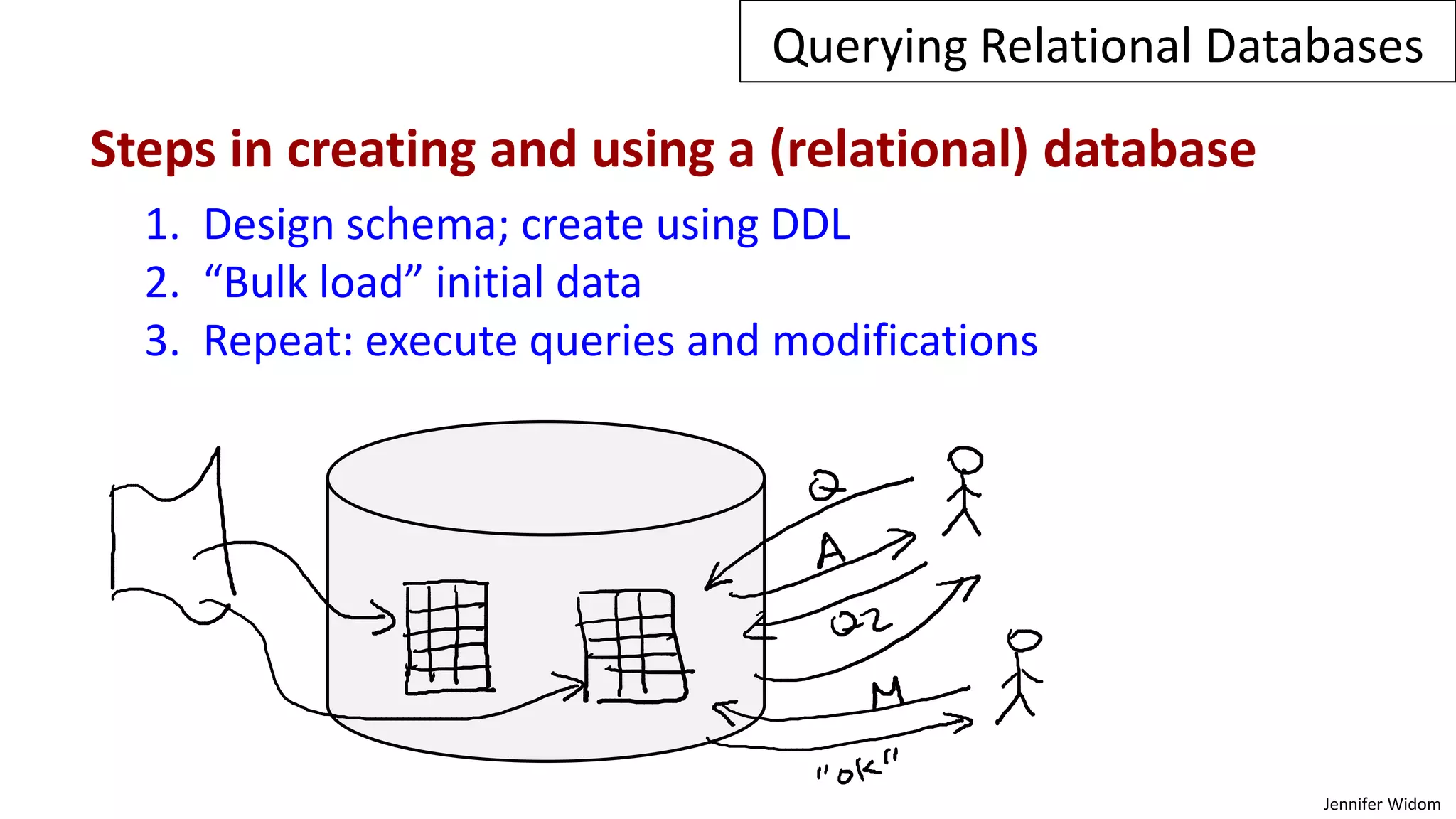
Steps in creating and using a (relational) database
1. Design schema; create using DDL
2. “Bulk load” initial data
3. Repeat: execute queries and modifications
Jennifer Widom
Querying Relational Databases
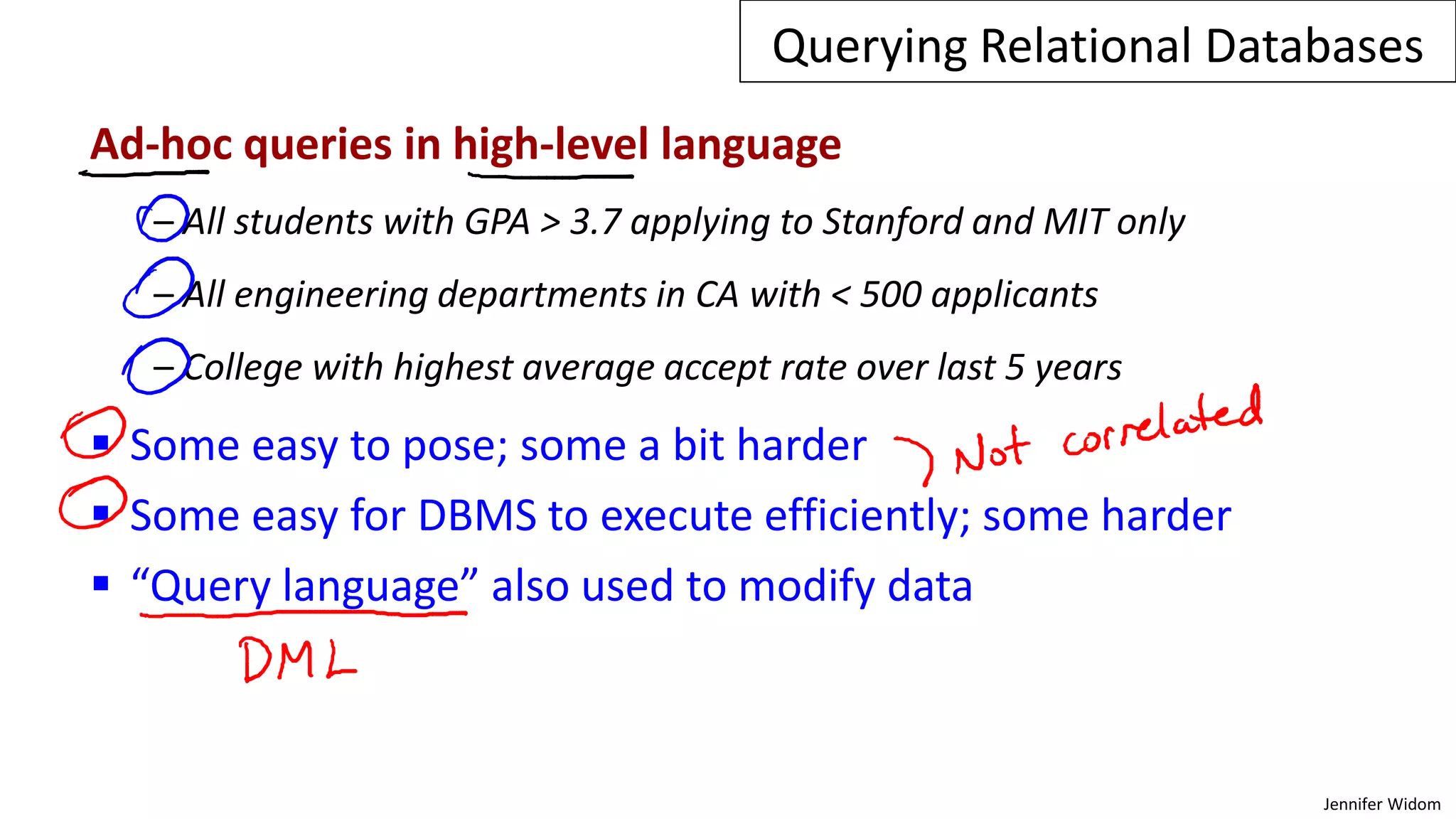
Ad-hoc queries in high-level language
– All students with GPA > 3.7 applying to Stanford and MIT only
– All engineering departments in CA with < 500 applicants
– College with highest average accept rate over last 5 years
 Some easy to pose; some a bit harder
 Some easy for DBMS to execute efficiently; some harder
 “Query language” also used to modify data
Jennifer Widom
Querying Relational Databases
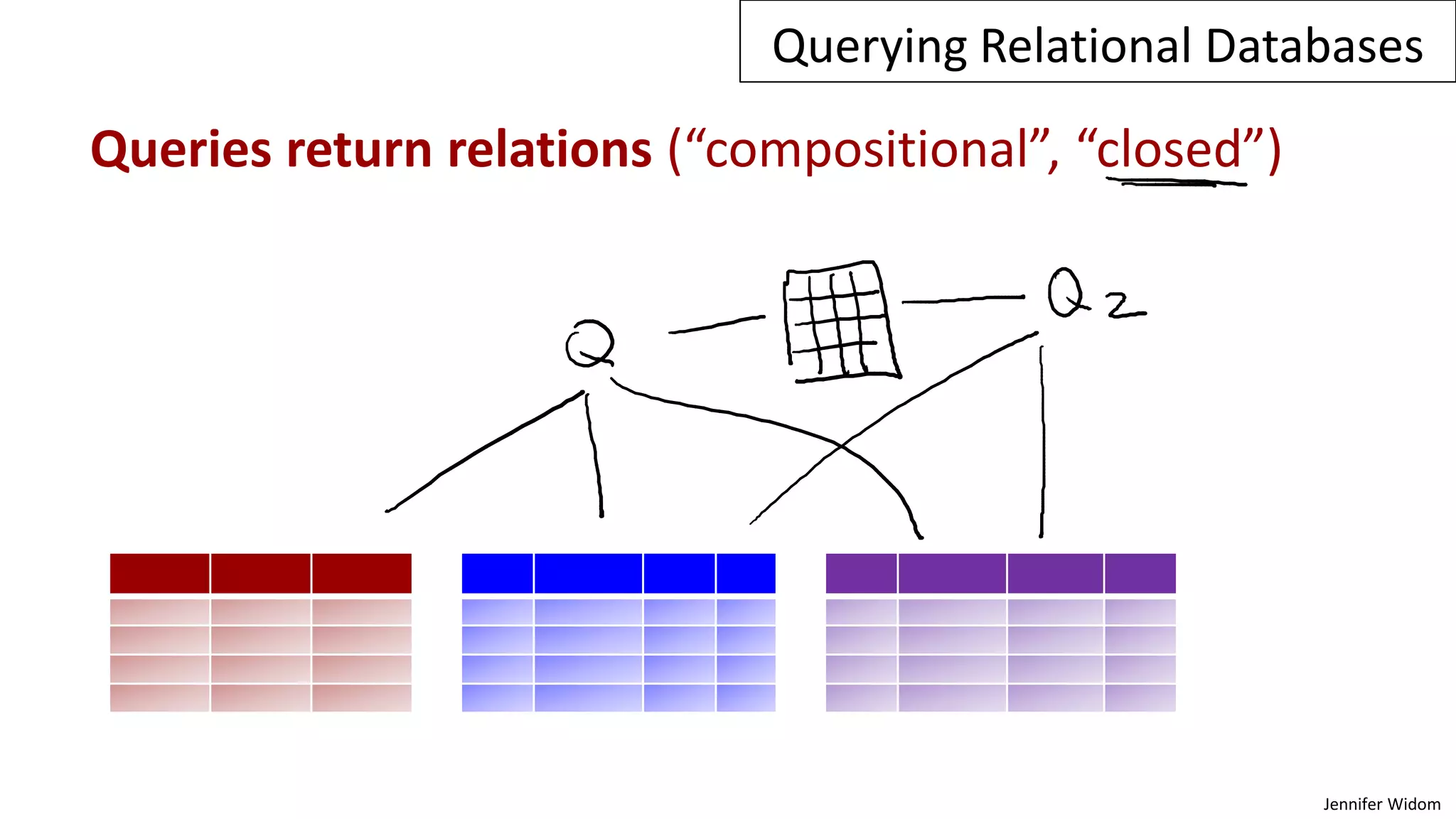
Queries return relations (“compositional”, “closed”)
Jennifer Widom
Querying Relational Databases
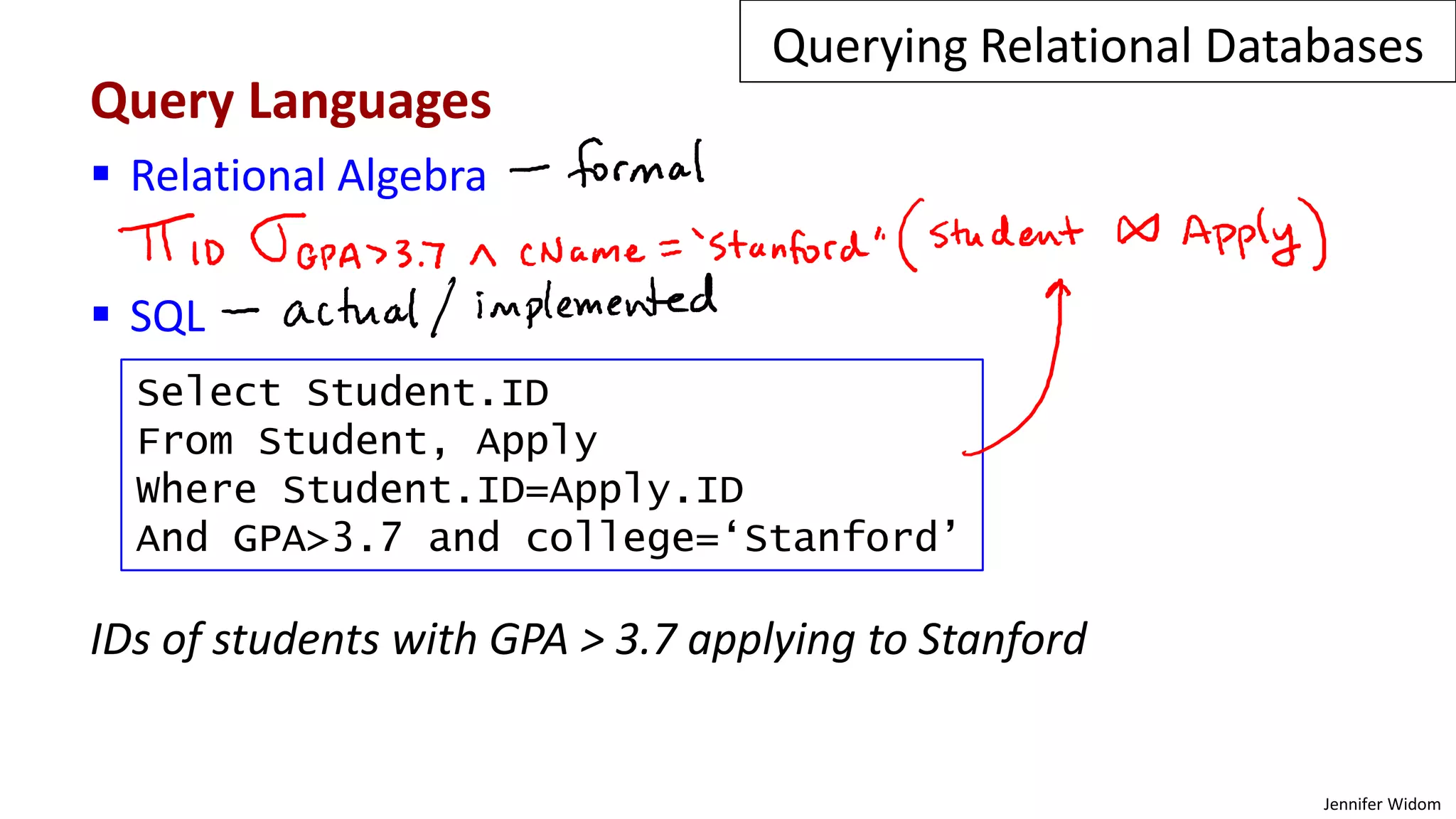
Query Languages
 Relational Algebra
 SQL
IDs of students with GPA > 3.7 applying to Stanford
Select Student.ID
From Student, Apply
Where Student.ID=Apply.ID
And GPA>3.7 and college=‘Stanford’

Relational querying

  • 1.
  • 2.
    Jennifer Widom Querying RelationalDatabases Steps in creating and using a (relational) database 1. Design schema; create using DDL 2. “Bulk load” initial data 3. Repeat: execute queries and modifications
  • 3.
    Jennifer Widom Querying RelationalDatabases Ad-hoc queries in high-level language – All students with GPA > 3.7 applying to Stanford and MIT only – All engineering departments in CA with < 500 applicants – College with highest average accept rate over last 5 years  Some easy to pose; some a bit harder  Some easy for DBMS to execute efficiently; some harder  “Query language” also used to modify data
  • 4.
    Jennifer Widom Querying RelationalDatabases Queries return relations (“compositional”, “closed”)
  • 5.
    Jennifer Widom Querying RelationalDatabases Query Languages  Relational Algebra  SQL IDs of students with GPA > 3.7 applying to Stanford Select Student.ID From Student, Apply Where Student.ID=Apply.ID And GPA>3.7 and college=‘Stanford’