Why do We Reinforce Concrete?
Concrete is Very Strong, Hard, and Durable in itself, but it is also Brittle and Stiff and not as
Strong as you think it is just by Looking at it and Feeling it. Therefore, Reinforcing Steel is
Needed to Give it more Tensile Strength, Flexibility, and Structural Support.
What is Required from a Designer to produce an RC Drawing?
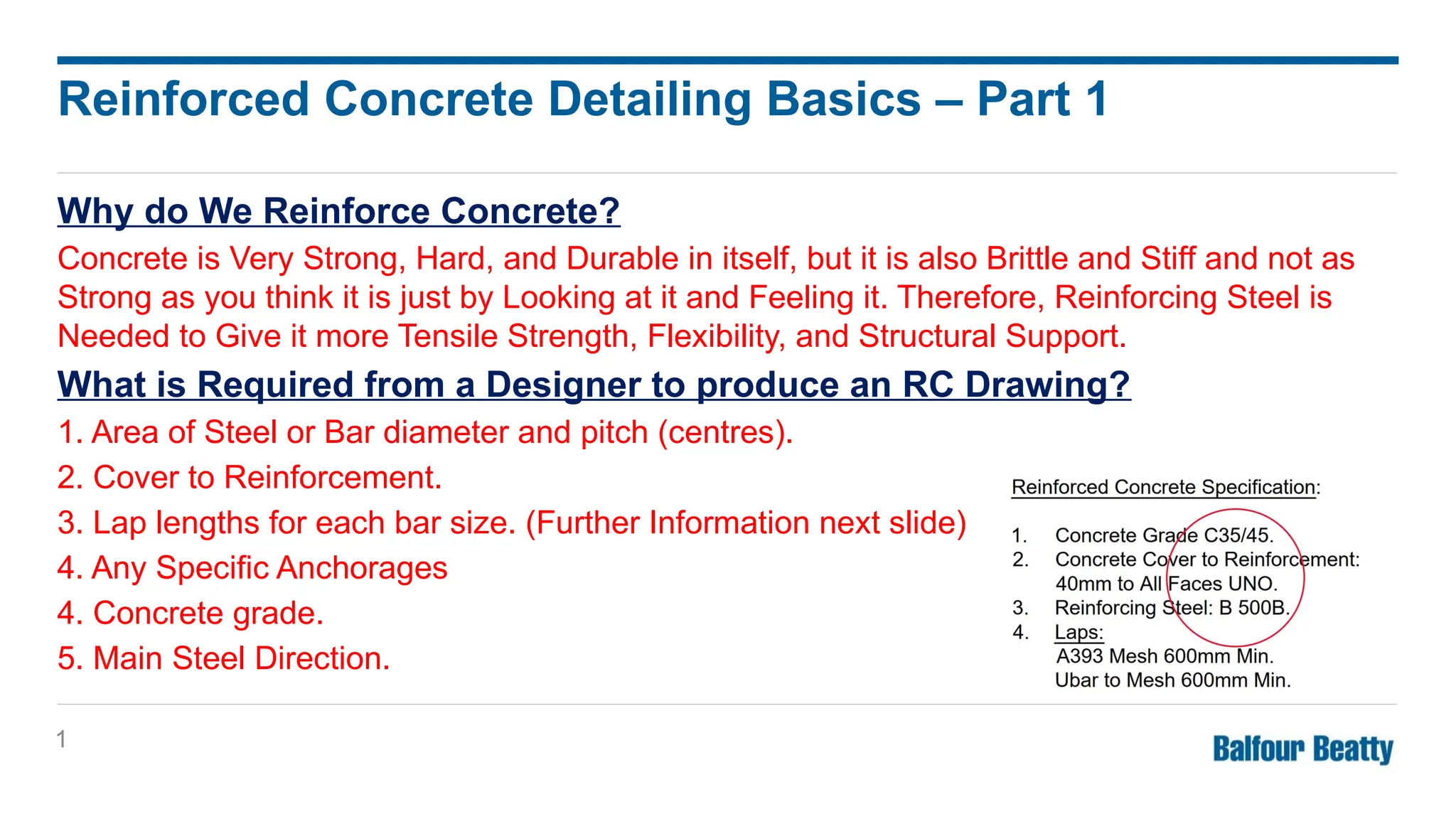
1. Area of Steel or Bar diameter and pitch (centres).
2. Cover to Reinforcement.
3. Lap lengths for each bar size. (Further Information next slide)
4. Any Specific Anchorages
4. Concrete grade.
5. Main Steel Direction.
1
Reinforced Concrete Detailing Basics – Part 1
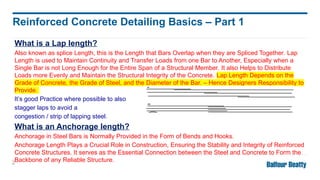
What is a Lap length?
Also known as splice Length, this is the Length that Bars Overlap when they are Spliced Together. Lap
Length is used to Maintain Continuity and Transfer Loads from one Bar to Another, Especially when a
Single Bar is not Long Enough for the Entire Span of a Structural Member. It also Helps to Distribute
Loads more Evenly and Maintain the Structural Integrity of the Concrete. Lap Length Depends on the
Grade of Concrete, the Grade of Steel, and the Diameter of the Bar. – Hence Designers Responsibility to
Provide.
It’s good Practice where possible to also
stagger laps to avoid a
congestion / strip of lapping steel.
What is an Anchorage length?
Anchorage in Steel Bars is Normally Provided in the Form of Bends and Hooks.
Anchorage Length Plays a Crucial Role in Construction, Ensuring the Stability and Integrity of Reinforced
Concrete Structures. It serves as the Essential Connection between the Steel and Concrete to Form the
Backbone of any Reliable Structure.
2
Reinforced Concrete Detailing Basics – Part 1
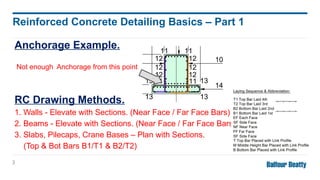
Anchorage Example.
Not enough Anchorage from this point
RC Drawing Methods.
1. Walls - Elevate with Sections. (Near Face / Far Face Bars)
2. Beams - Elevate with Sections. (Near Face / Far Face Bars)
3. Slabs, Pilecaps, Crane Bases – Plan with Sections.
(Top & Bot Bars B1/T1 & B2/T2)
3
Reinforced Concrete Detailing Basics – Part 1
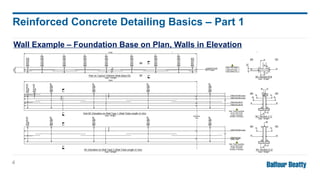
Wall Example – Foundation Base on Plan, Walls in Elevation
4
Reinforced Concrete Detailing Basics – Part 1
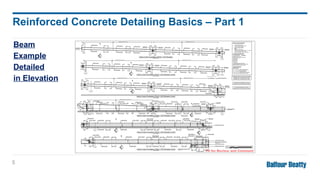
Beam
Example
Detailed
in Elevation
5
Reinforced Concrete Detailing Basics – Part 1
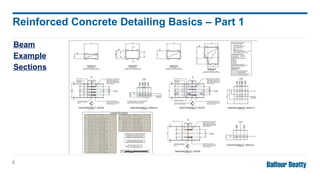
Beam
Example
Sections
6
Reinforced Concrete Detailing Basics – Part 1
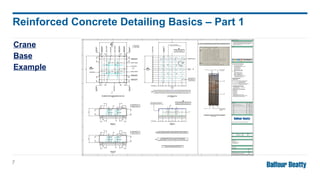
Crane
Base
Example
7
Reinforced Concrete Detailing Basics – Part 1
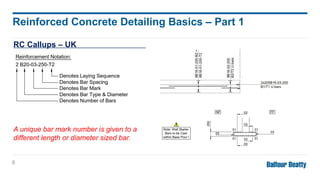
RC Callups – UK
A unique bar mark number is given to a
different length or diameter sized bar.
8
Reinforced Concrete Detailing Basics – Part 1
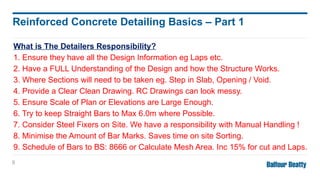
What is The Detailers Responsibility?
1. Ensure they have all the Design Information eg Laps etc.
2. Have a FULL Understanding of the Design and how the Structure Works.
3. Where Sections will need to be taken eg. Step in Slab, Opening / Void.
4. Provide a Clear Clean Drawing. RC Drawings can look messy.
5. Ensure Scale of Plan or Elevations are Large Enough.
6. Try to keep Straight Bars to Max 6.0m where Possible.
7. Consider Steel Fixers on Site. We have a responsibility with Manual Handling !
8. Minimise the Amount of Bar Marks. Saves time on site Sorting.
9. Schedule of Bars to BS: 8666 or Calculate Mesh Area. Inc 15% for cut and Laps.
9
Reinforced Concrete Detailing Basics – Part 1

Reinforced Concrete Detailing Basics knowledge

  • 1.
    Why do WeReinforce Concrete? Concrete is Very Strong, Hard, and Durable in itself, but it is also Brittle and Stiff and not as Strong as you think it is just by Looking at it and Feeling it. Therefore, Reinforcing Steel is Needed to Give it more Tensile Strength, Flexibility, and Structural Support. What is Required from a Designer to produce an RC Drawing? 1. Area of Steel or Bar diameter and pitch (centres). 2. Cover to Reinforcement. 3. Lap lengths for each bar size. (Further Information next slide) 4. Any Specific Anchorages 4. Concrete grade. 5. Main Steel Direction. 1 Reinforced Concrete Detailing Basics – Part 1
  • 2.
    What is aLap length? Also known as splice Length, this is the Length that Bars Overlap when they are Spliced Together. Lap Length is used to Maintain Continuity and Transfer Loads from one Bar to Another, Especially when a Single Bar is not Long Enough for the Entire Span of a Structural Member. It also Helps to Distribute Loads more Evenly and Maintain the Structural Integrity of the Concrete. Lap Length Depends on the Grade of Concrete, the Grade of Steel, and the Diameter of the Bar. – Hence Designers Responsibility to Provide. It’s good Practice where possible to also stagger laps to avoid a congestion / strip of lapping steel. What is an Anchorage length? Anchorage in Steel Bars is Normally Provided in the Form of Bends and Hooks. Anchorage Length Plays a Crucial Role in Construction, Ensuring the Stability and Integrity of Reinforced Concrete Structures. It serves as the Essential Connection between the Steel and Concrete to Form the Backbone of any Reliable Structure. 2 Reinforced Concrete Detailing Basics – Part 1
  • 3.
    Anchorage Example. Not enoughAnchorage from this point RC Drawing Methods. 1. Walls - Elevate with Sections. (Near Face / Far Face Bars) 2. Beams - Elevate with Sections. (Near Face / Far Face Bars) 3. Slabs, Pilecaps, Crane Bases – Plan with Sections. (Top & Bot Bars B1/T1 & B2/T2) 3 Reinforced Concrete Detailing Basics – Part 1
  • 4.
    Wall Example –Foundation Base on Plan, Walls in Elevation 4 Reinforced Concrete Detailing Basics – Part 1
  • 5.
  • 6.
  • 7.
  • 8.
    RC Callups –UK A unique bar mark number is given to a different length or diameter sized bar. 8 Reinforced Concrete Detailing Basics – Part 1
  • 9.
    What is TheDetailers Responsibility? 1. Ensure they have all the Design Information eg Laps etc. 2. Have a FULL Understanding of the Design and how the Structure Works. 3. Where Sections will need to be taken eg. Step in Slab, Opening / Void. 4. Provide a Clear Clean Drawing. RC Drawings can look messy. 5. Ensure Scale of Plan or Elevations are Large Enough. 6. Try to keep Straight Bars to Max 6.0m where Possible. 7. Consider Steel Fixers on Site. We have a responsibility with Manual Handling ! 8. Minimise the Amount of Bar Marks. Saves time on site Sorting. 9. Schedule of Bars to BS: 8666 or Calculate Mesh Area. Inc 15% for cut and Laps. 9 Reinforced Concrete Detailing Basics – Part 1