REGULATION By Lewis Pike
WHO REGULATES THE CONTENT OF
MUSIC VIDEOS IN THE UK & HOW THE
PROCESS OF REGULATION WORKS?The British Board of the film classification (BBFC) regulates music videos in the UK and is an
independent, non governmental body. The BBFC will age rate all music videos, this helps protect
younger children and make aware to consumers the contents. Vevo and YouTube will have the
BBFC rating appear in the left hand corner and will be age rated either 12, 15 or 18, should any
age restrictions apply.
The BBFC will assign a age rating to a music video depending on it’s content, which include:
•Drug Misuses
•Dangerous behaviour presented as safe
•Bad Language
•Sexual Behaviour and nudity
•Threatening behaviour
All music videos for release by Sony Music, Universal Music and Warner music online are submitted
by their record labels to BBFC to be classified. However the age rating only applies to UK produced
music videos.
Ofcom which was set up by parliament is a UK independent communications regulator, which does
have a large obligation to protect viewers. However unlike the BBFC, which has the power to
WHY ARE THEY
REGULATED?Music videos have been regulated because of the concerns of parents with the material being shown, which might
seriously impair the physical, mental or moral development of those under 18. In 2013 concerns grew over the sexual
content of music videos, such as Miley Cyrus and Rihanna, with many complaints made to Ofcom. High profile artists
have a huge influence on the younger generation, with many youngsters wanting to look a certain way because of their
idol. The image that is very often left in their minds is the wrong message, which can make a young person act or dress
a certain way.
If we look at Britney Spears music video hit me baby one more time. This video has not been rated, but many would
argue that school children are being sexualised. With Britney Spears dressed in a school uniform, bunches in hair and
showing her midriff. This supports Michael Shore’s theory that music videos are recycled styles that contain an
information overload and therefore contains views of adolescent male fantasies and conveys into soft-core pornography.
It is important that music videos are regulated to protect the young audience, which supports the hypodermic needle
theory which implies that the mass media has a direct, and powerful effect on it’s audience. Which is very evident with
the younger generation. In 2014 O.T. Genasis released the track ‘CoCo’ in which we see in the music video himself
taking cocaine and we see the stereotypical mise-en-scene drug lifestyle which is associated with gangs and guns. This
became a very popular song within schools and could influence children into drugs and violence.
Link to O.T Genasis YouTube Video: https://www.youtube.com/watch?v=6vYnas6q3Sg
HISTORY OF
REGULATION
Music videos became popular in the
1980’s, because of channels such as MTV.
Any music video deemed inappropriate, for
example Queen’s ‘Body Language’ was
banned because of homoerotic content.
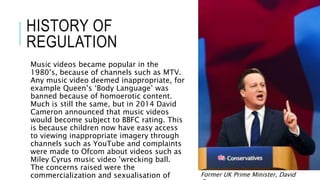
Much is still the same, but in 2014 David
Cameron announced that music videos
would become subject to BBFC rating. This
is because children now have easy access
to viewing inappropriate imagery through
channels such as YouTube and complaints
were made to Ofcom about videos such as
Miley Cyrus music video ’wrecking ball.
The concerns raised were the
commercialization and sexualisation of Former UK Prime Minister, David
GUIDELI
NES
YouTube has strict guidelines which must be respected by members. YouTube employees have to browse through user videos
to see if its breach’s their policies – more than 65,000 videos are posted everyday, which all have to be viewed by employees
of the company. YouTube policies are:
- Nudity or Sexual content: Nudity may only be allowed if it’s educational or scientific otherwise YouTube will not accept.
- Copyright: Copyright must be respected in videos.
- Hateful Content: Content that condones violence against a particular group (different ethnicities, sexualities, physical
status) isn’t acceptable
- Violent or graphic content: Gory content that’s intended to shock is not supported unless it’s part of the news.
- Spam and Scams: Unwanted repeated content isn’t allowed.
- Harmful or Dangerous Content: Encouraging audience members to perform dangerous acts isn’t allowed, or will have to be
agerestricted where users have to sign in to their account to prove their age. Educational and scientific content that is
dangerous is allowed.
- Threats: Revealing people’s personal information, stalking, making threats and encouraging audience members to commit
violent acts can result in someone being permanently banned from the platform.
CENSOR
SHIP
Music videos are censored if deemed to have inappropriate sexual content, violence, inappropriate
language and drugs. The first music video to be banned was Queen ‘Body language’ because of sexual
content involving character’s groping one another, by today’s standards the video seems very tame.
There has been much debate over censorship of music videos with many artists such as Madonna,
Rhianna and Miley Cyrus debating that we all have a freedom of speech. They argue that censorship limits
artists freedom to express themselves in their music. Artists produce music to show their creativity and
inspire the audience. The problem with restrictions is that music videos which contained LGBT themed
videos were also deemed as being inappropriate even despite the fact the content was non- sexual. There
was much protests and YouTube have since changed restrictions on gay themed content. As YouTube
has been accused of being hegemonic, because they are seen as this powerful elite which don’t want to
display LGBT related videos to their audience. This links to Gramsci theory. Gramsci was concerned how
the media might serve as a propaganda tool that promotes the dominant ideology of the elite. An
argument of censorship is that audience member’s are passive and will accept different information they
are being injected with (Hypodermic Needle).The main advantage of censorship is to protect children
from inappropriate content and expletive lyrics. Children are impressionable and music video’s glamorize
wrongdoings like drugs, rape, violence and racial discrimination. Censorship prevents children from
viewing explicit imagery and will discourage producers from using the shock value, to sell music as they
know using explicit imagery will get the audience talking and will encourage sales. Looking at Stuart
Hall’s Reception theory audience member’s will take a direct opposition to the reading presented by the
media text, an example is Robin Thicke’s track which featured sexual content.
ROBIN LINES- BLURRED
LINES
↑ Images from the unrated version of the
music videoRobin Thicke’s music video ‘Blurred Lines” the explicit version has not been rated on Vevo, but on YouTube the video has been banned,
in which you can only view the non explicit version. The unrated version features three topless models, allusions to drugs, bestiality
and a balloon arrangement that reads ”Robin Thicke has a big dick” The video supports Laura Mulvey’s male gaze theory, the three
women are solely in the music video for male pleasure. In the music video it’s surrounded by the idea of power, girls and the ideal
dominant lifestyle for men. This conforms to Michael Shore’s theory that rotate around the views of male fantasies and are recycled
styles that contain a information overload
The video has caused much controversy and males and females will both take different views of the video. Linking to Stuart Halls
reception theory, the male audience may take a preferred reading, as the video shows real dominance over the female characters and
males may be able to identify to the video. The female audience may take a oppositional reading and may oppose to the way the
females are being represented. However some females may take a negotiated reading, because if you took the female characters out of
this music video. The music video itself, both versions, would have not been so successful.
In the non explicit version, although we do not see no nudity. The lyrics are still powerful and the lyrics “ You know you want it” and
the song title ”blurred lines” could give confusion towards sex and consent. Sexual harassment may even be portrayed as being
acceptable. We can identify all Andrew Goodwin’s 6 key aspects theory, we see a relationship between the lyrics and visuals as the
music relates to the visuals, we see multiple close up shots. The genre is related to the style, Disco and R&B conventions are that
women are objectified through the mail gaze, because of the minimal amount of clothing worn. Voyeurism plays a major role in
’blurred lines’ and the intersexual reference relates to the ending where one of the models is dancing in front of the wall which says
”Robin Thicke has a big dick” which could be seen as the joke, as it’s persuading the audience that he did have his way with the girl.
Image of a protest
over the song
↑Image from clean
version
CONCLUSION
This task has allowed me to have the necessary information I need
surrounding the areas of music video regulation and censorship. I am
intending on producing a music video to the track ‘Living In America’
and will not be intending on having ‘banned’ content in my
production. I have reviewed the lyrics of the song and there is no
swearing or inappropriate language. When I have produced my
production I want the audience to have a ‘preferred reading’ and
share the programme’s code (Stuart Hall). When I plan my music
video it’s important that my production is suitable for my chosen
audience (16-35 years old) and will have to take into account the UK
Law. If a video is deemed inappropriate and banned from platforms
this doesn’t mean it’s removed from existence, which I learnt with
Blurred Lines where the ‘inappropriate’ content was found on
alternative sites such as Vevo.

Regulation

  • 1.
  • 2.
    WHO REGULATES THECONTENT OF MUSIC VIDEOS IN THE UK & HOW THE PROCESS OF REGULATION WORKS?The British Board of the film classification (BBFC) regulates music videos in the UK and is an independent, non governmental body. The BBFC will age rate all music videos, this helps protect younger children and make aware to consumers the contents. Vevo and YouTube will have the BBFC rating appear in the left hand corner and will be age rated either 12, 15 or 18, should any age restrictions apply. The BBFC will assign a age rating to a music video depending on it’s content, which include: •Drug Misuses •Dangerous behaviour presented as safe •Bad Language •Sexual Behaviour and nudity •Threatening behaviour All music videos for release by Sony Music, Universal Music and Warner music online are submitted by their record labels to BBFC to be classified. However the age rating only applies to UK produced music videos. Ofcom which was set up by parliament is a UK independent communications regulator, which does have a large obligation to protect viewers. However unlike the BBFC, which has the power to
  • 3.
    WHY ARE THEY REGULATED?Musicvideos have been regulated because of the concerns of parents with the material being shown, which might seriously impair the physical, mental or moral development of those under 18. In 2013 concerns grew over the sexual content of music videos, such as Miley Cyrus and Rihanna, with many complaints made to Ofcom. High profile artists have a huge influence on the younger generation, with many youngsters wanting to look a certain way because of their idol. The image that is very often left in their minds is the wrong message, which can make a young person act or dress a certain way. If we look at Britney Spears music video hit me baby one more time. This video has not been rated, but many would argue that school children are being sexualised. With Britney Spears dressed in a school uniform, bunches in hair and showing her midriff. This supports Michael Shore’s theory that music videos are recycled styles that contain an information overload and therefore contains views of adolescent male fantasies and conveys into soft-core pornography. It is important that music videos are regulated to protect the young audience, which supports the hypodermic needle theory which implies that the mass media has a direct, and powerful effect on it’s audience. Which is very evident with the younger generation. In 2014 O.T. Genasis released the track ‘CoCo’ in which we see in the music video himself taking cocaine and we see the stereotypical mise-en-scene drug lifestyle which is associated with gangs and guns. This became a very popular song within schools and could influence children into drugs and violence. Link to O.T Genasis YouTube Video: https://www.youtube.com/watch?v=6vYnas6q3Sg
  • 4.
    HISTORY OF REGULATION Music videosbecame popular in the 1980’s, because of channels such as MTV. Any music video deemed inappropriate, for example Queen’s ‘Body Language’ was banned because of homoerotic content. Much is still the same, but in 2014 David Cameron announced that music videos would become subject to BBFC rating. This is because children now have easy access to viewing inappropriate imagery through channels such as YouTube and complaints were made to Ofcom about videos such as Miley Cyrus music video ’wrecking ball. The concerns raised were the commercialization and sexualisation of Former UK Prime Minister, David
  • 5.
    GUIDELI NES YouTube has strictguidelines which must be respected by members. YouTube employees have to browse through user videos to see if its breach’s their policies – more than 65,000 videos are posted everyday, which all have to be viewed by employees of the company. YouTube policies are: - Nudity or Sexual content: Nudity may only be allowed if it’s educational or scientific otherwise YouTube will not accept. - Copyright: Copyright must be respected in videos. - Hateful Content: Content that condones violence against a particular group (different ethnicities, sexualities, physical status) isn’t acceptable - Violent or graphic content: Gory content that’s intended to shock is not supported unless it’s part of the news. - Spam and Scams: Unwanted repeated content isn’t allowed. - Harmful or Dangerous Content: Encouraging audience members to perform dangerous acts isn’t allowed, or will have to be agerestricted where users have to sign in to their account to prove their age. Educational and scientific content that is dangerous is allowed. - Threats: Revealing people’s personal information, stalking, making threats and encouraging audience members to commit violent acts can result in someone being permanently banned from the platform.
  • 6.
    CENSOR SHIP Music videos arecensored if deemed to have inappropriate sexual content, violence, inappropriate language and drugs. The first music video to be banned was Queen ‘Body language’ because of sexual content involving character’s groping one another, by today’s standards the video seems very tame. There has been much debate over censorship of music videos with many artists such as Madonna, Rhianna and Miley Cyrus debating that we all have a freedom of speech. They argue that censorship limits artists freedom to express themselves in their music. Artists produce music to show their creativity and inspire the audience. The problem with restrictions is that music videos which contained LGBT themed videos were also deemed as being inappropriate even despite the fact the content was non- sexual. There was much protests and YouTube have since changed restrictions on gay themed content. As YouTube has been accused of being hegemonic, because they are seen as this powerful elite which don’t want to display LGBT related videos to their audience. This links to Gramsci theory. Gramsci was concerned how the media might serve as a propaganda tool that promotes the dominant ideology of the elite. An argument of censorship is that audience member’s are passive and will accept different information they are being injected with (Hypodermic Needle).The main advantage of censorship is to protect children from inappropriate content and expletive lyrics. Children are impressionable and music video’s glamorize wrongdoings like drugs, rape, violence and racial discrimination. Censorship prevents children from viewing explicit imagery and will discourage producers from using the shock value, to sell music as they know using explicit imagery will get the audience talking and will encourage sales. Looking at Stuart Hall’s Reception theory audience member’s will take a direct opposition to the reading presented by the media text, an example is Robin Thicke’s track which featured sexual content.
  • 7.
    ROBIN LINES- BLURRED LINES ↑Images from the unrated version of the music videoRobin Thicke’s music video ‘Blurred Lines” the explicit version has not been rated on Vevo, but on YouTube the video has been banned, in which you can only view the non explicit version. The unrated version features three topless models, allusions to drugs, bestiality and a balloon arrangement that reads ”Robin Thicke has a big dick” The video supports Laura Mulvey’s male gaze theory, the three women are solely in the music video for male pleasure. In the music video it’s surrounded by the idea of power, girls and the ideal dominant lifestyle for men. This conforms to Michael Shore’s theory that rotate around the views of male fantasies and are recycled styles that contain a information overload The video has caused much controversy and males and females will both take different views of the video. Linking to Stuart Halls reception theory, the male audience may take a preferred reading, as the video shows real dominance over the female characters and males may be able to identify to the video. The female audience may take a oppositional reading and may oppose to the way the females are being represented. However some females may take a negotiated reading, because if you took the female characters out of this music video. The music video itself, both versions, would have not been so successful. In the non explicit version, although we do not see no nudity. The lyrics are still powerful and the lyrics “ You know you want it” and the song title ”blurred lines” could give confusion towards sex and consent. Sexual harassment may even be portrayed as being acceptable. We can identify all Andrew Goodwin’s 6 key aspects theory, we see a relationship between the lyrics and visuals as the music relates to the visuals, we see multiple close up shots. The genre is related to the style, Disco and R&B conventions are that women are objectified through the mail gaze, because of the minimal amount of clothing worn. Voyeurism plays a major role in ’blurred lines’ and the intersexual reference relates to the ending where one of the models is dancing in front of the wall which says ”Robin Thicke has a big dick” which could be seen as the joke, as it’s persuading the audience that he did have his way with the girl. Image of a protest over the song ↑Image from clean version
  • 8.
    CONCLUSION This task hasallowed me to have the necessary information I need surrounding the areas of music video regulation and censorship. I am intending on producing a music video to the track ‘Living In America’ and will not be intending on having ‘banned’ content in my production. I have reviewed the lyrics of the song and there is no swearing or inappropriate language. When I have produced my production I want the audience to have a ‘preferred reading’ and share the programme’s code (Stuart Hall). When I plan my music video it’s important that my production is suitable for my chosen audience (16-35 years old) and will have to take into account the UK Law. If a video is deemed inappropriate and banned from platforms this doesn’t mean it’s removed from existence, which I learnt with Blurred Lines where the ‘inappropriate’ content was found on alternative sites such as Vevo.