Prof.Neeraj Bhargava
Abhishek Kumar
Department of Computer Science
School of Engineering & System
Sciences,
MDS, University Ajmer, Rajasthan,
India
1
2
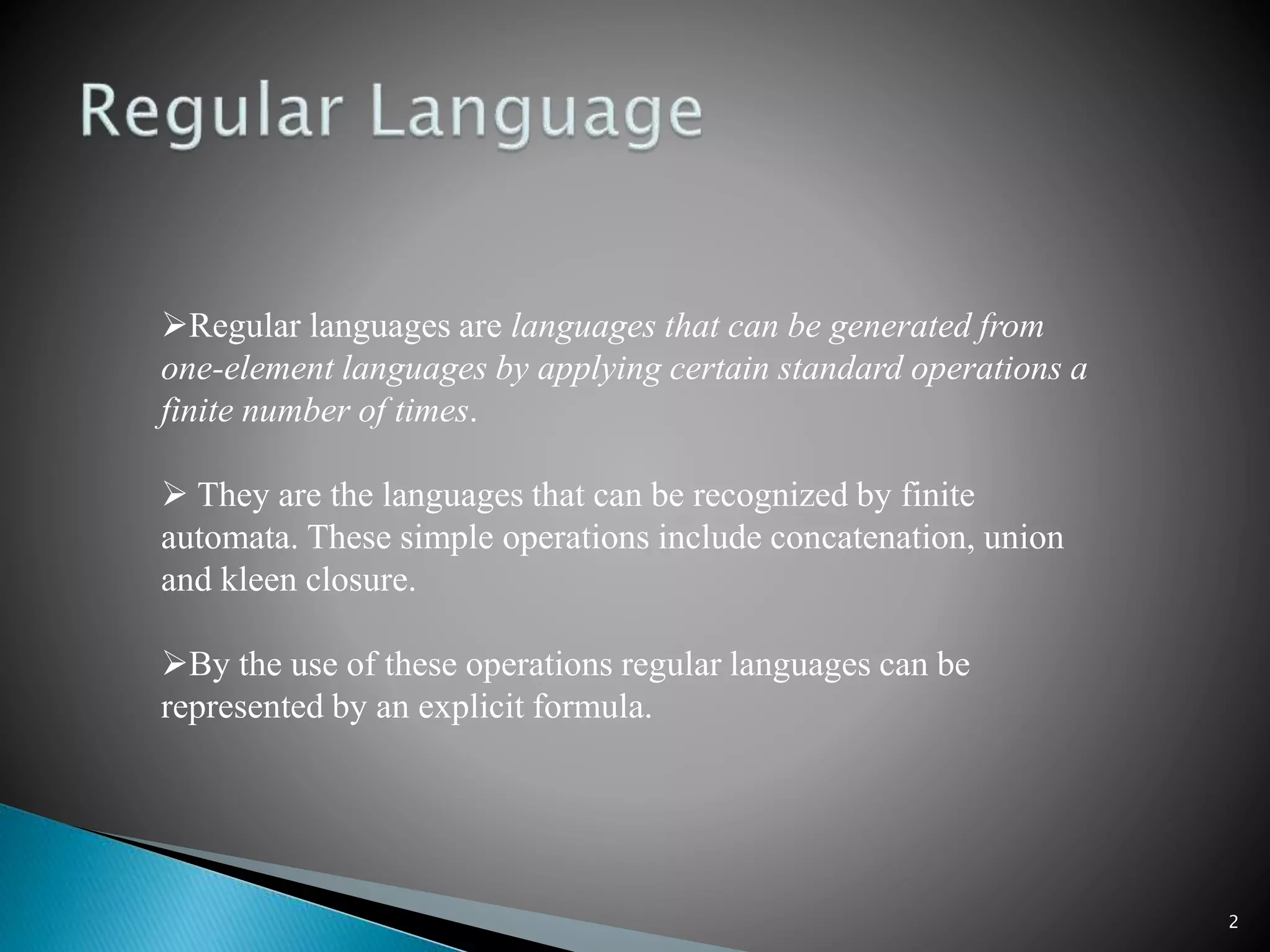
Regular languages are languages that can be generated from
one-element languages by applying certain standard operations a
finite number of times.
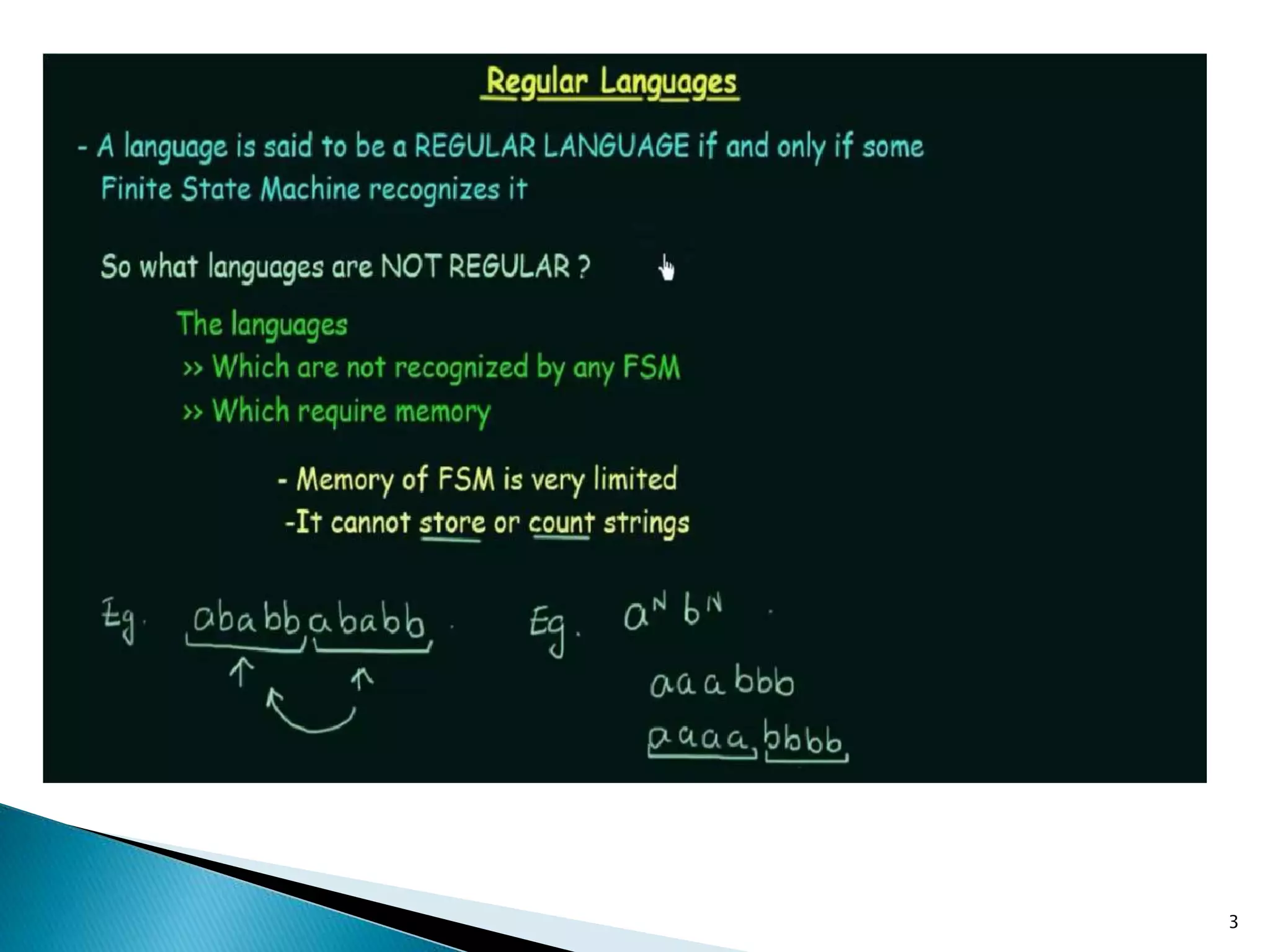
 They are the languages that can be recognized by finite
automata. These simple operations include concatenation, union
and kleen closure.
By the use of these operations regular languages can be
represented by an explicit formula.
3
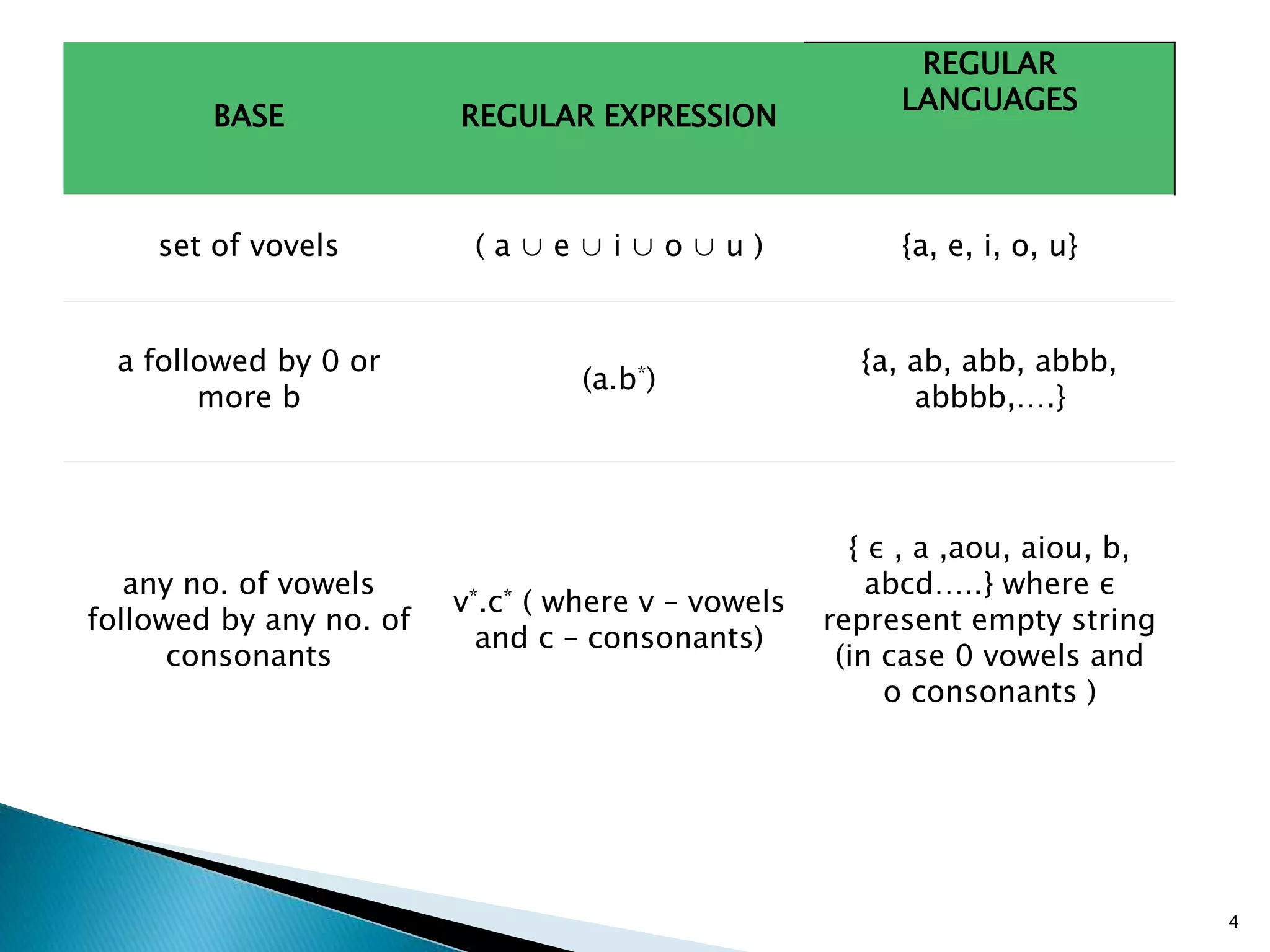
BASE REGULAR EXPRESSION
REGULAR
LANGUAGES
set of vovels ( a ∪ e ∪ i ∪ o ∪ u ) {a, e, i, o, u}
a followed by 0 or
more b
(a.b*)
{a, ab, abb, abbb,
abbbb,….}
any no. of vowels
followed by any no. of
consonants
v*.c* ( where v – vowels
and c – consonants)
{ ε , a ,aou, aiou, b,
abcd…..} where ε
represent empty string
(in case 0 vowels and
o consonants )
4
5
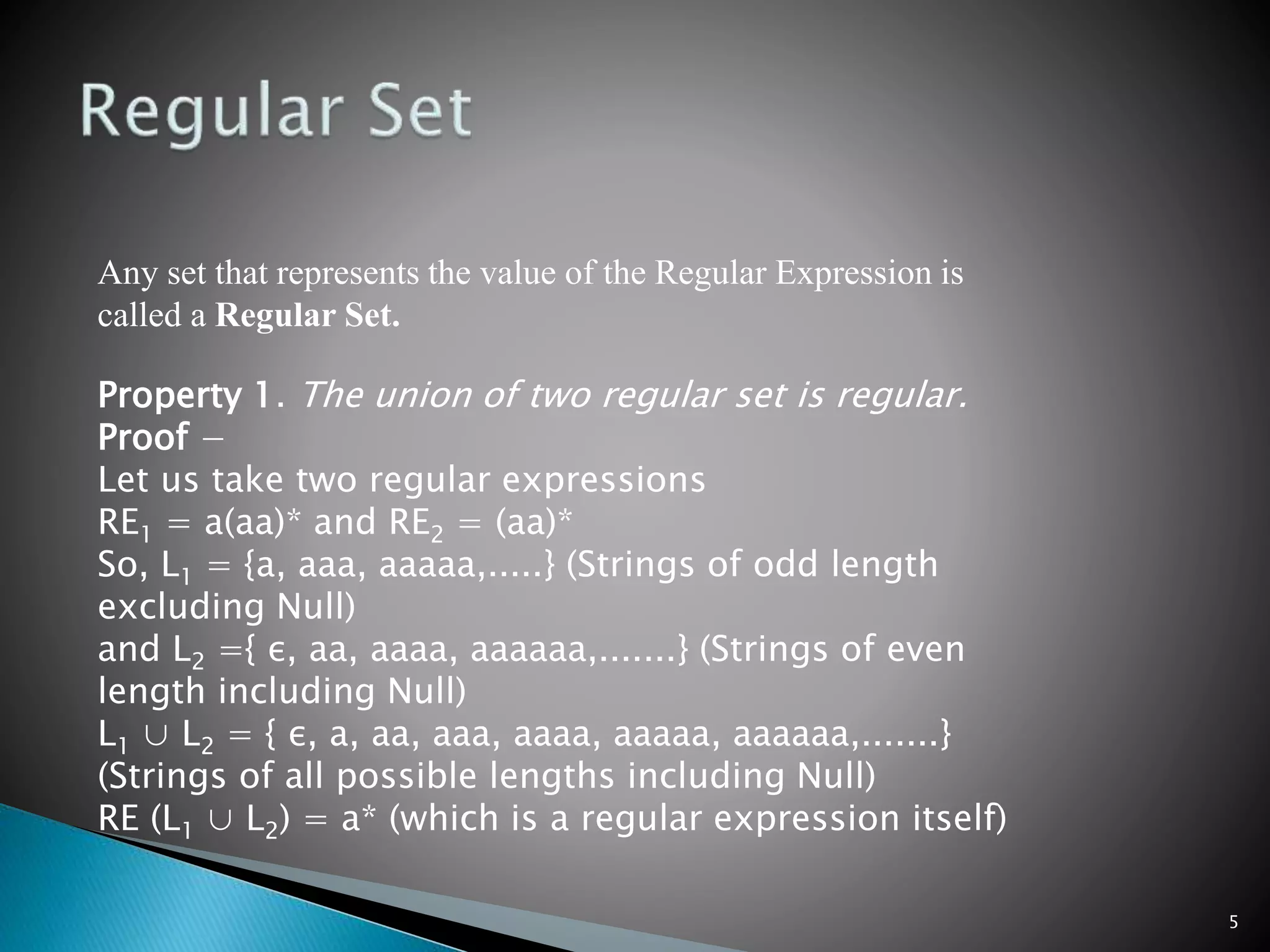
Any set that represents the value of the Regular Expression is
called a Regular Set.
Property 1. The union of two regular set is regular.
Proof −
Let us take two regular expressions
RE1 = a(aa)* and RE2 = (aa)*
So, L1 = {a, aaa, aaaaa,.....} (Strings of odd length
excluding Null)
and L2 ={ ε, aa, aaaa, aaaaaa,.......} (Strings of even
length including Null)
L1 ∪ L2 = { ε, a, aa, aaa, aaaa, aaaaa, aaaaaa,.......}
(Strings of all possible lengths including Null)
RE (L1 ∪ L2) = a* (which is a regular expression itself)
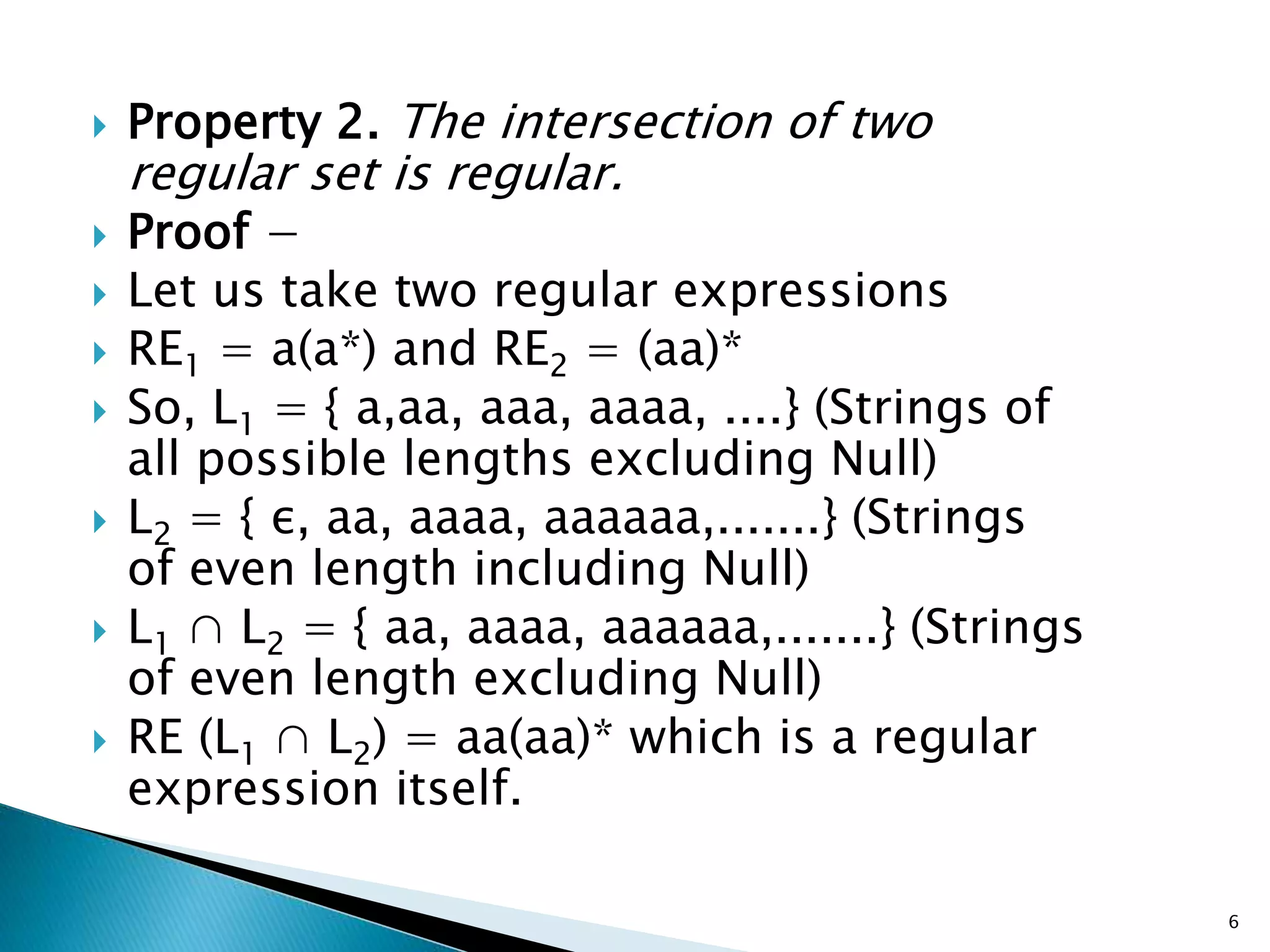
 Property 2. The intersection of two
regular set is regular.
 Proof −
 Let us take two regular expressions
 RE1 = a(a*) and RE2 = (aa)*
 So, L1 = { a,aa, aaa, aaaa, ....} (Strings of
all possible lengths excluding Null)
 L2 = { ε, aa, aaaa, aaaaaa,.......} (Strings
of even length including Null)
 L1 ∩ L2 = { aa, aaaa, aaaaaa,.......} (Strings
of even length excluding Null)
 RE (L1 ∩ L2) = aa(aa)* which is a regular
expression itself.
6
7

Regular languag regular set

  • 1.
    Prof.Neeraj Bhargava Abhishek Kumar Departmentof Computer Science School of Engineering & System Sciences, MDS, University Ajmer, Rajasthan, India 1
  • 2.
    2 Regular languages arelanguages that can be generated from one-element languages by applying certain standard operations a finite number of times.  They are the languages that can be recognized by finite automata. These simple operations include concatenation, union and kleen closure. By the use of these operations regular languages can be represented by an explicit formula.
  • 3.
  • 4.
    BASE REGULAR EXPRESSION REGULAR LANGUAGES setof vovels ( a ∪ e ∪ i ∪ o ∪ u ) {a, e, i, o, u} a followed by 0 or more b (a.b*) {a, ab, abb, abbb, abbbb,….} any no. of vowels followed by any no. of consonants v*.c* ( where v – vowels and c – consonants) { ε , a ,aou, aiou, b, abcd…..} where ε represent empty string (in case 0 vowels and o consonants ) 4
  • 5.
    5 Any set thatrepresents the value of the Regular Expression is called a Regular Set. Property 1. The union of two regular set is regular. Proof − Let us take two regular expressions RE1 = a(aa)* and RE2 = (aa)* So, L1 = {a, aaa, aaaaa,.....} (Strings of odd length excluding Null) and L2 ={ ε, aa, aaaa, aaaaaa,.......} (Strings of even length including Null) L1 ∪ L2 = { ε, a, aa, aaa, aaaa, aaaaa, aaaaaa,.......} (Strings of all possible lengths including Null) RE (L1 ∪ L2) = a* (which is a regular expression itself)
  • 6.
     Property 2.The intersection of two regular set is regular.  Proof −  Let us take two regular expressions  RE1 = a(a*) and RE2 = (aa)*  So, L1 = { a,aa, aaa, aaaa, ....} (Strings of all possible lengths excluding Null)  L2 = { ε, aa, aaaa, aaaaaa,.......} (Strings of even length including Null)  L1 ∩ L2 = { aa, aaaa, aaaaaa,.......} (Strings of even length excluding Null)  RE (L1 ∩ L2) = aa(aa)* which is a regular expression itself. 6
  • 7.