DEPARTMENT OF COMPUTER SCIENCE AND ENGINEERING
Submitted By :
Name : Rohit Giri
CLASS : B.Tech Cse 6TH Sem
Roll No : 20320147008
Subject : Automata theory II
Topic : Regular Expression
Submitted To :
Dr. Navneet Kaur Sandhu
DEPARTMENT OF COMPUTER SCIENCE AND ENGINEERING
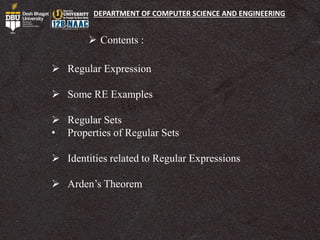
 Contents :
 Regular Expression
 Some RE Examples
 Regular Sets
• Properties of Regular Sets
 Identities related to Regular Expressions
 Arden’s Theorem
DEPARTMENT OF COMPUTER SCIENCE AND ENGINEERING
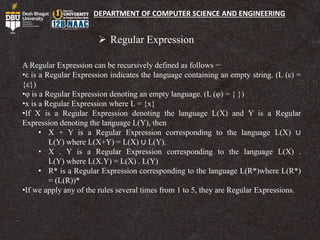
A Regular Expression can be recursively defined as follows −
•ε is a Regular Expression indicates the language containing an empty string. (L (ε) =
{ε})
•φ is a Regular Expression denoting an empty language. (L (φ) = { })
•x is a Regular Expression where L = {x}
•If X is a Regular Expression denoting the language L(X) and Y is a Regular
Expression denoting the language L(Y), then
• X + Y is a Regular Expression corresponding to the language L(X) ∪
L(Y) where L(X+Y) = L(X) ∪ L(Y).
• X . Y is a Regular Expression corresponding to the language L(X) .
L(Y) where L(X.Y) = L(X) . L(Y)
• R* is a Regular Expression corresponding to the language L(R*)where L(R*)
= (L(R))*
•If we apply any of the rules several times from 1 to 5, they are Regular Expressions.
 Regular Expression
DEPARTMENT OF COMPUTER SCIENCE AND ENGINEERING
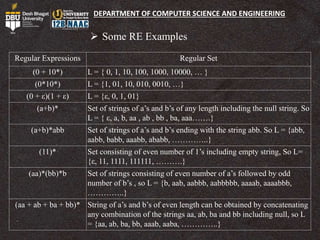
 Some RE Examples
Regular Expressions Regular Set
(0 + 10*) L = { 0, 1, 10, 100, 1000, 10000, … }
(0*10*) L = {1, 01, 10, 010, 0010, …}
(0 + ε)(1 + ε) L = {ε, 0, 1, 01}
(a+b)* Set of strings of a’s and b’s of any length including the null string. So
L = { ε, a, b, aa , ab , bb , ba, aaa…….}
(a+b)*abb Set of strings of a’s and b’s ending with the string abb. So L = {abb,
aabb, babb, aaabb, ababb, …………..}
(11)* Set consisting of even number of 1’s including empty string, So L=
{ε, 11, 1111, 111111, ……….}
(aa)*(bb)*b Set of strings consisting of even number of a’s followed by odd
number of b’s , so L = {b, aab, aabbb, aabbbbb, aaaab, aaaabbb,
…………..}
(aa + ab + ba + bb)* String of a’s and b’s of even length can be obtained by concatenating
any combination of the strings aa, ab, ba and bb including null, so L
= {aa, ab, ba, bb, aaab, aaba, …………..}
DEPARTMENT OF COMPUTER SCIENCE AND ENGINEERING
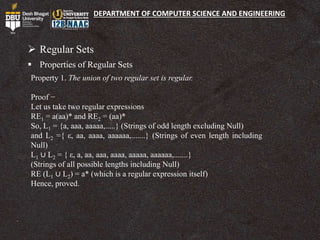
 Regular Sets
 Properties of Regular Sets
Property 1. The union of two regular set is regular.
Proof −
Let us take two regular expressions
RE1 = a(aa)* and RE2 = (aa)*
So, L1 = {a, aaa, aaaaa,.....} (Strings of odd length excluding Null)
and L2 ={ ε, aa, aaaa, aaaaaa,.......} (Strings of even length including
Null)
L1 ∪ L2 = { ε, a, aa, aaa, aaaa, aaaaa, aaaaaa,.......}
(Strings of all possible lengths including Null)
RE (L1 ∪ L2) = a* (which is a regular expression itself)
Hence, proved.
DEPARTMENT OF COMPUTER SCIENCE AND ENGINEERING
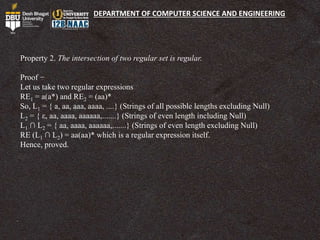
Property 2. The intersection of two regular set is regular.
Proof −
Let us take two regular expressions
RE1 = a(a*) and RE2 = (aa)*
So, L1 = { a, aa, aaa, aaaa, ....} (Strings of all possible lengths excluding Null)
L2 = { ε, aa, aaaa, aaaaaa,.......} (Strings of even length including Null)
L1 ∩ L2 = { aa, aaaa, aaaaaa,.......} (Strings of even length excluding Null)
RE (L1 ∩ L2) = aa(aa)* which is a regular expression itself.
Hence, proved.
DEPARTMENT OF COMPUTER SCIENCE AND ENGINEERING
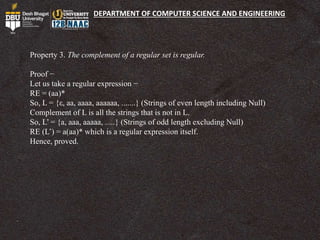
Property 3. The complement of a regular set is regular.
Proof −
Let us take a regular expression −
RE = (aa)*
So, L = {ε, aa, aaaa, aaaaaa, .......} (Strings of even length including Null)
Complement of L is all the strings that is not in L.
So, L’ = {a, aaa, aaaaa, .....} (Strings of odd length excluding Null)
RE (L’) = a(aa)* which is a regular expression itself.
Hence, proved.
DEPARTMENT OF COMPUTER SCIENCE AND ENGINEERING
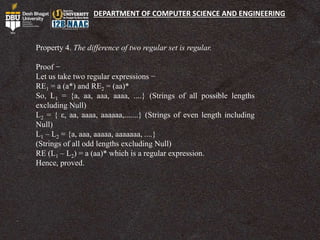
Property 4. The difference of two regular set is regular.
Proof −
Let us take two regular expressions −
RE1 = a (a*) and RE2 = (aa)*
So, L1 = {a, aa, aaa, aaaa, ....} (Strings of all possible lengths
excluding Null)
L2 = { ε, aa, aaaa, aaaaaa,.......} (Strings of even length including
Null)
L1 – L2 = {a, aaa, aaaaa, aaaaaaa, ....}
(Strings of all odd lengths excluding Null)
RE (L1 – L2) = a (aa)* which is a regular expression.
Hence, proved.
DEPARTMENT OF COMPUTER SCIENCE AND ENGINEERING
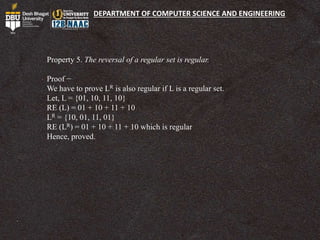
Property 5. The reversal of a regular set is regular.
Proof −
We have to prove LR is also regular if L is a regular set.
Let, L = {01, 10, 11, 10}
RE (L) = 01 + 10 + 11 + 10
LR = {10, 01, 11, 01}
RE (LR) = 01 + 10 + 11 + 10 which is regular
Hence, proved.
DEPARTMENT OF COMPUTER SCIENCE AND ENGINEERING
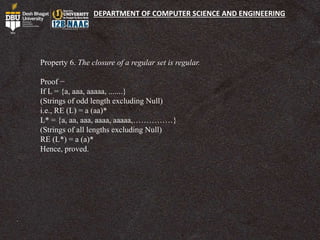
Property 6. The closure of a regular set is regular.
Proof −
If L = {a, aaa, aaaaa, .......}
(Strings of odd length excluding Null)
i.e., RE (L) = a (aa)*
L* = {a, aa, aaa, aaaa, aaaaa,……………}
(Strings of all lengths excluding Null)
RE (L*) = a (a)*
Hence, proved.
DEPARTMENT OF COMPUTER SCIENCE AND ENGINEERING
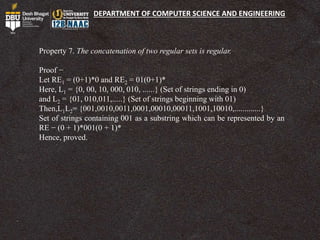
Property 7. The concatenation of two regular sets is regular.
Proof −
Let RE1 = (0+1)*0 and RE2 = 01(0+1)*
Here, L1 = {0, 00, 10, 000, 010, ......} (Set of strings ending in 0)
and L2 = {01, 010,011,.....} (Set of strings beginning with 01)
Then,L1L2= {001,0010,0011,0001,00010,00011,1001,10010,.............}
Set of strings containing 001 as a substring which can be represented by an
RE − (0 + 1)*001(0 + 1)*
Hence, proved.
DEPARTMENT OF COMPUTER SCIENCE AND ENGINEERING
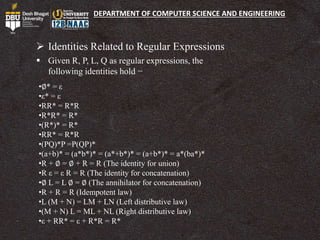
 Identities Related to Regular Expressions
 Given R, P, L, Q as regular expressions, the
following identities hold −
•∅* = ε
•ε* = ε
•RR* = R*R
•R*R* = R*
•(R*)* = R*
•RR* = R*R
•(PQ)*P =P(QP)*
•(a+b)* = (a*b*)* = (a*+b*)* = (a+b*)* = a*(ba*)*
•R + ∅ = ∅ + R = R (The identity for union)
•R ε = ε R = R (The identity for concatenation)
•∅ L = L ∅ = ∅ (The annihilator for concatenation)
•R + R = R (Idempotent law)
•L (M + N) = LM + LN (Left distributive law)
•(M + N) L = ML + NL (Right distributive law)
•ε + RR* = ε + R*R = R*
DEPARTMENT OF COMPUTER SCIENCE AND ENGINEERING
 Statement −
Let P and Q be two regular expressions.
If P does not contain null string, then R = Q + RP has a unique solution that is R
= QP*
 Arden's Theorem
Proof −
R = Q + (Q + RP)P [After putting the value R = Q + RP]
= Q + QP + RPP
When we put the value of R recursively again and again, we get the following
equation −
R = Q + QP + QP2 + QP3…..
R = Q (ε + P + P2 + P3 + …. )
R = QP* [As P* represents (ε + P + P2 + P3 + ….) ]
Hence, proved.
DEPARTMENT OF COMPUTER SCIENCE AND ENGINEERING
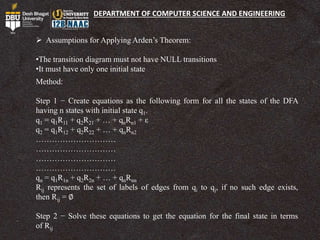
 Assumptions for Applying Arden’s Theorem:
•The transition diagram must not have NULL transitions
•It must have only one initial state
Method:
Step 1 − Create equations as the following form for all the states of the DFA
having n states with initial state q1.
q1 = q1R11 + q2R21 + … + qnRn1 + ε
q2 = q1R12 + q2R22 + … + qnRn2
…………………………
…………………………
…………………………
…………………………
qn = q1R1n + q2R2n + … + qnRnn
Rij represents the set of labels of edges from qi to qj, if no such edge exists,
then Rij = ∅
Step 2 − Solve these equations to get the equation for the final state in terms
of Rij
DEPARTMENT OF COMPUTER SCIENCE AND ENGINEERING
 Problem
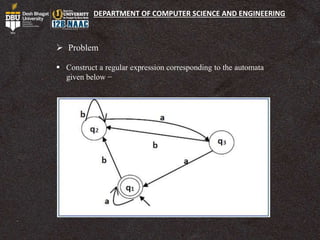
 Construct a regular expression corresponding to the automata
given below −
DEPARTMENT OF COMPUTER SCIENCE AND ENGINEERING
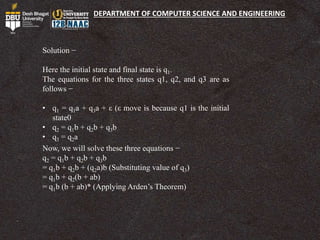
Solution −
Here the initial state and final state is q1.
The equations for the three states q1, q2, and q3 are as
follows −
• q1 = q1a + q3a + ε (ε move is because q1 is the initial
state0
• q2 = q1b + q2b + q3b
• q3 = q2a
Now, we will solve these three equations −
q2 = q1b + q2b + q3b
= q1b + q2b + (q2a)b (Substituting value of q3)
= q1b + q2(b + ab)
= q1b (b + ab)* (Applying Arden’s Theorem)
DEPARTMENT OF COMPUTER SCIENCE AND ENGINEERING
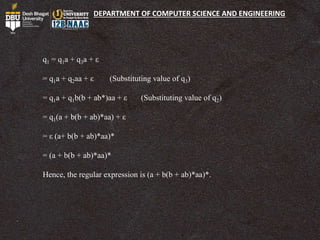
q1 = q1a + q3a + ε
= q1a + q2aa + ε (Substituting value of q3)
= q1a + q1b(b + ab*)aa + ε (Substituting value of q2)
= q1(a + b(b + ab)*aa) + ε
= ε (a+ b(b + ab)*aa)*
= (a + b(b + ab)*aa)*
Hence, the regular expression is (a + b(b + ab)*aa)*.
THANK YOU

regular expression

  • 1.
    DEPARTMENT OF COMPUTERSCIENCE AND ENGINEERING Submitted By : Name : Rohit Giri CLASS : B.Tech Cse 6TH Sem Roll No : 20320147008 Subject : Automata theory II Topic : Regular Expression Submitted To : Dr. Navneet Kaur Sandhu
  • 2.
    DEPARTMENT OF COMPUTERSCIENCE AND ENGINEERING  Contents :  Regular Expression  Some RE Examples  Regular Sets • Properties of Regular Sets  Identities related to Regular Expressions  Arden’s Theorem
  • 3.
    DEPARTMENT OF COMPUTERSCIENCE AND ENGINEERING A Regular Expression can be recursively defined as follows − •ε is a Regular Expression indicates the language containing an empty string. (L (ε) = {ε}) •φ is a Regular Expression denoting an empty language. (L (φ) = { }) •x is a Regular Expression where L = {x} •If X is a Regular Expression denoting the language L(X) and Y is a Regular Expression denoting the language L(Y), then • X + Y is a Regular Expression corresponding to the language L(X) ∪ L(Y) where L(X+Y) = L(X) ∪ L(Y). • X . Y is a Regular Expression corresponding to the language L(X) . L(Y) where L(X.Y) = L(X) . L(Y) • R* is a Regular Expression corresponding to the language L(R*)where L(R*) = (L(R))* •If we apply any of the rules several times from 1 to 5, they are Regular Expressions.  Regular Expression
  • 4.
    DEPARTMENT OF COMPUTERSCIENCE AND ENGINEERING  Some RE Examples Regular Expressions Regular Set (0 + 10*) L = { 0, 1, 10, 100, 1000, 10000, … } (0*10*) L = {1, 01, 10, 010, 0010, …} (0 + ε)(1 + ε) L = {ε, 0, 1, 01} (a+b)* Set of strings of a’s and b’s of any length including the null string. So L = { ε, a, b, aa , ab , bb , ba, aaa…….} (a+b)*abb Set of strings of a’s and b’s ending with the string abb. So L = {abb, aabb, babb, aaabb, ababb, …………..} (11)* Set consisting of even number of 1’s including empty string, So L= {ε, 11, 1111, 111111, ……….} (aa)*(bb)*b Set of strings consisting of even number of a’s followed by odd number of b’s , so L = {b, aab, aabbb, aabbbbb, aaaab, aaaabbb, …………..} (aa + ab + ba + bb)* String of a’s and b’s of even length can be obtained by concatenating any combination of the strings aa, ab, ba and bb including null, so L = {aa, ab, ba, bb, aaab, aaba, …………..}
  • 5.
    DEPARTMENT OF COMPUTERSCIENCE AND ENGINEERING  Regular Sets  Properties of Regular Sets Property 1. The union of two regular set is regular. Proof − Let us take two regular expressions RE1 = a(aa)* and RE2 = (aa)* So, L1 = {a, aaa, aaaaa,.....} (Strings of odd length excluding Null) and L2 ={ ε, aa, aaaa, aaaaaa,.......} (Strings of even length including Null) L1 ∪ L2 = { ε, a, aa, aaa, aaaa, aaaaa, aaaaaa,.......} (Strings of all possible lengths including Null) RE (L1 ∪ L2) = a* (which is a regular expression itself) Hence, proved.
  • 6.
    DEPARTMENT OF COMPUTERSCIENCE AND ENGINEERING Property 2. The intersection of two regular set is regular. Proof − Let us take two regular expressions RE1 = a(a*) and RE2 = (aa)* So, L1 = { a, aa, aaa, aaaa, ....} (Strings of all possible lengths excluding Null) L2 = { ε, aa, aaaa, aaaaaa,.......} (Strings of even length including Null) L1 ∩ L2 = { aa, aaaa, aaaaaa,.......} (Strings of even length excluding Null) RE (L1 ∩ L2) = aa(aa)* which is a regular expression itself. Hence, proved.
  • 7.
    DEPARTMENT OF COMPUTERSCIENCE AND ENGINEERING Property 3. The complement of a regular set is regular. Proof − Let us take a regular expression − RE = (aa)* So, L = {ε, aa, aaaa, aaaaaa, .......} (Strings of even length including Null) Complement of L is all the strings that is not in L. So, L’ = {a, aaa, aaaaa, .....} (Strings of odd length excluding Null) RE (L’) = a(aa)* which is a regular expression itself. Hence, proved.
  • 8.
    DEPARTMENT OF COMPUTERSCIENCE AND ENGINEERING Property 4. The difference of two regular set is regular. Proof − Let us take two regular expressions − RE1 = a (a*) and RE2 = (aa)* So, L1 = {a, aa, aaa, aaaa, ....} (Strings of all possible lengths excluding Null) L2 = { ε, aa, aaaa, aaaaaa,.......} (Strings of even length including Null) L1 – L2 = {a, aaa, aaaaa, aaaaaaa, ....} (Strings of all odd lengths excluding Null) RE (L1 – L2) = a (aa)* which is a regular expression. Hence, proved.
  • 9.
    DEPARTMENT OF COMPUTERSCIENCE AND ENGINEERING Property 5. The reversal of a regular set is regular. Proof − We have to prove LR is also regular if L is a regular set. Let, L = {01, 10, 11, 10} RE (L) = 01 + 10 + 11 + 10 LR = {10, 01, 11, 01} RE (LR) = 01 + 10 + 11 + 10 which is regular Hence, proved.
  • 10.
    DEPARTMENT OF COMPUTERSCIENCE AND ENGINEERING Property 6. The closure of a regular set is regular. Proof − If L = {a, aaa, aaaaa, .......} (Strings of odd length excluding Null) i.e., RE (L) = a (aa)* L* = {a, aa, aaa, aaaa, aaaaa,……………} (Strings of all lengths excluding Null) RE (L*) = a (a)* Hence, proved.
  • 11.
    DEPARTMENT OF COMPUTERSCIENCE AND ENGINEERING Property 7. The concatenation of two regular sets is regular. Proof − Let RE1 = (0+1)*0 and RE2 = 01(0+1)* Here, L1 = {0, 00, 10, 000, 010, ......} (Set of strings ending in 0) and L2 = {01, 010,011,.....} (Set of strings beginning with 01) Then,L1L2= {001,0010,0011,0001,00010,00011,1001,10010,.............} Set of strings containing 001 as a substring which can be represented by an RE − (0 + 1)*001(0 + 1)* Hence, proved.
  • 12.
    DEPARTMENT OF COMPUTERSCIENCE AND ENGINEERING  Identities Related to Regular Expressions  Given R, P, L, Q as regular expressions, the following identities hold − •∅* = ε •ε* = ε •RR* = R*R •R*R* = R* •(R*)* = R* •RR* = R*R •(PQ)*P =P(QP)* •(a+b)* = (a*b*)* = (a*+b*)* = (a+b*)* = a*(ba*)* •R + ∅ = ∅ + R = R (The identity for union) •R ε = ε R = R (The identity for concatenation) •∅ L = L ∅ = ∅ (The annihilator for concatenation) •R + R = R (Idempotent law) •L (M + N) = LM + LN (Left distributive law) •(M + N) L = ML + NL (Right distributive law) •ε + RR* = ε + R*R = R*
  • 13.
    DEPARTMENT OF COMPUTERSCIENCE AND ENGINEERING  Statement − Let P and Q be two regular expressions. If P does not contain null string, then R = Q + RP has a unique solution that is R = QP*  Arden's Theorem Proof − R = Q + (Q + RP)P [After putting the value R = Q + RP] = Q + QP + RPP When we put the value of R recursively again and again, we get the following equation − R = Q + QP + QP2 + QP3….. R = Q (ε + P + P2 + P3 + …. ) R = QP* [As P* represents (ε + P + P2 + P3 + ….) ] Hence, proved.
  • 14.
    DEPARTMENT OF COMPUTERSCIENCE AND ENGINEERING  Assumptions for Applying Arden’s Theorem: •The transition diagram must not have NULL transitions •It must have only one initial state Method: Step 1 − Create equations as the following form for all the states of the DFA having n states with initial state q1. q1 = q1R11 + q2R21 + … + qnRn1 + ε q2 = q1R12 + q2R22 + … + qnRn2 ………………………… ………………………… ………………………… ………………………… qn = q1R1n + q2R2n + … + qnRnn Rij represents the set of labels of edges from qi to qj, if no such edge exists, then Rij = ∅ Step 2 − Solve these equations to get the equation for the final state in terms of Rij
  • 15.
    DEPARTMENT OF COMPUTERSCIENCE AND ENGINEERING  Problem  Construct a regular expression corresponding to the automata given below −
  • 16.
    DEPARTMENT OF COMPUTERSCIENCE AND ENGINEERING Solution − Here the initial state and final state is q1. The equations for the three states q1, q2, and q3 are as follows − • q1 = q1a + q3a + ε (ε move is because q1 is the initial state0 • q2 = q1b + q2b + q3b • q3 = q2a Now, we will solve these three equations − q2 = q1b + q2b + q3b = q1b + q2b + (q2a)b (Substituting value of q3) = q1b + q2(b + ab) = q1b (b + ab)* (Applying Arden’s Theorem)
  • 17.
    DEPARTMENT OF COMPUTERSCIENCE AND ENGINEERING q1 = q1a + q3a + ε = q1a + q2aa + ε (Substituting value of q3) = q1a + q1b(b + ab*)aa + ε (Substituting value of q2) = q1(a + b(b + ab)*aa) + ε = ε (a+ b(b + ab)*aa)* = (a + b(b + ab)*aa)* Hence, the regular expression is (a + b(b + ab)*aa)*.
  • 18.