RegTech for IR:
Opportunities and
Lessons
Dr Liming Zhu, Research Director
CSIRO’s Data61
“when [legislation] is written in code, then that
makes for its very rapid implementation…”
“…there’s no reason why
development and building codes
cannot be written in code and you
simply submit a CAD design aiming
to provide for real-time
improvements.
That’s totally possible but we’re
not doing it.”
- Scott Morrison (Prime Minister of Australia)
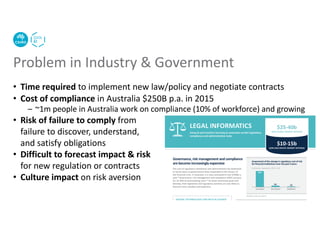
Problem in Industry & Government
• Time required to implement new law/policy and negotiate contracts
• Cost of compliance in Australia $250B p.a. in 2015
– ~1m people in Australia work on compliance (10% of workforce) and growing
• Risk of failure to comply from
failure to discover, understand,
and satisfy obligations
• Difficult to forecast impact & risk
for new regulation or contracts
• Culture impact on risk aversion
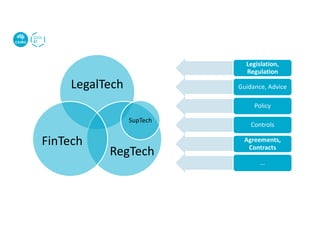
LegalTech
RegTech
FinTech
Legislation,
Regulation
Guidance, Advice
Policy
Controls
Agreements,
Contracts
…
SupTech
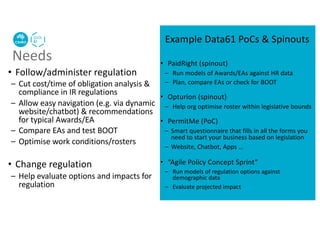
Needs
• Follow/administer regulation
– Cut cost/time of obligation analysis &
compliance in IR regulations
– Allow easy navigation (e.g. via dynamic
website/chatbot) & recommendations
for typical Awards/EA
– Compare EAs and test BOOT
– Optimise work conditions/rosters
• Change regulation
– Help evaluate options and impacts for
regulation
• PaidRight (spinout)
– Run models of Awards/EAs against HR data
– Plan, compare EAs or check for BOOT
• Opturion (spinout)
– Help org optimise roster within legislative bounds
• PermitMe (PoC)
– Smart questionnaire that fills in all the forms you
need to start your business based on legislation
– Website, Chatbot, Apps …
• “Agile Policy Concept Sprint”
– Run models of regulation options against
demographic data
– Evaluate projected impact
Example Data61 PoCs & Spinouts
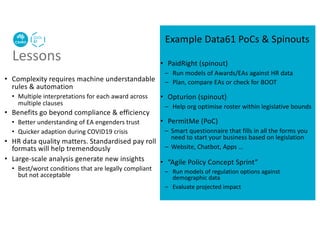
Lessons
• Complexity requires machine understandable
rules & automation
• Multiple interpretations for each award across
multiple clauses
• Benefits go beyond compliance & efficiency
• Better understanding of EA engenders trust
• Quicker adaption during COVID19 crisis
• HR data quality matters. Standardised pay roll
formats will help tremendously
• Large-scale analysis generate new insights
• Best/worst conditions that are legally compliant
but not acceptable
Example Data61 PoCs & Spinouts
• PaidRight (spinout)
– Run models of Awards/EAs against HR data
– Plan, compare EAs or check for BOOT
• Opturion (spinout)
– Help org optimise roster within legislative bounds
• PermitMe (PoC)
– Smart questionnaire that fills in all the forms you
need to start your business based on legislation
– Website, Chatbot, Apps …
• “Agile Policy Concept Sprint”
– Run models of regulation options against
demographic data
– Evaluate projected impact
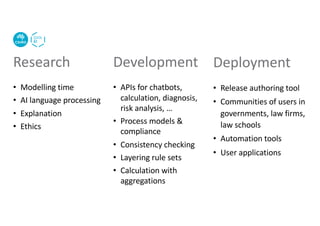
Research
• Modelling time
• AI language processing
• Explanation
• Ethics
• APIs for chatbots,
calculation, diagnosis,
risk analysis, …
• Process models &
compliance
• Consistency checking
• Layering rule sets
• Calculation with
aggregations
Development
• Release authoring tool
• Communities of users in
governments, law firms,
law schools
• Automation tools
• User applications
Deployment
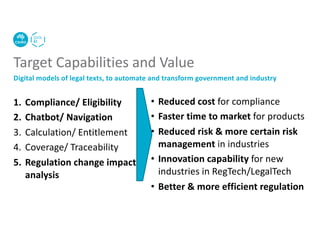
Target Capabilities and Value
Digital models of legal texts, to automate and transform government and industry
1. Compliance/ Eligibility
2. Chatbot/ Navigation
3. Calculation/ Entitlement
4. Coverage/ Traceability
5. Regulation change impact
analysis
• Reduced cost for compliance
• Faster time to market for products
• Reduced risk & more certain risk
management in industries
• Innovation capability for new
industries in RegTech/LegalTech
• Better & more efficient regulation
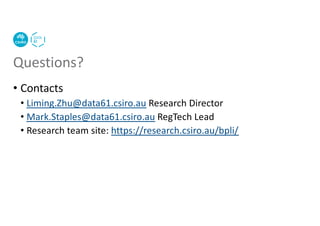
Questions?
• Contacts
• Liming.Zhu@data61.csiro.au Research Director
• Mark.Staples@data61.csiro.au RegTech Lead
• Research team site: https://research.csiro.au/bpli/
Backup Slides
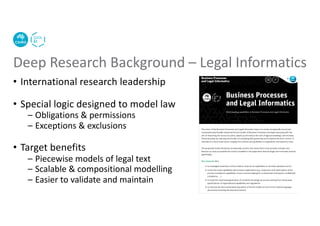
• International research leadership
• Special logic designed to model law
– Obligations & permissions
– Exceptions & exclusions
• Target benefits
– Piecewise models of legal text
– Scalable & compositional modelling
– Easier to validate and maintain
Deep Research Background – Legal Informatics
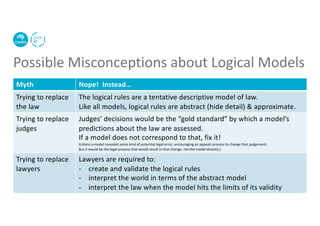
Myth Nope! Instead…
Trying to replace
the law
The logical rules are a tentative descriptive model of law.
Like all models, logical rules are abstract (hide detail) & approximate.
Trying to replace
judges
Judges’ decisions would be the “gold standard” by which a model’s
predictions about the law are assessed.
If a model does not correspond to that, fix it!
(Unless a model revealed some kind of potential legal error, encouraging an appeals process to change that judgement.
But it would be the legal process that would result in that change, not the model directly.)
Trying to replace
lawyers
Lawyers are required to:
- create and validate the logical rules
- interpret the world in terms of the abstract model
- interpret the law when the model hits the limits of its validity
Possible Misconceptions about Logical Models

RegTech for IR - Opportunities and Lessons

  • 1.
    RegTech for IR: Opportunitiesand Lessons Dr Liming Zhu, Research Director CSIRO’s Data61
  • 2.
    “when [legislation] iswritten in code, then that makes for its very rapid implementation…” “…there’s no reason why development and building codes cannot be written in code and you simply submit a CAD design aiming to provide for real-time improvements. That’s totally possible but we’re not doing it.” - Scott Morrison (Prime Minister of Australia)
  • 3.
    Problem in Industry& Government • Time required to implement new law/policy and negotiate contracts • Cost of compliance in Australia $250B p.a. in 2015 – ~1m people in Australia work on compliance (10% of workforce) and growing • Risk of failure to comply from failure to discover, understand, and satisfy obligations • Difficult to forecast impact & risk for new regulation or contracts • Culture impact on risk aversion
  • 4.
  • 5.
    Needs • Follow/administer regulation –Cut cost/time of obligation analysis & compliance in IR regulations – Allow easy navigation (e.g. via dynamic website/chatbot) & recommendations for typical Awards/EA – Compare EAs and test BOOT – Optimise work conditions/rosters • Change regulation – Help evaluate options and impacts for regulation • PaidRight (spinout) – Run models of Awards/EAs against HR data – Plan, compare EAs or check for BOOT • Opturion (spinout) – Help org optimise roster within legislative bounds • PermitMe (PoC) – Smart questionnaire that fills in all the forms you need to start your business based on legislation – Website, Chatbot, Apps … • “Agile Policy Concept Sprint” – Run models of regulation options against demographic data – Evaluate projected impact Example Data61 PoCs & Spinouts
  • 6.
    Lessons • Complexity requiresmachine understandable rules & automation • Multiple interpretations for each award across multiple clauses • Benefits go beyond compliance & efficiency • Better understanding of EA engenders trust • Quicker adaption during COVID19 crisis • HR data quality matters. Standardised pay roll formats will help tremendously • Large-scale analysis generate new insights • Best/worst conditions that are legally compliant but not acceptable Example Data61 PoCs & Spinouts • PaidRight (spinout) – Run models of Awards/EAs against HR data – Plan, compare EAs or check for BOOT • Opturion (spinout) – Help org optimise roster within legislative bounds • PermitMe (PoC) – Smart questionnaire that fills in all the forms you need to start your business based on legislation – Website, Chatbot, Apps … • “Agile Policy Concept Sprint” – Run models of regulation options against demographic data – Evaluate projected impact
  • 7.
    Research • Modelling time •AI language processing • Explanation • Ethics • APIs for chatbots, calculation, diagnosis, risk analysis, … • Process models & compliance • Consistency checking • Layering rule sets • Calculation with aggregations Development • Release authoring tool • Communities of users in governments, law firms, law schools • Automation tools • User applications Deployment
  • 8.
    Target Capabilities andValue Digital models of legal texts, to automate and transform government and industry 1. Compliance/ Eligibility 2. Chatbot/ Navigation 3. Calculation/ Entitlement 4. Coverage/ Traceability 5. Regulation change impact analysis • Reduced cost for compliance • Faster time to market for products • Reduced risk & more certain risk management in industries • Innovation capability for new industries in RegTech/LegalTech • Better & more efficient regulation
  • 9.
    Questions? • Contacts • Liming.Zhu@data61.csiro.auResearch Director • Mark.Staples@data61.csiro.au RegTech Lead • Research team site: https://research.csiro.au/bpli/
  • 10.
  • 11.
    • International researchleadership • Special logic designed to model law – Obligations & permissions – Exceptions & exclusions • Target benefits – Piecewise models of legal text – Scalable & compositional modelling – Easier to validate and maintain Deep Research Background – Legal Informatics
  • 12.
    Myth Nope! Instead… Tryingto replace the law The logical rules are a tentative descriptive model of law. Like all models, logical rules are abstract (hide detail) & approximate. Trying to replace judges Judges’ decisions would be the “gold standard” by which a model’s predictions about the law are assessed. If a model does not correspond to that, fix it! (Unless a model revealed some kind of potential legal error, encouraging an appeals process to change that judgement. But it would be the legal process that would result in that change, not the model directly.) Trying to replace lawyers Lawyers are required to: - create and validate the logical rules - interpret the world in terms of the abstract model - interpret the law when the model hits the limits of its validity Possible Misconceptions about Logical Models