REGGIO-EMILIA APPROACH
Reported by:
EDMAR C. TIGULO
MAEd-English1
Outline:
 Proponent and the Approach
 Theoretical Frameworks
 Fundamental Principles
 Malaguzzi’s thoughts about Reggio-Emilia
PROPONENT AND THE APPROACH:
 Loris Malaguzzi (1920-1994) is
best known for his instrumental
role in the creation and
development of the Reggio
Emilia approach — the child-
centered early educational
philosophy that hinges on the
belief that children are
powerful and capable
individuals, with the ability
and desire to construct their
own knowledge.
 It is an innovative and inspiring
approach to early childhood
education which values the child
as strong, capable, and resilient; rich
with wonder and knowledge. Every
child brings with them deep curiosity
and potential and this innate curiosity
drives their interest to understand
their world and their place within it.
PROPONENT AND THE APPROACH:
The Reggio Emilia Approach
originated in the town (and
surrounding areas) of Reggio Emilia
in Italy out of a movement towards
progressive and cooperative early
childhood education.
PROPONENT AND THE APPROACH:
The following theories were
enumerated and explained in the
paper of Slipp (2017) as the
theoretical frameworks of Reggio-
Emilia Approach:
THEORETICAL FRAMEWORKS:
A. Piaget’s Constructivist Theory
According to Hewett (2001), beginning
practices of the Reggio-Emilia school
were heavily influenced by Piaget’s
constructivist theory which states that
“the child constructs his or her own
version of reality from his or her own
unique experiences or interactions with
the environment”.
THEORETICAL FRAMEWORKS:
It is said to be the “continuous
interaction between the
external world and the
individual”. Harlow, Cummings,
and Aberasturi (2006) referred
to it as active construction of
knowledge.
THEORETICAL FRAMEWORKS:
B. Sociocultural Theory
As mentioned by Edwards (2005) and
supported by Scott and Palincsar
(2013), Vygotsky’s sociocultural theory
promotes that all knowledge exists
within sociohistorical context and that
as learners participate in a wide range
of activities together with other
learners, they acquire new knowledge
of the world and culture of which they
live.
THEORETICAL FRAMEWORKS:
This theory introduces the Zone of
Proximal Development (ZPD) which is
“the distance between the actual
developmental level as determined by
independent problem solving and the
level of potential development as
determined through problem solving
under adult guidance or in collaboration
with more capable peers”. Agreeing to
this, teachers then serve as facilitators
and guide.
THEORETICAL FRAMEWORKS:
Zone of Proximal Development (ZPD)
THEORETICAL FRAMEWORKS:
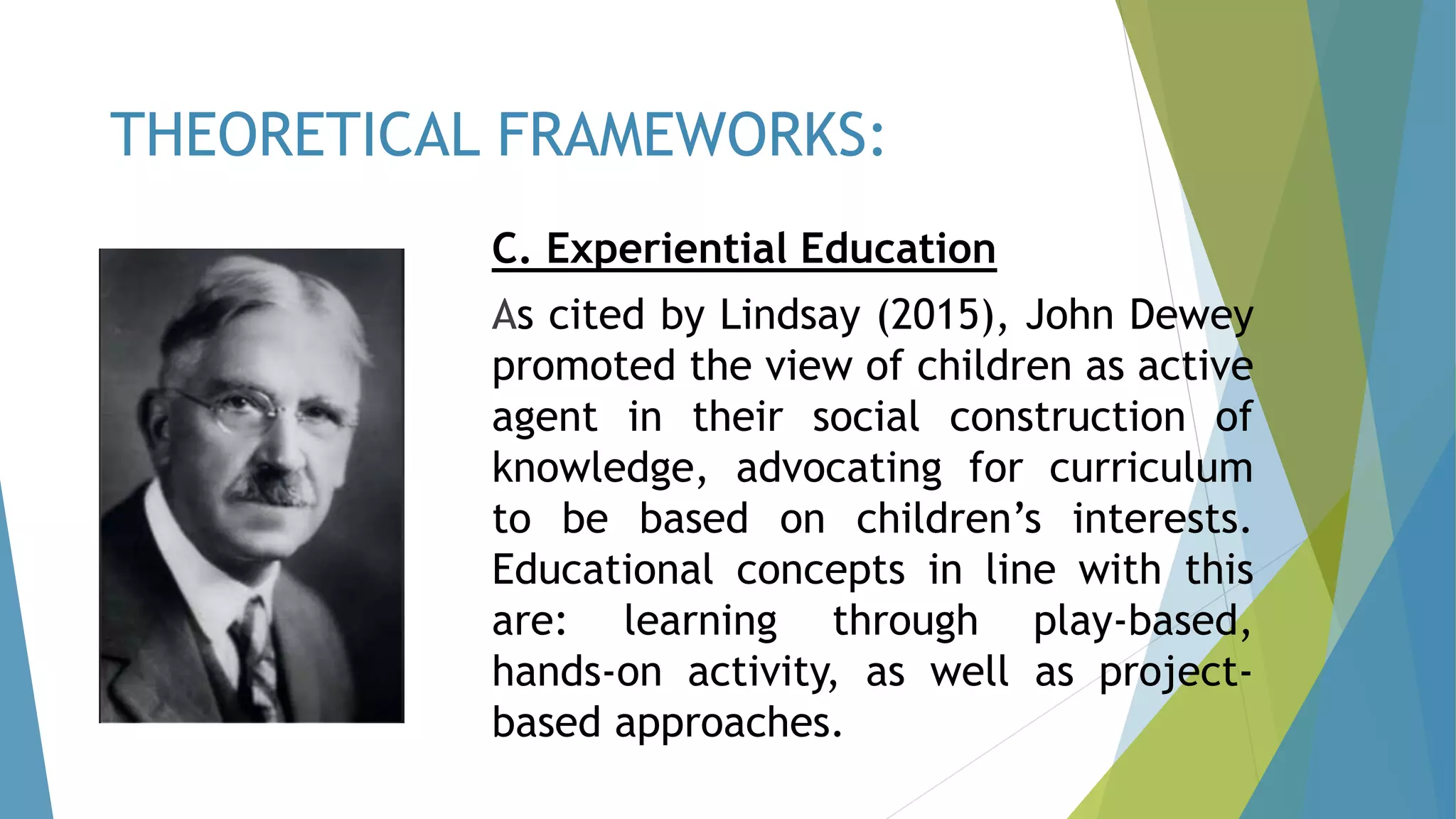
C. Experiential Education
As cited by Lindsay (2015), John Dewey
promoted the view of children as active
agent in their social construction of
knowledge, advocating for curriculum
to be based on children’s interests.
Educational concepts in line with this
are: learning through play-based,
hands-on activity, as well as project-
based approaches.
THEORETICAL FRAMEWORKS:
 Children are capable of
constructing their own learning.
They are driven by their interests
to understand and know more.
FUNDAMENTAL PRINCIPLES:
 Children form an understanding of
themselves and their place in the world
through their interactions with others.
There is a strong focus on social
collaboration, working in groups, where
each child is an equal participant, having
their thoughts and questions valued. The
adult is not the giver of knowledge.
FUNDAMENTAL PRINCIPLES:
Children are communicators.
Communication is a process, a
way of discovering things, asking
questions, using language
as play.
FUNDAMENTAL PRINCIPLES:
The adult is a mentor and
guide. Our role as adults is to
observe (our) children, listen to
their questions and their stories,
find what interests them and
then provide them with
opportunities to explore these
interests further.
FUNDAMENTAL PRINCIPLES:
 The Hundred Languages of Children.
It is probably the most well-known
aspect of the Reggio Emilia Approach.
The belief that children use many
different ways to show their
understanding and express their
thoughts and creativity. These
languages, or ways of learning, are all
a part of the child. Learning and play
are not separated.
FUNDAMENTAL PRINCIPLES:
A child must feel the joy of working with
adults who value his work.
Not all children are the same – each
child brings a part of something that’s
different into the school.
MALAGUZZI’S THOUGHTS ABOUT REGGIO-
EMILIA APPROACH:
The child wants the teacher to see the
process of her work, rather than the
product.
Interaction between children is a very
fertile and a very rich relationship.
Children have 100 languages and
adults/teachers must also have 100
languages and have the capacity for many
different roles.
MALAGUZZI’S THOUGHTS ABOUT REGGIO-
EMILIA APPROACH:
OTHERS
The children began to create their own moves that they would share with their peers. These moves began to
serve as a way for the class to communicate and became a language that was easily understood and readily
used by the classroom community (Wood, Thall, & Parnell, 2015)
Researchers noted that this experience deepened the children’s understanding of their bodily movements,
enabling students to better be able to express themselves (Wood, Thall, & Parnell, 2015)
Documenting children’s experiences is an integral component of the Reggio Emilia approach and has become a
part of classroom practice in many early childhood classrooms worldwide (Katz & Chard, 1996; Turner &
Wilson, 2009; 2010).
Documentation, which is much more than a collection of teacher or student produced artifacts adorning the
walls, includes the conversations and reflections that such artifacts evoke (Given et al., 2009, 2010).
The Reggio Emilia approach to learning often highlights the idea of three educators in the educational setting:
the child, the teacher, and the environment (Ellis & Strong-Wilson, 2007).
. The results from this study indicated that students chose the more maintained natural areas most conducive
to educational outcomes, and the less maintained areas seemed less conducive to educational outcomes,
suggesting that the preservice teachers may be missing out on many educational benefits of outdoor
unmaintained natural environments (Torquati & Ernst, 2013).
the child’s rights are recognized, respected, and embedded in their early childhood educational experiences
(Fyfe, 2011).
REFERENCES
Edwards, S. (2003). New directions: Charting the paths for the role of sociocultural theory in early childhood
education and curriculum. Contemporary Issues in Early Childhood, 4(3), 251.
Edwards, S. (2005). Constructivism does not only happen in the individual: Sociocultural theory and early childhood
education. Early Child Development and Care, 175(1), 3747.
Hewett, V. M. (2001). Examining the Reggio Emilia approach to early childhood education. Early Childhood Education
Journal, 29(2), 95-100.
Lindsay, G. (2015). Reflections in the mirror of Reggio Emilia's soul: John Dewey's foundational influence on pedagogy
in the Italian educational project. Early Childhood Education Journal, 43(6), 447-457.
Malaguzzi, L. (1993). Reggio-Emilia Approach
Scott, S. & Palincsar, A. (2013). Sociocultural Theory. Retrieved from
http://www.education.com/reference/article/sociocultural-theory/
Slipp, K. (2017). The Image of the child and the Reggio Emilia philosophy. University of Victoria. PDF. Retrieved from
http://dspace.library.uvic.ca/bitstream/handle/1828/8015/Slipp_Kari_MEd_2017.pdf?sequence=3&isAllowed=y
“What is The Reggio Emilia Approach?” (n.d.). Retrieved from http://www.aneverydaystory.com/beginners-guide-to-
reggio-emilia/main-principles/
“The Difference Between MONTESSORI and REGGIO EMILIA”. Retrieved from
http://littlewondersschool.com/difference-montessori-and-reggio-emilia/

The reggio emilia approach

  • 1.
  • 2.
    Outline:  Proponent andthe Approach  Theoretical Frameworks  Fundamental Principles  Malaguzzi’s thoughts about Reggio-Emilia
  • 3.
    PROPONENT AND THEAPPROACH:  Loris Malaguzzi (1920-1994) is best known for his instrumental role in the creation and development of the Reggio Emilia approach — the child- centered early educational philosophy that hinges on the belief that children are powerful and capable individuals, with the ability and desire to construct their own knowledge.
  • 4.
     It isan innovative and inspiring approach to early childhood education which values the child as strong, capable, and resilient; rich with wonder and knowledge. Every child brings with them deep curiosity and potential and this innate curiosity drives their interest to understand their world and their place within it. PROPONENT AND THE APPROACH:
  • 5.
    The Reggio EmiliaApproach originated in the town (and surrounding areas) of Reggio Emilia in Italy out of a movement towards progressive and cooperative early childhood education. PROPONENT AND THE APPROACH:
  • 6.
    The following theorieswere enumerated and explained in the paper of Slipp (2017) as the theoretical frameworks of Reggio- Emilia Approach: THEORETICAL FRAMEWORKS:
  • 7.
    A. Piaget’s ConstructivistTheory According to Hewett (2001), beginning practices of the Reggio-Emilia school were heavily influenced by Piaget’s constructivist theory which states that “the child constructs his or her own version of reality from his or her own unique experiences or interactions with the environment”. THEORETICAL FRAMEWORKS:
  • 8.
    It is saidto be the “continuous interaction between the external world and the individual”. Harlow, Cummings, and Aberasturi (2006) referred to it as active construction of knowledge. THEORETICAL FRAMEWORKS:
  • 9.
    B. Sociocultural Theory Asmentioned by Edwards (2005) and supported by Scott and Palincsar (2013), Vygotsky’s sociocultural theory promotes that all knowledge exists within sociohistorical context and that as learners participate in a wide range of activities together with other learners, they acquire new knowledge of the world and culture of which they live. THEORETICAL FRAMEWORKS:
  • 10.
    This theory introducesthe Zone of Proximal Development (ZPD) which is “the distance between the actual developmental level as determined by independent problem solving and the level of potential development as determined through problem solving under adult guidance or in collaboration with more capable peers”. Agreeing to this, teachers then serve as facilitators and guide. THEORETICAL FRAMEWORKS:
  • 11.
    Zone of ProximalDevelopment (ZPD) THEORETICAL FRAMEWORKS:
  • 12.
    C. Experiential Education Ascited by Lindsay (2015), John Dewey promoted the view of children as active agent in their social construction of knowledge, advocating for curriculum to be based on children’s interests. Educational concepts in line with this are: learning through play-based, hands-on activity, as well as project- based approaches. THEORETICAL FRAMEWORKS:
  • 13.
     Children arecapable of constructing their own learning. They are driven by their interests to understand and know more. FUNDAMENTAL PRINCIPLES:
  • 14.
     Children forman understanding of themselves and their place in the world through their interactions with others. There is a strong focus on social collaboration, working in groups, where each child is an equal participant, having their thoughts and questions valued. The adult is not the giver of knowledge. FUNDAMENTAL PRINCIPLES:
  • 15.
    Children are communicators. Communicationis a process, a way of discovering things, asking questions, using language as play. FUNDAMENTAL PRINCIPLES:
  • 16.
    The adult isa mentor and guide. Our role as adults is to observe (our) children, listen to their questions and their stories, find what interests them and then provide them with opportunities to explore these interests further. FUNDAMENTAL PRINCIPLES:
  • 17.
     The HundredLanguages of Children. It is probably the most well-known aspect of the Reggio Emilia Approach. The belief that children use many different ways to show their understanding and express their thoughts and creativity. These languages, or ways of learning, are all a part of the child. Learning and play are not separated. FUNDAMENTAL PRINCIPLES:
  • 18.
    A child mustfeel the joy of working with adults who value his work. Not all children are the same – each child brings a part of something that’s different into the school. MALAGUZZI’S THOUGHTS ABOUT REGGIO- EMILIA APPROACH:
  • 19.
    The child wantsthe teacher to see the process of her work, rather than the product. Interaction between children is a very fertile and a very rich relationship. Children have 100 languages and adults/teachers must also have 100 languages and have the capacity for many different roles. MALAGUZZI’S THOUGHTS ABOUT REGGIO- EMILIA APPROACH:
  • 20.
    OTHERS The children beganto create their own moves that they would share with their peers. These moves began to serve as a way for the class to communicate and became a language that was easily understood and readily used by the classroom community (Wood, Thall, & Parnell, 2015) Researchers noted that this experience deepened the children’s understanding of their bodily movements, enabling students to better be able to express themselves (Wood, Thall, & Parnell, 2015) Documenting children’s experiences is an integral component of the Reggio Emilia approach and has become a part of classroom practice in many early childhood classrooms worldwide (Katz & Chard, 1996; Turner & Wilson, 2009; 2010). Documentation, which is much more than a collection of teacher or student produced artifacts adorning the walls, includes the conversations and reflections that such artifacts evoke (Given et al., 2009, 2010). The Reggio Emilia approach to learning often highlights the idea of three educators in the educational setting: the child, the teacher, and the environment (Ellis & Strong-Wilson, 2007). . The results from this study indicated that students chose the more maintained natural areas most conducive to educational outcomes, and the less maintained areas seemed less conducive to educational outcomes, suggesting that the preservice teachers may be missing out on many educational benefits of outdoor unmaintained natural environments (Torquati & Ernst, 2013). the child’s rights are recognized, respected, and embedded in their early childhood educational experiences (Fyfe, 2011).
  • 21.
    REFERENCES Edwards, S. (2003).New directions: Charting the paths for the role of sociocultural theory in early childhood education and curriculum. Contemporary Issues in Early Childhood, 4(3), 251. Edwards, S. (2005). Constructivism does not only happen in the individual: Sociocultural theory and early childhood education. Early Child Development and Care, 175(1), 3747. Hewett, V. M. (2001). Examining the Reggio Emilia approach to early childhood education. Early Childhood Education Journal, 29(2), 95-100. Lindsay, G. (2015). Reflections in the mirror of Reggio Emilia's soul: John Dewey's foundational influence on pedagogy in the Italian educational project. Early Childhood Education Journal, 43(6), 447-457. Malaguzzi, L. (1993). Reggio-Emilia Approach Scott, S. & Palincsar, A. (2013). Sociocultural Theory. Retrieved from http://www.education.com/reference/article/sociocultural-theory/ Slipp, K. (2017). The Image of the child and the Reggio Emilia philosophy. University of Victoria. PDF. Retrieved from http://dspace.library.uvic.ca/bitstream/handle/1828/8015/Slipp_Kari_MEd_2017.pdf?sequence=3&isAllowed=y “What is The Reggio Emilia Approach?” (n.d.). Retrieved from http://www.aneverydaystory.com/beginners-guide-to- reggio-emilia/main-principles/ “The Difference Between MONTESSORI and REGGIO EMILIA”. Retrieved from http://littlewondersschool.com/difference-montessori-and-reggio-emilia/

Editor's Notes

  • #2 Photo is from https://www.google.com.ph/search?tbm=isch&q=audio+visual+aids&chips=q:av+aid,g_3:teaching&sa=X&ved=0ahUKEwjmu_r76sDYAhXFE7wKHS7oDjMQ4lYIKigA&biw=1366&bih=662&dpr=1#imgrc=5c9pD5TRJLg9qM: