“Let the wife make her husband
glad to come home and let him
make her sorry to see him
leave.”
Martin Luther
Quiz
On your knowledge about the
Protestant Reformation
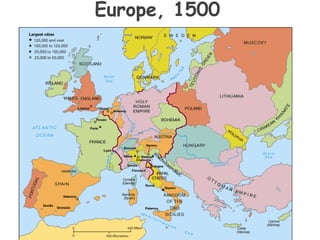
Europe, 1500
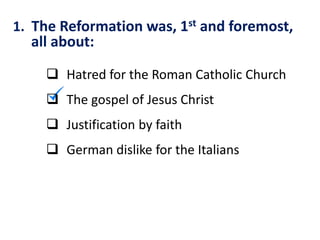
 Hatred for the Roman Catholic Church
 The gospel of Jesus Christ
 Justification by faith
 German dislike for the Italians
1. The Reformation was, 1st and foremost,
all about:
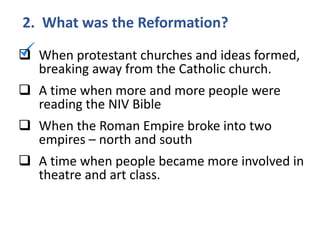
2. What was the Reformation?
 When protestant churches and ideas formed,
breaking away from the Catholic church.
 A time when more and more people were
reading the NIV Bible
 When the Roman Empire broke into two
empires – north and south
 A time when people became more involved in
theatre and art class.
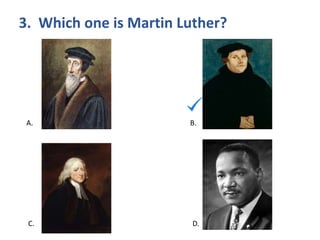
3. Which one is Martin Luther?
A. B.
C. D.
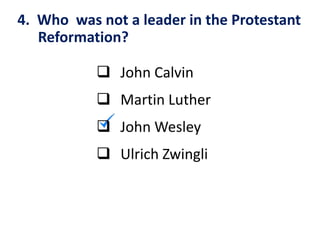
4. Who was not a leader in the Protestant
Reformation?
 John Calvin
 Martin Luther
 John Wesley
 Ulrich Zwingli
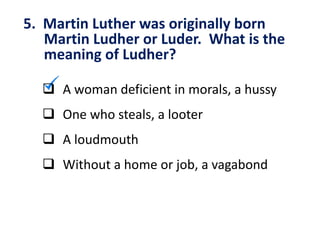
5. Martin Luther was originally born
Martin Ludher or Luder. What is the
meaning of Ludher?
 A woman deficient in morals, a hussy
 One who steals, a looter
 A loudmouth
 Without a home or job, a vagabond
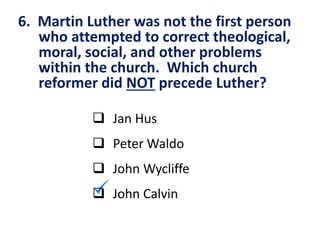
6. Martin Luther was not the first person
who attempted to correct theological,
moral, social, and other problems
within the church. Which church
reformer did NOT precede Luther?
 Jan Hus
 Peter Waldo
 John Wycliffe
 John Calvin
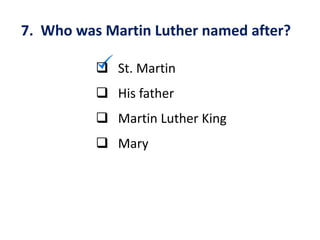
7. Who was Martin Luther named after?
 St. Martin
 His father
 Martin Luther King
 Mary
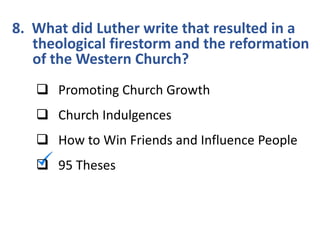
8. What did Luther write that resulted in a
theological firestorm and the reformation
of the Western Church?
 Promoting Church Growth
 Church Indulgences
 How to Win Friends and Influence People
 95 Theses
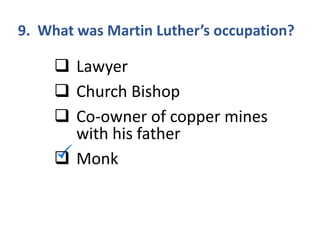
9. What was Martin Luther’s occupation?
 Lawyer
 Church Bishop
 Co-owner of copper mines
with his father
 Monk
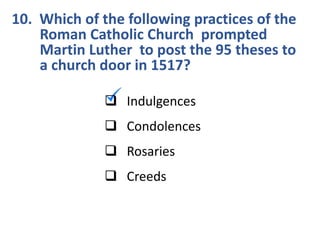
10. Which of the following practices of the
Roman Catholic Church prompted
Martin Luther to post the 95 theses to
a church door in 1517?
 Indulgences
 Condolences
 Rosaries
 Creeds
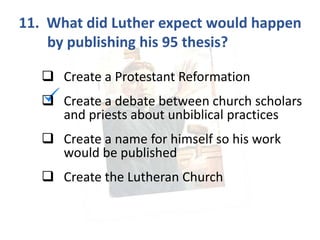
11. What did Luther expect would happen
by publishing his 95 thesis?
 Create a Protestant Reformation
 Create a debate between church scholars
and priests about unbiblical practices
 Create a name for himself so his work
would be published
 Create the Lutheran Church
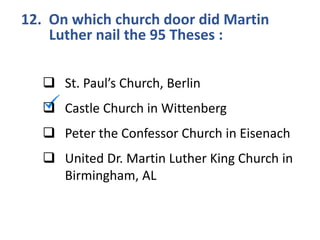
12. On which church door did Martin
Luther nail the 95 Theses :
 St. Paul’s Church, Berlin
 Castle Church in Wittenberg
 Peter the Confessor Church in Eisenach
 United Dr. Martin Luther King Church in
Birmingham, AL
13. Martin Luther opposed to the selling of
indulgences. What are indulgences?
 Too much dessert
 A token to get into church
 Pieces of paper the church sold, granting
people less time in purgatory
 A piece of paper the church sold,
granting a Sunday off
14. What did the Catholic church do to Martin
Luther for publishing his 95 theses?
 Had him burned at the stake in the public
square
 Forgave him but told him it would cost him
more time in purgatory
 Read his complaints and addressed them at
a board meeting
 Excommunicated him from the church for
being a heretic
15. What does Transubstantiation mean?
 A Christian confessor has truly repented
 A payment of Indulgences
 The miracle of a “saint” becoming a
part of the body of Christ
 The “host” becomes the body and
blood of Christ
16. What does Consubstantiation mean?
 The remembrance of Christ at the time
of communion
 The same as transubstantiation
 The miracle of a “con” becoming a part
of the body of Christ
 The “real presents” of Christ occurs at
the celebration of the Eucharist
17. What is the Diet of Worms?
 The meeting between Martin
Luther and Johann Eck which
resulted in Pope Leo X
excommunicating Luther.
 The cause of Luther’s dysentery
 An early attempt at Nutri-System
 The place at which many European
nobility and church hierarchy
acknowledged that Luther was
right
18. When did Luther decide to become a
monk?
 He saw a group of monks and liked their
cool outfits.
 Monk recruiters promised him a
scholarship at a private school
 His girlfriend became a nun and he
wanted to live in the monastery across
the street.
 He almost got struck by lightning and
feared that he may go to hell if he died.
19. Which of the following is NOT a direct
by-product of Luther’s Reformation?
 Bibles translated into every language
in the world.
 People singing hymns to popular
tunes during church worship services.
 Grape juice was substituted for
communion wine
 People receiving bread and wine(or
juice) at the Lord’s Table.
20. What event did NOT support the
expansion of the Reformation
 The Black Plague.
 The Peasants’ Revolt.
 The rise of nationalism in Germany.
 The building of new churches.
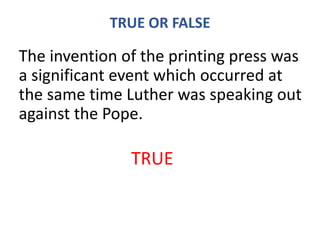
TRUE OR FALSE
The invention of the printing press was
a significant event which occurred at
the same time Luther was speaking out
against the Pope.
TRUE
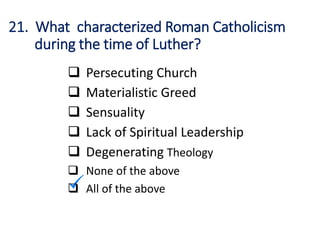
21. What characterized Roman Catholicism
during the time of Luther?
 Persecuting Church
 Materialistic Greed
 Sensuality
 Lack of Spiritual Leadership
 Degenerating Theology
 None of the above
 All of the above
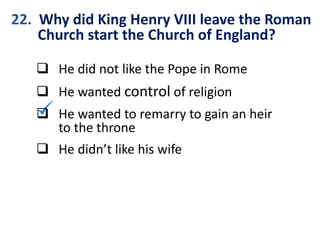
22. Why did King Henry VIII leave the Roman
Church start the Church of England?
 He did not like the Pope in Rome
 He wanted control of religion
 He wanted to remarry to gain an heir
to the throne
 He didn’t like his wife
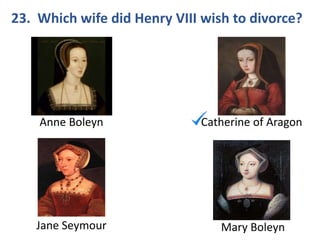
23. Which wife did Henry VIII wish to divorce?
Anne Boleyn Catherine of Aragon
Jane Seymour Mary Boleyn
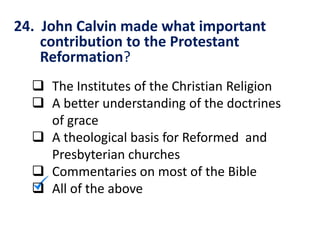
24. John Calvin made what important
contribution to the Protestant
Reformation?
 The Institutes of the Christian Religion
 A better understanding of the doctrines
of grace
 A theological basis for Reformed and
Presbyterian churches
 Commentaries on most of the Bible
 All of the above
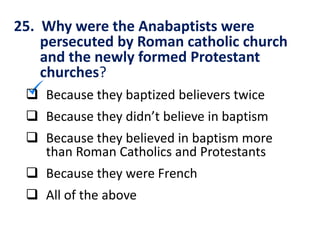
25. Why were the Anabaptists were
persecuted by Roman catholic church
and the newly formed Protestant
churches?
 Because they baptized believers twice
 Because they didn’t believe in baptism
 Because they believed in baptism more
than Roman Catholics and Protestants
 Because they were French
 All of the above
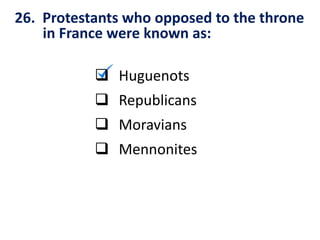
26. Protestants who opposed to the throne
in France were known as:
 Huguenots
 Republicans
 Moravians
 Mennonites
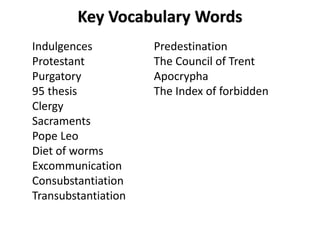
Key Vocabulary Words
Indulgences
Protestant
Purgatory
95 thesis
Clergy
Sacraments
Pope Leo
Diet of worms
Excommunication
Consubstantiation
Transubstantiation
Predestination
The Council of Trent
Apocrypha
The Index of forbidden
Renaissance Humanists
and Evangelicals
• Join in opposition to Scholasticism and deficiencies of
papacy – heading for “Y” in the road
• Humanists revive study of biblical languages,
emphasize and develop literal interpretation
• Nicholas of Lyra (1265-1349)
• Renaissance Humanists: promote textual criticism –
love for scientific investigation – individualism
Spread of the Written Word
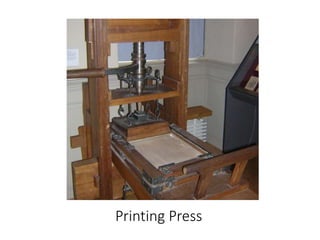
• Invention of printing press in 1446 by Johann
Gutenberg of Mainz, Germany (1400-1468)
• Crusades open trade routes allowing paper to
arrive from Egypt
• Luther: “Printing is God’s latest and best work to
spread the true religion throughout the world”
Printing Press
Reforming Evangelicals
• Peter de Bruys (d. ca. 1140) – Petrobusians
• Peter Waldo – Waldenses
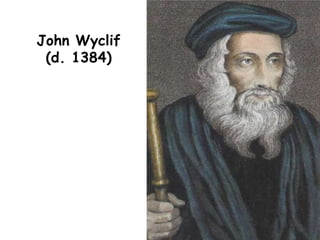
• John Wyclif (d. 1384) – Lollards
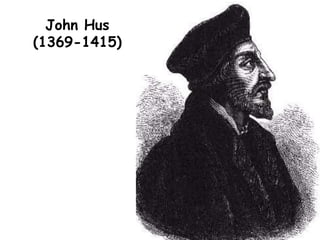
• John Huss (1369-1415)
John Wyclif
(d. 1384)
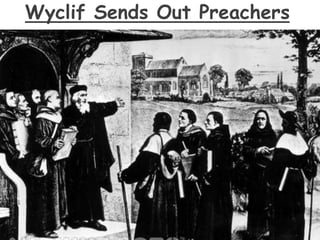
Wyclif Sends Out Preachers
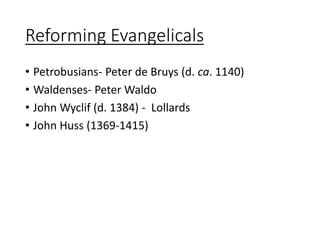
Reforming Evangelicals
• Petrobusians- Peter de Bruys (d. ca. 1140)
• Waldenses- Peter Waldo
• John Wyclif (d. 1384) - Lollards
• John Huss (1369-1415)
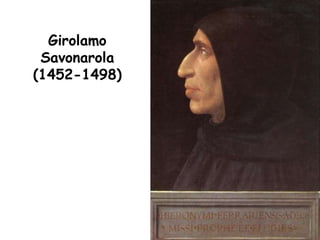
Girolamo
Savonarola
(1452-1498)
John Hus
(1369-1415)
“Compared with the persecution of heresy [by the RCC] . . . the
persecution of Christians by [pagan] Romans . . . was a mild
and humane procedure.”
- Will Durant
“Compared with the persecution of heresy [by the RCC] . . . the
persecution of Christians by [pagan] Romans . . . was a mild
and humane procedure.”
- Will Durant
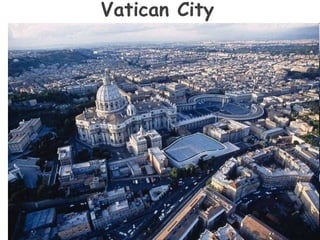
Vatican City
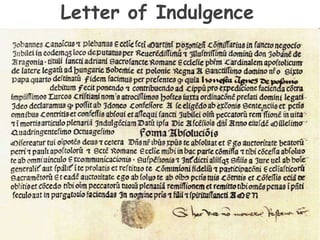
Letter of Indulgence
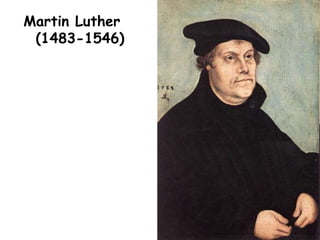
Martin Luther
(1483-1546)
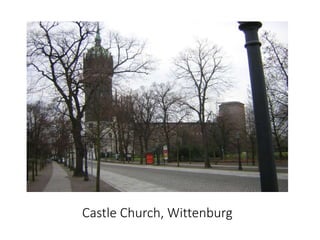
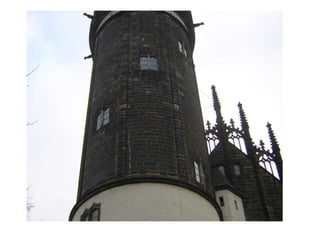
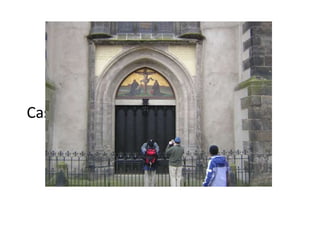
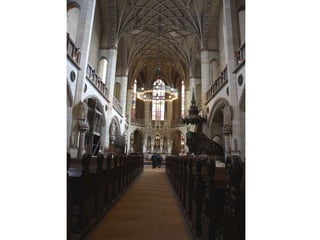
Castle Church, Wittenburg
Door of
Castle Church
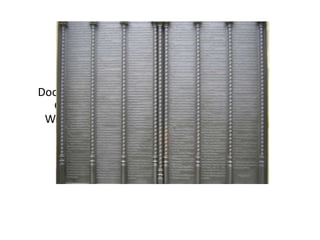
Door of Castle
Church,
Wittenburg
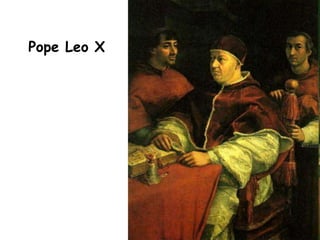
Pope Leo X
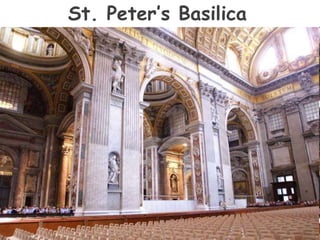
St. Peter’s Basilica
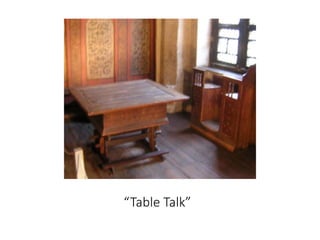
“Table Talk”
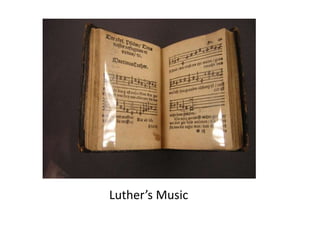
Luther’s Music
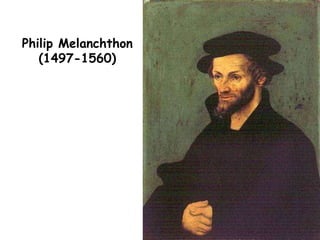
Philip Melanchthon
(1497-1560)
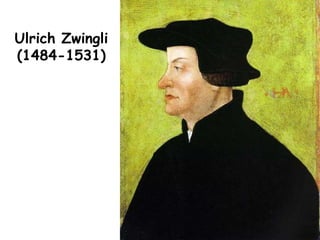
Ulrich Zwingli
(1484-1531)
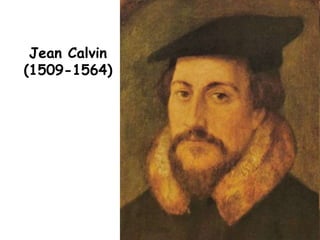
Jean Calvin
(1509-1564)
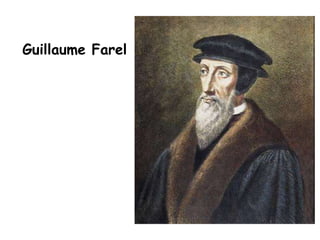
Guillaume Farel
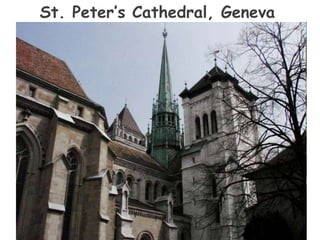
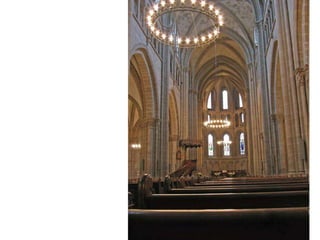
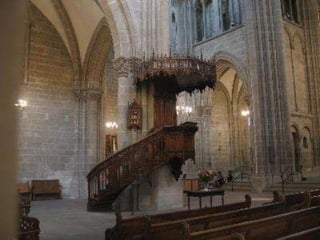
St. Peter’s Cathedral, Geneva
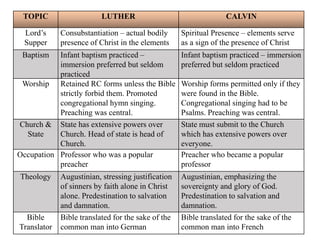
TOPIC LUTHER CALVIN
Lord’s
Supper
Consubstantiation – actual bodily
presence of Christ in the elements
Spiritual Presence – elements serve
as a sign of the presence of Christ
Baptism Infant baptism practiced –
immersion preferred but seldom
practiced
Infant baptism practiced – immersion
preferred but seldom practiced
Worship Retained RC forms unless the Bible
strictly forbid them. Promoted
congregational hymn singing.
Preaching was central.
Worship forms permitted only if they
were found in the Bible.
Congregational singing had to be
Psalms. Preaching was central.
Church &
State
State has extensive powers over
Church. Head of state is head of
Church.
State must submit to the Church
which has extensive powers over
everyone.
Occupation Professor who was a popular
preacher
Preacher who became a popular
professor
Theology Augustinian, stressing justification
of sinners by faith alone in Christ
alone. Predestination to salvation
and damnation.
Augustinian, emphasizing the
sovereignty and glory of God.
Predestination to salvation and
damnation.
Bible
Translator
Bible translated for the sake of the
common man into German
Bible translated for the sake of the
common man into French

Reformation Quiz

  • 2.
    “Let the wifemake her husband glad to come home and let him make her sorry to see him leave.” Martin Luther
  • 3.
    Quiz On your knowledgeabout the Protestant Reformation
  • 4.
  • 5.
     Hatred forthe Roman Catholic Church  The gospel of Jesus Christ  Justification by faith  German dislike for the Italians 1. The Reformation was, 1st and foremost, all about:
  • 6.
    2. What wasthe Reformation?  When protestant churches and ideas formed, breaking away from the Catholic church.  A time when more and more people were reading the NIV Bible  When the Roman Empire broke into two empires – north and south  A time when people became more involved in theatre and art class.
  • 7.
    3. Which oneis Martin Luther? A. B. C. D.
  • 8.
    4. Who wasnot a leader in the Protestant Reformation?  John Calvin  Martin Luther  John Wesley  Ulrich Zwingli
  • 9.
    5. Martin Lutherwas originally born Martin Ludher or Luder. What is the meaning of Ludher?  A woman deficient in morals, a hussy  One who steals, a looter  A loudmouth  Without a home or job, a vagabond
  • 10.
    6. Martin Lutherwas not the first person who attempted to correct theological, moral, social, and other problems within the church. Which church reformer did NOT precede Luther?  Jan Hus  Peter Waldo  John Wycliffe  John Calvin
  • 11.
    7. Who wasMartin Luther named after?  St. Martin  His father  Martin Luther King  Mary
  • 12.
    8. What didLuther write that resulted in a theological firestorm and the reformation of the Western Church?  Promoting Church Growth  Church Indulgences  How to Win Friends and Influence People  95 Theses
  • 13.
    9. What wasMartin Luther’s occupation?  Lawyer  Church Bishop  Co-owner of copper mines with his father  Monk
  • 14.
    10. Which ofthe following practices of the Roman Catholic Church prompted Martin Luther to post the 95 theses to a church door in 1517?  Indulgences  Condolences  Rosaries  Creeds
  • 15.
    11. What didLuther expect would happen by publishing his 95 thesis?  Create a Protestant Reformation  Create a debate between church scholars and priests about unbiblical practices  Create a name for himself so his work would be published  Create the Lutheran Church
  • 16.
    12. On whichchurch door did Martin Luther nail the 95 Theses :  St. Paul’s Church, Berlin  Castle Church in Wittenberg  Peter the Confessor Church in Eisenach  United Dr. Martin Luther King Church in Birmingham, AL
  • 17.
    13. Martin Lutheropposed to the selling of indulgences. What are indulgences?  Too much dessert  A token to get into church  Pieces of paper the church sold, granting people less time in purgatory  A piece of paper the church sold, granting a Sunday off
  • 18.
    14. What didthe Catholic church do to Martin Luther for publishing his 95 theses?  Had him burned at the stake in the public square  Forgave him but told him it would cost him more time in purgatory  Read his complaints and addressed them at a board meeting  Excommunicated him from the church for being a heretic
  • 19.
    15. What doesTransubstantiation mean?  A Christian confessor has truly repented  A payment of Indulgences  The miracle of a “saint” becoming a part of the body of Christ  The “host” becomes the body and blood of Christ
  • 20.
    16. What doesConsubstantiation mean?  The remembrance of Christ at the time of communion  The same as transubstantiation  The miracle of a “con” becoming a part of the body of Christ  The “real presents” of Christ occurs at the celebration of the Eucharist
  • 21.
    17. What isthe Diet of Worms?  The meeting between Martin Luther and Johann Eck which resulted in Pope Leo X excommunicating Luther.  The cause of Luther’s dysentery  An early attempt at Nutri-System  The place at which many European nobility and church hierarchy acknowledged that Luther was right
  • 22.
    18. When didLuther decide to become a monk?  He saw a group of monks and liked their cool outfits.  Monk recruiters promised him a scholarship at a private school  His girlfriend became a nun and he wanted to live in the monastery across the street.  He almost got struck by lightning and feared that he may go to hell if he died.
  • 23.
    19. Which ofthe following is NOT a direct by-product of Luther’s Reformation?  Bibles translated into every language in the world.  People singing hymns to popular tunes during church worship services.  Grape juice was substituted for communion wine  People receiving bread and wine(or juice) at the Lord’s Table.
  • 24.
    20. What eventdid NOT support the expansion of the Reformation  The Black Plague.  The Peasants’ Revolt.  The rise of nationalism in Germany.  The building of new churches.
  • 25.
    TRUE OR FALSE Theinvention of the printing press was a significant event which occurred at the same time Luther was speaking out against the Pope. TRUE
  • 26.
    21. What characterizedRoman Catholicism during the time of Luther?  Persecuting Church  Materialistic Greed  Sensuality  Lack of Spiritual Leadership  Degenerating Theology  None of the above  All of the above
  • 27.
    22. Why didKing Henry VIII leave the Roman Church start the Church of England?  He did not like the Pope in Rome  He wanted control of religion  He wanted to remarry to gain an heir to the throne  He didn’t like his wife
  • 28.
    23. Which wifedid Henry VIII wish to divorce? Anne Boleyn Catherine of Aragon Jane Seymour Mary Boleyn
  • 29.
    24. John Calvinmade what important contribution to the Protestant Reformation?  The Institutes of the Christian Religion  A better understanding of the doctrines of grace  A theological basis for Reformed and Presbyterian churches  Commentaries on most of the Bible  All of the above
  • 30.
    25. Why werethe Anabaptists were persecuted by Roman catholic church and the newly formed Protestant churches?  Because they baptized believers twice  Because they didn’t believe in baptism  Because they believed in baptism more than Roman Catholics and Protestants  Because they were French  All of the above
  • 31.
    26. Protestants whoopposed to the throne in France were known as:  Huguenots  Republicans  Moravians  Mennonites
  • 32.
    Key Vocabulary Words Indulgences Protestant Purgatory 95thesis Clergy Sacraments Pope Leo Diet of worms Excommunication Consubstantiation Transubstantiation Predestination The Council of Trent Apocrypha The Index of forbidden
  • 33.
    Renaissance Humanists and Evangelicals •Join in opposition to Scholasticism and deficiencies of papacy – heading for “Y” in the road • Humanists revive study of biblical languages, emphasize and develop literal interpretation • Nicholas of Lyra (1265-1349) • Renaissance Humanists: promote textual criticism – love for scientific investigation – individualism
  • 34.
    Spread of theWritten Word • Invention of printing press in 1446 by Johann Gutenberg of Mainz, Germany (1400-1468) • Crusades open trade routes allowing paper to arrive from Egypt • Luther: “Printing is God’s latest and best work to spread the true religion throughout the world”
  • 35.
  • 36.
    Reforming Evangelicals • Peterde Bruys (d. ca. 1140) – Petrobusians • Peter Waldo – Waldenses • John Wyclif (d. 1384) – Lollards • John Huss (1369-1415)
  • 37.
  • 38.
  • 39.
    Reforming Evangelicals • Petrobusians-Peter de Bruys (d. ca. 1140) • Waldenses- Peter Waldo • John Wyclif (d. 1384) - Lollards • John Huss (1369-1415)
  • 40.
  • 41.
  • 42.
    “Compared with thepersecution of heresy [by the RCC] . . . the persecution of Christians by [pagan] Romans . . . was a mild and humane procedure.” - Will Durant
  • 43.
    “Compared with thepersecution of heresy [by the RCC] . . . the persecution of Christians by [pagan] Romans . . . was a mild and humane procedure.” - Will Durant
  • 44.
  • 45.
  • 46.
  • 47.
  • 49.
  • 50.
  • 52.
  • 53.
  • 54.
  • 55.
  • 56.
  • 57.
  • 58.
  • 59.
  • 60.
  • 63.
    TOPIC LUTHER CALVIN Lord’s Supper Consubstantiation– actual bodily presence of Christ in the elements Spiritual Presence – elements serve as a sign of the presence of Christ Baptism Infant baptism practiced – immersion preferred but seldom practiced Infant baptism practiced – immersion preferred but seldom practiced Worship Retained RC forms unless the Bible strictly forbid them. Promoted congregational hymn singing. Preaching was central. Worship forms permitted only if they were found in the Bible. Congregational singing had to be Psalms. Preaching was central. Church & State State has extensive powers over Church. Head of state is head of Church. State must submit to the Church which has extensive powers over everyone. Occupation Professor who was a popular preacher Preacher who became a popular professor Theology Augustinian, stressing justification of sinners by faith alone in Christ alone. Predestination to salvation and damnation. Augustinian, emphasizing the sovereignty and glory of God. Predestination to salvation and damnation. Bible Translator Bible translated for the sake of the common man into German Bible translated for the sake of the common man into French

Editor's Notes