Knowledge Piece
On
Reflux Classifier
BY
Utsav Kant
Manager Operation (W#3)
157800
09-09-2013
1
Introduction
A reflux classifier is a fluidised bed separator for
classifying and separating particles on the basis
of size or density .
Reflux Classifier is a combination of a fluidised
bed separator, an autogenous dense medium
separator and a lamella settler
2
Basic Chambers of Reflux classifier
The machine consists of Lamella Chamber,
Mixing Chamber and Fluidisation Chamber
Upper Chamber is the Lamella Chamber, Middle
Chamber is the Mixing Chamber, Bottom most
chamber is the Fluidisation Chamber
3
The Reflux classifier
4
Mixing and Fluidisation Chambers
Reflux Classifier feed is introduced to the
Mixing Chamber via two square chutes
extending trough the lamella section. At the
base of the mixing chamber, high pressure
fluidisation water is introduced via 390
alumina ceramic nozzles and flows upwards
interacting with the slurry. The underflow is
drained from the bottom-centre of the
fluidisation chamber via an automatically
controlled underflow valve
5
What's Inside ?
6
Phenomena in the Mixing chamber
• The slurry inside the Reflux Classifier undergoes a sorting
process due to the force of gravity and the up flow of
fluidisation water leading to separation of high and low
density particles.
• The high density particles sink to the bottom of the
fluidised bed due to gravity and migrate towards the
central underflow valve and the low density particles are
held in the slurry suspension, which migrates to the lamella
section of the Reflux Classifier.
• The density of the middle section of the mixing chamber is
measured and used to determine when to allow some high
density solids to be discharged from the bottom of the
Reflux Classifier Fluidisation Chamber.
7
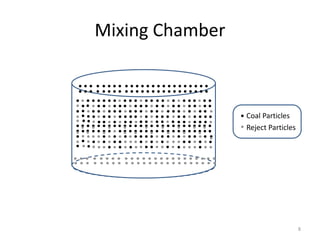
Mixing Chamber
Coal Particles
Reject Particles
8
Fluidisation Chamber
Water Particles
Coal Particles
Reject Particles
9
Features of the Reflux Classifier
Fluidisation water feed valve, Fluidisation chamber pressure relief
valve, Fluidisation chamber dump valve ( Clockwise from right)
10
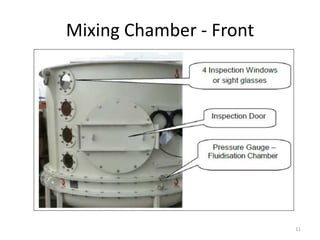
Mixing Chamber - Front
11
Mixing Chamber - Back
12
Lamella Chamber
• Arrays of inclined plates form lamellae and divide
the chamber into zones into which particles of
predetermined size or density migrate. Particle
differentiation is controlled by plate length,
inclination and spacing in each array, combined
with fluidization rate.
• The addition of parallel inclined plates towards
the overflow section improves sedimentation
area, resulting in increased throughput compared
to conventional separators.
13
Arrangement of Lamella Plates
14
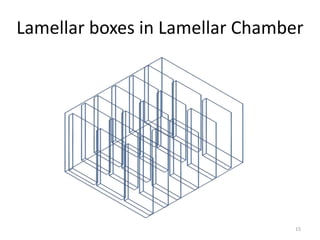
Lamellar boxes in Lamellar Chamber
15
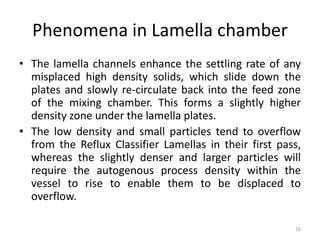
Phenomena in Lamella chamber
• The lamella channels enhance the settling rate of any
misplaced high density solids, which slide down the
plates and slowly re-circulate back into the feed zone
of the mixing chamber. This forms a slightly higher
density zone under the lamella plates.
• The low density and small particles tend to overflow
from the Reflux Classifier Lamellas in their first pass,
whereas the slightly denser and larger particles will
require the autogenous process density within the
vessel to rise to enable them to be displaced to
overflow.
16
Inclined Plates Philosophy
17
Lamella Classification
Water
Clean Coal
Shale
18
Lamella chamber
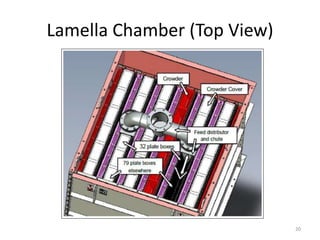
• Lamella Plates made of PVC
• Lamella Plates 1.5mm thick
• Lamella box made of HDPE
• No of lamella boxes – 16
• No of feed lamella boxes – 2
• No of lamella plates per box – 79
• No of lamella plates per feed box – 32
• Lamella chamber area – 2000 mm x 2000mm
19
Lamella Chamber (Top View)
20
Lamella chamber
• Lamella plate spacing – 6 mm
• Over flow launder – P.U.
• Overflow Crowder – P.U.
• Overflow Launder lining – P.U
• Lamella chamber – 3180 Kg
• Crowder – P.U.
• Crowder Cover - Aluminium
21
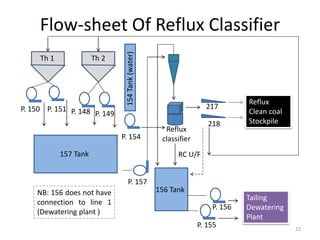
Flow-sheet Of Reflux Classifier
Th 1 Th 2
P. 150 P. 151 P. 148 P. 149
157 Tank
P. 157
Reflux
classifier
156 Tank
P. 155
P. 156
Tailing
Dewatering
Plant
217
218
RC U/F
Reflux
Clean coal
Stockpile
NB: 156 does not have
connection to line 1
(Dewatering plant )
22
P. 154
154Tank(water)
Modifications
Thickener 2Thickener 1
Thickener
Head Box
Effluent Tank
23

Reflux Classifiers

  • 1.
    Knowledge Piece On Reflux Classifier BY UtsavKant Manager Operation (W#3) 157800 09-09-2013 1
  • 2.
    Introduction A reflux classifieris a fluidised bed separator for classifying and separating particles on the basis of size or density . Reflux Classifier is a combination of a fluidised bed separator, an autogenous dense medium separator and a lamella settler 2
  • 3.
    Basic Chambers ofReflux classifier The machine consists of Lamella Chamber, Mixing Chamber and Fluidisation Chamber Upper Chamber is the Lamella Chamber, Middle Chamber is the Mixing Chamber, Bottom most chamber is the Fluidisation Chamber 3
  • 4.
  • 5.
    Mixing and FluidisationChambers Reflux Classifier feed is introduced to the Mixing Chamber via two square chutes extending trough the lamella section. At the base of the mixing chamber, high pressure fluidisation water is introduced via 390 alumina ceramic nozzles and flows upwards interacting with the slurry. The underflow is drained from the bottom-centre of the fluidisation chamber via an automatically controlled underflow valve 5
  • 6.
  • 7.
    Phenomena in theMixing chamber • The slurry inside the Reflux Classifier undergoes a sorting process due to the force of gravity and the up flow of fluidisation water leading to separation of high and low density particles. • The high density particles sink to the bottom of the fluidised bed due to gravity and migrate towards the central underflow valve and the low density particles are held in the slurry suspension, which migrates to the lamella section of the Reflux Classifier. • The density of the middle section of the mixing chamber is measured and used to determine when to allow some high density solids to be discharged from the bottom of the Reflux Classifier Fluidisation Chamber. 7
  • 8.
  • 9.
    Fluidisation Chamber Water Particles CoalParticles Reject Particles 9
  • 10.
    Features of theReflux Classifier Fluidisation water feed valve, Fluidisation chamber pressure relief valve, Fluidisation chamber dump valve ( Clockwise from right) 10
  • 11.
  • 12.
  • 13.
    Lamella Chamber • Arraysof inclined plates form lamellae and divide the chamber into zones into which particles of predetermined size or density migrate. Particle differentiation is controlled by plate length, inclination and spacing in each array, combined with fluidization rate. • The addition of parallel inclined plates towards the overflow section improves sedimentation area, resulting in increased throughput compared to conventional separators. 13
  • 14.
  • 15.
    Lamellar boxes inLamellar Chamber 15
  • 16.
    Phenomena in Lamellachamber • The lamella channels enhance the settling rate of any misplaced high density solids, which slide down the plates and slowly re-circulate back into the feed zone of the mixing chamber. This forms a slightly higher density zone under the lamella plates. • The low density and small particles tend to overflow from the Reflux Classifier Lamellas in their first pass, whereas the slightly denser and larger particles will require the autogenous process density within the vessel to rise to enable them to be displaced to overflow. 16
  • 17.
  • 18.
  • 19.
    Lamella chamber • LamellaPlates made of PVC • Lamella Plates 1.5mm thick • Lamella box made of HDPE • No of lamella boxes – 16 • No of feed lamella boxes – 2 • No of lamella plates per box – 79 • No of lamella plates per feed box – 32 • Lamella chamber area – 2000 mm x 2000mm 19
  • 20.
  • 21.
    Lamella chamber • Lamellaplate spacing – 6 mm • Over flow launder – P.U. • Overflow Crowder – P.U. • Overflow Launder lining – P.U • Lamella chamber – 3180 Kg • Crowder – P.U. • Crowder Cover - Aluminium 21
  • 22.
    Flow-sheet Of RefluxClassifier Th 1 Th 2 P. 150 P. 151 P. 148 P. 149 157 Tank P. 157 Reflux classifier 156 Tank P. 155 P. 156 Tailing Dewatering Plant 217 218 RC U/F Reflux Clean coal Stockpile NB: 156 does not have connection to line 1 (Dewatering plant ) 22 P. 154 154Tank(water)
  • 23.