Reflective Thinking & Web 2.0  Peter Skillen Brenda Sherry Life is a Metaphor - behance.net
What do we mean by ‘reflective thinking’?


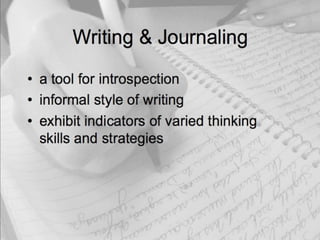
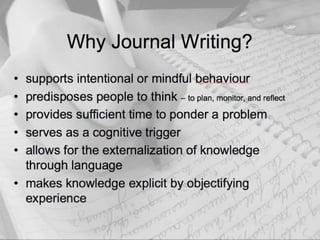
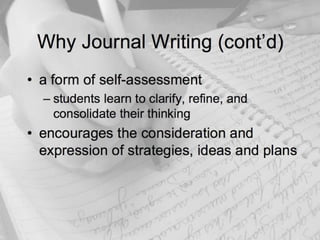
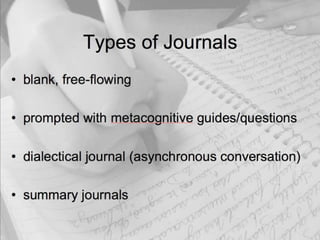
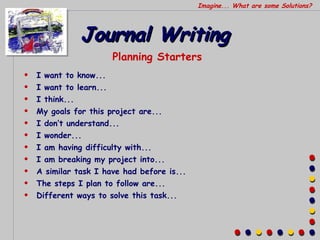
Journal Writing I want to know... I want to learn... I think... My goals for this project are... I don’t understand... I wonder... I am having difficulty with... I am breaking my project into... A similar task I have had before is... The steps I plan to follow are... Different ways to solve this task... Planning Starters Imagine... What are some Solutions?
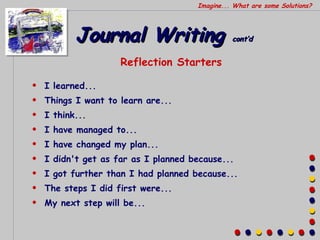
Journal Writing  cont’d I learned... Things I want to learn are... I think... I have managed to... I have changed my plan... I didn't get as far as I planned because... I got further than I had planned because... The steps I did first were... My next step will be... Reflection Starters Imagine... What are some Solutions?
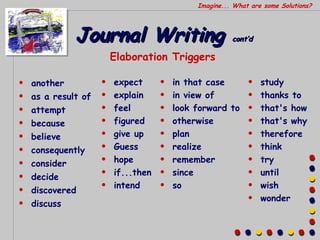
Journal Writing  cont’d another as a result of attempt because believe consequently consider decide discovered discuss in that case in view of look forward to otherwise plan realize remember since so expect explain feel figured give up Guess hope if...then intend study thanks to that's how that's why therefore think try until wish wonder Elaboration Triggers Imagine... What are some Solutions?
Does JW lead to Engagement? …or is it just another worksheet?
Journal Writing  cont’d I agree with you because ... I disagree with you because... Check... I think... I believe... Have you thought about... Maybe... I am confused... Another explanation... I don't understand... You need to... Your journal entry would be better if... Comment Starters Imagine... What are some Solutions?
Expert vs Novice Learners Novices typically don't plan, monitor, and reflect on their learning Expert learners use 'multiple representations’ Novices typically don't generate a number of potential solution strategies.
Expert vs Novice Learners  (cont’d) Novices engage in 'knowledge telling' rather than 'knowledge transformation' Experts realize that the ‘social context’ is important to learning Expert learners make multiple passes at knowledge.
Expert vs Novice Learners  (cont’d) Experts are able to transfer their learning to other domains Experts view 'mistakes' as opportunities to learn


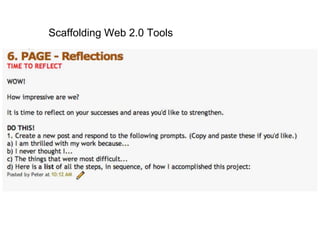
Scaffolding Web 2.0 Tools Scaffolding Web 2.0 Tools


Limitations of Web 2.0 Tools
 
Reflection What did you learn? How will your learning impact your practice?
Resources The Construction Zone blog  http://theconstructionzone.wordpress.com Tech2Learn Wiki  http://tech2learn.wikispaces.com ZPD - Who's in Charge Here?  http://bit.ly/eMVLOA PBL - Who IS in Charge? What Tools can Help?  http://bit.ly/5znahM Scaffolding for Deep Understanding  http://bit.ly/cWwX1o Journal Writing - Just Another Worksheet  http://bit.ly/hiuNoU

Reflective Thinking with Web 2.0 Tools

  • 1.
    Reflective Thinking &Web 2.0 Peter Skillen Brenda Sherry Life is a Metaphor - behance.net
  • 2.
    What do wemean by ‘reflective thinking’?
  • 3.
  • 4.
  • 5.
  • 6.
  • 7.
  • 8.
  • 9.
    Journal Writing Iwant to know... I want to learn... I think... My goals for this project are... I don’t understand... I wonder... I am having difficulty with... I am breaking my project into... A similar task I have had before is... The steps I plan to follow are... Different ways to solve this task... Planning Starters Imagine... What are some Solutions?
  • 10.
    Journal Writing cont’d I learned... Things I want to learn are... I think... I have managed to... I have changed my plan... I didn't get as far as I planned because... I got further than I had planned because... The steps I did first were... My next step will be... Reflection Starters Imagine... What are some Solutions?
  • 11.
    Journal Writing cont’d another as a result of attempt because believe consequently consider decide discovered discuss in that case in view of look forward to otherwise plan realize remember since so expect explain feel figured give up Guess hope if...then intend study thanks to that's how that's why therefore think try until wish wonder Elaboration Triggers Imagine... What are some Solutions?
  • 12.
    Does JW leadto Engagement? …or is it just another worksheet?
  • 13.
    Journal Writing cont’d I agree with you because ... I disagree with you because... Check... I think... I believe... Have you thought about... Maybe... I am confused... Another explanation... I don't understand... You need to... Your journal entry would be better if... Comment Starters Imagine... What are some Solutions?
  • 14.
    Expert vs NoviceLearners Novices typically don't plan, monitor, and reflect on their learning Expert learners use 'multiple representations’ Novices typically don't generate a number of potential solution strategies.
  • 15.
    Expert vs NoviceLearners (cont’d) Novices engage in 'knowledge telling' rather than 'knowledge transformation' Experts realize that the ‘social context’ is important to learning Expert learners make multiple passes at knowledge.
  • 16.
    Expert vs NoviceLearners (cont’d) Experts are able to transfer their learning to other domains Experts view 'mistakes' as opportunities to learn
  • 17.
  • 18.
  • 19.
  • 20.
  • 21.
  • 22.
  • 23.
  • 24.
    Scaffolding Web 2.0Tools Scaffolding Web 2.0 Tools
  • 25.
  • 26.
  • 27.
  • 28.
  • 29.
  • 30.
  • 31.
    Reflection What didyou learn? How will your learning impact your practice?
  • 32.
    Resources The ConstructionZone blog http://theconstructionzone.wordpress.com Tech2Learn Wiki http://tech2learn.wikispaces.com ZPD - Who's in Charge Here? http://bit.ly/eMVLOA PBL - Who IS in Charge? What Tools can Help? http://bit.ly/5znahM Scaffolding for Deep Understanding http://bit.ly/cWwX1o Journal Writing - Just Another Worksheet http://bit.ly/hiuNoU

Editor's Notes

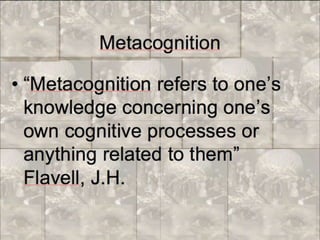
  • #4 1. Metacognitive knowledge (also called metacognitive awareness) is what individuals know about themselves and others as cognitive processors. 2. Metacognitive regulation is the regulation of cognition and learning experiences through a set of activities that help people control their learning. 3. Metacognitive experiences are those experiences that have something to do with the current, on-going cognitive endeavor.
  • #5 “I figured out the meaning of life. Life is a three dimensional picture show and what matters is the perspective you choose to observe it through. Sometimes you should look at ‘the big picture’; in fact, most of the time you should. Other times you can involve minute aspects of the movie in your everyday affairs. BUT!! Don’t take it too seriously because life is a comedy. 2 is a very simple number. √¯¯¯ is a very simple idea. But the two simple things, when mixed together, become excruciatingly complex (√2!!) Too many people think about √2 and forget about 2 or √. That’s a no-no. Like calculus, another important aspect of life is not A or B but the change (∆) from A to B (or vice versa). We change so much in life it is far better to accept its inevitability than to fight it. The hard part is accepting it when you are happy because the common assumption is that it can only be a change for the worse. If you are at the top of a mountain you can only go down, right? Wrong!! You can also jump to the top of a new and different mountain” – a twelfth grade calculus student
  • #11 - “Oh, That’s What I Did!” - Q & I sessions get more from JS - “your ideas”
  • #17 Multiple Passes - many sources are ‘read’ - books, videos, CD-ROMs, Internet 'Debugging' strategies are invoked when things go wrong. Therefore, you backtrack through your thinking -a means to 'think about one's thinking'