Reflective
Assessment Category 2: Written Assignment / Self-reflective
writing 1 - Critical Reflection on Dissertation/project
completion
During this week, you are required to submit your second
written summative assessment of 3.600 words, which counts for
the 30% of your overall grade.
Please pay attention on the below Task Requirements:
Task: Provide a critical self-reflection of the process of
completing your dissertation project through different phases.
During the process of completing your dissertation, you have
gone through different phases as an attempt to act as business
consultants and assist the client to meet its requirements. In
order to do this successfully you have gone through the
identification of aims and objectives towards client’s
requirements, located and discussed industry’s related
information as supportive evidence for business position and
your aims and objectives towards the suggestions you made,
completed an A3 map including a Gantt Chart that comprised a
concise summary of the problem and solution as well a
communication tool for reporting problems and suggestions for
improvement to management.
Now in this summative assessment you need to identify how the
process of completing your dissertation/project that included the
above brief main steps will assist you to apply this knowledge
to your business’ future operations as well identify how this
learning process expanded your thinking as well developed your
skills as future business leader.
You can approach your Self Reflective writing as per the below:
1. Assumptions 25%
Why it is critical to identify clearly stated business’
requirements? If the clients’ requirements were not provided in
a pre-determined view and you were responsible to identify or
assume what is required to improve a business, will you be able
to summarize all the information needed? You can rely your
answers based on the below:
· Challenging assumptions ie double loop learning (Argyris and
Schon, 1974)
· Reflection, reflectivity and reflexivity
2. Ethics and values 25%
How did you come up with the specific aims and objectives?
Did your ethical principles and values play any role to your
proposed intentions to come up with certain aims and objectives
to assist the Client to meet its requirements? Should our aims
and objectives reflect corporate social responsibility by
avoiding decisions that could possible harm organizations or
society?
You can rely your answers based on the below:
· Understanding our personal values
· Transactional Analysis Drivers (Kahler, 1975)
· Be perfect; Be strong; Try hard; Please people; Hurry up
· The impact of values on professional work (Anti) -
discriminatory practices (Thompson, 2012)
3. Time Management 25%
Why it is important to create a Gantt chart that outlines the
main tools and timeframes of the completion of your
suggestions? Do you believe that listing down certain
timeframes for future actions may impact the way of dealing
with tasks?
4. Learning from Experience and Moving Forward 25%
In case you will identify similar requirements in your business
environment, will you do the same process again? I yes why, if
not what would you do differently going forwards? You can rely
your answers based on the below:
· Theoretical models of experiential learning
· Driscoll’s ‘What’ model (2007)
· Kolb’s Experiential Learning Cycle (1984)
· Progression and Regression (Illeris, 2014)
· Managing change as a way of moving forward
· Managing stress as a way of moving forward
· Moving from ‘doing reflection’ to ‘reflection as a way of
being’ as a way of moving forward.
Guidelines for completion:
1. The word limit is 3.600 words, +/- 10% inclusive of
appendices. Bear in mind that the appendices count towards the
word limit so avoid including organisational material such as
annual reports in any appendices.
2. Where you quote directly or take ideas from something you
have read you must reference these correctly using the Harvard
referencing system, not numbered footnotes.
3. Assignments should be word-processed in Times New Roman
12 point type.
4. As this is a self reflective practice within your writing you
can use of the first person such as ‘I’ or ‘we’.
PART B: Reflective Portfolio.
The completed Reflective Portfolio that includes ALL the
sections MUST BE SUBMITED through the VLE link for
GRADING. Prior of submitting make sure that the document
includes the following:
1) Cover Page and List of Contents
2) Assumptions
3) Ethics and Values
4) Time Management
5) Learning from Experience and Moving Forward
6) References (if you are using text-citations and theoretical
viewpoints)
Word limit 3.600 (+/- 10%)
REFLECTIVE PORTFOLIO
Assessment Category 2: Written Assignment / Self reflective
writing 1 - Critical
Reflection on Dissertation/project completion
Dear Students,
During this week, you are required to submit your second
written summative
assessment of 3.600 words, which counts for the 30% of your
overall grade.
Please pay attention on the below Task Requirements:
Task:
Provide a critical self reflection of the process of completing
your
dissertation project through different phases.
During the process of completing your dissertation, you have
gone through
different phases as an attempt to act as business consultants and
assist the
client to meet its requirements. In order to do this successfully
you have gone
through the identification of aims and objectives towards
client’s requirements,
located and discussed industry’s related information as
supportive evidence for
business position and your aims and objectives towards the
suggestions you
made, completed an A3 map including a Gantt Chart that
comprised a concise
summary of the problem and solution as well a communication
tool for reporting
problems and suggestions for improvement to management.
Now in this summative assessment you need to identify how the
process of
completing your dissertation/project that included the above
brief main steps will
assist you to apply this knowledge to your business’ future
operations as well
identify how this learning process expanded your thinking as
well developed
your skills as future business leader.
You can approach your Self Reflective writing as per the below:
1. Assumptions 25%
Why it is critical to identify clearly stated business’
requirements? If the clients’
requirements were not provided in a pre-determined view and
you were
responsible to identify or assume what is required to improve a
business, will you
be able to summarize all the information needed? You can rely
your answers
based on the below:
Challenging assumptions ie double loop learning (Argyris and
Schon,
1974)
Reflection, reflectivity and reflexivity
2. Ethics and values 25%
How did you come up with the specific aims and objectives?
Did your ethical
principles and values play any role to your proposed intentions
to come up with
certain aims and objectives to assist the Client to meet its
requirements? Should
our aims and objectives reflect corporate social responsibility
by avoiding
decisions that could possible harm organizations or society??
You can rely your
answers based on the below:
Understanding our personal values
Transactional Analysis Drivers (Kahler, 1975)
o Be perfect; Be strong; Try hard; Please people; Hurry up
The impact of values on professional work
(Anti) -discriminatory practices (Thompson, 2012)
3. Time Management 25%
Why it is important to create a Gantt chart that outlines the
main tools and
timeframes of the completion of your suggestions? Do you
believe that listing
down certain timeframes for future actions may impact the way
of dealing with
tasks?
4. Learning from Experience and Moving Forward 25%
In case you will identify similar requirements in your business
environment,
will you do the same process again? I yes why, if not what
would you do
differently going forwards? You can rely your answers based on
the below:
Theoretical models of experiential
learning o Driscoll’s ‘What’ model
(2007)
o Kolb’s Experiential Learning Cycle (1984)
Progression and Regression (Illeris, 2014)
Managing change as a way of moving forward
Managing stress as a way of moving forward
Moving from ‘doing reflection’ to ‘reflection as a way of
being’ as a way of
moving forward.
Guidelines for completion:
1. The word limit is 3.600 words, +/- 10% inclusive of
appendices. Bear in mind
that the appendices count towards the word limit so avoid
including
organisational material such as annual reports in any
appendices.
2. Where you quote directly or take ideas from something you
have read you
must reference these correctly using the Harvard referencing
system, not
numbered footnotes.
3. Assignments should be word-processed in Times New Roman
12 point type.
4. As this is a self reflective practice within your writing you
can use of the first
person such as ‘I’ or ‘we’.
Plagiarism
You are free to quote directly or indirectly from any
publication, provided that you
give a reference for the author or originator. In other words, if
the research or the
views you cite are not your own, then you MUST acknowledge
your source(s), in
accordance with the Harvard style whereby citations are made
in the text by
author and date, with a full alphabetical listing at the end of the
paper. If you fail
to acknowledge your sources, you run the risk of being accused
of plagiarism,
which is an academic offence. The University’s guidelines on
academic offences
are available online.
http://asaqs.southwales.ac.uk/documents/download/5/
Please note that tutors cannot read large amounts of material
prior to handing in,
so please do not ask them to do so. We can advise on style and
overall structure
but will not proof read. Draft assignments cannot be evaluated
by module staff.
Please submit your work through the Turnitin link set up in the
Assessment folder
on the module’s Blackboard site. Please use your University
identification
number, not your name, and ensure that the document is clearly
marked in terms
of your Scheme, the module and the module leader. Number
each page of the
document submitted. It is recommended that you place your
identification
number on each separate page of the document.
Length: A word processed self reflective essay of 3,600 (+/-
10%) words
(inclusive of appendices, NOT inclusive of references).
Submission deadline: End of week 15
http://asaqs.southwales.ac.uk/documents/download/5/
REFERENCES
Argyris C. and Schon, D. (1974), Theory in Practice: Increasing
Professional
Effectiveness, San Francisco, CA: Jossey- Bass
Driscoll, J. (2007), (ed), Practising Clinical Supervision: A
Reflective Approach
for Healthcare Professionals, Edinburgh: Baliere Tindall,
Elsevier.
Illeris, K, (2014), Transformative Learning and Identity,
Abingdon: Routledge
Kahler, T., (1975), ‘Drivers – the key to the process script,’
Transactional
Analysis Journal, 5/3, 280-4
Kolb, D. (1984), Experiential Learning: Experience as the
Source of Learning and
Development, New Jersey: Prentice Hall
Thompson, N. (2012), Anti-Discriminatory Practice, 5
th
Edn, Basingstoke:
Palgrave Macmillan
Reflection
Highlights the need for further research, based on the economic
impacts of renewable energy developments on the Welsh
tourism industry
(particularly industry based research)
This
Report
contributes to raising awareness regarding
the economic impacts that onshore wind energy has on the
tourism sector in Wales
.
Further research into economically focused case studies is on
going
Further Development of Supporting Theory is ongoing
Porter’s Diamond was taken out of V2 due to a difficulty in
linking to the other models and relevance to the objectives.
Contribution
Will show a clear understanding of the size, growth, trends and
success factors of the tourism industry in the 7 Strategic Search
Areas
by using market analysis to determine
the size and future trends of the sector, using desk research
from industry and government data and also using survey to
capture survey from local stakeholders
.
To determine the economic impact of proposed developments on
the tourism industry; by using number of analytical tools to
look at the benefits and
dis
-benefits
, such as a PEST analysis focusing on economic trends to
measure potential economic impacts. Also using a Cost Benefit
Analysis to see whether the potential benefits outweigh the
potential
dis
benefits (particularly at an economic level)
T
o determine how Wind Farm developments could enable tourist
activity in Wales
, by using an input-output analysis to measure the relationship
between wind farm development and the tourism industry and
also by looking at the economic effects of this relationship in
terms of multipliers.
Shall provide complimentary support to the achievement of the
key project aims, including; potential for positive economic
impact in the Welsh tourism sector
Supporting Theory
Objective Based:
Stakeholder Mapping
Mendelow
(1991)
–
to identify key stakeholders and to identify interests of
stakeholders in relation to economic impacts of tourism in
Wales.
Also identifies possible conflict of interests and can be used to
look deeply at the relationships between these stakeholders.
Market Analysis
Kress et al (1994)
–
mainly used to assess the size, growth and future trends of the
tourism sector. Size will focus on volumes (turnover, visitors,
GVA). Trends focuses on potential changes in sector
(opportunities + threats
)(
could change market size). Also uses desk research for industry
figures (Govt, trade etc) as well as attitude surveys.
PEST Analysis
Used
to look at the political, economic, socio cultural, technological
changes in the business environment
.
Helps to identify potential opportunities and threats (particular
focus on economical side).
Cost Benefit Analysis
Depuit
(1844)
– used to measure the positive and negative consequences of a
project
over a period of time
, while including s
ocial and environmental impacts.
Used to see if it is economically beneficial to the regions in
terms of tourist activity.
Can be a quantifiable way of comparing other projects.
Input-Output Analysis
Leontif
(1966)
– used to identify interrelationships in a regional economy
which may lead to a multiplier effect
, focusing on economic activities (output/GVA, employment,
income).
Looks for direct, indirect and induced economic effects from
wind farm development into tourism.
SWOT Summary
Andrews et al (1969)
– to summarise the strengths, weaknesses, opportunities,
threats of the project. Used as
summary
of an external
analysis (stakeholder
, market and PEST)
and internal analysis
(Cost Benefit and Input-Output)
in order to show complete potential of the project.
Industry Based:
TAN-8
Welsh Assembly Government
(
2005
)
Economic Opportunities for Wales from future onshore wind
developments
RenewableUK
(
2013
)
Onshore Wind: Direct & wider economic impacts
RenewableUK
(
2012
)
Community Commitment: The benefits of onshore wind
RenewableUK
(
2011
)
Planning Policy Wales: Edition 5
Welsh Assembly Government
(
2012
)
Investigation into the potential impact of wind farms on tourism
in Wales
NFO World Group
(
2003
)
The Economic Impacts of wind farms on Scottish Tourism
Moffat
Centre 2008
)
Economic Impacts of Tourism
Stynes
D
(
2001
)
The Ontario Tourism Regional Economic Impact Model
(TRIEM)
Centre for Spatial Economics
(
2008
)
Assessing the Economic Impact of Wind Farms on Tourism in
Scotland:
GIS
Riddington
(2010)
Deliverables
Understand the size of the tourism industry in areas of current
and potential wind farm development, by looking at:
Stakeholder Mapping
Market Analysis tools
Determine the economic impact of proposed developments on
tourism – using benefits and
dis
-benefits, by looking at:
PEST Analysis
Cost Benefit Analysis
(Focusing on economic benefits and
dis
benefits)
Determine how wind farms may enable tourism activity, by
looking at:
Input-Output Analysis (Focusing on the Multiplier Effect)
SWOT Summary
Client Requirements
To
Undertake
a study to estimate the economic impact on the Welsh tourism
industry from on shore wind farms and any of its associated
infrastructure.
This study shall strengthen the projects potential to
:
Increase Tourism activity in Wales
Increase
economic activity in
the tourism sector in
Wales
Increase employment
from wind farm developments
Identify the adv
antages and disadvantages of the
s
e
project
s
on the tourism sector
The Dissertation/Management
Project
© University of South Wales
Paula Stephens
Questions you may have:
• What do I need to do?
• What is a Client Project?
• Why am I acting as a Consultant?
© University of South Wales
What Have I Got to Produce?
• There is one piece of assessment for this module that is
comprised by 2 parts; the
management project and the final reflection.
• It is a 12,000 word management report
• IT IS NOT a 20,000 academic research project (a traditional
Dissertation)
• You are taking on the role of a consultant bidding for a
project (for your company).
This will test important business skills
• The better the report bid…..the better the final
grade
© University of South Wales
Do I Need to Gather Primary Data?
NO
• You are bidding to win a Client Project (the client is
your company). You need to identify what would be
done in the future
• If you provide the data then you have worked for free.
• This is not a good way to survive in business and be able to
eat!
– If you were to win the bid,
– then you would get the money,
– then you would do the work
© University of South Wales
You are showing the Client that you know the best
way to achieve the required aims of a specific
study !!!
© University of South Wales
What is the process of a Client
Project?
Client projects follow basic steps:
1. Client identifies a problem/issue to be addressed
2. Client provides a PROJECT BRIEF that generally describes
the nature of the
problem/issue
3. Client asks interested companies/consultants to BID for the
work
4. Consultants submit a report that clearly shows and explains
how they
would do the study
5. The Client selects the bid that best fits their needs
6. The Client gives the successful Consultant the money to do
the work
7. The Consultant does the tasks that were identified in the BID
report
The client project will be identified by yourself – you are
looking for a
project your company would benefit from.
You will not be expected to work out the costs of the project –
we want you
to focus on the relevant methods to use
© University of South Wales
Why Am I a Consultant?
• One of the key skills for a manager is to be able to understand
what is
required in a task and set out the best way to achieve it
• This is essentially about COMMUNICATION – a fundamental
management skill
• Clients can exist within a company as well as outside e.g.
departments
looking for projects to be completed; scarce resources to be bid
for
• Bidding for a research project is a good way of developing a
range of research
and communication skills
• You have to THINK AHEAD about what would need to be
done
• The purpose of the report is to show the client What you
would do and
Why you would use the methods identified
• If you can not show a ‘client’ what you would do for them you
are not
communicating well…. you will lose the work or get sacked
© University of South Wales
Project Management Theory
• What is a Project?
– “A human activity that achieves a clear objective against a
timescale”
(Source: The Association of Project Managers)
– “A non-repetitive activity that is goal oriented, has a set of
constraints, has a
measurable outcome and changes something”
(Source: Maylor, 1996)
© University of South Wales
The Deming Cycle
© University of South Wales
The Deming Cycle
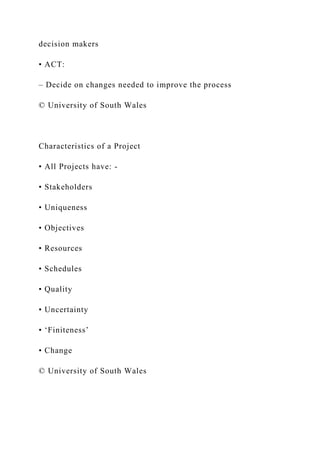
• PLAN:
– Design or revise business process components to improve
results
• DO:
– Implement the plan and measure its performance
• CHECK:
– Assess the measurements and report the results to
decision makers
• ACT:
– Decide on changes needed to improve the process
© University of South Wales
Characteristics of a Project
• All Projects have: -
• Stakeholders
• Uniqueness
• Objectives
• Resources
• Schedules
• Quality
• Uncertainty
• ‘Finiteness’
• Change
© University of South Wales
Types of Client Project
Even though a Client project is an individual study there are
types of
project that are commonly asked for:
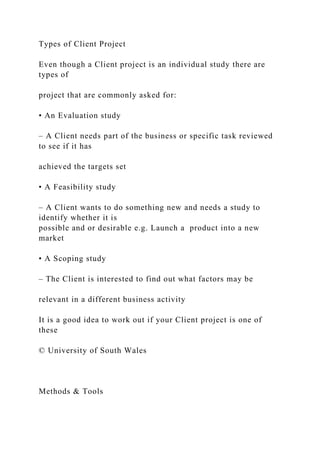
• An Evaluation study
– A Client needs part of the business or specific task reviewed
to see if it has
achieved the targets set
• A Feasibility study
– A Client wants to do something new and needs a study to
identify whether it is
possible and or desirable e.g. Launch a product into a new
market
• A Scoping study
– The Client is interested to find out what factors may be
relevant in a different business activity
It is a good idea to work out if your Client project is one of
these
© University of South Wales
Methods & Tools
Whatever the type of project you will need to identify relevant
and
recognised Methods & Tools
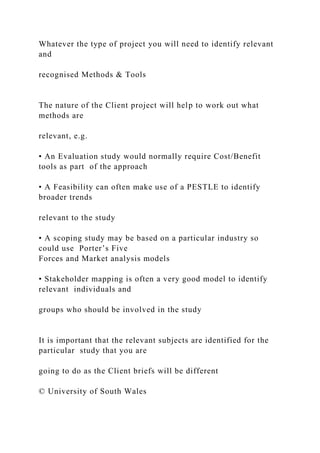
The nature of the Client project will help to work out what
methods are
relevant, e.g.
• An Evaluation study would normally require Cost/Benefit
tools as part of the approach
• A Feasibility can often make use of a PESTLE to identify
broader trends
relevant to the study
• A scoping study may be based on a particular industry so
could use Porter’s Five
Forces and Market analysis models
• Stakeholder mapping is often a very good model to identify
relevant individuals and
groups who should be involved in the study
It is important that the relevant subjects are identified for the
particular study that you are
going to do as the Client briefs will be different
© University of South Wales
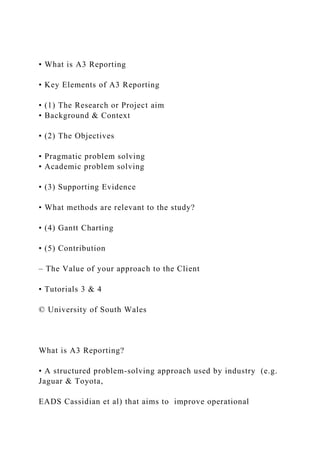
• What is A3 Reporting
• Key Elements of A3 Reporting
• (1) The Research or Project aim
• Background & Context
• (2) The Objectives
• Pragmatic problem solving
• Academic problem solving
• (3) Supporting Evidence
• What methods are relevant to the study?
• (4) Gantt Charting
• (5) Contribution
– The Value of your approach to the Client
• Tutorials 3 & 4
© University of South Wales
What is A3 Reporting?
• A structured problem-solving approach used by industry (e.g.
Jaguar & Toyota,
EADS Cassidian et al) that aims to improve operational
performance;
• Central to this is the training of people within a structured
problem-solving
methodology that uses a tool called “The A3 Problem-Solving
Report”.
• The methodology follows steps to proceed from – ‘problem
identification’ to
‘resolution’ in a fashion that fosters learning, collaboration,
and personal
development.
© University of South Wales
What is A3 Reporting?
• How?
– The problem-solver / project manager records the results of
investigation and
planning in a concise ONE-page document (i.e. the A3 Report)
that helps
facilitate knowledge sharing and collaboration;
– The term "A3" simply derives from the paper size used for the
report;
– Industry actually uses several styles of A3 reports for solving
problems,
for reporting project status and for proposing policy changes-
each
having its own "storyline."
• For the Business Project module we have focused on ONE
simple
bespoke version of the A3 report;
– It is the most basic style, making it the best starting point and
has been
adapted for you to -Plan, Do, Check & Act as you progress
through your
projects - (“The PDCA Cycle”, Deming, 1986) .
© University of South Wales
The A3 Report
Student Name and Number - Report Title -
1 Research aim or Project aim
What is the background?
What is the reason/rationale/motivation for this project?
4 Methods
Explain the main steps of the study
Use a Gantt Chart to track and report your project milestones.
2 Objectives
What does this project intend to do – i.e. the deliverables?
What questions will it answer for the Client?
What problems will it solve for the Client?
You should be able to identify this in clear bullet points 5
Contribution
The Outcomes: -
Will the project achieve its aims – critical reflection of
proposed
approach.
What are the advantages and potential weakness of the
proposed approach in terms of delivering the stated aim and
objectives.
3 Supporting Evidence
What are the main topics that underpin this project?
What literature has informed the research?
What Methods would be suggested to do this study?
What evidence is there from industry to support these
choices?
© University of South Wales
A3 Report – Why use it?
• Most problems that arise in organisations are addressed in
superficial ways, what
some call "first-order problem- solving."
– I.E. we work around the problem to accomplish our
immediate objective, but do not address the ‘root
causes’ of the problem so as to prevent its recurrence.
• By not addressing the ‘root cause’ we can encounter the same
problem or similar
types of problem again and again and as a result, operational
performance does not
improve.
© University of South Wales
A3 Report – Why use it?
• The A3 Process helps people engage in collaborative, in-depth
problem-solving
methodology – it is rigorous and underpinned by management
theory;
• It drives problem-solvers to address the ‘root causes’ of
problems which
surface in day-to-day work routines;
• The A3 Process can be used for any situation and in any type
of organisation;
• Our research and continuous interactions with industry
informs us that
when used properly (i.e. the process is followed and
completed) - the chances of success improve dramatically.
© University of South Wales
A3 Report – Why use it?
• So, this is why we are offering A3 Reporting to help you
manage your projects;
• Not only will A3 help you now, but also in the future, as
embedded in the A3 process
are 7 key employability skills recognised by industry.
© University of South Wales
Employability Skills
• Self-management
• Team working
• Business and customer awareness
• Problem solving
• Communication and literacy
• Application of numeracy
• Application of information technology
© University of South Wales
Employability Skills
• Underpinning all these skills / attributes, the key foundation,
must be a positive
attitude: a 'can-do' approach, a readiness to take part and
contribute,
openness to new ideas and a drive to make these happen.
• Employers also value entrepreneurial graduates who
demonstrate an innovative
approach, creative thinking, bring fresh knowledge and
challenge
assumptions.
– http://highereducation.cbi.org.uk/uploaded/CBI_HE_taskf
orce_report.pdf
– www.cbi.org.uk/pdf/20110509-building-for-growth.pdf
© University of South Wales
http://highereducation.cbi.org.uk/uploaded/CBI_HE_taskforce_r
eport.pdf
http://highereducation.cbi.org.uk/uploaded/CBI_HE_taskforce_r
eport.pdf
http://www.cbi.org.uk/pdf/20110509-building-for-growth.pdf
(1) The Project aim
• What is the aim of the Client Project?
– What is the (strategic) reason/rationale/motivation for this
project? i.e. what is the
range of problem(s) or issues involved?
– What impacts / implications would these problems
have if: -
• You attempt to address them in your project?
• If your project or the organisation does not address
these problems / issues
© University of South Wales
(2) The Objectives
• What does this research / project intend to do – i.e.
the deliverables?
• What questions will it answer for the Client?
• What problems will it solve for the Client?
• You should be able to identify this in clear bullet points
© University of South Wales
(3) Supporting Evidence
• What to research?
– You need to identify the methods that you would use to do
the study for the Client (if chosen)
• How do you do this?
– Understand the relevant topics for the Client problem
– This will help identify relevant models and tools that could
be used to do the
study
• What do I use to help me?
– Academic Theory – most models come from work by
academics to help
solve business problems
– Industry examples – what methods have already been
used in order to solve similar problems?
© University of South Wales
(4) Methods
What are you practically going to do for the Client?
• You need to be able to show the specific activities that would
need to
be completed in order to the project to be done successfully.
• Each Method or Tool identified in Section 3 will need tasks to
enable the data to be
gathered and analysed.
A way of making sense of these activities is through Gantt
Charts
• Main advantage of Gantt charts – they are a useful
communication tool & easy to
understand – “a picture paints a thousand words”;
• Provides a compact overview of responsibilities & progress on
the project;
• Helps to calculate the start and finish times of each activity on
the
Gantt chart.
© University of South Wales
(4) Methods - Gantt Charting
• What is a Gantt Chart?
– Henry Gantt a pioneer of scientific management – work
study
• Gantt Charts highlights the “critical path” in a project.
• Gantt charts are simple representation of a project from the
view of the
TIME taken for each activity and the RESOURCES required at
any
point in time;
• Used to monitor actual progress against a plan e.g. on a
month-by-
month, week-by-week or day-by-day basis;
• Gantt charts can be produced separately for each
person or parts of projects to show their total workload;
• Arrows can be added to show the interrelationships and
interdependencies of different activities;
• Any slack or float time can be shown in each activity;
© University of South Wales
How to complete a Gantt Chart
• Starting at the end date of the research / project and work
backwards to: -
– Identify all of the specific activities needed for the total
project – i.e. compile
an ‘activity list’;
– Avoid general headings e.g. Data gathering, PESTLE analysis,
etc
– What are the start and end dates of these activities?
– Understand each activities dependencies & interdependencies
– E.G. Some activities can only start when a previous activity
has
completed – it is therefore dependant upon that earlier activity!
» These activities are likely to be on the projects “critical path”
– i.e.
the longest duration through the project and MUST always be
completed on time;
– E.G. Some activities can take place simultaneously, i.e. at the
same time
as other activities!
» These activities are likely to have “slack” or “float” times
attached
to them and will not be activities on the projects critical path
– Identify these key milestones between the end date and today
– Map the activities onto your Gantt Chart
© University of South Wales
(5) Contribution
• What were the actual outcomes or Deliverables?
– Will Research project achieve its aims?
– What are the potential the unexpected benefits /
drawbacks?
– Did you set “SMART objectives” for the Research / Project?
– What was the innovation, impact, knowledge embedded
and contribution made by the research / project?
© University of South Wales
(5) Contribution
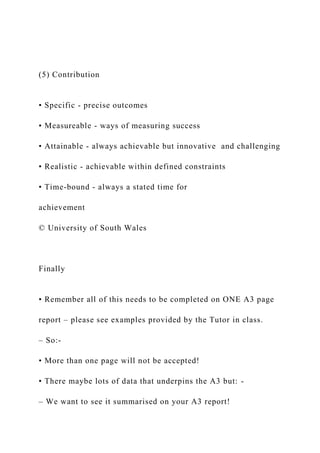
• Specific - precise outcomes
• Measureable - ways of measuring success
• Attainable - always achievable but innovative and challenging
• Realistic - achievable within defined constraints
• Time-bound - always a stated time for
achievement
© University of South Wales
Finally
• Remember all of this needs to be completed on ONE A3 page
report – please see examples provided by the Tutor in class.
– So:-
• More than one page will not be accepted!
• There maybe lots of data that underpins the A3 but: -
– We want to see it summarised on your A3 report!
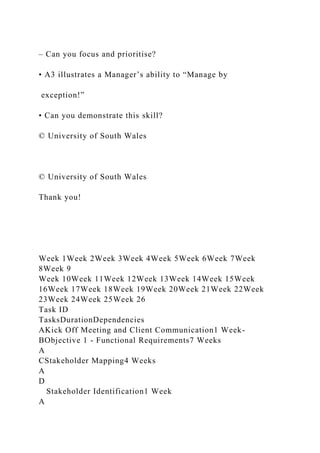
– Can you focus and prioritise?
• A3 illustrates a Manager’s ability to “Manage by
exception!”
• Can you demonstrate this skill?
© University of South Wales
Thank you!
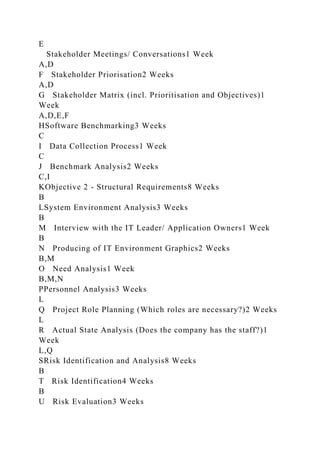
Week 1Week 2Week 3Week 4Week 5Week 6Week 7Week
8Week 9
Week 10Week 11Week 12Week 13Week 14Week 15Week
16Week 17Week 18Week 19Week 20Week 21Week 22Week
23Week 24Week 25Week 26
Task ID
TasksDurationDependencies
AKick Off Meeting and Client Communication1 Week-
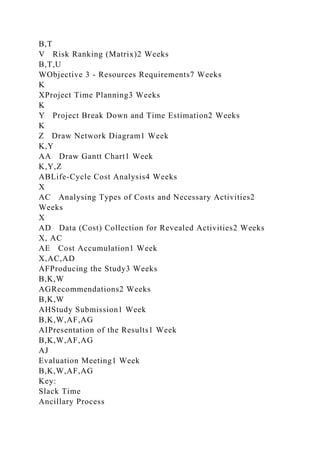
BObjective 1 - Functional Requirements7 Weeks
A
CStakeholder Mapping4 Weeks
A
D
Stakeholder Identification1 Week
A
E
Stakeholder Meetings/ Conversations1 Week
A,D
F Stakeholder Priorisation2 Weeks
A,D
G Stakeholder Matrix (incl. Prioritisation and Objectives)1
Week
A,D,E,F
HSoftware Benchmarking3 Weeks
C
I Data Collection Process1 Week
C
J Benchmark Analysis2 Weeks
C,I
KObjective 2 - Structural Requirements8 Weeks
B
LSystem Environment Analysis3 Weeks
B
M Interview with the IT Leader/ Application Owners1 Week
B
N Producing of IT Environment Graphics2 Weeks
B,M
O Need Analysis1 Week
B,M,N
PPersonnel Analysis3 Weeks
L
Q Project Role Planning (Which roles are necessary?)2 Weeks
L
R Actual State Analysis (Does the company has the staff?)1
Week
L,Q
SRisk Identification and Analysis8 Weeks
B
T Risk Identification4 Weeks
B
U Risk Evaluation3 Weeks
B,T
V Risk Ranking (Matrix)2 Weeks
B,T,U
WObjective 3 - Resources Requirements7 Weeks
K
XProject Time Planning3 Weeks
K
Y Project Break Down and Time Estimation2 Weeks
K
Z Draw Network Diagram1 Week
K,Y
AA Draw Gantt Chart1 Week
K,Y,Z
ABLife-Cycle Cost Analysis4 Weeks
X
AC Analysing Types of Costs and Necessary Activities2
Weeks
X
AD Data (Cost) Collection for Revealed Activities2 Weeks
X, AC
AE Cost Accumulation1 Week
X,AC,AD
AFProducing the Study3 Weeks
B,K,W
AGRecommendations2 Weeks
B,K,W
AHStudy Submission1 Week
B,K,W,AF,AG
AIPresentation of the Results1 Week
B,K,W,AF,AG
AJ
Evaluation Meeting1 Week
B,K,W,AF,AG
Key:
Slack Time
Ancillary Process
W
AF
Gantt Chart
Critical PathBK
Timeframe (6 months = 26 Weeks)
AJ
DISSERTATION PROJECT:
A SCOPING STUDY DETAILING THE NECESSARY
REQUIREMENT
FOR DEVELOPING A BUSINESS APP
A PROJECT BID FOR COMPANY X
Executive Summary
This document below is a report bid for Company X which
intends to obtain a scoping study on the necessary requirements
of developing a business mobile app. The report gives an
overview of factors that needs to be considered before
committing resources to the app development process and also
help the company in making preparations that will help manage
the development of the app and increase the possibility of a
successful outcome. The bid covers those issues highlighted by
the client and provide a guide to executing the project by
formulating aim and objectives targeted at giving form to the
study. Secondly, the report delivers a detailed theory section
that support the tools and techniques used for analysis and also
focused on identifying and explaining the relevant methods used
in completing the study in a clear manner. Thirdly, in a bid to
achieving successful and timely result, the report used the Gantt
chart in planning and determining where and when an activity
needs to be performed. This technique is applied so as to
ascertain and describe the various activities that needs to be
taken to complete the bid timely and effectively through the
adoption of the Gantt chart in planning the events. Lastly is the
contribution of the tools and techniques used in producing the
study of relevance to the project and why they have been
adopted in the study. The procedures and processes undergone
in producing this report represents the best practices and serves
as an eye opener in the area of app building and design.
Table of Contents
1.0 Client Aim and Objectives4
2.0 Supporting Theory5
2.1 Objective 15
2.1.1. Market Analysis5
2.1.2 Interactive model analysis6
2.2 Objective 28
2.2.1. Stakeholder mapping8
2.2.2. Task/technology fit analysis9
2.3 Objective 312
2.3.1. Examination of app development processes12
2.3.2 SWOT analysis13
3.0 Gantt Chart15
3.1 Gantt Chart Methodology16
4.0 Contribution18
4.1 Market Analysis18
4.2 Interactive model analysis18
4.3. Stakeholder Mapping19
4.4. Task/technology Fi19
4.5. Examination of the app development process20
4.6. SWOT analysis20
5.0 References21
6.0 Appendices24
6.1 Appendix 1 – First version of A3 Map24
6.2Appendix 2 – Second version of A3 Map25
6.3 Appendix 3 – Third version of A3 Map26
1.0 Client Aim and Objectives
Company X an SME in the food sector has made a call for
consultants to undertake a scoping study on the necessary
requirements for developing an app for the business based on
their understanding of key facts and the importance of apps in
increasing both sales and visibility of businesses.
Therefore, the Company is looking to engage a consultant to
undertake a scoping study for the requirements of developing a
mobile app so as to ensure the company’s:
· Visibility to customers at all times
· Provide value to customers
· Create a direct marketing channel
· Cultivate customer loyalty
· Stand out from competition
· Build brand recognition
As stated above, the purpose of this report is to conduct a
scoping study on app development for Company X, utilising
effective scoping techniques so as to achieve the study
objectives as stated below:
Objective 1: Aim at evaluating mobile app designs and
suitability in line with the business goals, this is done by:
· Conducting market analysis
· Utilising interactive model analysis
Objective 2: Aim at reviewing the app design components for
the business by:
· Conducting stakeholder mapping
· Adopting the principles of task /technology fit
Objective 3: Strategising for effect app development and
launching by:
· Examining mobile app development processes
· Carrying out SWOT analysis
The methodology used is this study is designed to provide the
client with high valued service which is aimed at realising the
business objective of developing a business app that will
facilitate business transactions in a timely manner. Also, the
study is conducted using information obtained from industry
based studies, case studies and past researches. Furthermore,
organisation wide assessment tour will be carried out in order to
collect necessary information required for the development and
content of the app and also point the usefulness of the study to
the client while providing critical analysis that justify the
methodology used in the study. 2.0 Supporting Theory
The significance of this section is to conduct a detailed
evaluation of academic theories significant to and applied in
this study while the theories will help in identifying and
evaluating the framework from industrial based practices that
are relevant to the study. In order to accurately carry out a
scoping study on the requirements for developing a business
app for Company X, the section focuses on theories that allows
for full analysis of the objectives of this study. The objectives
are explained as follows: 2.1 Objective 1
2.1.1. Market Analysis
Going by the objective which is aimed at evaluating mobile
application design for business use, it is therefore vital to carry
out market analysis in order to identify the market the business
is serving and consider the best app design that fit both the
market and the technology being introduced into the business.
Market analysis is an early step in deciding whether there is an
audience or a need for an idea (i.e. introducing a mobile app)
while an understanding of the market needs and the complexity
of what they can cope with provides businesses with relevant
information that is important in developing a unique marketing
plan (Slater et al; 1995). Market analysis help to describe the
stakeholders characteristics, competition, target customers
profile and how the company can gain advantage over others in
marketing its products and service in order to create a
successful business venture (Dalgic and Leeuw, 1994). So for
Company X to embark on developing an effective business
mobile app, a market analysis needs to be conducted primarily
for the following reasons according to Slater et al, (1995):
To determine if the target market is properly understood with
regards to their needs, expectation and preferences, also it help
to determine if the app need to be integrated into an existing
care pathway and how, i.e. does the app need to run on a
particular operating system or hardware device and finally
consider if the app should be paid for, free or should it come
with an existing service.
Mobile app development can be time consuming and expensive
endeavour therefore, careful consideration aimed at developing
a mobile app can be done through market analysis in order to
meet a clearly identified need of the market (University of
Bristol, 2016).
Also, market analysis has the potential of helping the company
in knowing the make up of the potential users in order to design
the features they can cope with and designing these features in
the app, how users will have access to the app (i.e. do customers
need to register and generate user name and password), the level
of transactions that can be carried out via the app, the aspect the
of the app that the public will be allowed to access and
restricted from etc. (Educause, 2011).
2.1.2 Interactive model analysis
An interactive application is a system in which the user interact
with the computer in a conversational mode (Aaker and
Weinberg, 1975). This model is an abstraction of a real world
system which demonstrates the interactive relationship that
exist between supplier’s offer and the buyer’s perceive product
(Linn, 2010, Aaker and Weinberg, 1975). This model structure
the means available for the business (supplier) to induce meta
as well as physical values which are realised in the in the world
of the buyers’ perception (Linn, 2010). The idea of businesses
using computer terminals in communicating directly with
models was proposed, and in an increasing number of
organisations the idea is becoming a reality (Aaker and
Weinberg, 1975). The motive behind this is that businesses
conceive a total product that is perceived as having a value
higher than the price asked by a large number of potential
buyers (Linn, 2010).
An increasing number of successful applications have been
recently launched for downloads on tablets and smartphone with
components and functionality more closely mimicking the
computer, for example several players in the food industry such
as Bwtri in 2014 launched its business app known as ‘Caws
Cymru’, McDonalds in 2015 launched it app known as
‘McDonalds mobile’, Domino’s in 2011 launched its ‘Easy
order’ mobile app and have used these apps in developing
advert programmes for their products (Aaker and Weinberg,
1975). These apps are software applications that can be
downloaded onto smart phones, e-readers and tablets to provide
solution to marketing hiccups or satisfy a niche requirements,
the apps can also be accessories that are attached to a mobile
communication devices and smart phones (NHS, 2014).
Furthermore, these apps can be programmed to inquire the
conversational language the user would like to use depending on
the customers the business is serving and the user response will
determine the feedback the app display to the user (Aaker and
Weinberg, 1975). In order to ensure an effective business app,
the end users which are often times the customer needs to use or
be involved with the app which implied that stakeholder
(including the customers) does not only use the app but be
committed to it and this is reflected in their subsequent
relationship with it. In developing mobile app lots of decisions
needs to be made and each of those decisions can have a
dramatic effect on the total cost of the finished app and can
affect its chances of being successful (NHS, 2014).
Furthermore, in defining an effective business app, Aaker and
Weinberg (1975) highlighted the following as important:
Stakeholder perception of the app’s usefulness, their
willingness to devote effort and time to using it and their
dependence on it for carrying out transactions.
However, the following needs to be considered in the
application development process as highlighted by Doolittle et
al. (2012); NHS (2014):
- A need assessment that ensure detailed understanding of the
aim and purpose that the app is set to achieve.
- An understanding that the app design should be simple and
easy to use by stakeholders.
- An understanding of the mobile security issues which includes
gateways, portals, one time passwords and mobile virtual
private networks (VPNs).
- Determining the user base for the mobile app operating system
OS.
- Following established regulations on production and
deployment models.
Following the increasing functionality linked to mobile device
hardware, it implied that mobile apps are more capable of
delivering increased functionality and has the capability of
responding faster than earlier devices (NHS, 2014).
Based on the foregoing discussions of the objective above and
the understanding of the conditions for introducing a business
mobile app for Company X which operates in the food industry,
two types of apps can be recommended suitable for the business
which are: the native app and mobile web app (Jobe, 2013).
The native app work on a mobile device and is developed
specially for the device software platform and uses specific
coding to using the device features such as the GPS capability
and the built in camera (NHS, 2014). A well built native has the
tendency of providing rich user experience with enhanced
control of the look and feel of the app and can also access
device specific features as the GPS, cameras and are likely to
work when the device does not have internet connection and can
be subject to development standard of the hardware maker
(Educause, 2011).
While mobile web apps on the other hand refer to web
applications that are designed and developed to imitate the
native applications as much as possible but they are executed in
a web browser in the host platform (Jobe, 2013). However,
mobile web apps can increasingly compete comfortably with
native app in terms of functions (NHS, 2013). Furthermore,
mobile web app allows a single development and support
process irrespective of supported device and typically depend
on internet connectivity, often with lesser functionality
compared to native app but can work on a wide range of devices
and does not need to be downloaded and installed (Educause,
2011). As a result Company X can choose to go for anyone that
best suit their purpose using information generated from market
analysis as explained above.
2.2 Objective 2
2.2.1. Stakeholder mapping
This objective is focused on guiding the client Company X in its
choice of choosing between apps by reviewing the app fit and
design components for the business which will ensure that all
stakeholder interest relating to the app are effectively met by
carrying out stakeholder mapping as a way of identifying the
key players and their interest in the app.
Stakeholder refers to all persons or groups with legitimate
interests participating in an enterprise without whose support
the organisation will cease to exist (Donaldson and Preston,
1995; Clarke, 1998). On the other hand, it can be said that the
company is a system of stakeholders operating within the larger
system of the host society that provides the necessary market
infrastructure for the firm’s activities (Clarke, 1998). In the
execution of the project, a powerful individual stakeholder may
have a significant influence on the project decisions and are
most influential in shaping the strategy for the project
(Newcombe, 2003). However, developing and maintaining a
separate version of app for numerous stakeholder devices can be
very expensive and may require the developers to share
revenues with the vendor’s app store (Educause, 2011).
The central task in the process of reviewing app design for
deployment to business in Company X is to manage and
integrate the relationships and interests of employees,
customers, suppliers and other groups in an approach that
ensures the long term success of the firm and promoting shared
interests (Freeman and McVea, 2001). These groups have
expectations which the app is under pressure to fulfil this can
pose as a challenge owing to the fact that there may exist
conflicting expectations from stakeholders and these conflicts
may revolve around short term versus long term objectives, cost
efficiency versus effectiveness, control versus independence
(Newcombe, 2003). Developing and launching a mobile
business app to facilitates business transactions can be likened
to what Freeman and McVea (2001) termed “strategy
development” this is done in two approaches that involves:
prediction and adaptation which is the process of carrying out
environmental scanning to identify trends that can help foresee
the future business environment and the second approach
involves identifying the best way for the firm to adapt to the
future environment in order to maximize its position as it has
been established that organisations practicing stakeholder
management will be successful in conventional performance in
terms profit, growth and stability (Donaldson and Preston,
1995).
The consultancy recommends undertaking a stakeholder analysis
for the company through a familiarity tour of the company in
order to identify the stakeholders in the app who need to be
involved in designing and development of the app or kept
informed which can include both individuals and organisations
(NHS, 2014). However, based on this study and its aim the
following are the likely stakeholders that ought to be put into
consideration in the app design and development are:
Internal stakeholders: This can include stakeholders at the
executives or management, divisional and departmental level
and the employees. These stakeholders may want the app
designed in a specific way or have some features which may
reflect their functions or ease their operational task (NHS,
2014).
External stakeholders: These consist of external individuals,
organisations or network of organisations who may have
influence in the app development and may be impacted by the
development and deployment of the app and these can include;
services providers (such as content providers, application
providers, payment agents), Communication providers which
provides communication service that enable mobile devices to
access mobile services (these actors include; mobile network
operators and the internet service providers), regulatory
authorities (they set the legal and societal framework in which
mobile business will evolve) and the end users (the consumers
are also important players in these project because they can
determine the success or failure of the business app
(Camponove and Pigneur, 2003; NHS, 2014). Furthermore,
external stakeholder can include providers of complementary
products to the company offerings which may proposing a link
to their site from the company’s proposed app.
In designing the mobile app components, the stakeholders
identified above (both internal and external) are put into
consideration by ensuring the platform has the capacity to
service substantial number of customers at any time and also
ensuring that the content of the app is carefully and
professionally chosen in order to accommodate all relevant,
effective and easy to use features. Also the app will be
developed in a cost effective way and expanded project scope
that ensure the technology fit the task to which it is meant to
perform (Doolittle et al., 2012).
2.2.2. Task/technology fit analysis
In designing and developing business app for Company X, the
consultancy will consider the impact of information technology
and compare it with the task it is expected to perform in order
to ensure its fit for purpose. Information technology (IT)
innovations such as mobile and wireless technologies can only
be successful when developed into applications and later put to
use (Gebauer and Shaw, 2002). The essence of task technology
fit is to ascertain that for information technology to have a
positive effect on individual performance, the technology must
be utilized and the technology must be a good fit with the task
its supporting (Goodhue and Thompson, 1995). Task-technology
fit (TTF) utilisation and user attitudes about the technology
result into individual performance impact through its ability to
make obvious the importance of TTF in explaining how
technology leads to performance and also make more explicit
the links between the construct by providing a stronger
theoretical basis for thoughts about issues relating to the impact
of IT on performance outcome (DeLone and McLean, 1992;
Goodhue and Thompson, 1995). The application of TTF in the
design and development of business app is to take into
consideration the fact that mobile app can cover a wide range of
usage than applications with a specific usage such as group
support systems (Gabauer and Shaw, 2002). In designing the
task the app will perform, the consultancy analyze task on
different levels according to different characteristics which
include: ambiguity, repetitiveness, structure and complexity of
cognitive processes i.e. complex vs simple task (Campbell,
1988; Simon, 1977). However, based on past experience,
interdependency may arise in the app design. Three types of
interdepedence that may arise are highlighted by Thompson
(1967) as sequential, pooled and reciprocal and it is suggested
that the application of relevant organisation technologies that
enables intensive, mediating and long-linked duties to ensure
task coordination. However, the company can measure the TTF
of the app after it is launched by those factors highlighted by
Goodhue and Thompson (1995) as; ease of use, quality,
timeliness, locatability, compatibility, authorisation,
relationship with user and system reliability as against these
measures TTF can undergo modifications to suit the purpose of
the company. The diagram below illustrate the task and
performance expectation of the app.
Source: Goodhue and Thompson (1995)
The project need to undertake TTF to ensure effectiveness and
foresee all possible failures that may result from the design and
development. When the app is fully launched it will serve as an
integral part of the day to day operations of the business as the
company will rely on it to generate revenues, attract customers
and communicate with suppliers therefore the cost of failed
online transaction can be huge also an hour of downtime can
cost the business huge sum in lost of sales (Pertet and
Narasimhan, 2005). Furthermore, downtime can result in:
damage to the company’s reputation, dissatisfied customers and
lost of employee productivity example of this is what
Amazon.com suffered in 2001 as a result of downtime which
cost the an estimated amount of £17,000 per minute of
downtime (Conrad, 2001). The following are the possible cause
of app failure that needed to be guide against as highlighted by
Pertet and Narasimhan (2005).
-Softwares failures and human error which is the most
significant cause of errors.
-System overload, complex fault recovery routines and resource
exhaustion.
-Software failure arising from system complexities, inadequate
testing and weak understanding of system dependencies.
-App inaccessibility which can last from minutes to days.
Security violations.
Having taken all these into consideration the main idea is that
mobile app can best be applied and successful when there is a
good fit between the technology and the underlying tasks
(Gebauer and Shaw, 2002) which is the objective the
consultancy is seeking to achieve so that the company can
derive full economic and other benefits when the app is
deployed to business.
2.3 Objective 3
2.3.1. Examination of app development processes
This section is aimed at enabling Company X mobile app
developers and providers strategies to effectively develop and
launch the app into business by summarising the app illustration
done above and highlighting a detailed analysis of step by step
approach of developing the app.
The following approaches represent a best practice as
highlighted by Microsoft (2012) as:
1) Choosing between a native app and a web app: This has been
explained earlier with features and capabilities in 2.1.2 above.
2) Examining the mobile app experience: This stage defines the
important characteristics of modern mobile app of which are
born out of best practices and provide a useful framework
through which planning and designing of the features are done.
As a result, a mobile app ought to be:
Lightweight and responsive: This section suggests that in the
design stage of the app, consideration should be given to speed
to which content can be accessed on the app. As a result, apps
should be lightweight and void of latency by avoiding
unimportant heavy markup, use of unnecessary and gratuitous
effects and poor data management. A better way of determining
the right size is to consider how long it will take users to load a
page (Varshney and Vetter, 2002).
Designed to fit each device’s capabilities and constraints:
Mobile gadgets come in different sizes, shapes and different
CPU power. As a result, instead of developing an app specific
to a certain platform browser, device grouping is a better
alternative to deliver a flexible app which target the lowest
common denominator app, and further layer additional features
and enhancements with reference to the capabilities and
constraints of each browser and device.
Enhanced, platform-agnostic user interface: This process is
strengthened by market analysis explained earlier. i.e. an app
can be well designed and has a nice interface but may be hard to
use. Users may make mistakes as a result of incomprehensible
language used, have difficulty if finding a feature and what a
feature is used for. Therefore, an enhanced interface should
work well with back end business logic and allow users to
complete their task effortlessly.
3) Choosing device and level of support: This section aim at
identifying those devices the app will support, and the users
achievable user interface experience on their devices by
determining the browsers and devices the app will support.
Considering the key features and behaviour of the app,
experience and context of use, i.e. whether the app will be
designed for all purpose use or restricted to shopping activities
etc. as explained in (2.2.2) TTF above.
4) Options for building mobile app experience: Making decision
on the approach to use in developing a mobile app is always not
easy, this is due to the various techniques available on building
an app and their various advantages and disadvantages
(Microsoft, 2010). Moreover, making this decision depend on
the circumstance and consideration of linked factors such as
resources, content structures, timeline and design architecture
(Educause, 2011).
The above listed steps constitute the minimum process that need
to be taken in building a mobile app after which the builder can
then proceed to the testing stage of the app in other to identify
any area where there may be a malfunctioning in the app while a
simple app as illustrated with upto four screens will cost
between £1,000 to £7,000, app with multi-features will cost
£30,000 upward, also app that can store information on mobile
device cost between £5,000 to £30,000 (NHS, 2014).
Furthermore, the SWOT analysis will give an inkling of the
possible downside that can be experience in the app
development processes.
2.3.2 SWOT analysis
This section explore the literature and provide a summary
details of the limitations and challenges that can be
encountered in building the app and by extension the threats the
app can pose to the business as a result of lapses that may be
observed in the app functioning and on the other hand highlight
the strength of building the app as the company can decide
either to build the app in house or contract it out and how it can
be of benefit to the company.
Paliwal (2006) explained that the SWOT is preferred for
assessing projects as it yields useful information about the
viability of the project due to the predictive capabilities in
determining how the app will fare in the light of changes taking
place around it. The consultancy emphasise carrying out this
analysis based on Milosevic (2010) explanation of SWOT from
the company’s point of view that from the moment the company
decides to undertake the project (being app development), the
company is in suspense regarding the final outcome and the app
being met to last over a period of time, large part of the
benefits from the investment are realised in the future therefore
the study highlight the risk involve so that the company can
decide the level of risk its willing to take so as to ensure the
project yield expected results. This follows Barney (1995)
description of SWOT as a framework that points to the
relevance of internal and external forces that help in
understanding the source of competitive advantage and also
assist to portray organizational situation and identify what
information is needed and the decision that are likely to be
made at the company level (Balamuralikrishna and Dugger,
1995). The SWOT analysis for this study is used to compare
builing the app in-house and contracting it out below:
Strength: Building an app in house has the benefit of connecting
the internal stakeholders, their objectives and actively
participating in formulating the execution plans and because
they formulate the plans they understand it and will assist in
producing the desired result and protect the company sensitive
data (Apple, 2011). On the other hand, contracting out the app
building to specialist has the benefits of using their extensive
experience in developing, operating and implementing mobile
app, and follow-through checks anytime, anywhere problem
arise with the app (T-system, 2012).
Opportunities: Building the app in-house has the capabilities of
availing the company the knowledge of app building, ability to
work on any area users are finding difficult to use immediately
and also has the opportunity of saving cost by bye passing
intermediary directly to relevant providers (Microsoft, 2012).
On the other hand, the company can push the responsibility to
consultant who will do the running around to ensure the app is
designed to specification, the company will save more resources
by saving the pay it would pay the staff in regular employment
in the company and cost of developing it wrongly.
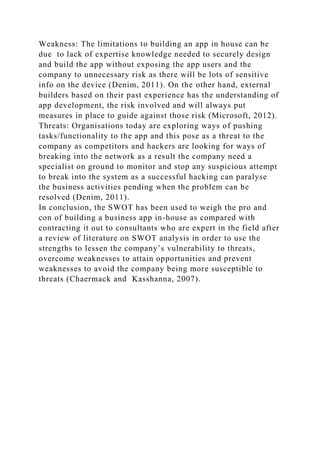
Weakness: The limitations to building an app in house can be
due to lack of expertise knowledge needed to securely design
and build the app without exposing the app users and the
company to unnecessary risk as there will be lots of sensitive
info on the device (Denim, 2011). On the other hand, external
builders based on their past experience has the understanding of
app development, the risk involved and will always put
measures in place to guide against those risk (Microsoft, 2012).
Threats: Organisations today are exploring ways of pushing
tasks/functionality to the app and this pose as a threat to the
company as competitors and hackers are looking for ways of
breaking into the network as a result the company need a
specialist on ground to monitor and stop any suspicious attempt
to break into the system as a successful hacking can paralyse
the business activities pending when the problem can be
resolved (Denim, 2011).
In conclusion, the SWOT has been used to weigh the pro and
con of building a business app in-house as compared with
contracting it out to consultants who are expert in the field after
a review of literature on SWOT analysis in order to use the
strengths to lessen the company’s vulnerability to threats,
overcome weaknesses to attain opportunities and prevent
weaknesses to avoid the company being more susceptible to
threats (Chaermack and Kasshanna, 2007).
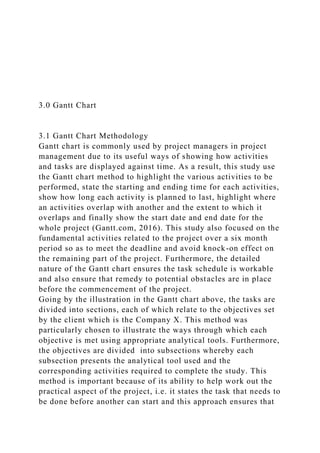
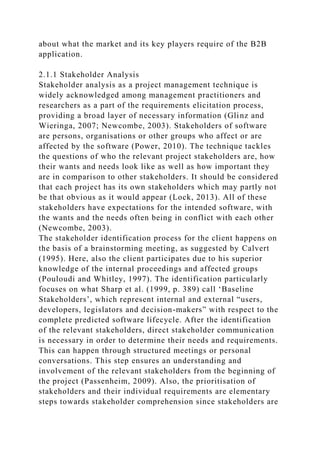
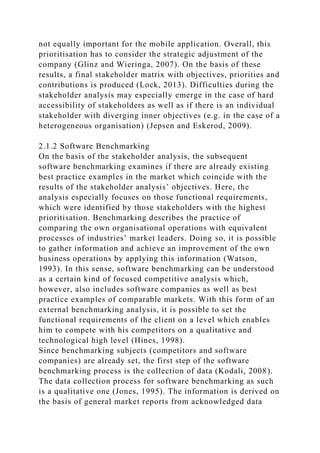
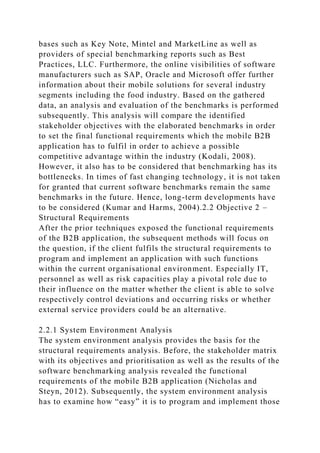
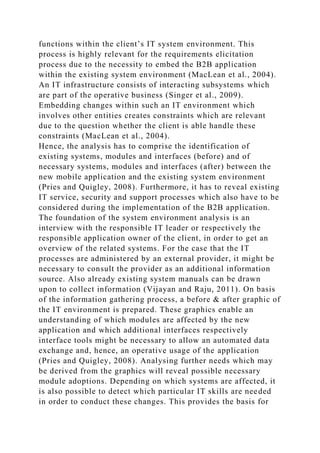
3.0 Gantt Chart
3.1 Gantt Chart Methodology
Gantt chart is commonly used by project managers in project
management due to its useful ways of showing how activities
and tasks are displayed against time. As a result, this study use
the Gantt chart method to highlight the various activities to be
performed, state the starting and ending time for each activities,
show how long each activity is planned to last, highlight where
an activities overlap with another and the extent to which it
overlaps and finally show the start date and end date for the
whole project (Gantt.com, 2016). This study also focused on the
fundamental activities related to the project over a six month
period so as to meet the deadline and avoid knock-on effect on
the remaining part of the project. Furthermore, the detailed
nature of the Gantt chart ensures the task schedule is workable
and also ensure that remedy to potential obstacles are in place
before the commencement of the project.
Going by the illustration in the Gantt chart above, the tasks are
divided into sections, each of which relate to the objectives set
by the client which is the Company X. This method was
particularly chosen to illustrate the ways through which each
objective is met using appropriate analytical tools. Furthermore,
the objectives are divided into subsections whereby each
subsection presents the analytical tool used and the
corresponding activities required to complete the study. This
method is important because of its ability to help work out the
practical aspect of the project, i.e. it states the task that needs to
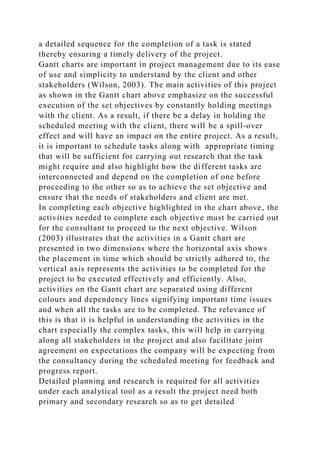
be done before another can start and this approach ensures that
a detailed sequence for the completion of a task is stated
thereby ensuring a timely delivery of the project.
Gantt charts are important in project management due to its ease
of use and simplicity to understand by the client and other
stakeholders (Wilson, 2003). The main activities of this project
as shown in the Gantt chart above emphasize on the successful
execution of the set objectives by constantly holding meetings
with the client. As a result, if there be a delay in holding the
scheduled meeting with the client, there will be a spill-over
effect and will have an impact on the entire project. As a result,
it is important to schedule tasks along with appropriate timing
that will be sufficient for carrying out research that the task
might require and also highlight how the different tasks are
interconnected and depend on the completion of one before
proceeding to the other so as to achieve the set objective and
ensure that the needs of stakeholders and client are met.
In completing each objective highlighted in the chart above, the
activities needed to complete each objective must be carried out
for the consultant to proceed to the next objective. Wilson
(2003) illustrates that the activities in a Gantt chart are
presented in two dimensions where the horizontal axis shows
the placement in time which should be strictly adhered to, the
vertical axis represents the activities to be completed for the
project to be executed effectively and efficiently. Also,
activities on the Gantt chart are separated using different
colours and dependency lines signifying important time issues
and when all the tasks are to be completed. The relevance of
this is that it is helpful in understanding the activities in the
chart especially the complex tasks, this will help in carrying
along all stakeholders in the project and also facilitate joint
agreement on expectations the company will be expecting from
the consultancy during the scheduled meeting for feedback and
progress report.
Detailed planning and research is required for all activities
under each analytical tool as a result the project need both
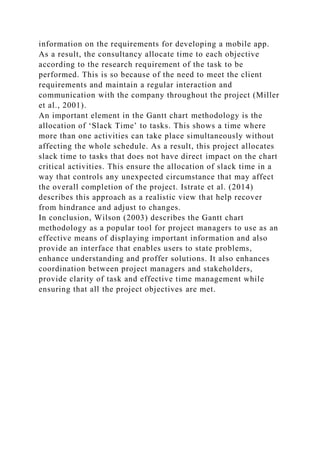
primary and secondary research so as to get detailed
information on the requirements for developing a mobile app.
As a result, the consultancy allocate time to each objective
according to the research requirement of the task to be
performed. This is so because of the need to meet the client
requirements and maintain a regular interaction and
communication with the company throughout the project (Miller
et al., 2001).
An important element in the Gantt chart methodology is the
allocation of ‘Slack Time’ to tasks. This shows a time where
more than one activities can take place simultaneously without
affecting the whole schedule. As a result, this project allocates
slack time to tasks that does not have direct impact on the chart
critical activities. This ensure the allocation of slack time in a
way that controls any unexpected circumstance that may affect
the overall completion of the project. Istrate et al. (2014)
describes this approach as a realistic view that help recover
from hindrance and adjust to changes.
In conclusion, Wilson (2003) describes the Gantt chart
methodology as a popular tool for project managers to use as an
effective means of displaying important information and also
provide an interface that enables users to state problems,
enhance understanding and proffer solutions. It also enhances
coordination between project managers and stakeholders,
provide clarity of task and effective time management while
ensuring that all the project objectives are met.
4.0 Contribution
The demonstrated frameworks and analytical tools used above
are based on high quality research aimed at enlightening the
client through the study. The attached Gantt chart above
highlight the relevant activities that will be involved in the
study to satisfy the models chosen for each objective which is
done through analysis of relevant literature and case studies.
This section ensures that a detailed assessment of the
deliverable outcome for the project is done and a set pattern for
meeting client requirements for the study is clear while making
sure the client is informed of the reasons for the approaches
adopted for the study and how effective they are in meeting
their requirements. 4.1 Market Analysis
In project management research, theory holds that market
analysis and testing is often carried out first by project
managers before making most decisions (Alketbi and Gardiner,
2014). It is argued that organisations seeking not just increase
revenue and profit but transformation in their business use
market analysis as a tool for achieving their purpose (Pursche,
1990). For this study, market analysis and the interactive model
help transmit information regarding the end users of the app,
their level of exposure to modern technology and also determine
the level of app (technological) complexities they can cope with
as Alketbi and Gardiner (2014) explained that this tool is
considered to be the simplest technique used by project
managers in solving complicated issues bordering on customers
expectations.
4.2 Interactive model analysis
In evaluating the suitability of mobile application for business
use, the interactive model play an important role because it
consider the need for allowing larger number of people have
access to organisations software applications for larger number
of purposes and in a wider number of contexts (Paterno, 2000).
Also, the model ensure this by making the system easy to use
why taking into consideration some factors in the design of the
interactive application that encourages involvement, active
engagement and reaction, two way communication, physical
action and feedback (Karimova, 2011). Furthermore, the model
help in determining the level of formality adopted, how
information is presented, and the level of abstraction that can be
use in the app as a tool for creating compelling and easy to
understand interaction (Paterno, 2000). This model further
ensure that the app is designed and developed in a way that is
beneficial in arousing the users and motivate them to stick to
the interactions longer, engaging and encouraging the users to
return over time, persuasive and increase sales, increase trust
and make people feel more secure and comfortable about
releasing personal information online, promoting a feeling of
personalised experience by making users feel special and also
creates feelings of liking, friendliness while supporting
generalised positive feelings towards the company (Reeves,
2016).
As a way of satisfying the first objective, the study made use of
market analysis and interactive model to evaluate the suitability
of business app to the company, which the consultancy consider
effective and beneficial tools. The interactive model consider
the relevance of customers having direct access to the company
and market analysis analysed the customers with regard to the
level of complexity in technology they can cope with.
4.3. Stakeholder Mapping
In reviewing the app building and design for the company, it
becomes necessary to conduct stakeholder mapping as a way of
identifying key stakeholders and featuring their interest in the
app design. This tool is important for the company in
identifying these stakeholders who can affect the project and
then managing their differing demand through communication
and fashioning out ways of realising the proposed project
objectives (Olander and Landin, 2005). For the company to
acquire relevant data on the app design, there is the need to
carry out extensive primary research in the form of interview
inquiring on their interest, designs, interactions and other
features in the app in a way that ensure the project objectives
correspond with the stakeholders’ (Freeman, 1984).
Stakeholder theory has been regarded to be important in
identifying stakeholders in any project and allows everyone to
understand the importance and influence of the project, allow
for continuous improvement while it can be effectively used to
determine stakeholder requirements by project managers
(Kennon et al., 2009; Scholl, 2011; Olander and Landin, 2005).
As it is believed that the views and initiative of stakeholders in
the project can be useful for strategic planning and design
process (Clarke, 1998). This justifies the relevance of
implementing stakeholder mapping in the review and design
stage of the project.
4.4. Task/technology Fit
Having known the technology at hand, this tool helps in
determining the task the company will like to be performed
using the app and then build the app to perform the task
identified to be done through the app i.e determining whether
the task will be best perfomed by native app or mobile web app.
Goodhue and Thompson (1995) explain that tasks are actions to
be carried out to turn input to output why task characteristics in
this case are those that make the company to rely heavily on
certain aspects of information technology. While technology on
the other hand, are tools used in carrying out tasks. As a result,
in building the app TTF will be used in helping to get a
reasonable balance between task to be formed and the
technology which is the app. The tool relied on Tornatzky and
Klein (1982) postulation that successful innovation happens
when the task and the technology are compatible. As TTF is the
correspondence between functionality of the technology,
individual/organisational abilities and the task requirement
(Goodhue and Thompson, 1995).4.5. Examination of the app
development process
The app development process is undertaken in order to give a
clear understanding on the task the app need to perform (TTF),
for whom it is meant (market analysis), and the environment it
needs to operate in (NHS, 2014). This aspect made clear app
design and development processes and the key steps that need to
be taken using an agile development process, while the process
offers a responsive and rapid approach to the building of the
app and its functionality using a range of development tools
with tried and tested processes. The section also serves as a
document to support internal development of the app and also
provide a clear and unambiguous requirements external
developer can seek if the company decides to outsource the app
development. This section strengthens Abrahamsson et al.
(2014) postulation that anyone with the needed skills can build
a mobile app while a good knowledge of the specific
characteristics and challenges of developing software for mobile
devices is required which this study has provided.
4.6. SWOT analysis
SWOT is used as an important support tool for making decision
and systematic analysis of of the company external and internal
capabilities and also provide a strong basis for decision making
(Yuksel and Deviren, 2007). In choice of developing the app,
the section uses the SWOT as a tool to highlight the benefits
and privileges the company stand to gain while on the other
hand it explained the short comings and possible consequence
of developing the app in-house. As a result, SWOT is used as a
tool to help the company in selecting amongst strategic
alternatives in the light of the strength, weakness, opportunities
and threats involved in building the app (Hanley and Spash,
1993).
5.0 References
Abrahamsson, P., Hanhineva, A., Huikko, H., Ihme, T.,
Jaalinnoja, J., Korkela, M., Koskela, J., Kyllonen, P. and Salo,
O. (2014) ‘Mobile-D: an agile approach for mobile application
development’, 19th annual ACM SIGPLAN conference on
object-oriented programming systems, languages and
applications.
Apple, (2011) ‘In-house app development accelerator guide’
Avalable at:
http://www.apple.com/fr/iphone/business/docs/20110801_in_ho
use_app_accelerator_guide.pdf (Accessed:// 24 April 2016)
Balamuralikrishna, R. and Dugger, J. (1995) ‘SWOT analysis: A
management tool for initiating new programmes in vocational
schools’, Journal of Vocation and Technical Education.Vol.12
Iss.5
Barney, J. (1995) ‘Looking inside for competitive advantage’,
The Academy of Management Executive. Vol. 4 No. 2
Camponovo, G. and Pigneur, Y. (2003) Business model analysis
applied to mobile business. In Proceedings of the 5th
International conference on Enterprise Information Systems, 23-
26 April.
Chandler, A. (1962) Strategy and structure: Chapters in the
history of the industrial enterprise. Cambridge, Ma: MIT Press.
Chermack, T.J. and Kasshanna, B. (2007) ‘The use and misuse
of SWOT analysis and implications for HRD professionals’,
Human Resources Development International. Vol.10 No.4
Clarke, T. (1998) ‘The stakeholder corporation: A business
philosophy for the information age,’ Long Range Planning, Vol.
31 Iss. 2
Conrad, R. (2001) Carlifornia power outages suspended for
now. Availabe at: http://news.com/2100-1017-251167.html
(Accessed: 06 April 2016).
Dalgic, T. And Leeuw, M. (1994) ‘Niche marketing revisited:
Concept, application and some European cases,’ European
Journal of Marketing, Vol.28 No.4
Darden Business School Working Paper No. 01-02. Available at
SSRN: http://ssrn.com/abstract=263511. (Accessed: 4 April
2016).
Denim Group (2011) ‘Secure mobile application development
reference’ Available at:
http://denimgroup.com/media/pdf/mobileDevreference.pdf.
(Accessed: 25 April 2016)
Doolittle, J., Moohan, A., Simpson, J. and Soanes, I. (2012)
‘Building a mobile application development framework’, Intel
White paper. Available at
http://communities.intel.com/docs/DOC-19555 (Accessed: 05
April 2016).
Educause (2011) ‘7 Things you should know about mobile app
development’ Available at:
http://net.educause.edu/ir/library/pdf/EST1102.pdf. Accessed
[18th April 2016]
Fisher, S. (2009) Guide to writing a killer marketing plan.
nsbdcLibrary [online]. Available
at://www.nsbdc.org/wpcontent/uploads/2010/11/Guide_to_writi
ng_a_killer_marketing_plan.pdf (accessed: 20 April 2016).
Freeman, R.E. and McVea, J. (2001) ‘A stakeholder approach to
strategic management,’ Jobe, W. (2013) ‘Native apps Vs.
Mobile Web Apps,’ International Journal of Interactive Mobile
Technologies, Vol. 7 Iss. 4
Karimova, G. Z. (2011) ‘Interactivty and advertising
communication’, Journal of Media and Communication Studies.
Vol.3 No.5.
Kennole, N., Howden, P. and Hartley, M.(2009) ‘Who really
matters? A stakeholder analysis tool’ Extension farming system
Journal. Vol.5 No.2
Microsoft (2012) ‘Building modern mobile web apps’ Availble
at: http://msdn.microsoft.com/en-us/library/hh994907
(Accessed: 24 April 2016)
Millar, G., Simeone, R.S. and Carnevale, J.T. (2001) ‘Logic
models: a systems tool for performance management’,
Evaluation and program Planning, Vol.24 No.1
Milosevic, I.N. (2010) ‘Practical application of SWOT analysis
in the management of a construction project’, Leadership and
Manage,ent in Engineering, Vol.10 No.2
Newcombe, R. (2003) ‘From client to project stakeholders: a
stakeholder mapping approach’, Construction Management and
Economics, Vol.21 No.8
Olander, S. and Landin, A. (2005) ‘Evaluation of stakeholder
influence in the implementation of construction projects’,
International Journal of Project Management. Vol.23 Iss.4
Paliwal, R. (2006) ‘EIA practice in India and its evaluation
using SWOT and analysis’, Environmental Impact Assessment
Review. Vol.26 Iss.5
Paterno, F. (2000) Model-based design and evaluation of
interactive applications. London: springer.
Pertet, S. and Narasimhan, P. (2005) Causes of failure in web
applications. Available at
http://resipository.cmu.edu/cgi/viewcontent.cgi (Accessed: 06
April, 2016).
Reeves, B. (2016) ‘The benefits of interactive online
characteristics’, Available at:
http://sitepal.com/pdf/casestudy/standford_university
_avatar_casestudy.pdf (Accessed: 19 April 2016).
Slater, S.F., Mohr, J.J. and Sengupta, S. (1995) ‘Market
orientation’ Wiley International Encyclopedia of Marketing.
T-System (2012) Mobile application services. Secure access to
business processes anytime, anyplace. Available at://t-
systems.com/blob/246782 (Accessed on:24 April 2016).
University of Bristol (2016) ‘Application Guidelines for
Schools, department and other organisational units who are
interested in developing mobile applications (mobile apps),’
Available at://www.bristol.ac.uk/media-library/sites/styles-
guides/documents/mobile-application-guidelines.pdf. Accessed
[16th April 2016]
Valentine, M. (2008) ‘Strategic advantage and the Microsoft
application platform’ Available at:
http://download.microsoft.com/download (Accessed: 19 April
2016).
Wilson, J.M. (2003) ‘Gantt Charts: A centenary appreciation’,
European Journal of Operational Research. Vol.149 Iss.2
Yuksel, I. And Deviren, M.D. (2007) ‘Using the analytic
network process in a SWOT analysis. A case study for a textile
firm’, Information Sciences. Vol.177 Iss.16
6.0 Appendices6.1 Appendix 1 – First version of A3 Map
6.2Appendix 2 – Second version of A3 Map
6.3 Appendix 3 – Third version of A3 Map
Page | 4
Requirements Elicitation for
Mobile B2B ApplicationsA project-based consulting approach
Management Summary
Mobile B2B applications are an emerging issue when it comes
to the adoption of new technologies in business, providing
innovative opportunities for multiple operations between
customers and companies. For organisations that have decided
to implement such an application within the scope of a project,
the requirements elicitation process depicts an important step in
order to determine necessities and to build a basis for
subsequent strategic decisions. This paper depicts an offer for a
B2B food sector company with the intention of identifying the
requirements for such a project. The introduced approach
utilises approved methods and techniques from the fields of
project and software management.
The offer covers an examination of three relevant categories of
requirements. In order to determine the functional requirements
(functionalities the B2B application has to exhibit), the methods
stakeholder analysis and software benchmarking are introduced.
For the structural requirements (possibility and appropriateness
to implement the application within the company’s structural
circumstances), system environment analysis, personnel
analysis as well as risk identification and analysis cover a basis
for future decisions. Finally, project time planning and life-
cycle cost analysis investigate the resources requirements the
company will have to face. The study will be conducted within a
timeframe of 6 months (26 weeks) which is illustrated by a
Gantt-chart. Overall, the holistic character of the approach, the
acknowledged benefits of the individual methods as well as the
recommendations which can be derived on the basis of the
defined objectives will make the study of high value to the
client and provide adequate information for further actions
regarding the application’s programming and implementation
process.
Table of Contents
1. Introduction – Background and Objectives 1
2. Supporting Evidence – The Requirements Elicitation
Approach 2
2.1 Objective 1 – Functional Requirements 3
2.1.1 Stakeholder Analysis 3
2.1.2 Software Benchmarking 3
2.2 Objective 2 – Structural Requirements 4
2.2.1 System Environment Analysis 4
2.2.2 Personnel Analysis 5
2.2.3 Risk Identification and Analysis 6
2.3 Objective 3 – Resources Requirements 6
2.3.1 Project Time Planning 6
2.3.2 Life-Cycle Cost Analysis 7
3. Study Gantt-Chart 8
4. Contribution 10
4.1 Stakeholder Analysis 10
4.2 Software Benchmarking 10
4.3 System Environment Analysis 11
4.4 Personnel Analysis 11
4.5 Risk Identification and Analysis 12
4.6 Project Time Planning 12
4.7 Life-Cycle Cost Analysis 13
5. Concluding Remarks 13
I. References 14
1. Introduction – Background and Objectives
New communication technologies always bring along new
chances and ways of conducting daily business operations. In
this context, the utilisation of the internet to collaborate with
trading partners depicts a notable advance within the last two
decades. These direct electronical collaborations are commonly
labelled as business-to-business (B2B) applications, which for
example target “e-procurement, supply-chain management
(SCM), and B2B e-payment” (Al-Naeem et al., 2005, p. 41).
Due to the rise of mobile devices like smartphones or tablets
and the concomitant increased usage of professionals’ mobile
devices during work, especially mobile B2B applications have
been evolving as an important tool for customer relationship
management (Smilansky, 2015). Nowadays, people already
spend more time using mobile applications than internet via
traditional desktop computers (Zamfiroiu, 2015). Well-known
software manufacturers already detected this development,
offering mobile B2B applications for multiple business purposes
(Tornack et al., 2011).
The client, an SME providing food products to catering
companies, is aware of this progress and intends to program and
implement a mobile B2B application for his customers.
However, due to the high complexity of such IT projects, only
an extensive exposure of the requirements can prevent the
project from certain failure (Azadegan et al., 2013). Based on
the results of more than hundred research and development
projects, Dvir et al. (2003) point out that project success is
strongly correlated with the definition of those requirements. In
order to determine relevant requirements of this project, a study
shall provide valuable information about different project
necessities. Regarding software development, this process is
commonly labelled as ‘requirements engineering’ respectively
‘requirements elicitation’ which describes “seeking, uncovering,
acquiring and elaborating requirements for computer based
systems” (Zowghi and Coulin, 2005, p. 19). Although
requirements elicitation is mostly perceived as the first major
step of a software engineering project, the shape of its process
and used methods varies, depending on the particular project
(Vijayan and Raju, 2011). Hence, this report can be understood
as a consulting offer to conduct a requirements elicitation study,
outlining all pertinent methods which are of importance for the
individual case of the client.
It is of fundamental importance that the study as well as the
development of the mobile B2B application for the client itself
can be seen as projects. Projects are unique sets of temporary
activities with a definable goal, which cut across functional
lines and imply risks as well as costs for an organisation
(Nicholas and Steyn, 2012). That is why project management
methods as well as experiences from software project
management case studies will take a key role in the presented
requirements elicitation approach. The study covers the
following objectives and related methods in order to reveal the
client’s requirements for the project of developing and
implementing a mobile B2B application, whereas objectives and
methods build on one another:
Objective 1: Identifying the functional requirements of mobile
B2B applications within the food market for catering companies
· Stakeholder Analysis
· Software Benchmarking
Objective 2: Identifying the structural requirements to program
and implement the application within the current company
structure and capabilities
· System Environment Analysis
· Personnel Analysis
· Risk Identification and Analysis
Objective 3: Identifying the resources requirements the client
has to raise for programming, implementing and operating the
mobile B2B application
· Project Time Planning
· Life-Cycle Cost Analysis
At first, the offer will illustrate the intended relevant methods
which are required in order to reveal the particular requirements
of the three objectives. Here, the methods are described shortly,
while evidences from project management background
exemplify the adequacy of the methods. Based on the introduced
methods and their approximate time need, the offer will
illustrate the intended approach with the aid of a Gantt chart,
providing an overview with start and end times for the
individual project steps and methods. Subsequently, the
contribution of the particular methods and the project as a
whole will elucidate why the illustrated approach is the most
useful one for the company’s objectives, supported by several
industry cases. Finally, the concluding remarks will summarise
the main details of the offer in order to provide final decision
guidance towards this offer.2. Supporting Evidence – The
Requirements Elicitation Approach
The general aim of the study is to provide a holistic research
approach for the client, which covers all relevant kinds of
requirements in order to assess the necessities of programming
and implementing the mobile B2B application. The following
chapter illustrates the background as well as the individual
processes of the particular methods.
It has to be considered that the information gathering process of
all the intended methods requires an open communicative
exchange with the client. Changing client requirements or
circumstances can occur during the whole requirements
elicitation process and should be incorporated as soon as the
changes are identified. Therefore, a continuous two-way
communication process with the client in the form of a
permanent contact person secures adequacy of the study
(Nakatani et al., 2014). This is supported by Houdek and Pohl
(2000) who examine the requirements elicitation process of
Daimler-Chrysler projects and emphasise that over 50% of the
requirements changes happen after the actual identification
process.2.1 Objective 1 – Functional Requirements
As already indicated, B2B applications are able to cover several
functionalities, from being just a marketing tool to comprising a
whole e-procurement system including embedded sales and
payment possibilities (Al-Naeem et al., 2005). In order to
provide a basis for the further requirements analyses, the
examination of the functional requirements focuses on the
questions, how the application has to look like to please the
stakeholders and in which functional direction (e.g. sales,
marketing, supply-chain management, e-payment, etc.) the
application has to go. Overall, the client receives knowledge
about what the market and its key players require of the B2B
application.
2.1.1 Stakeholder Analysis
Stakeholder analysis as a project management technique is
widely acknowledged among management practitioners and
researchers as a part of the requirements elicitation process,
providing a broad layer of necessary information (Glinz and
Wieringa, 2007; Newcombe, 2003). Stakeholders of software
are persons, organisations or other groups who affect or are
affected by the software (Power, 2010). The technique tackles
the questions of who the relevant project stakeholders are, how
their wants and needs look like as well as how important they
are in comparison to other stakeholders. It should be considered
that each project has its own stakeholders which may partly not
be that obvious as it would appear (Lock, 2013). All of these
stakeholders have expectations for the intended software, with
the wants and the needs often being in conflict with each other
(Newcombe, 2003).
The stakeholder identification process for the client happens on
the basis of a brainstorming meeting, as suggested by Calvert
(1995). Here, also the client participates due to his superior
knowledge of the internal proceedings and affected groups
(Pouloudi and Whitley, 1997). The identification particularly
focuses on what Sharp et al. (1999, p. 389) call ‘Baseline
Stakeholders’, which represent internal and external “users,
developers, legislators and decision-makers” with respect to the
complete predicted software lifecycle. After the identification
of the relevant stakeholders, direct stakeholder communication
is necessary in order to determine their needs and requirements.
This can happen through structured meetings or personal
conversations. This step ensures an understanding and
involvement of the relevant stakeholders from the beginning of
the project (Passenheim, 2009). Also, the prioritisation of
stakeholders and their individual requirements are elementary
steps towards stakeholder comprehension since stakeholders are
not equally important for the mobile application. Overall, this
prioritisation has to consider the strategic adjustment of the
company (Glinz and Wieringa, 2007). On the basis of these
results, a final stakeholder matrix with objectives, priorities and
contributions is produced (Lock, 2013). Difficulties during the
stakeholder analysis may especially emerge in the case of hard
accessibility of stakeholders as well as if there is an individual
stakeholder with diverging inner objectives (e.g. in the case of a
heterogeneous organisation) (Jepsen and Eskerod, 2009).
2.1.2 Software Benchmarking
On the basis of the stakeholder analysis, the subsequent
software benchmarking examines if there are already existing
best practice examples in the market which coincide with the
results of the stakeholder analysis’ objectives. Here, the
analysis especially focuses on those functional requirements,
which were identified by those stakeholders with the highest
prioritisation. Benchmarking describes the practice of
comparing the own organisational operations with equivalent
processes of industries’ market leaders. Doing so, it is possible
to gather information and achieve an improvement of the own
business operations by applying this information (Watson,
1993). In this sense, software benchmarking can be understood
as a certain kind of focused competitive analysis which,
however, also includes software companies as well as best
practice examples of comparable markets. With this form of an
external benchmarking analysis, it is possible to set the
functional requirements of the client on a level which enables
him to compete with his competitors on a qualitative and
technological high level (Hines, 1998).
Since benchmarking subjects (competitors and software
companies) are already set, the first step of the software
benchmarking process is the collection of data (Kodali, 2008).
The data collection process for software benchmarking as such
is a qualitative one (Jones, 1995). The information is derived on
the basis of general market reports from acknowledged data
bases such as Key Note, Mintel and MarketLine as well as
providers of special benchmarking reports such as Best
Practices, LLC. Furthermore, the online visibilities of software
manufacturers such as SAP, Oracle and Microsoft offer further
information about their mobile solutions for several industry
segments including the food industry. Based on the gathered
data, an analysis and evaluation of the benchmarks is performed
subsequently. This analysis will compare the identified
stakeholder objectives with the elaborated benchmarks in order
to set the final functional requirements which the mobile B2B
application has to fulfil in order to achieve a possible
competitive advantage within the industry (Kodali, 2008).
However, it also has to be considered that benchmarking has its
bottlenecks. In times of fast changing technology, it is not taken
for granted that current software benchmarks remain the same
benchmarks in the future. Hence, long-term developments have
to be considered (Kumar and Harms, 2004).2.2 Objective 2 –
Structural Requirements
After the prior techniques exposed the functional requirements
of the B2B application, the subsequent methods will focus on
the question, if the client fulfils the structural requirements to
program and implement an application with such functions
within the current organisational environment. Especially IT,
personnel as well as risk capacities play a pivotal role due to
their influence on the matter whether the client is able to solve
respectively control deviations and occurring risks or whether
external service providers could be an alternative.
2.2.1 System Environment Analysis
The system environment analysis provides the basis for the
structural requirements analysis. Before, the stakeholder matrix
with its objectives and prioritisation as well as the results of the
software benchmarking analysis revealed the functional
requirements of the mobile B2B application (Nicholas and
Steyn, 2012). Subsequently, the system environment analysis
has to examine how “easy” it is to program and implement those
functions within the client’s IT system environment. This
process is highly relevant for the requirements elicitation
process due to the necessity to embed the B2B application
within the existing system environment (MacLean et al., 2004).
An IT infrastructure consists of interacting subsystems which
are part of the operative business (Singer et al., 2009).
Embedding changes within such an IT environment which
involves other entities creates constraints which are relevant
due to the question whether the client is able handle these
constraints (MacLean et al., 2004).
Hence, the analysis has to comprise the identification of
existing systems, modules and interfaces (before) and of
necessary systems, modules and interfaces (after) between the
new mobile application and the existing system environment
(Pries and Quigley, 2008). Furthermore, it has to reveal existing
IT service, security and support processes which also have to be
considered during the implementation of the B2B application.
The foundation of the system environment analysis is an
interview with the responsible IT leader or respectively the
responsible application owner of the client, in order to get an
overview of the related systems. For the case that the IT
processes are administered by an external provider, it might be
necessary to consult the provider as an additional information
source. Also already existing system manuals can be drawn
upon to collect information (Vijayan and Raju, 2011). On basis
of the information gathering process, a before & after graphic of
the IT environment is prepared. These graphics enable an
understanding of which modules are affected by the new
application and which additional interfaces respectively
interface tools might be necessary to allow an automated data
exchange and, hence, an operative usage of the application
(Pries and Quigley, 2008). Analysing further needs which may
be derived from the graphics will reveal possible necessary
module adoptions. Depending on which systems are affected, it
is also possible to detect which particular IT skills are needed
in order to conduct these changes. This provides the basis for
the subsequent personnel analysis.
2.2.2 Personnel Analysis
After coming to know which functions need to be programmed,
implemented and embedded, and how those functions have to
interact with the system environment, it is possible to
investigate which personnel resources are necessary to
implement it. In order to determine the client’s requirements, an
important point is the question if the client is able to provide
the necessary personnel resources. Only if the client can
provide the required employees and their related skill sets
which are needed for the development and implementation of a
mobile B2B application, a self-initiated project is executable
(Project Management Institute, 2013). Moreover, the personnel
analysis has to illustrate, how the project organisation is
embedded within the organisation and how the project team
itself has to be structured (Passenheim, 2009).
Training time of developers and other staff in order to acquire
necessary skills can be quite intricate, so a systematic personnel
analysis which compares necessary tasks and roles with the
human capital of the client reveals the exact personnel
requirements for the project (Otero et al., 2009). In this sense,
the personnel analysis depicts an actual state analysis,
comparing ‘what we need’ with ‘what we have’. In this analysis,
the project role planning depicts the first step. Taking the data
of the functional requirements and the system environment
analysis as a basis, necessary roles have to be defined and
adjusted to the client’s project. The project roles also have to
consider and be embedded within the organisational hierarchy,
reflecting administrative as well as technical tasks (Jucan,
2013). The second major step is the actual state analysis which
takes the information gathered by the project role planning,
comparing it with the organisational capabilities. Here, sources
are the organigram of the client, position descriptions as well as
a possible personnel data base. If required, an interview with
the CEO or HR principle could deliver further insights (Project
Management Institute, 2013). Problems could occur if the staff
and skill set of the company is given, but the staffing collides
with other operational responsibilities of the client.
Furthermore, it can be hard to assess the amount of required
roles for a new project with a new combination of project teams
(Barreto et al., 2008).
2.2.3 Risk Identification and Analysis
The last step of the structural requirements analysis is risk
identification and analysis. Although project risk management
approaches normally contain the steps risk identification,
analysis, planning and control (Nicholas and Steyn, 2012), the
objective of assessing the structural requirements of the client
to realise the project just requires the execution of the first two
points. There is a broad consensus that a conscientiously
conducted risk management approach is one of the major steps
in the preparation of each project (Passenheim, 2009). Each
project contains risks which can be defined as unplanned
deviations from initial objectives. Although absolute
elimination of risks is not possible, the common aim is to
identify and control them (Nicholas and Steyn, 2012). Project
risks can be caused by multiple elements and can occur at each
project stage (Lock, 2013). Furthermore, they can be either
based on internal or on external factors (Maley, 2012).
The basis of the risk identification is a brainstorming meeting,
which is supported by a checklist of possible project risks, as
suggested by Maley (2012). The checklist is provided by Boehm
(1991). Furthermore, experiences from prior client projects have
an impact on the identification process (Lock, 2013). This
process contains each risk that may somehow have negative
consequences for the project outcome. Once identified, the risks
have to be analysed in order to allow for conclusions if the
client is able to handle them. The factors risk likelihood and
risk impact play a pivotal role in assessing the project risks
(Nicholas and Steyn, 2012). Here, the analysis provides an
ordinal scale (high, medium, low) for the likelihood as well as a
quantitative cost estimation for the risk impact (Maley, 2012;
Passenheim, 2009). Based on this assessment, the risks can be
ranked in a matrix. Due to the fact that the risk identification
and analysis affect multiple requirements elicitation areas such
as IT, personnel, time and costs risks, the risk identification and
analysis are conducted as an overarching process (see Gantt
chart). This approach enables a gapless identification,
considering the possibility that other methods also reveal
additional risks.2.3 Objective 3 – Resources Requirements
After revealing the structural requirements for implementing a
mobile B2B application, it is possible to conduct classical
project management planning techniques in order to determine
the required resources the client has to raise. The necessary
resources probably constitute the most tangible kind of
requirements, also because they are expressible in quantitative
numbers. Overall, this analysis unveils, how long the software
engineering and implementation process (including all
necessary testing and coordination procedures) will take and
which monetary resources will be necessary to conduct the
project and handle follow-up costs.
2.3.1 Project Time Planning
Just like each project, the client’s mobile B2B software
programming project consists of individual steps which have to
be undertaken. In order to get an overview of the time the
company has to spend for the project, project time planning is
an important step to reveal temporal requirements. Especially
for software engineering projects, time estimates depict a
special challenge due to the high complexity and dependency on
uncertain proceedings (Lock, 2013).
The two focus points of project time planning are the
manufacturing of an activity-based network and on this basis,
the drawing of a Gantt chart (Maley, 2012). The first step
towards the network is to break down the project into activities
in order to provide a foundation for estimation and scheduling
activities. This step requires deeper knowledge in software
programming and testing procedures, so that experiences from
managers who were involved in software engineering projects as
well as software engineering case studies support this step.
Those sources, together with published estimation data,
subsequently contribute to identify the approximate required
time (Project Management Institute, 2013). Afterwards, the
revealed activities have to be put into a logical sequence.
Dependencies and individual task durations allow for drawing a
network diagram, considering start times, end times and
milestones (Passenheim, 2009). More detailed planning
approaches would also consider costs and resource constraints
for the individual steps, which for the scope of this study
however is not relevant (Nicholas and Steyn, 2012). In the end,
the network diagram results in a detailed Gantt chart, as
introduced in chapter 3. Overall, the usage of project
management software like MS Project is elementary for a
project of such complexity and helps to avoid mistakes and
secures reliability for the planning approach. Furthermore, it
provides multiple options for the client regarding layout and
reports of the time planning (Zhang and Bishop, 2013).
2.3.2 Life-Cycle Cost Analysis
The second part of the resources requirements depicts the life-
cycle cost (LCC) analysis. This technique tackles the questions
of how much the cumulative costs for the client will be.
Software products have differing life cycle phases with
connected costs. However, many occurring costs are not obvious
without an appropriate analysis (Eckardt et al., 2014). To
determine the financial requirements of the mobile B2B
application, LCC analysis appears to be a sensible approach for
the client since it not only contains relevant programming and
implementation costs, but also follow-up costs such as
necessary operating, maintenance, support and disposal costs,
from the beginning to the end of the product (Nicholas and
Steyn, 2012). This technique is also necessary since those costs
are interrelated with each other: Cost savings in the
development and testing phase could lead to increased
maintenance costs in the operating phase (Passenheim, 2009).
LCC can already be defined in the pre-project planning phase,
providing an early overview over a long time range (Lindholm
and Suomala, 2005). The LCC analysis considers five different
types of costs: direct, indirect, contingent, intangible as well as
external costs (Norris, 2001). This can for example be material,
labour or overhead costs (Passenheim, 2009). The data
collection process for the LCC happens with help of a bottom-
up approach, applying activity-based costing which
subsequently are accumulated (Vlachý, 2014). The software life
cycle is separated into various phases in order to distinguish the
functional stages (Kapp and Girmscheid, 2005). The results of
the project time planning and its identified tasks provide a first
insight over necessary project steps. The process is supported
by an open-source estimation software and the calculations are
based on market-based prices for hourly wages and necessary
software tools (Abran, 2015). Finally, the individual costs are
accumulated, providing a statement about the costs for the
whole product life-cycle. However, the danger of LCC is a
possible unreliability of data. Costs can vary over time, so that
the analysis cannot anticipate possible changes (Higham et al.,
2015). Hence, the result has to be seen more as orientation and
not as hard fact. In the case of a final project implementation,
the cost estimation will become on the basis of performance
experiences more detailed and exact, improving its reliability
(Passenheim, 2009).3. Study Gantt-Chart
As introduced, all techniques are connected by individual
implementation steps and exhibit certain process durations. In
order to provide an overview of the process of the consulting
project for client, consultant and stakeholders, a Gantt chart is
broadly identified as a useful tool (Locke, 2013; Nicholas and
Steyn, 2012). The Gantt chart considers individual
implementation durations of the single project steps as well as
their dependencies. The dependencies are shown as “Finish-to-
start” dependencies, which means that they illustrate which
steps have to be completed before the dependent and following
step can begin. On the other hand, the critical path exemplifies
the order of those critical steps, which have to be completed to
finish the whole project (Maley, 2012).
The entire study is scheduled for 6 months, which depicts 26
weeks, with a kick off meeting initiating the project. As already
indicated, a continuous consultant-client communication ensures
the adequacy of the study. However, this consistent possibility
for consultation does not affect the meetings which are provided
for the individual techniques. The kick-off meeting at the
beginning of the study introduces the involved and responsible
persons and presents relevant details regarding the particular
project steps, as suggested by Passenheim (2009). While the
first 22 weeks are part of the data gathering process, all
information and notes will be shaped in week 23 till 25 in order
to produce the study. Since risk identification and analysis are
overlapping activities which include multiple factors, further
adoptions may be made during the resource requirements
analysis. In the last week, the client will receive the final
report, including a presentation with recommendations towards
further actions. Furthermore, an evaluation meeting will offer
the possibility for both sides to provide improvement feedback
for following consulting projects.
Figure 1 illustrates the Gantt chart, the sequence of the
particular methods, their durations and dependencies. The task
ID helps to orientate and to distribute the dependencies. While
the task itself is conducted if the cells are filled, dashed cells
symbolise that the individual tasks are ancillary processes at
those points. Grey cells represent slack time, which enables the
individual process to take longer, without increasing the critical
path and the maximum duration of the project. However, due to
the fact that the most processes build on one another, the Gantt
chart does not provide much space for slack time. However, the
project times were estimated permissively, so that there should
not be any major delays:
Figure 1 – Study Project Gantt Chart (Own Figure)4.
Contribution
After receiving an overview of the techniques and procedure of
the study, the following chapter will in detail deal with the
question of how the individual techniques contribute to the
identified objectives and the overall aim of exposing all
requirements for programming and implementing a mobile B2B
application. Evidences from industry and software case studies
are combined with insights researchers gained while using or
investigating the particular techniques.
Overall, the client will obtain all necessary information which
helps him to determine a picture of the project’s requirements
from this approach. Furthermore, the client receives a holistic
and scientific approach, providing detailed insights about
potentials and possibilities for future IT projects within the
company. Consequently, the client will be able to make further
relevant decisions regarding the project. If the revealed
functional, structural and resources requirements do not fit to
the capabilities of the client, outsourcing the project could be a
possibility. However, if the study shows that undertaking the
project is within the capabilities of the client, the study already
provides the first step of the project planning and requirements
elicitation phase, saving time and money for the client.4.1
Stakeholder Analysis
Regarding the stakeholder analysis, Pacheco and Garcia (2012)
point out that identification and understanding of stakeholders
is critical for the requirements elicitation process and for the
subsequent quality of the software. Only through the
identification of all relevant stakeholders, software can fulfil
sufficiently its value-based requirements (Babar et al., 2015).
Applying a stakeholder analysis approach at a company which
introduced an e-procurement system, Pan (2005) points out that
understanding stakeholders and their objectives is crucial in
order to avoid abandonment of information systems
development projects. According to Kaur and Sengupta (2011),
IT projects with a lack of user involvement can lead to a lack of
commitment and a declining project support which is necessary
for a successful project.
According to Vrhovec et al. (2015), stakeholder analysis before
undertaking software projects is also strongly connected to the
risk identification and analysis process due to the concomitant
problems in the case of ignoring stakeholder needs. Based on a
case study of an application development in the banking sector,
they point out that especially the IT personnel’s understanding
of the appropriate business process and the clear communication
among stakeholders are of particular importance. Also Rost and
Glass (2009) emphasise the impact of stakeholders on project
risks, emphasising the need to analyse and assess them. Due to
the coverage of all relevant market participants such as users,
programmers and customers, a conscientious conducted
stakeholder analysis in interaction with software benchmarking
makes a market analysis redundant.4.2 Software Benchmarking
The fact that several software manufacturers already offer
mobile B2B applications for several industries and business
segments, illustrates that a software benchmarking analysis
strongly contributes to the objective of revealing which
functionalities are required and appropriate for a certain
industry (Tornack et al., 2011). Overall, examining and
adapting software best practices can help companies to succeed
in high competitive markets such as the B2B food market (Ojala
and Tyrväinen, 2008).
Investigating its application in France, Maire et al. (2005) find
that 50% of the examined companies use benchmarking
regularly in order to find best practices with the aim of
improving IT processes. Applying benchmarking theoretically
and practically on the requirements elicitation process of a
website development project, Pang et al. (2009) illustrate that
benchmarking is a useful tool in order to assess IT-based
requirements. In the context of project management, Loo (2003)
successfully applies benchmarking for technical aspects,
proving the suitability of benchmarking for complex projects.
Especially regarding the objective of revealing the functional
requirements of the client’s mobile B2B application,
benchmarking is able to provide valuable industry insights of
already existing and adopted software. This fills the gap
between those functional requirements already detected in the
stakeholder analysis, and the functional requirements which are
necessary for a practical implementation.4.3 System
Environment Analysis
Regarding the application of the system environment analysis it
has to be considered that this is not a classic technique used in
software project management. However, considering the
particular case of the client, the system environment analysis
allows for conclusions about the subsequent personnel and risk
analysis since a different IT environment requires a different
need for staff and skill sets of the personnel and leads to
different risks. Furthermore, practical implementations within
several industry cases show its suitability regarding exposing
structural IT requirements.
Charette (2005) summarises multiple failed software projects of
small and large companies, with the result that IT problems as
well as inadequate adaptions were responsible for a large part.
Those problems can lead to foregone profits which can also be
prevented by a focused analysis of the IT infrastructure of the
client. Moreover, the system environment analysis allows
further conclusions regarding the requirements of the IT
security, service management and risk management which is
supported by the case of a Greek software company undertaking
implementation projects at clients (Maroukian, 2010). Also
Byrd and Turner (2000) emphasise the IT infrastructure’s key
role for the users (personnel) on the one hand and for further
developments on the other hand in a broad-based study. This
coincides with the introduced approach, which provides the
system environment analysis to be a foundation of the
subsequent personnel analysis.4.4 Personnel Analysis
The personnel analysis is highly recommended since
developing, implementing and maintaining software is a people
intensive task, not only regarding developers, but also for
project managers, testers, administrative or maintenance staff
(Barreto et al., 2008). Hence, only a focused analysis can
illustrate the personnel requirements, the client will have to
face. Also Firesmith (2004) emphasises that a case-based
requirements elicitation approach always has to consider the
scope and, hence, the required staffing. This especially concerns
the client, who exhibits as an SME much tighter personnel
resources as for example a multinational company.
Furthermore, Park et al. (2015) emphasise that planning and
allocation of human resources and especially of developers
during software projects to certain tasks and responsibilities
depicts a necessity in order to handle time issues and to
estimate the workload per employee. Hence, possible
bottlenecks can be revealed before they occur. For the client,
the personnel analysis depicts an elementary step in order to
decide whether outsourcing the project or hiring external
freelancers may be a sensible possibility. In the case of minor
expertise gaps respectively shortages, freelancers could fill
these gaps (Wu and Zmud, 2010).4.5 Risk Identification and
Analysis
Especially for the client, who intends to enter an unknown area
with a new product, risk identification and analysis appears
particularly important due to the high risk susceptibility of IT
projects (Lock, 2013). The risk identification and analysis is
crucial in order to classify the elaborated requirements and to
assess if the client is able to handle the risks alone. This is
supported by multiple cases: Applying a holistic risk
management framework for a software engineering project in
the Barbados government sector, Dey et al. (2007) point out that
risk identification and analysis at the beginning of a software
project depicts a necessity for ensuring a clear risk
understanding and comprehension of which actions may be
required to control those risks. According to Baccarini et al.
(2004), who undertook interviews with leading IT experts, IT
projects provide a large range of possible risks, especially
regarding personnel, scheduling and budget. The introduced
methodology considers this fact with respect to the
implementation of an overlapping risk approach. Moreover,
several examples of failed IT projects can be associated with
missing or insufficient risk management, such as in the cases of
“American Airlines AMR Information Services (AMRIS)” or the
“London Stock Exchange’s Transfer and Automated
Registration of Uncertified Stock (TAURUS) system”
(Baccarini et al., 2004, p. 286). Hence, it is of particular
importance for the client to receive an overview of the risks and
required countermeasures in order to assess the capabilities the
firm has to raise to handle the risks.4.6 Project Time Planning
In order to assess the resources requirements, project time
planning plays a crucial role for companies due to multiple
problems which occur with time: Bottlenecks and inaccurate
time estimates can cause time pressure and even late delivery,
which also negatively affects the project costs (Hazzan and
Dubinsky, 2007). Providing several examples of failed IT
projects, Charette (2005) illustrates the necessity of an
appropriate project time planning technique for the appropriate
estimation of temporal requirements. Although IT project
estimation often is not an exact science, scheduling is a step
towards less uncertainty.
Examining the adoption of time planning approaches for
software projects, Verner et al. (2007) find out that
unreasonable time planning goes along with inadequate
requirements engineering, leading to rising time risks, while the
failure of many projects can be derived by those events. Hence,
a conscious analysis with reasonable time estimation can
prevent the client from wrong time assessment, occurring risks
and connected losses.4.7 Life-Cycle Cost Analysis
Regarding the project requirements, costs often are a major
reason for or against implementation (Passenheim, 2009).
Applying LCC in an engineering project, Vlachý (2014) proves
that LCC is a very comprehensive and detailed technique
regarding assessing a company’s product costs till the end of
the product life cycle, especially when the technique is already
applied in the product conception phase. The assistance of LCC
for the strategic decision-making depicts a major advantage of
the technique (ibid.). This coincides with the advantages of the
intended implementation: Through the presented approach it is
possible to derive essential strategic conclusions for the later
realisation of the project, especially regarding the question if
the company is able to raise the required resources.
Investigating several industry cases about the adoption of LCC,
Korpi and Ala-Risku (2008) point out that the technique is
particularly popular due to its provided insights concerning
long-term affordability which makes it superior in comparison
to other cost estimation techniques. Also Chikofsky and Cross
(1990) underline the fact that LCC reduces a lot of uncertainty
for software projects by revealing hidden costs. This is of
particular importance for SMEs which come not from an IT
background due to possible lacks in estimating software costs.5.
Concluding Remarks
Overall, the offer provides a holistic approach to reliably reveal
different kinds of project requirements which are of particular
interest for the client. This holistic approach is based on
acknowledged and approved methods, which offer detailed
application instructions on the one hand, and hints regarding
possible problems on the other hand. It has to be considered that
the introduced approach is adapted to the individual case of the
client and his specific requirements, so that the client receives a
study which perfectly fits his needs. Especially the presented
experiences of prior software engineering projects demonstrate
the appropriateness and validity of the techniques to examine
the introduced objectives and, hence, the client’s multiple
requirements of daring the development of a mobile B2B
application. For the case of changes or enhancements in the
client’s requirements, the close communication process during
the study ensures optimal customisation of the gathered
information. Furthermore, the client is, with the help of the
Gantt-chart, always able to identify at which point in the study
he is located at the moment.
Due to the information the client receives from the study and
the final presentation about the pivotal results, he will be able
to make the important decision whether it is more sensible to
buy the mobile application or to build and implement it in-
house (“build or buy”) (Cortellessa et al., 2008). This decision
can be derived by the results of all conducted analyses, which
reveal if the client has the required knowledge, structure and
resources to build the application on his own while being able
to handle the risks. In order to provide a guideline for this
decision, the provided study concludes with valuable
recommendations for further actions.I. References
Abran, A. (2015), Software project estimation: the fundamentals
for providng high quality information to decision makers.
Hoboken, New Jersey: Wiley.
Al-Naeem, T., Rabhi, F.A., Benatallah, B. and Ray, P.K. (2005),
“Systematic Approaches for Designing B2B Applications”,
International Journal of Electronic Commerce, Vol.9(2), pp. 41-
70.
Azadegan, A., Cheng, X., Yin, G. and Niederman, F. (2013),
“Collaborative Requirements Elicitation in Facilitated
Collaboration: Report from a Case Study”, 46th Hawaii
International Conference on System Sciences, pp. 569-578.
Babar M.I., Ghazali M., Jawawi D.N.A. and Zaheer, K.B.
(2015), “StakeMeter: Value-Based Stakeholder Identification
and Quantification Framework for Value-Based Software
Systems”, PLoS ONE, Vol.10(3), pp. 1-33.
Baccarini, D., Salm, G. and Love, P.E.D. (2004), “Management
of risks in information technology projects”, Industrial
Management & Data Systems, Vol.104(4), pp. 286-295.
Barreto, A., Barros, M. and Werner, C.M.L. (2008), “Staffing a
software project: A constraint satisfaction and optimization-
based approach”, Computers & Operations Research, Vol.35,
pp. 3073-3089.
Boehm, B.W. (1991), “Software Risk Management: Principles
and Practices”, IEEE Software, Vol.8(1), pp. 426-435.
Byrd, T.A. and Turner, D.E. (2000), “Measuring the Flexibility
of Information Technology Infrastructure: Exploratory Analysis
of a Construct”, Journal of Management Information Systems,
Vol.17(1), pp. 167-208.
Calvert S. (1995), “Managing stakeholders”, in: Turner, J.R.
(ed.), The commercial project manager. Maidenhead: McGraw-
Hill, pp. 214-222.
Charette, R.N. (2005), “Why Software Fails”, IEEE Spectrum
[Online].
URL: http://spectrum.ieee.org/computing/software/why-
software-fails
(Accessed: 13.04.2016).
Chikofsky, E.J. and Cross, J.H. (1990), “Reverse Engineering
and Design Recovery: A Taxonomy”, IEEE Software, Vol.7(1),
pp. 13-17.
Cortellessa, V., Marinellia, F. and Potena, P. (2008), “An
optimization framework for “build-or-buy” decisions in
software architecture”, Computers & Operations Research,
Vol.35, pp. 3090-3106.
Dey, P.K., Kinch, J. and Ogunlana, S.O. (2007), “Managing risk
in software development projects: a case study”, Industrial
Management & Data Systems, Vol.107(2), pp. 284-303.
Dvir, D., Raz, T. and Shenhar, A.J. (2003), “An empirical
analysis of the relationship between project planning and
project success”, International Journal of Project Management,
Vol.21, pp. 89-95.
Eckardt, J.R., Davis, T.L., Stern, R.A., Wong, C.S., Marymee,
R.K. and Bedjanian, A.L. (2014), “The Path to Software Cost
Control”, Defense AT&L, November–December 2014, pp. 23-
27.
Firesmith, D.G. (2004), “Creating a Project-Specific
Requirements Engineering Process”, Journal of Object
Technology, Vol.3(5), pp. 31-44.
Glinz, M. and Wieringa, R.J. (2007), “Stakeholders in
Requirements Engineering”, IEEE Software, Vol.28, pp. 18-20.
Hazzan, O. and Dubinsky, Y. (2007), “The Software
Engineering Timeline: A Time Management Perspective”, IEEE
International Conference on Software – Science, Technology
and Engineering, pp. 95-103.
Higham, A., Fortune, C. and James, H. (2015), “Life cycle
costing: evaluating its use in UK practice”, Structural Survey,
Vol.33(1), pp. 73-87.
Hines, P. (1998), “Benchmarking Toyota’s supply chain: Japan
vs UK”, Long Range Planning, Vol. 31(6), pp. 911-918.
Houdek, F. and Pohl, K. (2000), “Analyzing requirements
engineering processes: A case study”, Proc. of the 11th
International Workshop on Database and Expert Systems
Applications (DEXA’00), pp. 983-987.
Jepsen, A.L. and Eskerod, P. (2009), “Stakeholder analysis in
projects: Challenges in using current guidelines in the real
world”, International Journal of Project Management, Vol.27,
pp. 335-343.
Jones, C. (1995), “Software Benchmarking”, Computer,
Vol.28(10), pp. 102-103.
Jucan, G. (2013), “People in Senior Project Roles”, in: Lock, D.
and Scott, L. (eds.), The Gower Handbook of People in Project
Management. Farnham: Gower.
Kapp, M.J. and Girmscheid, G. (2005), “Risk based life cycle
cost analysis model for comparable life cycle project delivery
decision taking”, in: Collaboration and Harmonization in
Creative Systems. London: Taylor & Francis, pp. 895-901.
Kaur, R. and Sengupta, J. (2011), “Software Process Models and
Analysis on Failure of Software Development Projects”,
International Journal of Scientific & Engineering Research,
Vol.2(2), pp. 1-4.
Kodali, G.A.R. (2008), “Benchmarking the benchmarking
models”, Benchmarking: An International Journal, Vol.15(3),
pp. 257-291.
Korpi, E. and Ala-Risku, T. (2008), “Life cycle costing: a
review of published case studies”, Managerial Auditing Journal,
Vol.23(3), pp. 240-261.
Kumar, S. and Harms, R. (2004), “Improving business processes
for increased operational efficiency: a case study”, Journal of
Manufacturing Technology Management, Vol.15(7), pp. 662-
674.
Lindholm, A. and Suomala, P. (2005), “Learning by costing:
sharpening cost image through life cycle costing?”, 7th
Manufacturing Accounting Research Conference, Tampere,
Finland, 30.May – 1.June.
Lock, D. (2013), Project Management. 10th ed., Farnham:
Gower Publishing Ltd.
Loo, R. (2003), “A multi-level causal model for best practices
in project management”, Benchmarking: An International
Journal, Vol.10(1), pp. 29-36.
MacLean, R., Stepney, S., Smith, S., Tordoff, N., Gradwell, D.,
Hoverd, T. and Katz, S. (2004), Analysing Systems:
determining requirements for object oriented development.
Hemel Hempstead: Prentice Hall International.
Maire, J.-L., Bronet, V. and France, A. (2005), “A typology of
best practices for a benchmarking process”, Benchmarking: An
International Journal, Vol.12(1), pp. 45-60.
Maley, C.H. (2012), Project management concepts, methods,
and techniques. Boca Raton, Fla.: CRC Press.
Maroukian, K. (2010), “IT Project Environment Factors
Affecting Requirements Analysis in Service Provisioning for
the Greek Banking Sector”, Journal of Software Engineering &
Applications, Vol.3, pp. 858-868.
Nakatani, T., Hori, S., Katamine, K., Tsuda, M. and Tsumaki, T.
(2014), “Estimation of the Maturation Type of Requirements
from Their Accessibility and Stability”, IEICE Transactions on
Information and Systems, Vol.97(5), pp. 1039-1048.
Newcombe, R. (2003), “From Client to Project Stakeholders: A
Stakeholder Mapping Approach”, Construction Management and
Economics, Vol.21, pp. 841-848.
Nicholas, J.M. and Steyn H. (2012), Project management for
engineering, business and technology. 4th ed., London:
Routledge.
Norris, G.A. (2001), “Integrating life cycle cost analysis and
LCA”, The International Journal of Life Cycle Assessment,
Vol.6(2), pp. 118-120.
Ojala, A. and Tyrväinen, P. (2008), “Best practices in the
Japanese software market”, Global Business & Organizational
Excellence, Vol.27(2), pp. 52-64.
Otero, L.D., Centeno, G., Ruiz-Torres, A.J. and Otero, C.E.
(2009), “A systematic approach for resource allocation in
software projects”, Computers & Industrial Engineering,
Vol.56, pp. 1333-1339.
Pacheco, C. and Garcia, I. (2012), “A systematic literature
review of stakeholder identification methods in requirements
elicitation”, The Journal of Systems and Software, Vol.85, pp.
2171-2181.
Pan, G.S.C. (2005), “Information systems project abandonment:
a stakeholder analysis”, International Journal of Information
Management, Vol.25, pp. 173-184.
Pang, M.-S., Suh, W., Kim, J. and Lee, H. (2009), “A
Benchmarking-Based Requirement Analysis Methodology for
Improving Web Sites”, International Journal of Electronic
Commerce, Vol.13(3), pp. 119-162.
Park, J., Seo, D., Hong, G., Shin, D., Hwa, J. and Bae, D.-H.
(2015), “Human Resource Allocation in Software Project with
Practical Considerations”, International Journal of Software
Engineering and Knowledge Engineering, Vol.25(1), pp. 5-26.
Passenheim, O. (2009), Project Management. Copenhagen:
Bookboon.
Pouloudi, A. and Whitley, E.A. (1997), “Stakeholder
identification in inter-organizational systems: gaining insights
for drug use”, European Journal of Information Systems,
Vol.6(1), pp. 1-14.
Power, K. (2010), “Stakeholder Identification in Agile Software
Product Development Organizations”, Agile Conference, August
2010, pp. 87-94.
Pries, K.M. and Quigley, J.M. (2008), Project Management of
Complex and Embedded Systems Ensuring Product Integrity and
Program Quality. Hoboken: Taylor and Francis.
Project Management Institute (2013), “A Guide to the Project
Management Body of Knowledge (PMBOK Guide)”, Newtown
Square, Pa.: Project Management Institute.
Rost, J. and Glass, R.L. (2009), “The Impact of Subversive
Stakeholders on Software Projects”, Communications of the
ACM, Vol.52(7), pp. 135-138.
Sharp, H., Finkelstein, A. and Galal, G. (1999), “Stakeholder
identification in the requirements engineering process”,
Proceedings of 10th International Workshop on Database &
Expert Systems Applications (DEXA), pp. 387-391.
Singer, L., Brill, O., Meyer, S. and Schneider, K. (2009),
“Utilizing Rule Deviations in IT Ecosystems for Implicit
Requirements Elicitation”, Second International Workshop on
Managing Requirements Knowledge (MaRK'09).
Smilansky, O. (2015), “Third-Party Power: The Rise of the B2B
App Store”, CRM Magazine, Vol.19(11), pp. 28-31.
Tornack, C., Christmann, S. and Hagenhoff, S. (2011),
“Tendenzielle Unterschiede zwischen B2B und B2C-
Anwendungen für mobile Endgeräte”, University of Goettingen,
Chair of Application Systems and E-Business, Working Paper
No. 3/2011.
Verner, J.M., Evanco, W.M. and Cerpa, N. (2007), “State of the
practice: An exploratory analysis of schedule estimation and
software project success prediction”, Information and Software
Technology, Vol.49, pp. 181-193.
Vijayan, J. and Raju, G. (2011), “A New approach to
Requirements Elicitation Using Paper Prototype”, International
Journal of Advanced Science and Technology, Vol. 28, pp. 9-
16.
Vlachý, J. (2014), “Using Life Cycle Costing for Product
Management”, Management, Vol.19(2), pp. 205-218.
Vrhovec S.L.R., Hovelja, T., Vavpotič, D. and Krisper, M.
(2015), “Diagnosing organizational risks in software projects:
Stakeholder resistance”, International Journal of Project
Management, Vol. 33, pp. 1262-1273.
Watson, G.H. (1993), Strategic Benchmarking: How to Rate
Your Company’s Performance Against the World’s Best. New
York: Wiley.
Wu, W.W. and Zmud, R.W. (2010), “Facing the Challenges of
Temporary External IS Project Personnel”, MIS Quarterly
Executive, Vol.9(1), pp.13-21.
Zamfiroiu, A. (2015), “Factors Influencing the Quality of
Mobile Applications”, Informatica Economică, Vol.18(1), pp.
131-138.
Zhang, Y. and Bishop, C. (2013), “Project-Management Tools
for Libraries: A Planning and Implementation Model Using
Microsoft Project 2000”, Information Technology and Libraries,
Vol.24(3), pp. 147-152.
Zowghi D. and Coulin C. (2005), “Requirements Elicitation: A
Survey of Techniques, Approaches, and Tools”, in: Engineering
and Managing Software Requirements. Berlin: Springer, pp. 19-
46.
Week 1Week 2Week 3Week 4Week 5Week 6Week 7Week
8Week 9
Week 10Week 11Week 12Week 13Week 14Week 15Week
16Week 17Week 18Week 19Week 20Week 21Week 22Week
23Week 24Week 25Week 26
Task ID
TasksDurationDependencies
AKick Off Meeting and Client Communication1 Week-
BObjective 1 - Functional Requirements7 Weeks
A
CStakeholder Mapping4 Weeks
A
D
Stakeholder Identification1 Week
A
E
Stakeholder Meetings/ Conversations1 Week
A,D
F Stakeholder Priorisation2 Weeks
A,D
G Stakeholder Matrix (incl. Prioritisation and Objectives)1
Week
A,D,E,F
HSoftware Benchmarking3 Weeks
C
I Data Collection Process1 Week
C
J Benchmark Analysis2 Weeks
C,I
KObjective 2 - Structural Requirements8 Weeks
B
LSystem Environment Analysis3 Weeks
B
M Interview with the IT Leader/ Application Owners1 Week
B
N Producing of IT Environment Graphics2 Weeks
B,M
O Need Analysis1 Week
B,M,N
PPersonnel Analysis3 Weeks
L
Q Project Role Planning (Which roles are necessary?)2 Weeks
L
R Actual State Analysis (Does the company has the staff?)1
Week
L,Q
SRisk Identification and Analysis8 Weeks
B
T Risk Identification4 Weeks
B
U Risk Evaluation3 Weeks
B,T
V Risk Ranking (Matrix)2 Weeks
B,T,U
WObjective 3 - Resources Requirements7 Weeks
K
XProject Time Planning3 Weeks
K
Y Project Break Down and Time Estimation2 Weeks
K
Z Draw Network Diagram1 Week
K,Y
AA Draw Gantt Chart1 Week
K,Y,Z
ABLife-Cycle Cost Analysis4 Weeks
X
AC Analysing Types of Costs and Necessary Activities2
Weeks
X
AD Data (Cost) Collection for Revealed Activities2 Weeks
X, AC
AE Cost Accumulation1 Week
X,AC,AD
AFProducing the Study3 Weeks
B,K,W
AGRecommendations2 Weeks
B,K,W
AHStudy Submission1 Week
B,K,W,AF,AG
AIPresentation of the Results1 Week
B,K,W,AF,AG
AJ
Evaluation Meeting1 Week
B,K,W,AF,AG
Key:
Slack Time
Ancillary Process
W
AF
Gantt Chart
Critical PathBK
Timeframe (6 months = 26 Weeks)
AJ
Project: - Airline Start up
Project Brief
AirAustralsia is a company looking to establish a low cost
airline to cater for the Australasian market and is seeking a
feasibility study to determine the feasibility of a supply chain
being set up to support the business venture.
Background Context
“The global airline industry continues to grow rapidly, but
consistent and robust profitability is elusive. Measured by
revenue, the industry has doubled over the past decade, from
US$369 billion in 2004 to a projected $746 billion in 2014,
according to the International Air Transport Association
(IATA).
Much of that growth has been driven by low-cost carriers
(LCCs), which now control some 25 percent of the worldwide
market and which have been expanding rapidly in emerging
markets; growth also came from continued gains by carriers in
developed markets, the IATA reported. Yet profit margins are
razor thin, less than 3 percent overall.
In the commercial aviation sector, just about every player in the
value chain — airports, airplane manufacturers, jet engine
makers, travel agents, and service companies, to name a few —
turns a tidy profit. Yet it’s one of the enduring ironies of the
industry that the companies that actually move passengers from
one place to another, the most crucial link in the chain, struggle
to break even.
Airlines need to make large and ongoing improvements to
operate more efficiently. With few exceptions, the most
successful airlines are those with the strictest cost controls. The
biggest (albeit cash-intensive) lever to reduce costs lies in fuel
efficiency, as jet fuel typically accounts for 40 to 55 percent of
operating expenses.
Cost reduction can also be achieved through enhancements in
organizational structure, operating model, and work practices.
In particular, legacy airlines have often built up complex
processes over decades that cost far more than the streamlined
processes of the LCCs.” (Price Waterhouse Coopers, 2015)
“The aviation industry in Australia has a long history and
currently it has a number of airlines operating within the
country and all over the world. The importance of airlines in
Australia has grown very rapidly because the country is an
island and also has a thriving economy. Defunct airlines and
planned airlines are the two types of airlines which are in
operation in this country. The main sectors of the Australian
civil aviation industry are the international airlines sector,
general aviation sector and its safety and the domestic regional
airlines sector. The aviation industry of Australia also
comprises of some small segments like hand gliding, gliding,
autogyros and ultra-light aircraft.
“The international airlines in Australia carry cargo and
passengers to and from various parts of the world. The total
number of international airlines which provides services to
Australia is 49. As Australia is an island more than 90% of the
visitors to this country come by air. The total annual average of
passengers who come to Australia from around the world is
about sixteen million. Though airlines are the main carrier of
passengers in Australia the freights are mostly carried by the
ships to various destinations”. (Australia Net, 2007)
The potential growth of the business and commercial markets
within China suggest a growth in demand for air travel around
the region. As part of any business development there are a
number of areas that need to be explored in order to establish
the business case for the venture. An essential part of the
business being considered is the logistics and supply chain that
is required to ensure the continuity of business. This is even
more the case as the model that the company is looking to
adopts is one of low cost and this inevitably puts greater
pressure on the margins that the company is looking to pay for
goods and services. The company have a range of areas to
consider in relation to supply chain and are looking for a
consultancy to provide an independent feasibility study within
this area. The two main aspects that have emerged from initial
investigation are a need to understand two factors:
AirAustralasia understand the highly competitive nature of the
modern airline industry and so are keen to ensure that they have
a clear examination of the issues that will inform the supply
chain requirements to run the business.
Client Requirement
The client is looking for consultants to provide a report bid
critically discussing how they would produce a study that
achieves the following:
A feasibility study providing a clear analysis of the supply
chain required to support the setting up of a low cost airline
within the Australasian market, meeting the aims and objectives
identified.
Project Timescale
The duration of the project is 6 Months.
Deliverable
Consultants need to produce a 8,400 word report outlining the
main objectives of the study and the methods that would be
employed – following the structure provided. In addition, an
‘A3 Report’ summarising the approach to this project needs to
be provided.
Assessment Task:
Final Report. The module explores the concept, theories and
practice of project management and consultancy skills. This
module builds on the research methodology skills and
requirements of critical debate established throughout the
program and shows how these key skills are vital within a
business context to ensure rigorous decision making. It
examines combining the traditional research skills with project
management and consultancy skills to enable an evidenced
based approach to problem solving within an organisation. This
module will improve student employability, enhance students'
ability to manage complex projects across a range of dynamic
business environments in the contexts of entrepreneurship and
leadership and management of change.
Students are required to submit:
1) A typed 8.400 words Management project report by the 15th
week of the module.
2) A typed 3.600 words Reflective Portfolio by the 15th week of
the module.
Learning Outcomes to be assessed
LO1: A critical appreciation of the principles of applied
management research
LO2: A critical application of a range of business related tools,
frameworks and concepts in the solution of a business issue.
Grading Criteria:
Essay marking criteria For Management Project Report (70%):
1) Client Aims & Objectives 10%
· Clear identification of the Client’s requirements setting out
the objectives of the study.
2) Supporting Evidence 45%
· Critical Identification and Evaluation of suitable industry
studies and frameworks applicable to the project
· A critical exploration of the relevant academic theory to
support the subjects covered in the project.
· This is NOT a literature review; it should identify and explain
the RELEVANT methods that would be used to conduct the
study
3) Gannt Chart & Methods 25%
· Identification, explanation and critical evaluation of the range
of activities needed to complete the Client’s project.
· Understanding and critical reflection in scheduling the
activities e.g. timelines, dependent activities, etc.
4 Contribution 20%
· A critical evaluation of the deliverable outcomes of the
project.
· Clear meeting of the Client objectives set for the project
· Remember, you are showing the Client WHY your approach is
the most suitable to meet their aims and thus win the bid
Essay marking criteria For Reflective Portfolio (30%):
1) Assumptions 25%
2) Ethics and Values 25%
3) Time Management 25%
4) Learning from Experience and Moving Forward 25%
Report format
PART A: Management Project. The completed management
project report that includes ALL the chapters. The final report
MUST BE SUBMITED through the VLE link for GRADING.
Prior of submitting make sure that the document includes the
following:
1) Cover Page and List of Contents
2) Chapter 1: Introduction - Background and Objectives.
3) Chapter 2: Supportive Evidence.
4) Chapter 3: Study of Gantt chart.
5) Chapter 4: Contribution.
6) Chapter 5: Concluding Remarks.
7) References.
8) Appendices (if there are any)
Please acknowledge and cite all the relevant sources. The
formatting of your citation and references must align with the
Harvard referencing system.
Word limit 8.400 (+/- 10%)
36119 Topic: Management Project
Number of Pages: 2 (Work on 2 Pages for A3 Map) Once done
you will work on the project to edit what was done or Improve
it.
Number of sources: 80
Writing Style: Harvard
Type of document: Essay
Academic Level:Master
Category: Business
Language Style: English (U.K.)
Order Instructions: ATTACHED
An A3 map will be required for the report and I will need that
in circa 3-5 days, I do not foresee that to be a challenge since
that is required in the early stages of the report.
Final project will be "Number of Pages: 37 (Double Spaced)"
Reflective Assessment Category 2 Written Assignment  Self-re.docx

Reflective Assessment Category 2 Written Assignment Self-re.docx

  • 1.
    Reflective Assessment Category 2:Written Assignment / Self-reflective writing 1 - Critical Reflection on Dissertation/project completion During this week, you are required to submit your second written summative assessment of 3.600 words, which counts for the 30% of your overall grade. Please pay attention on the below Task Requirements: Task: Provide a critical self-reflection of the process of completing your dissertation project through different phases. During the process of completing your dissertation, you have gone through different phases as an attempt to act as business consultants and assist the client to meet its requirements. In order to do this successfully you have gone through the identification of aims and objectives towards client’s requirements, located and discussed industry’s related information as supportive evidence for business position and your aims and objectives towards the suggestions you made, completed an A3 map including a Gantt Chart that comprised a concise summary of the problem and solution as well a communication tool for reporting problems and suggestions for improvement to management. Now in this summative assessment you need to identify how the process of completing your dissertation/project that included the above brief main steps will assist you to apply this knowledge to your business’ future operations as well identify how this learning process expanded your thinking as well developed your skills as future business leader.
  • 2.
    You can approachyour Self Reflective writing as per the below: 1. Assumptions 25% Why it is critical to identify clearly stated business’ requirements? If the clients’ requirements were not provided in a pre-determined view and you were responsible to identify or assume what is required to improve a business, will you be able to summarize all the information needed? You can rely your answers based on the below: · Challenging assumptions ie double loop learning (Argyris and Schon, 1974) · Reflection, reflectivity and reflexivity 2. Ethics and values 25% How did you come up with the specific aims and objectives? Did your ethical principles and values play any role to your proposed intentions to come up with certain aims and objectives to assist the Client to meet its requirements? Should our aims and objectives reflect corporate social responsibility by avoiding decisions that could possible harm organizations or society? You can rely your answers based on the below: · Understanding our personal values · Transactional Analysis Drivers (Kahler, 1975) · Be perfect; Be strong; Try hard; Please people; Hurry up · The impact of values on professional work (Anti) - discriminatory practices (Thompson, 2012) 3. Time Management 25% Why it is important to create a Gantt chart that outlines the
  • 3.
    main tools andtimeframes of the completion of your suggestions? Do you believe that listing down certain timeframes for future actions may impact the way of dealing with tasks? 4. Learning from Experience and Moving Forward 25% In case you will identify similar requirements in your business environment, will you do the same process again? I yes why, if not what would you do differently going forwards? You can rely your answers based on the below: · Theoretical models of experiential learning · Driscoll’s ‘What’ model (2007) · Kolb’s Experiential Learning Cycle (1984) · Progression and Regression (Illeris, 2014) · Managing change as a way of moving forward · Managing stress as a way of moving forward · Moving from ‘doing reflection’ to ‘reflection as a way of being’ as a way of moving forward. Guidelines for completion: 1. The word limit is 3.600 words, +/- 10% inclusive of appendices. Bear in mind that the appendices count towards the word limit so avoid including organisational material such as annual reports in any appendices. 2. Where you quote directly or take ideas from something you have read you must reference these correctly using the Harvard referencing system, not numbered footnotes. 3. Assignments should be word-processed in Times New Roman 12 point type. 4. As this is a self reflective practice within your writing you can use of the first person such as ‘I’ or ‘we’.
  • 4.
    PART B: ReflectivePortfolio. The completed Reflective Portfolio that includes ALL the sections MUST BE SUBMITED through the VLE link for GRADING. Prior of submitting make sure that the document includes the following: 1) Cover Page and List of Contents 2) Assumptions 3) Ethics and Values 4) Time Management 5) Learning from Experience and Moving Forward 6) References (if you are using text-citations and theoretical viewpoints) Word limit 3.600 (+/- 10%) REFLECTIVE PORTFOLIO Assessment Category 2: Written Assignment / Self reflective writing 1 - Critical Reflection on Dissertation/project completion Dear Students, During this week, you are required to submit your second written summative assessment of 3.600 words, which counts for the 30% of your
  • 5.
    overall grade. Please payattention on the below Task Requirements: Task: Provide a critical self reflection of the process of completing your dissertation project through different phases. During the process of completing your dissertation, you have gone through different phases as an attempt to act as business consultants and assist the client to meet its requirements. In order to do this successfully you have gone through the identification of aims and objectives towards client’s requirements, located and discussed industry’s related information as supportive evidence for business position and your aims and objectives towards the suggestions you made, completed an A3 map including a Gantt Chart that comprised a concise summary of the problem and solution as well a communication tool for reporting problems and suggestions for improvement to management. Now in this summative assessment you need to identify how the
  • 6.
    process of completing yourdissertation/project that included the above brief main steps will assist you to apply this knowledge to your business’ future operations as well identify how this learning process expanded your thinking as well developed your skills as future business leader. You can approach your Self Reflective writing as per the below: 1. Assumptions 25% Why it is critical to identify clearly stated business’ requirements? If the clients’ requirements were not provided in a pre-determined view and you were responsible to identify or assume what is required to improve a business, will you be able to summarize all the information needed? You can rely your answers based on the below: Challenging assumptions ie double loop learning (Argyris and Schon, 1974) Reflection, reflectivity and reflexivity 2. Ethics and values 25% How did you come up with the specific aims and objectives?
  • 7.
    Did your ethical principlesand values play any role to your proposed intentions to come up with certain aims and objectives to assist the Client to meet its requirements? Should our aims and objectives reflect corporate social responsibility by avoiding decisions that could possible harm organizations or society?? You can rely your answers based on the below: Understanding our personal values Transactional Analysis Drivers (Kahler, 1975) o Be perfect; Be strong; Try hard; Please people; Hurry up The impact of values on professional work (Anti) -discriminatory practices (Thompson, 2012) 3. Time Management 25% Why it is important to create a Gantt chart that outlines the main tools and timeframes of the completion of your suggestions? Do you believe that listing down certain timeframes for future actions may impact the way of dealing with tasks? 4. Learning from Experience and Moving Forward 25% In case you will identify similar requirements in your business environment, will you do the same process again? I yes why, if not what would you do differently going forwards? You can rely your answers based on the below:
  • 8.
    Theoretical models ofexperiential learning o Driscoll’s ‘What’ model (2007) o Kolb’s Experiential Learning Cycle (1984) Progression and Regression (Illeris, 2014) Managing change as a way of moving forward Managing stress as a way of moving forward Moving from ‘doing reflection’ to ‘reflection as a way of being’ as a way of moving forward. Guidelines for completion: 1. The word limit is 3.600 words, +/- 10% inclusive of appendices. Bear in mind that the appendices count towards the word limit so avoid including organisational material such as annual reports in any appendices. 2. Where you quote directly or take ideas from something you have read you must reference these correctly using the Harvard referencing system, not numbered footnotes. 3. Assignments should be word-processed in Times New Roman 12 point type. 4. As this is a self reflective practice within your writing you
  • 9.
    can use ofthe first person such as ‘I’ or ‘we’. Plagiarism You are free to quote directly or indirectly from any publication, provided that you give a reference for the author or originator. In other words, if the research or the views you cite are not your own, then you MUST acknowledge your source(s), in accordance with the Harvard style whereby citations are made in the text by author and date, with a full alphabetical listing at the end of the paper. If you fail to acknowledge your sources, you run the risk of being accused of plagiarism, which is an academic offence. The University’s guidelines on academic offences are available online. http://asaqs.southwales.ac.uk/documents/download/5/ Please note that tutors cannot read large amounts of material prior to handing in, so please do not ask them to do so. We can advise on style and overall structure but will not proof read. Draft assignments cannot be evaluated by module staff. Please submit your work through the Turnitin link set up in the Assessment folder on the module’s Blackboard site. Please use your University identification number, not your name, and ensure that the document is clearly marked in terms of your Scheme, the module and the module leader. Number
  • 10.
    each page ofthe document submitted. It is recommended that you place your identification number on each separate page of the document. Length: A word processed self reflective essay of 3,600 (+/- 10%) words (inclusive of appendices, NOT inclusive of references). Submission deadline: End of week 15 http://asaqs.southwales.ac.uk/documents/download/5/ REFERENCES Argyris C. and Schon, D. (1974), Theory in Practice: Increasing Professional Effectiveness, San Francisco, CA: Jossey- Bass Driscoll, J. (2007), (ed), Practising Clinical Supervision: A Reflective Approach for Healthcare Professionals, Edinburgh: Baliere Tindall, Elsevier. Illeris, K, (2014), Transformative Learning and Identity, Abingdon: Routledge Kahler, T., (1975), ‘Drivers – the key to the process script,’ Transactional
  • 11.
    Analysis Journal, 5/3,280-4 Kolb, D. (1984), Experiential Learning: Experience as the Source of Learning and Development, New Jersey: Prentice Hall Thompson, N. (2012), Anti-Discriminatory Practice, 5 th Edn, Basingstoke: Palgrave Macmillan Reflection Highlights the need for further research, based on the economic impacts of renewable energy developments on the Welsh tourism industry (particularly industry based research) This Report contributes to raising awareness regarding the economic impacts that onshore wind energy has on the tourism sector in Wales . Further research into economically focused case studies is on going Further Development of Supporting Theory is ongoing Porter’s Diamond was taken out of V2 due to a difficulty in linking to the other models and relevance to the objectives. Contribution Will show a clear understanding of the size, growth, trends and success factors of the tourism industry in the 7 Strategic Search Areas
  • 12.
    by using marketanalysis to determine the size and future trends of the sector, using desk research from industry and government data and also using survey to capture survey from local stakeholders . To determine the economic impact of proposed developments on the tourism industry; by using number of analytical tools to look at the benefits and dis -benefits , such as a PEST analysis focusing on economic trends to measure potential economic impacts. Also using a Cost Benefit Analysis to see whether the potential benefits outweigh the potential dis benefits (particularly at an economic level) T o determine how Wind Farm developments could enable tourist activity in Wales , by using an input-output analysis to measure the relationship between wind farm development and the tourism industry and also by looking at the economic effects of this relationship in terms of multipliers. Shall provide complimentary support to the achievement of the key project aims, including; potential for positive economic impact in the Welsh tourism sector Supporting Theory Objective Based: Stakeholder Mapping Mendelow (1991) – to identify key stakeholders and to identify interests of stakeholders in relation to economic impacts of tourism in Wales. Also identifies possible conflict of interests and can be used to
  • 13.
    look deeply atthe relationships between these stakeholders. Market Analysis Kress et al (1994) – mainly used to assess the size, growth and future trends of the tourism sector. Size will focus on volumes (turnover, visitors, GVA). Trends focuses on potential changes in sector (opportunities + threats )( could change market size). Also uses desk research for industry figures (Govt, trade etc) as well as attitude surveys. PEST Analysis Used to look at the political, economic, socio cultural, technological changes in the business environment . Helps to identify potential opportunities and threats (particular focus on economical side). Cost Benefit Analysis Depuit (1844) – used to measure the positive and negative consequences of a project over a period of time , while including s ocial and environmental impacts. Used to see if it is economically beneficial to the regions in terms of tourist activity. Can be a quantifiable way of comparing other projects. Input-Output Analysis Leontif (1966) – used to identify interrelationships in a regional economy which may lead to a multiplier effect
  • 14.
    , focusing oneconomic activities (output/GVA, employment, income). Looks for direct, indirect and induced economic effects from wind farm development into tourism. SWOT Summary Andrews et al (1969) – to summarise the strengths, weaknesses, opportunities, threats of the project. Used as summary of an external analysis (stakeholder , market and PEST) and internal analysis (Cost Benefit and Input-Output) in order to show complete potential of the project. Industry Based: TAN-8 Welsh Assembly Government ( 2005 ) Economic Opportunities for Wales from future onshore wind developments RenewableUK ( 2013 ) Onshore Wind: Direct & wider economic impacts RenewableUK ( 2012 ) Community Commitment: The benefits of onshore wind
  • 15.
    RenewableUK ( 2011 ) Planning Policy Wales:Edition 5 Welsh Assembly Government ( 2012 ) Investigation into the potential impact of wind farms on tourism in Wales NFO World Group ( 2003 ) The Economic Impacts of wind farms on Scottish Tourism Moffat Centre 2008 ) Economic Impacts of Tourism Stynes D ( 2001 ) The Ontario Tourism Regional Economic Impact Model (TRIEM) Centre for Spatial Economics ( 2008 ) Assessing the Economic Impact of Wind Farms on Tourism in Scotland: GIS Riddington
  • 16.
    (2010) Deliverables Understand the sizeof the tourism industry in areas of current and potential wind farm development, by looking at: Stakeholder Mapping Market Analysis tools Determine the economic impact of proposed developments on tourism – using benefits and dis -benefits, by looking at: PEST Analysis Cost Benefit Analysis (Focusing on economic benefits and dis benefits) Determine how wind farms may enable tourism activity, by looking at: Input-Output Analysis (Focusing on the Multiplier Effect) SWOT Summary Client Requirements To Undertake a study to estimate the economic impact on the Welsh tourism industry from on shore wind farms and any of its associated infrastructure. This study shall strengthen the projects potential to : Increase Tourism activity in Wales Increase economic activity in the tourism sector in Wales Increase employment from wind farm developments Identify the adv
  • 17.
    antages and disadvantagesof the s e project s on the tourism sector The Dissertation/Management Project © University of South Wales Paula Stephens Questions you may have: • What do I need to do? • What is a Client Project? • Why am I acting as a Consultant? © University of South Wales What Have I Got to Produce? • There is one piece of assessment for this module that is comprised by 2 parts; the management project and the final reflection.
  • 18.
    • It isa 12,000 word management report • IT IS NOT a 20,000 academic research project (a traditional Dissertation) • You are taking on the role of a consultant bidding for a project (for your company). This will test important business skills • The better the report bid…..the better the final grade © University of South Wales Do I Need to Gather Primary Data? NO • You are bidding to win a Client Project (the client is your company). You need to identify what would be done in the future • If you provide the data then you have worked for free. • This is not a good way to survive in business and be able to eat! – If you were to win the bid, – then you would get the money,
  • 19.
    – then youwould do the work © University of South Wales You are showing the Client that you know the best way to achieve the required aims of a specific study !!! © University of South Wales What is the process of a Client Project? Client projects follow basic steps: 1. Client identifies a problem/issue to be addressed 2. Client provides a PROJECT BRIEF that generally describes the nature of the problem/issue 3. Client asks interested companies/consultants to BID for the work 4. Consultants submit a report that clearly shows and explains how they
  • 20.
    would do thestudy 5. The Client selects the bid that best fits their needs 6. The Client gives the successful Consultant the money to do the work 7. The Consultant does the tasks that were identified in the BID report The client project will be identified by yourself – you are looking for a project your company would benefit from. You will not be expected to work out the costs of the project – we want you to focus on the relevant methods to use © University of South Wales Why Am I a Consultant? • One of the key skills for a manager is to be able to understand what is required in a task and set out the best way to achieve it • This is essentially about COMMUNICATION – a fundamental management skill • Clients can exist within a company as well as outside e.g.
  • 21.
    departments looking for projectsto be completed; scarce resources to be bid for • Bidding for a research project is a good way of developing a range of research and communication skills • You have to THINK AHEAD about what would need to be done • The purpose of the report is to show the client What you would do and Why you would use the methods identified • If you can not show a ‘client’ what you would do for them you are not communicating well…. you will lose the work or get sacked © University of South Wales Project Management Theory • What is a Project? – “A human activity that achieves a clear objective against a timescale”
  • 22.
    (Source: The Associationof Project Managers) – “A non-repetitive activity that is goal oriented, has a set of constraints, has a measurable outcome and changes something” (Source: Maylor, 1996) © University of South Wales The Deming Cycle © University of South Wales The Deming Cycle • PLAN: – Design or revise business process components to improve results • DO: – Implement the plan and measure its performance • CHECK: – Assess the measurements and report the results to
  • 23.
    decision makers • ACT: –Decide on changes needed to improve the process © University of South Wales Characteristics of a Project • All Projects have: - • Stakeholders • Uniqueness • Objectives • Resources • Schedules • Quality • Uncertainty • ‘Finiteness’ • Change © University of South Wales
  • 24.
    Types of ClientProject Even though a Client project is an individual study there are types of project that are commonly asked for: • An Evaluation study – A Client needs part of the business or specific task reviewed to see if it has achieved the targets set • A Feasibility study – A Client wants to do something new and needs a study to identify whether it is possible and or desirable e.g. Launch a product into a new market • A Scoping study – The Client is interested to find out what factors may be relevant in a different business activity It is a good idea to work out if your Client project is one of these © University of South Wales Methods & Tools
  • 25.
    Whatever the typeof project you will need to identify relevant and recognised Methods & Tools The nature of the Client project will help to work out what methods are relevant, e.g. • An Evaluation study would normally require Cost/Benefit tools as part of the approach • A Feasibility can often make use of a PESTLE to identify broader trends relevant to the study • A scoping study may be based on a particular industry so could use Porter’s Five Forces and Market analysis models • Stakeholder mapping is often a very good model to identify relevant individuals and groups who should be involved in the study It is important that the relevant subjects are identified for the particular study that you are going to do as the Client briefs will be different © University of South Wales
  • 26.
    • What isA3 Reporting • Key Elements of A3 Reporting • (1) The Research or Project aim • Background & Context • (2) The Objectives • Pragmatic problem solving • Academic problem solving • (3) Supporting Evidence • What methods are relevant to the study? • (4) Gantt Charting • (5) Contribution – The Value of your approach to the Client • Tutorials 3 & 4 © University of South Wales What is A3 Reporting? • A structured problem-solving approach used by industry (e.g. Jaguar & Toyota, EADS Cassidian et al) that aims to improve operational
  • 27.
    performance; • Central tothis is the training of people within a structured problem-solving methodology that uses a tool called “The A3 Problem-Solving Report”. • The methodology follows steps to proceed from – ‘problem identification’ to ‘resolution’ in a fashion that fosters learning, collaboration, and personal development. © University of South Wales What is A3 Reporting? • How? – The problem-solver / project manager records the results of investigation and planning in a concise ONE-page document (i.e. the A3 Report) that helps facilitate knowledge sharing and collaboration; – The term "A3" simply derives from the paper size used for the report; – Industry actually uses several styles of A3 reports for solving
  • 28.
    problems, for reporting projectstatus and for proposing policy changes- each having its own "storyline." • For the Business Project module we have focused on ONE simple bespoke version of the A3 report; – It is the most basic style, making it the best starting point and has been adapted for you to -Plan, Do, Check & Act as you progress through your projects - (“The PDCA Cycle”, Deming, 1986) . © University of South Wales The A3 Report Student Name and Number - Report Title - 1 Research aim or Project aim What is the background? What is the reason/rationale/motivation for this project? 4 Methods
  • 29.
    Explain the mainsteps of the study Use a Gantt Chart to track and report your project milestones. 2 Objectives What does this project intend to do – i.e. the deliverables? What questions will it answer for the Client? What problems will it solve for the Client? You should be able to identify this in clear bullet points 5 Contribution The Outcomes: - Will the project achieve its aims – critical reflection of proposed approach. What are the advantages and potential weakness of the proposed approach in terms of delivering the stated aim and objectives. 3 Supporting Evidence What are the main topics that underpin this project? What literature has informed the research? What Methods would be suggested to do this study? What evidence is there from industry to support these choices? © University of South Wales
  • 30.
    A3 Report –Why use it? • Most problems that arise in organisations are addressed in superficial ways, what some call "first-order problem- solving." – I.E. we work around the problem to accomplish our immediate objective, but do not address the ‘root causes’ of the problem so as to prevent its recurrence. • By not addressing the ‘root cause’ we can encounter the same problem or similar types of problem again and again and as a result, operational performance does not improve. © University of South Wales A3 Report – Why use it? • The A3 Process helps people engage in collaborative, in-depth problem-solving methodology – it is rigorous and underpinned by management theory;
  • 31.
    • It drivesproblem-solvers to address the ‘root causes’ of problems which surface in day-to-day work routines; • The A3 Process can be used for any situation and in any type of organisation; • Our research and continuous interactions with industry informs us that when used properly (i.e. the process is followed and completed) - the chances of success improve dramatically. © University of South Wales A3 Report – Why use it? • So, this is why we are offering A3 Reporting to help you manage your projects; • Not only will A3 help you now, but also in the future, as embedded in the A3 process are 7 key employability skills recognised by industry. © University of South Wales Employability Skills • Self-management
  • 32.
    • Team working •Business and customer awareness • Problem solving • Communication and literacy • Application of numeracy • Application of information technology © University of South Wales Employability Skills • Underpinning all these skills / attributes, the key foundation, must be a positive attitude: a 'can-do' approach, a readiness to take part and contribute, openness to new ideas and a drive to make these happen. • Employers also value entrepreneurial graduates who demonstrate an innovative approach, creative thinking, bring fresh knowledge and challenge assumptions. – http://highereducation.cbi.org.uk/uploaded/CBI_HE_taskf orce_report.pdf
  • 33.
    – www.cbi.org.uk/pdf/20110509-building-for-growth.pdf © Universityof South Wales http://highereducation.cbi.org.uk/uploaded/CBI_HE_taskforce_r eport.pdf http://highereducation.cbi.org.uk/uploaded/CBI_HE_taskforce_r eport.pdf http://www.cbi.org.uk/pdf/20110509-building-for-growth.pdf http://www.cbi.org.uk/pdf/20110509-building-for-growth.pdf http://www.cbi.org.uk/pdf/20110509-building-for-growth.pdf http://www.cbi.org.uk/pdf/20110509-building-for-growth.pdf http://www.cbi.org.uk/pdf/20110509-building-for-growth.pdf http://www.cbi.org.uk/pdf/20110509-building-for-growth.pdf http://www.cbi.org.uk/pdf/20110509-building-for-growth.pdf http://www.cbi.org.uk/pdf/20110509-building-for-growth.pdf http://www.cbi.org.uk/pdf/20110509-building-for-growth.pdf http://www.cbi.org.uk/pdf/20110509-building-for-growth.pdf (1) The Project aim • What is the aim of the Client Project? – What is the (strategic) reason/rationale/motivation for this project? i.e. what is the range of problem(s) or issues involved? – What impacts / implications would these problems have if: - • You attempt to address them in your project? • If your project or the organisation does not address
  • 34.
    these problems /issues © University of South Wales (2) The Objectives • What does this research / project intend to do – i.e. the deliverables? • What questions will it answer for the Client? • What problems will it solve for the Client? • You should be able to identify this in clear bullet points © University of South Wales (3) Supporting Evidence • What to research? – You need to identify the methods that you would use to do the study for the Client (if chosen) • How do you do this? – Understand the relevant topics for the Client problem – This will help identify relevant models and tools that could
  • 35.
    be used todo the study • What do I use to help me? – Academic Theory – most models come from work by academics to help solve business problems – Industry examples – what methods have already been used in order to solve similar problems? © University of South Wales (4) Methods What are you practically going to do for the Client? • You need to be able to show the specific activities that would need to be completed in order to the project to be done successfully. • Each Method or Tool identified in Section 3 will need tasks to enable the data to be gathered and analysed. A way of making sense of these activities is through Gantt Charts
  • 36.
    • Main advantageof Gantt charts – they are a useful communication tool & easy to understand – “a picture paints a thousand words”; • Provides a compact overview of responsibilities & progress on the project; • Helps to calculate the start and finish times of each activity on the Gantt chart. © University of South Wales (4) Methods - Gantt Charting • What is a Gantt Chart? – Henry Gantt a pioneer of scientific management – work study • Gantt Charts highlights the “critical path” in a project. • Gantt charts are simple representation of a project from the view of the TIME taken for each activity and the RESOURCES required at any point in time; • Used to monitor actual progress against a plan e.g. on a month-by-
  • 37.
    month, week-by-week orday-by-day basis; • Gantt charts can be produced separately for each person or parts of projects to show their total workload; • Arrows can be added to show the interrelationships and interdependencies of different activities; • Any slack or float time can be shown in each activity; © University of South Wales How to complete a Gantt Chart • Starting at the end date of the research / project and work backwards to: - – Identify all of the specific activities needed for the total project – i.e. compile an ‘activity list’; – Avoid general headings e.g. Data gathering, PESTLE analysis, etc – What are the start and end dates of these activities? – Understand each activities dependencies & interdependencies – E.G. Some activities can only start when a previous activity has completed – it is therefore dependant upon that earlier activity! » These activities are likely to be on the projects “critical path”
  • 38.
    – i.e. the longestduration through the project and MUST always be completed on time; – E.G. Some activities can take place simultaneously, i.e. at the same time as other activities! » These activities are likely to have “slack” or “float” times attached to them and will not be activities on the projects critical path – Identify these key milestones between the end date and today – Map the activities onto your Gantt Chart © University of South Wales (5) Contribution • What were the actual outcomes or Deliverables? – Will Research project achieve its aims? – What are the potential the unexpected benefits / drawbacks? – Did you set “SMART objectives” for the Research / Project? – What was the innovation, impact, knowledge embedded and contribution made by the research / project? © University of South Wales
  • 39.
    (5) Contribution • Specific- precise outcomes • Measureable - ways of measuring success • Attainable - always achievable but innovative and challenging • Realistic - achievable within defined constraints • Time-bound - always a stated time for achievement © University of South Wales Finally • Remember all of this needs to be completed on ONE A3 page report – please see examples provided by the Tutor in class. – So:- • More than one page will not be accepted! • There maybe lots of data that underpins the A3 but: - – We want to see it summarised on your A3 report!
  • 40.
    – Can youfocus and prioritise? • A3 illustrates a Manager’s ability to “Manage by exception!” • Can you demonstrate this skill? © University of South Wales © University of South Wales Thank you! Week 1Week 2Week 3Week 4Week 5Week 6Week 7Week 8Week 9 Week 10Week 11Week 12Week 13Week 14Week 15Week 16Week 17Week 18Week 19Week 20Week 21Week 22Week 23Week 24Week 25Week 26 Task ID TasksDurationDependencies AKick Off Meeting and Client Communication1 Week- BObjective 1 - Functional Requirements7 Weeks A CStakeholder Mapping4 Weeks A D Stakeholder Identification1 Week A
  • 41.
    E Stakeholder Meetings/ Conversations1Week A,D F Stakeholder Priorisation2 Weeks A,D G Stakeholder Matrix (incl. Prioritisation and Objectives)1 Week A,D,E,F HSoftware Benchmarking3 Weeks C I Data Collection Process1 Week C J Benchmark Analysis2 Weeks C,I KObjective 2 - Structural Requirements8 Weeks B LSystem Environment Analysis3 Weeks B M Interview with the IT Leader/ Application Owners1 Week B N Producing of IT Environment Graphics2 Weeks B,M O Need Analysis1 Week B,M,N PPersonnel Analysis3 Weeks L Q Project Role Planning (Which roles are necessary?)2 Weeks L R Actual State Analysis (Does the company has the staff?)1 Week L,Q SRisk Identification and Analysis8 Weeks B T Risk Identification4 Weeks B U Risk Evaluation3 Weeks
  • 42.
    B,T V Risk Ranking(Matrix)2 Weeks B,T,U WObjective 3 - Resources Requirements7 Weeks K XProject Time Planning3 Weeks K Y Project Break Down and Time Estimation2 Weeks K Z Draw Network Diagram1 Week K,Y AA Draw Gantt Chart1 Week K,Y,Z ABLife-Cycle Cost Analysis4 Weeks X AC Analysing Types of Costs and Necessary Activities2 Weeks X AD Data (Cost) Collection for Revealed Activities2 Weeks X, AC AE Cost Accumulation1 Week X,AC,AD AFProducing the Study3 Weeks B,K,W AGRecommendations2 Weeks B,K,W AHStudy Submission1 Week B,K,W,AF,AG AIPresentation of the Results1 Week B,K,W,AF,AG AJ Evaluation Meeting1 Week B,K,W,AF,AG Key: Slack Time Ancillary Process
  • 43.
    W AF Gantt Chart Critical PathBK Timeframe(6 months = 26 Weeks) AJ DISSERTATION PROJECT: A SCOPING STUDY DETAILING THE NECESSARY REQUIREMENT FOR DEVELOPING A BUSINESS APP A PROJECT BID FOR COMPANY X Executive Summary This document below is a report bid for Company X which intends to obtain a scoping study on the necessary requirements of developing a business mobile app. The report gives an overview of factors that needs to be considered before committing resources to the app development process and also help the company in making preparations that will help manage the development of the app and increase the possibility of a successful outcome. The bid covers those issues highlighted by the client and provide a guide to executing the project by formulating aim and objectives targeted at giving form to the
  • 44.
    study. Secondly, thereport delivers a detailed theory section that support the tools and techniques used for analysis and also focused on identifying and explaining the relevant methods used in completing the study in a clear manner. Thirdly, in a bid to achieving successful and timely result, the report used the Gantt chart in planning and determining where and when an activity needs to be performed. This technique is applied so as to ascertain and describe the various activities that needs to be taken to complete the bid timely and effectively through the adoption of the Gantt chart in planning the events. Lastly is the contribution of the tools and techniques used in producing the study of relevance to the project and why they have been adopted in the study. The procedures and processes undergone in producing this report represents the best practices and serves as an eye opener in the area of app building and design. Table of Contents 1.0 Client Aim and Objectives4 2.0 Supporting Theory5 2.1 Objective 15 2.1.1. Market Analysis5 2.1.2 Interactive model analysis6 2.2 Objective 28 2.2.1. Stakeholder mapping8 2.2.2. Task/technology fit analysis9 2.3 Objective 312 2.3.1. Examination of app development processes12 2.3.2 SWOT analysis13 3.0 Gantt Chart15 3.1 Gantt Chart Methodology16 4.0 Contribution18 4.1 Market Analysis18 4.2 Interactive model analysis18 4.3. Stakeholder Mapping19 4.4. Task/technology Fi19 4.5. Examination of the app development process20
  • 45.
    4.6. SWOT analysis20 5.0References21 6.0 Appendices24 6.1 Appendix 1 – First version of A3 Map24 6.2Appendix 2 – Second version of A3 Map25 6.3 Appendix 3 – Third version of A3 Map26 1.0 Client Aim and Objectives Company X an SME in the food sector has made a call for consultants to undertake a scoping study on the necessary requirements for developing an app for the business based on their understanding of key facts and the importance of apps in increasing both sales and visibility of businesses. Therefore, the Company is looking to engage a consultant to undertake a scoping study for the requirements of developing a mobile app so as to ensure the company’s: · Visibility to customers at all times · Provide value to customers · Create a direct marketing channel · Cultivate customer loyalty · Stand out from competition · Build brand recognition As stated above, the purpose of this report is to conduct a scoping study on app development for Company X, utilising effective scoping techniques so as to achieve the study objectives as stated below: Objective 1: Aim at evaluating mobile app designs and suitability in line with the business goals, this is done by: · Conducting market analysis · Utilising interactive model analysis Objective 2: Aim at reviewing the app design components for the business by: · Conducting stakeholder mapping · Adopting the principles of task /technology fit Objective 3: Strategising for effect app development and launching by: · Examining mobile app development processes
  • 46.
    · Carrying outSWOT analysis The methodology used is this study is designed to provide the client with high valued service which is aimed at realising the business objective of developing a business app that will facilitate business transactions in a timely manner. Also, the study is conducted using information obtained from industry based studies, case studies and past researches. Furthermore, organisation wide assessment tour will be carried out in order to collect necessary information required for the development and content of the app and also point the usefulness of the study to the client while providing critical analysis that justify the methodology used in the study. 2.0 Supporting Theory The significance of this section is to conduct a detailed evaluation of academic theories significant to and applied in this study while the theories will help in identifying and evaluating the framework from industrial based practices that are relevant to the study. In order to accurately carry out a scoping study on the requirements for developing a business app for Company X, the section focuses on theories that allows for full analysis of the objectives of this study. The objectives are explained as follows: 2.1 Objective 1 2.1.1. Market Analysis Going by the objective which is aimed at evaluating mobile application design for business use, it is therefore vital to carry out market analysis in order to identify the market the business is serving and consider the best app design that fit both the market and the technology being introduced into the business. Market analysis is an early step in deciding whether there is an audience or a need for an idea (i.e. introducing a mobile app) while an understanding of the market needs and the complexity of what they can cope with provides businesses with relevant information that is important in developing a unique marketing plan (Slater et al; 1995). Market analysis help to describe the stakeholders characteristics, competition, target customers profile and how the company can gain advantage over others in
  • 47.
    marketing its productsand service in order to create a successful business venture (Dalgic and Leeuw, 1994). So for Company X to embark on developing an effective business mobile app, a market analysis needs to be conducted primarily for the following reasons according to Slater et al, (1995): To determine if the target market is properly understood with regards to their needs, expectation and preferences, also it help to determine if the app need to be integrated into an existing care pathway and how, i.e. does the app need to run on a particular operating system or hardware device and finally consider if the app should be paid for, free or should it come with an existing service. Mobile app development can be time consuming and expensive endeavour therefore, careful consideration aimed at developing a mobile app can be done through market analysis in order to meet a clearly identified need of the market (University of Bristol, 2016). Also, market analysis has the potential of helping the company in knowing the make up of the potential users in order to design the features they can cope with and designing these features in the app, how users will have access to the app (i.e. do customers need to register and generate user name and password), the level of transactions that can be carried out via the app, the aspect the of the app that the public will be allowed to access and restricted from etc. (Educause, 2011). 2.1.2 Interactive model analysis An interactive application is a system in which the user interact with the computer in a conversational mode (Aaker and Weinberg, 1975). This model is an abstraction of a real world system which demonstrates the interactive relationship that exist between supplier’s offer and the buyer’s perceive product (Linn, 2010, Aaker and Weinberg, 1975). This model structure the means available for the business (supplier) to induce meta as well as physical values which are realised in the in the world of the buyers’ perception (Linn, 2010). The idea of businesses
  • 48.
    using computer terminalsin communicating directly with models was proposed, and in an increasing number of organisations the idea is becoming a reality (Aaker and Weinberg, 1975). The motive behind this is that businesses conceive a total product that is perceived as having a value higher than the price asked by a large number of potential buyers (Linn, 2010). An increasing number of successful applications have been recently launched for downloads on tablets and smartphone with components and functionality more closely mimicking the computer, for example several players in the food industry such as Bwtri in 2014 launched its business app known as ‘Caws Cymru’, McDonalds in 2015 launched it app known as ‘McDonalds mobile’, Domino’s in 2011 launched its ‘Easy order’ mobile app and have used these apps in developing advert programmes for their products (Aaker and Weinberg, 1975). These apps are software applications that can be downloaded onto smart phones, e-readers and tablets to provide solution to marketing hiccups or satisfy a niche requirements, the apps can also be accessories that are attached to a mobile communication devices and smart phones (NHS, 2014). Furthermore, these apps can be programmed to inquire the conversational language the user would like to use depending on the customers the business is serving and the user response will determine the feedback the app display to the user (Aaker and Weinberg, 1975). In order to ensure an effective business app, the end users which are often times the customer needs to use or be involved with the app which implied that stakeholder (including the customers) does not only use the app but be committed to it and this is reflected in their subsequent relationship with it. In developing mobile app lots of decisions needs to be made and each of those decisions can have a dramatic effect on the total cost of the finished app and can affect its chances of being successful (NHS, 2014). Furthermore, in defining an effective business app, Aaker and Weinberg (1975) highlighted the following as important:
  • 49.
    Stakeholder perception ofthe app’s usefulness, their willingness to devote effort and time to using it and their dependence on it for carrying out transactions. However, the following needs to be considered in the application development process as highlighted by Doolittle et al. (2012); NHS (2014): - A need assessment that ensure detailed understanding of the aim and purpose that the app is set to achieve. - An understanding that the app design should be simple and easy to use by stakeholders. - An understanding of the mobile security issues which includes gateways, portals, one time passwords and mobile virtual private networks (VPNs). - Determining the user base for the mobile app operating system OS. - Following established regulations on production and deployment models. Following the increasing functionality linked to mobile device hardware, it implied that mobile apps are more capable of delivering increased functionality and has the capability of responding faster than earlier devices (NHS, 2014). Based on the foregoing discussions of the objective above and the understanding of the conditions for introducing a business mobile app for Company X which operates in the food industry, two types of apps can be recommended suitable for the business which are: the native app and mobile web app (Jobe, 2013). The native app work on a mobile device and is developed specially for the device software platform and uses specific coding to using the device features such as the GPS capability and the built in camera (NHS, 2014). A well built native has the tendency of providing rich user experience with enhanced control of the look and feel of the app and can also access device specific features as the GPS, cameras and are likely to work when the device does not have internet connection and can be subject to development standard of the hardware maker (Educause, 2011).
  • 50.
    While mobile webapps on the other hand refer to web applications that are designed and developed to imitate the native applications as much as possible but they are executed in a web browser in the host platform (Jobe, 2013). However, mobile web apps can increasingly compete comfortably with native app in terms of functions (NHS, 2013). Furthermore, mobile web app allows a single development and support process irrespective of supported device and typically depend on internet connectivity, often with lesser functionality compared to native app but can work on a wide range of devices and does not need to be downloaded and installed (Educause, 2011). As a result Company X can choose to go for anyone that best suit their purpose using information generated from market analysis as explained above. 2.2 Objective 2 2.2.1. Stakeholder mapping This objective is focused on guiding the client Company X in its choice of choosing between apps by reviewing the app fit and design components for the business which will ensure that all stakeholder interest relating to the app are effectively met by carrying out stakeholder mapping as a way of identifying the key players and their interest in the app. Stakeholder refers to all persons or groups with legitimate interests participating in an enterprise without whose support the organisation will cease to exist (Donaldson and Preston, 1995; Clarke, 1998). On the other hand, it can be said that the company is a system of stakeholders operating within the larger
  • 51.
    system of thehost society that provides the necessary market infrastructure for the firm’s activities (Clarke, 1998). In the execution of the project, a powerful individual stakeholder may have a significant influence on the project decisions and are most influential in shaping the strategy for the project (Newcombe, 2003). However, developing and maintaining a separate version of app for numerous stakeholder devices can be very expensive and may require the developers to share revenues with the vendor’s app store (Educause, 2011). The central task in the process of reviewing app design for deployment to business in Company X is to manage and integrate the relationships and interests of employees, customers, suppliers and other groups in an approach that ensures the long term success of the firm and promoting shared interests (Freeman and McVea, 2001). These groups have expectations which the app is under pressure to fulfil this can pose as a challenge owing to the fact that there may exist conflicting expectations from stakeholders and these conflicts may revolve around short term versus long term objectives, cost efficiency versus effectiveness, control versus independence (Newcombe, 2003). Developing and launching a mobile business app to facilitates business transactions can be likened to what Freeman and McVea (2001) termed “strategy development” this is done in two approaches that involves: prediction and adaptation which is the process of carrying out environmental scanning to identify trends that can help foresee the future business environment and the second approach involves identifying the best way for the firm to adapt to the future environment in order to maximize its position as it has been established that organisations practicing stakeholder management will be successful in conventional performance in terms profit, growth and stability (Donaldson and Preston, 1995). The consultancy recommends undertaking a stakeholder analysis for the company through a familiarity tour of the company in order to identify the stakeholders in the app who need to be
  • 52.
    involved in designingand development of the app or kept informed which can include both individuals and organisations (NHS, 2014). However, based on this study and its aim the following are the likely stakeholders that ought to be put into consideration in the app design and development are: Internal stakeholders: This can include stakeholders at the executives or management, divisional and departmental level and the employees. These stakeholders may want the app designed in a specific way or have some features which may reflect their functions or ease their operational task (NHS, 2014). External stakeholders: These consist of external individuals, organisations or network of organisations who may have influence in the app development and may be impacted by the development and deployment of the app and these can include; services providers (such as content providers, application providers, payment agents), Communication providers which provides communication service that enable mobile devices to access mobile services (these actors include; mobile network operators and the internet service providers), regulatory authorities (they set the legal and societal framework in which mobile business will evolve) and the end users (the consumers are also important players in these project because they can determine the success or failure of the business app (Camponove and Pigneur, 2003; NHS, 2014). Furthermore, external stakeholder can include providers of complementary products to the company offerings which may proposing a link to their site from the company’s proposed app. In designing the mobile app components, the stakeholders identified above (both internal and external) are put into consideration by ensuring the platform has the capacity to service substantial number of customers at any time and also ensuring that the content of the app is carefully and professionally chosen in order to accommodate all relevant, effective and easy to use features. Also the app will be developed in a cost effective way and expanded project scope
  • 53.
    that ensure thetechnology fit the task to which it is meant to perform (Doolittle et al., 2012). 2.2.2. Task/technology fit analysis In designing and developing business app for Company X, the consultancy will consider the impact of information technology and compare it with the task it is expected to perform in order to ensure its fit for purpose. Information technology (IT) innovations such as mobile and wireless technologies can only be successful when developed into applications and later put to use (Gebauer and Shaw, 2002). The essence of task technology fit is to ascertain that for information technology to have a positive effect on individual performance, the technology must be utilized and the technology must be a good fit with the task its supporting (Goodhue and Thompson, 1995). Task-technology fit (TTF) utilisation and user attitudes about the technology result into individual performance impact through its ability to make obvious the importance of TTF in explaining how technology leads to performance and also make more explicit the links between the construct by providing a stronger theoretical basis for thoughts about issues relating to the impact of IT on performance outcome (DeLone and McLean, 1992; Goodhue and Thompson, 1995). The application of TTF in the design and development of business app is to take into consideration the fact that mobile app can cover a wide range of usage than applications with a specific usage such as group support systems (Gabauer and Shaw, 2002). In designing the task the app will perform, the consultancy analyze task on different levels according to different characteristics which include: ambiguity, repetitiveness, structure and complexity of cognitive processes i.e. complex vs simple task (Campbell, 1988; Simon, 1977). However, based on past experience, interdependency may arise in the app design. Three types of interdepedence that may arise are highlighted by Thompson (1967) as sequential, pooled and reciprocal and it is suggested
  • 54.
    that the applicationof relevant organisation technologies that enables intensive, mediating and long-linked duties to ensure task coordination. However, the company can measure the TTF of the app after it is launched by those factors highlighted by Goodhue and Thompson (1995) as; ease of use, quality, timeliness, locatability, compatibility, authorisation, relationship with user and system reliability as against these measures TTF can undergo modifications to suit the purpose of the company. The diagram below illustrate the task and performance expectation of the app. Source: Goodhue and Thompson (1995) The project need to undertake TTF to ensure effectiveness and foresee all possible failures that may result from the design and development. When the app is fully launched it will serve as an integral part of the day to day operations of the business as the company will rely on it to generate revenues, attract customers and communicate with suppliers therefore the cost of failed online transaction can be huge also an hour of downtime can cost the business huge sum in lost of sales (Pertet and Narasimhan, 2005). Furthermore, downtime can result in: damage to the company’s reputation, dissatisfied customers and lost of employee productivity example of this is what Amazon.com suffered in 2001 as a result of downtime which cost the an estimated amount of £17,000 per minute of downtime (Conrad, 2001). The following are the possible cause of app failure that needed to be guide against as highlighted by Pertet and Narasimhan (2005). -Softwares failures and human error which is the most significant cause of errors. -System overload, complex fault recovery routines and resource exhaustion. -Software failure arising from system complexities, inadequate testing and weak understanding of system dependencies. -App inaccessibility which can last from minutes to days. Security violations.
  • 55.
    Having taken allthese into consideration the main idea is that mobile app can best be applied and successful when there is a good fit between the technology and the underlying tasks (Gebauer and Shaw, 2002) which is the objective the consultancy is seeking to achieve so that the company can derive full economic and other benefits when the app is deployed to business. 2.3 Objective 3 2.3.1. Examination of app development processes This section is aimed at enabling Company X mobile app developers and providers strategies to effectively develop and launch the app into business by summarising the app illustration done above and highlighting a detailed analysis of step by step approach of developing the app. The following approaches represent a best practice as highlighted by Microsoft (2012) as: 1) Choosing between a native app and a web app: This has been explained earlier with features and capabilities in 2.1.2 above.
  • 56.
    2) Examining themobile app experience: This stage defines the important characteristics of modern mobile app of which are born out of best practices and provide a useful framework through which planning and designing of the features are done. As a result, a mobile app ought to be: Lightweight and responsive: This section suggests that in the design stage of the app, consideration should be given to speed to which content can be accessed on the app. As a result, apps should be lightweight and void of latency by avoiding unimportant heavy markup, use of unnecessary and gratuitous effects and poor data management. A better way of determining the right size is to consider how long it will take users to load a page (Varshney and Vetter, 2002). Designed to fit each device’s capabilities and constraints: Mobile gadgets come in different sizes, shapes and different CPU power. As a result, instead of developing an app specific to a certain platform browser, device grouping is a better alternative to deliver a flexible app which target the lowest common denominator app, and further layer additional features and enhancements with reference to the capabilities and constraints of each browser and device. Enhanced, platform-agnostic user interface: This process is strengthened by market analysis explained earlier. i.e. an app can be well designed and has a nice interface but may be hard to use. Users may make mistakes as a result of incomprehensible language used, have difficulty if finding a feature and what a feature is used for. Therefore, an enhanced interface should work well with back end business logic and allow users to complete their task effortlessly. 3) Choosing device and level of support: This section aim at identifying those devices the app will support, and the users achievable user interface experience on their devices by determining the browsers and devices the app will support. Considering the key features and behaviour of the app, experience and context of use, i.e. whether the app will be designed for all purpose use or restricted to shopping activities
  • 57.
    etc. as explainedin (2.2.2) TTF above. 4) Options for building mobile app experience: Making decision on the approach to use in developing a mobile app is always not easy, this is due to the various techniques available on building an app and their various advantages and disadvantages (Microsoft, 2010). Moreover, making this decision depend on the circumstance and consideration of linked factors such as resources, content structures, timeline and design architecture (Educause, 2011). The above listed steps constitute the minimum process that need to be taken in building a mobile app after which the builder can then proceed to the testing stage of the app in other to identify any area where there may be a malfunctioning in the app while a simple app as illustrated with upto four screens will cost between £1,000 to £7,000, app with multi-features will cost £30,000 upward, also app that can store information on mobile device cost between £5,000 to £30,000 (NHS, 2014). Furthermore, the SWOT analysis will give an inkling of the possible downside that can be experience in the app development processes. 2.3.2 SWOT analysis This section explore the literature and provide a summary details of the limitations and challenges that can be encountered in building the app and by extension the threats the app can pose to the business as a result of lapses that may be observed in the app functioning and on the other hand highlight the strength of building the app as the company can decide either to build the app in house or contract it out and how it can be of benefit to the company. Paliwal (2006) explained that the SWOT is preferred for assessing projects as it yields useful information about the viability of the project due to the predictive capabilities in determining how the app will fare in the light of changes taking place around it. The consultancy emphasise carrying out this analysis based on Milosevic (2010) explanation of SWOT from
  • 58.
    the company’s pointof view that from the moment the company decides to undertake the project (being app development), the company is in suspense regarding the final outcome and the app being met to last over a period of time, large part of the benefits from the investment are realised in the future therefore the study highlight the risk involve so that the company can decide the level of risk its willing to take so as to ensure the project yield expected results. This follows Barney (1995) description of SWOT as a framework that points to the relevance of internal and external forces that help in understanding the source of competitive advantage and also assist to portray organizational situation and identify what information is needed and the decision that are likely to be made at the company level (Balamuralikrishna and Dugger, 1995). The SWOT analysis for this study is used to compare builing the app in-house and contracting it out below: Strength: Building an app in house has the benefit of connecting the internal stakeholders, their objectives and actively participating in formulating the execution plans and because they formulate the plans they understand it and will assist in producing the desired result and protect the company sensitive data (Apple, 2011). On the other hand, contracting out the app building to specialist has the benefits of using their extensive experience in developing, operating and implementing mobile app, and follow-through checks anytime, anywhere problem arise with the app (T-system, 2012). Opportunities: Building the app in-house has the capabilities of availing the company the knowledge of app building, ability to work on any area users are finding difficult to use immediately and also has the opportunity of saving cost by bye passing intermediary directly to relevant providers (Microsoft, 2012). On the other hand, the company can push the responsibility to consultant who will do the running around to ensure the app is designed to specification, the company will save more resources by saving the pay it would pay the staff in regular employment in the company and cost of developing it wrongly.
  • 59.
    Weakness: The limitationsto building an app in house can be due to lack of expertise knowledge needed to securely design and build the app without exposing the app users and the company to unnecessary risk as there will be lots of sensitive info on the device (Denim, 2011). On the other hand, external builders based on their past experience has the understanding of app development, the risk involved and will always put measures in place to guide against those risk (Microsoft, 2012). Threats: Organisations today are exploring ways of pushing tasks/functionality to the app and this pose as a threat to the company as competitors and hackers are looking for ways of breaking into the network as a result the company need a specialist on ground to monitor and stop any suspicious attempt to break into the system as a successful hacking can paralyse the business activities pending when the problem can be resolved (Denim, 2011). In conclusion, the SWOT has been used to weigh the pro and con of building a business app in-house as compared with contracting it out to consultants who are expert in the field after a review of literature on SWOT analysis in order to use the strengths to lessen the company’s vulnerability to threats, overcome weaknesses to attain opportunities and prevent weaknesses to avoid the company being more susceptible to threats (Chaermack and Kasshanna, 2007).
  • 60.
    3.0 Gantt Chart 3.1Gantt Chart Methodology Gantt chart is commonly used by project managers in project management due to its useful ways of showing how activities and tasks are displayed against time. As a result, this study use the Gantt chart method to highlight the various activities to be performed, state the starting and ending time for each activities, show how long each activity is planned to last, highlight where an activities overlap with another and the extent to which it overlaps and finally show the start date and end date for the whole project (Gantt.com, 2016). This study also focused on the fundamental activities related to the project over a six month period so as to meet the deadline and avoid knock-on effect on the remaining part of the project. Furthermore, the detailed nature of the Gantt chart ensures the task schedule is workable and also ensure that remedy to potential obstacles are in place before the commencement of the project. Going by the illustration in the Gantt chart above, the tasks are divided into sections, each of which relate to the objectives set by the client which is the Company X. This method was particularly chosen to illustrate the ways through which each objective is met using appropriate analytical tools. Furthermore, the objectives are divided into subsections whereby each subsection presents the analytical tool used and the corresponding activities required to complete the study. This method is important because of its ability to help work out the practical aspect of the project, i.e. it states the task that needs to be done before another can start and this approach ensures that
  • 61.
    a detailed sequencefor the completion of a task is stated thereby ensuring a timely delivery of the project. Gantt charts are important in project management due to its ease of use and simplicity to understand by the client and other stakeholders (Wilson, 2003). The main activities of this project as shown in the Gantt chart above emphasize on the successful execution of the set objectives by constantly holding meetings with the client. As a result, if there be a delay in holding the scheduled meeting with the client, there will be a spill-over effect and will have an impact on the entire project. As a result, it is important to schedule tasks along with appropriate timing that will be sufficient for carrying out research that the task might require and also highlight how the different tasks are interconnected and depend on the completion of one before proceeding to the other so as to achieve the set objective and ensure that the needs of stakeholders and client are met. In completing each objective highlighted in the chart above, the activities needed to complete each objective must be carried out for the consultant to proceed to the next objective. Wilson (2003) illustrates that the activities in a Gantt chart are presented in two dimensions where the horizontal axis shows the placement in time which should be strictly adhered to, the vertical axis represents the activities to be completed for the project to be executed effectively and efficiently. Also, activities on the Gantt chart are separated using different colours and dependency lines signifying important time issues and when all the tasks are to be completed. The relevance of this is that it is helpful in understanding the activities in the chart especially the complex tasks, this will help in carrying along all stakeholders in the project and also facilitate joint agreement on expectations the company will be expecting from the consultancy during the scheduled meeting for feedback and progress report. Detailed planning and research is required for all activities under each analytical tool as a result the project need both primary and secondary research so as to get detailed
  • 62.
    information on therequirements for developing a mobile app. As a result, the consultancy allocate time to each objective according to the research requirement of the task to be performed. This is so because of the need to meet the client requirements and maintain a regular interaction and communication with the company throughout the project (Miller et al., 2001). An important element in the Gantt chart methodology is the allocation of ‘Slack Time’ to tasks. This shows a time where more than one activities can take place simultaneously without affecting the whole schedule. As a result, this project allocates slack time to tasks that does not have direct impact on the chart critical activities. This ensure the allocation of slack time in a way that controls any unexpected circumstance that may affect the overall completion of the project. Istrate et al. (2014) describes this approach as a realistic view that help recover from hindrance and adjust to changes. In conclusion, Wilson (2003) describes the Gantt chart methodology as a popular tool for project managers to use as an effective means of displaying important information and also provide an interface that enables users to state problems, enhance understanding and proffer solutions. It also enhances coordination between project managers and stakeholders, provide clarity of task and effective time management while ensuring that all the project objectives are met.
  • 63.
    4.0 Contribution The demonstratedframeworks and analytical tools used above are based on high quality research aimed at enlightening the client through the study. The attached Gantt chart above highlight the relevant activities that will be involved in the study to satisfy the models chosen for each objective which is done through analysis of relevant literature and case studies. This section ensures that a detailed assessment of the deliverable outcome for the project is done and a set pattern for meeting client requirements for the study is clear while making sure the client is informed of the reasons for the approaches adopted for the study and how effective they are in meeting their requirements. 4.1 Market Analysis In project management research, theory holds that market analysis and testing is often carried out first by project managers before making most decisions (Alketbi and Gardiner, 2014). It is argued that organisations seeking not just increase revenue and profit but transformation in their business use market analysis as a tool for achieving their purpose (Pursche, 1990). For this study, market analysis and the interactive model help transmit information regarding the end users of the app, their level of exposure to modern technology and also determine the level of app (technological) complexities they can cope with as Alketbi and Gardiner (2014) explained that this tool is considered to be the simplest technique used by project managers in solving complicated issues bordering on customers expectations.
  • 64.
    4.2 Interactive modelanalysis In evaluating the suitability of mobile application for business use, the interactive model play an important role because it consider the need for allowing larger number of people have access to organisations software applications for larger number of purposes and in a wider number of contexts (Paterno, 2000). Also, the model ensure this by making the system easy to use why taking into consideration some factors in the design of the interactive application that encourages involvement, active engagement and reaction, two way communication, physical action and feedback (Karimova, 2011). Furthermore, the model help in determining the level of formality adopted, how information is presented, and the level of abstraction that can be use in the app as a tool for creating compelling and easy to understand interaction (Paterno, 2000). This model further ensure that the app is designed and developed in a way that is beneficial in arousing the users and motivate them to stick to the interactions longer, engaging and encouraging the users to return over time, persuasive and increase sales, increase trust and make people feel more secure and comfortable about releasing personal information online, promoting a feeling of personalised experience by making users feel special and also creates feelings of liking, friendliness while supporting generalised positive feelings towards the company (Reeves, 2016). As a way of satisfying the first objective, the study made use of market analysis and interactive model to evaluate the suitability of business app to the company, which the consultancy consider effective and beneficial tools. The interactive model consider the relevance of customers having direct access to the company and market analysis analysed the customers with regard to the level of complexity in technology they can cope with. 4.3. Stakeholder Mapping In reviewing the app building and design for the company, it becomes necessary to conduct stakeholder mapping as a way of
  • 65.
    identifying key stakeholdersand featuring their interest in the app design. This tool is important for the company in identifying these stakeholders who can affect the project and then managing their differing demand through communication and fashioning out ways of realising the proposed project objectives (Olander and Landin, 2005). For the company to acquire relevant data on the app design, there is the need to carry out extensive primary research in the form of interview inquiring on their interest, designs, interactions and other features in the app in a way that ensure the project objectives correspond with the stakeholders’ (Freeman, 1984). Stakeholder theory has been regarded to be important in identifying stakeholders in any project and allows everyone to understand the importance and influence of the project, allow for continuous improvement while it can be effectively used to determine stakeholder requirements by project managers (Kennon et al., 2009; Scholl, 2011; Olander and Landin, 2005). As it is believed that the views and initiative of stakeholders in the project can be useful for strategic planning and design process (Clarke, 1998). This justifies the relevance of implementing stakeholder mapping in the review and design stage of the project. 4.4. Task/technology Fit Having known the technology at hand, this tool helps in determining the task the company will like to be performed using the app and then build the app to perform the task identified to be done through the app i.e determining whether the task will be best perfomed by native app or mobile web app. Goodhue and Thompson (1995) explain that tasks are actions to be carried out to turn input to output why task characteristics in this case are those that make the company to rely heavily on certain aspects of information technology. While technology on the other hand, are tools used in carrying out tasks. As a result, in building the app TTF will be used in helping to get a
  • 66.
    reasonable balance betweentask to be formed and the technology which is the app. The tool relied on Tornatzky and Klein (1982) postulation that successful innovation happens when the task and the technology are compatible. As TTF is the correspondence between functionality of the technology, individual/organisational abilities and the task requirement (Goodhue and Thompson, 1995).4.5. Examination of the app development process The app development process is undertaken in order to give a clear understanding on the task the app need to perform (TTF), for whom it is meant (market analysis), and the environment it needs to operate in (NHS, 2014). This aspect made clear app design and development processes and the key steps that need to be taken using an agile development process, while the process offers a responsive and rapid approach to the building of the app and its functionality using a range of development tools with tried and tested processes. The section also serves as a document to support internal development of the app and also provide a clear and unambiguous requirements external developer can seek if the company decides to outsource the app development. This section strengthens Abrahamsson et al. (2014) postulation that anyone with the needed skills can build a mobile app while a good knowledge of the specific characteristics and challenges of developing software for mobile devices is required which this study has provided. 4.6. SWOT analysis SWOT is used as an important support tool for making decision and systematic analysis of of the company external and internal capabilities and also provide a strong basis for decision making (Yuksel and Deviren, 2007). In choice of developing the app, the section uses the SWOT as a tool to highlight the benefits and privileges the company stand to gain while on the other hand it explained the short comings and possible consequence of developing the app in-house. As a result, SWOT is used as a tool to help the company in selecting amongst strategic alternatives in the light of the strength, weakness, opportunities
  • 67.
    and threats involvedin building the app (Hanley and Spash, 1993). 5.0 References Abrahamsson, P., Hanhineva, A., Huikko, H., Ihme, T., Jaalinnoja, J., Korkela, M., Koskela, J., Kyllonen, P. and Salo, O. (2014) ‘Mobile-D: an agile approach for mobile application development’, 19th annual ACM SIGPLAN conference on object-oriented programming systems, languages and applications. Apple, (2011) ‘In-house app development accelerator guide’ Avalable at: http://www.apple.com/fr/iphone/business/docs/20110801_in_ho use_app_accelerator_guide.pdf (Accessed:// 24 April 2016) Balamuralikrishna, R. and Dugger, J. (1995) ‘SWOT analysis: A management tool for initiating new programmes in vocational schools’, Journal of Vocation and Technical Education.Vol.12 Iss.5 Barney, J. (1995) ‘Looking inside for competitive advantage’, The Academy of Management Executive. Vol. 4 No. 2 Camponovo, G. and Pigneur, Y. (2003) Business model analysis applied to mobile business. In Proceedings of the 5th International conference on Enterprise Information Systems, 23- 26 April.
  • 68.
    Chandler, A. (1962)Strategy and structure: Chapters in the history of the industrial enterprise. Cambridge, Ma: MIT Press. Chermack, T.J. and Kasshanna, B. (2007) ‘The use and misuse of SWOT analysis and implications for HRD professionals’, Human Resources Development International. Vol.10 No.4 Clarke, T. (1998) ‘The stakeholder corporation: A business philosophy for the information age,’ Long Range Planning, Vol. 31 Iss. 2 Conrad, R. (2001) Carlifornia power outages suspended for now. Availabe at: http://news.com/2100-1017-251167.html (Accessed: 06 April 2016). Dalgic, T. And Leeuw, M. (1994) ‘Niche marketing revisited: Concept, application and some European cases,’ European Journal of Marketing, Vol.28 No.4 Darden Business School Working Paper No. 01-02. Available at SSRN: http://ssrn.com/abstract=263511. (Accessed: 4 April 2016). Denim Group (2011) ‘Secure mobile application development reference’ Available at: http://denimgroup.com/media/pdf/mobileDevreference.pdf. (Accessed: 25 April 2016) Doolittle, J., Moohan, A., Simpson, J. and Soanes, I. (2012) ‘Building a mobile application development framework’, Intel White paper. Available at http://communities.intel.com/docs/DOC-19555 (Accessed: 05 April 2016). Educause (2011) ‘7 Things you should know about mobile app development’ Available at: http://net.educause.edu/ir/library/pdf/EST1102.pdf. Accessed [18th April 2016] Fisher, S. (2009) Guide to writing a killer marketing plan. nsbdcLibrary [online]. Available at://www.nsbdc.org/wpcontent/uploads/2010/11/Guide_to_writi ng_a_killer_marketing_plan.pdf (accessed: 20 April 2016). Freeman, R.E. and McVea, J. (2001) ‘A stakeholder approach to strategic management,’ Jobe, W. (2013) ‘Native apps Vs.
  • 69.
    Mobile Web Apps,’International Journal of Interactive Mobile Technologies, Vol. 7 Iss. 4 Karimova, G. Z. (2011) ‘Interactivty and advertising communication’, Journal of Media and Communication Studies. Vol.3 No.5. Kennole, N., Howden, P. and Hartley, M.(2009) ‘Who really matters? A stakeholder analysis tool’ Extension farming system Journal. Vol.5 No.2 Microsoft (2012) ‘Building modern mobile web apps’ Availble at: http://msdn.microsoft.com/en-us/library/hh994907 (Accessed: 24 April 2016) Millar, G., Simeone, R.S. and Carnevale, J.T. (2001) ‘Logic models: a systems tool for performance management’, Evaluation and program Planning, Vol.24 No.1 Milosevic, I.N. (2010) ‘Practical application of SWOT analysis in the management of a construction project’, Leadership and Manage,ent in Engineering, Vol.10 No.2 Newcombe, R. (2003) ‘From client to project stakeholders: a stakeholder mapping approach’, Construction Management and Economics, Vol.21 No.8 Olander, S. and Landin, A. (2005) ‘Evaluation of stakeholder influence in the implementation of construction projects’, International Journal of Project Management. Vol.23 Iss.4 Paliwal, R. (2006) ‘EIA practice in India and its evaluation using SWOT and analysis’, Environmental Impact Assessment Review. Vol.26 Iss.5 Paterno, F. (2000) Model-based design and evaluation of interactive applications. London: springer. Pertet, S. and Narasimhan, P. (2005) Causes of failure in web applications. Available at http://resipository.cmu.edu/cgi/viewcontent.cgi (Accessed: 06 April, 2016). Reeves, B. (2016) ‘The benefits of interactive online characteristics’, Available at: http://sitepal.com/pdf/casestudy/standford_university _avatar_casestudy.pdf (Accessed: 19 April 2016).
  • 70.
    Slater, S.F., Mohr,J.J. and Sengupta, S. (1995) ‘Market orientation’ Wiley International Encyclopedia of Marketing. T-System (2012) Mobile application services. Secure access to business processes anytime, anyplace. Available at://t- systems.com/blob/246782 (Accessed on:24 April 2016). University of Bristol (2016) ‘Application Guidelines for Schools, department and other organisational units who are interested in developing mobile applications (mobile apps),’ Available at://www.bristol.ac.uk/media-library/sites/styles- guides/documents/mobile-application-guidelines.pdf. Accessed [16th April 2016] Valentine, M. (2008) ‘Strategic advantage and the Microsoft application platform’ Available at: http://download.microsoft.com/download (Accessed: 19 April 2016). Wilson, J.M. (2003) ‘Gantt Charts: A centenary appreciation’, European Journal of Operational Research. Vol.149 Iss.2 Yuksel, I. And Deviren, M.D. (2007) ‘Using the analytic network process in a SWOT analysis. A case study for a textile firm’, Information Sciences. Vol.177 Iss.16 6.0 Appendices6.1 Appendix 1 – First version of A3 Map
  • 71.
    6.2Appendix 2 –Second version of A3 Map 6.3 Appendix 3 – Third version of A3 Map Page | 4 Requirements Elicitation for Mobile B2B ApplicationsA project-based consulting approach
  • 72.
    Management Summary Mobile B2Bapplications are an emerging issue when it comes to the adoption of new technologies in business, providing innovative opportunities for multiple operations between customers and companies. For organisations that have decided to implement such an application within the scope of a project, the requirements elicitation process depicts an important step in order to determine necessities and to build a basis for subsequent strategic decisions. This paper depicts an offer for a B2B food sector company with the intention of identifying the requirements for such a project. The introduced approach utilises approved methods and techniques from the fields of project and software management. The offer covers an examination of three relevant categories of requirements. In order to determine the functional requirements (functionalities the B2B application has to exhibit), the methods stakeholder analysis and software benchmarking are introduced. For the structural requirements (possibility and appropriateness to implement the application within the company’s structural circumstances), system environment analysis, personnel analysis as well as risk identification and analysis cover a basis for future decisions. Finally, project time planning and life- cycle cost analysis investigate the resources requirements the company will have to face. The study will be conducted within a timeframe of 6 months (26 weeks) which is illustrated by a Gantt-chart. Overall, the holistic character of the approach, the acknowledged benefits of the individual methods as well as the recommendations which can be derived on the basis of the defined objectives will make the study of high value to the client and provide adequate information for further actions regarding the application’s programming and implementation
  • 73.
    process. Table of Contents 1.Introduction – Background and Objectives 1 2. Supporting Evidence – The Requirements Elicitation Approach 2 2.1 Objective 1 – Functional Requirements 3 2.1.1 Stakeholder Analysis 3 2.1.2 Software Benchmarking 3 2.2 Objective 2 – Structural Requirements 4 2.2.1 System Environment Analysis 4 2.2.2 Personnel Analysis 5 2.2.3 Risk Identification and Analysis 6 2.3 Objective 3 – Resources Requirements 6 2.3.1 Project Time Planning 6 2.3.2 Life-Cycle Cost Analysis 7 3. Study Gantt-Chart 8 4. Contribution 10 4.1 Stakeholder Analysis 10 4.2 Software Benchmarking 10 4.3 System Environment Analysis 11 4.4 Personnel Analysis 11 4.5 Risk Identification and Analysis 12 4.6 Project Time Planning 12 4.7 Life-Cycle Cost Analysis 13 5. Concluding Remarks 13 I. References 14 1. Introduction – Background and Objectives New communication technologies always bring along new chances and ways of conducting daily business operations. In this context, the utilisation of the internet to collaborate with trading partners depicts a notable advance within the last two decades. These direct electronical collaborations are commonly labelled as business-to-business (B2B) applications, which for example target “e-procurement, supply-chain management
  • 74.
    (SCM), and B2Be-payment” (Al-Naeem et al., 2005, p. 41). Due to the rise of mobile devices like smartphones or tablets and the concomitant increased usage of professionals’ mobile devices during work, especially mobile B2B applications have been evolving as an important tool for customer relationship management (Smilansky, 2015). Nowadays, people already spend more time using mobile applications than internet via traditional desktop computers (Zamfiroiu, 2015). Well-known software manufacturers already detected this development, offering mobile B2B applications for multiple business purposes (Tornack et al., 2011). The client, an SME providing food products to catering companies, is aware of this progress and intends to program and implement a mobile B2B application for his customers. However, due to the high complexity of such IT projects, only an extensive exposure of the requirements can prevent the project from certain failure (Azadegan et al., 2013). Based on the results of more than hundred research and development projects, Dvir et al. (2003) point out that project success is strongly correlated with the definition of those requirements. In order to determine relevant requirements of this project, a study shall provide valuable information about different project necessities. Regarding software development, this process is commonly labelled as ‘requirements engineering’ respectively ‘requirements elicitation’ which describes “seeking, uncovering, acquiring and elaborating requirements for computer based systems” (Zowghi and Coulin, 2005, p. 19). Although requirements elicitation is mostly perceived as the first major step of a software engineering project, the shape of its process and used methods varies, depending on the particular project (Vijayan and Raju, 2011). Hence, this report can be understood as a consulting offer to conduct a requirements elicitation study, outlining all pertinent methods which are of importance for the individual case of the client. It is of fundamental importance that the study as well as the development of the mobile B2B application for the client itself
  • 75.
    can be seenas projects. Projects are unique sets of temporary activities with a definable goal, which cut across functional lines and imply risks as well as costs for an organisation (Nicholas and Steyn, 2012). That is why project management methods as well as experiences from software project management case studies will take a key role in the presented requirements elicitation approach. The study covers the following objectives and related methods in order to reveal the client’s requirements for the project of developing and implementing a mobile B2B application, whereas objectives and methods build on one another: Objective 1: Identifying the functional requirements of mobile B2B applications within the food market for catering companies · Stakeholder Analysis · Software Benchmarking Objective 2: Identifying the structural requirements to program and implement the application within the current company structure and capabilities · System Environment Analysis · Personnel Analysis · Risk Identification and Analysis Objective 3: Identifying the resources requirements the client has to raise for programming, implementing and operating the mobile B2B application · Project Time Planning · Life-Cycle Cost Analysis At first, the offer will illustrate the intended relevant methods which are required in order to reveal the particular requirements of the three objectives. Here, the methods are described shortly, while evidences from project management background exemplify the adequacy of the methods. Based on the introduced methods and their approximate time need, the offer will illustrate the intended approach with the aid of a Gantt chart, providing an overview with start and end times for the individual project steps and methods. Subsequently, the
  • 76.
    contribution of theparticular methods and the project as a whole will elucidate why the illustrated approach is the most useful one for the company’s objectives, supported by several industry cases. Finally, the concluding remarks will summarise the main details of the offer in order to provide final decision guidance towards this offer.2. Supporting Evidence – The Requirements Elicitation Approach The general aim of the study is to provide a holistic research approach for the client, which covers all relevant kinds of requirements in order to assess the necessities of programming and implementing the mobile B2B application. The following chapter illustrates the background as well as the individual processes of the particular methods. It has to be considered that the information gathering process of all the intended methods requires an open communicative exchange with the client. Changing client requirements or circumstances can occur during the whole requirements elicitation process and should be incorporated as soon as the changes are identified. Therefore, a continuous two-way communication process with the client in the form of a permanent contact person secures adequacy of the study (Nakatani et al., 2014). This is supported by Houdek and Pohl (2000) who examine the requirements elicitation process of Daimler-Chrysler projects and emphasise that over 50% of the requirements changes happen after the actual identification process.2.1 Objective 1 – Functional Requirements As already indicated, B2B applications are able to cover several functionalities, from being just a marketing tool to comprising a whole e-procurement system including embedded sales and payment possibilities (Al-Naeem et al., 2005). In order to provide a basis for the further requirements analyses, the examination of the functional requirements focuses on the questions, how the application has to look like to please the stakeholders and in which functional direction (e.g. sales, marketing, supply-chain management, e-payment, etc.) the application has to go. Overall, the client receives knowledge
  • 77.
    about what themarket and its key players require of the B2B application. 2.1.1 Stakeholder Analysis Stakeholder analysis as a project management technique is widely acknowledged among management practitioners and researchers as a part of the requirements elicitation process, providing a broad layer of necessary information (Glinz and Wieringa, 2007; Newcombe, 2003). Stakeholders of software are persons, organisations or other groups who affect or are affected by the software (Power, 2010). The technique tackles the questions of who the relevant project stakeholders are, how their wants and needs look like as well as how important they are in comparison to other stakeholders. It should be considered that each project has its own stakeholders which may partly not be that obvious as it would appear (Lock, 2013). All of these stakeholders have expectations for the intended software, with the wants and the needs often being in conflict with each other (Newcombe, 2003). The stakeholder identification process for the client happens on the basis of a brainstorming meeting, as suggested by Calvert (1995). Here, also the client participates due to his superior knowledge of the internal proceedings and affected groups (Pouloudi and Whitley, 1997). The identification particularly focuses on what Sharp et al. (1999, p. 389) call ‘Baseline Stakeholders’, which represent internal and external “users, developers, legislators and decision-makers” with respect to the complete predicted software lifecycle. After the identification of the relevant stakeholders, direct stakeholder communication is necessary in order to determine their needs and requirements. This can happen through structured meetings or personal conversations. This step ensures an understanding and involvement of the relevant stakeholders from the beginning of the project (Passenheim, 2009). Also, the prioritisation of stakeholders and their individual requirements are elementary steps towards stakeholder comprehension since stakeholders are
  • 78.
    not equally importantfor the mobile application. Overall, this prioritisation has to consider the strategic adjustment of the company (Glinz and Wieringa, 2007). On the basis of these results, a final stakeholder matrix with objectives, priorities and contributions is produced (Lock, 2013). Difficulties during the stakeholder analysis may especially emerge in the case of hard accessibility of stakeholders as well as if there is an individual stakeholder with diverging inner objectives (e.g. in the case of a heterogeneous organisation) (Jepsen and Eskerod, 2009). 2.1.2 Software Benchmarking On the basis of the stakeholder analysis, the subsequent software benchmarking examines if there are already existing best practice examples in the market which coincide with the results of the stakeholder analysis’ objectives. Here, the analysis especially focuses on those functional requirements, which were identified by those stakeholders with the highest prioritisation. Benchmarking describes the practice of comparing the own organisational operations with equivalent processes of industries’ market leaders. Doing so, it is possible to gather information and achieve an improvement of the own business operations by applying this information (Watson, 1993). In this sense, software benchmarking can be understood as a certain kind of focused competitive analysis which, however, also includes software companies as well as best practice examples of comparable markets. With this form of an external benchmarking analysis, it is possible to set the functional requirements of the client on a level which enables him to compete with his competitors on a qualitative and technological high level (Hines, 1998). Since benchmarking subjects (competitors and software companies) are already set, the first step of the software benchmarking process is the collection of data (Kodali, 2008). The data collection process for software benchmarking as such is a qualitative one (Jones, 1995). The information is derived on the basis of general market reports from acknowledged data
  • 79.
    bases such asKey Note, Mintel and MarketLine as well as providers of special benchmarking reports such as Best Practices, LLC. Furthermore, the online visibilities of software manufacturers such as SAP, Oracle and Microsoft offer further information about their mobile solutions for several industry segments including the food industry. Based on the gathered data, an analysis and evaluation of the benchmarks is performed subsequently. This analysis will compare the identified stakeholder objectives with the elaborated benchmarks in order to set the final functional requirements which the mobile B2B application has to fulfil in order to achieve a possible competitive advantage within the industry (Kodali, 2008). However, it also has to be considered that benchmarking has its bottlenecks. In times of fast changing technology, it is not taken for granted that current software benchmarks remain the same benchmarks in the future. Hence, long-term developments have to be considered (Kumar and Harms, 2004).2.2 Objective 2 – Structural Requirements After the prior techniques exposed the functional requirements of the B2B application, the subsequent methods will focus on the question, if the client fulfils the structural requirements to program and implement an application with such functions within the current organisational environment. Especially IT, personnel as well as risk capacities play a pivotal role due to their influence on the matter whether the client is able to solve respectively control deviations and occurring risks or whether external service providers could be an alternative. 2.2.1 System Environment Analysis The system environment analysis provides the basis for the structural requirements analysis. Before, the stakeholder matrix with its objectives and prioritisation as well as the results of the software benchmarking analysis revealed the functional requirements of the mobile B2B application (Nicholas and Steyn, 2012). Subsequently, the system environment analysis has to examine how “easy” it is to program and implement those
  • 80.
    functions within theclient’s IT system environment. This process is highly relevant for the requirements elicitation process due to the necessity to embed the B2B application within the existing system environment (MacLean et al., 2004). An IT infrastructure consists of interacting subsystems which are part of the operative business (Singer et al., 2009). Embedding changes within such an IT environment which involves other entities creates constraints which are relevant due to the question whether the client is able handle these constraints (MacLean et al., 2004). Hence, the analysis has to comprise the identification of existing systems, modules and interfaces (before) and of necessary systems, modules and interfaces (after) between the new mobile application and the existing system environment (Pries and Quigley, 2008). Furthermore, it has to reveal existing IT service, security and support processes which also have to be considered during the implementation of the B2B application. The foundation of the system environment analysis is an interview with the responsible IT leader or respectively the responsible application owner of the client, in order to get an overview of the related systems. For the case that the IT processes are administered by an external provider, it might be necessary to consult the provider as an additional information source. Also already existing system manuals can be drawn upon to collect information (Vijayan and Raju, 2011). On basis of the information gathering process, a before & after graphic of the IT environment is prepared. These graphics enable an understanding of which modules are affected by the new application and which additional interfaces respectively interface tools might be necessary to allow an automated data exchange and, hence, an operative usage of the application (Pries and Quigley, 2008). Analysing further needs which may be derived from the graphics will reveal possible necessary module adoptions. Depending on which systems are affected, it is also possible to detect which particular IT skills are needed in order to conduct these changes. This provides the basis for
  • 81.
    the subsequent personnelanalysis. 2.2.2 Personnel Analysis After coming to know which functions need to be programmed, implemented and embedded, and how those functions have to interact with the system environment, it is possible to investigate which personnel resources are necessary to implement it. In order to determine the client’s requirements, an important point is the question if the client is able to provide the necessary personnel resources. Only if the client can provide the required employees and their related skill sets which are needed for the development and implementation of a mobile B2B application, a self-initiated project is executable (Project Management Institute, 2013). Moreover, the personnel analysis has to illustrate, how the project organisation is embedded within the organisation and how the project team itself has to be structured (Passenheim, 2009). Training time of developers and other staff in order to acquire necessary skills can be quite intricate, so a systematic personnel analysis which compares necessary tasks and roles with the human capital of the client reveals the exact personnel requirements for the project (Otero et al., 2009). In this sense, the personnel analysis depicts an actual state analysis, comparing ‘what we need’ with ‘what we have’. In this analysis, the project role planning depicts the first step. Taking the data of the functional requirements and the system environment analysis as a basis, necessary roles have to be defined and adjusted to the client’s project. The project roles also have to consider and be embedded within the organisational hierarchy, reflecting administrative as well as technical tasks (Jucan, 2013). The second major step is the actual state analysis which takes the information gathered by the project role planning, comparing it with the organisational capabilities. Here, sources are the organigram of the client, position descriptions as well as a possible personnel data base. If required, an interview with the CEO or HR principle could deliver further insights (Project
  • 82.
    Management Institute, 2013).Problems could occur if the staff and skill set of the company is given, but the staffing collides with other operational responsibilities of the client. Furthermore, it can be hard to assess the amount of required roles for a new project with a new combination of project teams (Barreto et al., 2008). 2.2.3 Risk Identification and Analysis The last step of the structural requirements analysis is risk identification and analysis. Although project risk management approaches normally contain the steps risk identification, analysis, planning and control (Nicholas and Steyn, 2012), the objective of assessing the structural requirements of the client to realise the project just requires the execution of the first two points. There is a broad consensus that a conscientiously conducted risk management approach is one of the major steps in the preparation of each project (Passenheim, 2009). Each project contains risks which can be defined as unplanned deviations from initial objectives. Although absolute elimination of risks is not possible, the common aim is to identify and control them (Nicholas and Steyn, 2012). Project risks can be caused by multiple elements and can occur at each project stage (Lock, 2013). Furthermore, they can be either based on internal or on external factors (Maley, 2012). The basis of the risk identification is a brainstorming meeting, which is supported by a checklist of possible project risks, as suggested by Maley (2012). The checklist is provided by Boehm (1991). Furthermore, experiences from prior client projects have an impact on the identification process (Lock, 2013). This process contains each risk that may somehow have negative consequences for the project outcome. Once identified, the risks have to be analysed in order to allow for conclusions if the client is able to handle them. The factors risk likelihood and risk impact play a pivotal role in assessing the project risks (Nicholas and Steyn, 2012). Here, the analysis provides an ordinal scale (high, medium, low) for the likelihood as well as a
  • 83.
    quantitative cost estimationfor the risk impact (Maley, 2012; Passenheim, 2009). Based on this assessment, the risks can be ranked in a matrix. Due to the fact that the risk identification and analysis affect multiple requirements elicitation areas such as IT, personnel, time and costs risks, the risk identification and analysis are conducted as an overarching process (see Gantt chart). This approach enables a gapless identification, considering the possibility that other methods also reveal additional risks.2.3 Objective 3 – Resources Requirements After revealing the structural requirements for implementing a mobile B2B application, it is possible to conduct classical project management planning techniques in order to determine the required resources the client has to raise. The necessary resources probably constitute the most tangible kind of requirements, also because they are expressible in quantitative numbers. Overall, this analysis unveils, how long the software engineering and implementation process (including all necessary testing and coordination procedures) will take and which monetary resources will be necessary to conduct the project and handle follow-up costs. 2.3.1 Project Time Planning Just like each project, the client’s mobile B2B software programming project consists of individual steps which have to be undertaken. In order to get an overview of the time the company has to spend for the project, project time planning is an important step to reveal temporal requirements. Especially for software engineering projects, time estimates depict a special challenge due to the high complexity and dependency on uncertain proceedings (Lock, 2013). The two focus points of project time planning are the manufacturing of an activity-based network and on this basis, the drawing of a Gantt chart (Maley, 2012). The first step towards the network is to break down the project into activities in order to provide a foundation for estimation and scheduling activities. This step requires deeper knowledge in software
  • 84.
    programming and testingprocedures, so that experiences from managers who were involved in software engineering projects as well as software engineering case studies support this step. Those sources, together with published estimation data, subsequently contribute to identify the approximate required time (Project Management Institute, 2013). Afterwards, the revealed activities have to be put into a logical sequence. Dependencies and individual task durations allow for drawing a network diagram, considering start times, end times and milestones (Passenheim, 2009). More detailed planning approaches would also consider costs and resource constraints for the individual steps, which for the scope of this study however is not relevant (Nicholas and Steyn, 2012). In the end, the network diagram results in a detailed Gantt chart, as introduced in chapter 3. Overall, the usage of project management software like MS Project is elementary for a project of such complexity and helps to avoid mistakes and secures reliability for the planning approach. Furthermore, it provides multiple options for the client regarding layout and reports of the time planning (Zhang and Bishop, 2013). 2.3.2 Life-Cycle Cost Analysis The second part of the resources requirements depicts the life- cycle cost (LCC) analysis. This technique tackles the questions of how much the cumulative costs for the client will be. Software products have differing life cycle phases with connected costs. However, many occurring costs are not obvious without an appropriate analysis (Eckardt et al., 2014). To determine the financial requirements of the mobile B2B application, LCC analysis appears to be a sensible approach for the client since it not only contains relevant programming and implementation costs, but also follow-up costs such as necessary operating, maintenance, support and disposal costs, from the beginning to the end of the product (Nicholas and Steyn, 2012). This technique is also necessary since those costs are interrelated with each other: Cost savings in the
  • 85.
    development and testingphase could lead to increased maintenance costs in the operating phase (Passenheim, 2009). LCC can already be defined in the pre-project planning phase, providing an early overview over a long time range (Lindholm and Suomala, 2005). The LCC analysis considers five different types of costs: direct, indirect, contingent, intangible as well as external costs (Norris, 2001). This can for example be material, labour or overhead costs (Passenheim, 2009). The data collection process for the LCC happens with help of a bottom- up approach, applying activity-based costing which subsequently are accumulated (Vlachý, 2014). The software life cycle is separated into various phases in order to distinguish the functional stages (Kapp and Girmscheid, 2005). The results of the project time planning and its identified tasks provide a first insight over necessary project steps. The process is supported by an open-source estimation software and the calculations are based on market-based prices for hourly wages and necessary software tools (Abran, 2015). Finally, the individual costs are accumulated, providing a statement about the costs for the whole product life-cycle. However, the danger of LCC is a possible unreliability of data. Costs can vary over time, so that the analysis cannot anticipate possible changes (Higham et al., 2015). Hence, the result has to be seen more as orientation and not as hard fact. In the case of a final project implementation, the cost estimation will become on the basis of performance experiences more detailed and exact, improving its reliability (Passenheim, 2009).3. Study Gantt-Chart As introduced, all techniques are connected by individual implementation steps and exhibit certain process durations. In order to provide an overview of the process of the consulting project for client, consultant and stakeholders, a Gantt chart is broadly identified as a useful tool (Locke, 2013; Nicholas and Steyn, 2012). The Gantt chart considers individual implementation durations of the single project steps as well as their dependencies. The dependencies are shown as “Finish-to- start” dependencies, which means that they illustrate which
  • 86.
    steps have tobe completed before the dependent and following step can begin. On the other hand, the critical path exemplifies the order of those critical steps, which have to be completed to finish the whole project (Maley, 2012). The entire study is scheduled for 6 months, which depicts 26 weeks, with a kick off meeting initiating the project. As already indicated, a continuous consultant-client communication ensures the adequacy of the study. However, this consistent possibility for consultation does not affect the meetings which are provided for the individual techniques. The kick-off meeting at the beginning of the study introduces the involved and responsible persons and presents relevant details regarding the particular project steps, as suggested by Passenheim (2009). While the first 22 weeks are part of the data gathering process, all information and notes will be shaped in week 23 till 25 in order to produce the study. Since risk identification and analysis are overlapping activities which include multiple factors, further adoptions may be made during the resource requirements analysis. In the last week, the client will receive the final report, including a presentation with recommendations towards further actions. Furthermore, an evaluation meeting will offer the possibility for both sides to provide improvement feedback for following consulting projects. Figure 1 illustrates the Gantt chart, the sequence of the particular methods, their durations and dependencies. The task ID helps to orientate and to distribute the dependencies. While the task itself is conducted if the cells are filled, dashed cells symbolise that the individual tasks are ancillary processes at those points. Grey cells represent slack time, which enables the individual process to take longer, without increasing the critical path and the maximum duration of the project. However, due to the fact that the most processes build on one another, the Gantt chart does not provide much space for slack time. However, the project times were estimated permissively, so that there should not be any major delays:
  • 87.
    Figure 1 –Study Project Gantt Chart (Own Figure)4. Contribution After receiving an overview of the techniques and procedure of the study, the following chapter will in detail deal with the question of how the individual techniques contribute to the identified objectives and the overall aim of exposing all requirements for programming and implementing a mobile B2B application. Evidences from industry and software case studies are combined with insights researchers gained while using or investigating the particular techniques. Overall, the client will obtain all necessary information which helps him to determine a picture of the project’s requirements from this approach. Furthermore, the client receives a holistic and scientific approach, providing detailed insights about potentials and possibilities for future IT projects within the company. Consequently, the client will be able to make further relevant decisions regarding the project. If the revealed functional, structural and resources requirements do not fit to the capabilities of the client, outsourcing the project could be a possibility. However, if the study shows that undertaking the project is within the capabilities of the client, the study already provides the first step of the project planning and requirements elicitation phase, saving time and money for the client.4.1 Stakeholder Analysis Regarding the stakeholder analysis, Pacheco and Garcia (2012) point out that identification and understanding of stakeholders is critical for the requirements elicitation process and for the subsequent quality of the software. Only through the identification of all relevant stakeholders, software can fulfil sufficiently its value-based requirements (Babar et al., 2015). Applying a stakeholder analysis approach at a company which introduced an e-procurement system, Pan (2005) points out that
  • 88.
    understanding stakeholders andtheir objectives is crucial in order to avoid abandonment of information systems development projects. According to Kaur and Sengupta (2011), IT projects with a lack of user involvement can lead to a lack of commitment and a declining project support which is necessary for a successful project. According to Vrhovec et al. (2015), stakeholder analysis before undertaking software projects is also strongly connected to the risk identification and analysis process due to the concomitant problems in the case of ignoring stakeholder needs. Based on a case study of an application development in the banking sector, they point out that especially the IT personnel’s understanding of the appropriate business process and the clear communication among stakeholders are of particular importance. Also Rost and Glass (2009) emphasise the impact of stakeholders on project risks, emphasising the need to analyse and assess them. Due to the coverage of all relevant market participants such as users, programmers and customers, a conscientious conducted stakeholder analysis in interaction with software benchmarking makes a market analysis redundant.4.2 Software Benchmarking The fact that several software manufacturers already offer mobile B2B applications for several industries and business segments, illustrates that a software benchmarking analysis strongly contributes to the objective of revealing which functionalities are required and appropriate for a certain industry (Tornack et al., 2011). Overall, examining and adapting software best practices can help companies to succeed in high competitive markets such as the B2B food market (Ojala and Tyrväinen, 2008). Investigating its application in France, Maire et al. (2005) find that 50% of the examined companies use benchmarking regularly in order to find best practices with the aim of improving IT processes. Applying benchmarking theoretically and practically on the requirements elicitation process of a website development project, Pang et al. (2009) illustrate that benchmarking is a useful tool in order to assess IT-based
  • 89.
    requirements. In thecontext of project management, Loo (2003) successfully applies benchmarking for technical aspects, proving the suitability of benchmarking for complex projects. Especially regarding the objective of revealing the functional requirements of the client’s mobile B2B application, benchmarking is able to provide valuable industry insights of already existing and adopted software. This fills the gap between those functional requirements already detected in the stakeholder analysis, and the functional requirements which are necessary for a practical implementation.4.3 System Environment Analysis Regarding the application of the system environment analysis it has to be considered that this is not a classic technique used in software project management. However, considering the particular case of the client, the system environment analysis allows for conclusions about the subsequent personnel and risk analysis since a different IT environment requires a different need for staff and skill sets of the personnel and leads to different risks. Furthermore, practical implementations within several industry cases show its suitability regarding exposing structural IT requirements. Charette (2005) summarises multiple failed software projects of small and large companies, with the result that IT problems as well as inadequate adaptions were responsible for a large part. Those problems can lead to foregone profits which can also be prevented by a focused analysis of the IT infrastructure of the client. Moreover, the system environment analysis allows further conclusions regarding the requirements of the IT security, service management and risk management which is supported by the case of a Greek software company undertaking implementation projects at clients (Maroukian, 2010). Also Byrd and Turner (2000) emphasise the IT infrastructure’s key role for the users (personnel) on the one hand and for further developments on the other hand in a broad-based study. This coincides with the introduced approach, which provides the system environment analysis to be a foundation of the
  • 90.
    subsequent personnel analysis.4.4Personnel Analysis The personnel analysis is highly recommended since developing, implementing and maintaining software is a people intensive task, not only regarding developers, but also for project managers, testers, administrative or maintenance staff (Barreto et al., 2008). Hence, only a focused analysis can illustrate the personnel requirements, the client will have to face. Also Firesmith (2004) emphasises that a case-based requirements elicitation approach always has to consider the scope and, hence, the required staffing. This especially concerns the client, who exhibits as an SME much tighter personnel resources as for example a multinational company. Furthermore, Park et al. (2015) emphasise that planning and allocation of human resources and especially of developers during software projects to certain tasks and responsibilities depicts a necessity in order to handle time issues and to estimate the workload per employee. Hence, possible bottlenecks can be revealed before they occur. For the client, the personnel analysis depicts an elementary step in order to decide whether outsourcing the project or hiring external freelancers may be a sensible possibility. In the case of minor expertise gaps respectively shortages, freelancers could fill these gaps (Wu and Zmud, 2010).4.5 Risk Identification and Analysis Especially for the client, who intends to enter an unknown area with a new product, risk identification and analysis appears particularly important due to the high risk susceptibility of IT projects (Lock, 2013). The risk identification and analysis is crucial in order to classify the elaborated requirements and to assess if the client is able to handle the risks alone. This is supported by multiple cases: Applying a holistic risk management framework for a software engineering project in the Barbados government sector, Dey et al. (2007) point out that risk identification and analysis at the beginning of a software project depicts a necessity for ensuring a clear risk understanding and comprehension of which actions may be
  • 91.
    required to controlthose risks. According to Baccarini et al. (2004), who undertook interviews with leading IT experts, IT projects provide a large range of possible risks, especially regarding personnel, scheduling and budget. The introduced methodology considers this fact with respect to the implementation of an overlapping risk approach. Moreover, several examples of failed IT projects can be associated with missing or insufficient risk management, such as in the cases of “American Airlines AMR Information Services (AMRIS)” or the “London Stock Exchange’s Transfer and Automated Registration of Uncertified Stock (TAURUS) system” (Baccarini et al., 2004, p. 286). Hence, it is of particular importance for the client to receive an overview of the risks and required countermeasures in order to assess the capabilities the firm has to raise to handle the risks.4.6 Project Time Planning In order to assess the resources requirements, project time planning plays a crucial role for companies due to multiple problems which occur with time: Bottlenecks and inaccurate time estimates can cause time pressure and even late delivery, which also negatively affects the project costs (Hazzan and Dubinsky, 2007). Providing several examples of failed IT projects, Charette (2005) illustrates the necessity of an appropriate project time planning technique for the appropriate estimation of temporal requirements. Although IT project estimation often is not an exact science, scheduling is a step towards less uncertainty. Examining the adoption of time planning approaches for software projects, Verner et al. (2007) find out that unreasonable time planning goes along with inadequate requirements engineering, leading to rising time risks, while the failure of many projects can be derived by those events. Hence, a conscious analysis with reasonable time estimation can prevent the client from wrong time assessment, occurring risks and connected losses.4.7 Life-Cycle Cost Analysis Regarding the project requirements, costs often are a major reason for or against implementation (Passenheim, 2009).
  • 92.
    Applying LCC inan engineering project, Vlachý (2014) proves that LCC is a very comprehensive and detailed technique regarding assessing a company’s product costs till the end of the product life cycle, especially when the technique is already applied in the product conception phase. The assistance of LCC for the strategic decision-making depicts a major advantage of the technique (ibid.). This coincides with the advantages of the intended implementation: Through the presented approach it is possible to derive essential strategic conclusions for the later realisation of the project, especially regarding the question if the company is able to raise the required resources. Investigating several industry cases about the adoption of LCC, Korpi and Ala-Risku (2008) point out that the technique is particularly popular due to its provided insights concerning long-term affordability which makes it superior in comparison to other cost estimation techniques. Also Chikofsky and Cross (1990) underline the fact that LCC reduces a lot of uncertainty for software projects by revealing hidden costs. This is of particular importance for SMEs which come not from an IT background due to possible lacks in estimating software costs.5. Concluding Remarks Overall, the offer provides a holistic approach to reliably reveal different kinds of project requirements which are of particular interest for the client. This holistic approach is based on acknowledged and approved methods, which offer detailed application instructions on the one hand, and hints regarding possible problems on the other hand. It has to be considered that the introduced approach is adapted to the individual case of the client and his specific requirements, so that the client receives a study which perfectly fits his needs. Especially the presented experiences of prior software engineering projects demonstrate the appropriateness and validity of the techniques to examine the introduced objectives and, hence, the client’s multiple requirements of daring the development of a mobile B2B application. For the case of changes or enhancements in the client’s requirements, the close communication process during
  • 93.
    the study ensuresoptimal customisation of the gathered information. Furthermore, the client is, with the help of the Gantt-chart, always able to identify at which point in the study he is located at the moment. Due to the information the client receives from the study and the final presentation about the pivotal results, he will be able to make the important decision whether it is more sensible to buy the mobile application or to build and implement it in- house (“build or buy”) (Cortellessa et al., 2008). This decision can be derived by the results of all conducted analyses, which reveal if the client has the required knowledge, structure and resources to build the application on his own while being able to handle the risks. In order to provide a guideline for this decision, the provided study concludes with valuable recommendations for further actions.I. References Abran, A. (2015), Software project estimation: the fundamentals for providng high quality information to decision makers. Hoboken, New Jersey: Wiley. Al-Naeem, T., Rabhi, F.A., Benatallah, B. and Ray, P.K. (2005), “Systematic Approaches for Designing B2B Applications”, International Journal of Electronic Commerce, Vol.9(2), pp. 41- 70. Azadegan, A., Cheng, X., Yin, G. and Niederman, F. (2013), “Collaborative Requirements Elicitation in Facilitated Collaboration: Report from a Case Study”, 46th Hawaii International Conference on System Sciences, pp. 569-578. Babar M.I., Ghazali M., Jawawi D.N.A. and Zaheer, K.B. (2015), “StakeMeter: Value-Based Stakeholder Identification and Quantification Framework for Value-Based Software Systems”, PLoS ONE, Vol.10(3), pp. 1-33. Baccarini, D., Salm, G. and Love, P.E.D. (2004), “Management of risks in information technology projects”, Industrial Management & Data Systems, Vol.104(4), pp. 286-295. Barreto, A., Barros, M. and Werner, C.M.L. (2008), “Staffing a software project: A constraint satisfaction and optimization- based approach”, Computers & Operations Research, Vol.35,
  • 94.
    pp. 3073-3089. Boehm, B.W.(1991), “Software Risk Management: Principles and Practices”, IEEE Software, Vol.8(1), pp. 426-435. Byrd, T.A. and Turner, D.E. (2000), “Measuring the Flexibility of Information Technology Infrastructure: Exploratory Analysis of a Construct”, Journal of Management Information Systems, Vol.17(1), pp. 167-208. Calvert S. (1995), “Managing stakeholders”, in: Turner, J.R. (ed.), The commercial project manager. Maidenhead: McGraw- Hill, pp. 214-222. Charette, R.N. (2005), “Why Software Fails”, IEEE Spectrum [Online]. URL: http://spectrum.ieee.org/computing/software/why- software-fails (Accessed: 13.04.2016). Chikofsky, E.J. and Cross, J.H. (1990), “Reverse Engineering and Design Recovery: A Taxonomy”, IEEE Software, Vol.7(1), pp. 13-17. Cortellessa, V., Marinellia, F. and Potena, P. (2008), “An optimization framework for “build-or-buy” decisions in software architecture”, Computers & Operations Research, Vol.35, pp. 3090-3106. Dey, P.K., Kinch, J. and Ogunlana, S.O. (2007), “Managing risk in software development projects: a case study”, Industrial Management & Data Systems, Vol.107(2), pp. 284-303. Dvir, D., Raz, T. and Shenhar, A.J. (2003), “An empirical analysis of the relationship between project planning and project success”, International Journal of Project Management, Vol.21, pp. 89-95. Eckardt, J.R., Davis, T.L., Stern, R.A., Wong, C.S., Marymee, R.K. and Bedjanian, A.L. (2014), “The Path to Software Cost Control”, Defense AT&L, November–December 2014, pp. 23- 27. Firesmith, D.G. (2004), “Creating a Project-Specific Requirements Engineering Process”, Journal of Object Technology, Vol.3(5), pp. 31-44.
  • 95.
    Glinz, M. andWieringa, R.J. (2007), “Stakeholders in Requirements Engineering”, IEEE Software, Vol.28, pp. 18-20. Hazzan, O. and Dubinsky, Y. (2007), “The Software Engineering Timeline: A Time Management Perspective”, IEEE International Conference on Software – Science, Technology and Engineering, pp. 95-103. Higham, A., Fortune, C. and James, H. (2015), “Life cycle costing: evaluating its use in UK practice”, Structural Survey, Vol.33(1), pp. 73-87. Hines, P. (1998), “Benchmarking Toyota’s supply chain: Japan vs UK”, Long Range Planning, Vol. 31(6), pp. 911-918. Houdek, F. and Pohl, K. (2000), “Analyzing requirements engineering processes: A case study”, Proc. of the 11th International Workshop on Database and Expert Systems Applications (DEXA’00), pp. 983-987. Jepsen, A.L. and Eskerod, P. (2009), “Stakeholder analysis in projects: Challenges in using current guidelines in the real world”, International Journal of Project Management, Vol.27, pp. 335-343. Jones, C. (1995), “Software Benchmarking”, Computer, Vol.28(10), pp. 102-103. Jucan, G. (2013), “People in Senior Project Roles”, in: Lock, D. and Scott, L. (eds.), The Gower Handbook of People in Project Management. Farnham: Gower. Kapp, M.J. and Girmscheid, G. (2005), “Risk based life cycle cost analysis model for comparable life cycle project delivery decision taking”, in: Collaboration and Harmonization in Creative Systems. London: Taylor & Francis, pp. 895-901. Kaur, R. and Sengupta, J. (2011), “Software Process Models and Analysis on Failure of Software Development Projects”, International Journal of Scientific & Engineering Research, Vol.2(2), pp. 1-4. Kodali, G.A.R. (2008), “Benchmarking the benchmarking models”, Benchmarking: An International Journal, Vol.15(3), pp. 257-291. Korpi, E. and Ala-Risku, T. (2008), “Life cycle costing: a
  • 96.
    review of publishedcase studies”, Managerial Auditing Journal, Vol.23(3), pp. 240-261. Kumar, S. and Harms, R. (2004), “Improving business processes for increased operational efficiency: a case study”, Journal of Manufacturing Technology Management, Vol.15(7), pp. 662- 674. Lindholm, A. and Suomala, P. (2005), “Learning by costing: sharpening cost image through life cycle costing?”, 7th Manufacturing Accounting Research Conference, Tampere, Finland, 30.May – 1.June. Lock, D. (2013), Project Management. 10th ed., Farnham: Gower Publishing Ltd. Loo, R. (2003), “A multi-level causal model for best practices in project management”, Benchmarking: An International Journal, Vol.10(1), pp. 29-36. MacLean, R., Stepney, S., Smith, S., Tordoff, N., Gradwell, D., Hoverd, T. and Katz, S. (2004), Analysing Systems: determining requirements for object oriented development. Hemel Hempstead: Prentice Hall International. Maire, J.-L., Bronet, V. and France, A. (2005), “A typology of best practices for a benchmarking process”, Benchmarking: An International Journal, Vol.12(1), pp. 45-60. Maley, C.H. (2012), Project management concepts, methods, and techniques. Boca Raton, Fla.: CRC Press. Maroukian, K. (2010), “IT Project Environment Factors Affecting Requirements Analysis in Service Provisioning for the Greek Banking Sector”, Journal of Software Engineering & Applications, Vol.3, pp. 858-868. Nakatani, T., Hori, S., Katamine, K., Tsuda, M. and Tsumaki, T. (2014), “Estimation of the Maturation Type of Requirements from Their Accessibility and Stability”, IEICE Transactions on Information and Systems, Vol.97(5), pp. 1039-1048. Newcombe, R. (2003), “From Client to Project Stakeholders: A Stakeholder Mapping Approach”, Construction Management and Economics, Vol.21, pp. 841-848. Nicholas, J.M. and Steyn H. (2012), Project management for
  • 97.
    engineering, business andtechnology. 4th ed., London: Routledge. Norris, G.A. (2001), “Integrating life cycle cost analysis and LCA”, The International Journal of Life Cycle Assessment, Vol.6(2), pp. 118-120. Ojala, A. and Tyrväinen, P. (2008), “Best practices in the Japanese software market”, Global Business & Organizational Excellence, Vol.27(2), pp. 52-64. Otero, L.D., Centeno, G., Ruiz-Torres, A.J. and Otero, C.E. (2009), “A systematic approach for resource allocation in software projects”, Computers & Industrial Engineering, Vol.56, pp. 1333-1339. Pacheco, C. and Garcia, I. (2012), “A systematic literature review of stakeholder identification methods in requirements elicitation”, The Journal of Systems and Software, Vol.85, pp. 2171-2181. Pan, G.S.C. (2005), “Information systems project abandonment: a stakeholder analysis”, International Journal of Information Management, Vol.25, pp. 173-184. Pang, M.-S., Suh, W., Kim, J. and Lee, H. (2009), “A Benchmarking-Based Requirement Analysis Methodology for Improving Web Sites”, International Journal of Electronic Commerce, Vol.13(3), pp. 119-162. Park, J., Seo, D., Hong, G., Shin, D., Hwa, J. and Bae, D.-H. (2015), “Human Resource Allocation in Software Project with Practical Considerations”, International Journal of Software Engineering and Knowledge Engineering, Vol.25(1), pp. 5-26. Passenheim, O. (2009), Project Management. Copenhagen: Bookboon. Pouloudi, A. and Whitley, E.A. (1997), “Stakeholder identification in inter-organizational systems: gaining insights for drug use”, European Journal of Information Systems, Vol.6(1), pp. 1-14. Power, K. (2010), “Stakeholder Identification in Agile Software Product Development Organizations”, Agile Conference, August 2010, pp. 87-94.
  • 98.
    Pries, K.M. andQuigley, J.M. (2008), Project Management of Complex and Embedded Systems Ensuring Product Integrity and Program Quality. Hoboken: Taylor and Francis. Project Management Institute (2013), “A Guide to the Project Management Body of Knowledge (PMBOK Guide)”, Newtown Square, Pa.: Project Management Institute. Rost, J. and Glass, R.L. (2009), “The Impact of Subversive Stakeholders on Software Projects”, Communications of the ACM, Vol.52(7), pp. 135-138. Sharp, H., Finkelstein, A. and Galal, G. (1999), “Stakeholder identification in the requirements engineering process”, Proceedings of 10th International Workshop on Database & Expert Systems Applications (DEXA), pp. 387-391. Singer, L., Brill, O., Meyer, S. and Schneider, K. (2009), “Utilizing Rule Deviations in IT Ecosystems for Implicit Requirements Elicitation”, Second International Workshop on Managing Requirements Knowledge (MaRK'09). Smilansky, O. (2015), “Third-Party Power: The Rise of the B2B App Store”, CRM Magazine, Vol.19(11), pp. 28-31. Tornack, C., Christmann, S. and Hagenhoff, S. (2011), “Tendenzielle Unterschiede zwischen B2B und B2C- Anwendungen für mobile Endgeräte”, University of Goettingen, Chair of Application Systems and E-Business, Working Paper No. 3/2011. Verner, J.M., Evanco, W.M. and Cerpa, N. (2007), “State of the practice: An exploratory analysis of schedule estimation and software project success prediction”, Information and Software Technology, Vol.49, pp. 181-193. Vijayan, J. and Raju, G. (2011), “A New approach to Requirements Elicitation Using Paper Prototype”, International Journal of Advanced Science and Technology, Vol. 28, pp. 9- 16. Vlachý, J. (2014), “Using Life Cycle Costing for Product Management”, Management, Vol.19(2), pp. 205-218. Vrhovec S.L.R., Hovelja, T., Vavpotič, D. and Krisper, M. (2015), “Diagnosing organizational risks in software projects:
  • 99.
    Stakeholder resistance”, InternationalJournal of Project Management, Vol. 33, pp. 1262-1273. Watson, G.H. (1993), Strategic Benchmarking: How to Rate Your Company’s Performance Against the World’s Best. New York: Wiley. Wu, W.W. and Zmud, R.W. (2010), “Facing the Challenges of Temporary External IS Project Personnel”, MIS Quarterly Executive, Vol.9(1), pp.13-21. Zamfiroiu, A. (2015), “Factors Influencing the Quality of Mobile Applications”, Informatica Economică, Vol.18(1), pp. 131-138. Zhang, Y. and Bishop, C. (2013), “Project-Management Tools for Libraries: A Planning and Implementation Model Using Microsoft Project 2000”, Information Technology and Libraries, Vol.24(3), pp. 147-152. Zowghi D. and Coulin C. (2005), “Requirements Elicitation: A Survey of Techniques, Approaches, and Tools”, in: Engineering and Managing Software Requirements. Berlin: Springer, pp. 19- 46. Week 1Week 2Week 3Week 4Week 5Week 6Week 7Week 8Week 9 Week 10Week 11Week 12Week 13Week 14Week 15Week 16Week 17Week 18Week 19Week 20Week 21Week 22Week 23Week 24Week 25Week 26 Task ID TasksDurationDependencies AKick Off Meeting and Client Communication1 Week- BObjective 1 - Functional Requirements7 Weeks A CStakeholder Mapping4 Weeks A D Stakeholder Identification1 Week A E Stakeholder Meetings/ Conversations1 Week
  • 100.
    A,D F Stakeholder Priorisation2Weeks A,D G Stakeholder Matrix (incl. Prioritisation and Objectives)1 Week A,D,E,F HSoftware Benchmarking3 Weeks C I Data Collection Process1 Week C J Benchmark Analysis2 Weeks C,I KObjective 2 - Structural Requirements8 Weeks B LSystem Environment Analysis3 Weeks B M Interview with the IT Leader/ Application Owners1 Week B N Producing of IT Environment Graphics2 Weeks B,M O Need Analysis1 Week B,M,N PPersonnel Analysis3 Weeks L Q Project Role Planning (Which roles are necessary?)2 Weeks L R Actual State Analysis (Does the company has the staff?)1 Week L,Q SRisk Identification and Analysis8 Weeks B T Risk Identification4 Weeks B U Risk Evaluation3 Weeks B,T V Risk Ranking (Matrix)2 Weeks
  • 101.
    B,T,U WObjective 3 -Resources Requirements7 Weeks K XProject Time Planning3 Weeks K Y Project Break Down and Time Estimation2 Weeks K Z Draw Network Diagram1 Week K,Y AA Draw Gantt Chart1 Week K,Y,Z ABLife-Cycle Cost Analysis4 Weeks X AC Analysing Types of Costs and Necessary Activities2 Weeks X AD Data (Cost) Collection for Revealed Activities2 Weeks X, AC AE Cost Accumulation1 Week X,AC,AD AFProducing the Study3 Weeks B,K,W AGRecommendations2 Weeks B,K,W AHStudy Submission1 Week B,K,W,AF,AG AIPresentation of the Results1 Week B,K,W,AF,AG AJ Evaluation Meeting1 Week B,K,W,AF,AG Key: Slack Time Ancillary Process W
  • 102.
    AF Gantt Chart Critical PathBK Timeframe(6 months = 26 Weeks) AJ Project: - Airline Start up Project Brief AirAustralsia is a company looking to establish a low cost airline to cater for the Australasian market and is seeking a feasibility study to determine the feasibility of a supply chain being set up to support the business venture. Background Context “The global airline industry continues to grow rapidly, but consistent and robust profitability is elusive. Measured by revenue, the industry has doubled over the past decade, from US$369 billion in 2004 to a projected $746 billion in 2014, according to the International Air Transport Association (IATA). Much of that growth has been driven by low-cost carriers (LCCs), which now control some 25 percent of the worldwide market and which have been expanding rapidly in emerging markets; growth also came from continued gains by carriers in developed markets, the IATA reported. Yet profit margins are razor thin, less than 3 percent overall. In the commercial aviation sector, just about every player in the value chain — airports, airplane manufacturers, jet engine makers, travel agents, and service companies, to name a few — turns a tidy profit. Yet it’s one of the enduring ironies of the industry that the companies that actually move passengers from one place to another, the most crucial link in the chain, struggle to break even. Airlines need to make large and ongoing improvements to
  • 103.
    operate more efficiently.With few exceptions, the most successful airlines are those with the strictest cost controls. The biggest (albeit cash-intensive) lever to reduce costs lies in fuel efficiency, as jet fuel typically accounts for 40 to 55 percent of operating expenses. Cost reduction can also be achieved through enhancements in organizational structure, operating model, and work practices. In particular, legacy airlines have often built up complex processes over decades that cost far more than the streamlined processes of the LCCs.” (Price Waterhouse Coopers, 2015) “The aviation industry in Australia has a long history and currently it has a number of airlines operating within the country and all over the world. The importance of airlines in Australia has grown very rapidly because the country is an island and also has a thriving economy. Defunct airlines and planned airlines are the two types of airlines which are in operation in this country. The main sectors of the Australian civil aviation industry are the international airlines sector, general aviation sector and its safety and the domestic regional airlines sector. The aviation industry of Australia also comprises of some small segments like hand gliding, gliding, autogyros and ultra-light aircraft. “The international airlines in Australia carry cargo and passengers to and from various parts of the world. The total number of international airlines which provides services to Australia is 49. As Australia is an island more than 90% of the visitors to this country come by air. The total annual average of passengers who come to Australia from around the world is about sixteen million. Though airlines are the main carrier of passengers in Australia the freights are mostly carried by the ships to various destinations”. (Australia Net, 2007) The potential growth of the business and commercial markets within China suggest a growth in demand for air travel around
  • 104.
    the region. Aspart of any business development there are a number of areas that need to be explored in order to establish the business case for the venture. An essential part of the business being considered is the logistics and supply chain that is required to ensure the continuity of business. This is even more the case as the model that the company is looking to adopts is one of low cost and this inevitably puts greater pressure on the margins that the company is looking to pay for goods and services. The company have a range of areas to consider in relation to supply chain and are looking for a consultancy to provide an independent feasibility study within this area. The two main aspects that have emerged from initial investigation are a need to understand two factors: AirAustralasia understand the highly competitive nature of the modern airline industry and so are keen to ensure that they have a clear examination of the issues that will inform the supply chain requirements to run the business. Client Requirement The client is looking for consultants to provide a report bid critically discussing how they would produce a study that achieves the following: A feasibility study providing a clear analysis of the supply chain required to support the setting up of a low cost airline within the Australasian market, meeting the aims and objectives identified. Project Timescale The duration of the project is 6 Months. Deliverable Consultants need to produce a 8,400 word report outlining the
  • 105.
    main objectives ofthe study and the methods that would be employed – following the structure provided. In addition, an ‘A3 Report’ summarising the approach to this project needs to be provided. Assessment Task: Final Report. The module explores the concept, theories and practice of project management and consultancy skills. This module builds on the research methodology skills and requirements of critical debate established throughout the program and shows how these key skills are vital within a business context to ensure rigorous decision making. It examines combining the traditional research skills with project management and consultancy skills to enable an evidenced based approach to problem solving within an organisation. This module will improve student employability, enhance students' ability to manage complex projects across a range of dynamic business environments in the contexts of entrepreneurship and leadership and management of change. Students are required to submit: 1) A typed 8.400 words Management project report by the 15th week of the module. 2) A typed 3.600 words Reflective Portfolio by the 15th week of the module. Learning Outcomes to be assessed LO1: A critical appreciation of the principles of applied management research LO2: A critical application of a range of business related tools,
  • 106.
    frameworks and conceptsin the solution of a business issue. Grading Criteria: Essay marking criteria For Management Project Report (70%): 1) Client Aims & Objectives 10% · Clear identification of the Client’s requirements setting out the objectives of the study. 2) Supporting Evidence 45% · Critical Identification and Evaluation of suitable industry studies and frameworks applicable to the project · A critical exploration of the relevant academic theory to support the subjects covered in the project. · This is NOT a literature review; it should identify and explain the RELEVANT methods that would be used to conduct the study 3) Gannt Chart & Methods 25% · Identification, explanation and critical evaluation of the range of activities needed to complete the Client’s project. · Understanding and critical reflection in scheduling the activities e.g. timelines, dependent activities, etc. 4 Contribution 20% · A critical evaluation of the deliverable outcomes of the project. · Clear meeting of the Client objectives set for the project · Remember, you are showing the Client WHY your approach is the most suitable to meet their aims and thus win the bid Essay marking criteria For Reflective Portfolio (30%): 1) Assumptions 25%
  • 107.
    2) Ethics andValues 25% 3) Time Management 25% 4) Learning from Experience and Moving Forward 25% Report format PART A: Management Project. The completed management project report that includes ALL the chapters. The final report MUST BE SUBMITED through the VLE link for GRADING. Prior of submitting make sure that the document includes the following: 1) Cover Page and List of Contents 2) Chapter 1: Introduction - Background and Objectives. 3) Chapter 2: Supportive Evidence. 4) Chapter 3: Study of Gantt chart. 5) Chapter 4: Contribution. 6) Chapter 5: Concluding Remarks. 7) References. 8) Appendices (if there are any) Please acknowledge and cite all the relevant sources. The formatting of your citation and references must align with the Harvard referencing system. Word limit 8.400 (+/- 10%)
  • 108.
    36119 Topic: ManagementProject Number of Pages: 2 (Work on 2 Pages for A3 Map) Once done you will work on the project to edit what was done or Improve it. Number of sources: 80 Writing Style: Harvard Type of document: Essay Academic Level:Master Category: Business Language Style: English (U.K.) Order Instructions: ATTACHED An A3 map will be required for the report and I will need that in circa 3-5 days, I do not foresee that to be a challenge since that is required in the early stages of the report. Final project will be "Number of Pages: 37 (Double Spaced)"