Eric Rousselle
Chief Innovation Officer
Discendum
Reflections on the future of Open
Badges
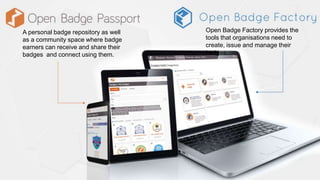
Open Badge Factory provides the
tools that organisations need to
create, issue and manage their
badges.
A personal badge repository as well
as a community space where badge
earners can receive and share their
badges and connect using them.
Where are we now with
badges?
Open Badge Factory’s statistics
show positive development
• Associations (40%), schools and universities (50%), businesses
(10%)
• Increasing number of customer organisations (100% growth)
• Increasing number of badges created and issued
• Better reception rate of badges (average 48%)
• About 95% of customers renew their OBF subscription
• Successful user stories
• Emerging small badge ecosystems
Open Badges is still an emerging
concept with a small impact on the
way we recognise learning today.
Why?
Some obvious reasons
• OB is a disruptive concept and a transformation tool challenging
and questioning the way we recognise learning.
• Trust is still a challenging question in contexts where recognition
of learning is the monopole of official bodies. (What is the
credibility of badges?)
• Developing meaningful badge ecosystems requires collaboration
and it can be challenging. (At least it take time)
• Organisation and creator centric approach and development.
• Badge earners are often placed in a role of passive recipients.
• Do badges we create and issue meet the expectation or at least
needs of the badge earners?
How to get the Open Badges concept to
fly?
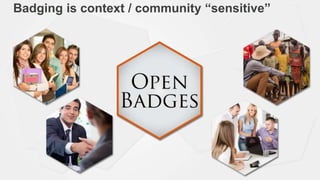
Badging is context / community “sensitive”
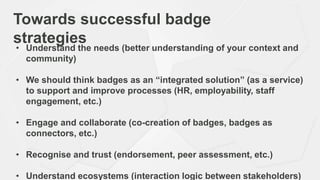
Towards successful badge
strategies
• Understand the needs (better understanding of your context and
community)
• We should think badges as an “integrated solution” (as a service)
to support and improve processes (HR, employability, staff
engagement, etc.)
• Engage and collaborate (co-creation of badges, badges as
connectors, etc.)
• Recognise and trust (endorsement, peer assessment, etc.)
• Understand ecosystems (interaction logic between stakeholders)
Thank
You
eric.rousselle@discendum.com
+358 400 587 373
openbadgefactory.com

Reflection on the future of Open Badges

  • 1.
    Eric Rousselle Chief InnovationOfficer Discendum Reflections on the future of Open Badges
  • 2.
    Open Badge Factoryprovides the tools that organisations need to create, issue and manage their badges. A personal badge repository as well as a community space where badge earners can receive and share their badges and connect using them.
  • 3.
    Where are wenow with badges?
  • 4.
    Open Badge Factory’sstatistics show positive development • Associations (40%), schools and universities (50%), businesses (10%) • Increasing number of customer organisations (100% growth) • Increasing number of badges created and issued • Better reception rate of badges (average 48%) • About 95% of customers renew their OBF subscription • Successful user stories • Emerging small badge ecosystems
  • 5.
    Open Badges isstill an emerging concept with a small impact on the way we recognise learning today. Why?
  • 6.
    Some obvious reasons •OB is a disruptive concept and a transformation tool challenging and questioning the way we recognise learning. • Trust is still a challenging question in contexts where recognition of learning is the monopole of official bodies. (What is the credibility of badges?) • Developing meaningful badge ecosystems requires collaboration and it can be challenging. (At least it take time) • Organisation and creator centric approach and development. • Badge earners are often placed in a role of passive recipients. • Do badges we create and issue meet the expectation or at least needs of the badge earners?
  • 7.
    How to getthe Open Badges concept to fly?
  • 8.
    Badging is context/ community “sensitive”
  • 9.
    Towards successful badge strategies •Understand the needs (better understanding of your context and community) • We should think badges as an “integrated solution” (as a service) to support and improve processes (HR, employability, staff engagement, etc.) • Engage and collaborate (co-creation of badges, badges as connectors, etc.) • Recognise and trust (endorsement, peer assessment, etc.) • Understand ecosystems (interaction logic between stakeholders)
  • 10.