Reflected code and conversion among
reflected code and 8 4 2 1 binary code
Saumya Som
BWU/BCA/17/207
BCA-D(1st Semester)
Teacher- SOUMIK GUHA ROY
Table of
Contents
Binary code
History Of Binary Code
Reflected Code
Reflected To 8 4 2 1 Code Conversion
8 4 2 1 To Reflected Code Conversion
History Of Reflected Code
Binary code
Binary code is the simplest form of computer code or programming
data. It is represented entirely by a binary system of digits consisting
of a string of ‘0’ and ‘1’.
The code is known as 8-4-2-1 code. This is because 8, 4, 2, and 1 are
the weights of the fours bits of the BCD code
1
History Of Binary
Code
167
9
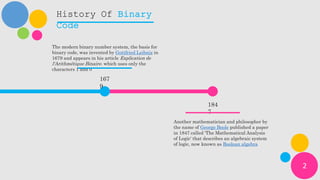
The modern binary number system, the basis for
binary code, was invented by Gottfried Leibniz in
1679 and appears in his article Explication de
l'Arithmétique Binaire. which uses only the
characters 1 and 0
2
184
7
Another mathematician and philosopher by
the name of George Boole published a paper
in 1847 called 'The Mathematical Analysis
of Logic' that describes an algebraic system
of logic, now known as Boolean algebra
Example of Binary Cody In Decimal
System
0
1
4
3
2
5
6
7
8
9
10
11
12
13
14
15
0 0 0 0
0 0 0 1
0 0 1 0
0 0 1 1
0 1 0 0
0 1 0 1
0 1 1 0
0 1 1 1
1 0 0 0
1 0 0 1
1 0 1 0
1 0 1 1
1 1 0 0
1 1 0 1
1 1 1 0
1 1 1 1
Example - (15)10 =
(?)2
Answer - (15)10 =
(1111)2
Rule : Even Number – Put ‘0’
Odd Number – Put ‘1’
3
15731
2 22
1111
Count Left To
Right
Reflected
CodeThis is a variable weighted code and is cyclic. This
means that if it is arranged so that every transition
form one value to the nest value involves only one bit
change . The gray code is sometimes referred to as
reflected binary code, because the first eight values
compare with those of the last 8 values, but in
reverse order
24
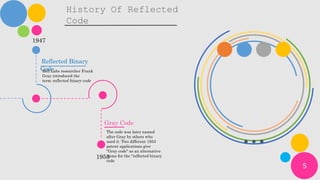
1947
Reflected Binary
CodeBell Labs researcher Frank
Gray introduced the
term reflected binary code
1953
Gray Code
The code was later named
after Gray by others who
used it. Two different 1953
patent applications give
"Gray code" as an alternative
name for the "reflected binary
code
History Of Reflected
Code
5
15
14
13
12
11
10
9
8 1 0 0
1 0 1
1 1 1
1 1 0
0 1 0
0 1 1
0 0 1
0 0 0
7
6
5
4
3
2
1
0 0 0 0
0 0 1
0 1 1
0 1 0
1 1 0
1 1 1
1 0 1
1 0 0
0
0
0
0
0
0
0
0
1
1
1
1
1
1
1
1
6
15
14
13
12
11
10
9
8 0 0 0
0 0 1
0 1 0
0 1 1
1 0 0
1 0 1
1 1 0
1 1 1
7
6
5
4
3
2
1
0 0 0 0
0 0 1
0 1 0
0 1 1
1 0 0
1 0 1
1 1 0
1 1 1
0
0
0
0
0
0
0
0
1
1
1
1
1
1
1
1
Reflected
Code
Binary
code
7
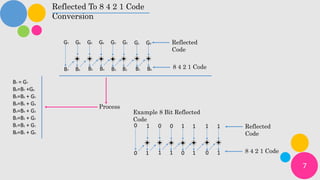
Reflected To 8 4 2 1 Code
Conversion
G7 G6 G4 G0G1G2G5 G3
B7 B1B2B3B4B5B6 B0
B7 = G7
B6=B7 +G6
B5=B6 + G5
B4=B5 + G4
B3=B4 + G3
B2=B3 + G2
B1=B2 + G1
B0=B1 + G0
Example 8 Bit Reflected
Code
Reflected
Code
8 4 2 1 Code
0 1 0 1110 1
0 010111 1
Reflected
Code
8 4 2 1 Code
Process
8
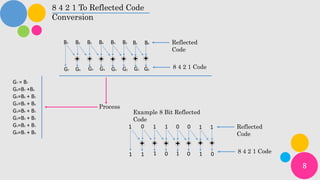
8 4 2 1 To Reflected Code
Conversion
B7 B6 B4 B0B1B2B5 B3
G7 G1G2G3G4G5G6 G0
G7 = B7
G6=B7 +B6
G5=B6 + B5
G4=B5 + B4
G3=B4 + B3
G2=B3 + B2
G1=B2 + B1
G0=B1 + B0
Example 8 Bit Reflected
Code
Reflected
Code
8 4 2 1 Code
Process
1 0 1 1101 0
1 101011 0
Reflected
Code
8 4 2 1 Code
Reflected code and conversion

Reflected code and conversion

  • 1.
    Reflected code andconversion among reflected code and 8 4 2 1 binary code Saumya Som BWU/BCA/17/207 BCA-D(1st Semester) Teacher- SOUMIK GUHA ROY
  • 2.
    Table of Contents Binary code HistoryOf Binary Code Reflected Code Reflected To 8 4 2 1 Code Conversion 8 4 2 1 To Reflected Code Conversion History Of Reflected Code
  • 3.
    Binary code Binary codeis the simplest form of computer code or programming data. It is represented entirely by a binary system of digits consisting of a string of ‘0’ and ‘1’. The code is known as 8-4-2-1 code. This is because 8, 4, 2, and 1 are the weights of the fours bits of the BCD code 1
  • 4.
    History Of Binary Code 167 9 Themodern binary number system, the basis for binary code, was invented by Gottfried Leibniz in 1679 and appears in his article Explication de l'Arithmétique Binaire. which uses only the characters 1 and 0 2 184 7 Another mathematician and philosopher by the name of George Boole published a paper in 1847 called 'The Mathematical Analysis of Logic' that describes an algebraic system of logic, now known as Boolean algebra
  • 5.
    Example of BinaryCody In Decimal System 0 1 4 3 2 5 6 7 8 9 10 11 12 13 14 15 0 0 0 0 0 0 0 1 0 0 1 0 0 0 1 1 0 1 0 0 0 1 0 1 0 1 1 0 0 1 1 1 1 0 0 0 1 0 0 1 1 0 1 0 1 0 1 1 1 1 0 0 1 1 0 1 1 1 1 0 1 1 1 1 Example - (15)10 = (?)2 Answer - (15)10 = (1111)2 Rule : Even Number – Put ‘0’ Odd Number – Put ‘1’ 3 15731 2 22 1111 Count Left To Right
  • 6.
    Reflected CodeThis is avariable weighted code and is cyclic. This means that if it is arranged so that every transition form one value to the nest value involves only one bit change . The gray code is sometimes referred to as reflected binary code, because the first eight values compare with those of the last 8 values, but in reverse order 24
  • 7.
    1947 Reflected Binary CodeBell Labsresearcher Frank Gray introduced the term reflected binary code 1953 Gray Code The code was later named after Gray by others who used it. Two different 1953 patent applications give "Gray code" as an alternative name for the "reflected binary code History Of Reflected Code 5
  • 8.
    15 14 13 12 11 10 9 8 1 00 1 0 1 1 1 1 1 1 0 0 1 0 0 1 1 0 0 1 0 0 0 7 6 5 4 3 2 1 0 0 0 0 0 0 1 0 1 1 0 1 0 1 1 0 1 1 1 1 0 1 1 0 0 0 0 0 0 0 0 0 0 1 1 1 1 1 1 1 1 6 15 14 13 12 11 10 9 8 0 0 0 0 0 1 0 1 0 0 1 1 1 0 0 1 0 1 1 1 0 1 1 1 7 6 5 4 3 2 1 0 0 0 0 0 0 1 0 1 0 0 1 1 1 0 0 1 0 1 1 1 0 1 1 1 0 0 0 0 0 0 0 0 1 1 1 1 1 1 1 1 Reflected Code Binary code
  • 9.
    7 Reflected To 84 2 1 Code Conversion G7 G6 G4 G0G1G2G5 G3 B7 B1B2B3B4B5B6 B0 B7 = G7 B6=B7 +G6 B5=B6 + G5 B4=B5 + G4 B3=B4 + G3 B2=B3 + G2 B1=B2 + G1 B0=B1 + G0 Example 8 Bit Reflected Code Reflected Code 8 4 2 1 Code 0 1 0 1110 1 0 010111 1 Reflected Code 8 4 2 1 Code Process
  • 10.
    8 8 4 21 To Reflected Code Conversion B7 B6 B4 B0B1B2B5 B3 G7 G1G2G3G4G5G6 G0 G7 = B7 G6=B7 +B6 G5=B6 + B5 G4=B5 + B4 G3=B4 + B3 G2=B3 + B2 G1=B2 + B1 G0=B1 + B0 Example 8 Bit Reflected Code Reflected Code 8 4 2 1 Code Process 1 0 1 1101 0 1 101011 0 Reflected Code 8 4 2 1 Code