
Refactoring, 2nd Ed.
A love story
Michael Hunger
Michael Hunger
Open Sourcerer
Neo4j
@mesirii
I know what
you're here for!
Covers By: dev.to/rly
It crashed at 940!
Which Refactoring do you like most?
Extract Method
Delete Unused Code
Ok, you won :)
Questions?!
1. Who has seen the Refactoring book in a shelf?
2. Who has read it?
3. Who thought that it's just common sense?
4. Who refactors code on a daily basis?
5. Who mentors new developers?
“Any fool can write code that a computer can
understand. Good programmers write code that
humans can understand.”
M. Fowler (1999)
My Refactoring Story
Started 18 years ago
Martin Fowler
Foreword by Erich Gamma
Contributions by Kent Beck,
William Opdyke, Don Roberts
28. Juni 1999
"A must-read"
I really liked that book too!
As did others ...
… e.g. authors!
My Student thesis at
TU Dresden
Student thesis at
TU Dresden
""
bit.ly/refactoring-thesis
Refactoring Tools for Java
in 2000!
Fast Forward 18 years
A nice surprise
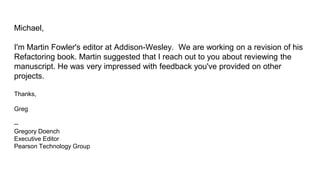
Michael,
I'm Martin Fowler's editor at Addison-Wesley. We are working on a revision of his
Refactoring book. Martin suggested that I reach out to you about reviewing the
manuscript. He was very impressed with feedback you've provided on other
projects.
Thanks,
Greg
--
Gregory Doench
Executive Editor
Pearson Technology Group
Several Weeks and 435 Pages later
28. November 2018
Latest Memo:
Most people will be disappointed
by the second edition
martinfowler.com/articles/refactoring-2nd-ed.html
Like the original, this edition explains what refactoring is; why you should
refactor; how to recognize code that needs refactoring; and how to actually
do it successfully, no matter what language you use.
● Understand the process and general principles of refactoring
● Quickly apply useful refactorings to make a program easier to
comprehend and change
● Recognize “bad smells” in code that signal opportunities to refactor
● Explore the refactorings, each with explanations, motivation, mechanics,
and simple examples
● Build solid tests for your refactorings
● Recognize tradeoffs and obstacles to refactoring
Why a new book?
Refactoring is as important as ever
Educate a new generation!
What changed?
martinfowler.com/articles/refactoring-2nd-changes.html
No one knows anymore
what video rentals are!
Javascript !?!?!
Book Structure (Basically the same)
1. Opening Narrative Example
Theatre Invoicing
2. Principles
3. Code Smells
4. Testing
5. Catalogue
a. most important ones first
b. other refactorings
6. Dropped tangential topics and big refactorings
Refactoring Changes
"Split Temporary Variable" => "Split Variable"
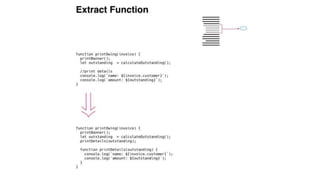
"Extract Method" => "Extract Function"
Add Parameter, Remove Parameter, Rename Method
=> Change Function Declaration
Extract Function
Inline Function
Extract Variable
Inline Variable
Rename Variable
Encapsulate Variable
Highlighted: Most important Refactorings
Migrate Function Declaration
Change Function Declaration
Introduce Parameter Object
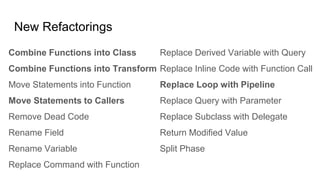
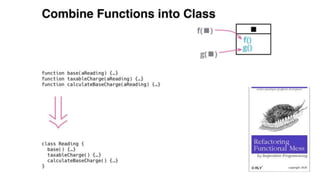
Combine Functions into Class
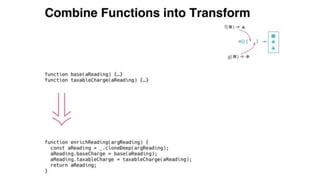
Combine Functions into Transform
New Refactorings
All about Functions and
Pipelines
Combine Functions into Class
Combine Functions into Transform
Move Statements into Function
Move Statements to Callers
Remove Dead Code
Rename Field
Rename Variable
Replace Command with Function
New Refactorings
Replace Derived Variable with Query
Replace Inline Code with Function Call
Replace Loop with Pipeline
Replace Query with Parameter
Replace Subclass with Delegate
Return Modified Value
Split Phase
Web-Book
Available
on Safari
My take on the new book
Back to the Essence
of Refactoring
Student thesis at
TU Dresden
""
Topics
1. What, When, How
2. Benefits
3. Costs / Issues
4. History
5. Catalogue
6. Tools
7. Example
What?
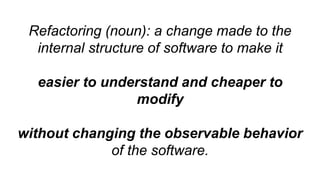
Refactoring (noun): a change made to the
internal structure of software to make it
easier to understand and cheaper to
modify
without changing the observable behavior
of the software.
Refactor (verb): to restructure software
by applying a series of refactorings
without changing the observable
behavior of the software.
When?
Code Smells!
If it stinks, change it
- Grandma Beck
Mysterious Name
Duplicated Code
Long Function
Long Parameter List
Global Data
Mutable Data
Divergent Change
Shotgun Surgery
Feature Envy
Data Clumps
Primitive Obsession
Repeated Switches
Code Smells
Lazy Element
Speculative Generality
Temporary Field
Message Chains
Middle Man
Insider Trading
Large Class
Alternative Classes with Different Interfaces
Data Class
Refused Bequest
Comments
Loops
Adding
features
is hard?
Working
Effectively
with
Legacy
Code
Michael Feathers
Full of
complexity
and bugs
Code as a
Crime Scene
Software Design
X-Rays
Adam Tornhill
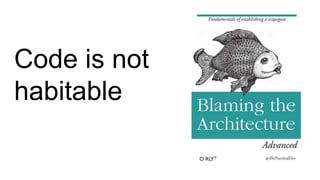
Code is not
habitable
Timeless
Way of
Building
Christopher Alexander
How?
Refactoring is as much about safety
testing, small steps, commit
as it is about code changes.
Refactoring changes the programs in
small steps. If you make a mistake, it is
easy to find the bug.
Two Hats
martinfowler.com/articles/preparatory-refactoring-example.html
Add Function
blog.gdinwiddie.com/2012/12/26/tdd-hat/
1. Red
2. Green
3. Refactor
1. Refactor
2. Green
3. Commit
Refactor
Before you start refactoring, check that
you have a solid suite of tests. These
tests must be self-checking.
Martin Fowler
Tests, are your safety net
Listen to the flight attendent
this one time
Make sure all tests are fully automatic
and that they check their own results.
Martin Fowler
Fast Tests
Test Ordering
R.I.P. JunitMax
Many small commits
Can squash later
Run your tests frequently. Localize tests
whenever you compile - every test at
least every day.
Martin Fowler
A suite of tests is a
powerful bug detector
that decapitates the time
it takes to find bugs.
Martin Fowler
Unit tests are like the second pair of
eyes of a pair programmer.
Kent Beck
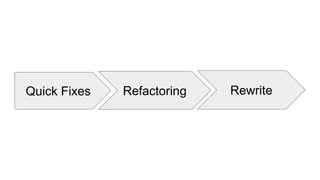
Kinds of Refactoring
Quick Fixes Refactoring Rewrite
Continous Clean-Up
Continous Clean-Up
● Rename
● Replace comment with function
● Make intent clear
● Intention in your IDE
● Not about polishing
DRY
Three strikes and you refactor.
Boy Scout Rule
Leave it better than you found it
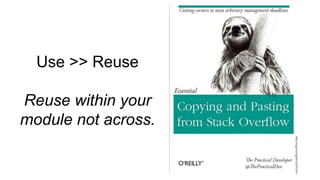
Use >> Reuse
Reuse within your
module not across.
Planned Refactoring
● Before adding a feature
● Addressing technical debt
● Improve testability (seams)
● Improve understandability
● For learning about a
new code-base
Planned Refactoring
(BIG) Refactoring /
Rewrite
Sunken Cost Fallacy
Deliberate Discovery
Dan North
Benefits
Forces you to test
Don’t let the fear that testing can’t catch
all bugs stop you from writing the tests
that will catch most bugs.
Martin Fowler
It is better to write and run incomplete
tests than not to run complete tests.
Martin Fowler
Code Ownership
Modify your code
ownership policies to
smooth refactoring.
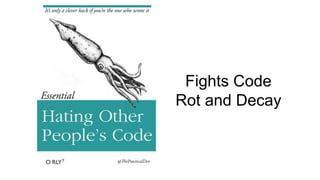
Fights Code
Rot and Decay
Improves
Understanding
Costs
APIs
Don’t publish interfaces prematurely.
Downstream dependencies.
Side Effects
e.g. Performance
How do I tell my
Boss?
Time invested
Refactoring &
Design
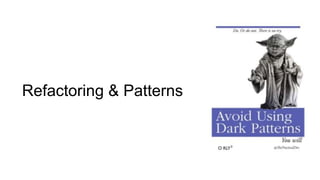
Refactoring & Patterns
● patterns encapsulate good solutions in a context
● represent roles of components
● avoid code-smells
● they can be the goal of a design improvment
● refactorings are steps to those designs
Refactoring
Catalogue
Refactoring Catalogue (my favorites)
Move Function
Split Loop
Replace Loop with Pipeline (Stream)
Replace Magic Literal
Replace Derived Variable with Query
Replace Typecode with Subclass
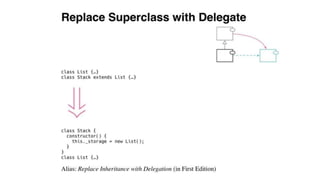
Replace Superclass with Delegate
Replace Control Flag with Break (Return)
Introduce Special Case (Null Object)
Replace Nested Conditionals with Guad
Clauses
Extract Function
Extract Variable
Push Statements into Function
Push members up
Extract Interface / Superclass
Migrate Function Declaration
Combine Functions into Transform
Encapsulate Collection
Replace Temp with Query
Separate Query from Modifier
Parameterize Function
Tools
Tools today make Refactoring a Joy
Smart Understanding of code & intent
Useful suggestions
Intentions & Quick fixes
Use and Learn the Shortcuts
Pragmatic Programmer
Intentions &
Quick Fixes
IntelliJ &
all Jetbrains IDEs
Help
Productivity
Guide
What did you
NOT use yet
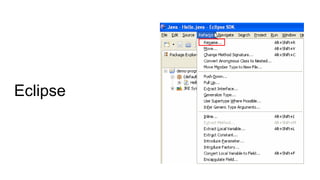
Eclipse
Eclipse
Language
Server
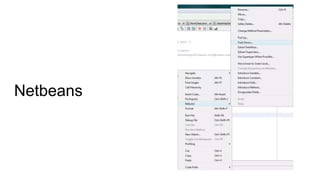
Netbeans
VS Code &
Visual Studio
Resources
dzone.com/refcardz/refactoring-patterns refactoring.guru
martinfowler.com/tags/refactoring.html refactoring.com/catalog
Ask your questions?
Thank you for your time!
Follow @mesirii

Refactoring, 2nd Edition

Editor's Notes

  • #10 This is still true today as it was back then.
  • #12 best non-fiction book loved the style and the boxes
  • #15 It sounds simple and obvious initially but then contains lots of wisdom. And we continually need to teach it.
  • #16 It sounds simple and obvious initially but then contains lots of wisdom. And we continually need to teach it.
  • #34 basically a refresher update examples chance to a more recent language gather feedback from 20 years accomodate for new refactorings, and not only object oriented
  • #36 new motivating example programming language some refactorings were updated / changed / renamed some refactoring were added duplex book https://martinfowler.com/bliki/DuplexBook.html
  • #37 Except in Dresden,Germany
  • #38 Javascript in 2018 is not that bad anymore (EcmaScript 2016) Simpler Function syntax Classes Testing Widely used -> have to cater for all audiences not just backend-java
  • #43 because JavaScript and Java 8
  • #50 as usual it is well written and engaging to read lots of common sense, but important to point it out if refactoring is already an part of your workflow you don't need it but hand it to your new colleagues
  • #58 I love code smells
  • #59 Today you get many of them highlighted by your IDE with intentions Some are obvious some require observation and thinking
  • #71 George Dinwiddie
  • #77 If your tests run in milliseconds or seconds it's a nobrainer to run them
  • #78 If your tests run in milliseconds or seconds it's a nobrainer to run them
  • #79 Much easier to roll back a commit than IntelliJ also has "local history" with safepoints
  • #90 DRY in your code/module Not across it And not at all costs Inline and re-extract is part of refactoring
  • #91 Should be a continous activity
  • #92 DRY in your code/module Not across it And not at all costs Inline and re-extract is part of refactoring
  • #96 Reason to keep it small Be honest Pull the plug (Lidl) There is always a next day, Software is soft
  • #97 depending on the size of the unit if small enough you can throw away, keep the interfaces and redo with lessons learned
  • #107 sometimes, seldomly small changes can have big performance impacts - inlining - polymorphic call sites don't need to freak out just be aware and have performance regression tests (git bisect)
  • #108 do you tell your management? if they are not onboard? -> change jobs? it's not about polishing
  • #124 Find the refactoring (Cmd+P, Shift-Ctrl-A) Remember the shortcut, close the menu use the shortcut