Redefining Valuation Framework
Cost Approach
By
CMA Dr.V.V.L.N. Sastry
Premier Investment Banking……...
Equity Research
House………...
Valuation is the process of determining the economic
worth of an asset or company under certain
assumptions and limiting conditions and subject to
the data available on the valuation date
Ref: International Valuation Standard Council
What is Valuation?
Are CMAs new to Valuation?
The answer is No
Why?
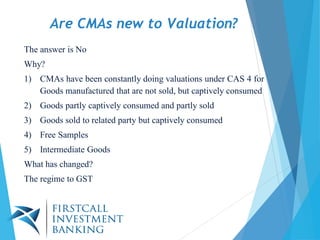
1) CMAs have been constantly doing valuations under CAS 4 for
Goods manufactured that are not sold, but captively consumed
2) Goods partly captively consumed and partly sold
3) Goods sold to related party but captively consumed
4) Free Samples
5) Intermediate Goods
What has changed?
The regime to GST
Are CMAs new to Valuation?
CAS 4 under GST
1. CAS-4 to determine the cost of production or acquisition of goods or cost of
provision of services, consequent to the change over to the GST regime.
2. Para 5.23 of the said draft clearly stipulates that the cost of production /
acquisition / provision shall include cost of inputs received FOC or at
concessional value, net of input tax credit, from the recipient of goods or
services, as well as the amortization cost of FOC tools, patterns, dies, etc.
necessary for the production / acquisition / provision.
3. The format specified for the statement to be prepared for arriving at the cost of
production / acquisition /provision of the taxable goods / supplies also clearly
require the cost of FOC inputs to be included in the cost computations.
Source: ICAI-CMA exposure draft for revision
Where are CMAs in the new regime of
Financial Valuation?
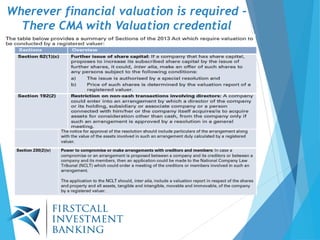
Wherever financial valuation is required –
There CMA with Valuation credential
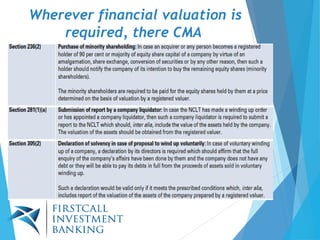
Wherever financial valuation is
required, there CMA
1. What is the core strength of CMAs?
2. Where do we figure in the valuation approaches
with our core strengths?
3. To know that let us first see the approaches!
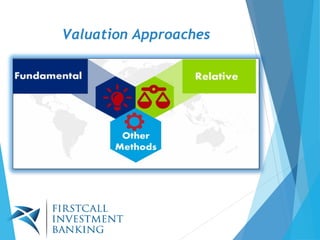
Valuation Approaches
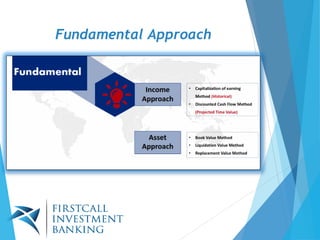
Fundamental Approach
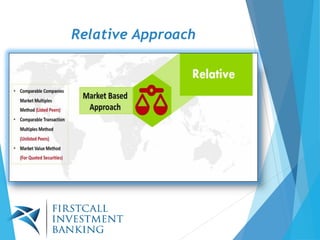
Relative Approach
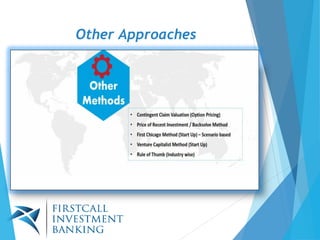
Other Approaches
Having seen the various approaches,
let us admit that we are strong in
Asset Based Approach which is also known as
Cost Approach
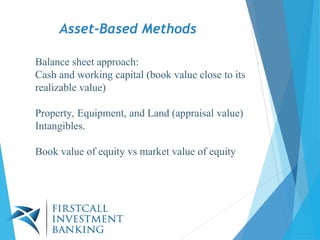
Balance sheet approach:
Cash and working capital (book value close to its
realizable value)
Property, Equipment, and Land (appraisal value)
Intangibles.
Book value of equity vs market value of equity
Asset-Based Methods
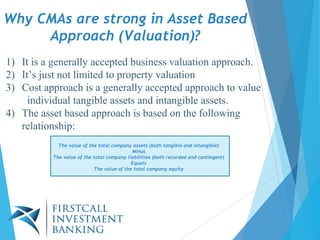
1) It is a generally accepted business valuation approach.
2) It’s just not limited to property valuation
3) Cost approach is a generally accepted approach to value
individual tangible assets and intangible assets.
4) The asset based approach is based on the following
relationship:
The value of the total company assets (both tangible and intangible)
Minus
The value of the total company liabilities (both recorded and contingent)
Equals
The value of the total company equity
Why CMAs are strong in Asset Based
Approach (Valuation)?
If we redefine the valuation framework by
co-relating with cost approach (asset based approach)
we the CMAs will be the leaders in financial valuation.
Let us propagate cost approach (asset based approach),
and let us develop unique standards
And
Let our CMA flag fly high.
CMAs will be the leaders in Valuation
Profession
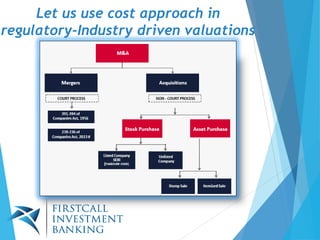
Let us use cost approach in
regulatory-Industry driven valuations
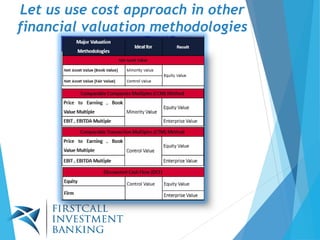
Let us use cost approach in other
financial valuation methodologies
Let us use cost approach in trend
setting start-up valuations
Indian digital retail and e-Commerce companies and their valuations
are being closely linked to the soaring valuation of US tech
start-ups and investors are under the fear of missing out.
The online retail companies were relying on a different metric of
valuations:
"GMV" gross merchandise value which is defined to indicate total
sales value for merchandise sold through a marketplace over a
period.
However, it must be noted that GMV is not reflected on their
financial statements and their actual revenues are just a fraction of
GMV. The GMV or sales (as per financial statement) was then
multiplied by a multiple (x times) to get the Valuation of the entity.
THANK YOU

Redefining Valuation Framework - Cost Approach

  • 1.
    Redefining Valuation Framework CostApproach By CMA Dr.V.V.L.N. Sastry Premier Investment Banking……... Equity Research House………...
  • 4.
    Valuation is theprocess of determining the economic worth of an asset or company under certain assumptions and limiting conditions and subject to the data available on the valuation date Ref: International Valuation Standard Council What is Valuation?
  • 5.
    Are CMAs newto Valuation? The answer is No Why? 1) CMAs have been constantly doing valuations under CAS 4 for Goods manufactured that are not sold, but captively consumed 2) Goods partly captively consumed and partly sold 3) Goods sold to related party but captively consumed 4) Free Samples 5) Intermediate Goods What has changed? The regime to GST
  • 6.
    Are CMAs newto Valuation? CAS 4 under GST 1. CAS-4 to determine the cost of production or acquisition of goods or cost of provision of services, consequent to the change over to the GST regime. 2. Para 5.23 of the said draft clearly stipulates that the cost of production / acquisition / provision shall include cost of inputs received FOC or at concessional value, net of input tax credit, from the recipient of goods or services, as well as the amortization cost of FOC tools, patterns, dies, etc. necessary for the production / acquisition / provision. 3. The format specified for the statement to be prepared for arriving at the cost of production / acquisition /provision of the taxable goods / supplies also clearly require the cost of FOC inputs to be included in the cost computations. Source: ICAI-CMA exposure draft for revision
  • 7.
    Where are CMAsin the new regime of Financial Valuation?
  • 8.
    Wherever financial valuationis required – There CMA with Valuation credential
  • 9.
    Wherever financial valuationis required, there CMA
  • 10.
    1. What isthe core strength of CMAs? 2. Where do we figure in the valuation approaches with our core strengths? 3. To know that let us first see the approaches!
  • 11.
  • 12.
  • 13.
  • 14.
  • 15.
    Having seen thevarious approaches, let us admit that we are strong in Asset Based Approach which is also known as Cost Approach
  • 16.
    Balance sheet approach: Cashand working capital (book value close to its realizable value) Property, Equipment, and Land (appraisal value) Intangibles. Book value of equity vs market value of equity Asset-Based Methods
  • 17.
    1) It isa generally accepted business valuation approach. 2) It’s just not limited to property valuation 3) Cost approach is a generally accepted approach to value individual tangible assets and intangible assets. 4) The asset based approach is based on the following relationship: The value of the total company assets (both tangible and intangible) Minus The value of the total company liabilities (both recorded and contingent) Equals The value of the total company equity Why CMAs are strong in Asset Based Approach (Valuation)?
  • 18.
    If we redefinethe valuation framework by co-relating with cost approach (asset based approach) we the CMAs will be the leaders in financial valuation. Let us propagate cost approach (asset based approach), and let us develop unique standards And Let our CMA flag fly high. CMAs will be the leaders in Valuation Profession
  • 19.
    Let us usecost approach in regulatory-Industry driven valuations
  • 20.
    Let us usecost approach in other financial valuation methodologies
  • 21.
    Let us usecost approach in trend setting start-up valuations Indian digital retail and e-Commerce companies and their valuations are being closely linked to the soaring valuation of US tech start-ups and investors are under the fear of missing out. The online retail companies were relying on a different metric of valuations: "GMV" gross merchandise value which is defined to indicate total sales value for merchandise sold through a marketplace over a period. However, it must be noted that GMV is not reflected on their financial statements and their actual revenues are just a fraction of GMV. The GMV or sales (as per financial statement) was then multiplied by a multiple (x times) to get the Valuation of the entity.
  • 22.