Valuation: Closing ThoughtsAswath Damodaran
Do you have your life vests on?
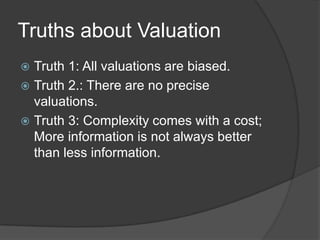
Truths about ValuationTruth 1: All valuations are biased.Truth 2.: There are no precise valuations. Truth 3: Complexity comes with a cost; More information is not always better than less information.
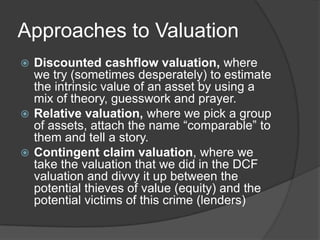
Approaches to ValuationDiscounted cashflow valuation, where we try (sometimes desperately) to estimate the intrinsic value of an asset by using a mix of theory, guesswork and prayer.Relative valuation, where we pick a group of assets, attach the name “comparable” to them and tell a story.Contingent claim valuation, where we take the valuation that we did in the DCF valuation and divvy it up between the potential thieves of value (equity) and the potential victims of this crime (lenders)
Basis for all valuation approachesWe all believe market are inefficient, and that we can find under and over valued assets because of our superior intellect, models, information or some combination of all three.Some Sobering facts:70-80% of portfolio managers under perform market indices.The Vanguard 500 Index fund is poised to overtake the Fidelity Magellan fund as the largest mutual fund in the United States. In the last 5 years, it has been the best performing large mutual fund in the United States.The more people trade, the more they seem to lose.A study of mutual fund portfolios discovered that they would have made a higher return, if they had frozen their portfolios on January 1. A study of individual investors by Terrence O”Dean also noted a negative correlation between returns earned and transactions volume (and this is before trading costs)
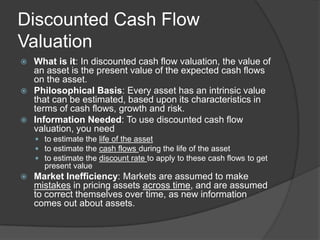
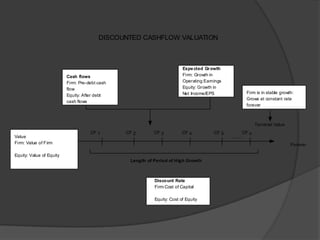
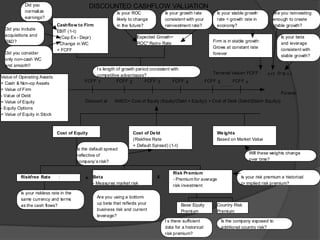
Discounted Cash Flow ValuationWhat is it: In discounted cash flow valuation, the value of an asset is the present value of the expected cash flows on the asset.Philosophical Basis: Every asset has an intrinsic value that can be estimated, based upon its characteristics in terms of cash flows, growth and risk.Information Needed: To use discounted cash flow valuation, you needto estimate the life of the assetto estimate the cash flows during the life of the assetto estimate the discount rate to apply to these cash flows to get present valueMarket Inefficiency: Markets are assumed to make mistakes in pricing assets across time, and are assumed to correct themselves over time, as new information comes out about assets.
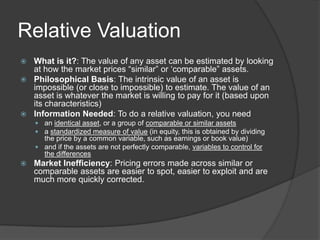
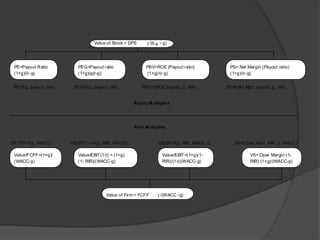
Relative ValuationWhat is it?: The value of any asset can be estimated by looking at how the market prices “similar” or ‘comparable” assets.Philosophical Basis: The intrinsic value of an asset is impossible (or close to impossible) to estimate. The value of an asset is whatever the market is willing to pay for it (based upon its characteristics)Information Needed: To do a relative valuation, you need an identical asset, or a group of comparable or similar assetsa standardized measure of value (in equity, this is obtained by dividing the price by a common variable, such as earnings or book value)and if the assets are not perfectly comparable, variables to control for the differencesMarket Inefficiency: Pricing errors made across similar or comparable assets are easier to spot, easier to exploit and are much more quickly corrected.
The Four Steps to Understanding MultiplesDefine the multipleIn use, the same multiple can be defined in different ways by different users. When comparing and using multiples, estimated by someone else, it is critical that we understand how the multiples have been estimatedDescribe the multipleToo many people who use a multiple have no idea what its cross sectional distribution is. If you do not know what the cross sectional distribution of a multiple is, it is difficult to look at a number and pass judgment on whether it is too high or low.Analyze the multipleIt is critical that we understand the fundamentals that drive each multiple, and the nature of the relationship between the multiple and each variable.Apply the multipleDefining the comparable universe and controlling for differences is far more difficult in practice than it is in theory.
Estimating a MultipleUse comparable firms, compute the average multiple and adjust subjectively for differencesUse comparable firms, run a regression of multiple against fundamentals and estimate predicted multiple for firmUse market, run a regression of multiple against fundamentals and estimate a predicted multiple for firm
What approach would work for you?As an investor, given your investment philosophy, time horizon and beliefs about markets (that you will be investing in), which of the the approaches to valuation would you choose?Discounted Cash Flow Valuation
Relative Valuation
Neither. I believe that markets are efficient.Contingent Claim (Option) ValuationOptions have several featuresThey derive their value from an underlying asset, which has valueThe payoff on a call (put) option occurs only if the value of the underlying asset is greater (lesser) than an exercise price that is specified at the time the option is created. If this contingency does not occur, the option is worthless.They have a fixed lifeAny security that shares these features can be valued as an option.
Indirect Examples of OptionsEquity in a deeply troubled firm - a firm with negative earnings and high leverage - can be viewed as an option to liquidate that is held by the stockholders of the firm.  Viewed as such, it is a call option on the assets of the firm.The reserves owned by natural resource firms can be viewed as call options on the underlying resource, since the firm can decide whether and how much of the resource to extract from the reserve,The patent owned by a firm or an exclusive license issued to a firm can be viewed as an option on the underlying product (project). The firm owns this option for the duration of the patent.
Value EnhancementFor an action to create value, it has toIncrease cash flows from assets in placeIncrease the expected growth rateIncrease the length of the growth periodReduce the cost of capitalThe value enhancement measures that have been widely promoted as new and different are neither. EVA and CFROI have their roots in traditional discounted cash flow modelsMeasures (like EVA and CFROI) do not create value; managers do.
Some Not Very Profound AdviceIts all in the fundamentalsFocus on the big picture; don’t let the details trip you up.Keep your perspective; it is only a valuation.

Chp 18 Val Closing

  • 1.
  • 2.
    Do you haveyour life vests on?
  • 3.
    Truths about ValuationTruth1: All valuations are biased.Truth 2.: There are no precise valuations. Truth 3: Complexity comes with a cost; More information is not always better than less information.
  • 4.
    Approaches to ValuationDiscountedcashflow valuation, where we try (sometimes desperately) to estimate the intrinsic value of an asset by using a mix of theory, guesswork and prayer.Relative valuation, where we pick a group of assets, attach the name “comparable” to them and tell a story.Contingent claim valuation, where we take the valuation that we did in the DCF valuation and divvy it up between the potential thieves of value (equity) and the potential victims of this crime (lenders)
  • 5.
    Basis for allvaluation approachesWe all believe market are inefficient, and that we can find under and over valued assets because of our superior intellect, models, information or some combination of all three.Some Sobering facts:70-80% of portfolio managers under perform market indices.The Vanguard 500 Index fund is poised to overtake the Fidelity Magellan fund as the largest mutual fund in the United States. In the last 5 years, it has been the best performing large mutual fund in the United States.The more people trade, the more they seem to lose.A study of mutual fund portfolios discovered that they would have made a higher return, if they had frozen their portfolios on January 1. A study of individual investors by Terrence O”Dean also noted a negative correlation between returns earned and transactions volume (and this is before trading costs)
  • 6.
    Discounted Cash FlowValuationWhat is it: In discounted cash flow valuation, the value of an asset is the present value of the expected cash flows on the asset.Philosophical Basis: Every asset has an intrinsic value that can be estimated, based upon its characteristics in terms of cash flows, growth and risk.Information Needed: To use discounted cash flow valuation, you needto estimate the life of the assetto estimate the cash flows during the life of the assetto estimate the discount rate to apply to these cash flows to get present valueMarket Inefficiency: Markets are assumed to make mistakes in pricing assets across time, and are assumed to correct themselves over time, as new information comes out about assets.
  • 9.
    Relative ValuationWhat isit?: The value of any asset can be estimated by looking at how the market prices “similar” or ‘comparable” assets.Philosophical Basis: The intrinsic value of an asset is impossible (or close to impossible) to estimate. The value of an asset is whatever the market is willing to pay for it (based upon its characteristics)Information Needed: To do a relative valuation, you need an identical asset, or a group of comparable or similar assetsa standardized measure of value (in equity, this is obtained by dividing the price by a common variable, such as earnings or book value)and if the assets are not perfectly comparable, variables to control for the differencesMarket Inefficiency: Pricing errors made across similar or comparable assets are easier to spot, easier to exploit and are much more quickly corrected.
  • 10.
    The Four Stepsto Understanding MultiplesDefine the multipleIn use, the same multiple can be defined in different ways by different users. When comparing and using multiples, estimated by someone else, it is critical that we understand how the multiples have been estimatedDescribe the multipleToo many people who use a multiple have no idea what its cross sectional distribution is. If you do not know what the cross sectional distribution of a multiple is, it is difficult to look at a number and pass judgment on whether it is too high or low.Analyze the multipleIt is critical that we understand the fundamentals that drive each multiple, and the nature of the relationship between the multiple and each variable.Apply the multipleDefining the comparable universe and controlling for differences is far more difficult in practice than it is in theory.
  • 12.
    Estimating a MultipleUsecomparable firms, compute the average multiple and adjust subjectively for differencesUse comparable firms, run a regression of multiple against fundamentals and estimate predicted multiple for firmUse market, run a regression of multiple against fundamentals and estimate a predicted multiple for firm
  • 13.
    What approach wouldwork for you?As an investor, given your investment philosophy, time horizon and beliefs about markets (that you will be investing in), which of the the approaches to valuation would you choose?Discounted Cash Flow Valuation
  • 14.
  • 15.
    Neither. I believethat markets are efficient.Contingent Claim (Option) ValuationOptions have several featuresThey derive their value from an underlying asset, which has valueThe payoff on a call (put) option occurs only if the value of the underlying asset is greater (lesser) than an exercise price that is specified at the time the option is created. If this contingency does not occur, the option is worthless.They have a fixed lifeAny security that shares these features can be valued as an option.
  • 16.
    Indirect Examples ofOptionsEquity in a deeply troubled firm - a firm with negative earnings and high leverage - can be viewed as an option to liquidate that is held by the stockholders of the firm. Viewed as such, it is a call option on the assets of the firm.The reserves owned by natural resource firms can be viewed as call options on the underlying resource, since the firm can decide whether and how much of the resource to extract from the reserve,The patent owned by a firm or an exclusive license issued to a firm can be viewed as an option on the underlying product (project). The firm owns this option for the duration of the patent.
  • 17.
    Value EnhancementFor anaction to create value, it has toIncrease cash flows from assets in placeIncrease the expected growth rateIncrease the length of the growth periodReduce the cost of capitalThe value enhancement measures that have been widely promoted as new and different are neither. EVA and CFROI have their roots in traditional discounted cash flow modelsMeasures (like EVA and CFROI) do not create value; managers do.
  • 18.
    Some Not VeryProfound AdviceIts all in the fundamentalsFocus on the big picture; don’t let the details trip you up.Keep your perspective; it is only a valuation.