Ask the Experts
Hybrid Multicloud Pitfalls
Roel Hodzelmans
Moderator
@RoelHodzelmans
Eric D. Schabell
Portfolio Architect Director
@ericschabell
What’s Multicloud
Multicloud is literally using multiple clouds from multiple
providers for multiple tasks. Typically, multicloud refers to
the use of several different public clouds with the goal of
achieving greater flexibility, lowering costs, avoiding
vendor lock-in, or using specific regional cloud providers.
One of the challenges of multicloud is achieving
consistent policies, compliance, and management.
Multicloud is more of a strategy.
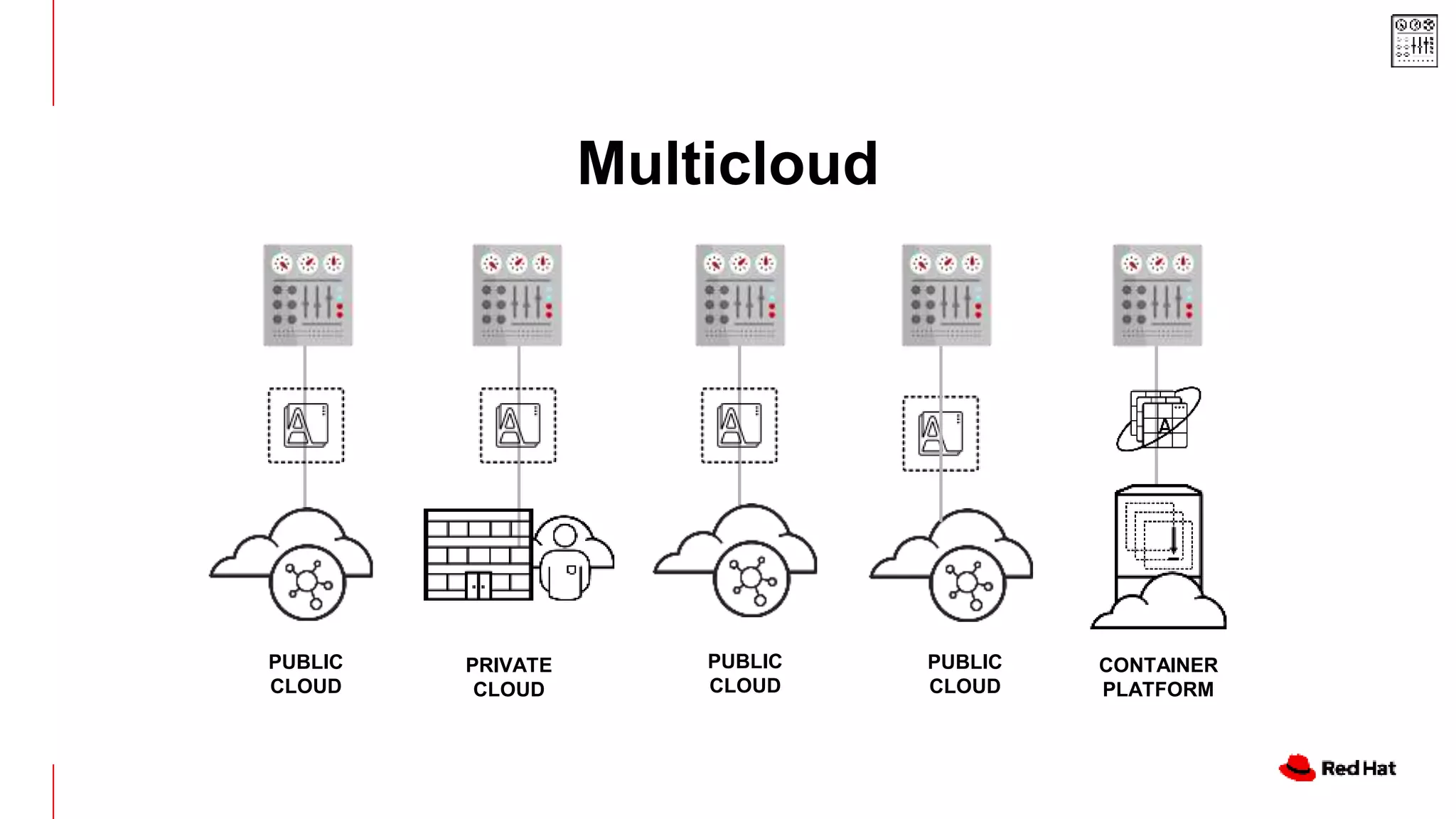
Multicloud
PUBLIC
CLOUD
CONTAINER
PLATFORM
PRIVATE
CLOUD
PUBLIC
CLOUD
PUBLIC
CLOUD
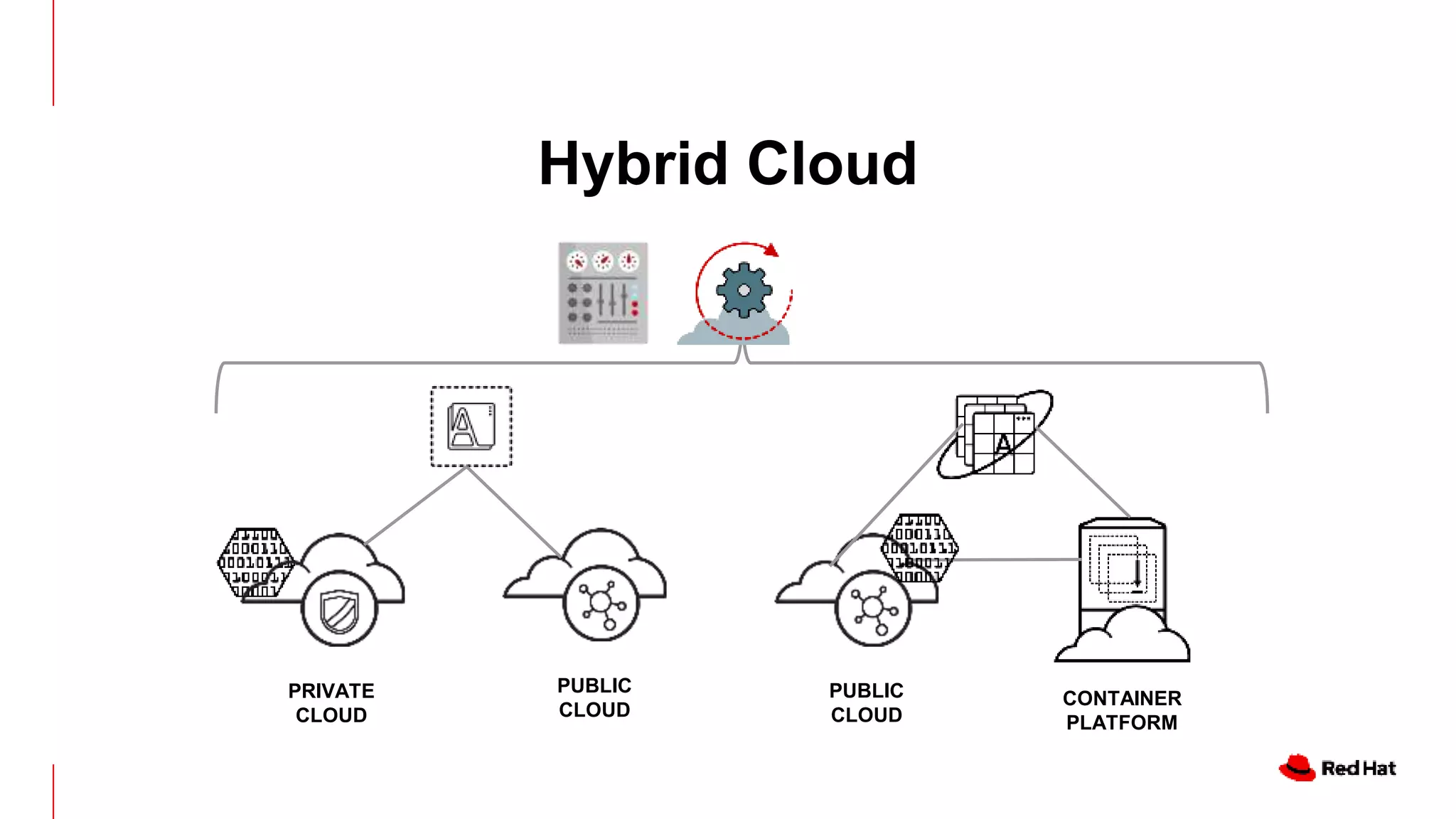
Hybrid cloud is a combination of one or more public and private clouds
with at least a degree of workload portability, integration, orchestration,
and unified management.
The key here is that there is an element of interoperability, migration
potential, and a connection between tasks running in public clouds and
on-premise infrastructure, even if it’s not always “seamless” or otherwise
fully implemented.
(Otherwise, it’s just a bunch of clouds)
Hybrid Cloud
PUBLIC
CLOUD
CONTAINER
PLATFORM
PRIVATE
CLOUD
PUBLIC
CLOUD
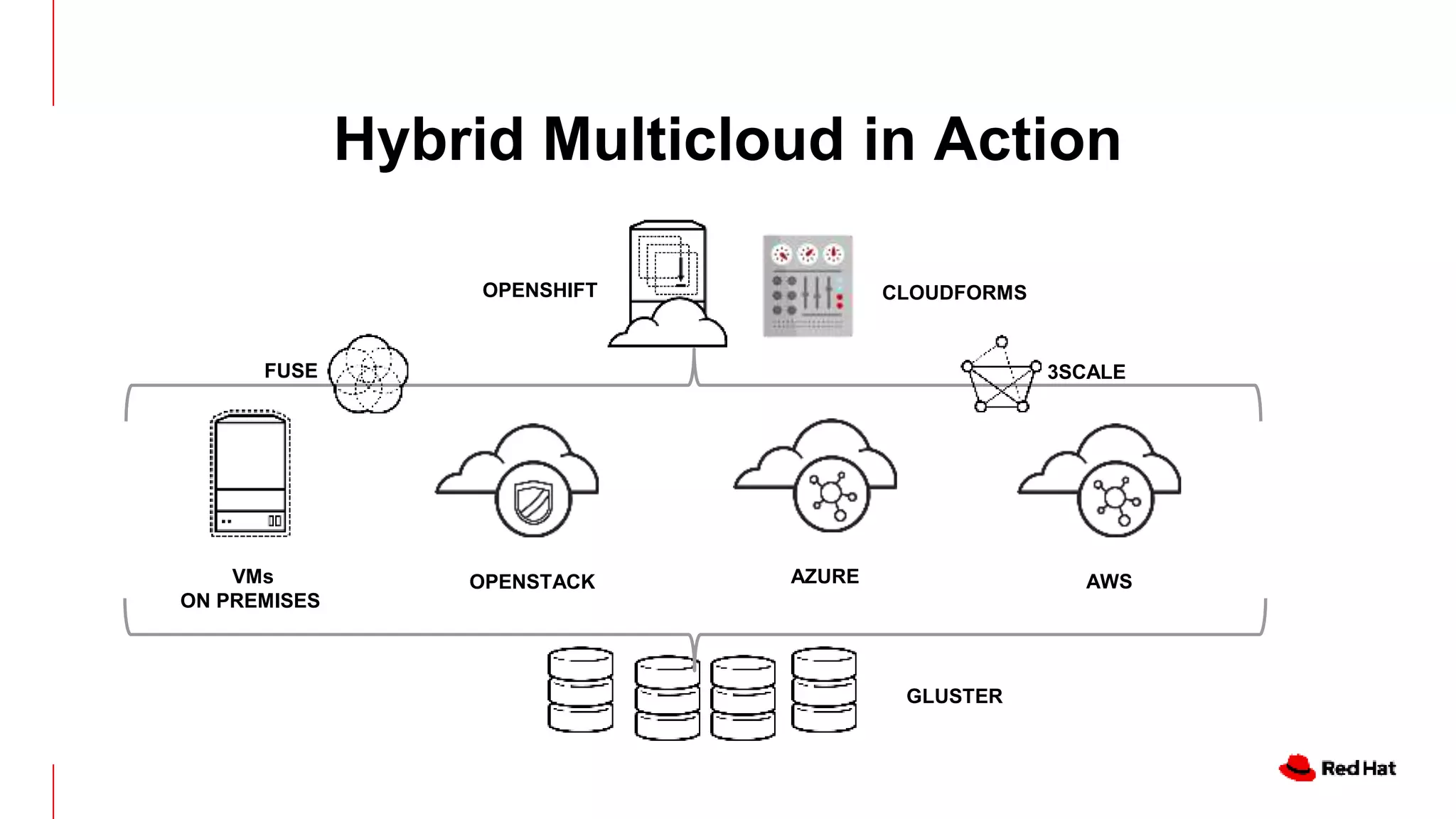
Hybrid Multicloud in Action
AWSOPENSTACK AZURE
OPENSHIFT CLOUDFORMS
VMs
ON PREMISES
GLUSTER
FUSE 3SCALE
Question #1
Is cost a factor in your company’s
journey to the Cloud?
Question #2
Will your organization move everything
to the cloud?
Question #3
Does your organization have a
baseline of your application
landscape?
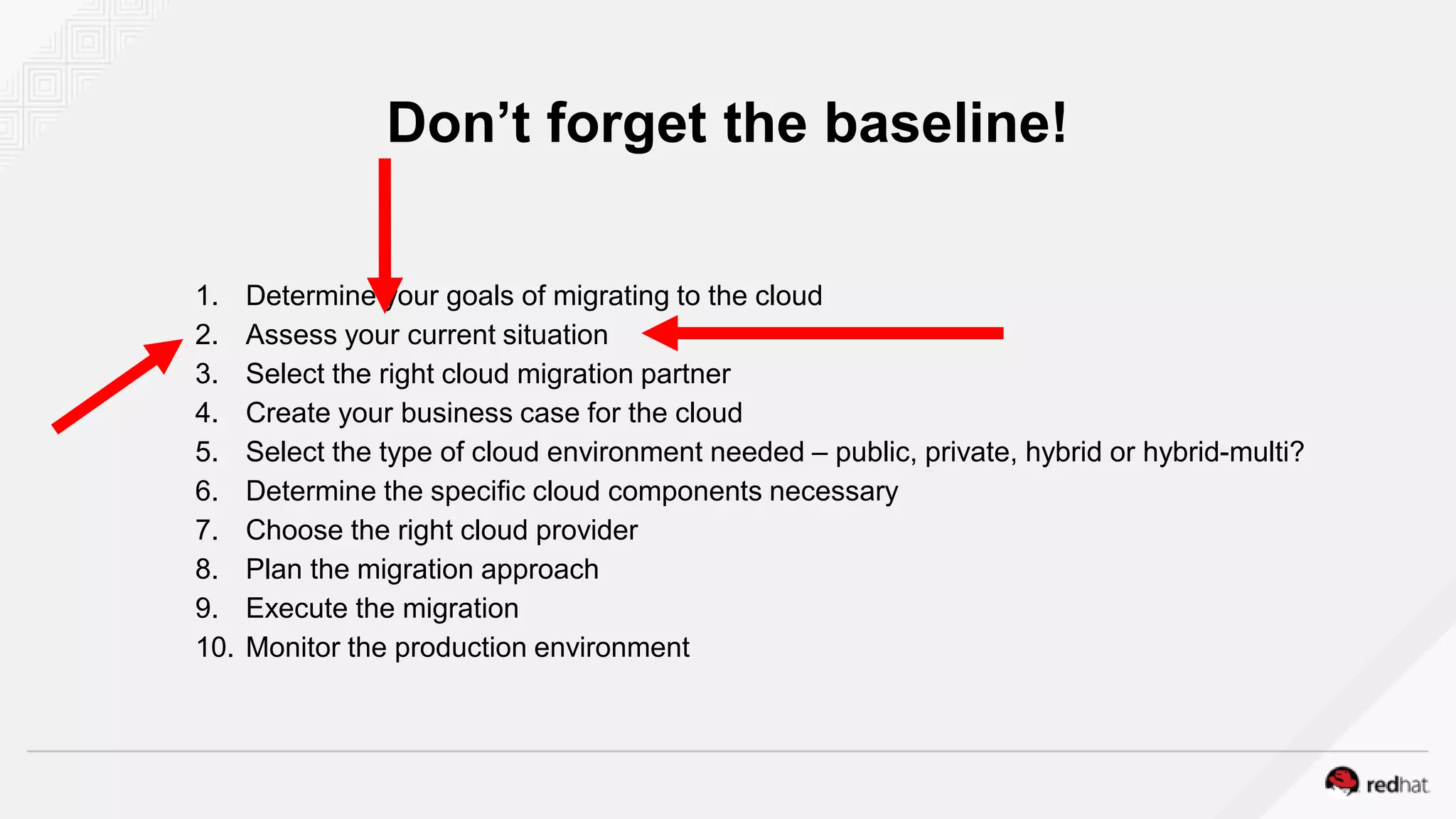
1. Determine your goals of migrating to the cloud
2. Assess your current situation
3. Select the right cloud migration partner
4. Create your business case for the cloud
5. Select the type of cloud environment needed – public, private, hybrid or hybrid-multi?
6. Determine the specific cloud components necessary
7. Choose the right cloud provider
8. Plan the migration approach
9. Execute the migration
10. Monitor the production environment
Don’t forget the baseline!
Question #4
Does your company have a exit-
strategy for the cloud?
Question #5
Does your company know their
bandwidth and storage needs?
References
● 3 Pitfalls Everyone Should Avoid with Hybrid Mulitcloud (full session video)
● Series on 3 Pitfalls Everyone Should Avoid with Hybrid Multicloud:
○ Part 1
○ Part 2
○ Part 3
○ Part 4
● Multicloud Portability (e-book)
Red Hat Summit 2020 -  Ask the experts: Hybrid multicloud pitfalls

Red Hat Summit 2020 - Ask the experts: Hybrid multicloud pitfalls

  • 1.
    Ask the Experts HybridMulticloud Pitfalls Roel Hodzelmans Moderator @RoelHodzelmans Eric D. Schabell Portfolio Architect Director @ericschabell
  • 2.
    What’s Multicloud Multicloud isliterally using multiple clouds from multiple providers for multiple tasks. Typically, multicloud refers to the use of several different public clouds with the goal of achieving greater flexibility, lowering costs, avoiding vendor lock-in, or using specific regional cloud providers. One of the challenges of multicloud is achieving consistent policies, compliance, and management. Multicloud is more of a strategy.
  • 3.
  • 4.
    Hybrid cloud isa combination of one or more public and private clouds with at least a degree of workload portability, integration, orchestration, and unified management. The key here is that there is an element of interoperability, migration potential, and a connection between tasks running in public clouds and on-premise infrastructure, even if it’s not always “seamless” or otherwise fully implemented. (Otherwise, it’s just a bunch of clouds)
  • 5.
  • 6.
    Hybrid Multicloud inAction AWSOPENSTACK AZURE OPENSHIFT CLOUDFORMS VMs ON PREMISES GLUSTER FUSE 3SCALE
  • 7.
    Question #1 Is costa factor in your company’s journey to the Cloud?
  • 8.
    Question #2 Will yourorganization move everything to the cloud?
  • 9.
    Question #3 Does yourorganization have a baseline of your application landscape?
  • 10.
    1. Determine yourgoals of migrating to the cloud 2. Assess your current situation 3. Select the right cloud migration partner 4. Create your business case for the cloud 5. Select the type of cloud environment needed – public, private, hybrid or hybrid-multi? 6. Determine the specific cloud components necessary 7. Choose the right cloud provider 8. Plan the migration approach 9. Execute the migration 10. Monitor the production environment Don’t forget the baseline!
  • 11.
    Question #4 Does yourcompany have a exit- strategy for the cloud?
  • 12.
    Question #5 Does yourcompany know their bandwidth and storage needs?
  • 14.
    References ● 3 PitfallsEveryone Should Avoid with Hybrid Mulitcloud (full session video) ● Series on 3 Pitfalls Everyone Should Avoid with Hybrid Multicloud: ○ Part 1 ○ Part 2 ○ Part 3 ○ Part 4 ● Multicloud Portability (e-book)

Editor's Notes

  • #2 Ask the Experts: Hybrid Multicloud Pitfalls The daily hype is all around you. From cloud, hybrid cloud, to hybrid multicloud, you’re told this is the way to ensure a digital future for your business. These choices you’ve got to make don’t preclude the daily work of enhancing your customer's experience and agile delivery of those applications. Let us take you on a journey, looking closely at what hybrid multicloud means for your business, the decisions being made about delivering applications, and dealing with legacy applications, likely the most important resources to your business. Join us for insights into real customer experiences and discussions around the three top lessons learned as they transitioned into hybrid multicloud environments. Note: The speakers have spent the last 6 years working with customers making their digital journeys a reality and speak first hand about the top lessons learned deploying new and existing applications.
  • #3 That leads into the next level, which is the view of multicloud from Red Hat’s point of view (https://www.redhat.com/en/topics/cloud-computing/what-is-multicloud).
  • #4 An IT environment with multiple cloud environments, managed separately, with applications isolated by environment.
  • #5 That leads into the next level, which is the view of hybrid cloud from Red Hat’s point of view (https://www.redhat.com/en/topics/cloud-computing/what-is-hybrid-cloud). Hybrid cloud is next generation infrastructure and require organizations to rethink current policies, procedures, and operations methodologies. Simple is better: complexity can destroy any hybrid cloud strategy. Do you really need to connect and/or integrate everything? Do you really need full hybrid orchestration? Do you need to support all of your current APIs?
  • #6 At least one public and private cloud (off & on premises) that have a degree of interoperability, application or data portability or common management.
  • #7 A customer implemented a hybrid development platform based on Red Hat OpenShift Container Platform deployed across a multicloud environment with Microsoft Azure and AWS plus on-premises virtualization and private cloud with Gluster Storage, CloudForms, Fuse and 3Scale helping make it all work together.
  • #8 1. Cost: not always the obvious motivator Asking the audience to give their accounts, customers and personal experiences as feedback.
  • #9 2. Technology: Everything in the cloud? Asking the audience to give their accounts, customers and personal experiences as feedback.
  • #10 Asking the audience to give their accounts, customers and personal experiences as feedback.
  • #11 A thorough assessment of your current situation is imperative, as it will lay the foundation for many important decisions you’ll need to make. A deep understanding of what applications you need to migrate to the cloud, your current IT environment, and the present level of resources and costs will help you make informed choices. A Banking customer asked RH for piloting business case public cloud, OCP and OSP. Looking at cost running container vs running VM’s. Without a baseline you can’t scope anything…. Justice Dept running containers on OCP so also have not baseline when asked. All decisions based on this! BTW: That Banking customer now decided that they go full cloud, just leaving the lights on for the traditional DC. Their own team say its a bad idea, but they are going anyway. What are critical apps? What needs clustering? What can run in cloud (certified) and what not? https://www.thorntech.com/2016/07/10-steps-cloud-computing-migration/#execute
  • #12 Asking the audience to give their accounts, customers and personal experiences as feedback.
  • #13 3. Data… Data… Data…. Asking the audience to give their accounts, customers and personal experiences as feedback.
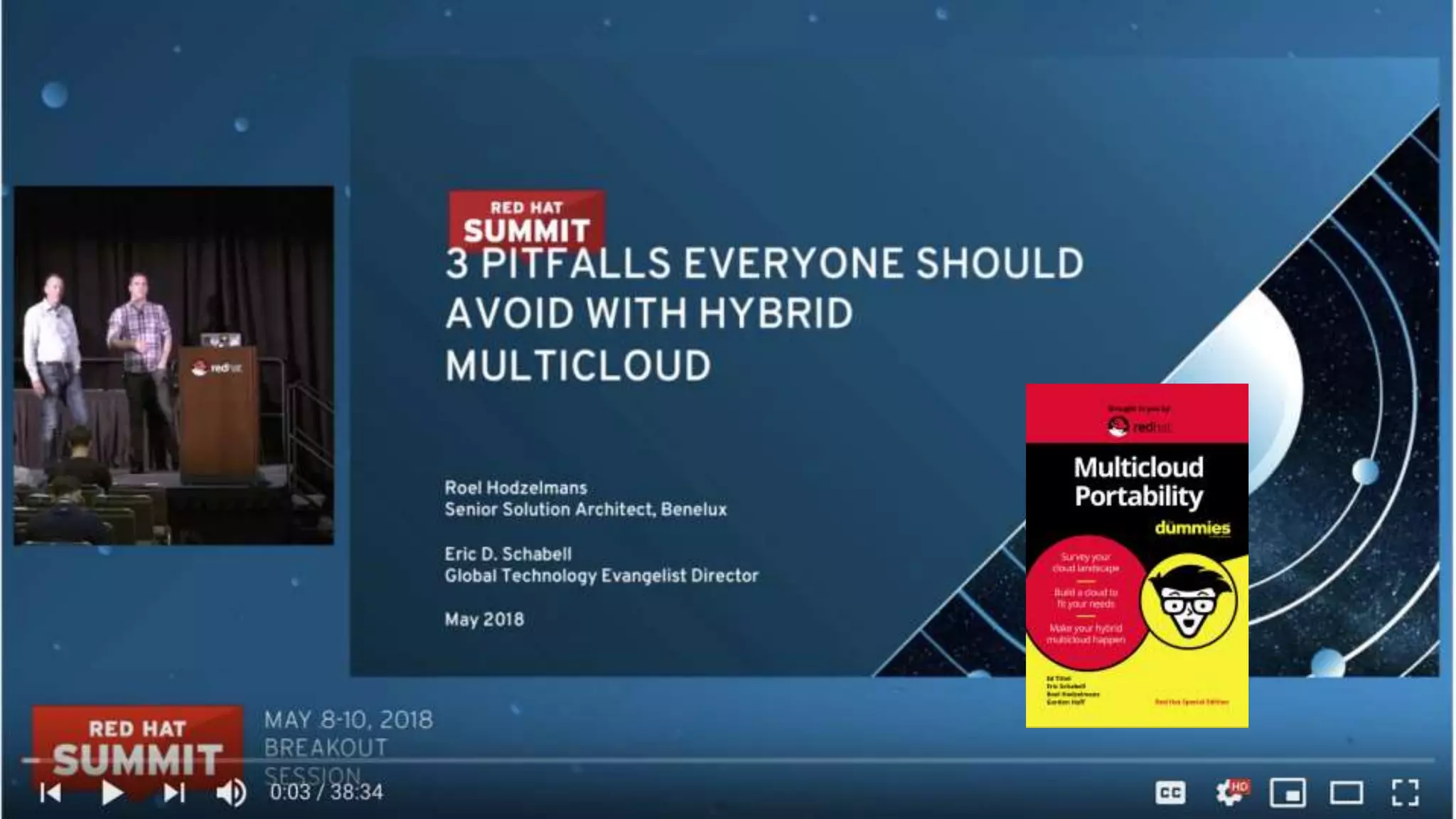
  • #14 The Red Hat Summit 2018 top rated session recording (https://youtu.be/eACHhV_uxTE) available and online free ebook download (https://www.redhat.com/en/engage/multicloud-portability-dummies-s-201903060959?sc_cid=701f20000012pHcAAI).
  • #15 These references provide more details and depth, especially the integration series found on dzone.com, and provide you with background to help you get from concept to reality in your advanced integration journey.
  • #16 Ask the Experts: Hybrid Multicloud Pitfalls The daily hype is all around you. From cloud, hybrid cloud, to hybrid multicloud, you’re told this is the way to ensure a digital future for your business. These choices you’ve got to make don’t preclude the daily work of enhancing your customer's experience and agile delivery of those applications. Let us take you on a journey, looking closely at what hybrid multicloud means for your business, the decisions being made about delivering applications, and dealing with legacy applications, likely the most important resources to your business. Join us for insights into real customer experiences and discussions around the three top lessons learned as they transitioned into hybrid multicloud environments. Note: The speakers have spent the last 6 years working with customers making their digital journeys a reality and speak first hand about the top lessons learned deploying new and existing applications.