

#CONNECT17
The	role	of	integration	in	your	
cloud-native	transformation
Richard	Seroter
Senior	Director	of	Product
Pivotal	(pivotal.io)
@rseroter
@rseroter
I’ve got 3 kids.
It’s hard to be
on-time for
anything.
Optimizing the
wrong step
won’t improve
the flow.
@rseroter
theory of constraints
@rseroter
@rseroter
Software teams
face the same
reality.
@rseroter
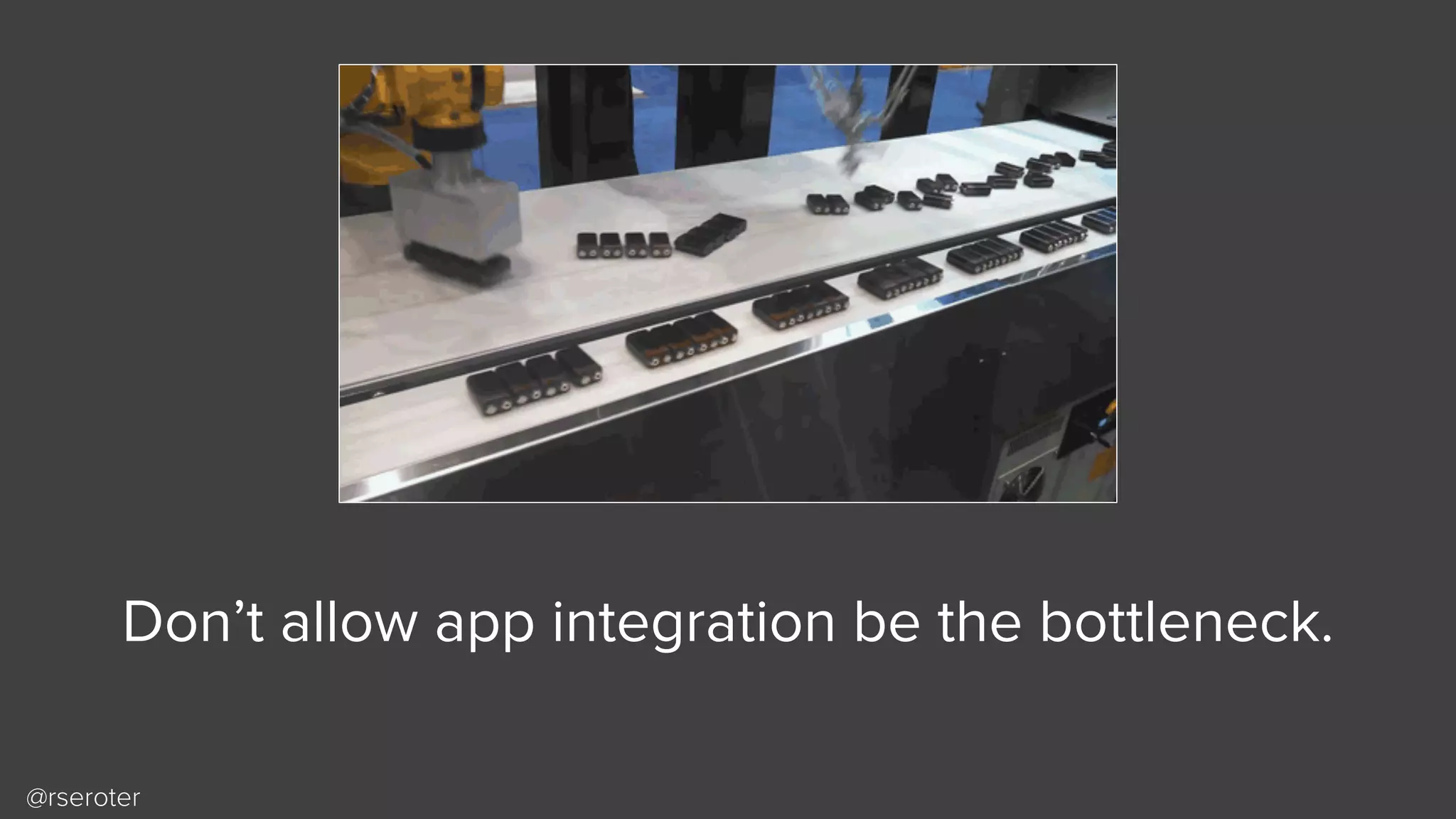
Don’t allow app integration be the bottleneck.
@rseroter
You need a
cloud-native
approach to
integration.
@rseroter
#1 Integration today
#2 What is “cloud-native”?
#3 Delivering cloud-native integration
@rseroter
#1 Integration today
#2 What is “cloud-native”?
#3 Delivering cloud-native integration
@rseroter
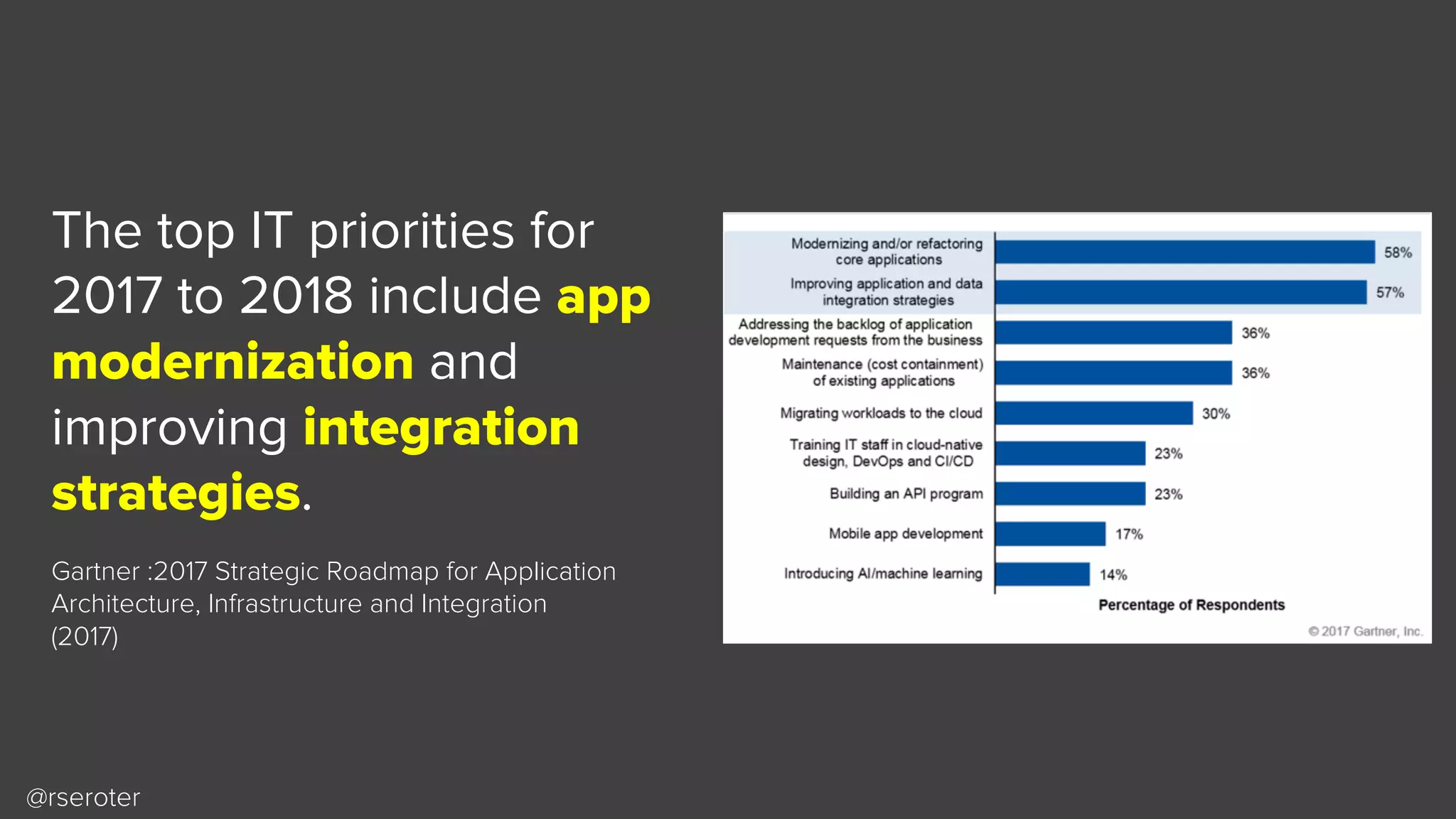
The top IT priorities for
2017 to 2018 include app
modernization and
improving integration
strategies.
Gartner :2017 Strategic Roadmap for Application
Architecture, Infrastructure and Integration
(2017)
@rseroter
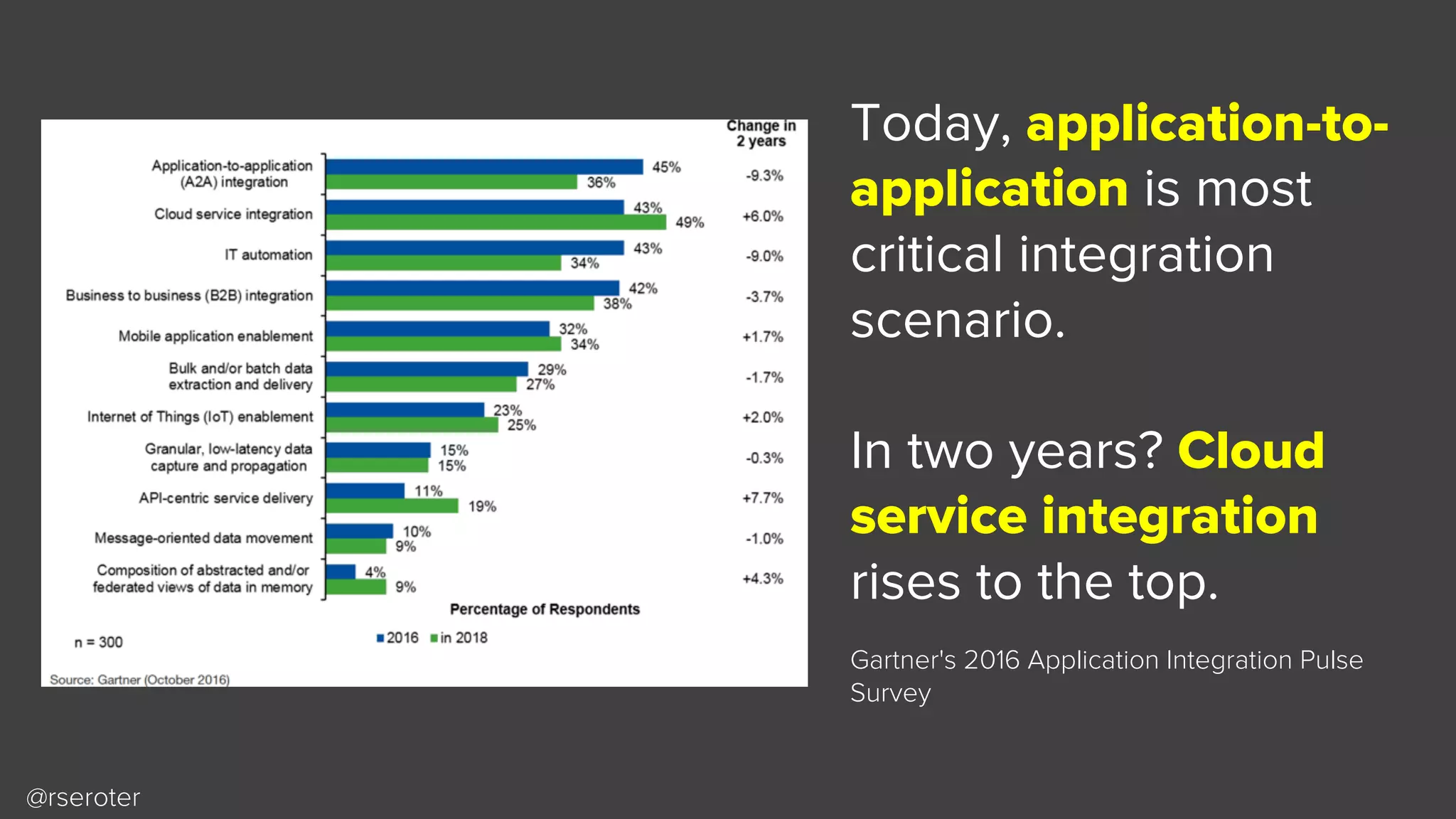
Today, application-to-
application is most
critical integration
scenario.
In two years? Cloud
service integration
rises to the top.
Gartner's 2016 Application Integration Pulse
Survey
@rseroter
Spending on
integration platforms is
accelerating, with
fastest growth in iPaaS
and API management.
Gartner "Forecast Analysis: Enterprise
Application Software, Worldwide, 4Q16
Update,"24 January 2017
@rseroter
“By 2020, more than 75%
of large organizations will
establish a hybrid
integration platform using
integration infrastructure
that they assemble from
multiple vendors.”
Gartner :Use the Integration Maturity Model to Assess
and Improve Your Integration Competency (2016)
@rseroter
“By 2021, at least 50% of
large organizations will
have incorporated citizen
integrator capabilities into
their strategic integration
infrastructure.”
Gartner: Citizen Integrators Bring Application and Data
Integration Into a Common Focus (2017)
@rseroter
#1 Integration today
#2 What is “cloud-native”?
#3 Delivering cloud-native integration
@rseroter
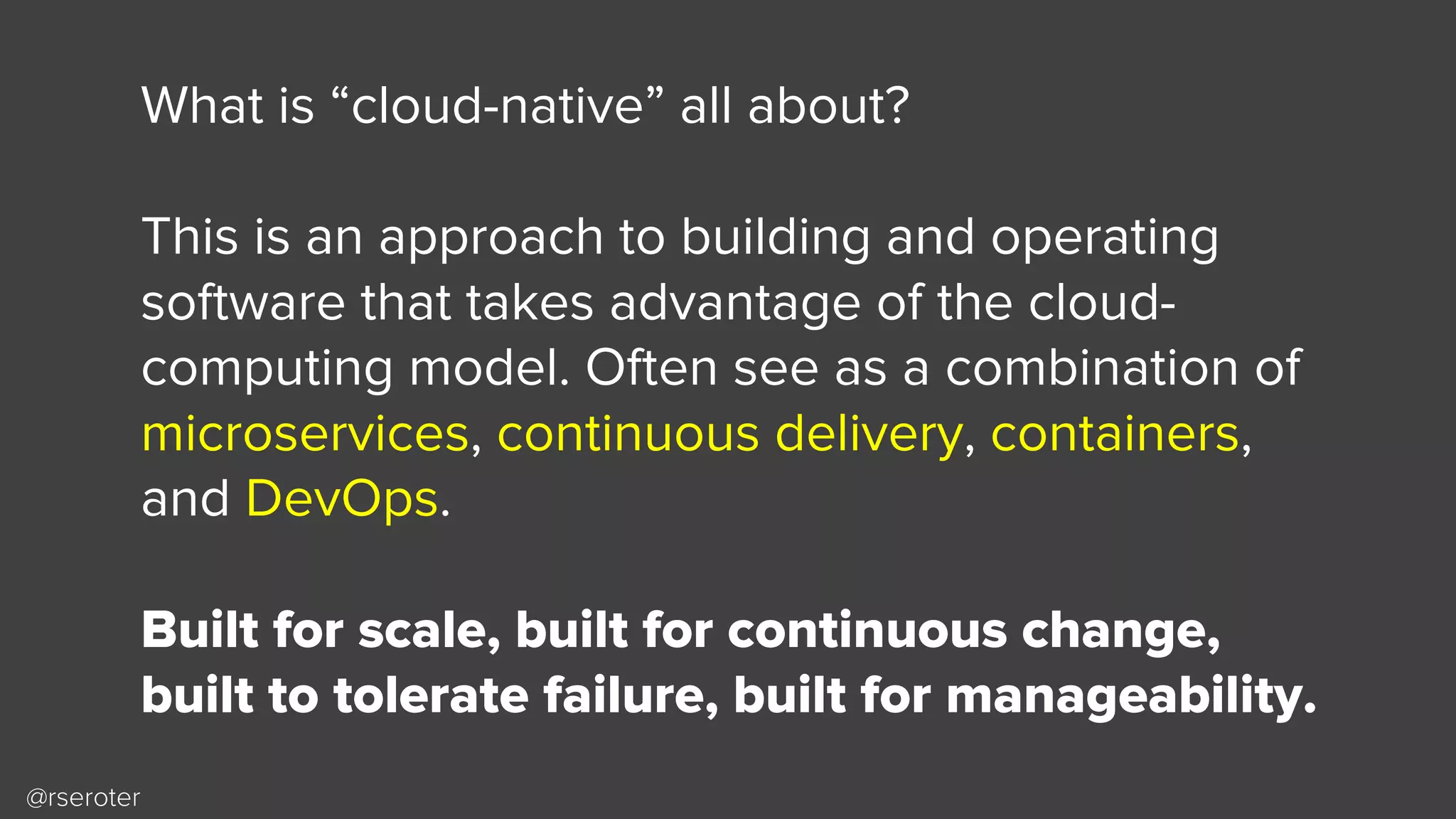
What is “cloud-native” all about?
This is an approach to building and operating
software that takes advantage of the cloud-
computing model. Often see as a combination of
microservices, continuous delivery, containers,
and DevOps.
Built for scale, built for continuous change,
built to tolerate failure, built for manageability.
@rseroter
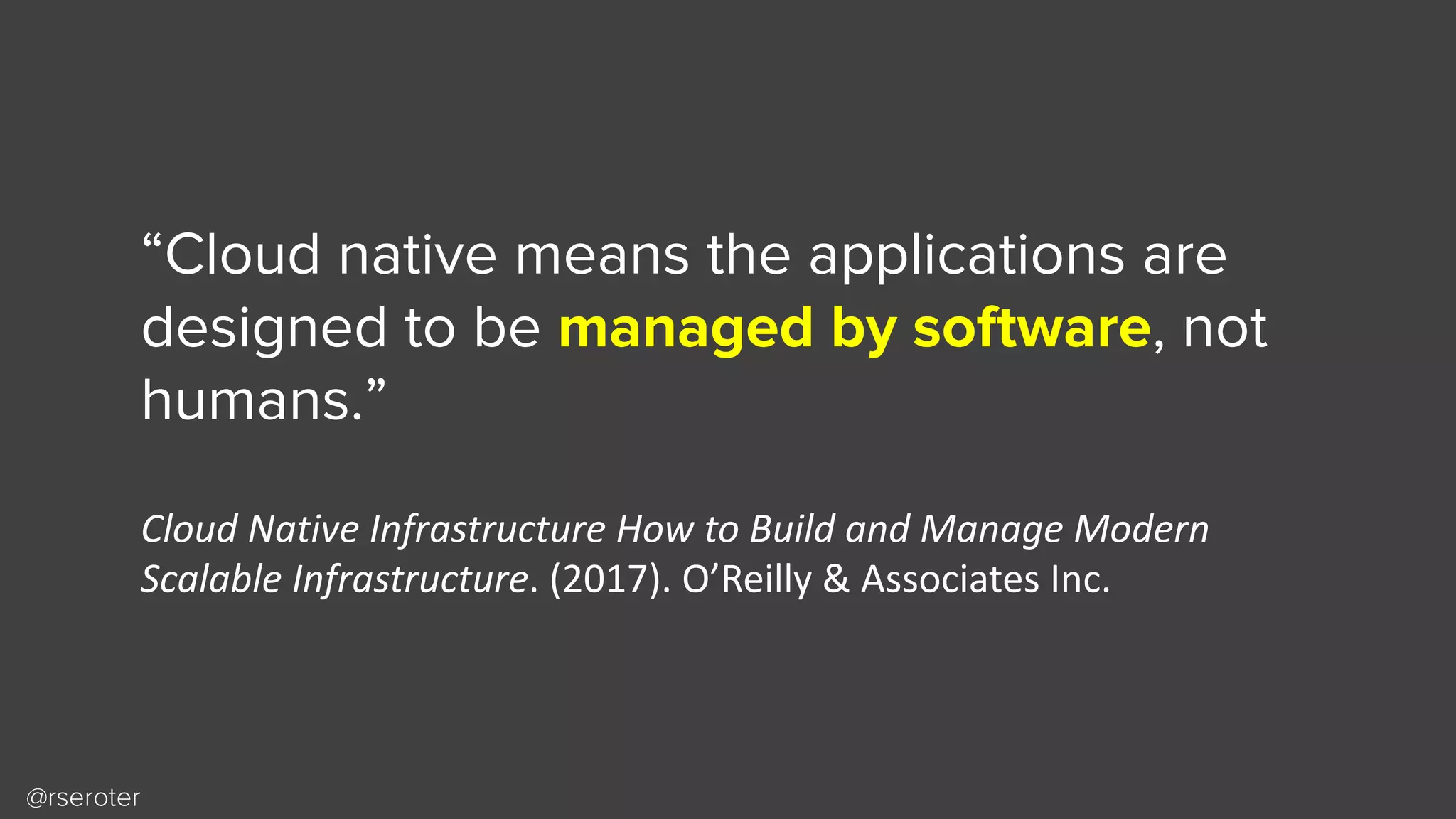
“Cloud native means the applications are
designed to be managed by software, not
humans.”
Cloud	Native	Infrastructure	How	to	Build	and	Manage	Modern	
Scalable	Infrastructure.	(2017).	O’Reilly	&	Associates	Inc.
@rseroter
Traditional Enterprise Cloud-Native
Orgs arranged in silos without common goals Balanced teams with shared objectives
Dissimilar environments; “works on my machine” Consistent setups everywhere
Changes are an exceptions, deployments risky Changes are an asset, deployments boring
Security via perimeter, triaged patches Security everywhere, 3 R’s (repair/repave/rotate)
Try to prevent mistakes; focus on MTBF Embrace resilience engineering; focus on MTTR
Scaling requires careful planning, entire stack Dynamic scaling of individual components
Software planned and delivered in bulk Software delivered in small batches
Single, long-lived technology stacks Diverse, on-demand technologies leveraged
@rseroter
Which one of
those sounds like
your integration
practice?
@rseroter
#1 Integration today
#2 What is “cloud-native”?
#3 Delivering cloud-native integration
@rseroter
Today’s integrations are often built by siloed
teams, managed manually, use centralized
platforms with on-premises focus, and aren’t
designed for elasticity.
@rseroter
MORE BLENDED
App and data scenarios
Value speed and agility
Aligned teams
Exceptions exist
@rseroter
MORE DECENTRALIZED
Logical/physical isolation
Edge, cloud, on-premises
Distinct products
Federated management
@rseroter
MORE COMPOSABLE
Loosely coupled
Choreographed services
Logic in endpoints
Targeted updates
@rseroter
MORE “ALWAYS ON”
Events always arriving
No maintenance windows
Smarter failure handling
Blue-green upgrades
@rseroter
MORE SCALE
Unpredictable usage
Scale each component
Avoid shared capacity
Buffering strategies
@rseroter
MORE SELF SERVICE
Ad hoc integrators
Environments on demand
Unaided deploy/manage
Embed experts in teams
@rseroter
MORE ENDPOINTS
Embrace modern sources
Variable latency demands
Embrace new patterns
Logic Apps for cloud
@rseroter
MORE AUTOMATION
Build, scale AND upgrade
Platform-managed
Changes to Ops approach
Product mindset
@rseroter
Introduce cloud-native integration and start
delivering integration as a service at scale.

The role of integration in your cloud-native transformation (Richard Seroter at CONNECT17)