






RECRUTMENT & SELECTION
PREPARED BY
DIMPLE RAMNANI
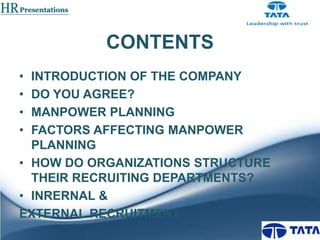
CONTENTS
•
•
•
•

INTRODUCTION OF THE COMPANY
DO YOU AGREE?
MANPOWER PLANNING
FACTORS AFFECTING MANPOWER
PLANNING
• HOW DO ORGANIZATIONS STRUCTURE
THEIR RECRUITING DEPARTMENTS?
• INRERNAL &
EXTERNAL RECRUITMENT
CONTENTS
• STRATEGIC RECRUITING STAGES
• RECRUITING DECISIONS & RECRUITING
METHODS
• SELECTION
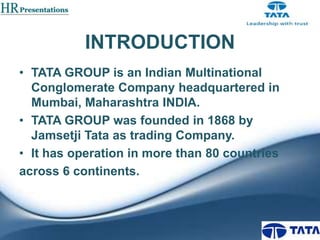
INTRODUCTION
• TATA GROUP is an Indian Multinational
Conglomerate Company headquartered in
Mumbai, Maharashtra INDIA.
• TATA GROUP was founded in 1868 by
Jamsetji Tata as trading Company.
• It has operation in more than 80 countries
across 6 continents.
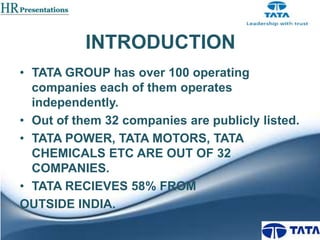
INTRODUCTION
• TATA GROUP has over 100 operating
companies each of them operates
independently.
• Out of them 32 companies are publicly listed.
• TATA POWER, TATA MOTORS, TATA
CHEMICALS ETC ARE OUT OF 32
COMPANIES.
• TATA RECIEVES 58% FROM
OUTSIDE INDIA.
DO YOU AGREE?
• Great companies “first got the right people
on the bus, the wrong people off the bus, and
the right people in the right seats – and then
they figured out where to drive it.”
• Good to Great: Why Some Companies Make
the Leap and Others Don’t – Jim Collins
MANPOWER PLANNING
• Manpower planning is a process by which
an organization ensure that:
– Right Number of people.
– Right Kind of People
– At the Right Time
– At the Right Place
FACTORS AFFECTING
MANPOWER PLANNING
• Sales & Production Forecast
• The effects of technological change on task
needs.
• Variation in efficiency, productivity, Work
study, New Motivation.
• Changes in Employment Practices.(use of
subcontracts or agency staff etc.)
WHAT IS RECRUITMENT
Recruitment is not about filing jobs that are
currently vacant- it is about making a
continuous, long-term investment to build a
high quality workforce capable of
accomplishing the organization’s mission now
and in the future
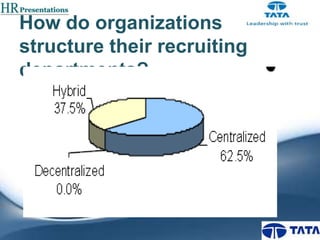
How do organizations
structure their recruiting
departments?
Main Functions of
Recruitment Process

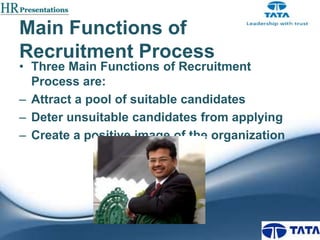
• Three Main Functions of Recruitment
Process are:
– Attract a pool of suitable candidates
– Deter unsuitable candidates from applying
– Create a positive image of the organization
RECRUITMENT TYPES
INTERNAL RECRUITMENT
VS
EXTERNAL RECRUITMENT
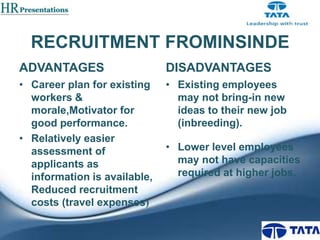
RECRUITMENT FROMINSINDE
ADVANTAGES

DISADVANTAGES

• Career plan for existing
workers &
morale,Motivator for
good performance.
• Relatively easier
assessment of
applicants as
information is available,
Reduced recruitment
costs (travel expenses)

• Existing employees
may not bring-in new
ideas to their new job
(inbreeding).
• Lower level employees
may not have capacities
required at higher jobs.
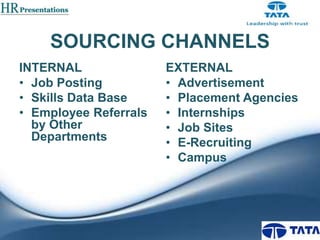
SOURCING CHANNELS
INTERNAL
• Job Posting
• Skills Data Base
• Employee Referrals
by Other
Departments

EXTERNAL
• Advertisement
• Placement Agencies
• Internships
• Job Sites
• E-Recruiting
• Campus
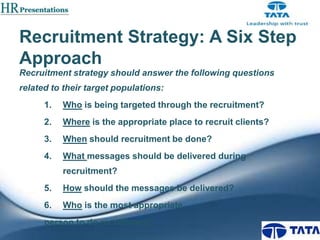
Recruitment Strategy: A Six Step
Approach
Recruitment strategy should answer the following questions
related to their target populations:
1.

Who is being targeted through the recruitment?

2.

Where is the appropriate place to recruit clients?

3.

When should recruitment be done?

4.

What messages should be delivered during
recruitment?

5.

How should the messages be delivered?

6.

Who is the most appropriate

person to do recruitment?
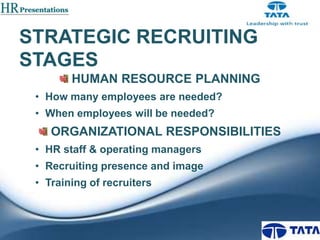
STRATEGIC RECRUITING
STAGES
HUMAN RESOURCE PLANNING
• How many employees are needed?
• When employees will be needed?

ORGANIZATIONAL RESPONSIBILITIES
• HR staff & operating managers
• Recruiting presence and image
• Training of recruiters
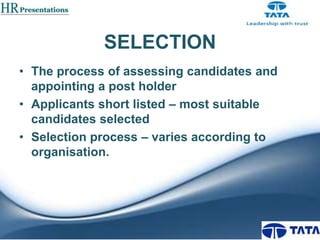
SELECTION
• The process of assessing candidates and
appointing a post holder
• Applicants short listed – most suitable
candidates selected
• Selection process – varies according to
organisation.
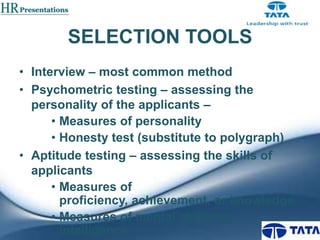
SELECTION TOOLS
• Interview – most common method
• Psychometric testing – assessing the
personality of the applicants –
• Measures of personality
• Honesty test (substitute to polygraph)
• Aptitude testing – assessing the skills of
applicants
• Measures of
proficiency, achievement, or knowledge
• Measures of mental ability or
intelligence
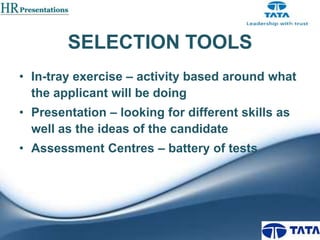
SELECTION TOOLS
• In-tray exercise – activity based around what
the applicant will be doing
• Presentation – looking for different skills as
well as the ideas of the candidate
• Assessment Centres – battery of tests
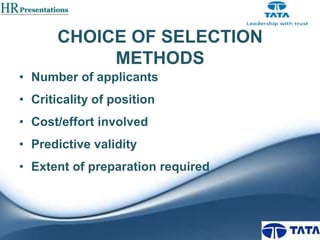
CHOICE OF SELECTION
METHODS
• Number of applicants

• Criticality of position
• Cost/effort involved
• Predictive validity
• Extent of preparation required
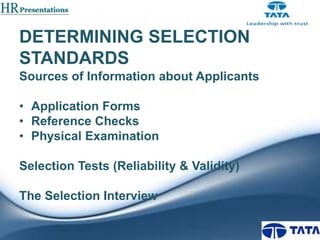
DETERMINING SELECTION
STANDARDS
Sources of Information about Applicants
• Application Forms
• Reference Checks
• Physical Examination
Selection Tests (Reliability & Validity)

The Selection Interview
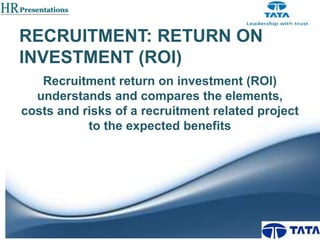
RECRUITMENT: RETURN ON
INVESTMENT (ROI)
Recruitment return on investment (ROI)
understands and compares the elements,
costs and risks of a recruitment related project
to the expected benefits
Recrutment & selection

Recrutment & selection

  • 1.
  • 2.
    CONTENTS • • • • INTRODUCTION OF THECOMPANY DO YOU AGREE? MANPOWER PLANNING FACTORS AFFECTING MANPOWER PLANNING • HOW DO ORGANIZATIONS STRUCTURE THEIR RECRUITING DEPARTMENTS? • INRERNAL & EXTERNAL RECRUITMENT
  • 3.
    CONTENTS • STRATEGIC RECRUITINGSTAGES • RECRUITING DECISIONS & RECRUITING METHODS • SELECTION
  • 4.
    INTRODUCTION • TATA GROUPis an Indian Multinational Conglomerate Company headquartered in Mumbai, Maharashtra INDIA. • TATA GROUP was founded in 1868 by Jamsetji Tata as trading Company. • It has operation in more than 80 countries across 6 continents.
  • 5.
    INTRODUCTION • TATA GROUPhas over 100 operating companies each of them operates independently. • Out of them 32 companies are publicly listed. • TATA POWER, TATA MOTORS, TATA CHEMICALS ETC ARE OUT OF 32 COMPANIES. • TATA RECIEVES 58% FROM OUTSIDE INDIA.
  • 6.
    DO YOU AGREE? •Great companies “first got the right people on the bus, the wrong people off the bus, and the right people in the right seats – and then they figured out where to drive it.” • Good to Great: Why Some Companies Make the Leap and Others Don’t – Jim Collins
  • 7.
    MANPOWER PLANNING • Manpowerplanning is a process by which an organization ensure that: – Right Number of people. – Right Kind of People – At the Right Time – At the Right Place
  • 8.
    FACTORS AFFECTING MANPOWER PLANNING •Sales & Production Forecast • The effects of technological change on task needs. • Variation in efficiency, productivity, Work study, New Motivation. • Changes in Employment Practices.(use of subcontracts or agency staff etc.)
  • 9.
    WHAT IS RECRUITMENT Recruitmentis not about filing jobs that are currently vacant- it is about making a continuous, long-term investment to build a high quality workforce capable of accomplishing the organization’s mission now and in the future
  • 10.
    How do organizations structuretheir recruiting departments?
  • 11.
    Main Functions of RecruitmentProcess • Three Main Functions of Recruitment Process are: – Attract a pool of suitable candidates – Deter unsuitable candidates from applying – Create a positive image of the organization
  • 12.
  • 13.
    RECRUITMENT FROMINSINDE ADVANTAGES DISADVANTAGES • Careerplan for existing workers & morale,Motivator for good performance. • Relatively easier assessment of applicants as information is available, Reduced recruitment costs (travel expenses) • Existing employees may not bring-in new ideas to their new job (inbreeding). • Lower level employees may not have capacities required at higher jobs.
  • 14.
    SOURCING CHANNELS INTERNAL • JobPosting • Skills Data Base • Employee Referrals by Other Departments EXTERNAL • Advertisement • Placement Agencies • Internships • Job Sites • E-Recruiting • Campus
  • 16.
    Recruitment Strategy: ASix Step Approach Recruitment strategy should answer the following questions related to their target populations: 1. Who is being targeted through the recruitment? 2. Where is the appropriate place to recruit clients? 3. When should recruitment be done? 4. What messages should be delivered during recruitment? 5. How should the messages be delivered? 6. Who is the most appropriate person to do recruitment?
  • 17.
    STRATEGIC RECRUITING STAGES HUMAN RESOURCEPLANNING • How many employees are needed? • When employees will be needed? ORGANIZATIONAL RESPONSIBILITIES • HR staff & operating managers • Recruiting presence and image • Training of recruiters
  • 18.
    SELECTION • The processof assessing candidates and appointing a post holder • Applicants short listed – most suitable candidates selected • Selection process – varies according to organisation.
  • 19.
    SELECTION TOOLS • Interview– most common method • Psychometric testing – assessing the personality of the applicants – • Measures of personality • Honesty test (substitute to polygraph) • Aptitude testing – assessing the skills of applicants • Measures of proficiency, achievement, or knowledge • Measures of mental ability or intelligence
  • 20.
    SELECTION TOOLS • In-trayexercise – activity based around what the applicant will be doing • Presentation – looking for different skills as well as the ideas of the candidate • Assessment Centres – battery of tests
  • 21.
    CHOICE OF SELECTION METHODS •Number of applicants • Criticality of position • Cost/effort involved • Predictive validity • Extent of preparation required
  • 22.
    DETERMINING SELECTION STANDARDS Sources ofInformation about Applicants • Application Forms • Reference Checks • Physical Examination Selection Tests (Reliability & Validity) The Selection Interview
  • 23.
    RECRUITMENT: RETURN ON INVESTMENT(ROI) Recruitment return on investment (ROI) understands and compares the elements, costs and risks of a recruitment related project to the expected benefits