
©2011 Hewlett-Packard Development Company, L.P.
The information contained herein is subject to change without
notice
Recovery, Logging and
the Transaction Log
Miroslav Dimitrov
Agenda
• Transaction Log Architecture
• Log Records
• Checkpoints
• Transaction Log operations
• Recovery and Crash Recovery
• Recovery Models and Minimal Logging
Transaction Log Architecture
• Creating and growing the log file
• Log is always zero-initialized
• TF 3004 and 3605
• VLFs, Log blocks and LSNs
• Undocumented DBCC LOGINFO
• DBCC SQLPERF (Logspace)
Log Records
• What are they?
• Where they stayed?
• Are they all part of transactions?
• TVF fn_dblog (startLSN,endLSN) – TF 2537
• Compensation records (rollback) – only roll
forward
Conundrum
If a full backup is being taken, then you have
transaction updated 100 000 records but it is rolled
back why is the diff backup so large? Surely
nothing has changed.
Checkpoints
• Why they exists?
• Thresholds 20 ms and 100 ms?!
• Log records during checkpoint
• Log records are written to disk via three ways:
– When we have commit/rollbacked transaction
– When a data file page is written to disk
– When a log block hits the maximum of 60 kb size and
must be flushed to disk
Checkpoints (cont.)
• Types:
– Automatic
– Indirect (new in SQL 2012)
– Internal
– Manual
• TF 3502 (for which db), 3504 (write latency), 3605
• XE Events - checkpoint_begin and
checkpoint_end
Transaction Log operations
• VLF is either active or inactive
• DBCC OPENTRAN
• VLF is made inactive by log clearing (truncation)
• Circular nature of log
• log_reuse_wait_desc in sys.databases – why log
clearing did not succeed last time it was
attempted
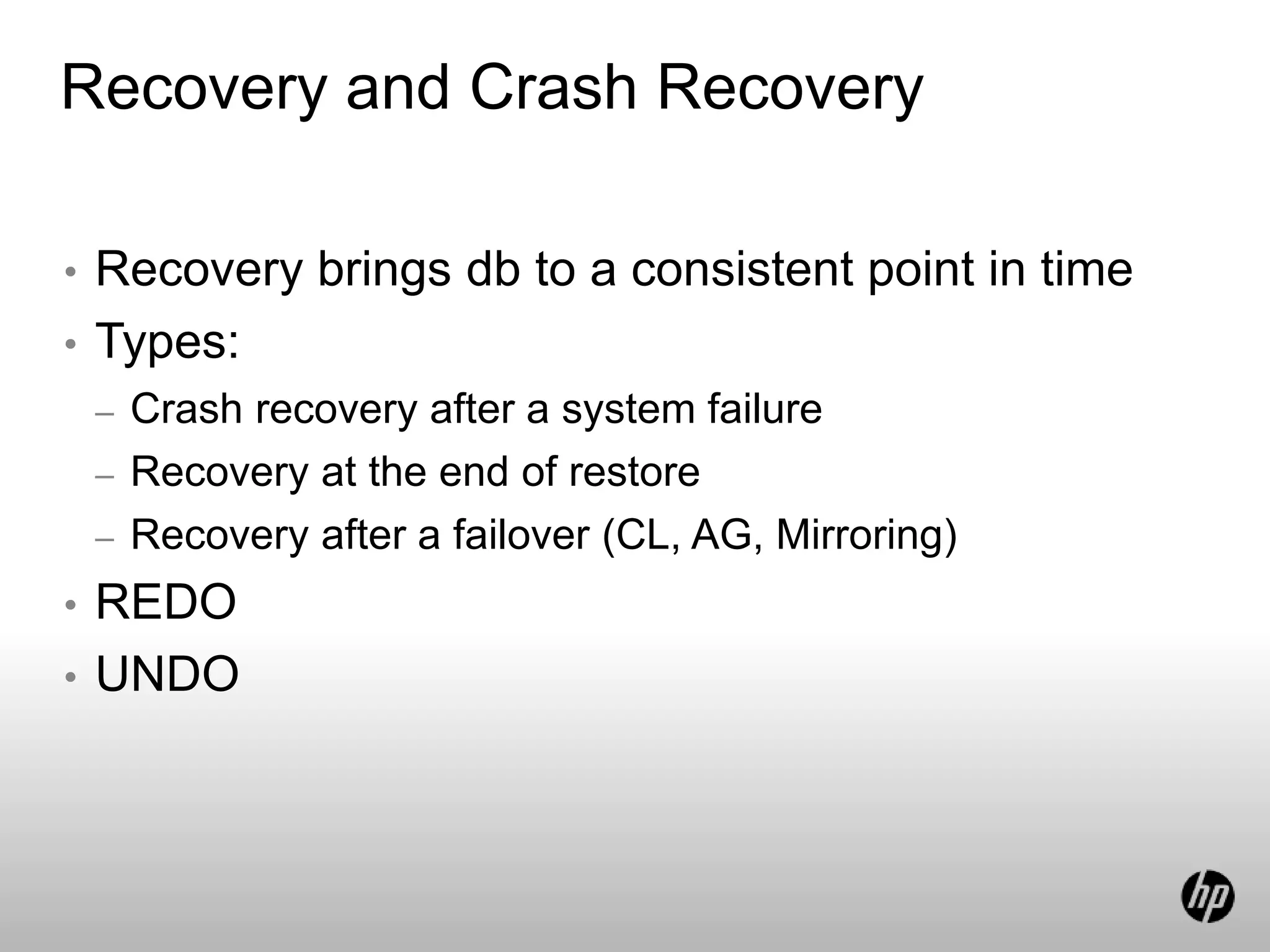
Recovery and Crash Recovery
• Recovery brings db to a consistent point in time
• Types:
– Crash recovery after a system failure
– Recovery at the end of restore
– Recovery after a failover (CL, AG, Mirroring)
• REDO
• UNDO
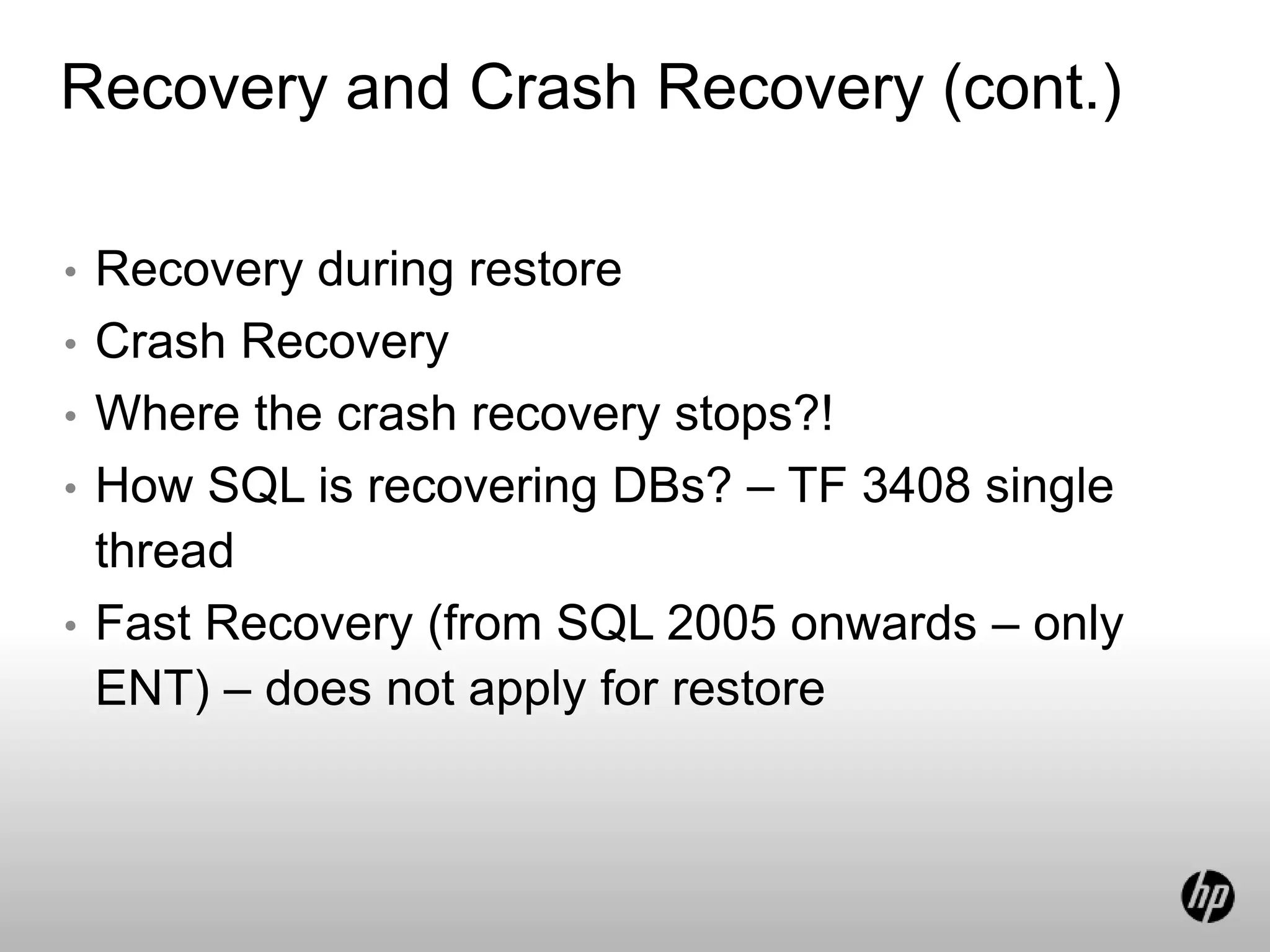
Recovery and Crash Recovery (cont.)
• Recovery during restore
• Crash Recovery
• Where the crash recovery stops?!
• How SQL is recovering DBs? – TF 3408 single
thread
• Fast Recovery (from SQL 2005 onwards – only
ENT) – does not apply for restore
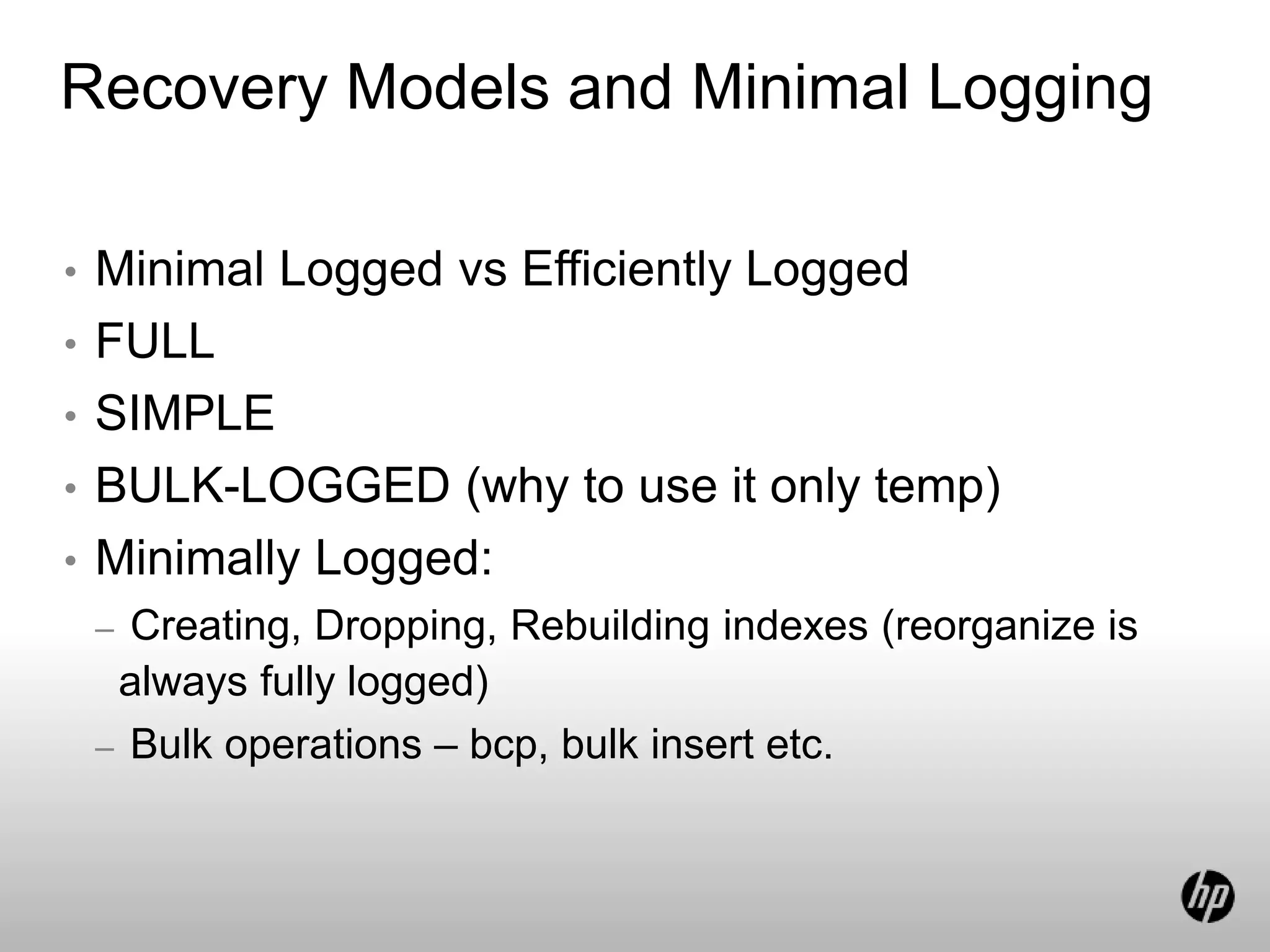
Recovery Models and Minimal Logging
• Minimal Logged vs Efficiently Logged
• FULL
• SIMPLE
• BULK-LOGGED (why to use it only temp)
• Minimally Logged:
– Creating, Dropping, Rebuilding indexes (reorganize is
always fully logged)
– Bulk operations – bcp, bulk insert etc.
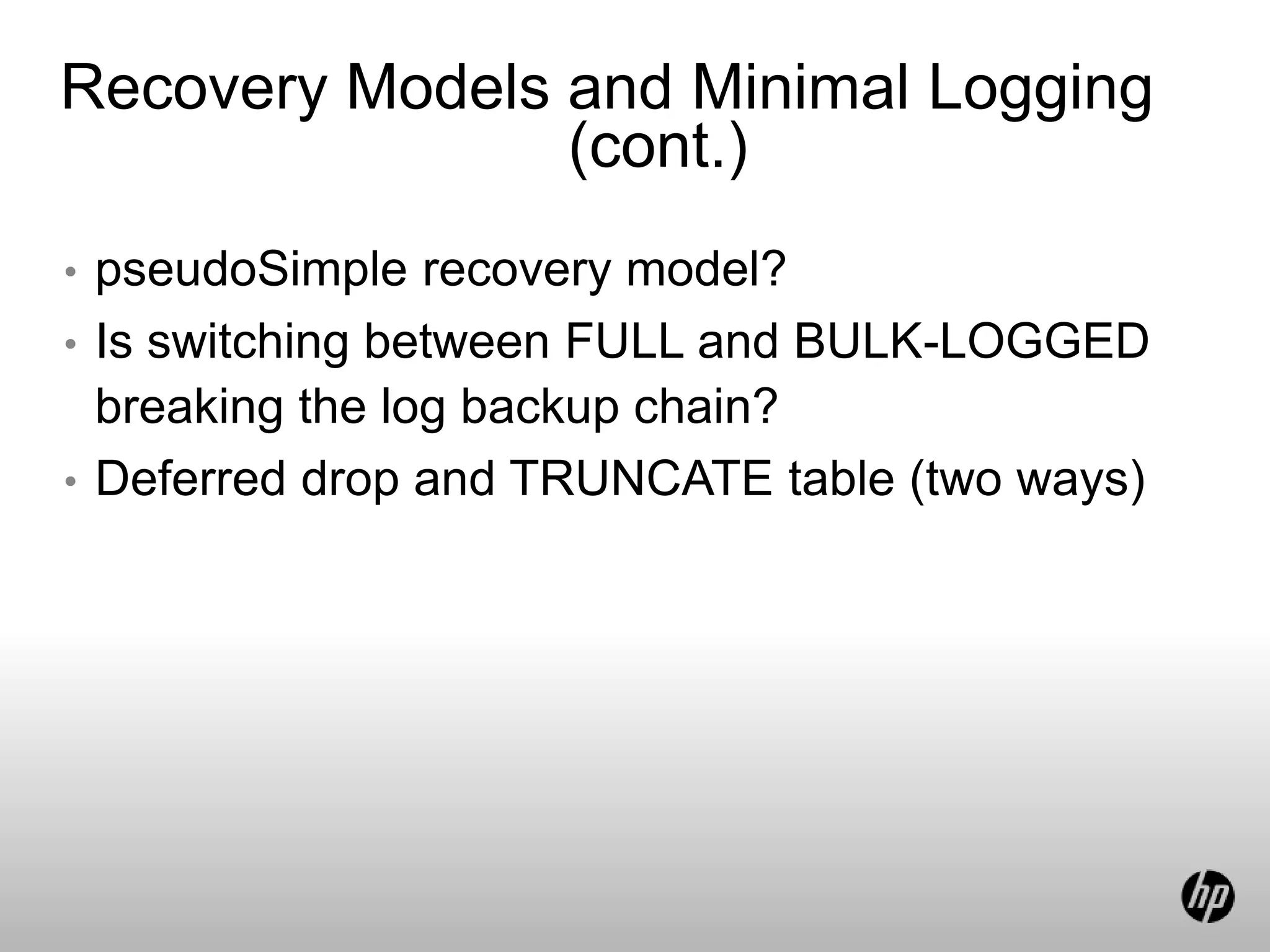
Recovery Models and Minimal Logging
(cont.)
• pseudoSimple recovery model?
• Is switching between FULL and BULK-LOGGED
breaking the log backup chain?
• Deferred drop and TRUNCATE table (two ways)
Questions?
Demo time

Recovery, logging and the transaction log

  • 1.
    ©2011 Hewlett-Packard DevelopmentCompany, L.P. The information contained herein is subject to change without notice Recovery, Logging and the Transaction Log Miroslav Dimitrov
  • 2.
    Agenda • Transaction LogArchitecture • Log Records • Checkpoints • Transaction Log operations • Recovery and Crash Recovery • Recovery Models and Minimal Logging
  • 3.
    Transaction Log Architecture •Creating and growing the log file • Log is always zero-initialized • TF 3004 and 3605 • VLFs, Log blocks and LSNs • Undocumented DBCC LOGINFO • DBCC SQLPERF (Logspace)
  • 4.
    Log Records • Whatare they? • Where they stayed? • Are they all part of transactions? • TVF fn_dblog (startLSN,endLSN) – TF 2537 • Compensation records (rollback) – only roll forward
  • 5.
    Conundrum If a fullbackup is being taken, then you have transaction updated 100 000 records but it is rolled back why is the diff backup so large? Surely nothing has changed.
  • 6.
    Checkpoints • Why theyexists? • Thresholds 20 ms and 100 ms?! • Log records during checkpoint • Log records are written to disk via three ways: – When we have commit/rollbacked transaction – When a data file page is written to disk – When a log block hits the maximum of 60 kb size and must be flushed to disk
  • 7.
    Checkpoints (cont.) • Types: –Automatic – Indirect (new in SQL 2012) – Internal – Manual • TF 3502 (for which db), 3504 (write latency), 3605 • XE Events - checkpoint_begin and checkpoint_end
  • 8.
    Transaction Log operations •VLF is either active or inactive • DBCC OPENTRAN • VLF is made inactive by log clearing (truncation) • Circular nature of log • log_reuse_wait_desc in sys.databases – why log clearing did not succeed last time it was attempted
  • 9.
    Recovery and CrashRecovery • Recovery brings db to a consistent point in time • Types: – Crash recovery after a system failure – Recovery at the end of restore – Recovery after a failover (CL, AG, Mirroring) • REDO • UNDO
  • 10.
    Recovery and CrashRecovery (cont.) • Recovery during restore • Crash Recovery • Where the crash recovery stops?! • How SQL is recovering DBs? – TF 3408 single thread • Fast Recovery (from SQL 2005 onwards – only ENT) – does not apply for restore
  • 11.
    Recovery Models andMinimal Logging • Minimal Logged vs Efficiently Logged • FULL • SIMPLE • BULK-LOGGED (why to use it only temp) • Minimally Logged: – Creating, Dropping, Rebuilding indexes (reorganize is always fully logged) – Bulk operations – bcp, bulk insert etc.
  • 12.
    Recovery Models andMinimal Logging (cont.) • pseudoSimple recovery model? • Is switching between FULL and BULK-LOGGED breaking the log backup chain? • Deferred drop and TRUNCATE table (two ways)
  • 13.
  • 14.