Enrollmytraining
• SQL PLSQL
• Online
• Training
IND: +91-9705981289
USA:+1-9518469856
Mail:info@enrollmytraining.com
Attend free SQL PLSQL online training demo
• INTRODUCTION TO ORACLE 10g and 11g DBA
• • What is DBA ?
• • Why a Company needs a DBA?
• • Roles & Responsibilities of DBA
• • Oracle Architecture
• • Physical and Logical Phase of Database
• • Types of files(Control file, Redolog file and Datafile)
• • Different types of Datafiles
• • Instance
• • SGA(System Global Area) and Background Process
• DATABASE CREATION
• • Different Startup Modes
• • Different Shutdown Modes
• • Types of Database Creation
• • Manual Method of Creation
• TABLESPACE MANAGEMENT
• • Introduction to Table space
• • Types of Table space(BIG & SMALL)
• • Temporary Table space
• • Altering/Renaming a Table space
• • Renaming a data file
• • Temporary Groups
• STORAGE PARAMETERS
• • What are segments?
• • What are extents?
• • What is Blocks?
• • Oracle Blocks
• •
• Estimation of Extents
• • Dictionary Managed Table space
• • Locally Managed Table space
• • Storage Parameters(Initial, Next, Min Extents, Xtents,
Pctincrease)
• USER MANAGEMENT
• • Who are Database Users?
• • Why to create a User?
• • Creation of Users
• • Assigning Privileges
• • Creating and granting Roles
• • Allocating table space Quotas to Users
• • Assigning default table space for the Users
• • Setting Profiles for the Users
• ORACLE 10G /11G DATABASE ADMINSTRATION
• Unfiled Notes Page 1 UNDO MANAGEMENT
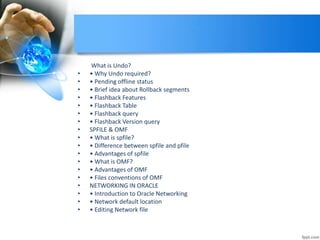
What is Undo?
• • Why Undo required?
• • Pending offline status
• • Brief idea about Rollback segments
• • Flashback Features
• • Flashback Table
• • Flashback query
• • Flashback Version query
• SPFILE & OMF
• • What is spfile?
• • Difference between spfile and pfile
• • Advantages of spfile
• • What is OMF?
• • Advantages of OMF
• • Files conventions of OMF
• NETWORKING IN ORACLE
• • Introduction to Oracle Networking
• • Network default location
• • Editing Network file
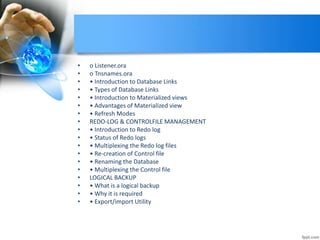
• o Listener.ora
• o Tnsnames.ora
• • Introduction to Database Links
• • Types of Database Links
• • Introduction to Materialized views
• • Advantages of Materialized view
• • Refresh Modes
• REDO-LOG & CONTROLFILE MANAGEMENT
• • Introduction to Redo log
• • Status of Redo logs
• • Multiplexing the Redo log files
• • Re-creation of Control file
• • Renaming the Database
• • Multiplexing the Control file
• LOGICAL BACKUP
• • What is a logical backup
• • Why it is required
• • Export/import Utility
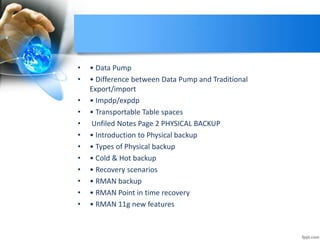
• • Data Pump
• • Difference between Data Pump and Traditional
Export/import
• • Impdp/expdp
• • Transportable Table spaces
• Unfiled Notes Page 2 PHYSICAL BACKUP
• • Introduction to Physical backup
• • Types of Physical backup
• • Cold & Hot backup
• • Recovery scenarios
• • RMAN backup
• • RMAN Point in time recovery
• • RMAN 11g new features
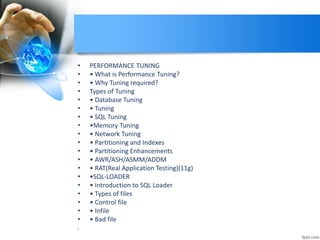
• PERFORMANCE TUNING
• • What is Performance Tuning?
• • Why Tuning required?
• Types of Tuning
• • Database Tuning
• • Tuning
• • SQL Tuning
• •Memory Tuning
• • Network Tuning
• • Partitioning and Indexes
• • Partitioning Enhancements
• • AWR/ASH/ASMM/ADDM
• • RAT(Real Application Testing)(11g)
• •SQL-LOADER
• • Introduction to SQL Loader
• • Types of files
• • Control file
• • Infile
• • Bad file
•
• • Discard file
• • Data file
• AUDITING
• • What is auditing?
• • Why auditing performed?
• • Types of Auditing
• • Levels of Auditing
• FLASHBACK FEATURES
• • Flashback Database
• • Flashback Archive(11g)
• MISCELLANEOUS
• • Oracle 11g Installations
• • Comparison between Oracle 10g and Oracle 11g
• • New features Introduced in Oracle 10g
• Installation of Oracle 10g on RHEL 4
Enrollmytraining
• SQL PLSQL
• Online
• Training
IND: +91-9705981289
USA:+1-9518469856
Mail:info@enrollmytraining.com
Attend free SQL PLSQL online training demo

Sql plsql online training

  • 1.
    Enrollmytraining • SQL PLSQL •Online • Training IND: +91-9705981289 USA:+1-9518469856 Mail:info@enrollmytraining.com Attend free SQL PLSQL online training demo
  • 2.
    • INTRODUCTION TOORACLE 10g and 11g DBA • • What is DBA ? • • Why a Company needs a DBA? • • Roles & Responsibilities of DBA • • Oracle Architecture • • Physical and Logical Phase of Database • • Types of files(Control file, Redolog file and Datafile) • • Different types of Datafiles • • Instance • • SGA(System Global Area) and Background Process • DATABASE CREATION • • Different Startup Modes • • Different Shutdown Modes • • Types of Database Creation
  • 3.
    • • ManualMethod of Creation • TABLESPACE MANAGEMENT • • Introduction to Table space • • Types of Table space(BIG & SMALL) • • Temporary Table space • • Altering/Renaming a Table space • • Renaming a data file • • Temporary Groups • STORAGE PARAMETERS • • What are segments? • • What are extents? • • What is Blocks? • • Oracle Blocks • •
  • 4.
    • Estimation ofExtents • • Dictionary Managed Table space • • Locally Managed Table space • • Storage Parameters(Initial, Next, Min Extents, Xtents, Pctincrease) • USER MANAGEMENT • • Who are Database Users? • • Why to create a User? • • Creation of Users • • Assigning Privileges • • Creating and granting Roles • • Allocating table space Quotas to Users • • Assigning default table space for the Users • • Setting Profiles for the Users • ORACLE 10G /11G DATABASE ADMINSTRATION • Unfiled Notes Page 1 UNDO MANAGEMENT
  • 5.
    What is Undo? •• Why Undo required? • • Pending offline status • • Brief idea about Rollback segments • • Flashback Features • • Flashback Table • • Flashback query • • Flashback Version query • SPFILE & OMF • • What is spfile? • • Difference between spfile and pfile • • Advantages of spfile • • What is OMF? • • Advantages of OMF • • Files conventions of OMF • NETWORKING IN ORACLE • • Introduction to Oracle Networking • • Network default location • • Editing Network file
  • 6.
    • o Listener.ora •o Tnsnames.ora • • Introduction to Database Links • • Types of Database Links • • Introduction to Materialized views • • Advantages of Materialized view • • Refresh Modes • REDO-LOG & CONTROLFILE MANAGEMENT • • Introduction to Redo log • • Status of Redo logs • • Multiplexing the Redo log files • • Re-creation of Control file • • Renaming the Database • • Multiplexing the Control file • LOGICAL BACKUP • • What is a logical backup • • Why it is required • • Export/import Utility
  • 7.
    • • DataPump • • Difference between Data Pump and Traditional Export/import • • Impdp/expdp • • Transportable Table spaces • Unfiled Notes Page 2 PHYSICAL BACKUP • • Introduction to Physical backup • • Types of Physical backup • • Cold & Hot backup • • Recovery scenarios • • RMAN backup • • RMAN Point in time recovery • • RMAN 11g new features
  • 8.
    • PERFORMANCE TUNING •• What is Performance Tuning? • • Why Tuning required? • Types of Tuning • • Database Tuning • • Tuning • • SQL Tuning • •Memory Tuning • • Network Tuning • • Partitioning and Indexes • • Partitioning Enhancements • • AWR/ASH/ASMM/ADDM • • RAT(Real Application Testing)(11g) • •SQL-LOADER • • Introduction to SQL Loader • • Types of files • • Control file • • Infile • • Bad file •
  • 9.
    • • Discardfile • • Data file • AUDITING • • What is auditing? • • Why auditing performed? • • Types of Auditing • • Levels of Auditing • FLASHBACK FEATURES • • Flashback Database • • Flashback Archive(11g) • MISCELLANEOUS • • Oracle 11g Installations • • Comparison between Oracle 10g and Oracle 11g • • New features Introduced in Oracle 10g • Installation of Oracle 10g on RHEL 4
  • 10.
    Enrollmytraining • SQL PLSQL •Online • Training IND: +91-9705981289 USA:+1-9518469856 Mail:info@enrollmytraining.com Attend free SQL PLSQL online training demo