Recommendation Engine
Using
Genetic Algorithm
- Vaibhav Varshney
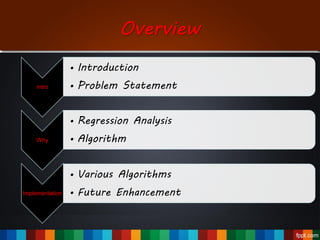
Overview
Intro
• Introduction
• Problem Statement
Why
• Regression Analysis
• Algorithm
Implementation
• Various Algorithms
• Future Enhancement
Netflix Prize
US$1,000,000
was given to
the BellKor's
Pragmatic Chaos
team
Steve Jobs
Problem Statement
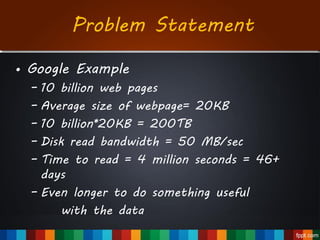
• Google Example
– 10 billion web pages
– Average size of webpage= 20KB
– 10 billion*20KB = 200TB
– Disk read bandwidth = 50 MB/sec
– Time to read = 4 million seconds = 46+
days
– Even longer to do something useful
with the data
• The world is an over-crowded place
Problem Statement
• They all want to get our attention
Problem Statement
Problem Statement
• Mobile recommendations
To design such algorithm so that
overcome the current challenges and
problems of existing recommendation
system and get better accuracy to the
consumers as well as marketers
Search Engine vs Recommender System
“The Web is leaving the era of search and
entering one of discovery. What's the difference?
Search is what you do when you're looking for
something.
Discovery is when something wonderful that you
didn't know existed, or didn't know how to ask
for, finds you.” – CNN Money, “The race to
create a 'smart' Google
First Challenge
• Features for better Recommendation
Features
• Screen Size
• Screen Resolution
• Camera
• Software
• Ram & processor
• Storage
• Build Quality
• Accessories
• Better Voice recognition
• A more durable Device
• Brand
• SAR
• Weight
• Sensor
• SIM
• OS
• Cost
Features
SAR(specific absorption rates)
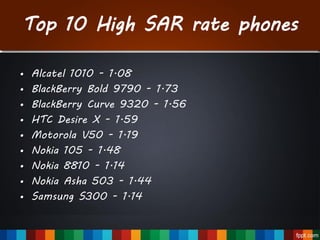
Top 10 High SAR rate phones
• Alcatel 1010 - 1.08
• BlackBerry Bold 9790 - 1.73
• BlackBerry Curve 9320 - 1.56
• HTC Desire X - 1.59
• Motorola V50 - 1.19
• Nokia 105 - 1.48
• Nokia 8810 - 1.14
• Nokia Asha 503 - 1.44
• Samsung S300 - 1.14
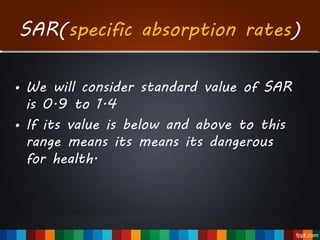
• We will consider standard value of SAR
is 0.9 to 1.4
• If its value is below and above to this
range means its means its dangerous
for health.
SAR(specific absorption rates)
Take The Survey
Few references are as follows:
• A Web-based personalized recommendation system for mobile phone
selection: Design, implementation, and evaluation
• Mobile Recommender Systems Francesco Ricci Faculty of Computer Science
Free University of Bolzano, Italy
• United State Patent Linden et al.
The Purpose of this study
• prioritize the design features
• prioritize the design aspects of cell phones
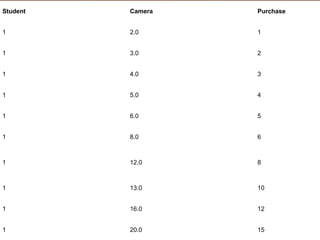
Student Camera Purchase
1 2.0 1
1 3.0 2
1 4.0 3
1 5.0 4
1 6.0 5
1 8.0 6
1 12.0 8
1 13.0 10
1 16.0 12
1 20.0 15
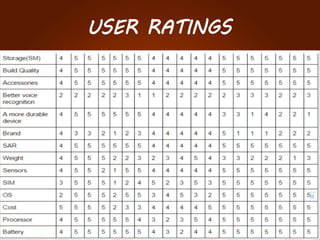
USER RATINGS
USER RATINGS
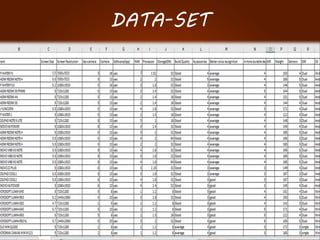
DATA-SET
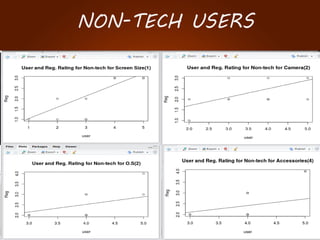
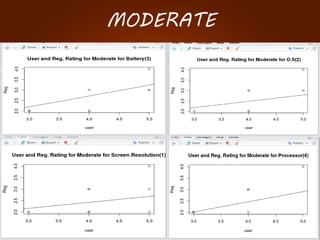
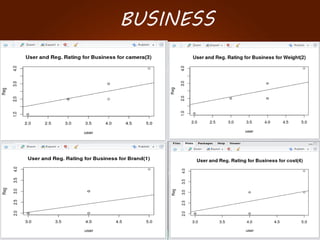
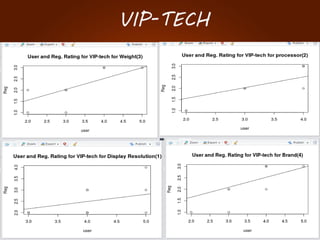
Regression Analysis for Proportions
When the response variable is a proportion or a binary
value (0 or 1), standard regression techniques must be
modified. STATGRAPHICS provides two important
procedures for this situation: Logistic Regression and Probit
Analysis. Both methods yield a prediction equation that is
constrained to lie between 0 and 1.
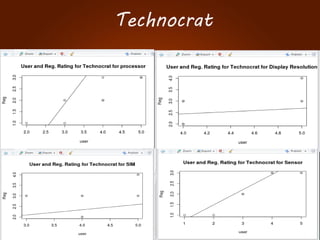
NOTE: We used R-language to find regression values for
data sets of different features.
Regression analysis
• It is used to model the relationship
between a response variable and one or
more predictor variables.
STATGRAPHICS provides a large number
of procedures for fitting different types
of regression models
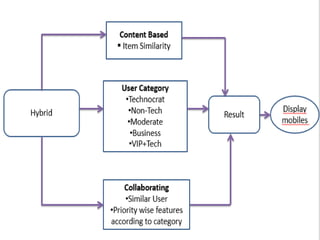
Technocrat
NON-TECH USERS
MODERATE
BUSINESS
VIP-TECH
Algorithms ??
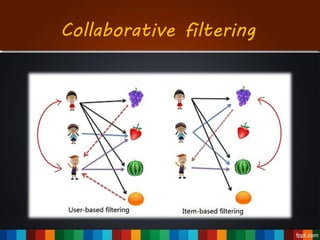
Collaborative filtering
– User-based method
– Item-based method
Content-based filtering
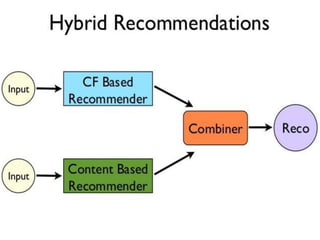
Hybrid
Ranking Approaches:
– Collaborative filtering: “Tell me what
is popular amongst my peers”
– Content Based: “Show me more of
what I liked”
– Knowledge Based: “Tell me what fits
my needs”
– Hybrid
Collaborative filtering
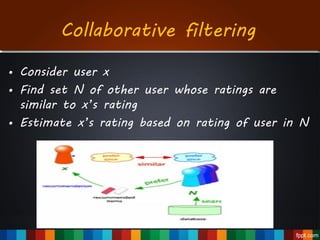
• Consider user x
• Find set N of other user whose ratings are
similar to x’s rating
• Estimate x’s rating based on rating of user in N
Collaborative filtering
• Pros:
– Extremely powerful and efficient
– Very relevant recommendations
– (1) The bigger the database,
– (2) the more the past behaviors, the
better the recommendations
Collaborative filtering
• Cons:
– Difficult to implement, resource and time-
consuming
– What about a new item that has never been
purchased?
Cannot be recommended
– What about a new customer who has never
bought anything? Cannot be compared to
other customers
 no items can be recommended
Collaborative filtering
Item Profile :-
• Description of items
• Profile is a set of feature or set of
important words
• Convenient to think of important item
profile as a vector
Content Based Algorithm
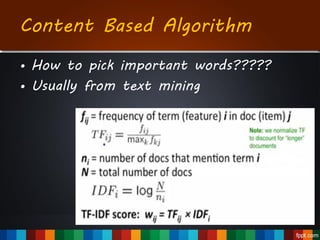
• How to pick important words?????
• Usually from text mining
Content Based Algorithm
Boolean utility matrix
• Items are movies, only feature is
“actor”
• Suppose user x has watched 5 movies
• 2 movies featuring actor A
• 3 movies featuring actor B
• User profile=mean of item profile
PROBLEMS
• Cold Start Problem
• 1) occurs when new user or item enter
in the system
• Synonymy
• 1) when an item is represented with
two or more different names or
• entries having similar meanings
• Problem of providing recommendations when
there is not yet data available
• Item cold-start : A new item has been
added to the database (e.g., when a new
movie or book is released) but has not yet
received enough ratings to be
recommendable.
• User cold-start : A new user has joined the
system but their preferences are not yet
known
PROBLEMS
• Shilling Attacks
• when malicious user or competitor
enters into a system and starts giving
false ratings on some items Privacy
• Feeding personal information to the
recommender systems results in better
recommendation services but may lead
to issues of data privacy and security
PROBLEMS
• Limited Content Analysis and
Overspecialization
• The limited availability of content leads
to problems including overspecialization
• Grey Sheep
• occurs in pure CF systems where
opinions of a user do not match with
any group
PROBLEMS
Genetic
Algorithm
Outline
• Why Genetic Algorithm (GA)
• Introduction to Genetic Algorithm (GA)
• GA Components
 Representation
 Recombination
 Mutation
 Parent Selection
 Survivor selection
Why Genetic Algorithms ?
• Exact methods or mathematical models
require lot of computational effort to solve
multi objective optimization problems.
• For real-life complex problems, not only
exact methods but also simple heuristic
techniques fail to obtain optimal/near-
optimal solutions efficiently.
Why Genetic Algorithms ?
Multiobjective evolutionary algorithms such
as genetic algorithms, nondominated sorting
genetic algorithm-II are suitable for searching
a true Results.
Widely-used in business, science, medical and
engineering
 Optimization and Search Problems
 Scheduling and Timetabling
Introduction to GA
• Genetic Algorithms are good at taking large,
potentially huge search spaces and navigating
them, looking for optimal combinations of
things, solutions you might not otherwise
find in a lifetime.”- Salvatore Mangano,
Computer Design, May 1995.
• The genetic algorithm (GA) is
a search heuristic that mimics the process of
natural evolution
GA is inspired from Nature
Natural Selection
Darwin's theory of evolution:-
only the organisms best adapted to their
environment tend to survive and transmit
their genetic characteristics in increasing
numbers to succeeding generations while those
less adapted tend to be eliminated.
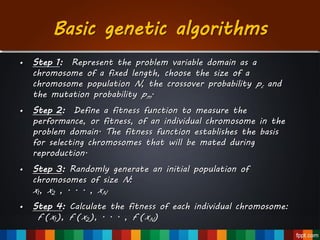
Basic genetic algorithms
• Step 1: Represent the problem variable domain as a
chromosome of a fixed length, choose the size of a
chromosome population N, the crossover probability pc and
the mutation probability pm.
• Step 2: Define a fitness function to measure the
performance, or fitness, of an individual chromosome in the
problem domain. The fitness function establishes the basis
for selecting chromosomes that will be mated during
reproduction.
• Step 3: Randomly generate an initial population of
chromosomes of size N:
x1, x2 , . . . , xN
• Step 4: Calculate the fitness of each individual chromosome:
f (x1), f (x2), . . . , f (xN)
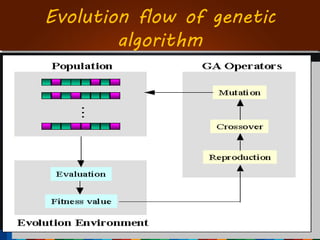
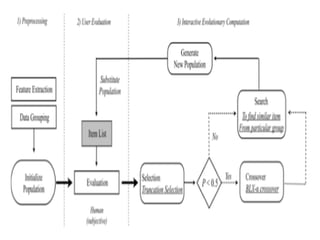
Evolution flow of genetic
algorithm
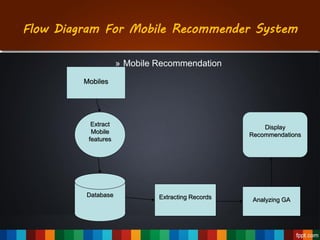
Flow Diagram For Mobile Recommender System
» Mobile Recommendation
Mobiles
Extract
Mobile
features
Database Extracting Records Analyzing GA
Display
Recommendations
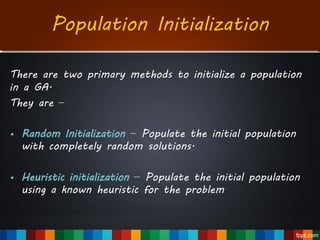
Population Initialization
There are two primary methods to initialize a population
in a GA.
They are −
• Random Initialization − Populate the initial population
with completely random solutions.
• Heuristic initialization − Populate the initial population
using a known heuristic for the problem
• It has been observed that the entire population should
not be initialized using a heuristic, as it can result in the
population having similar solutions and very little diversity.
It has been experimentally observed that the random
solutions are the ones to drive the population to
optimality. Therefore, with heuristic initialization, we just
seed the population with a couple of good solutions, filling
up the rest with random solutions rather than filling the
entire population with heuristic based solutions.
• It has also been observed that heuristic initialization in
some cases, only effects the initial fitness of the
population, but in the end, it is the diversity of the
solutions which lead to optimality.
Population Initialization
Genetic Algorithms:
Recommender System
• The fitness function simply defined is a
function which takes a candidate solution
to the problem as input and produces as
output how “fit” our how “good” the
solution is with respect to the problem
in consideration.
Features which dominate
Technocrat
Technocrat
RAM Processor Camera SM
Our aim is to maximize these
values according to their factors
and digital values.
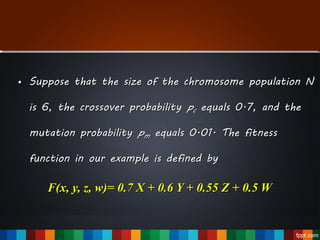
• Suppose that the size of the chromosome population N
is 6, the crossover probability pc equals 0.7, and the
mutation probability pm equals 0.01. The fitness
function in our example is defined by
F(x, y, z, w)= 0.7 X + 0.6 Y + 0.55 Z + 0.5 W
Parameters
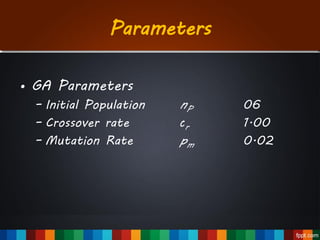
• GA Parameters
– Initial Population nP 06
– Crossover rate cr 1.00
– Mutation Rate pm 0.02
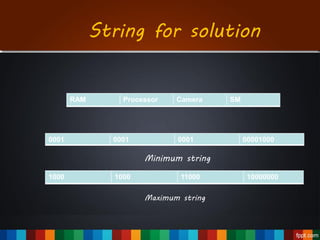
String for solution
1000 1000 11000 10000000
0001 0001 0001 00001000
RAM Processor Camera SM
Minimum string
Maximum string
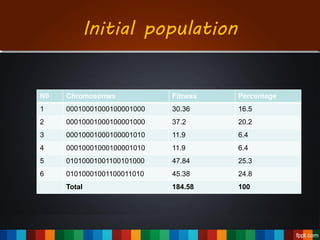
Initial population
N0 Chromosomes Fitness Percentage
1 00010001000100001000 30.36 16.5
2 00010001000100001000 37.2 20.2
3 00010001000100001010 11.9 6.4
4 00010001000100001010 11.9 6.4
5 01010001001100101000 47.84 25.3
6 01010001001100011010 45.38 24.8
Total 184.58 100
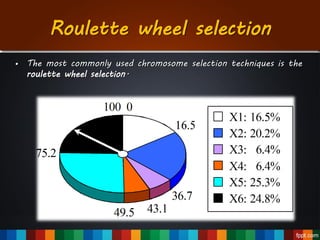
Roulette wheel selection
• The most commonly used chromosome selection techniques is the
roulette wheel selection.
Crossover operator
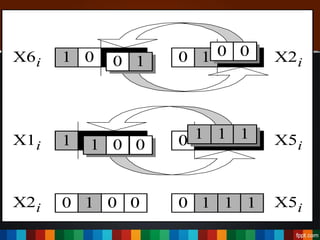
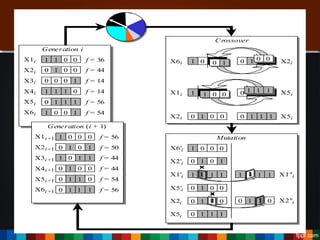
• In our example, we have an initial population of 6
chromosomes. Thus, to establish the same population in
the next generation, the roulette wheel would be spin six
times.
• Once a pair of parent chromosomes is selected, the
crossover operator is applied.
• First, the crossover operator randomly chooses a crossover
point where two parent chromosomes “break”, and then
exchanges the chromosome parts after that point. As a
result, two new offspring are created.
• If a pair of chromosomes does not cross over, then the
chromosome cloning takes place, and the offspring are
created as exact copies of each parent.
X6i 1 00 0 01 0 X2i
0 01 0X2i 0 11 1 X5i
0X1i 0 11 1 X5i1 01 0
0 1
0 0
11 1
01 0
Mutation operator
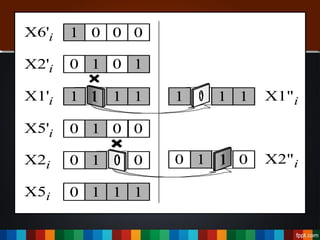
• Mutation represents a change in the gene.
• Mutation is a background operator. Its role is to provide a
guarantee that the search algorithm is not trapped on a local
optimum.
• The mutation operator flips a randomly selected gene in a
chromosome.
• The mutation probability is quite small in nature, and is kept
low for GAs, typically in the range between 0.001 and 0.01.
• We have taken one point crossover.
0 11 1X5'i 01 0
X6'i 1 00
0 01 0X2'i 0 1
0 0
0 1 111X5i
1 1 1 X1"i1 1
X2"i0 1 0
0X1'i 1 1 1
0 1 0X2i
1 01 0X1i
Generation i
0 01 0X2i
0 00 1X3i
1 11 0X4i
0 11 1X5i f = 56
1 00 1X6i f = 54
f = 36
f = 44
f = 14
f = 14
1 00 0X1i+1
Generation (i + 1)
0 01 1X2i+1
1 10 1X3i+1
0 01 0X4i+1
0 11 0X5i+1 f = 54
0 11 1X6i+1 f = 56
f = 56
f = 50
f = 44
f = 44
Crossover
X6i 1 00 0 01 0 X2i
0 01 0X2i 0 11 1 X5i
0X1i 0 11 1 X5i1 01 0
0 1
0 0
11 1
01 0
Mutation
0 11 1X5'i 01 0
X6'i 1 00
0 01 0X2'i 0 1
0 0
0 1 111X5i
1 1 1 X1"i1 1
X2"i0 1 0
0X1'i 1 1 1
0 1 0X2i
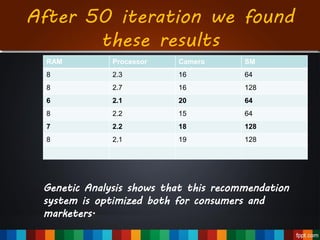
After 50 iteration we found
these results
RAM Processor Camera SM
8 2.3 16 64
8 2.7 16 128
6 2.1 20 64
8 2.2 15 64
7 2.2 18 128
8 2.1 19 128
Genetic Analysis shows that this recommendation
system is optimized both for consumers and
marketers.
MODERATE
MODERATE
NON-TECH
NON-TECH
BUSINESS
BUSINESS
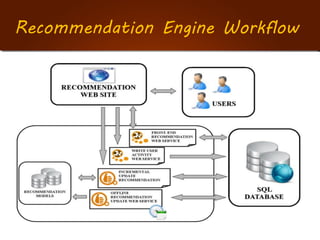
Recommendation Engine Workflow
FUTURE ENHANCEMENT
 In future we will work on Genetic Algorithm on different
cross-over like 1-crossover,2-crossover, α-crossover, β-
crossover so that we will predict product for consumer as
well as marketers.
 In future we will create a form so that we know the
current position of user that this particular user would
purchase an product or not. But user is closer to purchase
we recommend different EMI and various ways to save
money and as well as Increase the Company’s revenue.
We will Implement different regressions
techniques on the dataset so that we will
predict the user preference.
For combining previous 3-steps our ultimate
goal is to Implement the hybrid algorithm
for efficient and accurate results under
complex user environment.
FUTURE ENHANCEMENT
THANK YOU

Recommendation engine Using Genetic Algorithm

  • 1.
  • 2.
    Overview Intro • Introduction • ProblemStatement Why • Regression Analysis • Algorithm Implementation • Various Algorithms • Future Enhancement
  • 3.
    Netflix Prize US$1,000,000 was givento the BellKor's Pragmatic Chaos team
  • 4.
  • 5.
    Problem Statement • GoogleExample – 10 billion web pages – Average size of webpage= 20KB – 10 billion*20KB = 200TB – Disk read bandwidth = 50 MB/sec – Time to read = 4 million seconds = 46+ days – Even longer to do something useful with the data
  • 6.
    • The worldis an over-crowded place Problem Statement
  • 7.
    • They allwant to get our attention Problem Statement
  • 8.
    Problem Statement • Mobilerecommendations To design such algorithm so that overcome the current challenges and problems of existing recommendation system and get better accuracy to the consumers as well as marketers
  • 9.
    Search Engine vsRecommender System “The Web is leaving the era of search and entering one of discovery. What's the difference? Search is what you do when you're looking for something. Discovery is when something wonderful that you didn't know existed, or didn't know how to ask for, finds you.” – CNN Money, “The race to create a 'smart' Google
  • 10.
    First Challenge • Featuresfor better Recommendation
  • 11.
    Features • Screen Size •Screen Resolution • Camera • Software • Ram & processor • Storage • Build Quality • Accessories
  • 12.
    • Better Voicerecognition • A more durable Device • Brand • SAR • Weight • Sensor • SIM • OS • Cost Features
  • 13.
  • 14.
    Top 10 HighSAR rate phones • Alcatel 1010 - 1.08 • BlackBerry Bold 9790 - 1.73 • BlackBerry Curve 9320 - 1.56 • HTC Desire X - 1.59 • Motorola V50 - 1.19 • Nokia 105 - 1.48 • Nokia 8810 - 1.14 • Nokia Asha 503 - 1.44 • Samsung S300 - 1.14
  • 15.
    • We willconsider standard value of SAR is 0.9 to 1.4 • If its value is below and above to this range means its means its dangerous for health. SAR(specific absorption rates)
  • 16.
    Take The Survey Fewreferences are as follows: • A Web-based personalized recommendation system for mobile phone selection: Design, implementation, and evaluation • Mobile Recommender Systems Francesco Ricci Faculty of Computer Science Free University of Bolzano, Italy • United State Patent Linden et al.
  • 17.
    The Purpose ofthis study • prioritize the design features • prioritize the design aspects of cell phones
  • 18.
    Student Camera Purchase 12.0 1 1 3.0 2 1 4.0 3 1 5.0 4 1 6.0 5 1 8.0 6 1 12.0 8 1 13.0 10 1 16.0 12 1 20.0 15
  • 19.
  • 20.
  • 21.
  • 22.
    Regression Analysis forProportions When the response variable is a proportion or a binary value (0 or 1), standard regression techniques must be modified. STATGRAPHICS provides two important procedures for this situation: Logistic Regression and Probit Analysis. Both methods yield a prediction equation that is constrained to lie between 0 and 1. NOTE: We used R-language to find regression values for data sets of different features.
  • 23.
    Regression analysis • Itis used to model the relationship between a response variable and one or more predictor variables. STATGRAPHICS provides a large number of procedures for fitting different types of regression models
  • 24.
  • 25.
  • 26.
  • 27.
  • 28.
  • 29.
    Algorithms ?? Collaborative filtering –User-based method – Item-based method Content-based filtering Hybrid
  • 30.
    Ranking Approaches: – Collaborativefiltering: “Tell me what is popular amongst my peers” – Content Based: “Show me more of what I liked” – Knowledge Based: “Tell me what fits my needs” – Hybrid
  • 31.
  • 32.
    • Consider userx • Find set N of other user whose ratings are similar to x’s rating • Estimate x’s rating based on rating of user in N Collaborative filtering
  • 33.
    • Pros: – Extremelypowerful and efficient – Very relevant recommendations – (1) The bigger the database, – (2) the more the past behaviors, the better the recommendations Collaborative filtering
  • 34.
    • Cons: – Difficultto implement, resource and time- consuming – What about a new item that has never been purchased? Cannot be recommended – What about a new customer who has never bought anything? Cannot be compared to other customers  no items can be recommended Collaborative filtering
  • 35.
    Item Profile :- •Description of items • Profile is a set of feature or set of important words • Convenient to think of important item profile as a vector Content Based Algorithm
  • 36.
    • How topick important words????? • Usually from text mining Content Based Algorithm
  • 37.
    Boolean utility matrix •Items are movies, only feature is “actor” • Suppose user x has watched 5 movies • 2 movies featuring actor A • 3 movies featuring actor B • User profile=mean of item profile
  • 38.
    PROBLEMS • Cold StartProblem • 1) occurs when new user or item enter in the system • Synonymy • 1) when an item is represented with two or more different names or • entries having similar meanings
  • 39.
    • Problem ofproviding recommendations when there is not yet data available • Item cold-start : A new item has been added to the database (e.g., when a new movie or book is released) but has not yet received enough ratings to be recommendable. • User cold-start : A new user has joined the system but their preferences are not yet known PROBLEMS
  • 40.
    • Shilling Attacks •when malicious user or competitor enters into a system and starts giving false ratings on some items Privacy • Feeding personal information to the recommender systems results in better recommendation services but may lead to issues of data privacy and security PROBLEMS
  • 41.
    • Limited ContentAnalysis and Overspecialization • The limited availability of content leads to problems including overspecialization • Grey Sheep • occurs in pure CF systems where opinions of a user do not match with any group PROBLEMS
  • 42.
  • 43.
    Outline • Why GeneticAlgorithm (GA) • Introduction to Genetic Algorithm (GA) • GA Components  Representation  Recombination  Mutation  Parent Selection  Survivor selection
  • 44.
    Why Genetic Algorithms? • Exact methods or mathematical models require lot of computational effort to solve multi objective optimization problems. • For real-life complex problems, not only exact methods but also simple heuristic techniques fail to obtain optimal/near- optimal solutions efficiently.
  • 45.
    Why Genetic Algorithms? Multiobjective evolutionary algorithms such as genetic algorithms, nondominated sorting genetic algorithm-II are suitable for searching a true Results. Widely-used in business, science, medical and engineering  Optimization and Search Problems  Scheduling and Timetabling
  • 46.
    Introduction to GA •Genetic Algorithms are good at taking large, potentially huge search spaces and navigating them, looking for optimal combinations of things, solutions you might not otherwise find in a lifetime.”- Salvatore Mangano, Computer Design, May 1995. • The genetic algorithm (GA) is a search heuristic that mimics the process of natural evolution
  • 47.
    GA is inspiredfrom Nature Natural Selection Darwin's theory of evolution:- only the organisms best adapted to their environment tend to survive and transmit their genetic characteristics in increasing numbers to succeeding generations while those less adapted tend to be eliminated.
  • 48.
    Basic genetic algorithms •Step 1: Represent the problem variable domain as a chromosome of a fixed length, choose the size of a chromosome population N, the crossover probability pc and the mutation probability pm. • Step 2: Define a fitness function to measure the performance, or fitness, of an individual chromosome in the problem domain. The fitness function establishes the basis for selecting chromosomes that will be mated during reproduction. • Step 3: Randomly generate an initial population of chromosomes of size N: x1, x2 , . . . , xN • Step 4: Calculate the fitness of each individual chromosome: f (x1), f (x2), . . . , f (xN)
  • 49.
    Evolution flow ofgenetic algorithm
  • 50.
    Flow Diagram ForMobile Recommender System » Mobile Recommendation Mobiles Extract Mobile features Database Extracting Records Analyzing GA Display Recommendations
  • 51.
    Population Initialization There aretwo primary methods to initialize a population in a GA. They are − • Random Initialization − Populate the initial population with completely random solutions. • Heuristic initialization − Populate the initial population using a known heuristic for the problem
  • 52.
    • It hasbeen observed that the entire population should not be initialized using a heuristic, as it can result in the population having similar solutions and very little diversity. It has been experimentally observed that the random solutions are the ones to drive the population to optimality. Therefore, with heuristic initialization, we just seed the population with a couple of good solutions, filling up the rest with random solutions rather than filling the entire population with heuristic based solutions. • It has also been observed that heuristic initialization in some cases, only effects the initial fitness of the population, but in the end, it is the diversity of the solutions which lead to optimality. Population Initialization
  • 53.
    Genetic Algorithms: Recommender System •The fitness function simply defined is a function which takes a candidate solution to the problem as input and produces as output how “fit” our how “good” the solution is with respect to the problem in consideration.
  • 54.
    Features which dominate Technocrat Technocrat RAMProcessor Camera SM Our aim is to maximize these values according to their factors and digital values.
  • 55.
    • Suppose thatthe size of the chromosome population N is 6, the crossover probability pc equals 0.7, and the mutation probability pm equals 0.01. The fitness function in our example is defined by F(x, y, z, w)= 0.7 X + 0.6 Y + 0.55 Z + 0.5 W
  • 56.
    Parameters • GA Parameters –Initial Population nP 06 – Crossover rate cr 1.00 – Mutation Rate pm 0.02
  • 57.
    String for solution 10001000 11000 10000000 0001 0001 0001 00001000 RAM Processor Camera SM Minimum string Maximum string
  • 58.
    Initial population N0 ChromosomesFitness Percentage 1 00010001000100001000 30.36 16.5 2 00010001000100001000 37.2 20.2 3 00010001000100001010 11.9 6.4 4 00010001000100001010 11.9 6.4 5 01010001001100101000 47.84 25.3 6 01010001001100011010 45.38 24.8 Total 184.58 100
  • 59.
    Roulette wheel selection •The most commonly used chromosome selection techniques is the roulette wheel selection.
  • 60.
    Crossover operator • Inour example, we have an initial population of 6 chromosomes. Thus, to establish the same population in the next generation, the roulette wheel would be spin six times. • Once a pair of parent chromosomes is selected, the crossover operator is applied. • First, the crossover operator randomly chooses a crossover point where two parent chromosomes “break”, and then exchanges the chromosome parts after that point. As a result, two new offspring are created. • If a pair of chromosomes does not cross over, then the chromosome cloning takes place, and the offspring are created as exact copies of each parent.
  • 61.
    X6i 1 000 01 0 X2i 0 01 0X2i 0 11 1 X5i 0X1i 0 11 1 X5i1 01 0 0 1 0 0 11 1 01 0
  • 62.
    Mutation operator • Mutationrepresents a change in the gene. • Mutation is a background operator. Its role is to provide a guarantee that the search algorithm is not trapped on a local optimum. • The mutation operator flips a randomly selected gene in a chromosome. • The mutation probability is quite small in nature, and is kept low for GAs, typically in the range between 0.001 and 0.01. • We have taken one point crossover.
  • 63.
    0 11 1X5'i01 0 X6'i 1 00 0 01 0X2'i 0 1 0 0 0 1 111X5i 1 1 1 X1"i1 1 X2"i0 1 0 0X1'i 1 1 1 0 1 0X2i
  • 64.
    1 01 0X1i Generationi 0 01 0X2i 0 00 1X3i 1 11 0X4i 0 11 1X5i f = 56 1 00 1X6i f = 54 f = 36 f = 44 f = 14 f = 14 1 00 0X1i+1 Generation (i + 1) 0 01 1X2i+1 1 10 1X3i+1 0 01 0X4i+1 0 11 0X5i+1 f = 54 0 11 1X6i+1 f = 56 f = 56 f = 50 f = 44 f = 44 Crossover X6i 1 00 0 01 0 X2i 0 01 0X2i 0 11 1 X5i 0X1i 0 11 1 X5i1 01 0 0 1 0 0 11 1 01 0 Mutation 0 11 1X5'i 01 0 X6'i 1 00 0 01 0X2'i 0 1 0 0 0 1 111X5i 1 1 1 X1"i1 1 X2"i0 1 0 0X1'i 1 1 1 0 1 0X2i
  • 65.
    After 50 iterationwe found these results RAM Processor Camera SM 8 2.3 16 64 8 2.7 16 128 6 2.1 20 64 8 2.2 15 64 7 2.2 18 128 8 2.1 19 128 Genetic Analysis shows that this recommendation system is optimized both for consumers and marketers.
  • 69.
  • 70.
  • 71.
  • 72.
  • 73.
  • 74.
  • 75.
  • 81.
    FUTURE ENHANCEMENT  Infuture we will work on Genetic Algorithm on different cross-over like 1-crossover,2-crossover, α-crossover, β- crossover so that we will predict product for consumer as well as marketers.  In future we will create a form so that we know the current position of user that this particular user would purchase an product or not. But user is closer to purchase we recommend different EMI and various ways to save money and as well as Increase the Company’s revenue.
  • 82.
    We will Implementdifferent regressions techniques on the dataset so that we will predict the user preference. For combining previous 3-steps our ultimate goal is to Implement the hybrid algorithm for efficient and accurate results under complex user environment. FUTURE ENHANCEMENT
  • 83.