Information And Software Technology A
Projectbased Approach David Grover John Range

download
https://ebookbell.com/product/information-and-software-
technology-a-projectbased-approach-david-grover-john-
range-23372430
Explore and download more ebooks at ebookbell.com
Here are some recommended products that we believe you will be
interested in. You can click the link to download.
Managing Information Technology Projects Applying Project Management
Strategies To Software Hardware And Integration Initiatives James
Taylor
https://ebookbell.com/product/managing-information-technology-
projects-applying-project-management-strategies-to-software-hardware-
and-integration-initiatives-james-taylor-2232888
A Profile Of The Software Industry Emergence Ascendance Risks And
Rewards Sandra A Slaughter
https://ebookbell.com/product/a-profile-of-the-software-industry-
emergence-ascendance-risks-and-rewards-sandra-a-slaughter-5262956
Applied Problems Solved By Information Technology And Software Azman
Ismai
https://ebookbell.com/product/applied-problems-solved-by-information-
technology-and-software-azman-ismai-54665364
Proceedings Of The 2012 International Conference On Information
Technology And Software Engineering Information Technology Computing
Intelligence 1st Edition Wei Lu
https://ebookbell.com/product/proceedings-of-the-2012-international-
conference-on-information-technology-and-software-engineering-
information-technology-computing-intelligence-1st-edition-wei-
lu-4241162
Proceedings Of The 2012 International Conference On Information
Technology And Software Engineering Software Engineering Digital Media
Technology 1st Edition Wei Lu
https://ebookbell.com/product/proceedings-of-the-2012-international-
conference-on-information-technology-and-software-engineering-
software-engineering-digital-media-technology-1st-edition-wei-
lu-4241750
Proceedings Of The 2012 International Conference On Information
Technology And Software Engineering Information Technology 1st Edition
Yang Hao
https://ebookbell.com/product/proceedings-of-the-2012-international-
conference-on-information-technology-and-software-engineering-
information-technology-1st-edition-yang-hao-4241822
Process Aware Information Systems Bridging People And Software Through
Process Technology Marlon Dumas
https://ebookbell.com/product/process-aware-information-systems-
bridging-people-and-software-through-process-technology-marlon-
dumas-975296
The Fabric Of Mobile Services Software Paradigms And Business Demands
Information And Communication Technology Series 1st Edition Shoshana
Loeb
https://ebookbell.com/product/the-fabric-of-mobile-services-software-
paradigms-and-business-demands-information-and-communication-
technology-series-1st-edition-shoshana-loeb-2453374
Quantitative Approaches In Objectoriented Software Engineering
Innovative Technology Series Information Systems And Networks Fernando
Brito E Abreu
https://ebookbell.com/product/quantitative-approaches-in-
objectoriented-software-engineering-innovative-technology-series-
information-systems-and-networks-fernando-brito-e-abreu-1906282
Sydney, Melbourne, Brisbane, Perth and
associated companies around the world
ii Information and Software Technology A Project-based Approach
David Grover is Head Teacher of Computing Studies at
Chatswood High School, Sydney. He has been teaching
computing, running workshops and enjoying computers
for over thirty years. He is the author of the teacher
resource Creative Ideas for Teaching Computing and of
numerous textbooks and resources for students. David
has marked HSC computing subjects for many years and
is currently a Senior Marker in Information Processes
and Technology.
John Range is a Head Teacher of Information
Technology at Hornsby College of TAFE, co-managing a
range of IT certificate and diploma courses. He lectures
part-time at university, and runs a small business in IT
consulting, specialising in developing database
applications for Access and SQL Server. John is also the
author of two titles on computing studies at HSC level.
Heather Knights holds postgraduate qualifications
ininformation technology. In the classroom, she teaches
at secondary and tertiary levels and is currently the
Learning Technologies Coordinator at Meriden School,
Strathfield. Her current focus is the implementation of e-
learning technologies in corporate and educational
environments.
Eamon Gormley is a Computing Studies teacher at Picnic
Point High School, Panania, in Sydney’s south. He has
taught as a Technological and Applied Studies teacher in
the NSW public school system since 2000. In his writing
and teaching he is particularly interested in exploring the
social impacts of information and software technology.
Sonia Perri teaches information and software technology
at Santa Sabina College, Strathfield. Before taking up this
position, she was a Lecturer of Computing at the
Australian Catholic University, Strathfield campus. Sonia
also taught Computing Studies K–12 at Meriden School,
Strathfield, for twelve years. She is also an HSC marker.
Pearson Education Australia
A division of Pearson Australia Group Pty Ltd
Level 9, 5 Queens Road
Melbourne 3004
www.pearsoned.com.au/schools
Offices in Sydney, Brisbane and Perth, and associated companies throughout the
world.
Copyright © Pearson Education Australia 2004
First published 2004
All rights reserved. Except under the conditions described in the Copyright Act 1968
of Australia and subsequent amendments, no part of this publication may be
reproduced, stored in a retrieval system or transmitted in any form or by any means,
electronic, mechanical, photocopying, recording or otherwise, without the prior
permission of the copyright owner.
Designed by Sharon Carr, Graphic Divine
Edited by Lan Wang, Woven Words
Illustrated by Wendy Gorton
Prepress work by The Type Factory
Set in 10.5/13 pt Sabon, by SPG
Printed in Hong Kong
National Library of Australia
Cataloguing-in-Publication data:
Grover, David.
Information and software technology.
Includes index.
For secondary school students.
ISBN 0 12 360471 0.
1. Information technology—Textbooks. 2. Electronic data
processing—Textbooks. I. Title.
004.07
Every effort has been made to trace and acknowledge copyright. However, should
any infringement have occurred, the publishers tender their apologies and invite
copyright owners to contact them.
About the authors
About the book v
Student pack vi
To the student vii
Acknowledgements viii
CORE
1 Projects: Design, Produce, Evaluate 1
1.1 Defining and analysing the problem 2
1.2 Designing possible solutions 3
1.3 Producing solutions 5
1.4 Evaluation 6
1.5 Management 7
1.6 Communication techniques 8
1.7 Group work 9
2 Hardware 11
2.1 Hardware functions 12
2.2 Hardware components 13
2.3 Microprocessors 18
2.4 Classification of systems 18
2.5 Hardware solutions 20
2.6 Troubleshooting 21
2.7 Care and maintenance 21
3 Software 23
3.1 Software systems 24
3.2 Types and examples of software 24
3.3 Factors affecting hardware requirements 33
3.4 Interface design 34
3.5 Features and elements of a graphical user
interface 37
4 Data Handling 41
4.1 Data and information 42
4.2 Data forms 43
4.3 Data coding 43
4.4 Data sources 46
4.5 Data types 46
4.6 Data transmission types 48
4.7 Data storage and function 49
4.8 Data compression techniques 52
4.9 Data security 53
5 Past, Current and Emerging Technologies 55
5.1 Past information and software technologies 56
5.2 Current and emerging technologies 57
5.3 Exploring current and emerging technologies
for each option 60
5.4 The impact of technology on the environment 67
6 People 70
6.1 Roles and responsibilities 71
6.2 Careers in information and software technology 73
7 Issues 75
7.1 Legal issues 76
7.2 Ethical issues 77
7.3 Social issues 79
7.4 Industrial issues 81
OPTIONS
8 Artificial Intelligence, Simulation and
Modelling 83
8.1 Artificial intelligence 84
8.2 Areas of artificial intelligence 85
8.3 Requirements of artificial intelligence 90
8.4 Modelling and simulations 95
8.5 Requirements of models and simulations 98
8.6 Advantages and limitations 99
8.7 Using modelling and simulation programs 102
8.8 Project development 106
8.9 Additional content 108
9 Authoring and Multimedia 112
9.1 The beginning of a revolution 113
9.2 What is multimedia? 114
9.3 Types of multimedia products 115
9.4 Multimedia data types 119
9.5 Multimedia hardware 125
9.6 Processes used with multimedia data types 129
9.7 Authoring software systems 130
9.8 Developing a multimedia product 136
9.9 Project development 143
9.10 Additional content 144
Contents
Contents iii
10 Database Design 146
10.1 Database development 147
10.2 Collecting, organising and storing data 154
10.3 Processing and analysing data 160
10.4 Presenting information 164
10.5 Integration 165
10.6 Project development 170
10.7 Additional content 172
11 Digital media 175
11.1 The purpose of digital media 177
11.2 Types of digital media products 181
11.3 Data types for digital media products 187
11.4 Digitisation of data types 194
11.5 Digital manipulation techniques 198
11.6 Factors affecting file size 206
11.7 Display and distribution 208
11.8 Project development 211
11.9 Additional content 213
12 The Internet and Website Development 215
12.1 The Internet 216
12.2 An historical perspective on the Internet 217
12.3 Intranets 221
12.4 Features and uses of the Internet 221
12.5 Internet software 233
12.6 Types of Internet protocols 237
12.7 The World Wide Web 240
12.8 Control of access to information 243
12.9 Website development 246
12.10 Project development 248
12.11 Additional content 249
13 Networking Systems 254
13.1 A communications network 255
13.2 Network protocols 260
13.3 Data transmission modes 262
13.4 Data transmission rates 263
13.5 Data transmission media 263
13.6 Types of networks 266
13.7 Peer-to-peer and client–server networks 267
13.8 Components of networks 267
13.9 Security of information 272
13.10 Network topology 276
13.11 Network operating systems 278
13.12 Factors influencing media transmission 280
13.13 Project development 281
13.14 Additional content 283
14 Robotics and Automated Systems 285
14.1 Robotics 286
14.2 Types of robots 288
14.3 The purpose of robots 291
14.4 Use of robots 293
14.5 The function of robots 297
14.6 Automated control 302
14.7 Sensing devices 304
14.8 What are actuators? 307
14.9 Controlling devices 309
14.10 Project development 310
14.11 Additional content 312
15 Software Development and
Programming 315
15.1 Basic programming concepts 316
15.2 GUI layout 323
15.3 Data types 325
15.4 Data operators 328
15.5 Algorithms 330
15.6 Program control structures 332
15.7 Desk checking 337
15.8 Using sub-programs 338
15.9 Programming languages 339
15.10 Data structures 341
15.11 Testing program code 344
15.12 Error detection 345
15.13 Error correction 346
15.14 Documentation of program code 346
15.15 Project development 347
15.16 Additional content 350
Index 354
iv Information and Software Technology A Project-based Approach
Information and Software Technology: A Project-based
Approach is a brand new, full-colour text written to meet the
requirements of the new NSW 7–10 Information and
Software Technology syllabus to be implemented from 2005.
This text provides a clear project-development focus in line
with the spirit of the syllabus. It also presents a concise
coverage of the Core topics to provide a ready reference as
the Option topics are studied.
Project development
The opening chapter Projects: Design, Produce, Evaluate
introduces the basic principles of project work.
Throughout each Option chapter a series of step-by-
step tasks are included. These are designed to develop
students’ skills in technology application and to help
prepare them for the major project at the end of each
chapter.
Each Option chapter culminates in a substantial project
structured around the design process outlined in the
syllabus: defining and analysing the problem; and designing,
producing and evaluating project solutions. Further project
ideas are provided in the Teacher’s Resource.
Key features
• Each chapter opens with a list of outcomes based on the
syllabus and a summary of the chapter contents,
followed by a panel called In Action, which presents a
real-life application of the chapter content to highlight its
relevance to students.
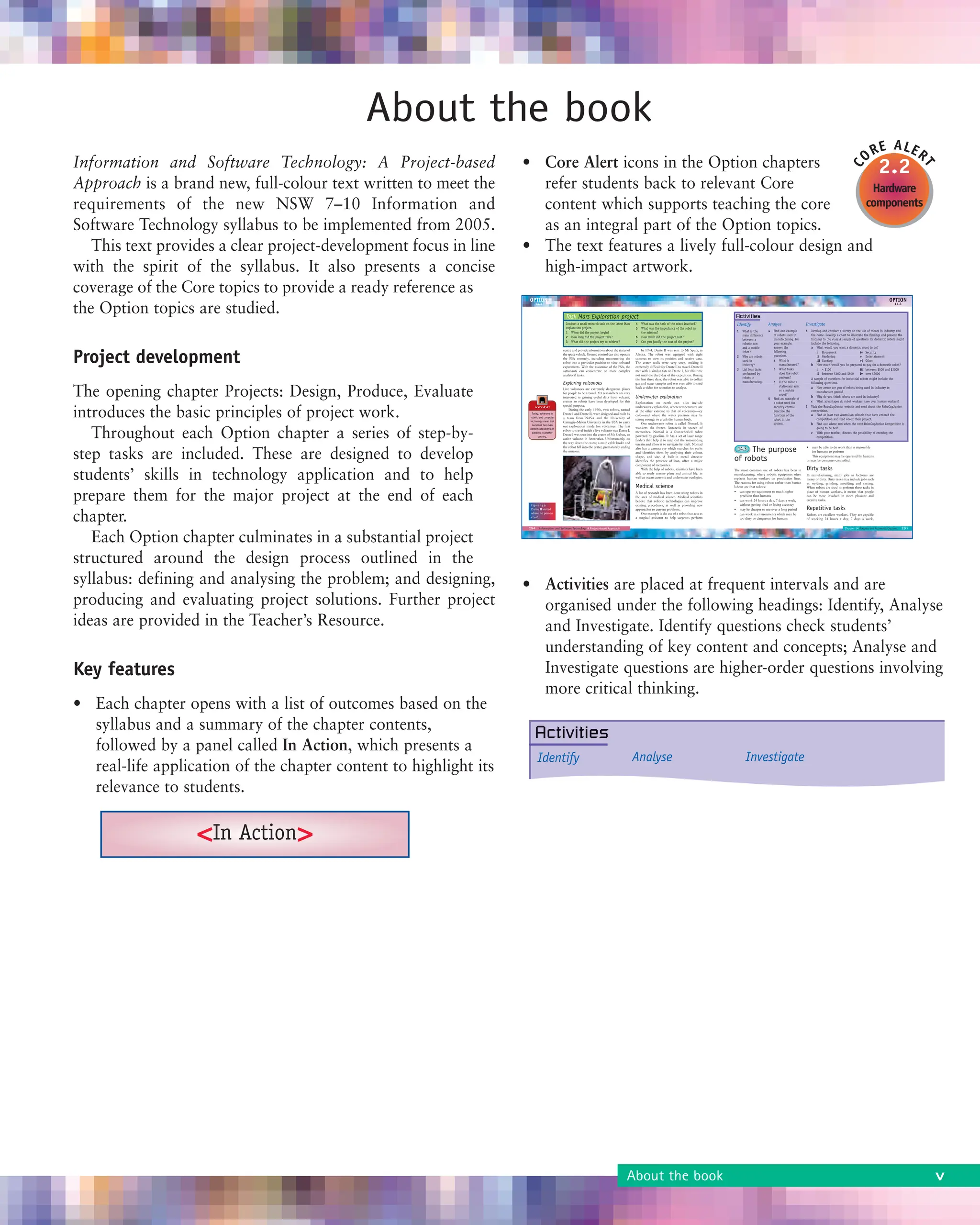
• Core Alert icons in the Option chapters
refer students back to relevant Core
content which supports teaching the core
as an integral part of the Option topics.
• The text features a lively full-colour design and
high-impact artwork.
• Activities are placed at frequent intervals and are
organised under the following headings: Identify, Analyse
and Investigate. Identify questions check students’
understanding of key content and concepts; Analyse and
Investigate questions are higher-order questions involving
more critical thinking.
2.2
Hardware
components
C
ORE ALER
T
About the book
<In Action>
About the book v
vi Information and Software Technology A Project-based Approach
The text is also available with a Student CD which contains
a PDF of the coursebook, a cached version of the Companion
Website and the student worksheets from the Teacher’s
Resource.
Companion Website
www.pearsoned.com.au/schools
The Companion Website provides a range of
technology-based material: self-marking on-line
chapter review questions; Destinations—links to websites
referred to in the text plus other useful websites; and a wide
range of technology activities—drag-and-drop interactives,
activities using software or specially developed files,
animations and video clips, as well as samples of students’
work. All this material is clearly cross-referenced in the text.
The CW icon by itself indicates there are web links
(Destinations) for students to use in support of the text. Other
CW icons are annotated to indicate further material to be
found on the Companion Website.
Teacher’s Resource
The Teacher’s Resource provides a wide range
of additional support: programming
suggestions; a Core matrix showing the links
between the Option chapters and the Core
content; approaches to developing projects; a list of
recommended software and other useful references; a range
of worksheets for each Option chapter; answers to the
worksheets; answers to all the activities in the coursebook;
and chapter tests and answers for each of the Option
chapters. All this material is clearly cross-referenced in the
text.
The Teacher’s Resource comprises a printout and a CD
which includes editable Word files of the worksheets and the
chapter tests, as well as the programming and Core matrix
documents.
• Issues, People, and Past, current and emerging
technologies are introduced in the Core chapters, but are
also addressed within the Options Chapters as separate
panels.
chapteroverview
WS
12
T
E
A
C
H
ER’S RES
O
U
R
C
E
Student pack
Issues Legal and social concerns
Past, current and emerging technologies
People People in multimedia
• Case studies highlight relevant, real-life examples of the
theory.
• Key words are highlighted in the text
and defined in the margins.
• Infobits provide snippets of interesting
related information to stimulate
students’ interest.
• The Chapter Overview summarises the key content of
each Option chapter.
About the book vii
To the student
The world of information and software technology that you
will explore in this textbook and its Companion Website is an
amazingly creative, exciting, challenging and rapidly
changing one.
It is a world which truly offers something for everyone. If
you are bursting with creative energy, you can explore digital
media and multimedia. If you wish to confront the uncharted
frontiers of the information revolution, you can harness the
power of the World Wide Web and begin solo exploration. If
you are a born organiser, you can contribute to this
revolution and build a website or a database of your own. If
you like to find out how things work, then topics such as
artificial intelligence, networking and operating systems will
fascinate you. If you love to be in control, robotics will give
you a chance to design and program your very own robot.
Finally, the topic of programming offers to empower you to
learn to write software yourself.
This book emphasises a project-based approach to
information and software technology. Each topic is built
upon a detailed practical project where you design, produce
and evaluate your own solution to a given problem, either
working on your own or as part of a team.
The carefully designed tasks included in each topic have
numbered steps which allow you to acquire the skills to
complete your project. Featured panels on Issues, People, and
Past, current and emerging technologies emphasise vital core
material, while a real-world In Action case study
demonstrates the application of each topic in industry and the
world of work.
Basic core knowledge about hardware, software and data
handling is introduced in the first section of the book (the
Core chapters). Social and ethical issues, and the history of
computing and its past achievements will help you
understand the impact computing technologies have had on
society and appreciate the incredible journey you are now
making. This core material also appears throughout the
book, integrated into each topic where it is emphasised by the
Core Alert icons.
With your energies focused on practical projects, it would
be easy to lose track of the vital facts, so there are plenty of
written activities to help make sure you haven’t missed
anything.
Most students know enough about computers to complete
basic daily tasks, such as word processing, browsing the
Internet or playing a computer game. However, as you learn
about information and software technology using this book
you will learn far more than this. You will discover why the
computer has been called the most complex and versatile
device ever built, and you will learn about a digital revolution
that has only just begun.
David Grover
To the student vii
viii Information and Software Technology A Project-based Approach
Acknowledgements
The publishers and authors wish to acknowledge the contribution made by Pam Kelly, Head of
Computing Studies, Arthur Phillip High School, to the chapter The Internet and Website
Development.
We would like to thank the following for permission to reproduce photographs, texts and illustrations.
The following abbreviations are used in this list: t = top, b = bottom, m = middle, l = left, r = right.
Acquired Intelligence: The ‘Whale Watcher’ was
built in ACQUIRE by Acquired Intelligence Inc.
<www.aiinc.ca> p. 94.
Adobe Systems Incorporated: Adobe product
screen shot(s) reprinted with permission from
Adobe Systems Incorporated, pp. 25, 29,
124(t).
Advanced Highway Maintenance and
Construction Technology (AHMCT), University
of California: p. 297(r).
Alex Mitchell: Reproduced by kind permission
of Alex Mitchell, The Sun Herald, Sydney, and
John Fairfax, pp. 312–313.
Alias Systems: p. 185.
Animated Programs: Used with permission of
Animated Programs, p. 73.
Apple Computer, Inc: pp. 39, 66, 123(b), 178,
203(t), 204.
Australian Associated Press: p. 289(b).
Australian Picture Library: pp. 5, 10(br), 19(ml,
tr), 61, 62, 72, 89, 154(bl, br, tm, tr), 176, 192,
209, 293.
Avalon: <www.avalon-rpg.com> p. 230(b).
Cinefex magazine: Joe Fordham, ‘Middle-earth
Strikes Back’, Cinefex, January 2003, extracted
and adapted with permission
<www.cinefex.com> p. 176.
Commonwealth Department of Veterans’
Affairs: Visit Gallipoli website
<www.anzacsite.gov.au> p. 247(t).
Commonwealth of Australia:
<www.bom.gov.au/weather> copyright
Commonwealth of Australia, reproduced by
permission, p. 216.
Corel Corporation Limited: Screen shot is ©
Copyright Corel Corporation Limited, reprinted
by permission. p. 182.
CyberSmart, Inc.: From the CyberSmart!
Education Company website
<www.cybersmart.org> Copyright © 2004 by
CyberSmart, Inc. Used by permission, p. 244.
Cyril J. Shilansky: p. 200.
Digital Media World magazine: Reprinted with
kind permission of Digital Media World
magazine (Australia), p. 113.
Dorling Kindersley: pp. 65, 120(r), 122, 190,
208.
Fairfax Photos: pp. 67, 313.
FileMaker International Inc.: p. 153.
Getty Images: pp. 68, 147.
Google.com: pp. 227, 233.
Harper San Francisco: Weaving the Web: The
Original Design and Ultimate Destiny of the
World Wide Web by its Inventor by Tim
Berners-Lee, 1999, p. 219.
Hornsby Shire Council:
<www.hornsby.nsw.gov.au> p. 161.
http://www.indezine.com © Geetesh Bajaj:
p. 118.
Human Rights and Equal Opportunity
Commission: p. 250(b).
IBM Australia Ltd: Photograph reproduced
with permission of IBM Australia Ltd, p. 59.
Image courtesy of Sydney Opera House Trust:
p. 238.
Klik & Play © Clickteam 1994: p. 134(br).
Krome Studios Pty Ltd: Ty the Tasmanian Tiger
TM & © 2004 Krome Studios Pty. Ltd., p. 113.
About the book ix
Lego Education Australia: Images are used with
special permission from the Lego Group. Lego,
Mindstorms and the Lego logo are trademarks
of the Lego Group, which does not sponsor or
endorse this publication. © 2004 The Lego
Group, pp. 300(r), 305, 308.
Macromedia Inc.: pp. 236, 132, 134.
Mark Baker: from Bar Codes by Mark Baker,
<www.markchrissoft.co.uk>, p. 156
Martin Philbey: p. 77.
Matrix Net Systems, Inc: p. 223.
Met Office: © Crown Copyright Met Office, p.
101.
Microsoft Corporation: Screen shots reprinted
by permission from Microsoft Corporation, pp.
25, 26, 27, 30, 34, 36, 38, 66, 131, 156, 157,
162, 225.
Morgan Stirling: p. 184(tr).
Museum of Hoaxes: p. 245.
Nathan Cochrane: ‘Ulterior motives behind ID
tags exposed’, Sydney Morning Herald, 15 June
2003, p. 169.
New South Wales Board of Studies: Trial
Computing Skills Test © Board of Studies NSW,
2002, p. 117(r).
News Limited: pp. 169, 286, 289(r).
Northern Territory News: p. 47.
Oddworld Inhabitants, Inc.: © 2001 Oddworld
Inhabitants, Inc. All Rights Reserved, p. 87.
Pearson Education Australia: Kim Nolan, pp.
24, 33, 198(t), 217; Mirai Stage 3&4
Companion Website by M. Evans, Y. Masano
& M. Groves-Moriwaki, 2004, p. 60.
Pearson Education, Inc.: Computer Confluence:
Introductory Edition, 6th edn, by George
Beekman & Paul Thurrott, © 2005. Reprinted
by permission of Pearson Education, Inc.,
Upper Saddle River, NJ, p. 15(r); Computers:
Tools for an Information Age, 7th edn, by
Harriett Capron & Jim A. Johnson, © 2002.
Reprinted with permission of Pearson
Education, Inc., Upper Saddle River, NJ, p.
12(t); How the Internet Works, 7th edn, by
Preston Gralla, © 2004. Reprinted by
permission of Pearson Education, Inc., Upper
Saddle, NJ, p. 240; How Computers Work, 7th
edn, by Ron White & Timothy Edward Downs
© 2004. Reprinted by permission of Pearson
Education, Inc., Upper Saddle River, NJ, pp.
15(l), 195, 197(b).
Photolibrary.com: pp. 19(bl, mr), 56, 90(b, t),
97(bl), 98(tl), 100(l, r), 154(tl), 288, 289(l),
294.
Richard A. Bartle: Extract from The Future of
Virtual Reality: A Thought Experiment, p. 114.
S. Joy Mountford, Manager, Apple Design
Center: Quoted in Multimedia Demystified: A
Guide to the World of Multimedia from Apple
Computer, Inc., Random House, 1995, p. 142.
Sherill Nixon: ‘School roll could be replaced
with eye scan’, Sydney Morning Herald, 8
March 2004, p. 199.
Sheryl England: p. 202(t).
Symantec Pty Ltd: Norton Antivirus 2002, pp.
30, 78.
Time Inc.: © 2004 Time Inc., reprinted by
permission, p. 102.
Mario Brce, 121(r).
University of Western Australia: Courtesy of the
School of Mechanical Engineering, The
University of Western Australia, p. 296.
VirtualAssistance.com: p. 230(t).
Watchfire Corporation: Copyright ©
2002–2204 Watchfire Corporation. Used with
permission. All rights reserved, p. 250(t).
Watson-Guptill Publications, New York: The
Digital Designer by Heller and Drennan, 1997,
p. 186.
WinZip Computing, Inc: Copyright 1991–2004
WinZip Computing, Inc. Winzip® is a
registered trademark of WinZip Computing,
Inc., p. 30.
Every effort has been made to trace and
acknowledge copyright. However, if any
infringement has occurred, the publishers tender
their apologies and invite the copyright owners
to contact them.
Acknowledgement ix
CORE
x.x
CHAPTER OUTCOMES
You will learn about:
• defining and analysing a problem
• designing possible solutions
• producing solutions
• evaluation criteria
• methods of evaluation
• management
• communication techniques
• collaboration and group work
You will learn to:
• identify factors which impact on solutions
• generate ideas using a range of methods
• model possible solutions
• apply set criteria to choose an appropriate
solution
• establish evaluation criteria
• document feedback and decision-making
• communicate ideas and solutions
• collaborate in a group situation
CHAPTER CONTENTS
1.1 Defining and analysing the problem 2
1.2 Designing possible solutions 3
1.3 Producing solutions 5
1.4 Evaluation 6
1.5 Management 7
1.6 Communication techniques 8
1.7 Group work 9
Projects: Design,
Produce, Evaluate
Projects: Design,
Produce, Evaluate
core
1
CORE
x.x
Today’s classroom is a colourful and dynamic
place. Using computer technology encourages
you to think for yourself and to become more
creative. It allows you to work collaboratively
within class groups or discuss issues with
students on the other side of the world. Beyond
school, you will be expected to be an
‘independent learner’. As technology evolves, so
you will need to keep pace with it and implement
it in your work and personal life.
Many of the tasks that you are set in class are
open-ended and are devised to encourage
thinking and planning skills. In fact, we need to
think and plan ahead every day in order to
complete any task effectively. When you have an
assignment to complete, you need to think about
how to do it, then carry out the plan, and
afterwards, consider how you might have done it
better. What you have done is to design your task,
produce a solution, and then evaluate your work.
When tasks are large and important they
become projects. You will have completed a
number of projects at school already, and in this
course you will learn how to manage project
work in the Information and Software
Technology (IST) environment. In business,
projects usually involve a team of people working
together. For example, a bank may need to install
a new computer network or to build a block of
new offices for staff. These sorts of projects must
be planned and managed very carefully, otherwise
there may be a lot of time and money wasted.
Throughout this chapter, we describe and
apply the problem-solving process. We will look
at the example of a small video hire shop. You
will see that each stage is important and has a
clearly defined purpose. Throughout this course,
you will design and produce projects which will
prepare you for future endeavours at higher
study levels and in accepted workplace practices.
Defining
and analysing
the problem
Identifying the problem
One of the first tasks that must be done before
we can solve any problem, is to identify the need
for a solution or exactly what the problem is. We
might also question whether the problem does in
fact need to be solved at all. If your friend rang
you one evening asking for help because he
couldn’t do his Maths homework, you would
need to know whether it was because he didn’t
understand Maths or because he was going to
the movies and didn’t have time to do it. You
need to identify the problem. You can then
decide whether to tell him you are busy or try to
find out more about his problem.
Read the scenario in the project panel. It
introduces the case study which we will follow
throughout this chapter. Take some time to
consider the problem and discuss your ideas
within your class groups.
key word
The three stages of
successful project work.
Design, produce, evaluate
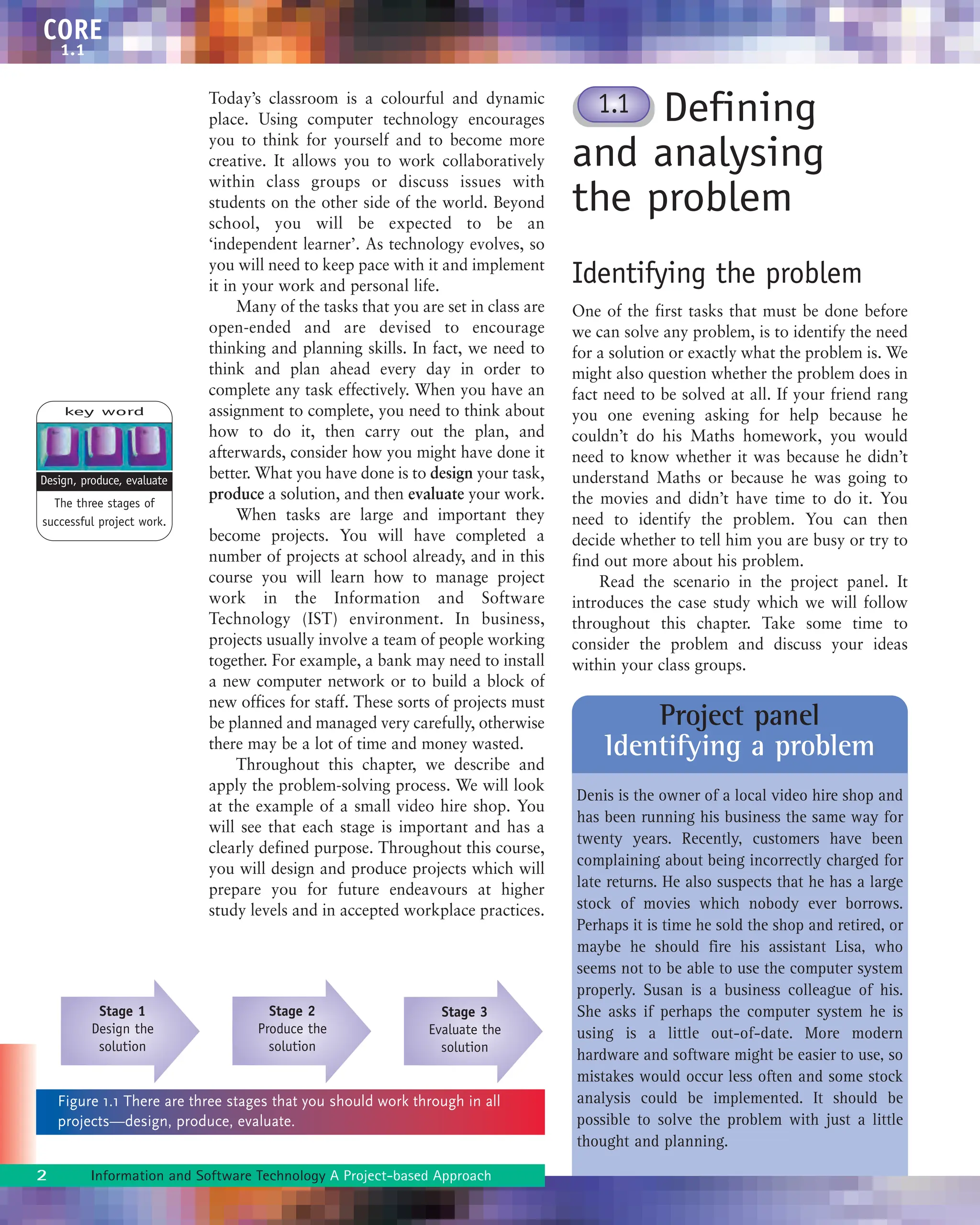
Figure 1.1 There are three stages that you should work through in all
projects—design, produce, evaluate.
Project panel
Identifying a problem
Denis is the owner of a local video hire shop and
has been running his business the same way for
twenty years. Recently, customers have been
complaining about being incorrectly charged for
late returns. He also suspects that he has a large
stock of movies which nobody ever borrows.
Perhaps it is time he sold the shop and retired, or
maybe he should fire his assistant Lisa, who
seems not to be able to use the computer system
properly. Susan is a business colleague of his.
She asks if perhaps the computer system he is
using is a little out-of-date. More modern
hardware and software might be easier to use, so
mistakes would occur less often and some stock
analysis could be implemented. It should be
possible to solve the problem with just a little
thought and planning.
2 Information and Software Technology A Project-based Approach
Stage 1
Design the
solution
Stage 2
Produce the
solution
Stage 3
Evaluate the
solution
CORE
1.1
1.1
Factors that impact on
problem-solving
In any project, there are various factors which
might impact on any planned solution. These fall
into four categories—technical, operational,
financial and ethical.
• Technical factors might include whether the
available hardware or software is adequate
for the task. Is there other hardware which
could be used to input information into the
system?
• Operational factors would need to be taken
into account to see how the new plans would
fit into the existing system or work place.
Will the staff be comfortable using a new
system or should there be some training
opportunities offered?
• Financial factors will influence the budget.
How much will the whole project cost to set
up and maintain? Will it in fact save money
and increase profits eventually?
• Ethical factors would influence ideas about
data access and marketing practices. What
information should be stored on the system
and who will be allowed access to it?
Designing
possible solutions
The first major stage in project development is
the design phase, in which we need to produce
several possible solutions for the project. It is
important to write down the criteria which the
solutions must meet in order to keep the ideas on
track. Think about the target audience, and the
time-frames and resources available.
Generating ideas
Generating ideas can be a creative and
spontaneous pursuit. It is a good idea to document
ideas so that you can revisit them later or share
them with other people. You might choose to use
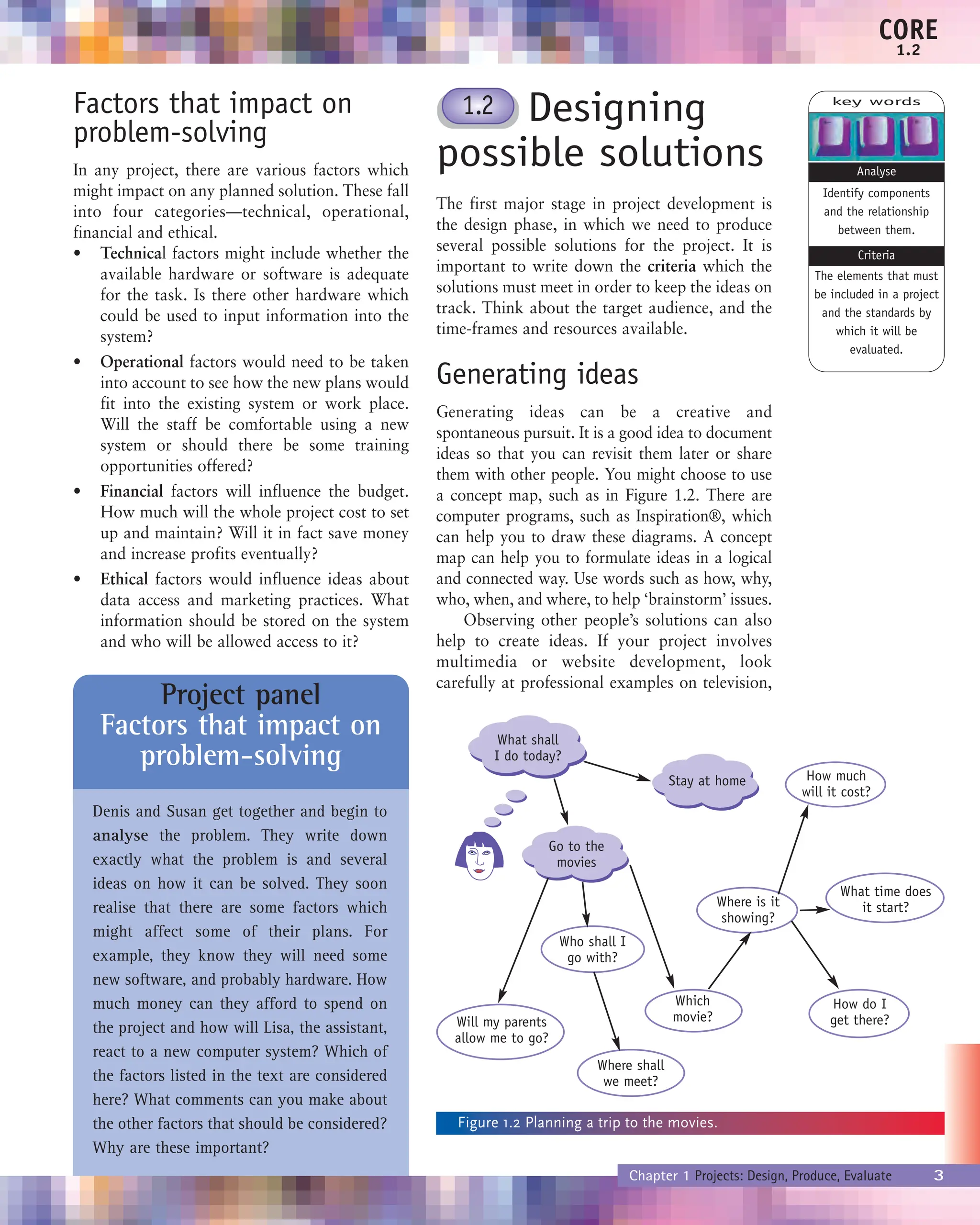
a concept map, such as in Figure 1.2. There are
computer programs, such as Inspiration®, which
can help you to draw these diagrams. A concept
map can help you to formulate ideas in a logical
and connected way. Use words such as how, why,
who, when, and where, to help ‘brainstorm’ issues.
Observing other people’s solutions can also
help to create ideas. If your project involves
multimedia or website development, look
carefully at professional examples on television,
key words
Identify components
and the relationship
between them.
The elements that must
be included in a project
and the standards by
which it will be
evaluated.
Criteria
Analyse
Project panel
Factors that impact on
problem-solving
Denis and Susan get together and begin to
analyse the problem. They write down
exactly what the problem is and several
ideas on how it can be solved. They soon
realise that there are some factors which
might affect some of their plans. For
example, they know they will need some
new software, and probably hardware. How
much money can they afford to spend on
the project and how will Lisa, the assistant,
react to a new computer system? Which of
the factors listed in the text are considered
here? What comments can you make about
the other factors that should be considered?
Why are these important?
Chapter 1 Projects: Design, Produce, Evaluate 3
CORE
1.2
Figure 1.2 Planning a trip to the movies.
What shall
I do today?
Stay at home
Go to the
movies
Will my parents
allow me to go?
Which
movie?
Who shall I
go with?
Where is it
showing?
How much
will it cost?
How do I
get there?
What time does
it start?
Where shall
we meet?
1.2
in magazines or on the Internet. How is a
particular mood or idea conveyed? What
colours, layout or images have been used? You
may not use all these ideas immediately, but they
may be helpful in a future project.
Researching information has been made an
easier task with the introduction of technology
into the classroom. Using search engines on your
favourite website, or e-mailing companies and
individuals, can be a great way to stimulate
ideas. Librarians or newspapers and magazines
can be very helpful resources. Information you
use from printed or digital media will need to be
summarised in any research that you do for a
project. Make sure you write down where you
found your ideas. You will need to acknowledge
them formally at the end of your project or you
may want to revisit them later.
Design techniques
Once you have several ideas in front of you, you
may want to try them out to see how they work.
Depending on the type of project you are
working on, you may want to build a prototype
or draw up a storyboard to help you decide on
the overall look of the project solution.
Software developers working on a new
project often use a prototype to test their ideas.
A prototype is a simple version of the final
product. It will not have every detail working,
but it can be used to get feedback from typical
users. For example, if a program was needed to
produce an on-line quiz for students, the initial
prototype could be used to judge whether
instructions to the user were clear, or if all the
modules connected with each other as planned.
You could get some useful feedback by giving the
user a list of questions to rate their opinions, or
just by observing how they use the quiz.
Software developers will also use an input,
process, output (IPO) table to document their
plans. An IPO table shows how data input to the
program is processed to become output. In the
same example of our student on-line quiz, it is
important to identify exactly what the program
is designed to produce (output), the data it needs
to create that result (input), and what work
needs to be done in between (processing).
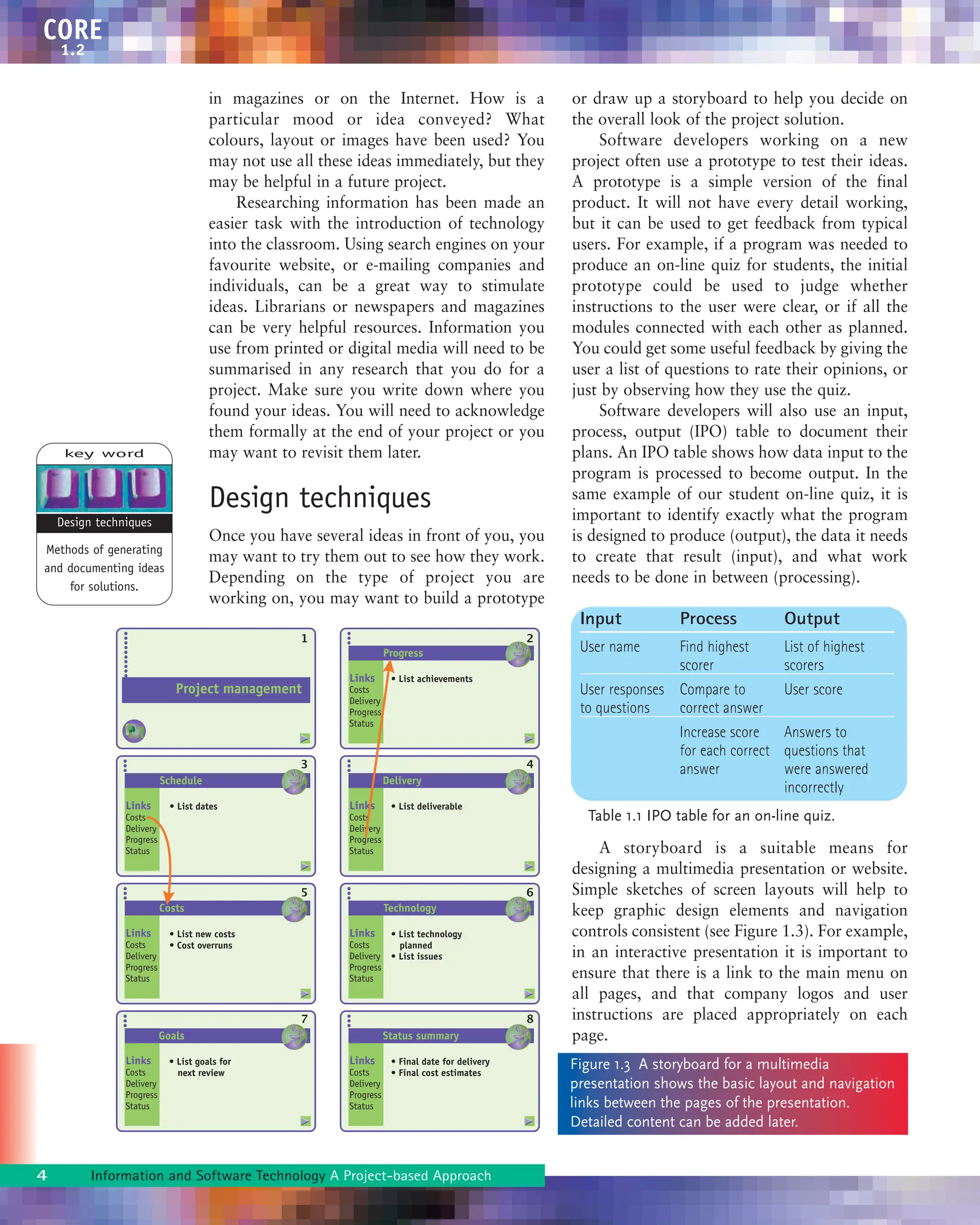
A storyboard is a suitable means for
designing a multimedia presentation or website.
Simple sketches of screen layouts will help to
keep graphic design elements and navigation
controls consistent (see Figure 1.3). For example,
in an interactive presentation it is important to
ensure that there is a link to the main menu on
all pages, and that company logos and user
instructions are placed appropriately on each
page.
4 Information and Software Technology A Project-based Approach
CORE
1.2
key word
Methods of generating
and documenting ideas
for solutions.
Design techniques
Input Process Output
User name Find highest List of highest
scorer scorers
User responses Compare to User score
to questions correct answer
Increase score Answers to
for each correct questions that
answer were answered
incorrectly
Project management
Links
Costs
Delivery
Progress
Status
Progress
• List achievements
Links
Costs
Delivery
Progress
Status
Schedule
• List dates Links
Costs
Delivery
Progress
Status
Delivery
• List deliverable
Links
Costs
Delivery
Progress
Status
Costs
• List new costs
• Cost overruns
Links
Costs
Delivery
Progress
Status
Technology
• List technology
planned
• List issues
Links
Costs
Delivery
Progress
Status
Goals
• List goals for
next review
Links
Costs
Delivery
Progress
Status
Status summary
• Final date for delivery
• Final cost estimates
1
3
5
7
2
4
6
8
Figure 1.3 A storyboard for a multimedia
presentation shows the basic layout and navigation
links between the pages of the presentation.
Detailed content can be added later.
Table 1.1 IPO table for an on-line quiz.
Producing
solutions
Criteria
Having spent a significant amount of time
generating and documenting ideas, the second
stage of your project will be to actually produce
a solution. At an early stage in any project, there
will need to be some agreement on the style and
scope of the finished product. These are
commonly called criteria, and are the standards
to which the solution must conform. There may
be a particular audience that needs to be
targeted, or a particular software application
that must be able to run the solution.
Your documentation should indicate clearly
the criteria which will need to be met, and you
may need to eliminate some of your ideas if they
do not qualify. If, for example, you have to make
a presentation on a subject you have researched,
you would need to ensure that the material you
gather is not too technical for your audience.
You may need to restrict your ideas to graphics
which are not copyrighted, nor too complex to
be understood by your audience. Remember that
you may need to explain how the criteria have
been met in a later stage of the project.
Basic rules and innovation
During this course, you will use many different
software applications to produce some exciting
projects. There will be frequent opportunities to
think outside the square and investigate different
methods of development. It is important,
however, to remember some basic rules. It is
better to have a simple presentation that works,
rather than a complex and sophisticated program
which is riddled with bugs. Also, losing your
work at a crucial moment can be frustrating, so
regular and secure backups are essential. Keep an
open mind and ask for constructive feedback
from your peers. Discovering new techniques can
be the best part of project work and encourages
innovative solutions.
In the remaining sections of this chapter, you
will learn more techniques to enable you to
Chapter 1 Projects: Design, Produce, Evaluate 5
CORE
1.3
Questions
1 Identify the three main stages of project
work. What needs to be done even before
the first stage?
2 You want to include a video clip in a
presentation you are making to your local
sports club. What are the possible ways you
could do this and what might be some of
the problems? Brainstorm some ideas and
draw up a concept map of possible
solutions.
3 What would be some of the most important
factors which would have to be considered
when working on a large project? Consider
the trip to the movies illustrated in Figure
1.2. What factors could impact on the
planned solutions? What could happen if
the trip was not planned adequately?
4 Make a list of all the ways you can generate
ideas or document your project design
processes. Select a project which would suit
each method.
5 Examine some designs, either in a magazine
or on the Internet, which advertise a
particular type of product. Evaluate the
designs by identifying what needs were
being met and how they were met. Produce
a simple reconstruction of the design using
presentation-type software.
1.3
key word
Apply set criteria to
choose the most
appropriate solution.
Produce solutions
Project panel
Designing possible
solutions
Our friends in the video shop write down some
clear ideas on the time scale, budget and
requirements for the new system. They start to
use a database program to see how the
information about videos and customers can be
organised. Susan has seen a website which
might give them some ideas for giving
customers on-line access to information. She
sketches out a storyboard to document her ideas.
What other activities should they be considering
at this stage?
produce quality IST projects. These include
evaluation, management plans, communication
and the challenges of working in a group.
Evaluation
As the final stage in any project, it is essential to
evaluate the solution. This means more than just
a verbal expression of personal opinion.
Evaluations need to be planned and documented
as much as the solution itself.
Evaluation criteria
The evaluation criteria that were originally
specified for the solution will need to be
examined carefully and you may need to explain
how they have been met. If, for example, you
have been creating a digital media presentation
for an advertising agency, it may be more
important to use quality graphic design
principles, rather than to include lots of busy
animations and sound effects. Similarly, file sizes
may be critical for a website design.
Functionality and quality
Some other criteria which should be considered
in the evaluation of all projects include
functionality and quality of information.
Functionality means whether the application
works satisfactorily. If a program does not work
properly or in the way we expect, this can cause
an enormous amount of frustration. Thorough
testing needs to be carried out to ensure that
there is no potential for misunderstanding by the
user. For example, in a multimedia presentation,
if an icon needs to be clicked to play a movie
clip, prompt the user to do it.
Quality of information in any project is
important. Information must be accurate,
otherwise errors can be made in processing data
or making decisions. This would certainly be the
case for a bank or a medical database service.
Clients may suffer as a result of incorrect data
entry, and controls should be put in place to
guard against this happening. Information stored
in a system or displayed on a screen must be
relevant to the project, otherwise it is useless and
it will take up valuable space. It may also be
confusing to the user.
Integrity of information is a measure of its
reliability and so it should be
collected only from a trusted source. Finding
information in a newspaper or on the Internet
does not guarantee that it is true. You should
take reasonable measures yourself to ensure your
data is correct. Even though all these precautions
are taken, information can also become out-of-
date, for example clients can move house or
change their job. This factor is referred to as
currency and is yet another factor to be
considered in collecting and storing information.
Ethics and the environment
Ethics and the environment will also be
important criteria for evaluating projects.
In core chapter 7: Issues, you will investigate
the issues of ethics and how they apply to
projects in IST. These issues must be part of the
evaluation criteria of all projects. For example,
there is a reasonable expectation that clients’
personal details will be protected from hackers
and that any statistics produced from stored data
will be presented in a fair and honest manner.
In addition, we must all take responsibility
6 Information and Software Technology A Project-based Approach
CORE
1.4
Project panel
Produce a solution
Denis and Susan gave the prototype database
that they had developed to the assistant Lisa to
see if it worked successfully. Although she was
quite an experienced computer user and keen
to use the new system, Lisa seemed to have a
problem understanding how it all worked.
There was obviously a need for some training
and on-line user help. In light of Lisa’s
comments, Denis and Susan decided that they
would be better off hiring a computer
professional to manage the whole project. The
time plan and financial analysis that they had
carried out earlier confirmed this decision. Why
do you think Denis and Susan decided to use a
computer professional to complete the project?
What factors would have been important in
making this decision?
key words
How the solution
compares with original
expectations.
The factors by which
the project will be
judged.
Evaluation
Evaluation criteria
1.4
for protecting our environment, both close to
home and across the world. Excessive use of
paper and inconsiderate disposal of old
hardware can make major impacts on our
environment. Issues such as the placement of
communication towers and clean methods of
delivering power to our computers are further
examples of such environmental concerns.
Methods of evaluation
We have looked at a range of criteria which
should be used to evaluate our projects. We can
also use different groups of people to test those
criteria. Initially of course, we would allow
ourselves the opportunity to consider our own
work. Making time to step back and consider
our own efforts is a first essential.
Asking for feedback from peers as well as
teachers is a valuable experience. Try to reflect
upon any comments so that you can modify your
work to meet the criteria more effectively, and
also to improve upon performance in future
projects. If the project is targeted at a particular
group of people or specific end-user, it would
make sense to get regular feedback from these
people during the development of the project. It
might be useful to write down some specific
questions for them to answer, rather than expect
just vague comments on all aspects of your work.
Management
We have seen how to use specific criteria to
develop successful projects. We will look now at
some other factors which will help to ensure
success in our endeavours. A small amount of
planning can take us a long way and the bigger
the project, the more important the planning will
be. Some statistics quote an eighty per cent
failure rate on projects in the information and
communication industry due to lack of project
management. This can become very expensive
and frustrating for the workers and the client. In
core chapter 6: People, you will read about
project managers who have specialised jobs in
the information technology field. They are
responsible for the overall success of the project
by planning the use of resources such as time,
finances and people.
Planning
Having a clear time schedule is essential for
completing a project on time. Remember that
problems may arise while you are developing your
solution, so it is a good idea to work well ahead of
Chapter 1 Projects: Design, Produce, Evaluate 7
CORE
1.5
Project panel
Evaluation
Denis and Susan hired Andrew, a computer
project manager, to complete the solution for
the video hire shop. They gave him all the
documentation they had created, and Andrew
discussed with them some of the other factors
which they had not yet considered, such as data
security and backup. Andrew was also able to
advise them on the legal implications of
collecting and storing information about
people. What issues do you think would have
been documented in this stage?
Questions
1 List the criteria by which all projects should be evaluated. Give an
example of how these would be met in the video hire shop example
discussed throughout this chapter.
2 Identify the four qualities that information should have. Give an
example to illustrate the importance of each in the context of a
database system in a doctor’s surgery.
3 Examine some of the projects that you have completed for other
subjects. What criteria were used to evaluate your work? Was content
more important than presentation? Reflect upon the evaluation and
describe how it will be useful in future projects.
4 Find some newspapers articles which deal with environmental issues
in IST projects. Summarise the issues and organise a debate in class
to discuss possible safeguards which should be used to protect the
environment.
5 Imagine your teacher has asked you to design some geography
posters for the junior school. Who would you ask to evaluate your
work? Draw up a list of questions or criteria which might help the
evaluators to complete this task.
1.5
key word
Planning and
co-ordinating resources.
Project management
CORE
x.x
deadlines. Items such as printer cartridges, e-mail
attachments and floppy disks all have the
potential to let you down at the most inconvenient
moments. Making secure backups of your work
will pay dividends and save you time.
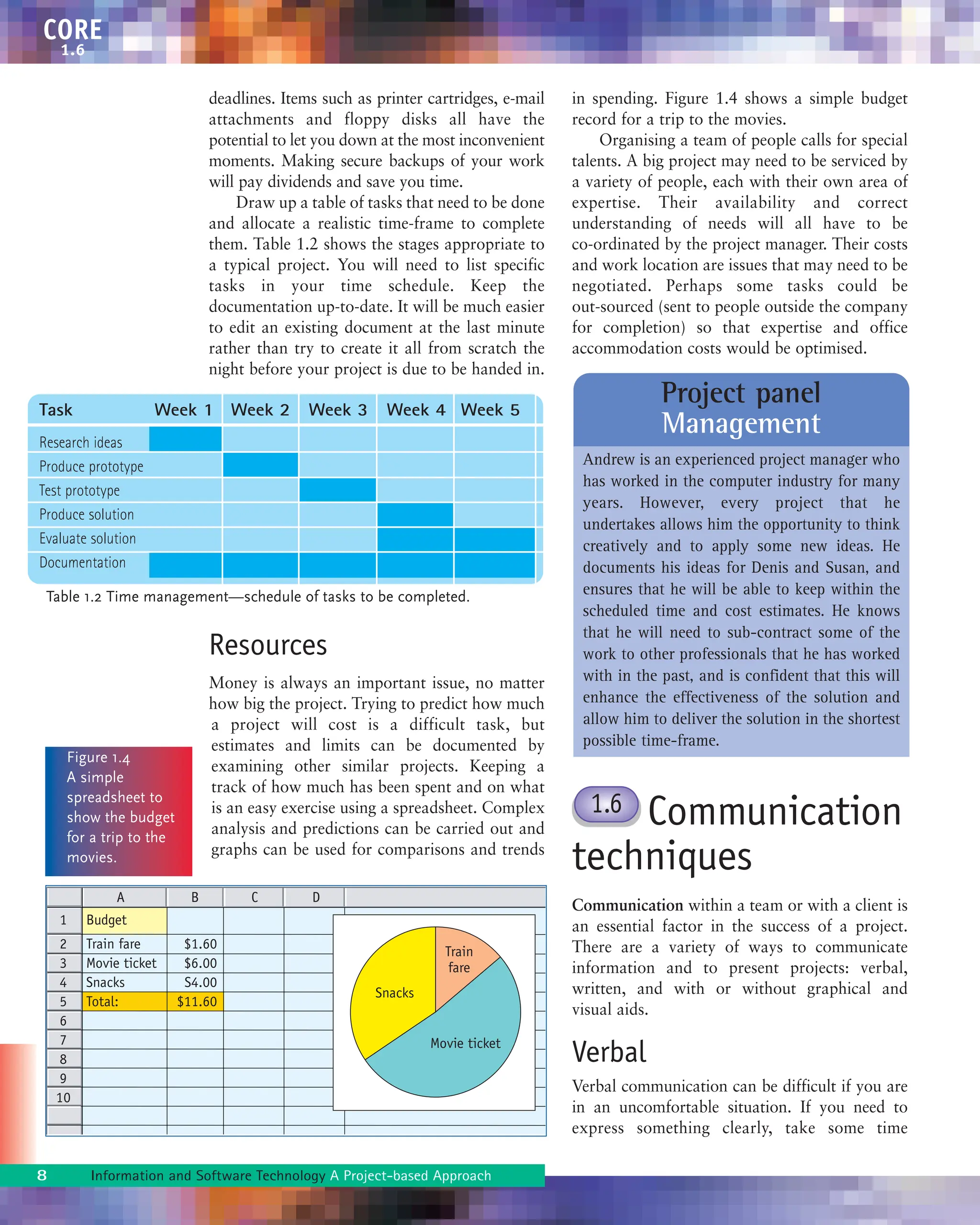
Draw up a table of tasks that need to be done
and allocate a realistic time-frame to complete
them. Table 1.2 shows the stages appropriate to
a typical project. You will need to list specific
tasks in your time schedule. Keep the
documentation up-to-date. It will be much easier
to edit an existing document at the last minute
rather than try to create it all from scratch the
night before your project is due to be handed in.
Resources
Money is always an important issue, no matter
how big the project. Trying to predict how much
a project will cost is a difficult task, but
estimates and limits can be documented by
examining other similar projects. Keeping a
track of how much has been spent and on what
is an easy exercise using a spreadsheet. Complex
analysis and predictions can be carried out and
graphs can be used for comparisons and trends
in spending. Figure 1.4 shows a simple budget
record for a trip to the movies.
Organising a team of people calls for special
talents. A big project may need to be serviced by
a variety of people, each with their own area of
expertise. Their availability and correct
understanding of needs will all have to be
co-ordinated by the project manager. Their costs
and work location are issues that may need to be
negotiated. Perhaps some tasks could be
out-sourced (sent to people outside the company
for completion) so that expertise and office
accommodation costs would be optimised.
Communication
techniques
Communication within a team or with a client is
an essential factor in the success of a project.
There are a variety of ways to communicate
information and to present projects: verbal,
written, and with or without graphical and
visual aids.
Verbal
Verbal communication can be difficult if you are
in an uncomfortable situation. If you need to
express something clearly, take some time
Task Week 1 Week 2 Week 3 Week 4 Week 5
Research ideas
Produce prototype
Test prototype
Produce solution
Evaluate solution
Documentation
B
A C D
1
2
3
4
5
6
7
8
9
10
Budget
Train fare $1.60
Movie ticket $6.00
Snacks S4.00
Total: $11.60
Snacks
Movie ticket
Train
fare
Figure 1.4
A simple
spreadsheet to
show the budget
for a trip to the
movies.
Project panel
Management
Andrew is an experienced project manager who
has worked in the computer industry for many
years. However, every project that he
undertakes allows him the opportunity to think
creatively and to apply some new ideas. He
documents his ideas for Denis and Susan, and
ensures that he will be able to keep within the
scheduled time and cost estimates. He knows
that he will need to sub-contract some of the
work to other professionals that he has worked
with in the past, and is confident that this will
enhance the effectiveness of the solution and
allow him to deliver the solution in the shortest
possible time-frame.
8 Information and Software Technology A Project-based Approach
1.6
Table 1.2 Time management—schedule of tasks to be completed.
CORE
1.6
beforehand to make a note of the main idea you
wish to convey. Remember that the more you
practise this skill, the easier it will become. Oral
presentations of projects bring their own
challenges. If you are presenting to an audience,
make sure all equipment is working as you would
expect. Practise the presentation beforehand on
the actual hardware you will use on the day. Any
visual aids you use must be large enough for all
your audience to see. Demonstrating the inside
workings of a hard disk drive, for example, will
be difficult if your audience is too far away.
Graphics and animations should be clear and
appropriate. Try not to read your script too much
and never insult your audience by reading word-
for-word off a screen.
Even though it is challenging, you should
take advantage of opportunities you have in this
course to present work in front of your class, as
this can be an important skill needed in the
workplace.
Written
Written documentation is an essential part of any
project. It is a good idea to write a diary of
events so that you can reflect on the progress you
have made. This will become increasingly
important for larger projects. Hard copies of
documentation or research findings should be
clearly named and dated and submitted in a
folder so that they are easy to read. Always
acknowledge your sources of information and
anyone who helped you with the project.
Graphical
Throughout this course, you will have the
opportunity to incorporate many graphical
images and visual aids into your projects. These
can add exciting impact and capture audience
interest. However, you must ensure that they are
appropriate to the theme of the project and that
issues of copyright are not violated. Another
option for presenting your project might be to
publish it on the Internet or your school’s
intranet.Your audience would have the flexibility
of accessing your presentation in their own time,
and you could ask for feedback from them by
e-mail or questionnaire.
Group work
Criteria for group formation
In any area of business, groups of people are
brought together to work on projects so that
there is a range of expertise within the team.
People find themselves working with other
people who they don’t know very well and they
may have different views on a number of work
issues. The challenge for any team leader is to
encourage collaboration so that each member of
the team can contribute positively to the project.
Every situation can provide opportunities to
develop organisational, communication and
negotiation skills.
Roles and responsibilities
Organising a list of the roles and responsibilities
for the team is important at an early stage in the
project planning. Individuals can then plan each
task so that it fits with everyone else’s schedule.
Sharing time and experience is an effective
tool in developing group dynamics, and each
team member should be prepared to do this. At
group meetings, take turns in expressing ideas
and reporting problems. You can learn a lot from
listening carefully to other people’s problem-
Project panel
Communication
Denis and Susan have every confidence that
Andrew will produce an effective solution to
the problem in the shortest possible time. It is
still important, however, for all of them to keep
in touch and to receive regular feedback as the
project progresses. Andrew has been careful to
make notes of all discussions and has kept the
documents that contained their original ideas.
He will continue to do this throughout the
project and to date and sign all decisions that
they make together. In turn, Andrew will need
to pass on specific tasks and time schedules to
the members of his team. All three means of
communication are important. How will they
be used at this stage of the project?
Chapter 1 Projects: Design, Produce, Evaluate 9
CORE
1.7
key word
Passing on information.
Communication
1.7
solving techniques. Take the opportunity to
understand other people’s strengths and
weaknesses.
When working as a group, it is important to
let everyone have the opportunity to express
their opinions in a positive and comfortable
atmosphere. Write down ideas and decisions so
that there is no misunderstanding later on by any
individual. Describing a problem and its solution
can help to avoid similar problems being
repeated in the future. If you are using e-mail,
make sure everyone gets a copy of each message.
Accept comments from your partners as positive
feedback and consider how any conflict might be
resolved calmly and amicably.
Collaboration
It is essential to document ideas and decisions so
that everyone in the group understands their
responsibilities. Plan regular meetings so that
people will work to deadlines and can report
their progress. Phone calls and e-mails are
effective for reminders, but all members of the
team need to be notified of any discussion that
took place. Allow time at meetings for each
member of the group to comment on the
development of the project as a whole. Agree on
strategies for assessment of individual
contributions. If anyone seems to be falling
behind the agreed schedule, it is important that
the problem be discussed and a solution
negotiated.
In the final project evaluation, reflect on the
challenges that collaboration presented and the
advantages you found from working as part of a
group.
10 Information and Software Technology A Project-based Approach
CORE
1.7
key word
Working together in a
group to share ideas
and expertise.
Collaboration
Questions
1 Imagine that you have been given
permission to decorate your bedroom at
home. List all the tasks that will need to be
done before you actually start work on
applying the paint. Create a time plan and
estimate the cost of the project using a
spreadsheet. Are there specific people you
will need help from? Will they be available
when you need them?
2 Identify at least three ways to communicate
information and discuss the advantages of
each.
3 Consider a group project that you have
completed for another subject. What
strategies did you use to ensure the project
was completed on time? What were the
largest areas of concern? How did you
negotiate through difficult situations? What
strengths do you feel you have that would
be beneficial to a project team?
WS
C
H
APTER TE
S
T
CORE
x.x
2 core
CHAPTER OUTCOMES
You will learn about:
• functions that hardware performs
• hardware components
• microprocessors
• classifications of hardware
• hardware solutions
• troubleshooting
• care and maintenance of hardware
You will learn to:
• classify hardware devices
• identify hardware components
• describe the uses of microprocessors
• develop hardware solutions
• identify troubleshooting procedures
• apply basic procedures for the care and
maintenance of hardware
CHAPTER CONTENTS
2.1 Hardware functions 12
2.2 Hardware components 13
2.3 Microprocessors 18
2.4 Classification of systems 18
2.5 Hardware solutions 20
2.6 Troubleshooting 21
2.7 Care and maintenance 21
Hardware
Hardware
A computer is often defined as an information
processor—we supply it with data to be changed
into an appropriate format, which can then be
stored or displayed for a specific purpose. The
components of the computer system are
classified according to which type of function
they perform—input, processing, output, storage
and control.
The input, output and storage devices are
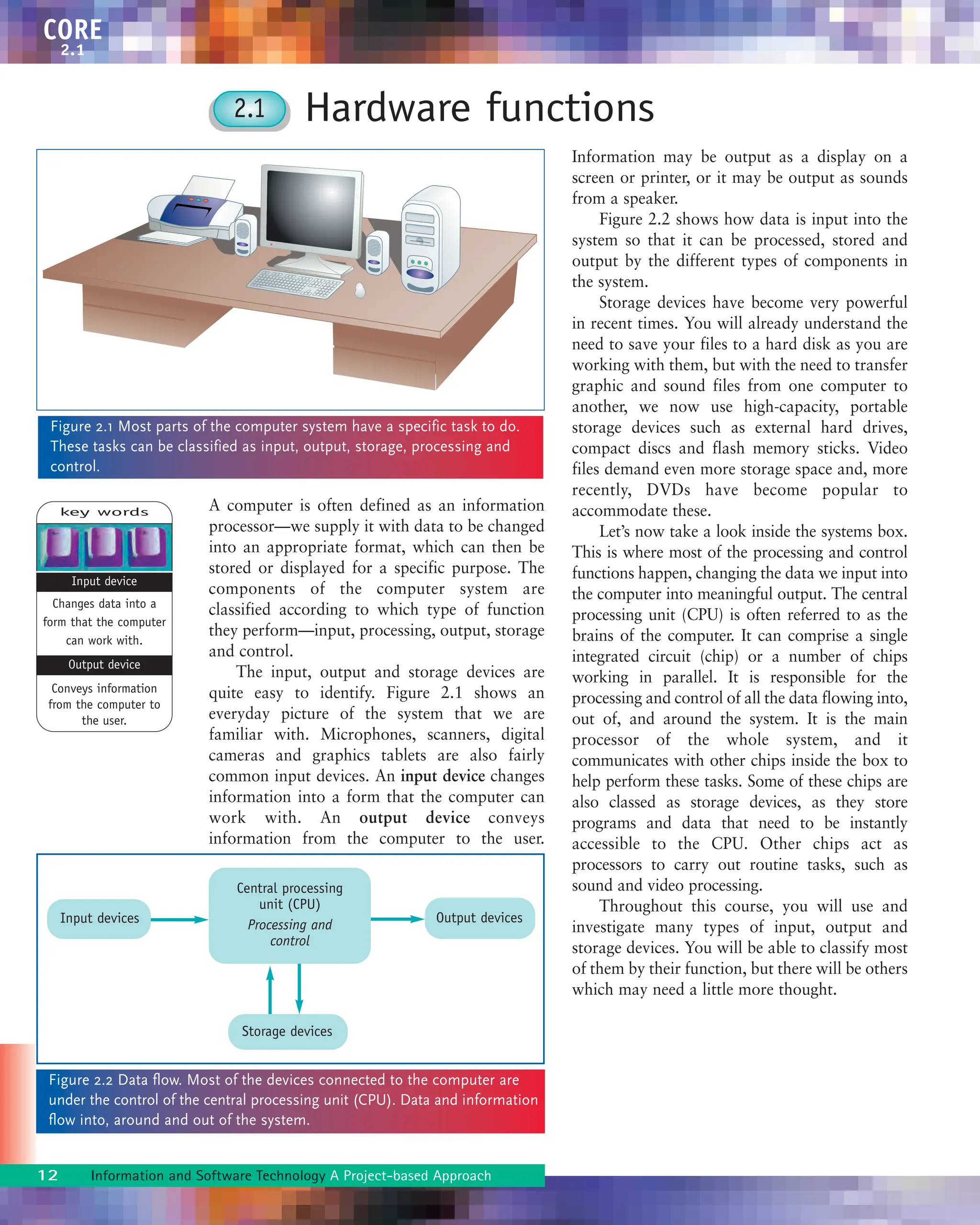
quite easy to identify. Figure 2.1 shows an
everyday picture of the system that we are
familiar with. Microphones, scanners, digital
cameras and graphics tablets are also fairly
common input devices. An input device changes
information into a form that the computer can
work with. An output device conveys
information from the computer to the user.
Information may be output as a display on a
screen or printer, or it may be output as sounds
from a speaker.
Figure 2.2 shows how data is input into the
system so that it can be processed, stored and
output by the different types of components in
the system.
Storage devices have become very powerful
in recent times. You will already understand the
need to save your files to a hard disk as you are
working with them, but with the need to transfer
graphic and sound files from one computer to
another, we now use high-capacity, portable
storage devices such as external hard drives,
compact discs and flash memory sticks. Video
files demand even more storage space and, more
recently, DVDs have become popular to
accommodate these.
Let’s now take a look inside the systems box.
This is where most of the processing and control
functions happen, changing the data we input into
the computer into meaningful output. The central
processing unit (CPU) is often referred to as the
brains of the computer. It can comprise a single
integrated circuit (chip) or a number of chips
working in parallel. It is responsible for the
processing and control of all the data flowing into,
out of, and around the system. It is the main
processor of the whole system, and it
communicates with other chips inside the box to
help perform these tasks. Some of these chips are
also classed as storage devices, as they store
programs and data that need to be instantly
accessible to the CPU. Other chips act as
processors to carry out routine tasks, such as
sound and video processing.
Throughout this course, you will use and
investigate many types of input, output and
storage devices. You will be able to classify most
of them by their function, but there will be others
which may need a little more thought.
CORE
2.1
Figure 2.1 Most parts of the computer system have a specific task to do.
These tasks can be classified as input, output, storage, processing and
control.
2.1
12 Information and Software Technology A Project-based Approach
Hardware functions
Figure 2.2 Data flow. Most of the devices connected to the computer are
under the control of the central processing unit (CPU). Data and information
flow into, around and out of the system.
Central processing
unit (CPU)
Processing and
control
Output devices
Input devices
Storage devices
key words
Changes data into a
form that the computer
can work with.
Conveys information
from the computer to
the user.
Input device
Output device
Ports
CPU
Power supply
Hard drive
CD/DVD
drive
3.5" floppy
drive
C
o
n
tr
o
ll
e
r
c
a
rd
G
ra
p
h
ic
s
a
d
a
p
to
r
c
a
rd
E
x
p
a
n
si
o
n
sl
o
ts
ROM
Bus lines
Hardware
components
We are beginning to see that a computer system
is made up of different parts, and each has its
own particular job to do. Some parts are
responsible for input or output of data, some
parts are designed to process, store or transfer
the data. Many of these components are inside
the systems box, while other devices such as the
keyboard and monitor, are connected to the
motherboard using the ports at the back of the
systems box.
The motherboard
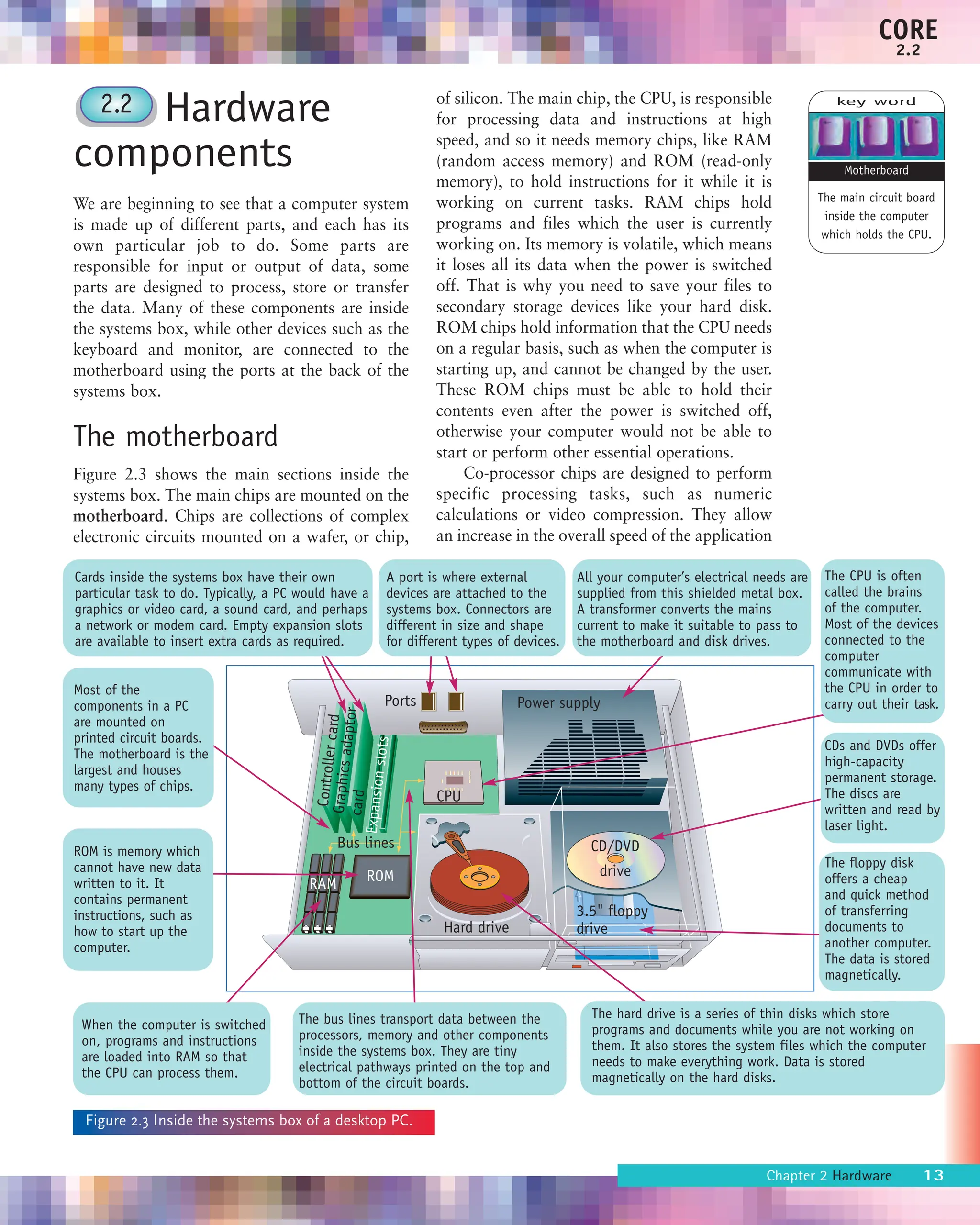
Figure 2.3 shows the main sections inside the
systems box. The main chips are mounted on the
motherboard. Chips are collections of complex
electronic circuits mounted on a wafer, or chip,
of silicon. The main chip, the CPU, is responsible
for processing data and instructions at high
speed, and so it needs memory chips, like RAM
(random access memory) and ROM (read-only
memory), to hold instructions for it while it is
working on current tasks. RAM chips hold
programs and files which the user is currently
working on. Its memory is volatile, which means
it loses all its data when the power is switched
off. That is why you need to save your files to
secondary storage devices like your hard disk.
ROM chips hold information that the CPU needs
on a regular basis, such as when the computer is
starting up, and cannot be changed by the user.
These ROM chips must be able to hold their
contents even after the power is switched off,
otherwise your computer would not be able to
start or perform other essential operations.
Co-processor chips are designed to perform
specific processing tasks, such as numeric
calculations or video compression. They allow
an increase in the overall speed of the application
2.2
Figure 2.3 Inside the systems box of a desktop PC.
Chapter 2 Hardware 13
CORE
2.2
key word
The main circuit board
inside the computer
which holds the CPU.
Motherboard
When the computer is switched
on, programs and instructions
are loaded into RAM so that
the CPU can process them.
The bus lines transport data between the
processors, memory and other components
inside the systems box. They are tiny
electrical pathways printed on the top and
bottom of the circuit boards.
The hard drive is a series of thin disks which store
programs and documents while you are not working on
them. It also stores the system files which the computer
needs to make everything work. Data is stored
magnetically on the hard disks.
Most of the
components in a PC
are mounted on
printed circuit boards.
The motherboard is the
largest and houses
many types of chips.
ROM is memory which
cannot have new data
written to it. It
contains permanent
instructions, such as
how to start up the
computer.
Cards inside the systems box have their own
particular task to do. Typically, a PC would have a
graphics or video card, a sound card, and perhaps
a network or modem card. Empty expansion slots
are available to insert extra cards as required.
A port is where external
devices are attached to the
systems box. Connectors are
different in size and shape
for different types of devices.
All your computer’s electrical needs are
supplied from this shielded metal box.
A transformer converts the mains
current to make it suitable to pass to
the motherboard and disk drives.
The CPU is often
called the brains
of the computer.
Most of the devices
connected to the
computer
communicate with
the CPU in order to
carry out their task.
CDs and DVDs offer
high-capacity
permanent storage.
The discs are
written and read by
laser light.
The floppy disk
offers a cheap
and quick method
of transferring
documents to
another computer.
The data is stored
magnetically.
as they relieve the CPU of some of the routine
tasks. Co-processor chips can be located on the
motherboard, or on other controller cards, such
as graphics cards.
Controller cards
Controller cards are often expansion boards
which fit into slots in the motherboard. They
include such things as a video card, a sound card,
a network card and a modem card. A video card,
also called a graphics adaptor card, converts
computer output into a video signal that can be
sent through a cable, to display an image on the
screen. Video cards contain their own processing
and memory chips. A sound card allows sound
to be input through a microphone and output
through speakers. Co-processors on graphics and
sound cards help the CPU to process some of the
data so that operations run faster.
Notebook and other digital devices have
special expansion slots for installing PC cards.
These can add memory, sound and modem
capabilities. Similarly, some computers and
printers are able to use flash memory cards.
Bus lines
In a typical desktop computer, the CPU and
memory chips are attached to circuit boards, and
data can pass between them along connecting
channels or bus lines. Buses typically have 32,
64, or even more wires that the data can travel
along in parallel, which allows much faster
transmission and processing. Some buses connect
to expansion slots inside the systems box. Other
buses connect to external ports or sockets on the
outside of the systems box.
Ports
External devices, such as keyboards, monitors or
printers, often are attached by a cable to the
systems box. A port is the interface, or point of
attachment, to the systems box. There are many
different types of connectors at these ports, but
the ports themselves fall into two categories,
serial and parallel. A serial port transmits data
one bit at a time between the external device and
the systems box, and is used for devices which do
not need fast data transmission rates, such as a
keyboard, mouse or modem. A parallel port
allows several bytes of data to be transmitted at
a time, and so is used for higher-speed devices
such as printers.
14 Information and Software Technology A Project-based Approach
CORE
2.2
RAM
Hard drive
ROM
CPU
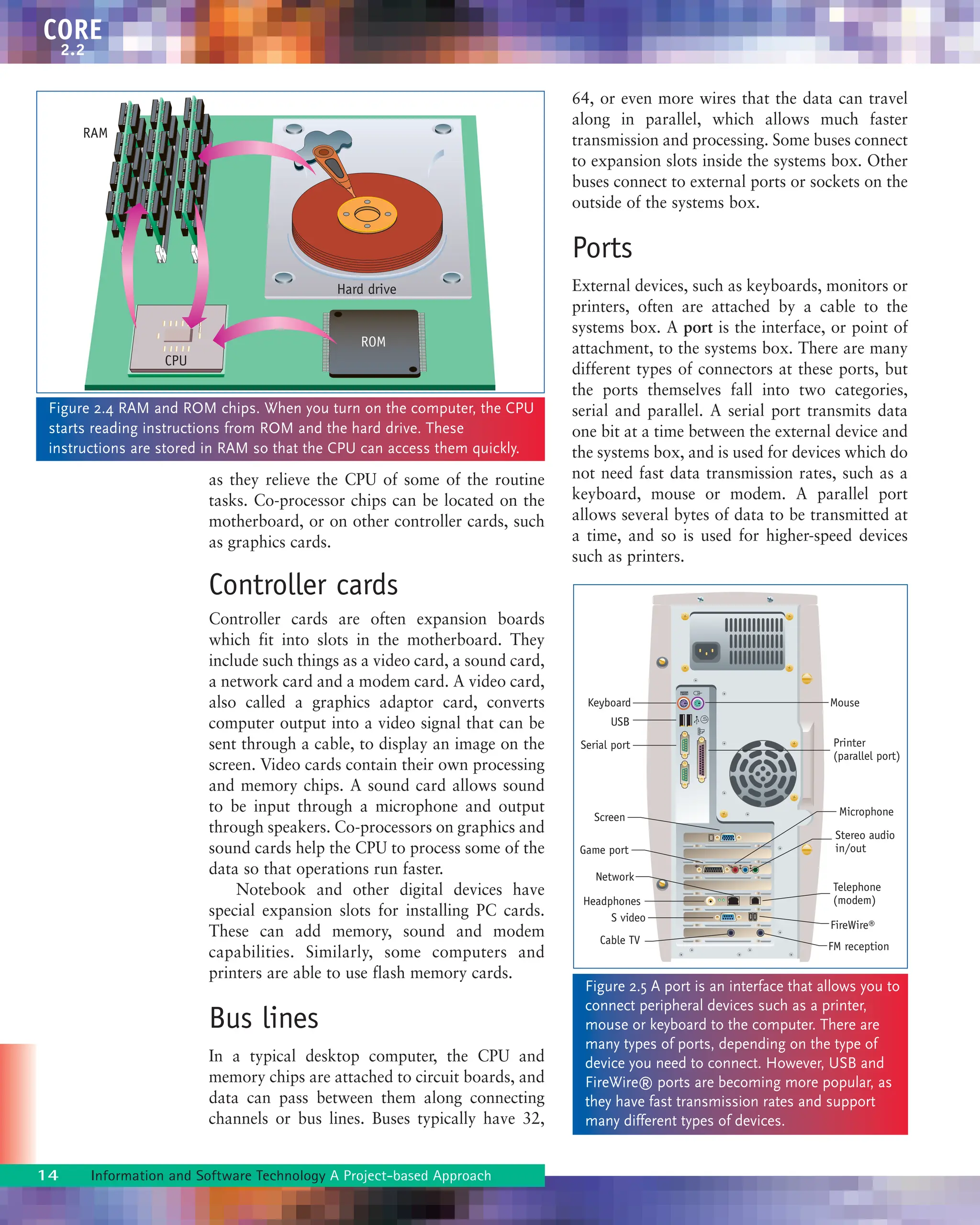
Figure 2.4 RAM and ROM chips. When you turn on the computer, the CPU
starts reading instructions from ROM and the hard drive. These
instructions are stored in RAM so that the CPU can access them quickly.
Keyboard Mouse
USB
Serial port Printer
(parallel port)
Screen
Game port
Microphone
Stereo audio
in/out
Headphones
S video
Network
FireWire®
Telephone
(modem)
Cable TV
FM reception
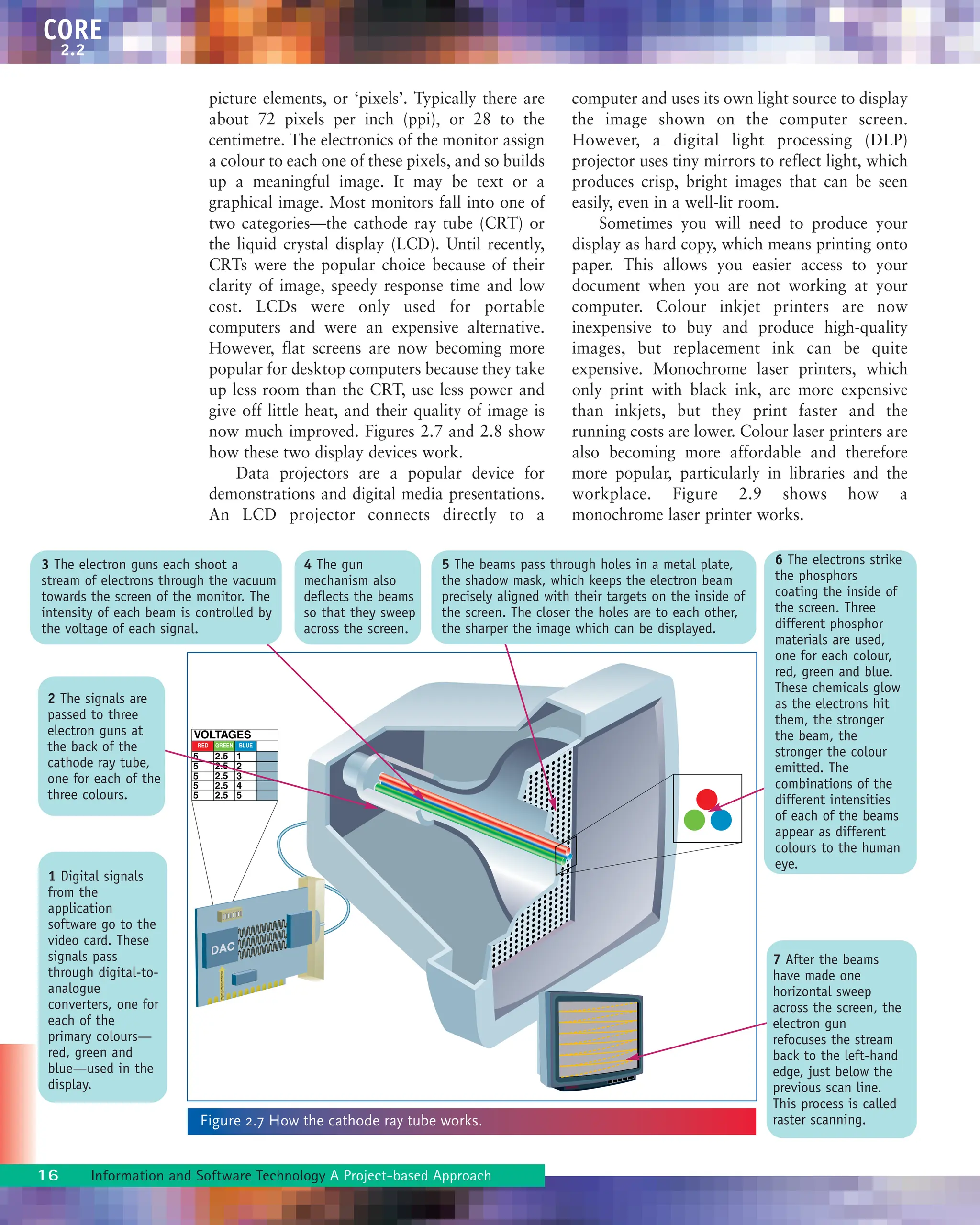
Figure 2.5 A port is an interface that allows you to
connect peripheral devices such as a printer,
mouse or keyboard to the computer. There are
many types of ports, depending on the type of
device you need to connect. However, USB and
FireWire® ports are becoming more popular, as
they have fast transmission rates and support
many different types of devices.
Having a standard port and connector
greatly simplifies the process of attaching devices
to a computer. A universal serial bus (USB) port
is many times faster than an ordinary serial port,
and so is gradually replacing both parallel and
serial ports. A single USB port can connect up to
127 different peripheral devices and supports
add-on devices such as keyboards, scanners,
printers, MPEG video devices and data gloves.
With USB technology, a new device can be added
to your computer without having to add an
adapter card or even having to turn the computer
off. Modern operating systems can detect any
new USB devices connected, and so are
immediately able to input or output data to it.
A different plug-and-play standard, IEEE
1394, often referred to as FireWire®, supports
much higher data rates and devices such as video
camcorders and digital video disc (DVD) players.
Power supply
The many components that make up the
computer system all need electricity to work. The
power supply is a small box inside the computer
case which makes sure that power is supplied to
each component in a form that is suitable. Some
components need only a very small voltage, and
so the mains supply needs to be transformed to a
suitable level.
If the computer is working from a battery,
then this will need recharging at regular
intervals. If the system is part of a network or
large mainframe computer, an uninterruptible
power supply (UPS) is often used to protect
against power failures.
Secondary storage
Before you turn your computer off, the
documents you have been working with need to
be stored for future use. There are several
secondary storage devices that can do this for
you. They all have different capacities, access
speeds and portability factors, so you will need
to make a decision about which one is most
suited to your needs. Magnetic storage disks
such as hard disks are fast and cheap, but not
very portable. CDs are much more portable than
hard disks but are slower in reading and writing
the data and have a limited storage capacity.
Figure 2.6 compares the way in which data is
stored on these two media.
Display
Today’s monitors are capable of displaying
graphics, animation and video, so it is important
to know a little bit about what determines size
and quality. The screen is divided into small
Chapter 2 Hardware 15
CORE
2.2
key word
Point of attachment of
external devices to the
systems box.
Port
Figure 2.6 How secondary storage works.
Hard disks are coated with a magnetic material. The
read–write head of a disk drive magnetises part of
the surface to record data. Recordable compact discs—data is written to the CD
by a laser burning unreflective areas into the layer
under the protective surface. The data can then be
read by a low-power laser reflecting off the areas in
between.
picture elements, or ‘pixels’. Typically there are
about 72 pixels per inch (ppi), or 28 to the
centimetre. The electronics of the monitor assign
a colour to each one of these pixels, and so builds
up a meaningful image. It may be text or a
graphical image. Most monitors fall into one of
two categories—the cathode ray tube (CRT) or
the liquid crystal display (LCD). Until recently,
CRTs were the popular choice because of their
clarity of image, speedy response time and low
cost. LCDs were only used for portable
computers and were an expensive alternative.
However, flat screens are now becoming more
popular for desktop computers because they take
up less room than the CRT, use less power and
give off little heat, and their quality of image is
now much improved. Figures 2.7 and 2.8 show
how these two display devices work.
Data projectors are a popular device for
demonstrations and digital media presentations.
An LCD projector connects directly to a
computer and uses its own light source to display
the image shown on the computer screen.
However, a digital light processing (DLP)
projector uses tiny mirrors to reflect light, which
produces crisp, bright images that can be seen
easily, even in a well-lit room.
Sometimes you will need to produce your
display as hard copy, which means printing onto
paper. This allows you easier access to your
document when you are not working at your
computer. Colour inkjet printers are now
inexpensive to buy and produce high-quality
images, but replacement ink can be quite
expensive. Monochrome laser printers, which
only print with black ink, are more expensive
than inkjets, but they print faster and the
running costs are lower. Colour laser printers are
also becoming more affordable and therefore
more popular, particularly in libraries and the
workplace. Figure 2.9 shows how a
monochrome laser printer works.
16 Information and Software Technology A Project-based Approach
CORE
2.2
4 The gun
mechanism also
deflects the beams
so that they sweep
across the screen.
Figure 2.7 How the cathode ray tube works.
2 The signals are
passed to three
electron guns at
the back of the
cathode ray tube,
one for each of the
three colours.
3 The electron guns each shoot a
stream of electrons through the vacuum
towards the screen of the monitor. The
intensity of each beam is controlled by
the voltage of each signal.
5 The beams pass through holes in a metal plate,
the shadow mask, which keeps the electron beam
precisely aligned with their targets on the inside of
the screen. The closer the holes are to each other,
the sharper the image which can be displayed.
6 The electrons strike
the phosphors
coating the inside of
the screen. Three
different phosphor
materials are used,
one for each colour,
red, green and blue.
These chemicals glow
as the electrons hit
them, the stronger
the beam, the
stronger the colour
emitted. The
combinations of the
different intensities
of each of the beams
appear as different
colours to the human
eye.
7 After the beams
have made one
horizontal sweep
across the screen, the
electron gun
refocuses the stream
back to the left-hand
edge, just below the
previous scan line.
This process is called
raster scanning.
1 Digital signals
from the
application
software go to the
video card. These
signals pass
through digital-to-
analogue
converters, one for
each of the
primary colours—
red, green and
blue—used in the
display.
Chapter 2 Hardware 17
CORE
2.2
Figure 2.8 How the liquid crystal display works.
1 Light from a fluorescent panel
spreads out in waves that vibrate
in all directions.
2 A polarising filter lets through
only the light waves that are
vibrating horizontally.
3 The light waves then pass
through the liquid crystal layer.
Each crystal cell is charged by
varying amounts to twist the
vibration of the light wave.
4 One of three coloured filters
then colours the light red, green
or blue.
5 A second polarising
filter only lets
through light that is
vibrating in a
partially or fully
vertical plane.
6 The mixture of
colours on the front
panel combine to
give the appearance
of a whole spectrum
of colours. In this
example, full red, half
green and no blue
will result in one
pixel appearing as a
pale brown.
Fluorescent
light source
Polarising
filter
Liquid
crystal
Coloured
filters
Second
polariser
Front
panel
Figure 2.9 How the monochrome laser printer works.
7 The paper passes
through the fusing
rollers, where heat
and pressure bind
the toner
permanently to the
paper.
3 A spinning mirror deflects the laser beam so that the path of the beam is a horizontal
line across the surface of the drum. After the laser has flashed points of light across the
width of the drum, the drum rotates about 0.004 mm, and the laser starts work on the next
line of dots.
6 The rotation of the drum brings its surface next to a thin wire,
called the corona wire, which has the task of removing the pattern
of charge from the surface of the drum.
2 The instructions from the printer’s processor
rapidly turn a beam of laser light on and off.
This on–off pattern represents the pattern of
dots as they will appear across the paper.
1 Your computer
sends signals to the
printer’s processor
to determine where
each dot of printing
toner is to be
placed on the
paper.
4 Where each
point of light
strikes the drum,
it makes a
charged dot on
the surface of
the drum which
will attract the
black printer
toner.
5 As the drum
continues to
rotate, it presses
against the sheet
of paper, and the
toner sticks to
the paper.
CORE
2.3
Digital watch
Inside a digital watch,
a quartz crystal vibrates
215
times per second.
The processor counts
the crystal’s vibrations
and advances the
digital display one
second each time the
total reaches 32 768.
The chip is also able to
store information input
by the user, such as
phone numbers and
appointments.
Microprocessors
Microprocessors are tiny electrical circuits made
up of millions of transistor switches, mounted on
a silicon chip, which control the flow of electrical
signals. Much of what a computer does is
dependent on these electronic switches routing
data in different ways, according to the software
instructions. The CPU inside the systems box of
a personal computer is often referred to as the
processor, or microprocessor, as it is very small
and controls the main operations of data
processing.
As well as computers, microprocessors are
found in many different electronic devices. Their
job is to store and process data—that is, to
change data into a form that is useful to humans
or another device. These devices include
cameras, watches and monitoring devices. Figure
2.10 shows a range of devices which use
microprocessors.
Classification
of systems
Computers don’t just come in one size. They are
often classified according to how powerful they
are, and this usually determines what type of job
they do. System classification is used to give
people a general idea of what the hardware can
do. The boundaries of these classifications are
sometimes a little unclear because technology
changes so rapidly. For example, several desktop
computers can be networked with each other to
act as a powerful server.
Figure 2.11 shows five different types of
hardware systems—handheld, personal computer,
server, mainframe and supercomputer.
Handheld computers have small screens and
keyboards, or sometimes no keyboard at all.
They might use a stylus for input instead.
Delivery people or meter readers often use these,
18 Information and Software Technology A Project-based Approach
Digital camera
Microprocessors enable the
camera to automatically
focus on a subject and take
a reading of the available
light. The camera sets the
aperture and shutter speed
for optimal exposure. A
processor may then
perform a preset level of
compression on the data
and stores it in a memory
device—often a flash
memory card.
Digital thermometer
Inside a digital
thermometer, the processor
converts the data from the
temperature sensor and
advances the LCD reading.
When the temperature is
steady, the reading is
locked in and a beeper
sounds.
Sensors provide
data to
processors in
hundreds of
applications,
such as climate
control and
robotics.
Figure 2.10 Microprocessors in other electronic devices.
key word
Microprocessor
A tiny but complex
electrical circuit
mounted on a silicon
chip.
2.4
2.3
as they are very easy to carry. Usually they can be
connected to a larger computer to exchange
information.
A personal computer is a computer that can
perform all of its input, processing, output and
storage activities by itself. It is small enough to
sit on a desktop, although the systems box is
sometimes positioned on the floor. A work-
station is a networked desktop computer which
can be used in combination with a server or
other computers on a network for a wide range
of tasks, including intense calculations and
graphics capabilities. Typical users might include
engineers, architects and graphic artists.
A notebook or laptop computer is light and
Chapter 2 Hardware 19
CORE
2.4
A handheld computer might be
web-enabled to allow you to access
the Internet wirelessly.
A personal computer might be small
enough to sit on your lap, yet powerful
enough to act as a server on a network.
A mid-range server is
about the size of a
cabinet. It is more
powerful than a
workstation, but less
powerful than a
mainframe.
Mainframe computers are large, expensive and
powerful. They can process up to millions of
instructions per second.
Supercomputers are used for weather forecasting
and science research.
Figure 2.11 Classifying hardware systems.
Questions
1 Draw up a table of hardware devices.
Identify each one as a device for input,
output, storage, processing and control and
describe the task of each one.
2 How do you think a touch-screen device
should be classified—input or output?
Could it be both? What about a mouse or a
modem?
3 List all the different storage devices you can
think of. Identify the most significant
strength of each. Does the floppy disk still
have a role to play? What is flash memory?
4 Look at the back of your computer. Can you
identify all the ports? Draw a diagram and
label each one with the device that would
be attached here.
5 Under the guidance of an adult, open up
the systems box of an old computer. Draw a
plan of the inside and label the main
components.
6 Find out how the inkjet printer works. Draw
a large labelled diagram like the one in
Figure 2.9.
7 Draw up a table to compare the different
categories of computer hardware systems.
For each category, compare physical size,
cost, storage capacity, processing speed and
typical applications.
portable, yet still powerful enough to meet most
needs of the individual worker.
A server can be any networked computer
that has appropriate server software installed.
However, in larger organisations, servers are
usually dedicated machines which control access
to software, files and printers. They are often
required to support thousands of connected users
at the same time. These host computers can be
used on the Internet to act as web servers.
Mainframe computers cost up to several
millions of dollars. They can store vast amounts
of data and are accessed with terminals or
personal computers. Banks and large government
organisations might use mainframe computers to
process their data. Users will communicate with
these computers using terminals.
A supercomputer is the fastest and most
expensive of all computers. They may contain
several processors that can share jobs and work
in parallel. This means that they are capable of
processing trillions of instructions in one second
and can be used for complex mathematical
calculations such as weather forecasting or
scientific research. A supercomputer might cover
the area of two basketball courts.
Hardware
solutions
Everyday, millions of computer users around the
world rely on different types of computer
systems for a variety of purposes. A student
working at home might require access to the
Internet for research, a business person might
need access to documents or a printer on a local
network. A bank or large retail organisation may
need to process millions of transactions every
day, yet still have fast and secure access to data.
A different hardware solution will need to be
found for each of these scenarios which will
allow their tasks to be completed as required.
Whatever the situation, it is important to
develop hardware solutions with careful
planning and consultation. In core chapter 1, we
considered the processes involved in project
development—design, produce, evaluate.
• Define and analyse the problem—Write
down the criteria to be met in the solution.
What are the most important factors? Cost?
Speed? Reliability? Storage capacity?
Security?
• Design possible solutions—Put together
some ideas that might provide a solution.
What are the essential items of hardware
which will be needed? Are there any extra
items which might be useful? Find out how
much the system might cost, how easy it
would be to install and train users, and how
long it would take.
• Producing solutions—What problems might
there be when the system is to be installed?
Will it be better to gradually install each
hardware item, or will the whole system
need to be installed in one go? Training
courses and user manuals will need to be
ready at this stage.
• Evaluation—Each component of the
hardware should be tested to ensure it
performs the task it was intended for.
Usually, test data has been prepared in the
design stage so that all important criteria
can be tested. A test report should be
written to confirm that the system performs
as expected. As time goes on, new
technology may become available or the
users’ needs may change, so evaluation of
the system is an on-going process.
Let’s consider applying this to the scenario of
designing a new computer room at your school.
You might discuss the most essential needs and
wants with your teachers and fellow students,
and decide that the room will be dedicated to
multimedia projects. The budget has not yet been
approved, so you need to produce several
alternative solutions, perhaps indicating the
priority items. The computers you need will have
large-capacity hard disk drives because the files
you will work with will be large. The displays
will need to be large and high-resolution
monitors.
Video cameras and digital cameras are
essential items, although quite expensive.
Perhaps the cost could be shared with another
department? Scanners and colour printers are
useful, but perhaps not as essential as other
items. What are some options for working with
20 Information and Software Technology A Project-based Approach
CORE
2.5
2.5
key word
A system of hardware
components designed to
meet a specific need.
Hardware solution
audio? Will microphones be useful, and how will
music be added to the project?
Storage of final projects will be an issue.
How big will the files be? What are some
options? Would a DVD burner be useful, or are
there more economical alternatives?
Troubleshooting
We all rely on computers to work correctly and
efficiently, but there usually comes a time when
something goes wrong or the system does not
seem to be working correctly. Troubleshooting is
a systematic, step-by-step, elimination process
for finding a system fault. Quite often, there will
be an easy solution if we know what to look for.
According to some technicians, the most
common problem is that cords are not plugged in
properly. If you are sure this is not a problem,
then Table 2.1 might help.
It is possible that the problem is a little more
serious, however. Worn parts, such as disk
drives, or dirty or damaged laser lenses in CD
drives may need to be replaced.
Care and
maintenance
Most computer equipment will last for years if
treated with care.
• Make sure the computer is positioned
correctly on a secure surface, with plenty of
air circulation. Cables should be tidied
away so that they are not caught on feet or
furniture. If you connect or disconnect any
power cables, make sure you switch the
power off first.
• Environmental factors, such as heat,
humidity, static electricity and dust, can all
affect the correct running of a computer
system. Clean your computer occasionally
Chapter 2 Hardware 21
CORE
2.6
2.7
Problem Check
Computer does not turn on Check power source is live—use another electrical appliance to confirm this
Check all leads are plugged in firmly and that power source is turned on
Check power lights on computer and monitor
Computer system acts erratically or Check connectors for each peripheral device
fails to connect to network Check Ethernet cable is plugged in correctly
If the connection is faulty, check the port for bent pins or other faults
Monitor does not display correctly Check the resolution and colour settings
Adjust the picture width and height settings
Printer does not work Check printer is switched on and that ‘on line’ light is on
Check paper is loaded correctly
Check the correct printer has been chosen in the print dialog box
Poor quality print Check printer cartridge
Check whether ‘draft quality’ has been selected in the print set-up dialog box
Disk drive fails to read or write Check the disk has been inserted the right way up
Ensure the disk is not old or damaged
Check the write–protect slot
Mouse does not respond correctly Check the connections
Reboot the machine
Clean dust and dirt from inside the mouse ball housing
Newly installed peripheral does not work correctly Ensure correct driver is installed
Check manual and manufacturer’s website
Table 2.1 Some common computer problems and possible solutions.
2.6
key word
A systematic procedure
for finding a fault in a
system.
Troubleshooting
using a soft, damp cloth. Clean the mouse
ball housing with a cotton swab.
• Food and drink are both potentially fatal to
computers. Keep them well apart.
• Take a moment to close documents and
eject disks correctly to avoid corruption of
files. All CD-ROM discs should be handled
with care—hold them by their edges and
use a soft-tipped pen if you need to write a
label on them. Avoid exposing them to
excessive heat, and store them in their own
jacket or case.
• Protect your system from viruses. Get a
virus checker and run it regularly. You will
learn more about this in option chapter 12:
The Internet and Website Development.
• Purging old files and applications will help
to keep your system running efficiently.
Back up your important files regularly.
• Defragment the hard disk regularly, as this
can increase the speed of your system
considerably. When you delete files from
your hard drive, it can leave many
differently sized spaces empty on the disk.
When you add new files, the computer will
try to fit them into those empty spaces, even
if this means splitting up the files into
several small pieces. Eventually, this will
mean the operating system takes longer to
find files. Defragmenting (often called
defragging) means that the file parts which
have been split up on the hard disk will be
re-organised so that they are stored
sequentially, in one place.
22 Information and Software Technology A Project-based Approach
CORE
2.7
Questions
1 Find the cost of the items suggested for the
new multimedia room discussed in the text.
Decide which items are high priority and
justify your answer. You may even present a
case for more than one particular piece of
hardware.
2 For each of the following situations,
develop a hardware solution by applying the
four stages of project development. Suggest
what hardware would be required and justify
your selection.
• A graphic designer working in an
advertising agency
• An international airline implementing a
new booking system
• A sales representative working across
several states
3 List some of the more common problems
that you have encountered with hardware.
Discuss with your class how best to avoid
these problems in the future.
4 Design a poster to alert users to the dos
and don’ts of computer care.
WS
C
H
APTER TE
S
T
CORE
x.x
3
Software
Software
CHAPTER OUTCOMES
You will learn about:
• the different types of software used on
computers and what we use them for
• the all-important operating system
• software factors which affect the hardware
requirements of a computer
• the features of the user interface and how
these features are used to control software
You will learn to:
• select the appropriate software for a task
you need to do
• compare and evaluate the usefulness of
applications software
• work with a computer operating system to
manage your work
CHAPTER CONTENTS
3.1 Software systems 24
3.2 Types and examples of software 24
3.3 Factors affecting hardware
requirements 33
3.4 Interface design 34
3.5 Features and elements of a
graphical user interface 37
core
CORE
3.1
Software
systems
The part of a computer you can see and touch is
the hardware. To enable the computer to have a
diverse range of uses, you need software. In this
section, we consider the purpose of software.
The purpose of software
The modern computer enables you to do an
extraordinary number of things, such as:
• writing lots of different types of documents
• performing calculations
• chatting with friends over the Internet
• capturing and storing photographs, music
and video
• managing the accounts for a business
• playing computer games
• working with databases
• controlling your home
• sending and receiving faxes
• researching on the web
For each of these, and other things you use
computers for, you need the appropriate
software. Software is developed by programmers
as a set of one or more computer programs. A
program is a set of detailed instructions which
control the computer and perform one or more
tasks. To make the software do its work, you
execute the programs it contains.
Types and
examples of
software
Many different types of software have developed
in the short time that computers have been
around. If you were running a software shop,
you would probably want to organise the
software packages on the shelves so that people
could easily find what they needed. To do this,
you would start by classifying the software into
groups, probably on the basis of what you use
the software for. It is possible that the groups you
would pick would be something like this:
• operating system (OS) software
• PC applications software
• PC utility software
• development tools
• special-purpose software
Let us consider each category of software so
that we can guide a customer to the right part of
the software shop!
3.1
3.2
key word
The process of using
software requires you to
execute, run, start, or
launch it. Whichever
term you use, the
software is loaded into
the computer memory
and the program starts
executing the
instructions it contains.
Execute programs
Figure 3.1 Modern computers must have an
operating system in order to be able to use the
many applications which make the computer useful.
24 Information and Software Technology A Project-based Approach
Operating system software
The need for an operating system
All desktop, notebook and server computers
need to have an operating system—in fact,
without an operating system, these computers
would not work at all. What you see on the
screen of a computer when it starts up is some of
the output of the operating system.
Operating systems have been designed to
enable computer users to:
• load and run one or more application
programs at a time
• organise documents and other files that you
work on with applications
• install, configure and make use of computer
hardware devices such as printers, scanners
and modems
• connect to a network of computers and
users
There are several different types of operating
systems which are in widespread use. These are:
• Microsoft® Windows®
• Apple® Mac OS®
• Linux®
The operating system is created as a group of
program components or sub-systems which
communicate with each other like members of a
well-organised sporting team. Each member of
an operating system ‘team’ has a job to perform.
The printing sub-system exists to enable printing
so that when you click the printer icon in a
software application, the document you are
working with will print onto your printer. In
Figure 3.2 you can see that the applications used
on a computer rely on the work of the computer
operating system.
Using the operating system to
manage devices
The operating system provides utility software to
help us to manage the devices which are in the
computer or connected to the computer. In
Figure 3.3 you can see that the tools provided in
Chapter 3 Software 25
CORE
3.2
Memory
Output
More than one
application can
be in memory
at once
SCHEDULE OF EVENTS FOR SATURDAY APRIL 22 The ancient poet and philosop
glorious music, man would be silent. It is our universal tongue and the mother of all langua
musicians from around the globe. Each of the artists featured this year brings different genre
their music transcends cultural and national borders.We think you’ll be especially pleased w
range from classical to grunge.
9:00VIOLINAS
This trio of violinists hails from Provençe, France.They have been touring for over ten year
series of engagements in Southeast Asia, sponsored by Winkydink Popcorn™.Today they w
ballet,“The Dark Corner of Paradise,” at 9:00 a.m. in the lower pavilion.
First Movement
Paradise is engineered onVos, the hidden sister planet of Earth that orbits the sun directly o
satyrs dance to the music of love and bounty; the seer arrives to warn of the approaching D
Second Movement
Los the Irrational attempts to stifle the music; the sirens and satyrs are concerned, but are to
whichVos rotates grinds to a halt; the birds and insects leave Paradise; the Darkness begins.
Third Movement
Many sirens and satyrs perish in the frigid Darkness; Emau stumbles across a hollow reed in
Irrational battles Emau with Silence; Emau triumphs; light returns to Paradise.
10:00 GUNTER GOUDY
German opera legend Gunter Goudy joins the festival for the second year in a row. Former
after he sawed through a beam he was standing on and fell 10 meters.“I guess I wasn’t cut
accident. Good thing, or the world might never have heard his wonderful voice. Goudy per
a.m.
11:15 FIONA CLEMENTE
Virtually unknown before her victory at last year’s Grammy Awards, Italian artist Fiona Cle
blending elements of traditional folk music with her own contemporary jazz style. Only 17
unbridled vitality and youthful flair.Already, her debut album “The Other Side” has sold ov
Don't miss Fiona Clemente in the lower pavilion at 11:15 a.m.!
Application software—a
word processing program
Application software—
a graphics program
Hardware control
Figure 3.2 The operating system provides a ‘platform’ which supports other forms of software. The application software you use
doesn’t have to worry about what type of hardware is installed as the operating system conceals this detail and presents a
consistent interface. The examples here are from the Windows® operating system.
Operating system
the operating system provides a layer that
interacts with and controls the hardware. The
operating system also provides all the
graphical user interface elements that we see
on a computer screen. Here we see a volume
control dialogue box, used to control the
sound and audio hardware on the computer.
Output
Output
the operating system can be used to configure
how the operating system works.
Using the operating system to
manage files
Figure 3.4 shows an example of an operating
system tool called Windows® Explorer. You use
tools like this to work with the computer files
which contain your data and programs. One of
the main uses of Windows® Explorer is to
manage files. The operating system of a
computer has a hierarchical file system—creating
new levels within the system involves creating
new folders (also called directories). Folders are
containers for files and other folders.
Using an OS such as this, you can do various
things with your files and folders, including:
• create new files and folders
• move files and folders from one location to
another
• copy files and folders from one location to
another
• delete files and folders
• rename files and folders
• use operating system features to secure files
and folders
• open files or folders for editing or reading
Starting up the operating system
The operating system is usually stored on your
computer’s hard disk, and is loaded into
computer memory when the power is turned on.
Once the main part of the operating system, the
kernel, is loaded, it is given control of the
computer. The kernel loads the rest of the
operating system and prepares it for you to use.
You are then able to use and control the
computer by using the operating system and the
tools it provides. Let us consider how the
computer loads the operating system when it is
turned on.
Computers have a small piece of software
called the basic input output system (BIOS),
which is stored in a read-only memory (ROM)
chip. An important task of the BIOS is to manage
the computer ‘boot’ process of getting the
computer started. The BIOS does the work of
loading the operating system and giving it
control. Once the operating system is running,
26 Information and Software Technology A Project-based Approach
CORE
3.2
O
u
t
p
u
t
Hardware control
Operating system—
through the
operating system,
you can configure
the way the
computer system
hardware works.
Memory
Figure 3.3 You can use the operating system software to configure the way the computer hardware works, modifying things like
screen settings, the system clock and the way the mouse behaves. The examples here are from the Windows® operating system.
You use the
Mouse
Properties
dialogue box
to modify the
sensitivity and
behaviour of
the mouse.
A variety of
tools are
presented
within the
Control
Panel folder.
The time and
date settings
can be
modified in
the Date and
Time
Properties
dialogue box.
You use the
Display
Properties
dialogue box
to modify the
way the
screen is
configured.
Output
Output
O
u
t
p
u
t
the BIOS manages important but basic functions
that make the computer work—things like:
• the keyboard
• the display
• the computer’s ports
Application software
There are many types of application software.
An application may have some general purpose
or a specific use. Figure 3.5 shows some common
examples of applications that you might find on
typical PCs.
Business software
Business organisations depend on a variety of
software tools to manage the workload
effectively. These include the following.
• Word processing software is used to write a
broad variety of documents which may then
be published in print or electronic form.
Sophisticated tools in word processors
enable you to distribute copies of
documents with mail or e-mail merges.
• E-mail and scheduling software, such as
Microsoft® Outlook®, has tools to enable
you to plan your time and schedule
appointments, send and receive e-mails,
organise lists of contacts like an address
book, manage the business tasks in ‘to-do’
lists, and many other things. When this
software is used to help communications in
a work group, it is often referred to as
‘groupware’.
• Accounting software is used to help manage
business accounts. Some common examples
are MYOB® (Mind Your Own Business)
and QuickBooks®.
• Spreadsheet software was invented to help
with accounting calculations, but this form
of software now has much broader use.
Some examples of spreadsheet uses include
a tradesperson creating a quotation for a
customer, managers using spreadsheets to
analyse the figures from a business, and
sporting groups using a spreadsheet to
calculate the points scored by participants
in a competition.
Internet software
There are several types of products in this
category. These include the following.
• Internet browser software is used to browse
and view a wide variety of World Wide Web
Chapter 3 Software 27
CORE
3.2
Figure 3.4 Windows® Explorer is typical
of operating system utilities used for file
management. It provides you with a
graphical view of the way the files are
stored on your computers disks and other
media, as well as letting you browse files
stored on other connected computers.
Disk
The folders
the disk
contains.
28 Information and Software Technology A Project-based Approach
CORE
3.2
and intranet documents. Browsers are also
used to enable users to interact with web
applications, for example for on-line
banking, shopping, auctions, and many
more.
• File transfer programs allow users to
transfer files over the Internet.
• Remote access programs enable users to
connect to and control another computer
over a network or the Internet. Examples of
this sort of software include Symantec®
pcAnywhere® or the built-in Remote Access
facility on the Macintosh®.
• Videoconferencing software enables users to
have videoconferences between two or more
computer users over the Internet. To see
each other, each user needs to have a
‘webcam’ (web camera) or video camera
connected to the computer. These programs
provide audio, video and chat, and some
other sophisticated tools.
• Instant messaging software enables real-
time text-based communication between
two or more people.
• Internet security software is used by families
to protect their children from unwanted
web content, such as pornography sites and
sites with content that children could find
disturbing. Schools and colleges also use
such software to filter out inappropriate
content in order to protect students from
unsolicited and offensive materials. This
form of software is becoming increasingly
important with the growth in popularity of
the Internet.
Graphics software
We have a wide choice of tools for working with
different types of graphics. These include the
following.
• Photographic and paint software, such as
Adobe® Photoshop®, enables us to work
with photographs, and other bitmapped
pictures and line drawings.
• Drawing software, including Macromedia®
Freehand® and Adobe® Illustrator®, is
used to create drawings with lines,
polygons, circles and other objects.
• Computer-aided design (CAD) software is
used to create 3D design diagrams for
architecture, manufacturing and other
purposes. AutoCAD® is a widely used
example. The software displays the designs
in graphical format, giving many different
views of the designed object. Architects use
software like this to produce building plans
and specifications. Engineers can use this
software to design machine parts, electrical
circuit boards and many other things.
• Page layout software is used to prepare
documents for printing as books,
magazines, leaflets, posters and more,
whether in print or electronic form. Widely
used examples include Adobe®
PageMaker® and InDesign®,
QuarkXPress®, and Microsoft®
Publisher®.
Utility software
Utility software describes a range of tools which
might be used to protect or maintain a computer,
or help a computer to be more versatile. In
Figure 3.6 you can look at examples of some
types of utilities. There are several categories of
utility software described below.
• Antivirus software protects a computer
system from computer viruses and related
problems. The example seen in Figure 3.6 is
Norton® AntiVirus®. There are many
products available to protect computers
from viruses. To be an effective protection,
all antivirus software tools need to be kept
up-to-date.
• Backup software is used by clever computer
users to make sure that the work they do is
regularly copied (backed up) to protect
against loss of data. Backup software is a
must on computer networks. Network
administrators spend a lot of their time
ensuring that backups of important data are
made and protected.
• Compression tools are used to compress or
‘squeeze’ large files into a smaller size,
usually to enable you to fit the files on a
floppy disk, or to send them by e-mail.
Common compression programs include
Chapter 3 Software 29
CORE
3.2
This tool is used by many businesses to
manage their product lists, sales, invoicing,
tax, and many other business matters.
Microsoft® Flight Simulator enables users to
practise using a variety of aircraft from light
plane to commercial airlines, without leaving
the ground!
In this view, the designer has created a
brochure, using text, photographs and other
shapes. More sophisticated programs, such
as Adobe® InDesign® and QuarkXPress® are
used in the design industry to prepare
books, magazines and a wide range of
advertising publications.
This pamphlet is structured to allow a
heading across the top of the page, with
the rest of the document in two columns.
You can see several formatting examples
in this document. Microsoft® Word has
evolved into a very sophisticated tool for
working with documents.
Adobe® Photoshop® is a sophisticated tool used to
work with graphics represented as bitmaps, like
photographs. Here you see part of a photograph of
a bird. The software enables us to create new
pictures, but many use it to work with and change
photographs.
Microsoft® FrontPage® and Macromedia®
Dreamweaver® are two examples of
software used to create websites. Here you
see a list of pages in the left pane of a
window and in the right pane you can see
three parts of the default site.
This worksheet is being used by a market
research company to analyse the results of
their interview teams. The data is seen in a
table format, with a summary area in the
yellow block, and a colour chart showing
the performance in a graphical view.
Figure 3.5 You may use many applications at once on a computer for many different tasks. This diagram shows some of the more
commonly used applications.
WinZip® and StuffIt®.
• Systems management tools are used to
ensure that a computer functions properly
and help prevent computer operating
systems from ‘crashing’. The tools can be
used to diagnose and automatically repair
problems which sometimes crop up when
the user makes changes to their computer.
• Disk management tools are used to organise
the space available on large hard disks into
areas called partitions. These tools can
partition, format and maintain the hard
disk to suit your data storage needs. They
can also be used for defragmenting, which
re-organises the way computer files are
stored so that they can be read into memory
more quickly, and to make available more
disk space.
• Communications software, such as fax and
telephony programs, allow the computer to
function as a telecommunications tool. A
computer can be used to send and receive
faxes and to answer telephone calls.
Increasing numbers of companies are moving
to ‘IP telephony’, which enables workers to
make phone calls over the Internet, saving
the company money on call charges.
Features of software
packages
Most software has evolved over many years. As
new versions are issued, these are labelled with
decimal version numbers which indicate the
amount of change they have undergone. Thus if
version 4.3 of a particular application were
compared with version 6.2, many more
differences would be apparent than when
compared with version 4.4. With each new
30 Information and Software Technology A Project-based Approach
CORE
3.2
Figure 3.6 Some examples of utility software.
A window from the CuteFTP® program
which is used to copy files to a website.
This window reveals something of the
behind-the-scenes monitoring that
Norton® SystemWorks® does to help
manage a computer system. Tools like this
have been developed to compensate for
operating systems which have occasional
failures.
A window from the WinFax® program, used to
allow a PC to send and receive faxes
Norton® AntiVirus® is used to
manage and monitor protection of a
computer system against computer
viruses.
The PartionMagic® software can be used to
manage the disks on a computer system. The
main feature is the ability to divide up the disk
into partitions and then to manage those
partitions. The software was developed to make
simple a set of tasks which are not as simple to
do in the operating system.
This well-known tool is used to
compress one or more files into an
‘archive’, a special file containing the
compressed files. A compressed file
may use less storage space than a file
in its native format.
version, new features are added. Some users
believe that some software applications are now
overburdened or bloated with unnecessary
features. The features which are important to you
in a software package depend on what you use the
package for and your level of expertise in using
the package. In this section, we look at some of
the features that are common to many packages.
Search facilities
Many programs contain search facilities. You
may be searching for things like:
• the existence of a phrase in a document
• the location of a file or document
• an e-mail you received a long time ago
• records in a database
• content from the web or your network
Most packages have advanced search
facilities which help you to find what you are
looking for.
Macro capabilities
A macro is like a mini-program—a set of stored
instructions grouped together, which you may
use many times. Macros are often used when you
find you need to do the same task repeatedly,
particularly when the task involves several steps.
Microsoft® Office® programs such as Word,
Excel, Access, PowerPoint® and Outlook® have
sophisticated macro capabilities. This suite also
includes Visual Basic®, which is a complete
programming language for expert users.
Chapter 3 Software 31
CORE
3.2
The Search dialogue from Microsoft® Excel. The same feature is found in Word and other applications.
You can use it for many things, including finding documents with a key word in the file name, or
files which contain the key word within the document. On the right, you can see the Advanced Find
dialogue box used in Microsoft® Outlook®. You might use this to find an e-mail message, for example
where you can’t remember who sent it or when, but can remember it was about chocolate. In this
case, you would type in the word ‘chocolate’ in the Search for the word(s) text box.
The Paint editor has tools for creating shapes, adding
text, and using colour to create diagrams and
pictures. Along the left of the window is the tool
palette and across the bottom is a colour palette.
Most applications have a Help file,
which usually provides a contents
list, index and search feature so that
you can quickly find the answer to a
problem you are having with a
software package. Here we see the
Help file for Microsoft® Word.
Figure 3.7 Common
features of software
applications.
Questions
1 An older relative has asked your advice on
the programs they should buy when they
get a computer. Write a list of questions
you might ask them before giving your
advice.
2 Write a list of all the applications a school
student would need on a computer.
3 Write a list of seven applications used on
computers and order the list from the most
common to the least common.
32 Information and Software Technology A Project-based Approach
CORE
3.2
Some users create macros by using a macro-
recording wizard. When activated, the macro
recorder will ‘watch’ and record what you do—
which commands you use, what you select in the
document, keystrokes you use, and other events.
When you have finished recording, the wizard
creates a set of macro instructions to enable you
to repeat the work the wizard has just recorded.
The macro may then be given a name and a
keyboard shortcut, so that you can quickly
execute or run the macro again when you need to.
Editing capabilities
Most applications enable you to work with or
edit data contained in documents, databases or
other files. To enable editing, the application will
have one or more editing tools.
Microsoft® Word is a widely used tool for
working with text documents. It provides several
editing views to enable you to choose the one
which most suits your way of working. The main
views are:
• Print Layout—to view the document as it
would print out
• Normal—this views the document as if it
were on a continual roll of paper and does
not show some of the layout features, such
as columns
• Outline—this view is used by more
advanced users to organise documents
through the use of formatting styles
• Web Layout or Online Layout—introduced
in recent versions to enable users to view
and edit web documents
Cut, Copy, Paste and the
clipboard
An important part of the graphical user interface
(GUI) of a computer is the ease with which you
can edit your data, and move the data from one
program to another. There are three very
important commands you can use to do this.
These are:
• Cut—removes the selected item from a
document, and places it into a clipboard
• Copy—leaves the selected item in the
document, but places a copy of it in the
clipboard
• Paste—takes a copy of a clipboard item and
inserts it into a document
Drag-and-drop
The computer mouse makes it easy to move
things around in our documents and in the
operating system. The drag-and-drop feature lets
you do many things, such as:
• drag text from place to another
• move a graphic from one place to another
• move and copy files in the operating system
The Undo command
From time to time we will make mistakes in our
work. Programs enable us in most cases to undo the
last action performed, using the Undo command.
Some applications ‘remember’ a large number of
our actions so that, if we choose, we could undo
several of the last actions and commands.
There are some actions which cannot be
undone. If we have just deleted an important
part of our work and used the Save command,
this usually cannot be undone.
Preventing users from editing a
document
There are often reasons why you might want to
provide documents for use by others, but you
may not want them to be able to change the
document contents. When this is the situation,
you may choose to set the document as read-only
to prevent accidental change. If you really want
to ‘lock’ someone out of a document so they
can’t tamper with it, you may have to provide
them with a version of the document which
cannot be changed. One approach is to secure
the document on a network server or you could
place the document on a web server so that the
original document can be seen but not changed.
Another method is to publish it in the portable
document format (PDF), which allows the
publisher to apply various security options, such
as disabling the Save button so that users cannot
save the document and redistribute it to others.
This format also prevents users altering an
original document.
key words
A software feature
which involves stepping
the user through a
complex task, screen by
screen, to help make
sure they get it right.
Many software
applications contain
wizards to help you to
perform tasks.
A special memory
feature which can
temporarily hold things
we have cut or copied.
The clipboard may be
used by many
applications so that we
can copy from one
application’s document
into a different
application’s document.
Wizard
Clipboard
Factors
affecting hardware
requirements
When we pull a software package off the shelf in
a software shop, we will probably find, on the
box or CD cover, the heading ‘System
requirements’. What sort of things do you find
under the heading? The answer is the minimum
requirements in terms of hardware and operating
system versions for the software to work
properly.
The central processing unit
(CPU)
It is rare to find modern software which will run
on any type of CPU. If a package defines a
Pentium® III 500 MHz CPU or an iMac® 600
MHz as the minimum requirement, the package
may fail to run properly on anything less than
this, or it may run so slowly that you’d be
disappointed with the software.
Some programs use the CPU much more
than other programs. Graphics programs that
manipulate photographs and CAD systems
generally use the CPU far more than word
processing programs, because of the very large
number and complexity of the calculations
required to manipulate graphics. The software
companies who make these forms of software
recommend minimum hardware requirements so
that our expectations of the software can be
realised.
Businesses that need to work with the latest
versions of software will be caught up in the need
to upgrade their hardware, as well as the
software, on a regular basis.
Demands on memory
Memory space in the computer is used up by:
• the operating system of the computer
• any programs that are currently running
• the data those programs are working with
If a program needs a lot of memory to run,
and it works with large files in memory, then
your computer system needs to have more than
the minimum memory required by the operating
system or a single program.
When programs cannot find enough memory,
the operating system may have to use part of the
hard disk to store some of the data in ‘swap files’
Chapter 3 Software 33
CORE
3.3
Figure 3.8 Factors affecting hardware requirements.
3.3
Software may need the use of
specific ports on a computer system.
Software may require special cards.
The computer system needs to have
sufficient ports for all the required
components.
The memory is used by the
operating system, any
applications that are
running, and the data they
are using. On some systems,
the memory may also be
used for video display.
Increasing the amount of
memory in a computer
system can increase its
performance.
The speed of the central processing
unit (CPU) makes a difference to the
performance of software run on the
computer.
and this will slow our work down. It therefore
makes sense to make sure the computer has more
than enough memory for the work we ask it to do.
Communications and
peripheral devices
Computers which are used for graphic-intensive
applications, such as CAD, simulation programs,
photographic imaging and games, are usually
fitted with specialised video cards which have
special processors and memory to handle the
video display.
Depending on the software you need to use,
you may also find the need for specialised devices
to be connected to the computer, such as:
• a digitising tablet—enables a designer to
draw using a pen-like stylus, rather than
using a mouse
• a scanner
• a modem
• a network card—these are often built-in to
the computer motherboard
If a device has to be fitted in order for the
software to work, it will be listed in the ‘System
requirements’. In some cases, the device will be
required, sometimes only recommended.
Interface
design
The operating system you run on a computer has
to enable you to use the computer interactively.
To make this possible, part of the operating
system software is dedicated to providing you
with what we call a user interface. The user
interface is the part of the system that enables
you to work directly with the operating system.
Experts in user interface design say that a
‘good’ user interface is one which is easy to use,
intuitive, and allows the user to work effectively
with the computer system. The designers of
computer software try to apply good design with
these principles in mind.
In order to understand some of the principles
of interface design, we need to recognise what an
interface actually does, how it works, and how
the user interacts with it. We also need to
understand the method of communication
between the operating system and computer
applications.
The function of the user
interface
The computer has evolved into a machine which
can do many things. To use it, you need to know
what functionality the computer system has—
34 Information and Software Technology A Project-based Approach
CORE
3.4
The command prompt shown here is a command
line interface (CLI) tool provided as part of
Windows® 2000. The CLI was the main way of
interacting with computers prior to the
introduction of the Macintosh® graphical user
interface in 1984 and the subsequent development
of Windows®. In fact, the single colour background
and the text display took up the whole screen.
The CLI provides a line on which you can enter
commands, which is where its name comes from.
This line is indicated by a prompt, which is ‘C:>’ in
this example. As this was the default prompt that
most people saw, it became known as the
‘C prompt’ in computer jargon.
To use the interface, you type a command on the
command line, then tap the Enter key. This submits
the text to the CLI program. If the program can
interpret the command, it will execute the
command and may output the results to the screen.
If the text can’t be interpreted, the program will
display an error message.
Figure 3.9 A command line interface.
3.4
what it can do for you. You have to know how
to unlock its functionality and you have to know
how to drive it.
The user interface enables you to do this—to
communicate or interact with the computer.
Once a computer has started up, it waits for you
to do something. The operating system software
‘watches’ all of the input devices, to see if you
have given a command or entered some data.
The way you interact with the system
depends on the type of interface you are using.
We can identify several types of interface in the
development of the personal computer
Types of interfaces
There are three main types of interface we will
consider. These are the:
• command line interface (CLI)
• graphical user interface (GUI)
• natural language interface (NLI)
Command line interface (CLI)
Early user interfaces on personal computers were
command line interfaces.
An example of a command line interface can
be seen in Figure 3.9. The command line
interface displays output from the computer as
lines of text on the screen. In Figure 3.9 you can
see several lines of information displayed after
the user has run the ‘mem’ command, which
displays information about the memory installed
in the computer.
In a way, using a command line interface
works a little bit like an ICQ chat program,
except that you ‘chat’ with the computer
operating system. Most operating systems are
not very talkative! To use a command line
interface, you need to know the commands that
can be used, and you need to be able to type
them in at the keyboard.
Graphical user interface (GUI)
During the early years of personal computing,
the command line interface ruled supreme. This
all changed when the Apple Computer company
released a ‘graphical’ operating system with the
Lisa computer, then followed up with the more
successful Macintosh® computers in 1983.
The Macintosh® (or Mac® as it became
known) had a small built-in screen, and included
a new piece of hardware—a pointing device
called a mouse. The interface was quickly
described as a WIMP (windows, icons, menus
and pointers) interface.
The main idea of a graphical interface was to
create a visual metaphor (we consider the features
of this metaphor in more detail in the next topic).
The metaphor used the screen view to represent
the business desktop, and small pictures called
icons to represent the documents that we work
with. The window was a metaphor for a window
into a document so that we could see and work
on the document through the window.
To open a window into a document, all you
have to do is to position the mouse pointer over
the document’s icon, and double-click on the icon,
which is a fairly easy thing for a new computer
user to learn to do. The mouse pointer becomes an
electronic extension of the user’s hand.
Natural language interface (NLI)
Natural language tools use speech recognition
technologies so that you can give commands by
speaking to the computer, or get a word processor
to take dictation. Many such interfaces have
developed and may be included in operating
systems or as part of special packages. The natural
language interface is particularly useful for those
who find it difficult to use a keyboard or mouse,
particularly people with disabilities.
Interactivity with the user
The interaction between the computer user and
the graphical user interface involves some
mechanical action by the user—you move the
mouse, click mouse buttons, or tap keys on a
keyboard. If you have a graphics drawing tablet,
you can move the stylus (pen) across the tablet.
The computer operating system responds to
these actions in a way that the user will
understand. You have a conversation with the
computer system through an exchange of signals.
The software responds by providing visual
signals on the screen, and by performing other
actions that are unseen.
Chapter 3 Software 35
CORE
3.4
Communication between
applications and operating
system
As we have seen, the software and hardware of a
computer system collaborate in a dialogue with
the user—a dialogue in which the user makes the
choices about what to do next, and the computer
software follows the instructions given.
Behind the scenes, applications software
communicates with the operating system, calling
on it to provide memory, to open and save
documents, to use devices such as printers and
scanners, and to display output to the screen. In
effect, what users experience is the result of a
subtle partnership between the operating system
and the applications they use. What they actually
see on the screen of the computer appears
through a consistent graphical user interface.
Features and
elements of a
graphical user
interface
Consistency of elements
The design or customisation of software
applications requires that graphical user
interface elements are applied consistently. One
of the strengths of a well-designed user interface
is that once you have learned how something
36 Information and Software Technology A Project-based Approach
CORE
3.4
Search
Print
Spelling &
Grammar
UndoRedo
Paste Table &
Borders Excel
Workbook
Drawing Show/Hide
New Preview
Cut
Copy
Format
painter
Insert
Hyperlink
Insert
Table
Columns
Zoom
Word Help
Document
Map
Open Mail
Save
Desktop icons are part of the desktop
metaphor. Each icon responds to a
double-click by launching an
application or utility program.
Figure 3.10 Windows, icons, menus and pointers: the features of a graphical user interface.
3.5
The mouse pointer can take on
different forms, depending on what
you are doing. The hour glass is a way
for the computer to say ‘Please wait’.
CORE
x.x
works, you can use that knowledge when using a
new application.
A good GUI should be consistent in the:
• colour of forms, controls and text
• layout of controls on forms and dialogues
• behaviour of controls—drop-down lists,
checkboxes and other types of control
should behave consistently across
applications
There are widely used standards to help software
designers maintain consistency—this helps to
make the software more ‘intuitive’.
Functionality
Applications we use often make the functionality
available in the commands visible in the menus.
Simply by pulling down the menus and exploring
the dialogue boxes, we may be able to work out
some of the things the software is capable of.
Therefore, to make software relatively easy to
use, programmers need to consider how to
arrange the menu and command structures—
choosing the words carefully.
Good software usually includes a quick-start
guide to walk the user through an introduction
to the software—this too reveals something of
the functionality and purpose of the software.
Navigation
Navigation in software is the process by which
you find your way to specific parts of the
software’s functionality. Software may have a
hierarchical menu and command structure. For
example, to insert a picture into a Word
document, you might:
• pull down the Insert menu
• choose the Picture command
• choose from a sub-menu under the Picture
command
• make choices from a dialogue box
You may choose to use the mouse or
keyboard shortcuts to work your way to the
same part of the software. You should always try
to minimise the number of steps that have to be
taken to perform an action.
Similarly, if you are designing a layout for a
website, you would try to minimise the number
of mouse clicks required to get to any page on
the site.
Radio buttons, drop-down
lists and other interface
elements
In Figure 3.11 you can see many of the
commonly used elements used in software
applications. These elements are known as
controls. They include:
• pull-down or drop-down menus and lists
• buttons—a click of a button is expected to
result in some action
• check boxes—these allow us to make a
number of simple selections
• radio or option buttons—allow us to
choose one from a number of options
• scrolling lists—these are used when we have
lots of choices—often when these choices
are things that change regularly
• text fields or text boxes—used for free-form
text entry by the user
• spin boxes—these allow us to cycle through
a list of choices
• sliders—these provide a graphic
representation of a sliding switch, for
example, a volume control
• tab controls—used to group things together
in a logical way on a dialogue or form, and
to save a lot of screen space
• palettes—used where we need to make
colour choices in software, e.g. the fill
colour of a rectangle or the colour of text
Borders and white space
Borders and white space need to be used
carefully in designing the interface.
White space is not necessarily white, but is
space on which there are no text, graphics or
objects.
It is a good design feature to include enough
white space so that the design does not look
crowded. The amount of white space to include
in any design is rather subjective, so the designer
needs to consult with users who are testing the
CORE
3.5
Chapter 3 Software 37
CORE
3.5
38 Information and Software Technology A Project-based Approach
Radio or options buttons are seen here
in the Print dialogue in Microsoft® Word.
You can choose to print either the whole
document (which is the default choice),
just the page the cursor is on, or a range
of pages that you can choose.
Here you can see five spin boxes, which
are used to set the numeric values for the
margins and gutters for a document.
In this Page Setup dialogue box, you can
use a drop-down menu to select from a
list of different page sizes associated with
the chosen printer.
A scrolling list is displayed in the Borders
and Shading dialogue in Microsoft® Word,
which allows you to choose a particular
type of border. In this list box, you can
only make one choice as it would make no
sense to have two borders for a table cell.
This tabbed dialogue box has eleven
tabs, each of which has quite a lot of
data. A tabbed dialogue saves a lot of
space and avoids displaying too much
data at once. The close resemblance to
the tabbed folders in a filing cabinet
makes this control relatively easy for a
new computer user to learn to use.
Here you see six sliders in a volume control
dialogue box. With each volume setting, you
can also mute the sound, using a check box.
This will override the volume slider, which
means that even if you have the sound
turned up to the maximum, checking the
Mute box will silence that output source.
The colour palette can set the three
primary screen colours—red, green and
blue—with choices in the range of 0–255
for each colour. This can produce more
than 16.7 million colours. Some computer
screens are only set to show 256 colours
and so can only show a limited set of
colours. Note that most software programs
are from the US and therefore use the
word ‘color’ instead of ‘colour’
This dialogue has fourteen check
boxes, offering you a variety of
choices.
Figure 3.11 Graphical user interface elements.
In the Save As dialogue box, you can type
the name of the document into the File
Name text field.
interface to find out how they respond.
Borders can be used to group things together,
to gain a focus on some specific controls. The use
of too many borders, or borders which are too
thick, can be very distracting for the user. Again,
feedback from test users can guide designers in
the appropriate use of borders.
Instructions to the user
Good software design includes well-thought-out
instructions to help the user achieve what they
are trying to do.
Some actions require little explanation. For
example, in the Print dialogue box, the Cancel
button is clearly intended to cancel the decision
to print. In the same dialogue box there is a
Pages text box, with instructions underneath, as
seen in Figure 3.12.
Any instructions given should always be
quite brief and very clear in their meaning. The
last thing a software developer wants to do is
confuse the user!
In some software, the user is asked for
confirmation, particularly if the action following
a command is potentially damaging. Warnings
like ‘This will delete all files—proceed?’ give the
user a last chance to change their mind.
Inclusive design factors
For a long time, software was designed to suit
those in the community who were able-bodied
and had good or corrected eyesight. Over recent
years however, changes have taken place in
community attitudes and legislation to ensure that
software potentially includes all groups in society.
The move to inclusive design takes into
account the needs of the aging and those with
disabilities.
Design experts agree that the first step in
inclusive design is for the designer to adopt an
attitude that inclusion of as much of society as
possible is important.
Such inclusive design principles are known as
accessibility features.
Chapter 3 Software 39
CORE
3.5
Figure 3.12 Print dialogue box in Windows®.
Figure 3.13 Interface of Apple’s UNIX-based OS X operating system.
key word
Ensuring that software
content and design can
be used easily by all
groups in society.
Accessibility
40 Information and Software Technology A Project-based Approach
CORE
3.5
1 List as many elements as you can that can
be found in a graphical user interface.
2 Set out clear instructions for an older
relative on how to:
a copy a document from their hard drive to
a floppy disk
b save a word processor document to a
folder of their choice.
3 A friend is designing a computer-controlled
coffee machine and has asked you to design
the form that asks customers how they would
like their coffee. Consider carefully what
choices the customers might be offered on
the computer screen. Draw a sketch to show
the ‘How do you like your coffee?’ dialogue
box, including all the GUI elements which
would be on it.
4 Find out the main differences in the GUIs
used by Mac OS®, Windows® and Linux®, and
set them out in a comparison table. Also list
the features they all have in common. Make
sure you compare recent versions.
5 Find out about speech recognition features
and facilities for people with vision
impairment that are built into your
computer’s operating system. Prepare a short
presentation on your findings.
Questions
WS
C
H
APTER TE
S
T
Exploring the Variety of Random
Documents with Different Content
dispositions which had been made against the event of Alexander’s
death appeared so just and prudent, that no disorders, as might
naturally be apprehended, ensued in the kingdom. Five guardians,
the Bishops of St. Andrew’s and Glasgow, the Earls of Fife and
Bucan, and James Steward, were appointed to take charge of the
young princess. These men, who were distinguished for their talents
and integrity, entered peaceably upon the administration, and the
infant queen, under the protection of Edward, her great uncle, and
Eric her father, set forth on her voyage towards Scotland. But either
the fatigue attendant on an expedition by sea, or else, in her young
mind, grief at leaving the companions of her childhood, affected her
health; she suddenly became ill, and died on the passage.
There were sad hearts in Scotland, when the heavy tidings reached
her of the young queen’s death; and when it was heard by those
who met at evening around the oak of Ellerslie, they looked
anxiously one upon the other, for they knew not what to say; it
seemed to them that all hope for the weal of Scotland was about to
be extinguished. They knew that Edward was both powerful and
crafty; that having lately, by force of arms, brought Wales under
subjection, he had designed, by the marriage of Margaret with his
eldest son, to unite the whole island under one monarchy. With this
view he had dispatched an embassy to the states of Scotland, when
the late king died, and the proposal being favourable to the
happiness and security of the kingdom, it was readily assented to. It
was even agreed by the five guardians, that their young sovereign
should be educated at the English court, while they at the same
time, stipulated that Scotland should enjoy her ancient liberties and
customs, and that in case the prince and Margaret should die
without children, the crown of Scotland should revert to the next
heir. The projected marriage promised well, but the sudden death of
the young princess left only a dismal prospect for the kingdom. No
breaking-out among the people immediately ensued, for the regency
was sufficiently powerful to keep the crown from sudden spoliation.
It was otherwise in the course of a short time, for several pretenders
laid claim to the vacant throne. The posterity of William, King of
Scotland, the prince who was taken prisoner by Henry II., being
extinct on the death of Margaret, the crown devolved by natural
right to the representatives of David, Earl of Huntingdon, brother to
William, whose male line being also extinct, left the succession open
to the descendants of his daughters. John Baliol represented his
maternal ancestor Margaret, one of the three daughters of the Earl
of Huntingdon, married to Alan, Lord of Galloway; Robert Bruce of
Annandale, his mother Isabella; and John Hastings, the lady Adama,
who espoused Henry Lord Hastings. This last pretended that the
kingdom of Scotland, like other inheritances, was divisible among
the three co-heiresses of the Earl of Huntingdon, and that he, in
right of his mother, was entitled to a third. Baliol and Bruce spurned
at the thought of dismembering the country, while each asserted the
superiority of his own claim. Baliol was sprung from the elder
branch, Bruce was one degree nearer the common stock; if the
principle of representation was regarded, the former had the better
claim; if consanguinity was considered, the latter was entitled to the
preference. The sentiments of men were divided, all the nobility took
part with one or other of the claimants, and the people implicitly
followed their leaders. The different claimants themselves had great
power and numerous retainers in Scotland, and each thought
himself secure of gaining the Scottish throne. The danger which
threatened the country was therefore iminent. The most thoughtless
saw that a furious civil war would infallibly occur, unless some plan
could be devised for adverting so terrible a calamity; and men, high
in power, of all parties, and themselves secretly inclining either to
Baliol, or Bruce, or Hastings, resolved, if possible, to lay aside their
mutual differences, and to agree upon some measure for preserving
the public peace.
Many and lengthened were the discussions which they held. The
best and most obvious method of averting the threatened calamity,
was to prevail upon two of the contending parties to lay aside their
mutual claims. But this they would not do; each saw, or fancied that
he saw, the crown of Scotland within his grasp, and he cared not if it
was gained at the cost of a civil war. Another expedient then
occurred to those who sat in council for the public good. This was
the submitting of the question to the judgment of King Edward. For
such a measure they had many precedents. The English king and his
barons, in the preceding reign, had endeavoured to settle their
differences by a reference to the King of France, and the integrity of
that monarch had prevented any of the bad effects which might
otherwise have ensued. The kings of France and Arragon, and
afterwards other princes, had appealed in like manner to Edward’s
arbitration, and he had acquitted himself with honour in his
decisions. The parliament of Scotland, therefore, wishing if possible
to prevent the misery attendant on civil discord, and allured by the
great reputation of the English monarch, as well as by the amicable
correspondence which had existed between the kingdoms, agreed in
making a reference to Edward. Men of probity were chosen as
deputies, and among these, Frazer, Bishop of St. Andrews, left his
quiet home on the plains of Fife, at a short distance from the
German ocean, to undertake a long and perilous expedition to the
English court. They remembered that her monarch would have stood
in the relationship of a father to their young queen, they had heard
much concerning his integrity and honour, and how he had kept
peace in France and Arragon, and they flattered themselves that he
would now interfere in the affairs of a sister kingdom, with such
authority as none of the competitors would dare to withstand.
Hope revived in Scotland, and many fondly trusted that the heavy
cloud which had begun to settle on her mountains, and threatened
to deluge her plains with wretchedness, would yet pass away.
Men often possess a high character for virtue, because they have no
temptation to act wrong. In the case of France and Arragon, the
remoteness of the states, the great power of their respective
princes, and the little interest which Edward had on either side,
induced him to acquit himself with strict impartiality in his decisions.
It was not so in the present case, and the temptation was too strong
for the English monarch to resist. He secretly purposed to lay hold of
the present favourable opportunity, and if not to create, at least to
revive, his claim of a feudal supremacy over Scotland; a claim which
had hitherto lain in the deepest obscurity, and which, if it had ever
been an object of attention, or had been so much as suspected,
would have prevented the Scottish barons from choosing him as
umpire. Passing by the archives of the empire, which, had his claim
been real, must have afforded numerous records of homage done by
the Scottish princes, he caused the monasteries to be ransacked for
old chronicles and histories of bygone days, and from these every
passage was transcribed which seemed to favour his pretensions.
The amount of all such transcripts, when taken collectively, merely
went to show that the Scots had occasionally been defeated by the
English, and had concluded peace on disadvantageous terms. It was
proved, indeed, that when the King of Scotland, William, was taken
prisoner at the battle of Alnwic, he was constrained, for the recovery
of his liberty, to swear fealty to the victor. But even this faint claim to
feudal superiority on one side, of submission on the other, was done
away by Richard II. That monarch being desirous to conciliate the
friendship of the Scottish king, before his departure for the Holy
Land, renounced the homage, which he said, in express terms, had
been extorted by his father.
The commissioners soon perceived with dismay, that all which they
could urge against the pretensions of the English monarch, were
utterly unavailing. They heard, too, that a royal commission had
been issued for the fitting out of a great armament, and intelligence
quickly followed that the army was on its march to Scotland.
Edward and his men-at-arms, reached Norham Castle, on the
southern banks of the Tweed, where he insiduously invited the
Scottish parliament, and all the competitors to attend him, in order
to determine the cause which had been referred to his arbitration.
They came, but not on equal terms, for the English king brought
with him a large body of warlike men, ready to do his bidding; while
the parliament found themselves betrayed into a situation in which it
was impossible to make any stand, for the liberty and independence
of their country. One anxious year for Scotland passed on, while
Edward pretended, impartially, to examine the claims of the various
competitors, for nine others had now started. Having thus gained
time for the furtherance of his ambitious view, he pronounced
sentence in favour of Baliol. Baliol was, therefore, placed on the
throne of Scotland, with the shadow merely of royal authority, for
many and humiliating were the concessions which Edward required
of the seeming king. They were such as even his mild and yielding
disposition could not brook, and at length, taking advantage of a
favourable juncture, he resolved to make a desperate effort for the
restoration of his rights.
Rumours were soon afloat that an English army was rapidly
advancing, and scarcely was the intelligence received, than it was
also heard that some of the most powerful among the Scottish
nobles, with Robert Bruce, the father and the son, and the Earls of
March and Angus, foreseeing the ruin of their country from the
concurrence of intestine divisions, and a foreign invasion, had
submitted to the English king. Other rumours followed, fraught with
distress for Scotland. Some related that the English troops had
actually crossed the Tweed without opposition, at Coldstream; others
that Baliol, having procured for himself, and for his nation, Pope
Celestine’s dispensation from former oaths, renounced the homage
which he had done to England, and was already at the head of a
great army. Some spoke what they believed, others as they wished;
but there was little ground for exultation as respected the
movements of the Scotch king. Instead of bringing into the field any
effective force, with which to oppose the encroachments of the
English, he was constrained to hear of their continual successes. The
castle of Roxborough was taken; Edinburgh and Stirling opened their
gates to the enemy. All the southern portions of the country were
readily subdued, and Edward, still better to reduce the northern,
whose rocks and fastnesses afforded some security, sent for a strong
reinforcement of Welch and Irish. These men, being accustomed to
a desultory kind of warfare, were best fitted to pursue the fugitive
Scots into the recesses of their glens and mountains. The quiet
valleys and the upland solitudes, which had been untrodden by
stranger steps for ages, were visited in consequence, and hostile
men sat down beneath the shade of the old Oak of Ellerslie.
The spirit of the nation was broken at this period. Edward marched
northward to Aberdeen and Elgin, without meeting an enemy. No
Scotchman approached, but to pay him homage. Even the bold
chieftains, ever refractory to their own princes, and averse to the
restraint of laws, endeavoured to prevent the devastation of their
mountain homes, by giving the usurper early proofs of obedience.
The bards alone stood firm; they sung to the music of their harps
the high and moving strains which, in ancient days, had roused
those who heard them to a pitch of the wildest enthusiasm.
Scotland being thus reduced to a state of seeming dependence, the
English forces generally repassed the Tweed, although strong
garrisons remained in every castle of importance. They had carried
with them that ancient stone, on which, from the remotest period
either of history or of tradition, the Kings of Scotland received the
rite of inauguration. They believed, on the faith of an ancient
prophecy, that wherever this stone was placed, their nation should
always govern; it was also treasured up in the minds of men, among
their fondest traditions, that the day would come when one of
Scottish birth should rule over England. Scone was no longer
permitted to retain the true palladium of their monarchy; it was
proudly carried off, and placed in the palace of Westminster. There
was seeming tranquillity throughout Scotland on the day of its
removal from the ancient church at Scone, but the hearts of all who
saw it pass, or who heard of its removal, burned within them. The
deed was spoken of throughout all Scotland. Men heard of it in the
remotest parts; the chieftain in his castle-hall, the peasant in his
highland hut; they were constrained to smother the indignation that
glowed within them, yet they secretly awaited a favourable
opportunity to assert the independence of their country. Baliol, too,
was carried, a prisoner, to London; his great seal was broken, and
when, after the lapse of two years’ confinement in the Tower, he was
restored to liberty, it was with the harsh condition that he should
submit to a voluntary banishment in France. Thither, accordingly, he
retired, and died in a private station.
Scotland, meanwhile, was in a deplorable condition. Her king was
powerless, and the administration of the country was in the hands of
rapacious men—of Ormesby, who had been appointed justiciary by
Edward; and Cressingham the treasurer. The latter had no other
object than to amass money by rapine and injustice; the former was
notorious for the rigour and severity of his temper: and both,
treating the Scots as a conquered people, made them sensible too
early of the grievous servitude into which they had fallen.
William Wallace was now grown to man’s estate. His young
companions had grown up also, and the group of merry children,
that had played under the old Oak of Ellerslie, were now thoughtful
men and women; for the troubles of the days in which they lived,
made even the young grow thoughtful. The old men wished that
they could wield their good weapons as in days of yore, for then,
they said, stout-hearts that beat beneath the highland tartan, would
not have tamely yielded to become the vassals of proud England.
Their country had once held, they said, a station among the
kingdoms of the earth, but now she was fallen and degraded; their
king was taken from them, and mercenary men oppressed the
people with heavy taxes. Thus spoke the old men of Ellerslie, and
such were the thoughts of thousands throughout the land.
Wallace and his young companions, actuated by that enthusiasm
which the oft-told tale of ancient valour and present degradation,
was calculated to inspire; excited also by the conversation of
strangers from the north, and stimulated by the present favourable
aspect of affairs, (for the English troops were mostly withdrawn to
their own country,) resolved to attempt the desperate enterprise of
delivering their native land from the dominion of foreigners. Wallace
was well-fitted for the purpose. He was a man of gigantic strength,
his nerves were braced by a youth of hardihood and exercise; he
possessed likewise ability to bear fatigue, and the utmost severity of
weather. Nor were his mental characteristics less remarkable. He
was endowed with heroic courage, with disinterested magnanimity,
and incredible patience. The ill conduct of an English officer had
provoked him beyond endurance, and finding himself obnoxious to
the severity of the administration, he fled into the woods which
surrounded his once happy home, and invited to his banner all those
whom their crimes, or misfortunes, or avowed hatred to the English,
had reduced to a like necessity.
Beginning with small attempts, in which he was uniformly successful,
Wallace gradually proceeded to momentous enterprises. He was
enabled by his knowledge of the country to ensure a safe retreat
whenever it was needful to hide himself among the morasses and
the mountains; and it was said, that he once concealed himself, with
three hundred of his men, among the branches of the aged oak,
beneath which he had played in childhood. But Ellerslie was not long
a place for him, though he still loved to linger in its beautiful
retreats. They were too well known to those who sought to take his
life, for the village in which his parents lived, lay not far distant from
one of the strong castles, in which the English had a garrison. He
went, therefore, to Torwood, in the county of Stirling, and made the
giant oak which stood there his head-quarters. It was believed to be
the largest tree that ever grew in Scotland. Centuries were
chronicled on its venerable trunk, and tradition traced it to the era of
the Druids. The remains of a circle of unhewn stone were seen
within its precincts, and near it was an ancient causeway. Wallace
often slept in its hollow trunk during his protracted struggles against
the tyranny of Edward, with many of his officers, for the cavity
afforded an ample space.
The old Oak of Torwood was to him a favourite haunt; perhaps it
was associated in his mind with the one he had left at Ellerslie: but
other, and far-off scenes, were often the theatre of his most heroic
actions, when, having ensured a retreat from the close pursuit of the
enemy, he collected his dispersed associates, and unexpectedly
appearing in another quarter, surprised and routed the unwary
English. Such actions soon gained for him the applause and
admiration of his countrymen. They seemed to vindicate the nation
from the ignominy into which it had fallen, by its tame submission to
a foreign yoke; and although no man of rank ventured as yet to join
his party, he was universally spoken of, by all who desired the
independence of their country, as one who promised to realise their
most ardent wishes.
Cambuskenneth, on the opposite banks of the impetuous Forth,
became the theatre of a decisive victory, which seemed about to
deliver Scotland from the oppression of a foreign yoke. Wallace, at
this time, stood alone with a band of faithful men, who adhered to
him in all his struggles and vicissitudes. Earl Warrenne, whom the
king had originally appointed Governor of Scotland, on the
abdication of Baliol, which office he had relinquished conditionally,
from ill health, had crossed the border-land with an army of forty
thousand men; he now sought by the celerity of his armament, and
his march, to compensate for his past negligence in the appointment
of Cressingham and Ormsby. Advancing with incredible rapidity, he
suddenly entered Annandale, and came up with the Scots at Ervine,
before their forces were collected, and before they had put
themselves in a posture of defence. Many of the nobles being thus
unexpectedly placed in a great dilemma, thought to save their
estates by submitting to Earl Warrenne. But Wallace, nothing
daunted, awaited his further progress on the banks of the Forth.
Victory declared in his favour, and the wreck of the invading army,
being driven from the field, made its escape to England.
Had Wallace been permitted to retain the dignity of regent or
guardian of the kingdom, under the captive Baliol, all might yet have
been well with Scotland. The elevation of the patriot chief, though
purchased by so great merit, and such eminent services, was not,
however, agreeable to the nobility; they could not brook that a
private gentleman should be raised above them by his rank, still less
by his wisdom and reputation. Wallace himself, sensible of their
jealousies, and fearing for the safety of his country, resigned his
authority, and retained only the command over that small troop,
many of whom had been his companions in their boyhood days,
whose parents had dwelt with his, beside the Oak of Ellerslie, and
who refused to follow the standard of any other leader. Nobly,
therefore, did he consent to serve under the Steward of Scotland,
and Cummin of Badenoch, into whose hands the great chieftains had
devolved the guardianship of their country. Meanwhile another army
crossed the Forth, and the two commanders proposed to await its
coming up on the banks of Falkirk river. Wallace was also there with
his chosen band. In this battle the Scots were worsted, and it
seemed to those who heard of it, that the ruin of Scotland was
inevitable.
Wallace, although he continually exposed himself in the hottest of
the fray, was enabled by his military skill and great presence of
mind, to keep his men together. Retiring behind the Carron, he
marched along the banks of the river, which protected him from the
enemy. The country on either side was wild and picturesque; the
yellow gorse was in blossom, and the continuous flowers of the
heath seemed to shed a purple light upon the mountains. It was
then in all its beauty, for even the sternest scenes are beautiful
when decked in their summer glory, when gay flowers grow upon
the rocks, and birds and butterflies sport among them. The heavens
above were clear, and the shadows of flying clouds seemed to set
the plain country in motion; where the grass grew wild and high, it
looked as if innumerable pigmies were passing swiftly beneath the
blades, and causing them to rock to and fro with their rapid
movement. But not a sound was heard, except the heavy tread of
weary men, and the murmur of the river over its pebbly bed.
Young Bruce, who had given many proofs of aspiring genius, and
who had served hitherto in the English army, appeared on the
opposite bank of the river. While standing there, and thinking,
perhaps, as men are apt to think, when the loveliness of creation is
presented in striking contrast to scenes of ruin and desolation, he
observed the Scottish chief, who was distinguished as well by his
majestic port, as by the intrepid activity of his behaviour. Calling out
to him, he demanded a short conference, and having represented to
Wallace the fruitless and ruinous enterprise in which he was
engaged, he endeavoured to bend his ardent spirit to submission.
He represented the almost hopeless condition of the country, the
prevailing factions among the people, and the jealousy of the chiefs.
He spoke concerning the wisdom and martial character of Edward,
and how impossible it was that a weak state, deprived of its head,
could long maintain such an unequal warfare. He told him, that if the
love of his country was his motive for persevering, his obstinacy
tended to prolong her woes; if he carried his views to personal
aggrandisement and ambition, he might remember from past
experience, that the proud nobles who constituted the aristocracy of
Scotland, had already refused to submit to personal merit, although
the elevation to which that merit attained had been won by the
greatest privations, and by the consummate skill which had gained
for them the hard-earned victory of Cambuskenneth.
Wallace was not slow to answer. He told young Bruce, that if he had
acted as the champion of his country, it was solely because no
leader had arisen, beneath whose banner he could lead on his
faithful men. Why was not Bruce himself that leader? He had noble
birth, and strength; he was in the vigour of his days, and yet,
although uniting personal merit to dignity of family, he had been
induced to desert the post which Heaven had assigned him. He told
him that the Scots, possessed of such a head, would gladly
assemble to his standard; that the proud nobles would submit to
him, because he was of more exalted birth than any of them, being
himself of royal descent; and that even now, though many brave,
and some greatly distinguished men, had fallen on the battle-field at
no great distance, and it seemed as if all hope as respects the future
weal of Scotland was about to be extinguished; yet, if the noble
youth to whom he spoke would but arouse himself, he might oppose
successfully the power and abilities of Edward. Wallace urged him
further to consider, that the Most High rarely offered a more glorious
prize before the view either of virtue or ambition, than the
acquisition of a crown, with the defence of national independence.
That for his own part, while life remained, he should regard neither
his own ease, nor yet the hardships to which he was exposed; that
Scotland was dearer to him than the closest ties that entwine
themselves around a brave man’s heart, and that he was
determined, as far as in him lay, to prolong, not her misery, but her
independence, and to save her if possible from receiving the chains
of a haughty victor. Bruce felt that what he said was true. From that
moment he repented of his engagement with Edward, and opening
his eyes to the honourable path, which the noble-minded Wallace
had pointed out to him, he secretly determined to embrace the
cause, however desperate, of his oppressed country.
Armies met again; other battles followed, and for two miserable
years did the Scots and English fight hand to hand for the liberty or
subjugation of Scotland. Edward at length triumphed, and Wallace
became his prisoner. The boy of Ellerslie, he, who in after life
thought only to preserve his country from spoliation; who was
determined, amid the general defection, the abrogation of laws and
customs, and the razing of all monuments of antiquity, still to
maintain her independence, was betrayed into Edward’s hands, by a
false friend, whom he had made acquainted with the place of his
retreat. He was carried in chains to London, to be tried as a rebel
and a traitor, though he had never made submission, nor sworn
fealty to England, and to be executed on Tower Hill.
The old Oak of Ellerslie is still standing, and young children play
beneath its shade; the birds fly in and out, and around it the life and
business of husbandry proceeds, as if neither grief nor death, had
ever visited the beautiful hills and dales that lie around.
More than five centuries have passed away since young Wallace
played with his companions beside the tree, and a few short years,
subtracted from that period, since he took shelter with many of his
playmates, when grown up to manhood, among its ample branches.
But though long since barbarously executed, and though his bones
might not be laid to rest in the land which he sought to save, he is
not forgotten in the hallowed spot—the birth-place of his parents—
which he loved above all others. The children of the village are still
taught to lisp his name, and are carried to hear of him beneath his
own old tree. All his favourite haunts by glen or burn, or up the
mountain-side, are fondly traced by the young men and maidens
when their work is done. Here, they say, he used to sit and listen to
the strain of the pibroch, and from off the margin of the little stream
he gathered flowers in his days of childhood. Yonder are the
mountains, through the secret passes of which he used to conduct
his small company of valiant men, when the storm of war gathered
dense and dark, and from which he rushed like a mountain-torrent
on the enemies of his country. Close at hand, say they, and
extending even to the verge of the common on which stands the
village of Ellerslie, are a few trees of the ancient wood, which often
served for a hiding-place during his rapid alternations of advance
and of retreat, and when in the small beginnings, which suited best
with his youth—with the youth, too, of his companions—he gave
good earnest of what his single arm might have effected, if secret
jealousies and discordant counsels had not undermined his best
concerted plans.
The Nut Tree or Rosamond’s Grave.
Oh many a one that weeps alone,
And whom the stern world brushes by,
Has friends whom kings might proudly own,
Though all unseen by mortal eye.—M. R.
“Away with that unseemly object!” said the stern St. Hugh, bishop of
Lincoln, to the sisters of Godstow Nunnery, when he came in the
course of visitation to their quiet dwelling among the rich meadows
of Evenlod. “Away with that unseemly object! the hearse of one who
was a Magdalen, is not a fitting spectacle for a quire of nuns to
contemplate, nor is the front of the holy altar a proper place for such
an exhibition.”
The sisters dared not refuse, and the coffin which contained the
remains of Fair Rosamond was removed to the church-yard. But they
said among themselves, that the stern bishop needed not to have
thus harshly judged, for Rosamond had lived among them for many
years, in the utmost innocence and seclusion. They knew too, for so
tradition tells, though the truth could not then be safely spoken, that
poor Rosamond did not deserve the harsh aspersions of St. Hugh. It
was believed that King Henry had married her in early life, but
secretly, and without such witnesses as might avail, to have her
constituted queen of England. Henry himself, when driven nearly to
distraction by the rebellion of his acknowledged sons, spoke
unadvisedly certain words, that confirmed the belief of the simple-
hearted nuns. He said to one of the sons of Rosamond, who met
him at the head of an armed company, “Thou art my legitimate son;
the rest have no claim on me.”[3]
Rosamond was told, most probably by the queen herself, of King
Henry’s conduct, for the queen, having seen him walking one day in
the pleasure-grounds at Woodstock, with the end of a ball of silk
attached to his spurs, and wondering greatly at the circumstance,
resolved to follow him. She took up the ball, and when he went
away, she followed warily, the silk meanwhile unwinding, till at
length he suddenly disappeared in a thicket belonging to the
celebrated labyrinth of Woodstock. The queen went no further, and
kept the matter to herself. She, however, took advantage of his
absence on a distant journey, and having threaded the mazes of the
labyrinth, she began searching the thicket into which the king had
disappeared. Finding a low door carefully concealed, the queen
caused it to be forced open, and passing on with a beating heart,
through a long, winding, subterraneous passage, she emerged again
into the open air, and following on a little further, she discovered a
lodge, situated in the most retired part of the forest. Beautiful trees
grew round, with a spacious garden, and a bower, in which a young
lady was seen busily engaged in embroidery. This isolated fact
records merely the circumstance which led to the finding of Fair
Rosamond by Queen Eleanor; it speaks, not of the bitter misery of
the one, nor the distress occasioned to the other, nor, most probably,
the making known by Rosamond, in the first moment of her dismay,
that she believed herself the wife of the man who had entailed such
wretchedness upon her. But whatever might have passed at that
interview, its result was, the retiring of Fair Rosamond from her
secret bower to the nunnery of Godstow, where she passed twenty
years of her weary life, and died when she was forty years of age, in
“the high odour of sanctity.” Her grave remained unclosed, according
to the fashion of the times, but a sort of temporary covering,
somewhat resembling a tent, was raised immediately above it. The
coffin and the tent were both before the altar, and over them was
spread a pall of fair white silk, with tapers burning round, and richly
emblazoned banners waving over. Thus lying in state, it awaited the
erection of a costly monument, till St. Hugh commanded its
expulsion. But the nuns remembered their poor sister, whom they
had laid to rest in that open grave; and when the bishop died, they
gathered her bones from out the place of their interment into a bag,
which they inclosed in a leather case, and tenderly deposited before
the altar.
The altar has long since been broken, and the place wherein the
memorial tent, with its pall of fair white silk, was stationed, is
roofless now. Instead of tapers burning round, and emblazoned
banners waving over, springs up a solitary nut-tree—the Nut-tree of
Rosamond’s grave. It bears a profusion of nuts, but without kernels,
empty as the deceptive pleasures of this world’s pageants.[4]
And silent too, sad, vacant, and unpeopled, is the mound on which
once stood the castle of William Longespé, poor Rosamond’s eldest
son. It was a drear and treeless elevation, rising over the wide
extent of downs, that were seen spreading far as the eye could
reach; yet there were glad hearts within, young children and
cheerful voices, the lady Ela and William Longespé, with their visitors
and dependants, and those who came and went, making that stately
castle to seem a royal residence.
William Longespé was distinguished for his chivalry and feats of
arms, the lady Ela for her mild and benignant virtues. They had
married in early life, and her estates and honours, according to the
customs of the feudal ages, had served to enoble a brave and
deserving youth, who had no other patrimony than his sword. Ela
was born among the beautiful shades of Amesbury, whither her
mother had retired before her birth. It was called the ladies’ bower,
and was appended to the castle of Salisbury, as that of Woodstock to
Oxford castle, and there her young days passed among trees and
flowers, till, as years passed on, she became the delight and
ornament of her father’s court. Earl William stood high in favour with
King Richard. He carried the dove-surmounted verge, or rod, before
that monarch at his coronation; and to him was confided the
responsible office of keeping the king’s charter, for licensing
tournaments throughout the country.[5] His titular castle frowned
over the stern ramparts of Sarisbyrig, where no stream was heard to
murmur, nor the song of birds came remotely on the ear, except the
joyous warble of the soaring lark, or the simple unvaried note of the
whinchat, seeking its insect food among the thyme hills. But instead
of woods and streams, the castle was surrounded with extensive
downs, covered with short herbage, and in the space where two
valleys obliquely intersected each other, was one of the five fields, or
steads, for the holding of feats of arms. The field was full in view of
the majestic fortress of old Sarum, and although it seemed as a dip,
or rather hollow in the elevated downs, it afforded ample space for
the combatants and spectators, and those who stood on the highest
point of what—had seats been cut in the broad slope—might have
been termed an amphitheatre, looked down on the rich and smiling
banks of the Avon and the Nadder, with the venerable towers of
Wilton Abbey.[6] Here then, were often witnessed the proudest
exhibitions of chivalric enterprise, and often did the little Ela gaze
with awe and wonder from the windows of her father’s castle, on
knight and banners, and all the pomp and pageantry of those heroic
games.
Scarcely, however, had Ela attained her eighth year, when the Earl of
Salisbury having died, after a short illness, she became the orphan
heiress of his princely patrimony, and an exile; for scarcely had the
banners, and the scutcheons, and the mutes passed by, and all the
pomp of death went after him to his last resting-place, than the little
Ela suddenly disappeared, and was nowhere to be found. Some said
that her mother sought her sorrowing; others, that she gave but
little heed, and that while knights and servants rode the country
over, asking questions of all they met, and exploring every brake and
hollow on the ample downs; returning ever and anon, either with
some hope of finding the lost child, or else to consult with her lady
mother concerning the next course to pursue; she alone seemed as
if indifferent to the matter. The countess had large possessions in
Normandy or Champaign, and it was at length conjectured that the
orphan had been sent to her relations, lest King Richard should avail
himself of his feudal right, to marry her according to his will. But
such was not the case, though true in part, as respected her distant
home. Ela had three uncles, of whom the eldest was next heir to the
great possessions of the deceased earl. No historic light gleams on
the biography of these kinsmen, excepting that being younger
brothers, without patrimony, and unmarried, they retired into the
monastery of Bradenstoke.[7] Yet tradition tells, that when the elder
brother heard of Ela’s fatherless condition, he threw aside his cowl,
and assumed the cuirass. It might have been, that often in the
silence and the solitude of that old abbey, when passing its dimly-
lighted cloisters, dark thoughts had worked within him; that scowling
on his books and beads, he had contrasted his condition as a poor
and obscure monk, with the grandeur and the vast possessions of
the earldom of Salisbury. The pope absolved him from vows of
poverty, for thus it is recorded in the traditions of the place, and
forth he came, a claimant to the honours and the wealth of that
illustrious house. Tradition lingers among old walls and deserted
hearths; there may be nothing for history to glean, but her lowlier
sister loves to keep alive the feeble glimmering of her lone lamp, in
places from whence all other light is gone.
Rightly, therefore, did the anxious and affectionate mother of young
Ela seek to remove her daughter from the reach of one whose
ambitious and turbulent disposition might have prompted him to
crime. But the days in which she lived were those of stirring
incidents. A train of gallant troubadours gave life and animation to
the court of lion-hearted Richard, and the mysterious disappearance
of the orphan heiress was with them a theme of frequent conjecture
and resolve. An English knight, of the name of William Talbot,
inspired, it would seem, by the romantic adventures of the minstrel
Blondel, resolved to find out the place of her concealment. He went
forth attired as a pilgrim, with his staff and cockle-shell, and having
landed on the coast of Normandy, he wandered to and fro, for the
space of two years,[8] as if in quest of the shrine at which he sought
to pay his vows. There were shrines in the depth of solitary forests,
and to such he bent his way, others in populous towns, and before
them he would duly kneel, asking questions of those he met, and
warily seeking to discover where the lost one was concealed. At
length, so the poet tells, he saw a maiden, whose English accent
and fair hair denoted her foreign birth, come forth with her
companions from a castle on the coast. Talbot concealed himself
behind a rock, and listened while the maiden, who was gathering
shells from off the sand, spoke of the far country whence she came.
It seemed to him that she gazed wistfully over the wide sea, and
when the dew began to fall, and the bell tolled out from the grey
turret, she looked back from beneath the postern, as if to catch a
last glimpse of the dim waters. Laying aside his pilgrim dress, he
assumed that of a wandering troubadour, and gained admittance to
the inmates of the castle. He recounted the deeds of former times,
concerning the perils of King Richard, and how the minstrel Blondel,
wandering through storm and sunshine, had found the prison of his
master. He repeated the wild strain which Blondel had sung before
the old fortress, and the answering melody that responded from
within; and thus in sentiment, if not in words, for the thoughts are
those of the minstrel Peter d’Auvergne, the gallant Talbot made
known his errand to the orphan daughter.[9]
Haste, haste thee, haste, my faithful bird,
O’er the tumbling and tossing sea,
Breathe to my love the sighs you have heard,
And her answer respond to me.
O, the fond bird flew from the green hill’s side,
Where blossoming roses blow,
She spread her wing o’er the ocean wide,
While the blue waves danced below.
And the strains which she sang to the evening star,
As it rose o’er the darkling hill,
She pour’d forth again to the lov’d one afar,
By the gush of the flowing rill.
The lady heard in her lonely bower,
As she gazed on the wandering moon;
When her pale beams brightened the old grey tower,
Riding now in her highest noon.
Ah! thou dost not heed my plaintive strain,
For thus the fair bird sang;
I have flown in my haste o’er the stormy main,
From groves where my music rang.
Where my music rang, when the glow-worm’s light
Glimmer’d oft in the darkling glen,
And no sounds were heard ’mid the stilly night,
From the homes, or the haunts of men.
Save from one, who fear’d not the dew nor the damp,
Who told me his true love tale,
As he linger’d alone, by the glow-worm’s lamp,
In the depth of the hawthorn dale.
Methinks e’en now, o’er the dewy grass,
All alone on the moonlit plain,
Will his constant step, ’mid the dim light pass,
To list for my answering strain.
And that answering strain the young knight heard,
As he stole from his castle hall,
For the lady breathed low to the faithful bird,
Words of love from her distant thrall.
Thus sung the troubadour, and the maiden longed to see again the
wide downs on which her young eyes had gazed, for she knew not
the thraldom that awaited a rich heiress in those days of feudal
tyranny. The book of Lacock is silent with regard to the means by
which the troubadour contrived to bear her off, concerning her perils
by sea or land, or her joyous meeting with her widowed mother. The
book tells merely, that King Richard bestowed her hand on his
brother Longespé, and with it the vast possessions and the title of
the Earl of Salisbury. Longespé was then a youth, just rising into
manhood,[10] and happy was it for the orphan heiress that King
Richard gave her to one whom she could love. For it happened not
unfrequently that great heiresses were married to stern men, either
that their lands might enrich the younger sons of royalty, or else to
repay services that had been rendered the crown. It is generally
conjectured, that Richard designed the Lady Ela for his brother from
the period of his father’s death, when the hostile conduct of her
uncle occasioned the young child to be sent away. His faithful Talbot
sought and found her, most probably by the desire of the king, for
he was loyal and experienced, and in none of the minstrel knights
whom he admitted as companions to the festive board, did King
Richard more unreservedly confide. He was proud, also, to be
numbered among the devoted friends of the youthful Longespé, and
in after years his name occurs among the witnesses to several
charters given by the earl.[11] Whether, therefore, he was a friend of
Longespé from his days of boyhood, or whether he had earned that
friendship by his services in recovering the lovely Ela, certain it is,
that neither his friendship nor his services were forgotten, and that
when Longespé obtained the honours and possessions of the house
of Salisbury, Talbot became an inmate of his castle.[12]
Ela returned to her father’s hall, to the old castle of Sarum, from
which she had looked in her childhood on the feats of arms that
were exhibited in the tournament arena. But those days had passed,
for King John, who now filled the throne, cared little for jousts or
minstrelsy. His thoughts brooded in sullen mood on the discontents
that were abroad, and on the distracted condition of the country.
Meanwhile the chivalrous and devoted Longespé accompanied King
John, who went from place to place like the wild Arab, staying
nowhere, ever restless and inconstant. The Lady Ela occasionally
accompanied her husband in his expeditions, but she preferred the
order and dignity of her own well-regulated household to the
migrations of the court. The earl, too, was often weary of his mode
of life, but his affection to his brother made him willing to relinquish
his home comforts, and if the king was ever sincerely attached to
any human being, it was to the gallant Longespé. There is little
doubt but that his affection for the earl induced him to erect a tomb
to the memory of his unhappy mother, whose remains had been
removed from the place of their interment; it was tastefully
embossed with fine brass, and had an inscription around the edge.
[13] When the differences that existed between the monarch and his
barons arose to a fearful height, and the month of June witnessed
the proud triumph of the rebel chiefs, and the acquisition of Magna
Charta, on the field of Runnimede, the brother stood unshaken in his
fidelity. Many had transferred their allegiance from the king to the
prevailing party, and John was reduced by an imperious necessity to
a reluctant and insincere concession; but the banners of the Earl of
Salisbury[14] floated in the camp of his royal kinsman, together with
those of the Earls of Pembroke, Arundel, and Warren. The country
was quiet for a season, but at length disturbances broke out again.
It was no longer safe to venture unattended, by an armed force,
beyond the precincts of the castle, and the “most dear friend and
brother” of the wayward monarch, shared in the disasters of his
reign. At one time a prisoner,[15] at another deputed to place
garrisons in the castles of Windsor, Hertford, and Berkhampstead,
and to cut off supplies from the city of London, where the insurgents
had fixed themselves. At length, hardened by the scenes of misery
to which he had been accustomed, his kindlier feelings seemed to be
totally obscured. Marching at the head of troops, with the fierce
Falcasius de Breant, the earl imbibed his spirit, and shared in his
enormities. Before them was often a smiling and well-peopled
country, behind them a desolate wilderness,[16] and while the earl
and Falcasius were thus mercilessly occupied, the king’s arms spread
equal desolation in other parts, till at length the castles of
Mountsorrel, in Leicestershire, and that of Robert de Ros, in
Yorkshire, alone remained to the insurgent barons. To this succeeded
the coming over of the French king, in order to assist the barons, the
seeming defection of the earl, the death of John, and the coronation
of young Henry. The country was again at peace, and Longespé
returned to his home and family. With the passing away of battle
scenes, seemed to have passed also the fierce spirit of the earl. We
hear of him as a kind husband and indulgent father, as a bounteous
master, and one who loved to promote good works. The gentle
influence of Lady Ela apparently recalled him to the mood of better
days, as the associating with De Breant had urged him to deeds of
rapine and injustice. The beautiful cathedral of Salisbury was
founded by him, and thither came, at his request, the bishop of the
diocese, with a few earls and barons, and a vast concourse of people
from all parts, on the day appointed for laying the first stone. Divine
service having been performed in the ancient edifice, the bishop put
off his shoes, and walked in procession with his clergy to the site of
the new foundation, singing the litany as they went. The bishop then
addressed the people, and taking a stone in his hand, he placed it in
the name of Pope Honorius, and afterwards another, for the
Archbishop of Canterbury. The fourth was laid by the Earl of
Salisbury, the fifth by the Countess Ela, “a truly praise-worthy
woman,” as wrote William de Wanda, afterwards Dean of Sarum,
“because she was filled with the fear of the Lord.” Other stones were
added by a few noblemen, archdeacons, and canons of the church
of Sarum, amidst the acclamations of the assembled multitude,
many of whom wept for joy, and gladly contributed according to
their ability. A negociation was then pending with the Welch at
Tewkesbury, or the company would have been much larger, but most
of the nobility who passed that way on their return, requested leave
to add each a stone, and some bound themselves to make
contributions for the next seven years.[17]
To this succeeded the stern and stirring incidents of war, for King
Henry’s brother, having recently received the honour of knighthood,
with the earldoms of Cornwall and Poictou, it was resolved that he
should commence his military career on the plains of Gascony, under
the guidance of his uncle, the Earl of Salisbury, and Philip de
Albeney.[18] Forth, then, they went, with sixty knights and their
attendants, and an army of French and English, and again were
homes despoiled, and castles set on fire, and fields and vineyards
trodden down by hostile steps, till, having achieved the purpose of
their predatory warfare, the earl and his companions embarked for
England. But the nights were dark, and October winds, gathering
strength and fierceness from the early setting in of a long winter,
tost their unwieldy ships like cockle-shells on the face of the deep
waters. The chieftains despaired of life, as did the bravest of the
seamen, and the earl resolved to throw overboard whatever he
possessed, either of rings, or gold, or silver, rich vestments, or
scutcheoned banners, that as he had entered life unprovided with
them, so he might pass in like manner to his eternal home. But a
waxen light, of large size and brilliancy, was seen by all on board,
suddenly appearing on the summit of the mast, and near it stood a
female of surpassing beauty, who preserved that warning light,
shining in the midnight darkness, from being extinguished by the
wind or rain. Seeing this, the mariners took courage, and when the
day began to dawn, the violence of the storm abated, a fresh gale
sprung up, and urged the ship onward to the isle of Rhé, about
three miles distant from Rochelle. As they neared the coast, an old
abbey came in sight, and thither the earl sent messengers on
landing, requesting favour and protection, and that he might remain
concealed from his enemies till a fair wind should admit of his
returning home. To this the abbot gave consent, and received both
the earl and his companions with kindness and hospitality. But the
island was in charge of Savaric de Maloleone, who served the French
king, and kept watch over the adjoining coast, and great peril would
have accrued to Earl William, had not two of Maloleone’s retainers
gone secretly to the abbey and warned him to remain no longer,
telling him, that unless he left the island before the following
morning, he would be captured by their comrades, who guarded the
island and the straits. Upon this the earl, after presenting them with
twenty pounds sterling, hastened to the shore, from which the whole
company embarked on a raging sea. They trusted, as the distance
was but short, that they should speedily gain the English coast, but
in this they were mistaken, and, for three long wintry months, did
those ill-fated men struggle with the raging elements, before they
arrived within sight of land.[19]
Meanwhile, the Lady Ela hoped from day to day that the earl might
yet return, but, still as weeks past on, and the storms of winter
gathered strength, she began to fear that his ships had been lost at
sea. There were also other wives and mothers, who suffered as
intensely as the countess, for among the knights and soldiers that
accompanied him on his perilous undertaking, many had families at
home, who looked wistfully for their return. But the Lady Ela had
trials that especially attended her high rank and large possessions,
for although a matron, whose age and dignity might have
commanded more respect, she became an object of pursuit to the
fortune-hunters of the court. Hubert de Burgh, who stood high in
favour with Henry III., sought for his nephew the hand of the
widowed countess, and the youth, entering with a kindred spirit into
the interested views of his ambitious kinsman, prepared for the
undertaking. De Burgh had been twice at Salisbury in attendance on
the king during the earl’s perilous voyage,[20] and it is therefore not
surprising that the future disposal of the honours and broad lands of
the Lady Ela should have become an object of his speculations.
Henry III. was said to be much afflicted by the supposed death of
the earl, but when De Burgh petitioned that he would permit his
inheritance to pass with the Lady Ela into his own family, the king
readily gave leave, on condition that the countess could be induced
to consent. The justiciary, for such was the office of De Burgh,
accordingly dispatched his nephew, on a courser richly caparisoned,
with knights and squires sumptuously arrayed, that he might present
himself in a distinguished manner before the countess. But the lady
scorned his suit; she heeded neither his flattering speeches nor large
promises, and she told him, with becoming dignity, that messengers
had arrived from her absent husband, bringing the welcome news
that he was both safe and well. She added, further, that if indeed
the earl was dead, she would in no wise receive the nephew of the
Justiciary De Burgh as a second husband. “Therefore,” said she, “you
may seek a marriage elsewhere, because you find that you have
come hither in vain.” On hearing this, Reimund de Burgh became
exceedingly crest-fallen, and, having remounted his gaily trapped
courser, he hurried from the castle with his train.[21]
The earl returned to his home on the fourth of the ides of January,
and went the following day to see the king, who was then ill at
Marlborough. He made a heavy complaint to his royal nephew, that
base men had been allowed to insult his countess with proffers
unworthy of her. He had been abroad, he said, and suffered much in
the king’s service, and it seemed hard that advantage should be
taken of his protracted absence by the Justiciary de Burgh, to send a
certain low-bred man, who was not even a knight, into the presence
of his wife, with the intention of constraining her to an unlawful
marriage, had she not most nobly repelled him. He added, moreover,
that unless the king caused full reparation to be made by the
justiciary, for so great an outrage, he would himself seek redress,
though it should involve a serious disturbance of the country. The
king, who was greatly rejoiced to see his uncle, well knowing that he
was both powerful and valorous, did not attempt to excuse himself,
and the Justiciary de Burg being present at the interview, wisely
resolved to atone for his misconduct, by confessing that the fault
rested with him. He besought the earl to pass the matter over, and
to accept, as a proof of his forgiveness, some fine horses, and other
costly gifts. He next invited the earl to dine with him, who went
accordingly on the day appointed, but being taken ill immediately
after dinner, he was obliged to return home. Rumours went abroad
that poison had been administered, but the character of De Burgh
does not warrant any suspicion of the kind.[22] The hardships which
the earl sustained while abroad, with his subsequent agitation,
occasioned by the insult offered to his countess, were sufficient to
account for his sudden illness. Finding himself dying, he sent for the
Bishop of Salisbury, that he might receive in the confession and
viaticum, such blessings as were needful to one in his condition. The
bishop came immediately, and, when he entered the apartment,
bearing with him the sacred elements, the earl sprung from his bed,
and hastily tying a rough noose about his neck, he threw himself
weeping upon the floor. He was, he said, a traitor to the Most High,
and could not rise till he had confessed his past sins, and received
the communion of the life-giving sacrament, that he might testify
himself to be the servant of his Creator. He afterwards continued for
some days in prayer, and such acts of penitence as his faith
enjoined, and he then peaceably yielded up his soul to his
Redeemer;[23] to Him “who willeth not the death of a sinner, but
rather that he should turn from his wickedness and live.”
The earl died on the seventh of March, 1226, and his corpse,
according to the fashion of the age, was immediately removed to the
cathedral of New Sarum. The day was stormy, and loud gusts of
wind, accompanied with heavy rain, swept over the open downs, but
still the funeral train went on, with its long, long line of torches, for it
might not be that the corpse of one who had been so great on
earth, should remain from out the sacred walls of the cathedral
which he had founded. It was about a mile from the castle to the
church, and a multitude of people followed; some were loud in their
lamentations, others wept silently as they went; for the earl had
been a kind master, and it seemed hard that he should so soon be
taken from them, who had but just returned to his home. They
remembered, too, that only eight weeks before, and at the same
hour of the day, he had passed through the wide portals of the
magnificent cathedral to offer praises and thanksgivings for his
preservation and safe return; that on the very spot where he was
then received in procession by the clergy, with great demonstrations
of joy,[24] the same company was coming forth to meet him, who
was now being borne a corpse before them; for the bier was met at
the western door by the bishop and the neighbouring chieftains,
with the cathedral clergy, choristers, and precentor, chanting in Latin
as they passed up the nave, the same funeral service which is now
chanted in English, on occasions of public funerals within the walls of
cathedrals.
His martial figure of grey marble still reposes on his tomb, sleeping,
as it were, from century to century with his sword and shield. The
features of this son, and brother, and uncle of kings, are only
partially exposed, through a small aperture in the hood of mail,
which covers his mouth and chin, the eyebrows betoken somewhat
of a lofty and impetuous feeling, but the eyes seem gentle and
intelligent.[25]
The day of death is light, in comparison of its bitterness, with that of
the interment. In the former case, the spirit indeed has passed
away, yet the form remains. The wife, or child, or parent can sit
beside the couch, and gaze on the still unchanged features. But
when the grave has once closed upon the loved one, what words
can tell the utter desolation that presses on the heart! Thus felt the
Lady Ela, when the last words of the solemn service ceased, when
the sound of footsteps neared to the grave’s edge, and somewhat
heavy seemed to be letting down into the darkness and the depth,—
when her half-averted eye looked for the last time on the narrow
coffin, resting now within the grave, but soon to be concealed for
ever. Lady Ela heeded not the words of comfort which the pale priest
spoke, nor yet the solemn chanting that burst forth again, as if to
bear her spirit up with holy hopes from out the wretchedness of her
sad lot. But the Lord, in whom she trusted, did not forsake her, and
when she returned to her home, it was with a firm resolve to devote
herself to the service of her Maker, by cherishing the memory of her
husband, and taking care of her large family.
It was happy for the Lady Ela that she was suffered to remain in free
widowhood; that even the powerful Justiciary de Burgh and his
aspiring nephew dared not molest her. This was an especial favour,
and as such the countess ever regarded it, for ladies of large estates
were rarely permitted to continue single; their lands and dignities
passed by right of inheritance to persons whom they were often
constrained to marry.[26] Thus, at the same period of English history,
the rich heiress of Albemarle conferred the title of earl successively
on her three husbands, William Mandeville, William de Fortibus, and
Baldwin de Betun. The countess, therefore, being priviliged to
continue in a widowed state, exercised the office of Sheriff of
Wiltshire, and that of Castellan of Old Sarum, even when her son
became of age, and claimed, by his mother’s wish, the investiture of
the earldom; the king his cousin refused it, not in displeasure, but
according to the principles of feudal law; and hence it happened,
that in consequence of the Lady Ela’s protracted life, the earldom of
Salisbury continued dormant, and as she survived both her son and
grandson, it was never renewed in the house of Longespé. The great
seal with which the countess ratified the many legal instruments that
were required in the administration of her feudal rights is still extant.
We may not perhaps regard it as presenting a portrait of the
Countess Ela, like the effigy of her husband in Salisbury cathedral,
but it affords, no doubt, a faithful resemblance of her noble and
dignified bearing, and of her graceful, though simple costume. Her
right hand is on her breast, her left supports a hawk, the usual
symbol of nobility, her head is covered with a singularly small cap,
possibly, the precursor of the more recent coronet; her long hair
flows negligently upon her neck, and on either side the royal lions of
Salisbury appear to gaze on her, like the lions of Spenser’s “Fairy
Queen,” on the desolate lady Una.[27]
Seven years had now elapsed from the time of the earl’s death,
during which the countess sedulously fulfilled the duties of her high
condition. Her eldest son, who was then a minor, married the rich
heiress of two baronies, the daughter of Richard de Camville, and
the Lady Eustachia.[28] Richard, Stephen, and Nicholas were gone
forth into the world, and her daughters Isabella, Petronilla, Ela, and
Sola being either married or of age, the countess thought herself at
liberty to relinquish the arduous duties in which she had hitherto
been engaged, and to devote herself to a secluded life. Yielding,
therefore, to the natural desire of withdrawing from the busy world,
she proceeded to undertake a task that was calculated as much for a
season to add to her employments, as it afterwards contributed to
her repose.
River scenery has ever been a passion with me. I can gaze
unwearied on the tranquil flowing of deep, clear waters, now shaded
with old trees, that droop their branches to the water’s edge, and
now by rock and underwood, where roses and wild honeysuckles,
harebells, and primroses mingle their beauty and their fragrance.
Such is the tranquil Avon, passing in gloom and depth, dark, silent,
and unruffled, among rocks and trees; or murmuring in its onward
course, with that calm sound of moving waters which seems to tell
of peace and solitude. It is flowing now, through a spacious and
level meadow, with tall elms, and cattle feeding on its margin, and in
the distance, high spiral chimneys appear at intervals among the
trees. They belong to the ancient nunnery of Lacock, which the Lady
Ela founded; not standing as many stand, with smokeless chimneys,
lone and tenantless, over which the creeping ivy and wild wall-flower
seek to hide the rents of ruin, but dwelt in still; a place where the
living may think of those who are resting in the cells beneath, who
have neither heard the winds of winter, nor felt the cheering
sunbeams for more than six hundred years.
This spacious and level meadow, with its tall elms and cattle, was
once a glade; this bright river, now journeying in shade and sunshine
along peopled districts, flowed once in silence and in loneliness
through the ancient forests of Chippenham and Melksham. Yonder,
and at a distance over the wide wood, rises the high and lonely arch
of Malmesbury Abbey, the “august, but melancholy mother,” as the
poet Bowles has well observed, with a poet’s feeling, of many a cell
or monastery beside the Avon. Battlements and buttresses, seen far
off in the bright sunshine, point out the remains of Bradenstoke
Abbey, rising among old trees, and seeming to overlook the river as
it winds through the vale and pastures of Somerford and Christian
Malford. Scarcely a vestige remains of Stanley priory; its walls are
low and roofless, but the bright blue “forget-me-not,” nestling itself
among ferns and foxgloves in the fissures of the walls, seems to call
upon the passenger to remember that men once thought, and felt,
and suffered, where all now is silent and deserted—an emblem-
flower, a living motto, inscribed on the wrecks of ruin. But Lacock
Abbey, standing on the verge of the spacious and level meadow, is
still inhabited, and its cloisters are fresh, as if they were just
completed, although the arches are hung with ivy. More than six
centuries have passed since the Countess of Salisbury came, in the
year 1232, accompanied by such persons as she loved to consort
with, to this remote part of her hereditary domain. The woods
around were bursting into leaf, and the “one word spoken” of the
contented cuckoo was heard at intervals.
It was early in the month of April,[29] and as yet the winds were
chill, but April was in unison with her past life, one of storm and
sunshine, and now about to close, as respected this world’s turmoils,
amid the beautiful scenes of woodland and of river. Two monasteries
were founded by the countess on that memorable day; Lacock,
which she designed for her own abode, in which holy canonesses
might dwell, continually and devoutly serving the Most High; the
other, the priory of Henton, of the Carthusian order.[30] It was
believed that the countess in thus founding these religious
establishments, desired to perform the vows of her husband, which
he made during his great perils, when returning from Gascony to
England. A few years more, and the bright sun which beamed on the
day of the foundation of Lacock nunnery, looked down on a dark
marble stone, which men placed, with heavy hearts, over the
remains of its noble foundress. “As I stood, in a moody day of the
declining year,” wrote one,[31] who has recorded with deep feeling
the long-forgotten history of the Lady Ela, “and thought of her
youthful romantic history, a gleam of pale sunshine struggled
through the dark drapery of ivy, and fell upon the spot. At the same
moment a wintry bird, which had taken shelter among the branches,
piped one small note; no other sound was heard amid the profound
silence of the place, and as the short note ceased, the gleam faded
also.”
Dunmow Priory.
The old tree, the old tree,
Has fallen long ago;
But I shall tell of thee, old tree,
As if thou wert standing now.
How thy ample branches spread,
In the days of ruthless John;
How they waved o’er the silent dead,
When the last dread deed was done.—M. R.
Dancing lights and shadows are playing on the tomb of Lady Marian.
[32] They are cast by the old tree whose waving branches, seen
through the lofty window, with its tracery and mullions, grey and
time-worn, recall to my mind the day in which it stood with its
brotherhood beside the little church of Dunmow, when bold
Robinhood, the outlawed Earl of Huntingdon, passed and repassed
with his lady and their archers through the green recesses of
Sherwood forest. The contiguous priory was standing then, but this
memorial of the olden time, the present church of Dunmow, formed
merely the south aisle of a magnificent collegiate church, and of a
religious house founded many years before the days of Robinhood,
by the sister of Raef Baynard, who held the manor in the time of
Domesday survey. Far and near extended a wild forest with its glens
and dingles, but farmhouses are standing now where the wolf used
to range, and a public road passes within sight of the ancient
building, from which it is divided by a corn-field, and burying-
ground, with head-stones worn and lichen-dotted, and crumbling
from long exposure to the weather. How still and solemn is this
place! Here knees have bent in prayer for successive generations,
and here successive generations have been laid to rest; the poor
Welcome to our website – the perfect destination for book lovers and
knowledge seekers. We believe that every book holds a new world,
offering opportunities for learning, discovery, and personal growth.
That’s why we are dedicated to bringing you a diverse collection of
books, ranging from classic literature and specialized publications to
self-development guides and children's books.
More than just a book-buying platform, we strive to be a bridge
connecting you with timeless cultural and intellectual values. With an
elegant, user-friendly interface and a smart search system, you can
quickly find the books that best suit your interests. Additionally,
our special promotions and home delivery services help you save time
and fully enjoy the joy of reading.
Join us on a journey of knowledge exploration, passion nurturing, and
personal growth every day!
ebookbell.com

Information And Software Technology A Projectbased Approach David Grover John Range

  • 1.
    Information And SoftwareTechnology A Projectbased Approach David Grover John Range download https://ebookbell.com/product/information-and-software- technology-a-projectbased-approach-david-grover-john- range-23372430 Explore and download more ebooks at ebookbell.com

  • 2.
    Here are somerecommended products that we believe you will be interested in. You can click the link to download. Managing Information Technology Projects Applying Project Management Strategies To Software Hardware And Integration Initiatives James Taylor https://ebookbell.com/product/managing-information-technology- projects-applying-project-management-strategies-to-software-hardware- and-integration-initiatives-james-taylor-2232888 A Profile Of The Software Industry Emergence Ascendance Risks And Rewards Sandra A Slaughter https://ebookbell.com/product/a-profile-of-the-software-industry- emergence-ascendance-risks-and-rewards-sandra-a-slaughter-5262956 Applied Problems Solved By Information Technology And Software Azman Ismai https://ebookbell.com/product/applied-problems-solved-by-information- technology-and-software-azman-ismai-54665364 Proceedings Of The 2012 International Conference On Information Technology And Software Engineering Information Technology Computing Intelligence 1st Edition Wei Lu https://ebookbell.com/product/proceedings-of-the-2012-international- conference-on-information-technology-and-software-engineering- information-technology-computing-intelligence-1st-edition-wei- lu-4241162
  • 3.
    Proceedings Of The2012 International Conference On Information Technology And Software Engineering Software Engineering Digital Media Technology 1st Edition Wei Lu https://ebookbell.com/product/proceedings-of-the-2012-international- conference-on-information-technology-and-software-engineering- software-engineering-digital-media-technology-1st-edition-wei- lu-4241750 Proceedings Of The 2012 International Conference On Information Technology And Software Engineering Information Technology 1st Edition Yang Hao https://ebookbell.com/product/proceedings-of-the-2012-international- conference-on-information-technology-and-software-engineering- information-technology-1st-edition-yang-hao-4241822 Process Aware Information Systems Bridging People And Software Through Process Technology Marlon Dumas https://ebookbell.com/product/process-aware-information-systems- bridging-people-and-software-through-process-technology-marlon- dumas-975296 The Fabric Of Mobile Services Software Paradigms And Business Demands Information And Communication Technology Series 1st Edition Shoshana Loeb https://ebookbell.com/product/the-fabric-of-mobile-services-software- paradigms-and-business-demands-information-and-communication- technology-series-1st-edition-shoshana-loeb-2453374 Quantitative Approaches In Objectoriented Software Engineering Innovative Technology Series Information Systems And Networks Fernando Brito E Abreu https://ebookbell.com/product/quantitative-approaches-in- objectoriented-software-engineering-innovative-technology-series- information-systems-and-networks-fernando-brito-e-abreu-1906282
  • 5.
    Sydney, Melbourne, Brisbane,Perth and associated companies around the world
  • 6.
    ii Information andSoftware Technology A Project-based Approach David Grover is Head Teacher of Computing Studies at Chatswood High School, Sydney. He has been teaching computing, running workshops and enjoying computers for over thirty years. He is the author of the teacher resource Creative Ideas for Teaching Computing and of numerous textbooks and resources for students. David has marked HSC computing subjects for many years and is currently a Senior Marker in Information Processes and Technology. John Range is a Head Teacher of Information Technology at Hornsby College of TAFE, co-managing a range of IT certificate and diploma courses. He lectures part-time at university, and runs a small business in IT consulting, specialising in developing database applications for Access and SQL Server. John is also the author of two titles on computing studies at HSC level. Heather Knights holds postgraduate qualifications ininformation technology. In the classroom, she teaches at secondary and tertiary levels and is currently the Learning Technologies Coordinator at Meriden School, Strathfield. Her current focus is the implementation of e- learning technologies in corporate and educational environments. Eamon Gormley is a Computing Studies teacher at Picnic Point High School, Panania, in Sydney’s south. He has taught as a Technological and Applied Studies teacher in the NSW public school system since 2000. In his writing and teaching he is particularly interested in exploring the social impacts of information and software technology. Sonia Perri teaches information and software technology at Santa Sabina College, Strathfield. Before taking up this position, she was a Lecturer of Computing at the Australian Catholic University, Strathfield campus. Sonia also taught Computing Studies K–12 at Meriden School, Strathfield, for twelve years. She is also an HSC marker. Pearson Education Australia A division of Pearson Australia Group Pty Ltd Level 9, 5 Queens Road Melbourne 3004 www.pearsoned.com.au/schools Offices in Sydney, Brisbane and Perth, and associated companies throughout the world. Copyright © Pearson Education Australia 2004 First published 2004 All rights reserved. Except under the conditions described in the Copyright Act 1968 of Australia and subsequent amendments, no part of this publication may be reproduced, stored in a retrieval system or transmitted in any form or by any means, electronic, mechanical, photocopying, recording or otherwise, without the prior permission of the copyright owner. Designed by Sharon Carr, Graphic Divine Edited by Lan Wang, Woven Words Illustrated by Wendy Gorton Prepress work by The Type Factory Set in 10.5/13 pt Sabon, by SPG Printed in Hong Kong National Library of Australia Cataloguing-in-Publication data: Grover, David. Information and software technology. Includes index. For secondary school students. ISBN 0 12 360471 0. 1. Information technology—Textbooks. 2. Electronic data processing—Textbooks. I. Title. 004.07 Every effort has been made to trace and acknowledge copyright. However, should any infringement have occurred, the publishers tender their apologies and invite copyright owners to contact them. About the authors
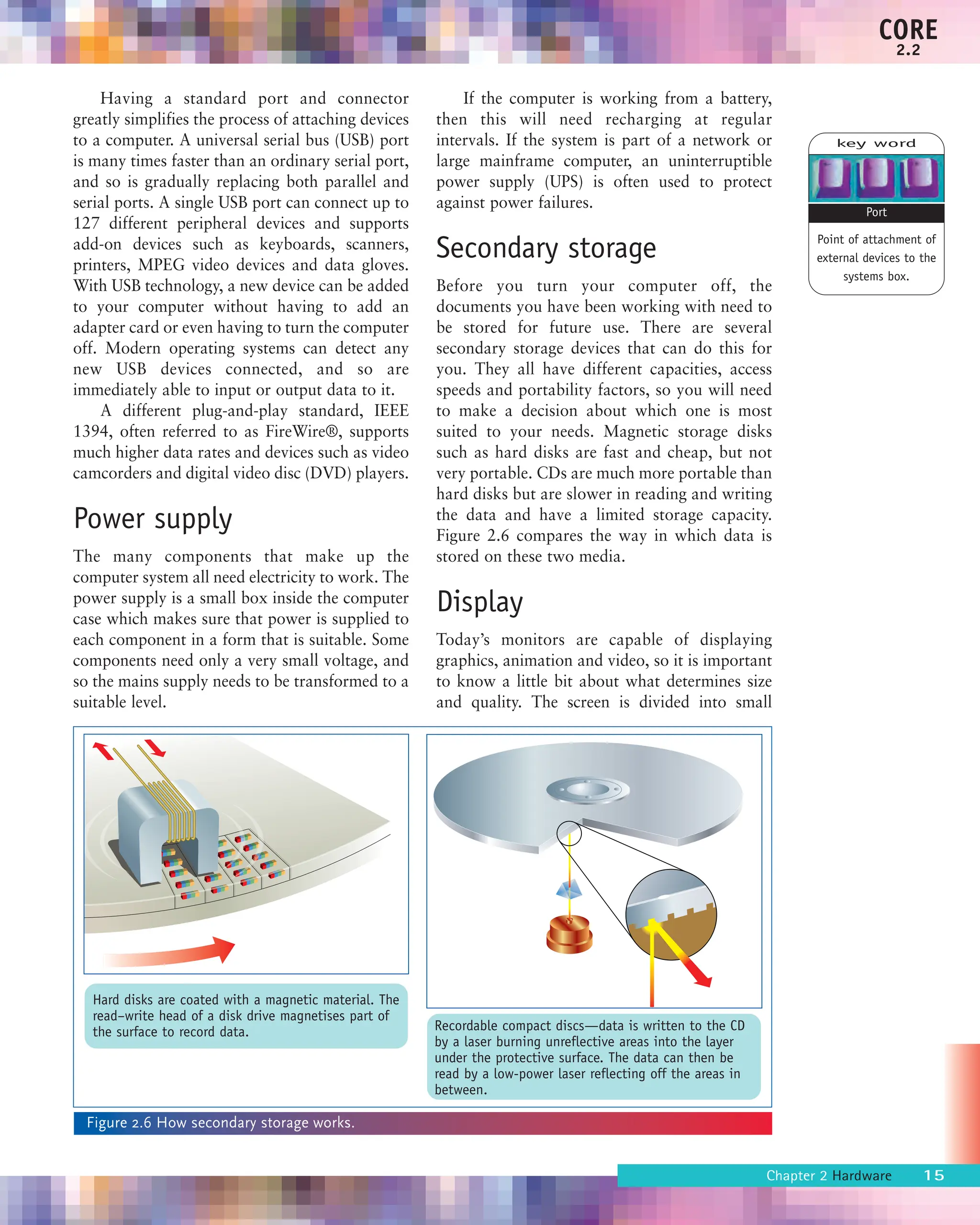
  • 7.
    About the bookv Student pack vi To the student vii Acknowledgements viii CORE 1 Projects: Design, Produce, Evaluate 1 1.1 Defining and analysing the problem 2 1.2 Designing possible solutions 3 1.3 Producing solutions 5 1.4 Evaluation 6 1.5 Management 7 1.6 Communication techniques 8 1.7 Group work 9 2 Hardware 11 2.1 Hardware functions 12 2.2 Hardware components 13 2.3 Microprocessors 18 2.4 Classification of systems 18 2.5 Hardware solutions 20 2.6 Troubleshooting 21 2.7 Care and maintenance 21 3 Software 23 3.1 Software systems 24 3.2 Types and examples of software 24 3.3 Factors affecting hardware requirements 33 3.4 Interface design 34 3.5 Features and elements of a graphical user interface 37 4 Data Handling 41 4.1 Data and information 42 4.2 Data forms 43 4.3 Data coding 43 4.4 Data sources 46 4.5 Data types 46 4.6 Data transmission types 48 4.7 Data storage and function 49 4.8 Data compression techniques 52 4.9 Data security 53 5 Past, Current and Emerging Technologies 55 5.1 Past information and software technologies 56 5.2 Current and emerging technologies 57 5.3 Exploring current and emerging technologies for each option 60 5.4 The impact of technology on the environment 67 6 People 70 6.1 Roles and responsibilities 71 6.2 Careers in information and software technology 73 7 Issues 75 7.1 Legal issues 76 7.2 Ethical issues 77 7.3 Social issues 79 7.4 Industrial issues 81 OPTIONS 8 Artificial Intelligence, Simulation and Modelling 83 8.1 Artificial intelligence 84 8.2 Areas of artificial intelligence 85 8.3 Requirements of artificial intelligence 90 8.4 Modelling and simulations 95 8.5 Requirements of models and simulations 98 8.6 Advantages and limitations 99 8.7 Using modelling and simulation programs 102 8.8 Project development 106 8.9 Additional content 108 9 Authoring and Multimedia 112 9.1 The beginning of a revolution 113 9.2 What is multimedia? 114 9.3 Types of multimedia products 115 9.4 Multimedia data types 119 9.5 Multimedia hardware 125 9.6 Processes used with multimedia data types 129 9.7 Authoring software systems 130 9.8 Developing a multimedia product 136 9.9 Project development 143 9.10 Additional content 144 Contents Contents iii
  • 8.
    10 Database Design146 10.1 Database development 147 10.2 Collecting, organising and storing data 154 10.3 Processing and analysing data 160 10.4 Presenting information 164 10.5 Integration 165 10.6 Project development 170 10.7 Additional content 172 11 Digital media 175 11.1 The purpose of digital media 177 11.2 Types of digital media products 181 11.3 Data types for digital media products 187 11.4 Digitisation of data types 194 11.5 Digital manipulation techniques 198 11.6 Factors affecting file size 206 11.7 Display and distribution 208 11.8 Project development 211 11.9 Additional content 213 12 The Internet and Website Development 215 12.1 The Internet 216 12.2 An historical perspective on the Internet 217 12.3 Intranets 221 12.4 Features and uses of the Internet 221 12.5 Internet software 233 12.6 Types of Internet protocols 237 12.7 The World Wide Web 240 12.8 Control of access to information 243 12.9 Website development 246 12.10 Project development 248 12.11 Additional content 249 13 Networking Systems 254 13.1 A communications network 255 13.2 Network protocols 260 13.3 Data transmission modes 262 13.4 Data transmission rates 263 13.5 Data transmission media 263 13.6 Types of networks 266 13.7 Peer-to-peer and client–server networks 267 13.8 Components of networks 267 13.9 Security of information 272 13.10 Network topology 276 13.11 Network operating systems 278 13.12 Factors influencing media transmission 280 13.13 Project development 281 13.14 Additional content 283 14 Robotics and Automated Systems 285 14.1 Robotics 286 14.2 Types of robots 288 14.3 The purpose of robots 291 14.4 Use of robots 293 14.5 The function of robots 297 14.6 Automated control 302 14.7 Sensing devices 304 14.8 What are actuators? 307 14.9 Controlling devices 309 14.10 Project development 310 14.11 Additional content 312 15 Software Development and Programming 315 15.1 Basic programming concepts 316 15.2 GUI layout 323 15.3 Data types 325 15.4 Data operators 328 15.5 Algorithms 330 15.6 Program control structures 332 15.7 Desk checking 337 15.8 Using sub-programs 338 15.9 Programming languages 339 15.10 Data structures 341 15.11 Testing program code 344 15.12 Error detection 345 15.13 Error correction 346 15.14 Documentation of program code 346 15.15 Project development 347 15.16 Additional content 350 Index 354 iv Information and Software Technology A Project-based Approach
  • 9.
    Information and SoftwareTechnology: A Project-based Approach is a brand new, full-colour text written to meet the requirements of the new NSW 7–10 Information and Software Technology syllabus to be implemented from 2005. This text provides a clear project-development focus in line with the spirit of the syllabus. It also presents a concise coverage of the Core topics to provide a ready reference as the Option topics are studied. Project development The opening chapter Projects: Design, Produce, Evaluate introduces the basic principles of project work. Throughout each Option chapter a series of step-by- step tasks are included. These are designed to develop students’ skills in technology application and to help prepare them for the major project at the end of each chapter. Each Option chapter culminates in a substantial project structured around the design process outlined in the syllabus: defining and analysing the problem; and designing, producing and evaluating project solutions. Further project ideas are provided in the Teacher’s Resource. Key features • Each chapter opens with a list of outcomes based on the syllabus and a summary of the chapter contents, followed by a panel called In Action, which presents a real-life application of the chapter content to highlight its relevance to students. • Core Alert icons in the Option chapters refer students back to relevant Core content which supports teaching the core as an integral part of the Option topics. • The text features a lively full-colour design and high-impact artwork. • Activities are placed at frequent intervals and are organised under the following headings: Identify, Analyse and Investigate. Identify questions check students’ understanding of key content and concepts; Analyse and Investigate questions are higher-order questions involving more critical thinking. 2.2 Hardware components C ORE ALER T About the book <In Action> About the book v
  • 10.
    vi Information andSoftware Technology A Project-based Approach The text is also available with a Student CD which contains a PDF of the coursebook, a cached version of the Companion Website and the student worksheets from the Teacher’s Resource. Companion Website www.pearsoned.com.au/schools The Companion Website provides a range of technology-based material: self-marking on-line chapter review questions; Destinations—links to websites referred to in the text plus other useful websites; and a wide range of technology activities—drag-and-drop interactives, activities using software or specially developed files, animations and video clips, as well as samples of students’ work. All this material is clearly cross-referenced in the text. The CW icon by itself indicates there are web links (Destinations) for students to use in support of the text. Other CW icons are annotated to indicate further material to be found on the Companion Website. Teacher’s Resource The Teacher’s Resource provides a wide range of additional support: programming suggestions; a Core matrix showing the links between the Option chapters and the Core content; approaches to developing projects; a list of recommended software and other useful references; a range of worksheets for each Option chapter; answers to the worksheets; answers to all the activities in the coursebook; and chapter tests and answers for each of the Option chapters. All this material is clearly cross-referenced in the text. The Teacher’s Resource comprises a printout and a CD which includes editable Word files of the worksheets and the chapter tests, as well as the programming and Core matrix documents. • Issues, People, and Past, current and emerging technologies are introduced in the Core chapters, but are also addressed within the Options Chapters as separate panels. chapteroverview WS 12 T E A C H ER’S RES O U R C E Student pack Issues Legal and social concerns Past, current and emerging technologies People People in multimedia • Case studies highlight relevant, real-life examples of the theory. • Key words are highlighted in the text and defined in the margins. • Infobits provide snippets of interesting related information to stimulate students’ interest. • The Chapter Overview summarises the key content of each Option chapter.
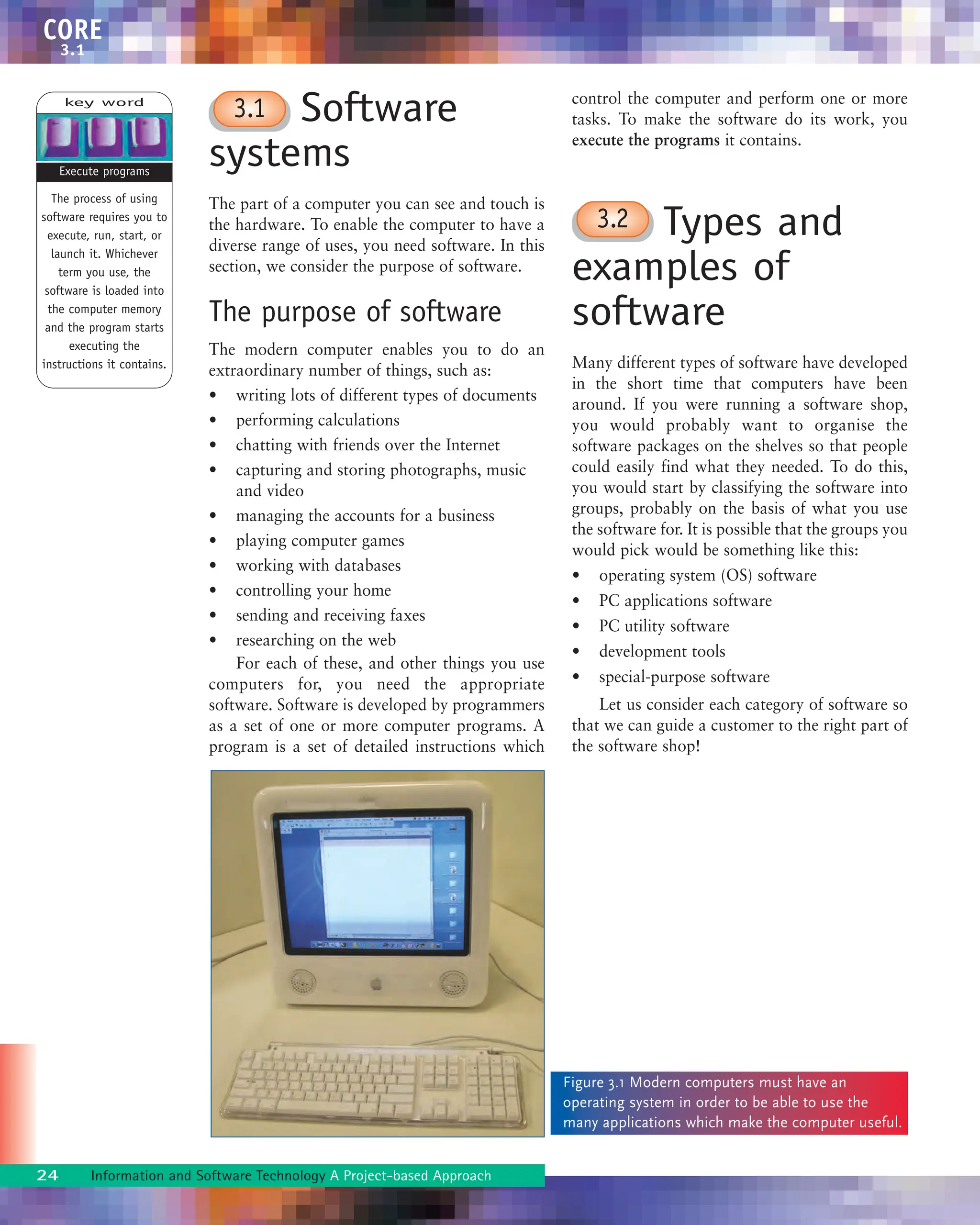
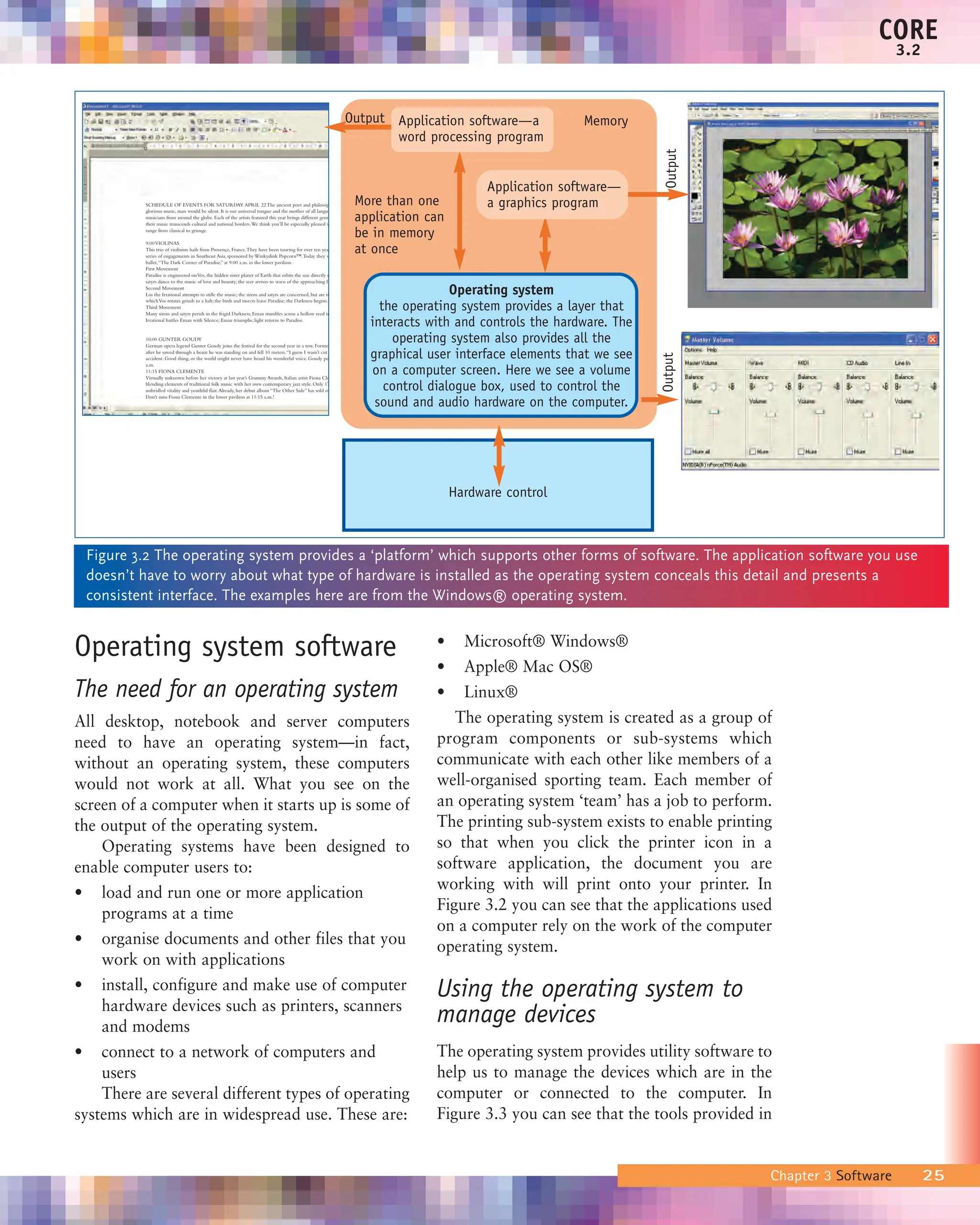
  • 11.
    About the bookvii To the student The world of information and software technology that you will explore in this textbook and its Companion Website is an amazingly creative, exciting, challenging and rapidly changing one. It is a world which truly offers something for everyone. If you are bursting with creative energy, you can explore digital media and multimedia. If you wish to confront the uncharted frontiers of the information revolution, you can harness the power of the World Wide Web and begin solo exploration. If you are a born organiser, you can contribute to this revolution and build a website or a database of your own. If you like to find out how things work, then topics such as artificial intelligence, networking and operating systems will fascinate you. If you love to be in control, robotics will give you a chance to design and program your very own robot. Finally, the topic of programming offers to empower you to learn to write software yourself. This book emphasises a project-based approach to information and software technology. Each topic is built upon a detailed practical project where you design, produce and evaluate your own solution to a given problem, either working on your own or as part of a team. The carefully designed tasks included in each topic have numbered steps which allow you to acquire the skills to complete your project. Featured panels on Issues, People, and Past, current and emerging technologies emphasise vital core material, while a real-world In Action case study demonstrates the application of each topic in industry and the world of work. Basic core knowledge about hardware, software and data handling is introduced in the first section of the book (the Core chapters). Social and ethical issues, and the history of computing and its past achievements will help you understand the impact computing technologies have had on society and appreciate the incredible journey you are now making. This core material also appears throughout the book, integrated into each topic where it is emphasised by the Core Alert icons. With your energies focused on practical projects, it would be easy to lose track of the vital facts, so there are plenty of written activities to help make sure you haven’t missed anything. Most students know enough about computers to complete basic daily tasks, such as word processing, browsing the Internet or playing a computer game. However, as you learn about information and software technology using this book you will learn far more than this. You will discover why the computer has been called the most complex and versatile device ever built, and you will learn about a digital revolution that has only just begun. David Grover To the student vii
  • 12.
    viii Information andSoftware Technology A Project-based Approach Acknowledgements The publishers and authors wish to acknowledge the contribution made by Pam Kelly, Head of Computing Studies, Arthur Phillip High School, to the chapter The Internet and Website Development. We would like to thank the following for permission to reproduce photographs, texts and illustrations. The following abbreviations are used in this list: t = top, b = bottom, m = middle, l = left, r = right. Acquired Intelligence: The ‘Whale Watcher’ was built in ACQUIRE by Acquired Intelligence Inc. <www.aiinc.ca> p. 94. Adobe Systems Incorporated: Adobe product screen shot(s) reprinted with permission from Adobe Systems Incorporated, pp. 25, 29, 124(t). Advanced Highway Maintenance and Construction Technology (AHMCT), University of California: p. 297(r). Alex Mitchell: Reproduced by kind permission of Alex Mitchell, The Sun Herald, Sydney, and John Fairfax, pp. 312–313. Alias Systems: p. 185. Animated Programs: Used with permission of Animated Programs, p. 73. Apple Computer, Inc: pp. 39, 66, 123(b), 178, 203(t), 204. Australian Associated Press: p. 289(b). Australian Picture Library: pp. 5, 10(br), 19(ml, tr), 61, 62, 72, 89, 154(bl, br, tm, tr), 176, 192, 209, 293. Avalon: <www.avalon-rpg.com> p. 230(b). Cinefex magazine: Joe Fordham, ‘Middle-earth Strikes Back’, Cinefex, January 2003, extracted and adapted with permission <www.cinefex.com> p. 176. Commonwealth Department of Veterans’ Affairs: Visit Gallipoli website <www.anzacsite.gov.au> p. 247(t). Commonwealth of Australia: <www.bom.gov.au/weather> copyright Commonwealth of Australia, reproduced by permission, p. 216. Corel Corporation Limited: Screen shot is © Copyright Corel Corporation Limited, reprinted by permission. p. 182. CyberSmart, Inc.: From the CyberSmart! Education Company website <www.cybersmart.org> Copyright © 2004 by CyberSmart, Inc. Used by permission, p. 244. Cyril J. Shilansky: p. 200. Digital Media World magazine: Reprinted with kind permission of Digital Media World magazine (Australia), p. 113. Dorling Kindersley: pp. 65, 120(r), 122, 190, 208. Fairfax Photos: pp. 67, 313. FileMaker International Inc.: p. 153. Getty Images: pp. 68, 147. Google.com: pp. 227, 233. Harper San Francisco: Weaving the Web: The Original Design and Ultimate Destiny of the World Wide Web by its Inventor by Tim Berners-Lee, 1999, p. 219. Hornsby Shire Council: <www.hornsby.nsw.gov.au> p. 161. http://www.indezine.com © Geetesh Bajaj: p. 118. Human Rights and Equal Opportunity Commission: p. 250(b). IBM Australia Ltd: Photograph reproduced with permission of IBM Australia Ltd, p. 59. Image courtesy of Sydney Opera House Trust: p. 238. Klik & Play © Clickteam 1994: p. 134(br). Krome Studios Pty Ltd: Ty the Tasmanian Tiger TM & © 2004 Krome Studios Pty. Ltd., p. 113.
  • 13.
    About the bookix Lego Education Australia: Images are used with special permission from the Lego Group. Lego, Mindstorms and the Lego logo are trademarks of the Lego Group, which does not sponsor or endorse this publication. © 2004 The Lego Group, pp. 300(r), 305, 308. Macromedia Inc.: pp. 236, 132, 134. Mark Baker: from Bar Codes by Mark Baker, <www.markchrissoft.co.uk>, p. 156 Martin Philbey: p. 77. Matrix Net Systems, Inc: p. 223. Met Office: © Crown Copyright Met Office, p. 101. Microsoft Corporation: Screen shots reprinted by permission from Microsoft Corporation, pp. 25, 26, 27, 30, 34, 36, 38, 66, 131, 156, 157, 162, 225. Morgan Stirling: p. 184(tr). Museum of Hoaxes: p. 245. Nathan Cochrane: ‘Ulterior motives behind ID tags exposed’, Sydney Morning Herald, 15 June 2003, p. 169. New South Wales Board of Studies: Trial Computing Skills Test © Board of Studies NSW, 2002, p. 117(r). News Limited: pp. 169, 286, 289(r). Northern Territory News: p. 47. Oddworld Inhabitants, Inc.: © 2001 Oddworld Inhabitants, Inc. All Rights Reserved, p. 87. Pearson Education Australia: Kim Nolan, pp. 24, 33, 198(t), 217; Mirai Stage 3&4 Companion Website by M. Evans, Y. Masano & M. Groves-Moriwaki, 2004, p. 60. Pearson Education, Inc.: Computer Confluence: Introductory Edition, 6th edn, by George Beekman & Paul Thurrott, © 2005. Reprinted by permission of Pearson Education, Inc., Upper Saddle River, NJ, p. 15(r); Computers: Tools for an Information Age, 7th edn, by Harriett Capron & Jim A. Johnson, © 2002. Reprinted with permission of Pearson Education, Inc., Upper Saddle River, NJ, p. 12(t); How the Internet Works, 7th edn, by Preston Gralla, © 2004. Reprinted by permission of Pearson Education, Inc., Upper Saddle, NJ, p. 240; How Computers Work, 7th edn, by Ron White & Timothy Edward Downs © 2004. Reprinted by permission of Pearson Education, Inc., Upper Saddle River, NJ, pp. 15(l), 195, 197(b). Photolibrary.com: pp. 19(bl, mr), 56, 90(b, t), 97(bl), 98(tl), 100(l, r), 154(tl), 288, 289(l), 294. Richard A. Bartle: Extract from The Future of Virtual Reality: A Thought Experiment, p. 114. S. Joy Mountford, Manager, Apple Design Center: Quoted in Multimedia Demystified: A Guide to the World of Multimedia from Apple Computer, Inc., Random House, 1995, p. 142. Sherill Nixon: ‘School roll could be replaced with eye scan’, Sydney Morning Herald, 8 March 2004, p. 199. Sheryl England: p. 202(t). Symantec Pty Ltd: Norton Antivirus 2002, pp. 30, 78. Time Inc.: © 2004 Time Inc., reprinted by permission, p. 102. Mario Brce, 121(r). University of Western Australia: Courtesy of the School of Mechanical Engineering, The University of Western Australia, p. 296. VirtualAssistance.com: p. 230(t). Watchfire Corporation: Copyright © 2002–2204 Watchfire Corporation. Used with permission. All rights reserved, p. 250(t). Watson-Guptill Publications, New York: The Digital Designer by Heller and Drennan, 1997, p. 186. WinZip Computing, Inc: Copyright 1991–2004 WinZip Computing, Inc. Winzip® is a registered trademark of WinZip Computing, Inc., p. 30. Every effort has been made to trace and acknowledge copyright. However, if any infringement has occurred, the publishers tender their apologies and invite the copyright owners to contact them. Acknowledgement ix
  • 15.
    CORE x.x CHAPTER OUTCOMES You willlearn about: • defining and analysing a problem • designing possible solutions • producing solutions • evaluation criteria • methods of evaluation • management • communication techniques • collaboration and group work You will learn to: • identify factors which impact on solutions • generate ideas using a range of methods • model possible solutions • apply set criteria to choose an appropriate solution • establish evaluation criteria • document feedback and decision-making • communicate ideas and solutions • collaborate in a group situation CHAPTER CONTENTS 1.1 Defining and analysing the problem 2 1.2 Designing possible solutions 3 1.3 Producing solutions 5 1.4 Evaluation 6 1.5 Management 7 1.6 Communication techniques 8 1.7 Group work 9 Projects: Design, Produce, Evaluate Projects: Design, Produce, Evaluate core 1
  • 16.
    CORE x.x Today’s classroom isa colourful and dynamic place. Using computer technology encourages you to think for yourself and to become more creative. It allows you to work collaboratively within class groups or discuss issues with students on the other side of the world. Beyond school, you will be expected to be an ‘independent learner’. As technology evolves, so you will need to keep pace with it and implement it in your work and personal life. Many of the tasks that you are set in class are open-ended and are devised to encourage thinking and planning skills. In fact, we need to think and plan ahead every day in order to complete any task effectively. When you have an assignment to complete, you need to think about how to do it, then carry out the plan, and afterwards, consider how you might have done it better. What you have done is to design your task, produce a solution, and then evaluate your work. When tasks are large and important they become projects. You will have completed a number of projects at school already, and in this course you will learn how to manage project work in the Information and Software Technology (IST) environment. In business, projects usually involve a team of people working together. For example, a bank may need to install a new computer network or to build a block of new offices for staff. These sorts of projects must be planned and managed very carefully, otherwise there may be a lot of time and money wasted. Throughout this chapter, we describe and apply the problem-solving process. We will look at the example of a small video hire shop. You will see that each stage is important and has a clearly defined purpose. Throughout this course, you will design and produce projects which will prepare you for future endeavours at higher study levels and in accepted workplace practices. Defining and analysing the problem Identifying the problem One of the first tasks that must be done before we can solve any problem, is to identify the need for a solution or exactly what the problem is. We might also question whether the problem does in fact need to be solved at all. If your friend rang you one evening asking for help because he couldn’t do his Maths homework, you would need to know whether it was because he didn’t understand Maths or because he was going to the movies and didn’t have time to do it. You need to identify the problem. You can then decide whether to tell him you are busy or try to find out more about his problem. Read the scenario in the project panel. It introduces the case study which we will follow throughout this chapter. Take some time to consider the problem and discuss your ideas within your class groups. key word The three stages of successful project work. Design, produce, evaluate Figure 1.1 There are three stages that you should work through in all projects—design, produce, evaluate. Project panel Identifying a problem Denis is the owner of a local video hire shop and has been running his business the same way for twenty years. Recently, customers have been complaining about being incorrectly charged for late returns. He also suspects that he has a large stock of movies which nobody ever borrows. Perhaps it is time he sold the shop and retired, or maybe he should fire his assistant Lisa, who seems not to be able to use the computer system properly. Susan is a business colleague of his. She asks if perhaps the computer system he is using is a little out-of-date. More modern hardware and software might be easier to use, so mistakes would occur less often and some stock analysis could be implemented. It should be possible to solve the problem with just a little thought and planning. 2 Information and Software Technology A Project-based Approach Stage 1 Design the solution Stage 2 Produce the solution Stage 3 Evaluate the solution CORE 1.1 1.1
  • 17.
    Factors that impacton problem-solving In any project, there are various factors which might impact on any planned solution. These fall into four categories—technical, operational, financial and ethical. • Technical factors might include whether the available hardware or software is adequate for the task. Is there other hardware which could be used to input information into the system? • Operational factors would need to be taken into account to see how the new plans would fit into the existing system or work place. Will the staff be comfortable using a new system or should there be some training opportunities offered? • Financial factors will influence the budget. How much will the whole project cost to set up and maintain? Will it in fact save money and increase profits eventually? • Ethical factors would influence ideas about data access and marketing practices. What information should be stored on the system and who will be allowed access to it? Designing possible solutions The first major stage in project development is the design phase, in which we need to produce several possible solutions for the project. It is important to write down the criteria which the solutions must meet in order to keep the ideas on track. Think about the target audience, and the time-frames and resources available. Generating ideas Generating ideas can be a creative and spontaneous pursuit. It is a good idea to document ideas so that you can revisit them later or share them with other people. You might choose to use a concept map, such as in Figure 1.2. There are computer programs, such as Inspiration®, which can help you to draw these diagrams. A concept map can help you to formulate ideas in a logical and connected way. Use words such as how, why, who, when, and where, to help ‘brainstorm’ issues. Observing other people’s solutions can also help to create ideas. If your project involves multimedia or website development, look carefully at professional examples on television, key words Identify components and the relationship between them. The elements that must be included in a project and the standards by which it will be evaluated. Criteria Analyse Project panel Factors that impact on problem-solving Denis and Susan get together and begin to analyse the problem. They write down exactly what the problem is and several ideas on how it can be solved. They soon realise that there are some factors which might affect some of their plans. For example, they know they will need some new software, and probably hardware. How much money can they afford to spend on the project and how will Lisa, the assistant, react to a new computer system? Which of the factors listed in the text are considered here? What comments can you make about the other factors that should be considered? Why are these important? Chapter 1 Projects: Design, Produce, Evaluate 3 CORE 1.2 Figure 1.2 Planning a trip to the movies. What shall I do today? Stay at home Go to the movies Will my parents allow me to go? Which movie? Who shall I go with? Where is it showing? How much will it cost? How do I get there? What time does it start? Where shall we meet? 1.2
  • 18.
    in magazines oron the Internet. How is a particular mood or idea conveyed? What colours, layout or images have been used? You may not use all these ideas immediately, but they may be helpful in a future project. Researching information has been made an easier task with the introduction of technology into the classroom. Using search engines on your favourite website, or e-mailing companies and individuals, can be a great way to stimulate ideas. Librarians or newspapers and magazines can be very helpful resources. Information you use from printed or digital media will need to be summarised in any research that you do for a project. Make sure you write down where you found your ideas. You will need to acknowledge them formally at the end of your project or you may want to revisit them later. Design techniques Once you have several ideas in front of you, you may want to try them out to see how they work. Depending on the type of project you are working on, you may want to build a prototype or draw up a storyboard to help you decide on the overall look of the project solution. Software developers working on a new project often use a prototype to test their ideas. A prototype is a simple version of the final product. It will not have every detail working, but it can be used to get feedback from typical users. For example, if a program was needed to produce an on-line quiz for students, the initial prototype could be used to judge whether instructions to the user were clear, or if all the modules connected with each other as planned. You could get some useful feedback by giving the user a list of questions to rate their opinions, or just by observing how they use the quiz. Software developers will also use an input, process, output (IPO) table to document their plans. An IPO table shows how data input to the program is processed to become output. In the same example of our student on-line quiz, it is important to identify exactly what the program is designed to produce (output), the data it needs to create that result (input), and what work needs to be done in between (processing). A storyboard is a suitable means for designing a multimedia presentation or website. Simple sketches of screen layouts will help to keep graphic design elements and navigation controls consistent (see Figure 1.3). For example, in an interactive presentation it is important to ensure that there is a link to the main menu on all pages, and that company logos and user instructions are placed appropriately on each page. 4 Information and Software Technology A Project-based Approach CORE 1.2 key word Methods of generating and documenting ideas for solutions. Design techniques Input Process Output User name Find highest List of highest scorer scorers User responses Compare to User score to questions correct answer Increase score Answers to for each correct questions that answer were answered incorrectly Project management Links Costs Delivery Progress Status Progress • List achievements Links Costs Delivery Progress Status Schedule • List dates Links Costs Delivery Progress Status Delivery • List deliverable Links Costs Delivery Progress Status Costs • List new costs • Cost overruns Links Costs Delivery Progress Status Technology • List technology planned • List issues Links Costs Delivery Progress Status Goals • List goals for next review Links Costs Delivery Progress Status Status summary • Final date for delivery • Final cost estimates 1 3 5 7 2 4 6 8 Figure 1.3 A storyboard for a multimedia presentation shows the basic layout and navigation links between the pages of the presentation. Detailed content can be added later. Table 1.1 IPO table for an on-line quiz.
  • 19.
    Producing solutions Criteria Having spent asignificant amount of time generating and documenting ideas, the second stage of your project will be to actually produce a solution. At an early stage in any project, there will need to be some agreement on the style and scope of the finished product. These are commonly called criteria, and are the standards to which the solution must conform. There may be a particular audience that needs to be targeted, or a particular software application that must be able to run the solution. Your documentation should indicate clearly the criteria which will need to be met, and you may need to eliminate some of your ideas if they do not qualify. If, for example, you have to make a presentation on a subject you have researched, you would need to ensure that the material you gather is not too technical for your audience. You may need to restrict your ideas to graphics which are not copyrighted, nor too complex to be understood by your audience. Remember that you may need to explain how the criteria have been met in a later stage of the project. Basic rules and innovation During this course, you will use many different software applications to produce some exciting projects. There will be frequent opportunities to think outside the square and investigate different methods of development. It is important, however, to remember some basic rules. It is better to have a simple presentation that works, rather than a complex and sophisticated program which is riddled with bugs. Also, losing your work at a crucial moment can be frustrating, so regular and secure backups are essential. Keep an open mind and ask for constructive feedback from your peers. Discovering new techniques can be the best part of project work and encourages innovative solutions. In the remaining sections of this chapter, you will learn more techniques to enable you to Chapter 1 Projects: Design, Produce, Evaluate 5 CORE 1.3 Questions 1 Identify the three main stages of project work. What needs to be done even before the first stage? 2 You want to include a video clip in a presentation you are making to your local sports club. What are the possible ways you could do this and what might be some of the problems? Brainstorm some ideas and draw up a concept map of possible solutions. 3 What would be some of the most important factors which would have to be considered when working on a large project? Consider the trip to the movies illustrated in Figure 1.2. What factors could impact on the planned solutions? What could happen if the trip was not planned adequately? 4 Make a list of all the ways you can generate ideas or document your project design processes. Select a project which would suit each method. 5 Examine some designs, either in a magazine or on the Internet, which advertise a particular type of product. Evaluate the designs by identifying what needs were being met and how they were met. Produce a simple reconstruction of the design using presentation-type software. 1.3 key word Apply set criteria to choose the most appropriate solution. Produce solutions Project panel Designing possible solutions Our friends in the video shop write down some clear ideas on the time scale, budget and requirements for the new system. They start to use a database program to see how the information about videos and customers can be organised. Susan has seen a website which might give them some ideas for giving customers on-line access to information. She sketches out a storyboard to document her ideas. What other activities should they be considering at this stage?
  • 20.
    produce quality ISTprojects. These include evaluation, management plans, communication and the challenges of working in a group. Evaluation As the final stage in any project, it is essential to evaluate the solution. This means more than just a verbal expression of personal opinion. Evaluations need to be planned and documented as much as the solution itself. Evaluation criteria The evaluation criteria that were originally specified for the solution will need to be examined carefully and you may need to explain how they have been met. If, for example, you have been creating a digital media presentation for an advertising agency, it may be more important to use quality graphic design principles, rather than to include lots of busy animations and sound effects. Similarly, file sizes may be critical for a website design. Functionality and quality Some other criteria which should be considered in the evaluation of all projects include functionality and quality of information. Functionality means whether the application works satisfactorily. If a program does not work properly or in the way we expect, this can cause an enormous amount of frustration. Thorough testing needs to be carried out to ensure that there is no potential for misunderstanding by the user. For example, in a multimedia presentation, if an icon needs to be clicked to play a movie clip, prompt the user to do it. Quality of information in any project is important. Information must be accurate, otherwise errors can be made in processing data or making decisions. This would certainly be the case for a bank or a medical database service. Clients may suffer as a result of incorrect data entry, and controls should be put in place to guard against this happening. Information stored in a system or displayed on a screen must be relevant to the project, otherwise it is useless and it will take up valuable space. It may also be confusing to the user. Integrity of information is a measure of its reliability and so it should be collected only from a trusted source. Finding information in a newspaper or on the Internet does not guarantee that it is true. You should take reasonable measures yourself to ensure your data is correct. Even though all these precautions are taken, information can also become out-of- date, for example clients can move house or change their job. This factor is referred to as currency and is yet another factor to be considered in collecting and storing information. Ethics and the environment Ethics and the environment will also be important criteria for evaluating projects. In core chapter 7: Issues, you will investigate the issues of ethics and how they apply to projects in IST. These issues must be part of the evaluation criteria of all projects. For example, there is a reasonable expectation that clients’ personal details will be protected from hackers and that any statistics produced from stored data will be presented in a fair and honest manner. In addition, we must all take responsibility 6 Information and Software Technology A Project-based Approach CORE 1.4 Project panel Produce a solution Denis and Susan gave the prototype database that they had developed to the assistant Lisa to see if it worked successfully. Although she was quite an experienced computer user and keen to use the new system, Lisa seemed to have a problem understanding how it all worked. There was obviously a need for some training and on-line user help. In light of Lisa’s comments, Denis and Susan decided that they would be better off hiring a computer professional to manage the whole project. The time plan and financial analysis that they had carried out earlier confirmed this decision. Why do you think Denis and Susan decided to use a computer professional to complete the project? What factors would have been important in making this decision? key words How the solution compares with original expectations. The factors by which the project will be judged. Evaluation Evaluation criteria 1.4
  • 21.
    for protecting ourenvironment, both close to home and across the world. Excessive use of paper and inconsiderate disposal of old hardware can make major impacts on our environment. Issues such as the placement of communication towers and clean methods of delivering power to our computers are further examples of such environmental concerns. Methods of evaluation We have looked at a range of criteria which should be used to evaluate our projects. We can also use different groups of people to test those criteria. Initially of course, we would allow ourselves the opportunity to consider our own work. Making time to step back and consider our own efforts is a first essential. Asking for feedback from peers as well as teachers is a valuable experience. Try to reflect upon any comments so that you can modify your work to meet the criteria more effectively, and also to improve upon performance in future projects. If the project is targeted at a particular group of people or specific end-user, it would make sense to get regular feedback from these people during the development of the project. It might be useful to write down some specific questions for them to answer, rather than expect just vague comments on all aspects of your work. Management We have seen how to use specific criteria to develop successful projects. We will look now at some other factors which will help to ensure success in our endeavours. A small amount of planning can take us a long way and the bigger the project, the more important the planning will be. Some statistics quote an eighty per cent failure rate on projects in the information and communication industry due to lack of project management. This can become very expensive and frustrating for the workers and the client. In core chapter 6: People, you will read about project managers who have specialised jobs in the information technology field. They are responsible for the overall success of the project by planning the use of resources such as time, finances and people. Planning Having a clear time schedule is essential for completing a project on time. Remember that problems may arise while you are developing your solution, so it is a good idea to work well ahead of Chapter 1 Projects: Design, Produce, Evaluate 7 CORE 1.5 Project panel Evaluation Denis and Susan hired Andrew, a computer project manager, to complete the solution for the video hire shop. They gave him all the documentation they had created, and Andrew discussed with them some of the other factors which they had not yet considered, such as data security and backup. Andrew was also able to advise them on the legal implications of collecting and storing information about people. What issues do you think would have been documented in this stage? Questions 1 List the criteria by which all projects should be evaluated. Give an example of how these would be met in the video hire shop example discussed throughout this chapter. 2 Identify the four qualities that information should have. Give an example to illustrate the importance of each in the context of a database system in a doctor’s surgery. 3 Examine some of the projects that you have completed for other subjects. What criteria were used to evaluate your work? Was content more important than presentation? Reflect upon the evaluation and describe how it will be useful in future projects. 4 Find some newspapers articles which deal with environmental issues in IST projects. Summarise the issues and organise a debate in class to discuss possible safeguards which should be used to protect the environment. 5 Imagine your teacher has asked you to design some geography posters for the junior school. Who would you ask to evaluate your work? Draw up a list of questions or criteria which might help the evaluators to complete this task. 1.5 key word Planning and co-ordinating resources. Project management
  • 22.
    CORE x.x deadlines. Items suchas printer cartridges, e-mail attachments and floppy disks all have the potential to let you down at the most inconvenient moments. Making secure backups of your work will pay dividends and save you time. Draw up a table of tasks that need to be done and allocate a realistic time-frame to complete them. Table 1.2 shows the stages appropriate to a typical project. You will need to list specific tasks in your time schedule. Keep the documentation up-to-date. It will be much easier to edit an existing document at the last minute rather than try to create it all from scratch the night before your project is due to be handed in. Resources Money is always an important issue, no matter how big the project. Trying to predict how much a project will cost is a difficult task, but estimates and limits can be documented by examining other similar projects. Keeping a track of how much has been spent and on what is an easy exercise using a spreadsheet. Complex analysis and predictions can be carried out and graphs can be used for comparisons and trends in spending. Figure 1.4 shows a simple budget record for a trip to the movies. Organising a team of people calls for special talents. A big project may need to be serviced by a variety of people, each with their own area of expertise. Their availability and correct understanding of needs will all have to be co-ordinated by the project manager. Their costs and work location are issues that may need to be negotiated. Perhaps some tasks could be out-sourced (sent to people outside the company for completion) so that expertise and office accommodation costs would be optimised. Communication techniques Communication within a team or with a client is an essential factor in the success of a project. There are a variety of ways to communicate information and to present projects: verbal, written, and with or without graphical and visual aids. Verbal Verbal communication can be difficult if you are in an uncomfortable situation. If you need to express something clearly, take some time Task Week 1 Week 2 Week 3 Week 4 Week 5 Research ideas Produce prototype Test prototype Produce solution Evaluate solution Documentation B A C D 1 2 3 4 5 6 7 8 9 10 Budget Train fare $1.60 Movie ticket $6.00 Snacks S4.00 Total: $11.60 Snacks Movie ticket Train fare Figure 1.4 A simple spreadsheet to show the budget for a trip to the movies. Project panel Management Andrew is an experienced project manager who has worked in the computer industry for many years. However, every project that he undertakes allows him the opportunity to think creatively and to apply some new ideas. He documents his ideas for Denis and Susan, and ensures that he will be able to keep within the scheduled time and cost estimates. He knows that he will need to sub-contract some of the work to other professionals that he has worked with in the past, and is confident that this will enhance the effectiveness of the solution and allow him to deliver the solution in the shortest possible time-frame. 8 Information and Software Technology A Project-based Approach 1.6 Table 1.2 Time management—schedule of tasks to be completed. CORE 1.6
  • 23.
    beforehand to makea note of the main idea you wish to convey. Remember that the more you practise this skill, the easier it will become. Oral presentations of projects bring their own challenges. If you are presenting to an audience, make sure all equipment is working as you would expect. Practise the presentation beforehand on the actual hardware you will use on the day. Any visual aids you use must be large enough for all your audience to see. Demonstrating the inside workings of a hard disk drive, for example, will be difficult if your audience is too far away. Graphics and animations should be clear and appropriate. Try not to read your script too much and never insult your audience by reading word- for-word off a screen. Even though it is challenging, you should take advantage of opportunities you have in this course to present work in front of your class, as this can be an important skill needed in the workplace. Written Written documentation is an essential part of any project. It is a good idea to write a diary of events so that you can reflect on the progress you have made. This will become increasingly important for larger projects. Hard copies of documentation or research findings should be clearly named and dated and submitted in a folder so that they are easy to read. Always acknowledge your sources of information and anyone who helped you with the project. Graphical Throughout this course, you will have the opportunity to incorporate many graphical images and visual aids into your projects. These can add exciting impact and capture audience interest. However, you must ensure that they are appropriate to the theme of the project and that issues of copyright are not violated. Another option for presenting your project might be to publish it on the Internet or your school’s intranet.Your audience would have the flexibility of accessing your presentation in their own time, and you could ask for feedback from them by e-mail or questionnaire. Group work Criteria for group formation In any area of business, groups of people are brought together to work on projects so that there is a range of expertise within the team. People find themselves working with other people who they don’t know very well and they may have different views on a number of work issues. The challenge for any team leader is to encourage collaboration so that each member of the team can contribute positively to the project. Every situation can provide opportunities to develop organisational, communication and negotiation skills. Roles and responsibilities Organising a list of the roles and responsibilities for the team is important at an early stage in the project planning. Individuals can then plan each task so that it fits with everyone else’s schedule. Sharing time and experience is an effective tool in developing group dynamics, and each team member should be prepared to do this. At group meetings, take turns in expressing ideas and reporting problems. You can learn a lot from listening carefully to other people’s problem- Project panel Communication Denis and Susan have every confidence that Andrew will produce an effective solution to the problem in the shortest possible time. It is still important, however, for all of them to keep in touch and to receive regular feedback as the project progresses. Andrew has been careful to make notes of all discussions and has kept the documents that contained their original ideas. He will continue to do this throughout the project and to date and sign all decisions that they make together. In turn, Andrew will need to pass on specific tasks and time schedules to the members of his team. All three means of communication are important. How will they be used at this stage of the project? Chapter 1 Projects: Design, Produce, Evaluate 9 CORE 1.7 key word Passing on information. Communication 1.7
  • 24.
    solving techniques. Takethe opportunity to understand other people’s strengths and weaknesses. When working as a group, it is important to let everyone have the opportunity to express their opinions in a positive and comfortable atmosphere. Write down ideas and decisions so that there is no misunderstanding later on by any individual. Describing a problem and its solution can help to avoid similar problems being repeated in the future. If you are using e-mail, make sure everyone gets a copy of each message. Accept comments from your partners as positive feedback and consider how any conflict might be resolved calmly and amicably. Collaboration It is essential to document ideas and decisions so that everyone in the group understands their responsibilities. Plan regular meetings so that people will work to deadlines and can report their progress. Phone calls and e-mails are effective for reminders, but all members of the team need to be notified of any discussion that took place. Allow time at meetings for each member of the group to comment on the development of the project as a whole. Agree on strategies for assessment of individual contributions. If anyone seems to be falling behind the agreed schedule, it is important that the problem be discussed and a solution negotiated. In the final project evaluation, reflect on the challenges that collaboration presented and the advantages you found from working as part of a group. 10 Information and Software Technology A Project-based Approach CORE 1.7 key word Working together in a group to share ideas and expertise. Collaboration Questions 1 Imagine that you have been given permission to decorate your bedroom at home. List all the tasks that will need to be done before you actually start work on applying the paint. Create a time plan and estimate the cost of the project using a spreadsheet. Are there specific people you will need help from? Will they be available when you need them? 2 Identify at least three ways to communicate information and discuss the advantages of each. 3 Consider a group project that you have completed for another subject. What strategies did you use to ensure the project was completed on time? What were the largest areas of concern? How did you negotiate through difficult situations? What strengths do you feel you have that would be beneficial to a project team? WS C H APTER TE S T
  • 25.
    CORE x.x 2 core CHAPTER OUTCOMES Youwill learn about: • functions that hardware performs • hardware components • microprocessors • classifications of hardware • hardware solutions • troubleshooting • care and maintenance of hardware You will learn to: • classify hardware devices • identify hardware components • describe the uses of microprocessors • develop hardware solutions • identify troubleshooting procedures • apply basic procedures for the care and maintenance of hardware CHAPTER CONTENTS 2.1 Hardware functions 12 2.2 Hardware components 13 2.3 Microprocessors 18 2.4 Classification of systems 18 2.5 Hardware solutions 20 2.6 Troubleshooting 21 2.7 Care and maintenance 21 Hardware Hardware
  • 26.
    A computer isoften defined as an information processor—we supply it with data to be changed into an appropriate format, which can then be stored or displayed for a specific purpose. The components of the computer system are classified according to which type of function they perform—input, processing, output, storage and control. The input, output and storage devices are quite easy to identify. Figure 2.1 shows an everyday picture of the system that we are familiar with. Microphones, scanners, digital cameras and graphics tablets are also fairly common input devices. An input device changes information into a form that the computer can work with. An output device conveys information from the computer to the user. Information may be output as a display on a screen or printer, or it may be output as sounds from a speaker. Figure 2.2 shows how data is input into the system so that it can be processed, stored and output by the different types of components in the system. Storage devices have become very powerful in recent times. You will already understand the need to save your files to a hard disk as you are working with them, but with the need to transfer graphic and sound files from one computer to another, we now use high-capacity, portable storage devices such as external hard drives, compact discs and flash memory sticks. Video files demand even more storage space and, more recently, DVDs have become popular to accommodate these. Let’s now take a look inside the systems box. This is where most of the processing and control functions happen, changing the data we input into the computer into meaningful output. The central processing unit (CPU) is often referred to as the brains of the computer. It can comprise a single integrated circuit (chip) or a number of chips working in parallel. It is responsible for the processing and control of all the data flowing into, out of, and around the system. It is the main processor of the whole system, and it communicates with other chips inside the box to help perform these tasks. Some of these chips are also classed as storage devices, as they store programs and data that need to be instantly accessible to the CPU. Other chips act as processors to carry out routine tasks, such as sound and video processing. Throughout this course, you will use and investigate many types of input, output and storage devices. You will be able to classify most of them by their function, but there will be others which may need a little more thought. CORE 2.1 Figure 2.1 Most parts of the computer system have a specific task to do. These tasks can be classified as input, output, storage, processing and control. 2.1 12 Information and Software Technology A Project-based Approach Hardware functions Figure 2.2 Data flow. Most of the devices connected to the computer are under the control of the central processing unit (CPU). Data and information flow into, around and out of the system. Central processing unit (CPU) Processing and control Output devices Input devices Storage devices key words Changes data into a form that the computer can work with. Conveys information from the computer to the user. Input device Output device
  • 27.
    Ports CPU Power supply Hard drive CD/DVD drive 3.5"floppy drive C o n tr o ll e r c a rd G ra p h ic s a d a p to r c a rd E x p a n si o n sl o ts ROM Bus lines Hardware components We are beginning to see that a computer system is made up of different parts, and each has its own particular job to do. Some parts are responsible for input or output of data, some parts are designed to process, store or transfer the data. Many of these components are inside the systems box, while other devices such as the keyboard and monitor, are connected to the motherboard using the ports at the back of the systems box. The motherboard Figure 2.3 shows the main sections inside the systems box. The main chips are mounted on the motherboard. Chips are collections of complex electronic circuits mounted on a wafer, or chip, of silicon. The main chip, the CPU, is responsible for processing data and instructions at high speed, and so it needs memory chips, like RAM (random access memory) and ROM (read-only memory), to hold instructions for it while it is working on current tasks. RAM chips hold programs and files which the user is currently working on. Its memory is volatile, which means it loses all its data when the power is switched off. That is why you need to save your files to secondary storage devices like your hard disk. ROM chips hold information that the CPU needs on a regular basis, such as when the computer is starting up, and cannot be changed by the user. These ROM chips must be able to hold their contents even after the power is switched off, otherwise your computer would not be able to start or perform other essential operations. Co-processor chips are designed to perform specific processing tasks, such as numeric calculations or video compression. They allow an increase in the overall speed of the application 2.2 Figure 2.3 Inside the systems box of a desktop PC. Chapter 2 Hardware 13 CORE 2.2 key word The main circuit board inside the computer which holds the CPU. Motherboard When the computer is switched on, programs and instructions are loaded into RAM so that the CPU can process them. The bus lines transport data between the processors, memory and other components inside the systems box. They are tiny electrical pathways printed on the top and bottom of the circuit boards. The hard drive is a series of thin disks which store programs and documents while you are not working on them. It also stores the system files which the computer needs to make everything work. Data is stored magnetically on the hard disks. Most of the components in a PC are mounted on printed circuit boards. The motherboard is the largest and houses many types of chips. ROM is memory which cannot have new data written to it. It contains permanent instructions, such as how to start up the computer. Cards inside the systems box have their own particular task to do. Typically, a PC would have a graphics or video card, a sound card, and perhaps a network or modem card. Empty expansion slots are available to insert extra cards as required. A port is where external devices are attached to the systems box. Connectors are different in size and shape for different types of devices. All your computer’s electrical needs are supplied from this shielded metal box. A transformer converts the mains current to make it suitable to pass to the motherboard and disk drives. The CPU is often called the brains of the computer. Most of the devices connected to the computer communicate with the CPU in order to carry out their task. CDs and DVDs offer high-capacity permanent storage. The discs are written and read by laser light. The floppy disk offers a cheap and quick method of transferring documents to another computer. The data is stored magnetically.
  • 28.
    as they relievethe CPU of some of the routine tasks. Co-processor chips can be located on the motherboard, or on other controller cards, such as graphics cards. Controller cards Controller cards are often expansion boards which fit into slots in the motherboard. They include such things as a video card, a sound card, a network card and a modem card. A video card, also called a graphics adaptor card, converts computer output into a video signal that can be sent through a cable, to display an image on the screen. Video cards contain their own processing and memory chips. A sound card allows sound to be input through a microphone and output through speakers. Co-processors on graphics and sound cards help the CPU to process some of the data so that operations run faster. Notebook and other digital devices have special expansion slots for installing PC cards. These can add memory, sound and modem capabilities. Similarly, some computers and printers are able to use flash memory cards. Bus lines In a typical desktop computer, the CPU and memory chips are attached to circuit boards, and data can pass between them along connecting channels or bus lines. Buses typically have 32, 64, or even more wires that the data can travel along in parallel, which allows much faster transmission and processing. Some buses connect to expansion slots inside the systems box. Other buses connect to external ports or sockets on the outside of the systems box. Ports External devices, such as keyboards, monitors or printers, often are attached by a cable to the systems box. A port is the interface, or point of attachment, to the systems box. There are many different types of connectors at these ports, but the ports themselves fall into two categories, serial and parallel. A serial port transmits data one bit at a time between the external device and the systems box, and is used for devices which do not need fast data transmission rates, such as a keyboard, mouse or modem. A parallel port allows several bytes of data to be transmitted at a time, and so is used for higher-speed devices such as printers. 14 Information and Software Technology A Project-based Approach CORE 2.2 RAM Hard drive ROM CPU Figure 2.4 RAM and ROM chips. When you turn on the computer, the CPU starts reading instructions from ROM and the hard drive. These instructions are stored in RAM so that the CPU can access them quickly. Keyboard Mouse USB Serial port Printer (parallel port) Screen Game port Microphone Stereo audio in/out Headphones S video Network FireWire® Telephone (modem) Cable TV FM reception Figure 2.5 A port is an interface that allows you to connect peripheral devices such as a printer, mouse or keyboard to the computer. There are many types of ports, depending on the type of device you need to connect. However, USB and FireWire® ports are becoming more popular, as they have fast transmission rates and support many different types of devices.
  • 29.
    Having a standardport and connector greatly simplifies the process of attaching devices to a computer. A universal serial bus (USB) port is many times faster than an ordinary serial port, and so is gradually replacing both parallel and serial ports. A single USB port can connect up to 127 different peripheral devices and supports add-on devices such as keyboards, scanners, printers, MPEG video devices and data gloves. With USB technology, a new device can be added to your computer without having to add an adapter card or even having to turn the computer off. Modern operating systems can detect any new USB devices connected, and so are immediately able to input or output data to it. A different plug-and-play standard, IEEE 1394, often referred to as FireWire®, supports much higher data rates and devices such as video camcorders and digital video disc (DVD) players. Power supply The many components that make up the computer system all need electricity to work. The power supply is a small box inside the computer case which makes sure that power is supplied to each component in a form that is suitable. Some components need only a very small voltage, and so the mains supply needs to be transformed to a suitable level. If the computer is working from a battery, then this will need recharging at regular intervals. If the system is part of a network or large mainframe computer, an uninterruptible power supply (UPS) is often used to protect against power failures. Secondary storage Before you turn your computer off, the documents you have been working with need to be stored for future use. There are several secondary storage devices that can do this for you. They all have different capacities, access speeds and portability factors, so you will need to make a decision about which one is most suited to your needs. Magnetic storage disks such as hard disks are fast and cheap, but not very portable. CDs are much more portable than hard disks but are slower in reading and writing the data and have a limited storage capacity. Figure 2.6 compares the way in which data is stored on these two media. Display Today’s monitors are capable of displaying graphics, animation and video, so it is important to know a little bit about what determines size and quality. The screen is divided into small Chapter 2 Hardware 15 CORE 2.2 key word Point of attachment of external devices to the systems box. Port Figure 2.6 How secondary storage works. Hard disks are coated with a magnetic material. The read–write head of a disk drive magnetises part of the surface to record data. Recordable compact discs—data is written to the CD by a laser burning unreflective areas into the layer under the protective surface. The data can then be read by a low-power laser reflecting off the areas in between.
  • 30.
    picture elements, or‘pixels’. Typically there are about 72 pixels per inch (ppi), or 28 to the centimetre. The electronics of the monitor assign a colour to each one of these pixels, and so builds up a meaningful image. It may be text or a graphical image. Most monitors fall into one of two categories—the cathode ray tube (CRT) or the liquid crystal display (LCD). Until recently, CRTs were the popular choice because of their clarity of image, speedy response time and low cost. LCDs were only used for portable computers and were an expensive alternative. However, flat screens are now becoming more popular for desktop computers because they take up less room than the CRT, use less power and give off little heat, and their quality of image is now much improved. Figures 2.7 and 2.8 show how these two display devices work. Data projectors are a popular device for demonstrations and digital media presentations. An LCD projector connects directly to a computer and uses its own light source to display the image shown on the computer screen. However, a digital light processing (DLP) projector uses tiny mirrors to reflect light, which produces crisp, bright images that can be seen easily, even in a well-lit room. Sometimes you will need to produce your display as hard copy, which means printing onto paper. This allows you easier access to your document when you are not working at your computer. Colour inkjet printers are now inexpensive to buy and produce high-quality images, but replacement ink can be quite expensive. Monochrome laser printers, which only print with black ink, are more expensive than inkjets, but they print faster and the running costs are lower. Colour laser printers are also becoming more affordable and therefore more popular, particularly in libraries and the workplace. Figure 2.9 shows how a monochrome laser printer works. 16 Information and Software Technology A Project-based Approach CORE 2.2 4 The gun mechanism also deflects the beams so that they sweep across the screen. Figure 2.7 How the cathode ray tube works. 2 The signals are passed to three electron guns at the back of the cathode ray tube, one for each of the three colours. 3 The electron guns each shoot a stream of electrons through the vacuum towards the screen of the monitor. The intensity of each beam is controlled by the voltage of each signal. 5 The beams pass through holes in a metal plate, the shadow mask, which keeps the electron beam precisely aligned with their targets on the inside of the screen. The closer the holes are to each other, the sharper the image which can be displayed. 6 The electrons strike the phosphors coating the inside of the screen. Three different phosphor materials are used, one for each colour, red, green and blue. These chemicals glow as the electrons hit them, the stronger the beam, the stronger the colour emitted. The combinations of the different intensities of each of the beams appear as different colours to the human eye. 7 After the beams have made one horizontal sweep across the screen, the electron gun refocuses the stream back to the left-hand edge, just below the previous scan line. This process is called raster scanning. 1 Digital signals from the application software go to the video card. These signals pass through digital-to- analogue converters, one for each of the primary colours— red, green and blue—used in the display.
  • 31.
    Chapter 2 Hardware17 CORE 2.2 Figure 2.8 How the liquid crystal display works. 1 Light from a fluorescent panel spreads out in waves that vibrate in all directions. 2 A polarising filter lets through only the light waves that are vibrating horizontally. 3 The light waves then pass through the liquid crystal layer. Each crystal cell is charged by varying amounts to twist the vibration of the light wave. 4 One of three coloured filters then colours the light red, green or blue. 5 A second polarising filter only lets through light that is vibrating in a partially or fully vertical plane. 6 The mixture of colours on the front panel combine to give the appearance of a whole spectrum of colours. In this example, full red, half green and no blue will result in one pixel appearing as a pale brown. Fluorescent light source Polarising filter Liquid crystal Coloured filters Second polariser Front panel Figure 2.9 How the monochrome laser printer works. 7 The paper passes through the fusing rollers, where heat and pressure bind the toner permanently to the paper. 3 A spinning mirror deflects the laser beam so that the path of the beam is a horizontal line across the surface of the drum. After the laser has flashed points of light across the width of the drum, the drum rotates about 0.004 mm, and the laser starts work on the next line of dots. 6 The rotation of the drum brings its surface next to a thin wire, called the corona wire, which has the task of removing the pattern of charge from the surface of the drum. 2 The instructions from the printer’s processor rapidly turn a beam of laser light on and off. This on–off pattern represents the pattern of dots as they will appear across the paper. 1 Your computer sends signals to the printer’s processor to determine where each dot of printing toner is to be placed on the paper. 4 Where each point of light strikes the drum, it makes a charged dot on the surface of the drum which will attract the black printer toner. 5 As the drum continues to rotate, it presses against the sheet of paper, and the toner sticks to the paper.
  • 32.
    CORE 2.3 Digital watch Inside adigital watch, a quartz crystal vibrates 215 times per second. The processor counts the crystal’s vibrations and advances the digital display one second each time the total reaches 32 768. The chip is also able to store information input by the user, such as phone numbers and appointments. Microprocessors Microprocessors are tiny electrical circuits made up of millions of transistor switches, mounted on a silicon chip, which control the flow of electrical signals. Much of what a computer does is dependent on these electronic switches routing data in different ways, according to the software instructions. The CPU inside the systems box of a personal computer is often referred to as the processor, or microprocessor, as it is very small and controls the main operations of data processing. As well as computers, microprocessors are found in many different electronic devices. Their job is to store and process data—that is, to change data into a form that is useful to humans or another device. These devices include cameras, watches and monitoring devices. Figure 2.10 shows a range of devices which use microprocessors. Classification of systems Computers don’t just come in one size. They are often classified according to how powerful they are, and this usually determines what type of job they do. System classification is used to give people a general idea of what the hardware can do. The boundaries of these classifications are sometimes a little unclear because technology changes so rapidly. For example, several desktop computers can be networked with each other to act as a powerful server. Figure 2.11 shows five different types of hardware systems—handheld, personal computer, server, mainframe and supercomputer. Handheld computers have small screens and keyboards, or sometimes no keyboard at all. They might use a stylus for input instead. Delivery people or meter readers often use these, 18 Information and Software Technology A Project-based Approach Digital camera Microprocessors enable the camera to automatically focus on a subject and take a reading of the available light. The camera sets the aperture and shutter speed for optimal exposure. A processor may then perform a preset level of compression on the data and stores it in a memory device—often a flash memory card. Digital thermometer Inside a digital thermometer, the processor converts the data from the temperature sensor and advances the LCD reading. When the temperature is steady, the reading is locked in and a beeper sounds. Sensors provide data to processors in hundreds of applications, such as climate control and robotics. Figure 2.10 Microprocessors in other electronic devices. key word Microprocessor A tiny but complex electrical circuit mounted on a silicon chip. 2.4 2.3
  • 33.
    as they arevery easy to carry. Usually they can be connected to a larger computer to exchange information. A personal computer is a computer that can perform all of its input, processing, output and storage activities by itself. It is small enough to sit on a desktop, although the systems box is sometimes positioned on the floor. A work- station is a networked desktop computer which can be used in combination with a server or other computers on a network for a wide range of tasks, including intense calculations and graphics capabilities. Typical users might include engineers, architects and graphic artists. A notebook or laptop computer is light and Chapter 2 Hardware 19 CORE 2.4 A handheld computer might be web-enabled to allow you to access the Internet wirelessly. A personal computer might be small enough to sit on your lap, yet powerful enough to act as a server on a network. A mid-range server is about the size of a cabinet. It is more powerful than a workstation, but less powerful than a mainframe. Mainframe computers are large, expensive and powerful. They can process up to millions of instructions per second. Supercomputers are used for weather forecasting and science research. Figure 2.11 Classifying hardware systems. Questions 1 Draw up a table of hardware devices. Identify each one as a device for input, output, storage, processing and control and describe the task of each one. 2 How do you think a touch-screen device should be classified—input or output? Could it be both? What about a mouse or a modem? 3 List all the different storage devices you can think of. Identify the most significant strength of each. Does the floppy disk still have a role to play? What is flash memory? 4 Look at the back of your computer. Can you identify all the ports? Draw a diagram and label each one with the device that would be attached here. 5 Under the guidance of an adult, open up the systems box of an old computer. Draw a plan of the inside and label the main components. 6 Find out how the inkjet printer works. Draw a large labelled diagram like the one in Figure 2.9. 7 Draw up a table to compare the different categories of computer hardware systems. For each category, compare physical size, cost, storage capacity, processing speed and typical applications.
  • 34.
    portable, yet stillpowerful enough to meet most needs of the individual worker. A server can be any networked computer that has appropriate server software installed. However, in larger organisations, servers are usually dedicated machines which control access to software, files and printers. They are often required to support thousands of connected users at the same time. These host computers can be used on the Internet to act as web servers. Mainframe computers cost up to several millions of dollars. They can store vast amounts of data and are accessed with terminals or personal computers. Banks and large government organisations might use mainframe computers to process their data. Users will communicate with these computers using terminals. A supercomputer is the fastest and most expensive of all computers. They may contain several processors that can share jobs and work in parallel. This means that they are capable of processing trillions of instructions in one second and can be used for complex mathematical calculations such as weather forecasting or scientific research. A supercomputer might cover the area of two basketball courts. Hardware solutions Everyday, millions of computer users around the world rely on different types of computer systems for a variety of purposes. A student working at home might require access to the Internet for research, a business person might need access to documents or a printer on a local network. A bank or large retail organisation may need to process millions of transactions every day, yet still have fast and secure access to data. A different hardware solution will need to be found for each of these scenarios which will allow their tasks to be completed as required. Whatever the situation, it is important to develop hardware solutions with careful planning and consultation. In core chapter 1, we considered the processes involved in project development—design, produce, evaluate. • Define and analyse the problem—Write down the criteria to be met in the solution. What are the most important factors? Cost? Speed? Reliability? Storage capacity? Security? • Design possible solutions—Put together some ideas that might provide a solution. What are the essential items of hardware which will be needed? Are there any extra items which might be useful? Find out how much the system might cost, how easy it would be to install and train users, and how long it would take. • Producing solutions—What problems might there be when the system is to be installed? Will it be better to gradually install each hardware item, or will the whole system need to be installed in one go? Training courses and user manuals will need to be ready at this stage. • Evaluation—Each component of the hardware should be tested to ensure it performs the task it was intended for. Usually, test data has been prepared in the design stage so that all important criteria can be tested. A test report should be written to confirm that the system performs as expected. As time goes on, new technology may become available or the users’ needs may change, so evaluation of the system is an on-going process. Let’s consider applying this to the scenario of designing a new computer room at your school. You might discuss the most essential needs and wants with your teachers and fellow students, and decide that the room will be dedicated to multimedia projects. The budget has not yet been approved, so you need to produce several alternative solutions, perhaps indicating the priority items. The computers you need will have large-capacity hard disk drives because the files you will work with will be large. The displays will need to be large and high-resolution monitors. Video cameras and digital cameras are essential items, although quite expensive. Perhaps the cost could be shared with another department? Scanners and colour printers are useful, but perhaps not as essential as other items. What are some options for working with 20 Information and Software Technology A Project-based Approach CORE 2.5 2.5 key word A system of hardware components designed to meet a specific need. Hardware solution
  • 35.
    audio? Will microphonesbe useful, and how will music be added to the project? Storage of final projects will be an issue. How big will the files be? What are some options? Would a DVD burner be useful, or are there more economical alternatives? Troubleshooting We all rely on computers to work correctly and efficiently, but there usually comes a time when something goes wrong or the system does not seem to be working correctly. Troubleshooting is a systematic, step-by-step, elimination process for finding a system fault. Quite often, there will be an easy solution if we know what to look for. According to some technicians, the most common problem is that cords are not plugged in properly. If you are sure this is not a problem, then Table 2.1 might help. It is possible that the problem is a little more serious, however. Worn parts, such as disk drives, or dirty or damaged laser lenses in CD drives may need to be replaced. Care and maintenance Most computer equipment will last for years if treated with care. • Make sure the computer is positioned correctly on a secure surface, with plenty of air circulation. Cables should be tidied away so that they are not caught on feet or furniture. If you connect or disconnect any power cables, make sure you switch the power off first. • Environmental factors, such as heat, humidity, static electricity and dust, can all affect the correct running of a computer system. Clean your computer occasionally Chapter 2 Hardware 21 CORE 2.6 2.7 Problem Check Computer does not turn on Check power source is live—use another electrical appliance to confirm this Check all leads are plugged in firmly and that power source is turned on Check power lights on computer and monitor Computer system acts erratically or Check connectors for each peripheral device fails to connect to network Check Ethernet cable is plugged in correctly If the connection is faulty, check the port for bent pins or other faults Monitor does not display correctly Check the resolution and colour settings Adjust the picture width and height settings Printer does not work Check printer is switched on and that ‘on line’ light is on Check paper is loaded correctly Check the correct printer has been chosen in the print dialog box Poor quality print Check printer cartridge Check whether ‘draft quality’ has been selected in the print set-up dialog box Disk drive fails to read or write Check the disk has been inserted the right way up Ensure the disk is not old or damaged Check the write–protect slot Mouse does not respond correctly Check the connections Reboot the machine Clean dust and dirt from inside the mouse ball housing Newly installed peripheral does not work correctly Ensure correct driver is installed Check manual and manufacturer’s website Table 2.1 Some common computer problems and possible solutions. 2.6 key word A systematic procedure for finding a fault in a system. Troubleshooting
  • 36.
    using a soft,damp cloth. Clean the mouse ball housing with a cotton swab. • Food and drink are both potentially fatal to computers. Keep them well apart. • Take a moment to close documents and eject disks correctly to avoid corruption of files. All CD-ROM discs should be handled with care—hold them by their edges and use a soft-tipped pen if you need to write a label on them. Avoid exposing them to excessive heat, and store them in their own jacket or case. • Protect your system from viruses. Get a virus checker and run it regularly. You will learn more about this in option chapter 12: The Internet and Website Development. • Purging old files and applications will help to keep your system running efficiently. Back up your important files regularly. • Defragment the hard disk regularly, as this can increase the speed of your system considerably. When you delete files from your hard drive, it can leave many differently sized spaces empty on the disk. When you add new files, the computer will try to fit them into those empty spaces, even if this means splitting up the files into several small pieces. Eventually, this will mean the operating system takes longer to find files. Defragmenting (often called defragging) means that the file parts which have been split up on the hard disk will be re-organised so that they are stored sequentially, in one place. 22 Information and Software Technology A Project-based Approach CORE 2.7 Questions 1 Find the cost of the items suggested for the new multimedia room discussed in the text. Decide which items are high priority and justify your answer. You may even present a case for more than one particular piece of hardware. 2 For each of the following situations, develop a hardware solution by applying the four stages of project development. Suggest what hardware would be required and justify your selection. • A graphic designer working in an advertising agency • An international airline implementing a new booking system • A sales representative working across several states 3 List some of the more common problems that you have encountered with hardware. Discuss with your class how best to avoid these problems in the future. 4 Design a poster to alert users to the dos and don’ts of computer care. WS C H APTER TE S T
  • 37.
    CORE x.x 3 Software Software CHAPTER OUTCOMES You willlearn about: • the different types of software used on computers and what we use them for • the all-important operating system • software factors which affect the hardware requirements of a computer • the features of the user interface and how these features are used to control software You will learn to: • select the appropriate software for a task you need to do • compare and evaluate the usefulness of applications software • work with a computer operating system to manage your work CHAPTER CONTENTS 3.1 Software systems 24 3.2 Types and examples of software 24 3.3 Factors affecting hardware requirements 33 3.4 Interface design 34 3.5 Features and elements of a graphical user interface 37 core
  • 38.
    CORE 3.1 Software systems The part ofa computer you can see and touch is the hardware. To enable the computer to have a diverse range of uses, you need software. In this section, we consider the purpose of software. The purpose of software The modern computer enables you to do an extraordinary number of things, such as: • writing lots of different types of documents • performing calculations • chatting with friends over the Internet • capturing and storing photographs, music and video • managing the accounts for a business • playing computer games • working with databases • controlling your home • sending and receiving faxes • researching on the web For each of these, and other things you use computers for, you need the appropriate software. Software is developed by programmers as a set of one or more computer programs. A program is a set of detailed instructions which control the computer and perform one or more tasks. To make the software do its work, you execute the programs it contains. Types and examples of software Many different types of software have developed in the short time that computers have been around. If you were running a software shop, you would probably want to organise the software packages on the shelves so that people could easily find what they needed. To do this, you would start by classifying the software into groups, probably on the basis of what you use the software for. It is possible that the groups you would pick would be something like this: • operating system (OS) software • PC applications software • PC utility software • development tools • special-purpose software Let us consider each category of software so that we can guide a customer to the right part of the software shop! 3.1 3.2 key word The process of using software requires you to execute, run, start, or launch it. Whichever term you use, the software is loaded into the computer memory and the program starts executing the instructions it contains. Execute programs Figure 3.1 Modern computers must have an operating system in order to be able to use the many applications which make the computer useful. 24 Information and Software Technology A Project-based Approach
  • 39.
    Operating system software Theneed for an operating system All desktop, notebook and server computers need to have an operating system—in fact, without an operating system, these computers would not work at all. What you see on the screen of a computer when it starts up is some of the output of the operating system. Operating systems have been designed to enable computer users to: • load and run one or more application programs at a time • organise documents and other files that you work on with applications • install, configure and make use of computer hardware devices such as printers, scanners and modems • connect to a network of computers and users There are several different types of operating systems which are in widespread use. These are: • Microsoft® Windows® • Apple® Mac OS® • Linux® The operating system is created as a group of program components or sub-systems which communicate with each other like members of a well-organised sporting team. Each member of an operating system ‘team’ has a job to perform. The printing sub-system exists to enable printing so that when you click the printer icon in a software application, the document you are working with will print onto your printer. In Figure 3.2 you can see that the applications used on a computer rely on the work of the computer operating system. Using the operating system to manage devices The operating system provides utility software to help us to manage the devices which are in the computer or connected to the computer. In Figure 3.3 you can see that the tools provided in Chapter 3 Software 25 CORE 3.2 Memory Output More than one application can be in memory at once SCHEDULE OF EVENTS FOR SATURDAY APRIL 22 The ancient poet and philosop glorious music, man would be silent. It is our universal tongue and the mother of all langua musicians from around the globe. Each of the artists featured this year brings different genre their music transcends cultural and national borders.We think you’ll be especially pleased w range from classical to grunge. 9:00VIOLINAS This trio of violinists hails from Provençe, France.They have been touring for over ten year series of engagements in Southeast Asia, sponsored by Winkydink Popcorn™.Today they w ballet,“The Dark Corner of Paradise,” at 9:00 a.m. in the lower pavilion. First Movement Paradise is engineered onVos, the hidden sister planet of Earth that orbits the sun directly o satyrs dance to the music of love and bounty; the seer arrives to warn of the approaching D Second Movement Los the Irrational attempts to stifle the music; the sirens and satyrs are concerned, but are to whichVos rotates grinds to a halt; the birds and insects leave Paradise; the Darkness begins. Third Movement Many sirens and satyrs perish in the frigid Darkness; Emau stumbles across a hollow reed in Irrational battles Emau with Silence; Emau triumphs; light returns to Paradise. 10:00 GUNTER GOUDY German opera legend Gunter Goudy joins the festival for the second year in a row. Former after he sawed through a beam he was standing on and fell 10 meters.“I guess I wasn’t cut accident. Good thing, or the world might never have heard his wonderful voice. Goudy per a.m. 11:15 FIONA CLEMENTE Virtually unknown before her victory at last year’s Grammy Awards, Italian artist Fiona Cle blending elements of traditional folk music with her own contemporary jazz style. Only 17 unbridled vitality and youthful flair.Already, her debut album “The Other Side” has sold ov Don't miss Fiona Clemente in the lower pavilion at 11:15 a.m.! Application software—a word processing program Application software— a graphics program Hardware control Figure 3.2 The operating system provides a ‘platform’ which supports other forms of software. The application software you use doesn’t have to worry about what type of hardware is installed as the operating system conceals this detail and presents a consistent interface. The examples here are from the Windows® operating system. Operating system the operating system provides a layer that interacts with and controls the hardware. The operating system also provides all the graphical user interface elements that we see on a computer screen. Here we see a volume control dialogue box, used to control the sound and audio hardware on the computer. Output Output
  • 40.
    the operating systemcan be used to configure how the operating system works. Using the operating system to manage files Figure 3.4 shows an example of an operating system tool called Windows® Explorer. You use tools like this to work with the computer files which contain your data and programs. One of the main uses of Windows® Explorer is to manage files. The operating system of a computer has a hierarchical file system—creating new levels within the system involves creating new folders (also called directories). Folders are containers for files and other folders. Using an OS such as this, you can do various things with your files and folders, including: • create new files and folders • move files and folders from one location to another • copy files and folders from one location to another • delete files and folders • rename files and folders • use operating system features to secure files and folders • open files or folders for editing or reading Starting up the operating system The operating system is usually stored on your computer’s hard disk, and is loaded into computer memory when the power is turned on. Once the main part of the operating system, the kernel, is loaded, it is given control of the computer. The kernel loads the rest of the operating system and prepares it for you to use. You are then able to use and control the computer by using the operating system and the tools it provides. Let us consider how the computer loads the operating system when it is turned on. Computers have a small piece of software called the basic input output system (BIOS), which is stored in a read-only memory (ROM) chip. An important task of the BIOS is to manage the computer ‘boot’ process of getting the computer started. The BIOS does the work of loading the operating system and giving it control. Once the operating system is running, 26 Information and Software Technology A Project-based Approach CORE 3.2 O u t p u t Hardware control Operating system— through the operating system, you can configure the way the computer system hardware works. Memory Figure 3.3 You can use the operating system software to configure the way the computer hardware works, modifying things like screen settings, the system clock and the way the mouse behaves. The examples here are from the Windows® operating system. You use the Mouse Properties dialogue box to modify the sensitivity and behaviour of the mouse. A variety of tools are presented within the Control Panel folder. The time and date settings can be modified in the Date and Time Properties dialogue box. You use the Display Properties dialogue box to modify the way the screen is configured. Output Output O u t p u t
  • 41.
    the BIOS managesimportant but basic functions that make the computer work—things like: • the keyboard • the display • the computer’s ports Application software There are many types of application software. An application may have some general purpose or a specific use. Figure 3.5 shows some common examples of applications that you might find on typical PCs. Business software Business organisations depend on a variety of software tools to manage the workload effectively. These include the following. • Word processing software is used to write a broad variety of documents which may then be published in print or electronic form. Sophisticated tools in word processors enable you to distribute copies of documents with mail or e-mail merges. • E-mail and scheduling software, such as Microsoft® Outlook®, has tools to enable you to plan your time and schedule appointments, send and receive e-mails, organise lists of contacts like an address book, manage the business tasks in ‘to-do’ lists, and many other things. When this software is used to help communications in a work group, it is often referred to as ‘groupware’. • Accounting software is used to help manage business accounts. Some common examples are MYOB® (Mind Your Own Business) and QuickBooks®. • Spreadsheet software was invented to help with accounting calculations, but this form of software now has much broader use. Some examples of spreadsheet uses include a tradesperson creating a quotation for a customer, managers using spreadsheets to analyse the figures from a business, and sporting groups using a spreadsheet to calculate the points scored by participants in a competition. Internet software There are several types of products in this category. These include the following. • Internet browser software is used to browse and view a wide variety of World Wide Web Chapter 3 Software 27 CORE 3.2 Figure 3.4 Windows® Explorer is typical of operating system utilities used for file management. It provides you with a graphical view of the way the files are stored on your computers disks and other media, as well as letting you browse files stored on other connected computers. Disk The folders the disk contains.
  • 42.
    28 Information andSoftware Technology A Project-based Approach CORE 3.2 and intranet documents. Browsers are also used to enable users to interact with web applications, for example for on-line banking, shopping, auctions, and many more. • File transfer programs allow users to transfer files over the Internet. • Remote access programs enable users to connect to and control another computer over a network or the Internet. Examples of this sort of software include Symantec® pcAnywhere® or the built-in Remote Access facility on the Macintosh®. • Videoconferencing software enables users to have videoconferences between two or more computer users over the Internet. To see each other, each user needs to have a ‘webcam’ (web camera) or video camera connected to the computer. These programs provide audio, video and chat, and some other sophisticated tools. • Instant messaging software enables real- time text-based communication between two or more people. • Internet security software is used by families to protect their children from unwanted web content, such as pornography sites and sites with content that children could find disturbing. Schools and colleges also use such software to filter out inappropriate content in order to protect students from unsolicited and offensive materials. This form of software is becoming increasingly important with the growth in popularity of the Internet. Graphics software We have a wide choice of tools for working with different types of graphics. These include the following. • Photographic and paint software, such as Adobe® Photoshop®, enables us to work with photographs, and other bitmapped pictures and line drawings. • Drawing software, including Macromedia® Freehand® and Adobe® Illustrator®, is used to create drawings with lines, polygons, circles and other objects. • Computer-aided design (CAD) software is used to create 3D design diagrams for architecture, manufacturing and other purposes. AutoCAD® is a widely used example. The software displays the designs in graphical format, giving many different views of the designed object. Architects use software like this to produce building plans and specifications. Engineers can use this software to design machine parts, electrical circuit boards and many other things. • Page layout software is used to prepare documents for printing as books, magazines, leaflets, posters and more, whether in print or electronic form. Widely used examples include Adobe® PageMaker® and InDesign®, QuarkXPress®, and Microsoft® Publisher®. Utility software Utility software describes a range of tools which might be used to protect or maintain a computer, or help a computer to be more versatile. In Figure 3.6 you can look at examples of some types of utilities. There are several categories of utility software described below. • Antivirus software protects a computer system from computer viruses and related problems. The example seen in Figure 3.6 is Norton® AntiVirus®. There are many products available to protect computers from viruses. To be an effective protection, all antivirus software tools need to be kept up-to-date. • Backup software is used by clever computer users to make sure that the work they do is regularly copied (backed up) to protect against loss of data. Backup software is a must on computer networks. Network administrators spend a lot of their time ensuring that backups of important data are made and protected. • Compression tools are used to compress or ‘squeeze’ large files into a smaller size, usually to enable you to fit the files on a floppy disk, or to send them by e-mail. Common compression programs include
  • 43.
    Chapter 3 Software29 CORE 3.2 This tool is used by many businesses to manage their product lists, sales, invoicing, tax, and many other business matters. Microsoft® Flight Simulator enables users to practise using a variety of aircraft from light plane to commercial airlines, without leaving the ground! In this view, the designer has created a brochure, using text, photographs and other shapes. More sophisticated programs, such as Adobe® InDesign® and QuarkXPress® are used in the design industry to prepare books, magazines and a wide range of advertising publications. This pamphlet is structured to allow a heading across the top of the page, with the rest of the document in two columns. You can see several formatting examples in this document. Microsoft® Word has evolved into a very sophisticated tool for working with documents. Adobe® Photoshop® is a sophisticated tool used to work with graphics represented as bitmaps, like photographs. Here you see part of a photograph of a bird. The software enables us to create new pictures, but many use it to work with and change photographs. Microsoft® FrontPage® and Macromedia® Dreamweaver® are two examples of software used to create websites. Here you see a list of pages in the left pane of a window and in the right pane you can see three parts of the default site. This worksheet is being used by a market research company to analyse the results of their interview teams. The data is seen in a table format, with a summary area in the yellow block, and a colour chart showing the performance in a graphical view. Figure 3.5 You may use many applications at once on a computer for many different tasks. This diagram shows some of the more commonly used applications.
  • 44.
    WinZip® and StuffIt®. •Systems management tools are used to ensure that a computer functions properly and help prevent computer operating systems from ‘crashing’. The tools can be used to diagnose and automatically repair problems which sometimes crop up when the user makes changes to their computer. • Disk management tools are used to organise the space available on large hard disks into areas called partitions. These tools can partition, format and maintain the hard disk to suit your data storage needs. They can also be used for defragmenting, which re-organises the way computer files are stored so that they can be read into memory more quickly, and to make available more disk space. • Communications software, such as fax and telephony programs, allow the computer to function as a telecommunications tool. A computer can be used to send and receive faxes and to answer telephone calls. Increasing numbers of companies are moving to ‘IP telephony’, which enables workers to make phone calls over the Internet, saving the company money on call charges. Features of software packages Most software has evolved over many years. As new versions are issued, these are labelled with decimal version numbers which indicate the amount of change they have undergone. Thus if version 4.3 of a particular application were compared with version 6.2, many more differences would be apparent than when compared with version 4.4. With each new 30 Information and Software Technology A Project-based Approach CORE 3.2 Figure 3.6 Some examples of utility software. A window from the CuteFTP® program which is used to copy files to a website. This window reveals something of the behind-the-scenes monitoring that Norton® SystemWorks® does to help manage a computer system. Tools like this have been developed to compensate for operating systems which have occasional failures. A window from the WinFax® program, used to allow a PC to send and receive faxes Norton® AntiVirus® is used to manage and monitor protection of a computer system against computer viruses. The PartionMagic® software can be used to manage the disks on a computer system. The main feature is the ability to divide up the disk into partitions and then to manage those partitions. The software was developed to make simple a set of tasks which are not as simple to do in the operating system. This well-known tool is used to compress one or more files into an ‘archive’, a special file containing the compressed files. A compressed file may use less storage space than a file in its native format.
  • 45.
    version, new featuresare added. Some users believe that some software applications are now overburdened or bloated with unnecessary features. The features which are important to you in a software package depend on what you use the package for and your level of expertise in using the package. In this section, we look at some of the features that are common to many packages. Search facilities Many programs contain search facilities. You may be searching for things like: • the existence of a phrase in a document • the location of a file or document • an e-mail you received a long time ago • records in a database • content from the web or your network Most packages have advanced search facilities which help you to find what you are looking for. Macro capabilities A macro is like a mini-program—a set of stored instructions grouped together, which you may use many times. Macros are often used when you find you need to do the same task repeatedly, particularly when the task involves several steps. Microsoft® Office® programs such as Word, Excel, Access, PowerPoint® and Outlook® have sophisticated macro capabilities. This suite also includes Visual Basic®, which is a complete programming language for expert users. Chapter 3 Software 31 CORE 3.2 The Search dialogue from Microsoft® Excel. The same feature is found in Word and other applications. You can use it for many things, including finding documents with a key word in the file name, or files which contain the key word within the document. On the right, you can see the Advanced Find dialogue box used in Microsoft® Outlook®. You might use this to find an e-mail message, for example where you can’t remember who sent it or when, but can remember it was about chocolate. In this case, you would type in the word ‘chocolate’ in the Search for the word(s) text box. The Paint editor has tools for creating shapes, adding text, and using colour to create diagrams and pictures. Along the left of the window is the tool palette and across the bottom is a colour palette. Most applications have a Help file, which usually provides a contents list, index and search feature so that you can quickly find the answer to a problem you are having with a software package. Here we see the Help file for Microsoft® Word. Figure 3.7 Common features of software applications. Questions 1 An older relative has asked your advice on the programs they should buy when they get a computer. Write a list of questions you might ask them before giving your advice. 2 Write a list of all the applications a school student would need on a computer. 3 Write a list of seven applications used on computers and order the list from the most common to the least common.
  • 46.
    32 Information andSoftware Technology A Project-based Approach CORE 3.2 Some users create macros by using a macro- recording wizard. When activated, the macro recorder will ‘watch’ and record what you do— which commands you use, what you select in the document, keystrokes you use, and other events. When you have finished recording, the wizard creates a set of macro instructions to enable you to repeat the work the wizard has just recorded. The macro may then be given a name and a keyboard shortcut, so that you can quickly execute or run the macro again when you need to. Editing capabilities Most applications enable you to work with or edit data contained in documents, databases or other files. To enable editing, the application will have one or more editing tools. Microsoft® Word is a widely used tool for working with text documents. It provides several editing views to enable you to choose the one which most suits your way of working. The main views are: • Print Layout—to view the document as it would print out • Normal—this views the document as if it were on a continual roll of paper and does not show some of the layout features, such as columns • Outline—this view is used by more advanced users to organise documents through the use of formatting styles • Web Layout or Online Layout—introduced in recent versions to enable users to view and edit web documents Cut, Copy, Paste and the clipboard An important part of the graphical user interface (GUI) of a computer is the ease with which you can edit your data, and move the data from one program to another. There are three very important commands you can use to do this. These are: • Cut—removes the selected item from a document, and places it into a clipboard • Copy—leaves the selected item in the document, but places a copy of it in the clipboard • Paste—takes a copy of a clipboard item and inserts it into a document Drag-and-drop The computer mouse makes it easy to move things around in our documents and in the operating system. The drag-and-drop feature lets you do many things, such as: • drag text from place to another • move a graphic from one place to another • move and copy files in the operating system The Undo command From time to time we will make mistakes in our work. Programs enable us in most cases to undo the last action performed, using the Undo command. Some applications ‘remember’ a large number of our actions so that, if we choose, we could undo several of the last actions and commands. There are some actions which cannot be undone. If we have just deleted an important part of our work and used the Save command, this usually cannot be undone. Preventing users from editing a document There are often reasons why you might want to provide documents for use by others, but you may not want them to be able to change the document contents. When this is the situation, you may choose to set the document as read-only to prevent accidental change. If you really want to ‘lock’ someone out of a document so they can’t tamper with it, you may have to provide them with a version of the document which cannot be changed. One approach is to secure the document on a network server or you could place the document on a web server so that the original document can be seen but not changed. Another method is to publish it in the portable document format (PDF), which allows the publisher to apply various security options, such as disabling the Save button so that users cannot save the document and redistribute it to others. This format also prevents users altering an original document. key words A software feature which involves stepping the user through a complex task, screen by screen, to help make sure they get it right. Many software applications contain wizards to help you to perform tasks. A special memory feature which can temporarily hold things we have cut or copied. The clipboard may be used by many applications so that we can copy from one application’s document into a different application’s document. Wizard Clipboard
  • 47.
    Factors affecting hardware requirements When wepull a software package off the shelf in a software shop, we will probably find, on the box or CD cover, the heading ‘System requirements’. What sort of things do you find under the heading? The answer is the minimum requirements in terms of hardware and operating system versions for the software to work properly. The central processing unit (CPU) It is rare to find modern software which will run on any type of CPU. If a package defines a Pentium® III 500 MHz CPU or an iMac® 600 MHz as the minimum requirement, the package may fail to run properly on anything less than this, or it may run so slowly that you’d be disappointed with the software. Some programs use the CPU much more than other programs. Graphics programs that manipulate photographs and CAD systems generally use the CPU far more than word processing programs, because of the very large number and complexity of the calculations required to manipulate graphics. The software companies who make these forms of software recommend minimum hardware requirements so that our expectations of the software can be realised. Businesses that need to work with the latest versions of software will be caught up in the need to upgrade their hardware, as well as the software, on a regular basis. Demands on memory Memory space in the computer is used up by: • the operating system of the computer • any programs that are currently running • the data those programs are working with If a program needs a lot of memory to run, and it works with large files in memory, then your computer system needs to have more than the minimum memory required by the operating system or a single program. When programs cannot find enough memory, the operating system may have to use part of the hard disk to store some of the data in ‘swap files’ Chapter 3 Software 33 CORE 3.3 Figure 3.8 Factors affecting hardware requirements. 3.3 Software may need the use of specific ports on a computer system. Software may require special cards. The computer system needs to have sufficient ports for all the required components. The memory is used by the operating system, any applications that are running, and the data they are using. On some systems, the memory may also be used for video display. Increasing the amount of memory in a computer system can increase its performance. The speed of the central processing unit (CPU) makes a difference to the performance of software run on the computer.
  • 48.
    and this willslow our work down. It therefore makes sense to make sure the computer has more than enough memory for the work we ask it to do. Communications and peripheral devices Computers which are used for graphic-intensive applications, such as CAD, simulation programs, photographic imaging and games, are usually fitted with specialised video cards which have special processors and memory to handle the video display. Depending on the software you need to use, you may also find the need for specialised devices to be connected to the computer, such as: • a digitising tablet—enables a designer to draw using a pen-like stylus, rather than using a mouse • a scanner • a modem • a network card—these are often built-in to the computer motherboard If a device has to be fitted in order for the software to work, it will be listed in the ‘System requirements’. In some cases, the device will be required, sometimes only recommended. Interface design The operating system you run on a computer has to enable you to use the computer interactively. To make this possible, part of the operating system software is dedicated to providing you with what we call a user interface. The user interface is the part of the system that enables you to work directly with the operating system. Experts in user interface design say that a ‘good’ user interface is one which is easy to use, intuitive, and allows the user to work effectively with the computer system. The designers of computer software try to apply good design with these principles in mind. In order to understand some of the principles of interface design, we need to recognise what an interface actually does, how it works, and how the user interacts with it. We also need to understand the method of communication between the operating system and computer applications. The function of the user interface The computer has evolved into a machine which can do many things. To use it, you need to know what functionality the computer system has— 34 Information and Software Technology A Project-based Approach CORE 3.4 The command prompt shown here is a command line interface (CLI) tool provided as part of Windows® 2000. The CLI was the main way of interacting with computers prior to the introduction of the Macintosh® graphical user interface in 1984 and the subsequent development of Windows®. In fact, the single colour background and the text display took up the whole screen. The CLI provides a line on which you can enter commands, which is where its name comes from. This line is indicated by a prompt, which is ‘C:>’ in this example. As this was the default prompt that most people saw, it became known as the ‘C prompt’ in computer jargon. To use the interface, you type a command on the command line, then tap the Enter key. This submits the text to the CLI program. If the program can interpret the command, it will execute the command and may output the results to the screen. If the text can’t be interpreted, the program will display an error message. Figure 3.9 A command line interface. 3.4
  • 49.
    what it cando for you. You have to know how to unlock its functionality and you have to know how to drive it. The user interface enables you to do this—to communicate or interact with the computer. Once a computer has started up, it waits for you to do something. The operating system software ‘watches’ all of the input devices, to see if you have given a command or entered some data. The way you interact with the system depends on the type of interface you are using. We can identify several types of interface in the development of the personal computer Types of interfaces There are three main types of interface we will consider. These are the: • command line interface (CLI) • graphical user interface (GUI) • natural language interface (NLI) Command line interface (CLI) Early user interfaces on personal computers were command line interfaces. An example of a command line interface can be seen in Figure 3.9. The command line interface displays output from the computer as lines of text on the screen. In Figure 3.9 you can see several lines of information displayed after the user has run the ‘mem’ command, which displays information about the memory installed in the computer. In a way, using a command line interface works a little bit like an ICQ chat program, except that you ‘chat’ with the computer operating system. Most operating systems are not very talkative! To use a command line interface, you need to know the commands that can be used, and you need to be able to type them in at the keyboard. Graphical user interface (GUI) During the early years of personal computing, the command line interface ruled supreme. This all changed when the Apple Computer company released a ‘graphical’ operating system with the Lisa computer, then followed up with the more successful Macintosh® computers in 1983. The Macintosh® (or Mac® as it became known) had a small built-in screen, and included a new piece of hardware—a pointing device called a mouse. The interface was quickly described as a WIMP (windows, icons, menus and pointers) interface. The main idea of a graphical interface was to create a visual metaphor (we consider the features of this metaphor in more detail in the next topic). The metaphor used the screen view to represent the business desktop, and small pictures called icons to represent the documents that we work with. The window was a metaphor for a window into a document so that we could see and work on the document through the window. To open a window into a document, all you have to do is to position the mouse pointer over the document’s icon, and double-click on the icon, which is a fairly easy thing for a new computer user to learn to do. The mouse pointer becomes an electronic extension of the user’s hand. Natural language interface (NLI) Natural language tools use speech recognition technologies so that you can give commands by speaking to the computer, or get a word processor to take dictation. Many such interfaces have developed and may be included in operating systems or as part of special packages. The natural language interface is particularly useful for those who find it difficult to use a keyboard or mouse, particularly people with disabilities. Interactivity with the user The interaction between the computer user and the graphical user interface involves some mechanical action by the user—you move the mouse, click mouse buttons, or tap keys on a keyboard. If you have a graphics drawing tablet, you can move the stylus (pen) across the tablet. The computer operating system responds to these actions in a way that the user will understand. You have a conversation with the computer system through an exchange of signals. The software responds by providing visual signals on the screen, and by performing other actions that are unseen. Chapter 3 Software 35 CORE 3.4
  • 50.
    Communication between applications andoperating system As we have seen, the software and hardware of a computer system collaborate in a dialogue with the user—a dialogue in which the user makes the choices about what to do next, and the computer software follows the instructions given. Behind the scenes, applications software communicates with the operating system, calling on it to provide memory, to open and save documents, to use devices such as printers and scanners, and to display output to the screen. In effect, what users experience is the result of a subtle partnership between the operating system and the applications they use. What they actually see on the screen of the computer appears through a consistent graphical user interface. Features and elements of a graphical user interface Consistency of elements The design or customisation of software applications requires that graphical user interface elements are applied consistently. One of the strengths of a well-designed user interface is that once you have learned how something 36 Information and Software Technology A Project-based Approach CORE 3.4 Search Print Spelling & Grammar UndoRedo Paste Table & Borders Excel Workbook Drawing Show/Hide New Preview Cut Copy Format painter Insert Hyperlink Insert Table Columns Zoom Word Help Document Map Open Mail Save Desktop icons are part of the desktop metaphor. Each icon responds to a double-click by launching an application or utility program. Figure 3.10 Windows, icons, menus and pointers: the features of a graphical user interface. 3.5 The mouse pointer can take on different forms, depending on what you are doing. The hour glass is a way for the computer to say ‘Please wait’.
  • 51.
    CORE x.x works, you canuse that knowledge when using a new application. A good GUI should be consistent in the: • colour of forms, controls and text • layout of controls on forms and dialogues • behaviour of controls—drop-down lists, checkboxes and other types of control should behave consistently across applications There are widely used standards to help software designers maintain consistency—this helps to make the software more ‘intuitive’. Functionality Applications we use often make the functionality available in the commands visible in the menus. Simply by pulling down the menus and exploring the dialogue boxes, we may be able to work out some of the things the software is capable of. Therefore, to make software relatively easy to use, programmers need to consider how to arrange the menu and command structures— choosing the words carefully. Good software usually includes a quick-start guide to walk the user through an introduction to the software—this too reveals something of the functionality and purpose of the software. Navigation Navigation in software is the process by which you find your way to specific parts of the software’s functionality. Software may have a hierarchical menu and command structure. For example, to insert a picture into a Word document, you might: • pull down the Insert menu • choose the Picture command • choose from a sub-menu under the Picture command • make choices from a dialogue box You may choose to use the mouse or keyboard shortcuts to work your way to the same part of the software. You should always try to minimise the number of steps that have to be taken to perform an action. Similarly, if you are designing a layout for a website, you would try to minimise the number of mouse clicks required to get to any page on the site. Radio buttons, drop-down lists and other interface elements In Figure 3.11 you can see many of the commonly used elements used in software applications. These elements are known as controls. They include: • pull-down or drop-down menus and lists • buttons—a click of a button is expected to result in some action • check boxes—these allow us to make a number of simple selections • radio or option buttons—allow us to choose one from a number of options • scrolling lists—these are used when we have lots of choices—often when these choices are things that change regularly • text fields or text boxes—used for free-form text entry by the user • spin boxes—these allow us to cycle through a list of choices • sliders—these provide a graphic representation of a sliding switch, for example, a volume control • tab controls—used to group things together in a logical way on a dialogue or form, and to save a lot of screen space • palettes—used where we need to make colour choices in software, e.g. the fill colour of a rectangle or the colour of text Borders and white space Borders and white space need to be used carefully in designing the interface. White space is not necessarily white, but is space on which there are no text, graphics or objects. It is a good design feature to include enough white space so that the design does not look crowded. The amount of white space to include in any design is rather subjective, so the designer needs to consult with users who are testing the CORE 3.5 Chapter 3 Software 37
  • 52.
    CORE 3.5 38 Information andSoftware Technology A Project-based Approach Radio or options buttons are seen here in the Print dialogue in Microsoft® Word. You can choose to print either the whole document (which is the default choice), just the page the cursor is on, or a range of pages that you can choose. Here you can see five spin boxes, which are used to set the numeric values for the margins and gutters for a document. In this Page Setup dialogue box, you can use a drop-down menu to select from a list of different page sizes associated with the chosen printer. A scrolling list is displayed in the Borders and Shading dialogue in Microsoft® Word, which allows you to choose a particular type of border. In this list box, you can only make one choice as it would make no sense to have two borders for a table cell. This tabbed dialogue box has eleven tabs, each of which has quite a lot of data. A tabbed dialogue saves a lot of space and avoids displaying too much data at once. The close resemblance to the tabbed folders in a filing cabinet makes this control relatively easy for a new computer user to learn to use. Here you see six sliders in a volume control dialogue box. With each volume setting, you can also mute the sound, using a check box. This will override the volume slider, which means that even if you have the sound turned up to the maximum, checking the Mute box will silence that output source. The colour palette can set the three primary screen colours—red, green and blue—with choices in the range of 0–255 for each colour. This can produce more than 16.7 million colours. Some computer screens are only set to show 256 colours and so can only show a limited set of colours. Note that most software programs are from the US and therefore use the word ‘color’ instead of ‘colour’ This dialogue has fourteen check boxes, offering you a variety of choices. Figure 3.11 Graphical user interface elements. In the Save As dialogue box, you can type the name of the document into the File Name text field.
  • 53.
    interface to findout how they respond. Borders can be used to group things together, to gain a focus on some specific controls. The use of too many borders, or borders which are too thick, can be very distracting for the user. Again, feedback from test users can guide designers in the appropriate use of borders. Instructions to the user Good software design includes well-thought-out instructions to help the user achieve what they are trying to do. Some actions require little explanation. For example, in the Print dialogue box, the Cancel button is clearly intended to cancel the decision to print. In the same dialogue box there is a Pages text box, with instructions underneath, as seen in Figure 3.12. Any instructions given should always be quite brief and very clear in their meaning. The last thing a software developer wants to do is confuse the user! In some software, the user is asked for confirmation, particularly if the action following a command is potentially damaging. Warnings like ‘This will delete all files—proceed?’ give the user a last chance to change their mind. Inclusive design factors For a long time, software was designed to suit those in the community who were able-bodied and had good or corrected eyesight. Over recent years however, changes have taken place in community attitudes and legislation to ensure that software potentially includes all groups in society. The move to inclusive design takes into account the needs of the aging and those with disabilities. Design experts agree that the first step in inclusive design is for the designer to adopt an attitude that inclusion of as much of society as possible is important. Such inclusive design principles are known as accessibility features. Chapter 3 Software 39 CORE 3.5 Figure 3.12 Print dialogue box in Windows®. Figure 3.13 Interface of Apple’s UNIX-based OS X operating system. key word Ensuring that software content and design can be used easily by all groups in society. Accessibility
  • 54.
    40 Information andSoftware Technology A Project-based Approach CORE 3.5 1 List as many elements as you can that can be found in a graphical user interface. 2 Set out clear instructions for an older relative on how to: a copy a document from their hard drive to a floppy disk b save a word processor document to a folder of their choice. 3 A friend is designing a computer-controlled coffee machine and has asked you to design the form that asks customers how they would like their coffee. Consider carefully what choices the customers might be offered on the computer screen. Draw a sketch to show the ‘How do you like your coffee?’ dialogue box, including all the GUI elements which would be on it. 4 Find out the main differences in the GUIs used by Mac OS®, Windows® and Linux®, and set them out in a comparison table. Also list the features they all have in common. Make sure you compare recent versions. 5 Find out about speech recognition features and facilities for people with vision impairment that are built into your computer’s operating system. Prepare a short presentation on your findings. Questions WS C H APTER TE S T
  • 55.
    Exploring the Varietyof Random Documents with Different Content
  • 56.
    dispositions which hadbeen made against the event of Alexander’s death appeared so just and prudent, that no disorders, as might naturally be apprehended, ensued in the kingdom. Five guardians, the Bishops of St. Andrew’s and Glasgow, the Earls of Fife and Bucan, and James Steward, were appointed to take charge of the young princess. These men, who were distinguished for their talents and integrity, entered peaceably upon the administration, and the infant queen, under the protection of Edward, her great uncle, and Eric her father, set forth on her voyage towards Scotland. But either the fatigue attendant on an expedition by sea, or else, in her young mind, grief at leaving the companions of her childhood, affected her health; she suddenly became ill, and died on the passage. There were sad hearts in Scotland, when the heavy tidings reached her of the young queen’s death; and when it was heard by those who met at evening around the oak of Ellerslie, they looked anxiously one upon the other, for they knew not what to say; it seemed to them that all hope for the weal of Scotland was about to be extinguished. They knew that Edward was both powerful and crafty; that having lately, by force of arms, brought Wales under subjection, he had designed, by the marriage of Margaret with his eldest son, to unite the whole island under one monarchy. With this view he had dispatched an embassy to the states of Scotland, when the late king died, and the proposal being favourable to the happiness and security of the kingdom, it was readily assented to. It was even agreed by the five guardians, that their young sovereign should be educated at the English court, while they at the same time, stipulated that Scotland should enjoy her ancient liberties and customs, and that in case the prince and Margaret should die without children, the crown of Scotland should revert to the next heir. The projected marriage promised well, but the sudden death of the young princess left only a dismal prospect for the kingdom. No breaking-out among the people immediately ensued, for the regency was sufficiently powerful to keep the crown from sudden spoliation. It was otherwise in the course of a short time, for several pretenders laid claim to the vacant throne. The posterity of William, King of
  • 57.
    Scotland, the princewho was taken prisoner by Henry II., being extinct on the death of Margaret, the crown devolved by natural right to the representatives of David, Earl of Huntingdon, brother to William, whose male line being also extinct, left the succession open to the descendants of his daughters. John Baliol represented his maternal ancestor Margaret, one of the three daughters of the Earl of Huntingdon, married to Alan, Lord of Galloway; Robert Bruce of Annandale, his mother Isabella; and John Hastings, the lady Adama, who espoused Henry Lord Hastings. This last pretended that the kingdom of Scotland, like other inheritances, was divisible among the three co-heiresses of the Earl of Huntingdon, and that he, in right of his mother, was entitled to a third. Baliol and Bruce spurned at the thought of dismembering the country, while each asserted the superiority of his own claim. Baliol was sprung from the elder branch, Bruce was one degree nearer the common stock; if the principle of representation was regarded, the former had the better claim; if consanguinity was considered, the latter was entitled to the preference. The sentiments of men were divided, all the nobility took part with one or other of the claimants, and the people implicitly followed their leaders. The different claimants themselves had great power and numerous retainers in Scotland, and each thought himself secure of gaining the Scottish throne. The danger which threatened the country was therefore iminent. The most thoughtless saw that a furious civil war would infallibly occur, unless some plan could be devised for adverting so terrible a calamity; and men, high in power, of all parties, and themselves secretly inclining either to Baliol, or Bruce, or Hastings, resolved, if possible, to lay aside their mutual differences, and to agree upon some measure for preserving the public peace. Many and lengthened were the discussions which they held. The best and most obvious method of averting the threatened calamity, was to prevail upon two of the contending parties to lay aside their mutual claims. But this they would not do; each saw, or fancied that he saw, the crown of Scotland within his grasp, and he cared not if it was gained at the cost of a civil war. Another expedient then
  • 58.
    occurred to thosewho sat in council for the public good. This was the submitting of the question to the judgment of King Edward. For such a measure they had many precedents. The English king and his barons, in the preceding reign, had endeavoured to settle their differences by a reference to the King of France, and the integrity of that monarch had prevented any of the bad effects which might otherwise have ensued. The kings of France and Arragon, and afterwards other princes, had appealed in like manner to Edward’s arbitration, and he had acquitted himself with honour in his decisions. The parliament of Scotland, therefore, wishing if possible to prevent the misery attendant on civil discord, and allured by the great reputation of the English monarch, as well as by the amicable correspondence which had existed between the kingdoms, agreed in making a reference to Edward. Men of probity were chosen as deputies, and among these, Frazer, Bishop of St. Andrews, left his quiet home on the plains of Fife, at a short distance from the German ocean, to undertake a long and perilous expedition to the English court. They remembered that her monarch would have stood in the relationship of a father to their young queen, they had heard much concerning his integrity and honour, and how he had kept peace in France and Arragon, and they flattered themselves that he would now interfere in the affairs of a sister kingdom, with such authority as none of the competitors would dare to withstand. Hope revived in Scotland, and many fondly trusted that the heavy cloud which had begun to settle on her mountains, and threatened to deluge her plains with wretchedness, would yet pass away. Men often possess a high character for virtue, because they have no temptation to act wrong. In the case of France and Arragon, the remoteness of the states, the great power of their respective princes, and the little interest which Edward had on either side, induced him to acquit himself with strict impartiality in his decisions. It was not so in the present case, and the temptation was too strong for the English monarch to resist. He secretly purposed to lay hold of the present favourable opportunity, and if not to create, at least to
  • 59.
    revive, his claimof a feudal supremacy over Scotland; a claim which had hitherto lain in the deepest obscurity, and which, if it had ever been an object of attention, or had been so much as suspected, would have prevented the Scottish barons from choosing him as umpire. Passing by the archives of the empire, which, had his claim been real, must have afforded numerous records of homage done by the Scottish princes, he caused the monasteries to be ransacked for old chronicles and histories of bygone days, and from these every passage was transcribed which seemed to favour his pretensions. The amount of all such transcripts, when taken collectively, merely went to show that the Scots had occasionally been defeated by the English, and had concluded peace on disadvantageous terms. It was proved, indeed, that when the King of Scotland, William, was taken prisoner at the battle of Alnwic, he was constrained, for the recovery of his liberty, to swear fealty to the victor. But even this faint claim to feudal superiority on one side, of submission on the other, was done away by Richard II. That monarch being desirous to conciliate the friendship of the Scottish king, before his departure for the Holy Land, renounced the homage, which he said, in express terms, had been extorted by his father. The commissioners soon perceived with dismay, that all which they could urge against the pretensions of the English monarch, were utterly unavailing. They heard, too, that a royal commission had been issued for the fitting out of a great armament, and intelligence quickly followed that the army was on its march to Scotland. Edward and his men-at-arms, reached Norham Castle, on the southern banks of the Tweed, where he insiduously invited the Scottish parliament, and all the competitors to attend him, in order to determine the cause which had been referred to his arbitration. They came, but not on equal terms, for the English king brought with him a large body of warlike men, ready to do his bidding; while the parliament found themselves betrayed into a situation in which it was impossible to make any stand, for the liberty and independence of their country. One anxious year for Scotland passed on, while
  • 60.
    Edward pretended, impartially,to examine the claims of the various competitors, for nine others had now started. Having thus gained time for the furtherance of his ambitious view, he pronounced sentence in favour of Baliol. Baliol was, therefore, placed on the throne of Scotland, with the shadow merely of royal authority, for many and humiliating were the concessions which Edward required of the seeming king. They were such as even his mild and yielding disposition could not brook, and at length, taking advantage of a favourable juncture, he resolved to make a desperate effort for the restoration of his rights. Rumours were soon afloat that an English army was rapidly advancing, and scarcely was the intelligence received, than it was also heard that some of the most powerful among the Scottish nobles, with Robert Bruce, the father and the son, and the Earls of March and Angus, foreseeing the ruin of their country from the concurrence of intestine divisions, and a foreign invasion, had submitted to the English king. Other rumours followed, fraught with distress for Scotland. Some related that the English troops had actually crossed the Tweed without opposition, at Coldstream; others that Baliol, having procured for himself, and for his nation, Pope Celestine’s dispensation from former oaths, renounced the homage which he had done to England, and was already at the head of a great army. Some spoke what they believed, others as they wished; but there was little ground for exultation as respected the movements of the Scotch king. Instead of bringing into the field any effective force, with which to oppose the encroachments of the English, he was constrained to hear of their continual successes. The castle of Roxborough was taken; Edinburgh and Stirling opened their gates to the enemy. All the southern portions of the country were readily subdued, and Edward, still better to reduce the northern, whose rocks and fastnesses afforded some security, sent for a strong reinforcement of Welch and Irish. These men, being accustomed to a desultory kind of warfare, were best fitted to pursue the fugitive Scots into the recesses of their glens and mountains. The quiet valleys and the upland solitudes, which had been untrodden by
  • 61.
    stranger steps forages, were visited in consequence, and hostile men sat down beneath the shade of the old Oak of Ellerslie. The spirit of the nation was broken at this period. Edward marched northward to Aberdeen and Elgin, without meeting an enemy. No Scotchman approached, but to pay him homage. Even the bold chieftains, ever refractory to their own princes, and averse to the restraint of laws, endeavoured to prevent the devastation of their mountain homes, by giving the usurper early proofs of obedience. The bards alone stood firm; they sung to the music of their harps the high and moving strains which, in ancient days, had roused those who heard them to a pitch of the wildest enthusiasm. Scotland being thus reduced to a state of seeming dependence, the English forces generally repassed the Tweed, although strong garrisons remained in every castle of importance. They had carried with them that ancient stone, on which, from the remotest period either of history or of tradition, the Kings of Scotland received the rite of inauguration. They believed, on the faith of an ancient prophecy, that wherever this stone was placed, their nation should always govern; it was also treasured up in the minds of men, among their fondest traditions, that the day would come when one of Scottish birth should rule over England. Scone was no longer permitted to retain the true palladium of their monarchy; it was proudly carried off, and placed in the palace of Westminster. There was seeming tranquillity throughout Scotland on the day of its removal from the ancient church at Scone, but the hearts of all who saw it pass, or who heard of its removal, burned within them. The deed was spoken of throughout all Scotland. Men heard of it in the remotest parts; the chieftain in his castle-hall, the peasant in his highland hut; they were constrained to smother the indignation that glowed within them, yet they secretly awaited a favourable opportunity to assert the independence of their country. Baliol, too, was carried, a prisoner, to London; his great seal was broken, and when, after the lapse of two years’ confinement in the Tower, he was restored to liberty, it was with the harsh condition that he should
  • 62.
    submit to avoluntary banishment in France. Thither, accordingly, he retired, and died in a private station. Scotland, meanwhile, was in a deplorable condition. Her king was powerless, and the administration of the country was in the hands of rapacious men—of Ormesby, who had been appointed justiciary by Edward; and Cressingham the treasurer. The latter had no other object than to amass money by rapine and injustice; the former was notorious for the rigour and severity of his temper: and both, treating the Scots as a conquered people, made them sensible too early of the grievous servitude into which they had fallen. William Wallace was now grown to man’s estate. His young companions had grown up also, and the group of merry children, that had played under the old Oak of Ellerslie, were now thoughtful men and women; for the troubles of the days in which they lived, made even the young grow thoughtful. The old men wished that they could wield their good weapons as in days of yore, for then, they said, stout-hearts that beat beneath the highland tartan, would not have tamely yielded to become the vassals of proud England. Their country had once held, they said, a station among the kingdoms of the earth, but now she was fallen and degraded; their king was taken from them, and mercenary men oppressed the people with heavy taxes. Thus spoke the old men of Ellerslie, and such were the thoughts of thousands throughout the land. Wallace and his young companions, actuated by that enthusiasm which the oft-told tale of ancient valour and present degradation, was calculated to inspire; excited also by the conversation of strangers from the north, and stimulated by the present favourable aspect of affairs, (for the English troops were mostly withdrawn to their own country,) resolved to attempt the desperate enterprise of delivering their native land from the dominion of foreigners. Wallace was well-fitted for the purpose. He was a man of gigantic strength, his nerves were braced by a youth of hardihood and exercise; he possessed likewise ability to bear fatigue, and the utmost severity of weather. Nor were his mental characteristics less remarkable. He
  • 63.
    was endowed withheroic courage, with disinterested magnanimity, and incredible patience. The ill conduct of an English officer had provoked him beyond endurance, and finding himself obnoxious to the severity of the administration, he fled into the woods which surrounded his once happy home, and invited to his banner all those whom their crimes, or misfortunes, or avowed hatred to the English, had reduced to a like necessity. Beginning with small attempts, in which he was uniformly successful, Wallace gradually proceeded to momentous enterprises. He was enabled by his knowledge of the country to ensure a safe retreat whenever it was needful to hide himself among the morasses and the mountains; and it was said, that he once concealed himself, with three hundred of his men, among the branches of the aged oak, beneath which he had played in childhood. But Ellerslie was not long a place for him, though he still loved to linger in its beautiful retreats. They were too well known to those who sought to take his life, for the village in which his parents lived, lay not far distant from one of the strong castles, in which the English had a garrison. He went, therefore, to Torwood, in the county of Stirling, and made the giant oak which stood there his head-quarters. It was believed to be the largest tree that ever grew in Scotland. Centuries were chronicled on its venerable trunk, and tradition traced it to the era of the Druids. The remains of a circle of unhewn stone were seen within its precincts, and near it was an ancient causeway. Wallace often slept in its hollow trunk during his protracted struggles against the tyranny of Edward, with many of his officers, for the cavity afforded an ample space. The old Oak of Torwood was to him a favourite haunt; perhaps it was associated in his mind with the one he had left at Ellerslie: but other, and far-off scenes, were often the theatre of his most heroic actions, when, having ensured a retreat from the close pursuit of the enemy, he collected his dispersed associates, and unexpectedly appearing in another quarter, surprised and routed the unwary English. Such actions soon gained for him the applause and
  • 64.
    admiration of hiscountrymen. They seemed to vindicate the nation from the ignominy into which it had fallen, by its tame submission to a foreign yoke; and although no man of rank ventured as yet to join his party, he was universally spoken of, by all who desired the independence of their country, as one who promised to realise their most ardent wishes. Cambuskenneth, on the opposite banks of the impetuous Forth, became the theatre of a decisive victory, which seemed about to deliver Scotland from the oppression of a foreign yoke. Wallace, at this time, stood alone with a band of faithful men, who adhered to him in all his struggles and vicissitudes. Earl Warrenne, whom the king had originally appointed Governor of Scotland, on the abdication of Baliol, which office he had relinquished conditionally, from ill health, had crossed the border-land with an army of forty thousand men; he now sought by the celerity of his armament, and his march, to compensate for his past negligence in the appointment of Cressingham and Ormsby. Advancing with incredible rapidity, he suddenly entered Annandale, and came up with the Scots at Ervine, before their forces were collected, and before they had put themselves in a posture of defence. Many of the nobles being thus unexpectedly placed in a great dilemma, thought to save their estates by submitting to Earl Warrenne. But Wallace, nothing daunted, awaited his further progress on the banks of the Forth. Victory declared in his favour, and the wreck of the invading army, being driven from the field, made its escape to England. Had Wallace been permitted to retain the dignity of regent or guardian of the kingdom, under the captive Baliol, all might yet have been well with Scotland. The elevation of the patriot chief, though purchased by so great merit, and such eminent services, was not, however, agreeable to the nobility; they could not brook that a private gentleman should be raised above them by his rank, still less by his wisdom and reputation. Wallace himself, sensible of their jealousies, and fearing for the safety of his country, resigned his authority, and retained only the command over that small troop,
  • 65.
    many of whomhad been his companions in their boyhood days, whose parents had dwelt with his, beside the Oak of Ellerslie, and who refused to follow the standard of any other leader. Nobly, therefore, did he consent to serve under the Steward of Scotland, and Cummin of Badenoch, into whose hands the great chieftains had devolved the guardianship of their country. Meanwhile another army crossed the Forth, and the two commanders proposed to await its coming up on the banks of Falkirk river. Wallace was also there with his chosen band. In this battle the Scots were worsted, and it seemed to those who heard of it, that the ruin of Scotland was inevitable. Wallace, although he continually exposed himself in the hottest of the fray, was enabled by his military skill and great presence of mind, to keep his men together. Retiring behind the Carron, he marched along the banks of the river, which protected him from the enemy. The country on either side was wild and picturesque; the yellow gorse was in blossom, and the continuous flowers of the heath seemed to shed a purple light upon the mountains. It was then in all its beauty, for even the sternest scenes are beautiful when decked in their summer glory, when gay flowers grow upon the rocks, and birds and butterflies sport among them. The heavens above were clear, and the shadows of flying clouds seemed to set the plain country in motion; where the grass grew wild and high, it looked as if innumerable pigmies were passing swiftly beneath the blades, and causing them to rock to and fro with their rapid movement. But not a sound was heard, except the heavy tread of weary men, and the murmur of the river over its pebbly bed. Young Bruce, who had given many proofs of aspiring genius, and who had served hitherto in the English army, appeared on the opposite bank of the river. While standing there, and thinking, perhaps, as men are apt to think, when the loveliness of creation is presented in striking contrast to scenes of ruin and desolation, he observed the Scottish chief, who was distinguished as well by his majestic port, as by the intrepid activity of his behaviour. Calling out
  • 66.
    to him, hedemanded a short conference, and having represented to Wallace the fruitless and ruinous enterprise in which he was engaged, he endeavoured to bend his ardent spirit to submission. He represented the almost hopeless condition of the country, the prevailing factions among the people, and the jealousy of the chiefs. He spoke concerning the wisdom and martial character of Edward, and how impossible it was that a weak state, deprived of its head, could long maintain such an unequal warfare. He told him, that if the love of his country was his motive for persevering, his obstinacy tended to prolong her woes; if he carried his views to personal aggrandisement and ambition, he might remember from past experience, that the proud nobles who constituted the aristocracy of Scotland, had already refused to submit to personal merit, although the elevation to which that merit attained had been won by the greatest privations, and by the consummate skill which had gained for them the hard-earned victory of Cambuskenneth. Wallace was not slow to answer. He told young Bruce, that if he had acted as the champion of his country, it was solely because no leader had arisen, beneath whose banner he could lead on his faithful men. Why was not Bruce himself that leader? He had noble birth, and strength; he was in the vigour of his days, and yet, although uniting personal merit to dignity of family, he had been induced to desert the post which Heaven had assigned him. He told him that the Scots, possessed of such a head, would gladly assemble to his standard; that the proud nobles would submit to him, because he was of more exalted birth than any of them, being himself of royal descent; and that even now, though many brave, and some greatly distinguished men, had fallen on the battle-field at no great distance, and it seemed as if all hope as respects the future weal of Scotland was about to be extinguished; yet, if the noble youth to whom he spoke would but arouse himself, he might oppose successfully the power and abilities of Edward. Wallace urged him further to consider, that the Most High rarely offered a more glorious prize before the view either of virtue or ambition, than the acquisition of a crown, with the defence of national independence.
  • 67.
    That for hisown part, while life remained, he should regard neither his own ease, nor yet the hardships to which he was exposed; that Scotland was dearer to him than the closest ties that entwine themselves around a brave man’s heart, and that he was determined, as far as in him lay, to prolong, not her misery, but her independence, and to save her if possible from receiving the chains of a haughty victor. Bruce felt that what he said was true. From that moment he repented of his engagement with Edward, and opening his eyes to the honourable path, which the noble-minded Wallace had pointed out to him, he secretly determined to embrace the cause, however desperate, of his oppressed country. Armies met again; other battles followed, and for two miserable years did the Scots and English fight hand to hand for the liberty or subjugation of Scotland. Edward at length triumphed, and Wallace became his prisoner. The boy of Ellerslie, he, who in after life thought only to preserve his country from spoliation; who was determined, amid the general defection, the abrogation of laws and customs, and the razing of all monuments of antiquity, still to maintain her independence, was betrayed into Edward’s hands, by a false friend, whom he had made acquainted with the place of his retreat. He was carried in chains to London, to be tried as a rebel and a traitor, though he had never made submission, nor sworn fealty to England, and to be executed on Tower Hill. The old Oak of Ellerslie is still standing, and young children play beneath its shade; the birds fly in and out, and around it the life and business of husbandry proceeds, as if neither grief nor death, had ever visited the beautiful hills and dales that lie around. More than five centuries have passed away since young Wallace played with his companions beside the tree, and a few short years, subtracted from that period, since he took shelter with many of his playmates, when grown up to manhood, among its ample branches. But though long since barbarously executed, and though his bones might not be laid to rest in the land which he sought to save, he is not forgotten in the hallowed spot—the birth-place of his parents—
  • 68.
    which he lovedabove all others. The children of the village are still taught to lisp his name, and are carried to hear of him beneath his own old tree. All his favourite haunts by glen or burn, or up the mountain-side, are fondly traced by the young men and maidens when their work is done. Here, they say, he used to sit and listen to the strain of the pibroch, and from off the margin of the little stream he gathered flowers in his days of childhood. Yonder are the mountains, through the secret passes of which he used to conduct his small company of valiant men, when the storm of war gathered dense and dark, and from which he rushed like a mountain-torrent on the enemies of his country. Close at hand, say they, and extending even to the verge of the common on which stands the village of Ellerslie, are a few trees of the ancient wood, which often served for a hiding-place during his rapid alternations of advance and of retreat, and when in the small beginnings, which suited best with his youth—with the youth, too, of his companions—he gave good earnest of what his single arm might have effected, if secret jealousies and discordant counsels had not undermined his best concerted plans.
  • 70.
    The Nut Treeor Rosamond’s Grave. Oh many a one that weeps alone, And whom the stern world brushes by, Has friends whom kings might proudly own, Though all unseen by mortal eye.—M. R. “Away with that unseemly object!” said the stern St. Hugh, bishop of Lincoln, to the sisters of Godstow Nunnery, when he came in the course of visitation to their quiet dwelling among the rich meadows of Evenlod. “Away with that unseemly object! the hearse of one who was a Magdalen, is not a fitting spectacle for a quire of nuns to contemplate, nor is the front of the holy altar a proper place for such an exhibition.” The sisters dared not refuse, and the coffin which contained the remains of Fair Rosamond was removed to the church-yard. But they said among themselves, that the stern bishop needed not to have thus harshly judged, for Rosamond had lived among them for many years, in the utmost innocence and seclusion. They knew too, for so tradition tells, though the truth could not then be safely spoken, that poor Rosamond did not deserve the harsh aspersions of St. Hugh. It was believed that King Henry had married her in early life, but secretly, and without such witnesses as might avail, to have her constituted queen of England. Henry himself, when driven nearly to distraction by the rebellion of his acknowledged sons, spoke unadvisedly certain words, that confirmed the belief of the simple- hearted nuns. He said to one of the sons of Rosamond, who met him at the head of an armed company, “Thou art my legitimate son; the rest have no claim on me.”[3] Rosamond was told, most probably by the queen herself, of King Henry’s conduct, for the queen, having seen him walking one day in
  • 71.
    the pleasure-grounds atWoodstock, with the end of a ball of silk attached to his spurs, and wondering greatly at the circumstance, resolved to follow him. She took up the ball, and when he went away, she followed warily, the silk meanwhile unwinding, till at length he suddenly disappeared in a thicket belonging to the celebrated labyrinth of Woodstock. The queen went no further, and kept the matter to herself. She, however, took advantage of his absence on a distant journey, and having threaded the mazes of the labyrinth, she began searching the thicket into which the king had disappeared. Finding a low door carefully concealed, the queen caused it to be forced open, and passing on with a beating heart, through a long, winding, subterraneous passage, she emerged again into the open air, and following on a little further, she discovered a lodge, situated in the most retired part of the forest. Beautiful trees grew round, with a spacious garden, and a bower, in which a young lady was seen busily engaged in embroidery. This isolated fact records merely the circumstance which led to the finding of Fair Rosamond by Queen Eleanor; it speaks, not of the bitter misery of the one, nor the distress occasioned to the other, nor, most probably, the making known by Rosamond, in the first moment of her dismay, that she believed herself the wife of the man who had entailed such wretchedness upon her. But whatever might have passed at that interview, its result was, the retiring of Fair Rosamond from her secret bower to the nunnery of Godstow, where she passed twenty years of her weary life, and died when she was forty years of age, in “the high odour of sanctity.” Her grave remained unclosed, according to the fashion of the times, but a sort of temporary covering, somewhat resembling a tent, was raised immediately above it. The coffin and the tent were both before the altar, and over them was spread a pall of fair white silk, with tapers burning round, and richly emblazoned banners waving over. Thus lying in state, it awaited the erection of a costly monument, till St. Hugh commanded its expulsion. But the nuns remembered their poor sister, whom they had laid to rest in that open grave; and when the bishop died, they gathered her bones from out the place of their interment into a bag,
  • 72.
    which they inclosedin a leather case, and tenderly deposited before the altar. The altar has long since been broken, and the place wherein the memorial tent, with its pall of fair white silk, was stationed, is roofless now. Instead of tapers burning round, and emblazoned banners waving over, springs up a solitary nut-tree—the Nut-tree of Rosamond’s grave. It bears a profusion of nuts, but without kernels, empty as the deceptive pleasures of this world’s pageants.[4] And silent too, sad, vacant, and unpeopled, is the mound on which once stood the castle of William Longespé, poor Rosamond’s eldest son. It was a drear and treeless elevation, rising over the wide extent of downs, that were seen spreading far as the eye could reach; yet there were glad hearts within, young children and cheerful voices, the lady Ela and William Longespé, with their visitors and dependants, and those who came and went, making that stately castle to seem a royal residence. William Longespé was distinguished for his chivalry and feats of arms, the lady Ela for her mild and benignant virtues. They had married in early life, and her estates and honours, according to the customs of the feudal ages, had served to enoble a brave and deserving youth, who had no other patrimony than his sword. Ela was born among the beautiful shades of Amesbury, whither her mother had retired before her birth. It was called the ladies’ bower, and was appended to the castle of Salisbury, as that of Woodstock to Oxford castle, and there her young days passed among trees and flowers, till, as years passed on, she became the delight and ornament of her father’s court. Earl William stood high in favour with King Richard. He carried the dove-surmounted verge, or rod, before that monarch at his coronation; and to him was confided the responsible office of keeping the king’s charter, for licensing tournaments throughout the country.[5] His titular castle frowned over the stern ramparts of Sarisbyrig, where no stream was heard to murmur, nor the song of birds came remotely on the ear, except the joyous warble of the soaring lark, or the simple unvaried note of the
  • 73.
    whinchat, seeking itsinsect food among the thyme hills. But instead of woods and streams, the castle was surrounded with extensive downs, covered with short herbage, and in the space where two valleys obliquely intersected each other, was one of the five fields, or steads, for the holding of feats of arms. The field was full in view of the majestic fortress of old Sarum, and although it seemed as a dip, or rather hollow in the elevated downs, it afforded ample space for the combatants and spectators, and those who stood on the highest point of what—had seats been cut in the broad slope—might have been termed an amphitheatre, looked down on the rich and smiling banks of the Avon and the Nadder, with the venerable towers of Wilton Abbey.[6] Here then, were often witnessed the proudest exhibitions of chivalric enterprise, and often did the little Ela gaze with awe and wonder from the windows of her father’s castle, on knight and banners, and all the pomp and pageantry of those heroic games. Scarcely, however, had Ela attained her eighth year, when the Earl of Salisbury having died, after a short illness, she became the orphan heiress of his princely patrimony, and an exile; for scarcely had the banners, and the scutcheons, and the mutes passed by, and all the pomp of death went after him to his last resting-place, than the little Ela suddenly disappeared, and was nowhere to be found. Some said that her mother sought her sorrowing; others, that she gave but little heed, and that while knights and servants rode the country over, asking questions of all they met, and exploring every brake and hollow on the ample downs; returning ever and anon, either with some hope of finding the lost child, or else to consult with her lady mother concerning the next course to pursue; she alone seemed as if indifferent to the matter. The countess had large possessions in Normandy or Champaign, and it was at length conjectured that the orphan had been sent to her relations, lest King Richard should avail himself of his feudal right, to marry her according to his will. But such was not the case, though true in part, as respected her distant home. Ela had three uncles, of whom the eldest was next heir to the great possessions of the deceased earl. No historic light gleams on
  • 74.
    the biography ofthese kinsmen, excepting that being younger brothers, without patrimony, and unmarried, they retired into the monastery of Bradenstoke.[7] Yet tradition tells, that when the elder brother heard of Ela’s fatherless condition, he threw aside his cowl, and assumed the cuirass. It might have been, that often in the silence and the solitude of that old abbey, when passing its dimly- lighted cloisters, dark thoughts had worked within him; that scowling on his books and beads, he had contrasted his condition as a poor and obscure monk, with the grandeur and the vast possessions of the earldom of Salisbury. The pope absolved him from vows of poverty, for thus it is recorded in the traditions of the place, and forth he came, a claimant to the honours and the wealth of that illustrious house. Tradition lingers among old walls and deserted hearths; there may be nothing for history to glean, but her lowlier sister loves to keep alive the feeble glimmering of her lone lamp, in places from whence all other light is gone. Rightly, therefore, did the anxious and affectionate mother of young Ela seek to remove her daughter from the reach of one whose ambitious and turbulent disposition might have prompted him to crime. But the days in which she lived were those of stirring incidents. A train of gallant troubadours gave life and animation to the court of lion-hearted Richard, and the mysterious disappearance of the orphan heiress was with them a theme of frequent conjecture and resolve. An English knight, of the name of William Talbot, inspired, it would seem, by the romantic adventures of the minstrel Blondel, resolved to find out the place of her concealment. He went forth attired as a pilgrim, with his staff and cockle-shell, and having landed on the coast of Normandy, he wandered to and fro, for the space of two years,[8] as if in quest of the shrine at which he sought to pay his vows. There were shrines in the depth of solitary forests, and to such he bent his way, others in populous towns, and before them he would duly kneel, asking questions of those he met, and warily seeking to discover where the lost one was concealed. At length, so the poet tells, he saw a maiden, whose English accent and fair hair denoted her foreign birth, come forth with her
  • 75.
    companions from acastle on the coast. Talbot concealed himself behind a rock, and listened while the maiden, who was gathering shells from off the sand, spoke of the far country whence she came. It seemed to him that she gazed wistfully over the wide sea, and when the dew began to fall, and the bell tolled out from the grey turret, she looked back from beneath the postern, as if to catch a last glimpse of the dim waters. Laying aside his pilgrim dress, he assumed that of a wandering troubadour, and gained admittance to the inmates of the castle. He recounted the deeds of former times, concerning the perils of King Richard, and how the minstrel Blondel, wandering through storm and sunshine, had found the prison of his master. He repeated the wild strain which Blondel had sung before the old fortress, and the answering melody that responded from within; and thus in sentiment, if not in words, for the thoughts are those of the minstrel Peter d’Auvergne, the gallant Talbot made known his errand to the orphan daughter.[9] Haste, haste thee, haste, my faithful bird, O’er the tumbling and tossing sea, Breathe to my love the sighs you have heard, And her answer respond to me. O, the fond bird flew from the green hill’s side, Where blossoming roses blow, She spread her wing o’er the ocean wide, While the blue waves danced below. And the strains which she sang to the evening star, As it rose o’er the darkling hill, She pour’d forth again to the lov’d one afar, By the gush of the flowing rill. The lady heard in her lonely bower, As she gazed on the wandering moon; When her pale beams brightened the old grey tower, Riding now in her highest noon.
  • 76.
    Ah! thou dostnot heed my plaintive strain, For thus the fair bird sang; I have flown in my haste o’er the stormy main, From groves where my music rang. Where my music rang, when the glow-worm’s light Glimmer’d oft in the darkling glen, And no sounds were heard ’mid the stilly night, From the homes, or the haunts of men. Save from one, who fear’d not the dew nor the damp, Who told me his true love tale, As he linger’d alone, by the glow-worm’s lamp, In the depth of the hawthorn dale. Methinks e’en now, o’er the dewy grass, All alone on the moonlit plain, Will his constant step, ’mid the dim light pass, To list for my answering strain. And that answering strain the young knight heard, As he stole from his castle hall, For the lady breathed low to the faithful bird, Words of love from her distant thrall. Thus sung the troubadour, and the maiden longed to see again the wide downs on which her young eyes had gazed, for she knew not the thraldom that awaited a rich heiress in those days of feudal tyranny. The book of Lacock is silent with regard to the means by which the troubadour contrived to bear her off, concerning her perils by sea or land, or her joyous meeting with her widowed mother. The book tells merely, that King Richard bestowed her hand on his brother Longespé, and with it the vast possessions and the title of the Earl of Salisbury. Longespé was then a youth, just rising into manhood,[10] and happy was it for the orphan heiress that King
  • 77.
    Richard gave herto one whom she could love. For it happened not unfrequently that great heiresses were married to stern men, either that their lands might enrich the younger sons of royalty, or else to repay services that had been rendered the crown. It is generally conjectured, that Richard designed the Lady Ela for his brother from the period of his father’s death, when the hostile conduct of her uncle occasioned the young child to be sent away. His faithful Talbot sought and found her, most probably by the desire of the king, for he was loyal and experienced, and in none of the minstrel knights whom he admitted as companions to the festive board, did King Richard more unreservedly confide. He was proud, also, to be numbered among the devoted friends of the youthful Longespé, and in after years his name occurs among the witnesses to several charters given by the earl.[11] Whether, therefore, he was a friend of Longespé from his days of boyhood, or whether he had earned that friendship by his services in recovering the lovely Ela, certain it is, that neither his friendship nor his services were forgotten, and that when Longespé obtained the honours and possessions of the house of Salisbury, Talbot became an inmate of his castle.[12] Ela returned to her father’s hall, to the old castle of Sarum, from which she had looked in her childhood on the feats of arms that were exhibited in the tournament arena. But those days had passed, for King John, who now filled the throne, cared little for jousts or minstrelsy. His thoughts brooded in sullen mood on the discontents that were abroad, and on the distracted condition of the country. Meanwhile the chivalrous and devoted Longespé accompanied King John, who went from place to place like the wild Arab, staying nowhere, ever restless and inconstant. The Lady Ela occasionally accompanied her husband in his expeditions, but she preferred the order and dignity of her own well-regulated household to the migrations of the court. The earl, too, was often weary of his mode of life, but his affection to his brother made him willing to relinquish his home comforts, and if the king was ever sincerely attached to any human being, it was to the gallant Longespé. There is little doubt but that his affection for the earl induced him to erect a tomb
  • 78.
    to the memoryof his unhappy mother, whose remains had been removed from the place of their interment; it was tastefully embossed with fine brass, and had an inscription around the edge. [13] When the differences that existed between the monarch and his barons arose to a fearful height, and the month of June witnessed the proud triumph of the rebel chiefs, and the acquisition of Magna Charta, on the field of Runnimede, the brother stood unshaken in his fidelity. Many had transferred their allegiance from the king to the prevailing party, and John was reduced by an imperious necessity to a reluctant and insincere concession; but the banners of the Earl of Salisbury[14] floated in the camp of his royal kinsman, together with those of the Earls of Pembroke, Arundel, and Warren. The country was quiet for a season, but at length disturbances broke out again. It was no longer safe to venture unattended, by an armed force, beyond the precincts of the castle, and the “most dear friend and brother” of the wayward monarch, shared in the disasters of his reign. At one time a prisoner,[15] at another deputed to place garrisons in the castles of Windsor, Hertford, and Berkhampstead, and to cut off supplies from the city of London, where the insurgents had fixed themselves. At length, hardened by the scenes of misery to which he had been accustomed, his kindlier feelings seemed to be totally obscured. Marching at the head of troops, with the fierce Falcasius de Breant, the earl imbibed his spirit, and shared in his enormities. Before them was often a smiling and well-peopled country, behind them a desolate wilderness,[16] and while the earl and Falcasius were thus mercilessly occupied, the king’s arms spread equal desolation in other parts, till at length the castles of Mountsorrel, in Leicestershire, and that of Robert de Ros, in Yorkshire, alone remained to the insurgent barons. To this succeeded the coming over of the French king, in order to assist the barons, the seeming defection of the earl, the death of John, and the coronation of young Henry. The country was again at peace, and Longespé returned to his home and family. With the passing away of battle scenes, seemed to have passed also the fierce spirit of the earl. We hear of him as a kind husband and indulgent father, as a bounteous master, and one who loved to promote good works. The gentle
  • 79.
    influence of LadyEla apparently recalled him to the mood of better days, as the associating with De Breant had urged him to deeds of rapine and injustice. The beautiful cathedral of Salisbury was founded by him, and thither came, at his request, the bishop of the diocese, with a few earls and barons, and a vast concourse of people from all parts, on the day appointed for laying the first stone. Divine service having been performed in the ancient edifice, the bishop put off his shoes, and walked in procession with his clergy to the site of the new foundation, singing the litany as they went. The bishop then addressed the people, and taking a stone in his hand, he placed it in the name of Pope Honorius, and afterwards another, for the Archbishop of Canterbury. The fourth was laid by the Earl of Salisbury, the fifth by the Countess Ela, “a truly praise-worthy woman,” as wrote William de Wanda, afterwards Dean of Sarum, “because she was filled with the fear of the Lord.” Other stones were added by a few noblemen, archdeacons, and canons of the church of Sarum, amidst the acclamations of the assembled multitude, many of whom wept for joy, and gladly contributed according to their ability. A negociation was then pending with the Welch at Tewkesbury, or the company would have been much larger, but most of the nobility who passed that way on their return, requested leave to add each a stone, and some bound themselves to make contributions for the next seven years.[17] To this succeeded the stern and stirring incidents of war, for King Henry’s brother, having recently received the honour of knighthood, with the earldoms of Cornwall and Poictou, it was resolved that he should commence his military career on the plains of Gascony, under the guidance of his uncle, the Earl of Salisbury, and Philip de Albeney.[18] Forth, then, they went, with sixty knights and their attendants, and an army of French and English, and again were homes despoiled, and castles set on fire, and fields and vineyards trodden down by hostile steps, till, having achieved the purpose of their predatory warfare, the earl and his companions embarked for England. But the nights were dark, and October winds, gathering strength and fierceness from the early setting in of a long winter,
  • 80.
    tost their unwieldyships like cockle-shells on the face of the deep waters. The chieftains despaired of life, as did the bravest of the seamen, and the earl resolved to throw overboard whatever he possessed, either of rings, or gold, or silver, rich vestments, or scutcheoned banners, that as he had entered life unprovided with them, so he might pass in like manner to his eternal home. But a waxen light, of large size and brilliancy, was seen by all on board, suddenly appearing on the summit of the mast, and near it stood a female of surpassing beauty, who preserved that warning light, shining in the midnight darkness, from being extinguished by the wind or rain. Seeing this, the mariners took courage, and when the day began to dawn, the violence of the storm abated, a fresh gale sprung up, and urged the ship onward to the isle of Rhé, about three miles distant from Rochelle. As they neared the coast, an old abbey came in sight, and thither the earl sent messengers on landing, requesting favour and protection, and that he might remain concealed from his enemies till a fair wind should admit of his returning home. To this the abbot gave consent, and received both the earl and his companions with kindness and hospitality. But the island was in charge of Savaric de Maloleone, who served the French king, and kept watch over the adjoining coast, and great peril would have accrued to Earl William, had not two of Maloleone’s retainers gone secretly to the abbey and warned him to remain no longer, telling him, that unless he left the island before the following morning, he would be captured by their comrades, who guarded the island and the straits. Upon this the earl, after presenting them with twenty pounds sterling, hastened to the shore, from which the whole company embarked on a raging sea. They trusted, as the distance was but short, that they should speedily gain the English coast, but in this they were mistaken, and, for three long wintry months, did those ill-fated men struggle with the raging elements, before they arrived within sight of land.[19] Meanwhile, the Lady Ela hoped from day to day that the earl might yet return, but, still as weeks past on, and the storms of winter gathered strength, she began to fear that his ships had been lost at
  • 81.
    sea. There werealso other wives and mothers, who suffered as intensely as the countess, for among the knights and soldiers that accompanied him on his perilous undertaking, many had families at home, who looked wistfully for their return. But the Lady Ela had trials that especially attended her high rank and large possessions, for although a matron, whose age and dignity might have commanded more respect, she became an object of pursuit to the fortune-hunters of the court. Hubert de Burgh, who stood high in favour with Henry III., sought for his nephew the hand of the widowed countess, and the youth, entering with a kindred spirit into the interested views of his ambitious kinsman, prepared for the undertaking. De Burgh had been twice at Salisbury in attendance on the king during the earl’s perilous voyage,[20] and it is therefore not surprising that the future disposal of the honours and broad lands of the Lady Ela should have become an object of his speculations. Henry III. was said to be much afflicted by the supposed death of the earl, but when De Burgh petitioned that he would permit his inheritance to pass with the Lady Ela into his own family, the king readily gave leave, on condition that the countess could be induced to consent. The justiciary, for such was the office of De Burgh, accordingly dispatched his nephew, on a courser richly caparisoned, with knights and squires sumptuously arrayed, that he might present himself in a distinguished manner before the countess. But the lady scorned his suit; she heeded neither his flattering speeches nor large promises, and she told him, with becoming dignity, that messengers had arrived from her absent husband, bringing the welcome news that he was both safe and well. She added, further, that if indeed the earl was dead, she would in no wise receive the nephew of the Justiciary De Burgh as a second husband. “Therefore,” said she, “you may seek a marriage elsewhere, because you find that you have come hither in vain.” On hearing this, Reimund de Burgh became exceedingly crest-fallen, and, having remounted his gaily trapped courser, he hurried from the castle with his train.[21] The earl returned to his home on the fourth of the ides of January, and went the following day to see the king, who was then ill at
  • 82.
    Marlborough. He madea heavy complaint to his royal nephew, that base men had been allowed to insult his countess with proffers unworthy of her. He had been abroad, he said, and suffered much in the king’s service, and it seemed hard that advantage should be taken of his protracted absence by the Justiciary de Burgh, to send a certain low-bred man, who was not even a knight, into the presence of his wife, with the intention of constraining her to an unlawful marriage, had she not most nobly repelled him. He added, moreover, that unless the king caused full reparation to be made by the justiciary, for so great an outrage, he would himself seek redress, though it should involve a serious disturbance of the country. The king, who was greatly rejoiced to see his uncle, well knowing that he was both powerful and valorous, did not attempt to excuse himself, and the Justiciary de Burg being present at the interview, wisely resolved to atone for his misconduct, by confessing that the fault rested with him. He besought the earl to pass the matter over, and to accept, as a proof of his forgiveness, some fine horses, and other costly gifts. He next invited the earl to dine with him, who went accordingly on the day appointed, but being taken ill immediately after dinner, he was obliged to return home. Rumours went abroad that poison had been administered, but the character of De Burgh does not warrant any suspicion of the kind.[22] The hardships which the earl sustained while abroad, with his subsequent agitation, occasioned by the insult offered to his countess, were sufficient to account for his sudden illness. Finding himself dying, he sent for the Bishop of Salisbury, that he might receive in the confession and viaticum, such blessings as were needful to one in his condition. The bishop came immediately, and, when he entered the apartment, bearing with him the sacred elements, the earl sprung from his bed, and hastily tying a rough noose about his neck, he threw himself weeping upon the floor. He was, he said, a traitor to the Most High, and could not rise till he had confessed his past sins, and received the communion of the life-giving sacrament, that he might testify himself to be the servant of his Creator. He afterwards continued for some days in prayer, and such acts of penitence as his faith enjoined, and he then peaceably yielded up his soul to his
  • 83.
    Redeemer;[23] to Him“who willeth not the death of a sinner, but rather that he should turn from his wickedness and live.” The earl died on the seventh of March, 1226, and his corpse, according to the fashion of the age, was immediately removed to the cathedral of New Sarum. The day was stormy, and loud gusts of wind, accompanied with heavy rain, swept over the open downs, but still the funeral train went on, with its long, long line of torches, for it might not be that the corpse of one who had been so great on earth, should remain from out the sacred walls of the cathedral which he had founded. It was about a mile from the castle to the church, and a multitude of people followed; some were loud in their lamentations, others wept silently as they went; for the earl had been a kind master, and it seemed hard that he should so soon be taken from them, who had but just returned to his home. They remembered, too, that only eight weeks before, and at the same hour of the day, he had passed through the wide portals of the magnificent cathedral to offer praises and thanksgivings for his preservation and safe return; that on the very spot where he was then received in procession by the clergy, with great demonstrations of joy,[24] the same company was coming forth to meet him, who was now being borne a corpse before them; for the bier was met at the western door by the bishop and the neighbouring chieftains, with the cathedral clergy, choristers, and precentor, chanting in Latin as they passed up the nave, the same funeral service which is now chanted in English, on occasions of public funerals within the walls of cathedrals. His martial figure of grey marble still reposes on his tomb, sleeping, as it were, from century to century with his sword and shield. The features of this son, and brother, and uncle of kings, are only partially exposed, through a small aperture in the hood of mail, which covers his mouth and chin, the eyebrows betoken somewhat of a lofty and impetuous feeling, but the eyes seem gentle and intelligent.[25]
  • 84.
    The day ofdeath is light, in comparison of its bitterness, with that of the interment. In the former case, the spirit indeed has passed away, yet the form remains. The wife, or child, or parent can sit beside the couch, and gaze on the still unchanged features. But when the grave has once closed upon the loved one, what words can tell the utter desolation that presses on the heart! Thus felt the Lady Ela, when the last words of the solemn service ceased, when the sound of footsteps neared to the grave’s edge, and somewhat heavy seemed to be letting down into the darkness and the depth,— when her half-averted eye looked for the last time on the narrow coffin, resting now within the grave, but soon to be concealed for ever. Lady Ela heeded not the words of comfort which the pale priest spoke, nor yet the solemn chanting that burst forth again, as if to bear her spirit up with holy hopes from out the wretchedness of her sad lot. But the Lord, in whom she trusted, did not forsake her, and when she returned to her home, it was with a firm resolve to devote herself to the service of her Maker, by cherishing the memory of her husband, and taking care of her large family. It was happy for the Lady Ela that she was suffered to remain in free widowhood; that even the powerful Justiciary de Burgh and his aspiring nephew dared not molest her. This was an especial favour, and as such the countess ever regarded it, for ladies of large estates were rarely permitted to continue single; their lands and dignities passed by right of inheritance to persons whom they were often constrained to marry.[26] Thus, at the same period of English history, the rich heiress of Albemarle conferred the title of earl successively on her three husbands, William Mandeville, William de Fortibus, and Baldwin de Betun. The countess, therefore, being priviliged to continue in a widowed state, exercised the office of Sheriff of Wiltshire, and that of Castellan of Old Sarum, even when her son became of age, and claimed, by his mother’s wish, the investiture of the earldom; the king his cousin refused it, not in displeasure, but according to the principles of feudal law; and hence it happened, that in consequence of the Lady Ela’s protracted life, the earldom of Salisbury continued dormant, and as she survived both her son and
  • 85.
    grandson, it wasnever renewed in the house of Longespé. The great seal with which the countess ratified the many legal instruments that were required in the administration of her feudal rights is still extant. We may not perhaps regard it as presenting a portrait of the Countess Ela, like the effigy of her husband in Salisbury cathedral, but it affords, no doubt, a faithful resemblance of her noble and dignified bearing, and of her graceful, though simple costume. Her right hand is on her breast, her left supports a hawk, the usual symbol of nobility, her head is covered with a singularly small cap, possibly, the precursor of the more recent coronet; her long hair flows negligently upon her neck, and on either side the royal lions of Salisbury appear to gaze on her, like the lions of Spenser’s “Fairy Queen,” on the desolate lady Una.[27] Seven years had now elapsed from the time of the earl’s death, during which the countess sedulously fulfilled the duties of her high condition. Her eldest son, who was then a minor, married the rich heiress of two baronies, the daughter of Richard de Camville, and the Lady Eustachia.[28] Richard, Stephen, and Nicholas were gone forth into the world, and her daughters Isabella, Petronilla, Ela, and Sola being either married or of age, the countess thought herself at liberty to relinquish the arduous duties in which she had hitherto been engaged, and to devote herself to a secluded life. Yielding, therefore, to the natural desire of withdrawing from the busy world, she proceeded to undertake a task that was calculated as much for a season to add to her employments, as it afterwards contributed to her repose. River scenery has ever been a passion with me. I can gaze unwearied on the tranquil flowing of deep, clear waters, now shaded with old trees, that droop their branches to the water’s edge, and now by rock and underwood, where roses and wild honeysuckles, harebells, and primroses mingle their beauty and their fragrance. Such is the tranquil Avon, passing in gloom and depth, dark, silent, and unruffled, among rocks and trees; or murmuring in its onward course, with that calm sound of moving waters which seems to tell
  • 86.
    of peace andsolitude. It is flowing now, through a spacious and level meadow, with tall elms, and cattle feeding on its margin, and in the distance, high spiral chimneys appear at intervals among the trees. They belong to the ancient nunnery of Lacock, which the Lady Ela founded; not standing as many stand, with smokeless chimneys, lone and tenantless, over which the creeping ivy and wild wall-flower seek to hide the rents of ruin, but dwelt in still; a place where the living may think of those who are resting in the cells beneath, who have neither heard the winds of winter, nor felt the cheering sunbeams for more than six hundred years. This spacious and level meadow, with its tall elms and cattle, was once a glade; this bright river, now journeying in shade and sunshine along peopled districts, flowed once in silence and in loneliness through the ancient forests of Chippenham and Melksham. Yonder, and at a distance over the wide wood, rises the high and lonely arch of Malmesbury Abbey, the “august, but melancholy mother,” as the poet Bowles has well observed, with a poet’s feeling, of many a cell or monastery beside the Avon. Battlements and buttresses, seen far off in the bright sunshine, point out the remains of Bradenstoke Abbey, rising among old trees, and seeming to overlook the river as it winds through the vale and pastures of Somerford and Christian Malford. Scarcely a vestige remains of Stanley priory; its walls are low and roofless, but the bright blue “forget-me-not,” nestling itself among ferns and foxgloves in the fissures of the walls, seems to call upon the passenger to remember that men once thought, and felt, and suffered, where all now is silent and deserted—an emblem- flower, a living motto, inscribed on the wrecks of ruin. But Lacock Abbey, standing on the verge of the spacious and level meadow, is still inhabited, and its cloisters are fresh, as if they were just completed, although the arches are hung with ivy. More than six centuries have passed since the Countess of Salisbury came, in the year 1232, accompanied by such persons as she loved to consort with, to this remote part of her hereditary domain. The woods around were bursting into leaf, and the “one word spoken” of the contented cuckoo was heard at intervals.
  • 87.
    It was earlyin the month of April,[29] and as yet the winds were chill, but April was in unison with her past life, one of storm and sunshine, and now about to close, as respected this world’s turmoils, amid the beautiful scenes of woodland and of river. Two monasteries were founded by the countess on that memorable day; Lacock, which she designed for her own abode, in which holy canonesses might dwell, continually and devoutly serving the Most High; the other, the priory of Henton, of the Carthusian order.[30] It was believed that the countess in thus founding these religious establishments, desired to perform the vows of her husband, which he made during his great perils, when returning from Gascony to England. A few years more, and the bright sun which beamed on the day of the foundation of Lacock nunnery, looked down on a dark marble stone, which men placed, with heavy hearts, over the remains of its noble foundress. “As I stood, in a moody day of the declining year,” wrote one,[31] who has recorded with deep feeling the long-forgotten history of the Lady Ela, “and thought of her youthful romantic history, a gleam of pale sunshine struggled through the dark drapery of ivy, and fell upon the spot. At the same moment a wintry bird, which had taken shelter among the branches, piped one small note; no other sound was heard amid the profound silence of the place, and as the short note ceased, the gleam faded also.”
  • 89.
    Dunmow Priory. The oldtree, the old tree, Has fallen long ago; But I shall tell of thee, old tree, As if thou wert standing now. How thy ample branches spread, In the days of ruthless John; How they waved o’er the silent dead, When the last dread deed was done.—M. R. Dancing lights and shadows are playing on the tomb of Lady Marian. [32] They are cast by the old tree whose waving branches, seen through the lofty window, with its tracery and mullions, grey and time-worn, recall to my mind the day in which it stood with its brotherhood beside the little church of Dunmow, when bold Robinhood, the outlawed Earl of Huntingdon, passed and repassed with his lady and their archers through the green recesses of Sherwood forest. The contiguous priory was standing then, but this memorial of the olden time, the present church of Dunmow, formed merely the south aisle of a magnificent collegiate church, and of a religious house founded many years before the days of Robinhood, by the sister of Raef Baynard, who held the manor in the time of Domesday survey. Far and near extended a wild forest with its glens and dingles, but farmhouses are standing now where the wolf used to range, and a public road passes within sight of the ancient building, from which it is divided by a corn-field, and burying- ground, with head-stones worn and lichen-dotted, and crumbling from long exposure to the weather. How still and solemn is this place! Here knees have bent in prayer for successive generations, and here successive generations have been laid to rest; the poor
  • 90.
    Welcome to ourwebsite – the perfect destination for book lovers and knowledge seekers. We believe that every book holds a new world, offering opportunities for learning, discovery, and personal growth. That’s why we are dedicated to bringing you a diverse collection of books, ranging from classic literature and specialized publications to self-development guides and children's books. More than just a book-buying platform, we strive to be a bridge connecting you with timeless cultural and intellectual values. With an elegant, user-friendly interface and a smart search system, you can quickly find the books that best suit your interests. Additionally, our special promotions and home delivery services help you save time and fully enjoy the joy of reading. Join us on a journey of knowledge exploration, passion nurturing, and personal growth every day! ebookbell.com