Presents
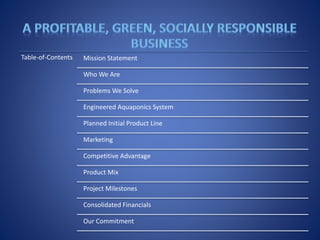
Table-of-Contents Mission Statement
Who We Are
Problems We Solve
Engineered Aquaponics System
Planned Initial Product Line
Marketing
Competitive Advantage
Product Mix
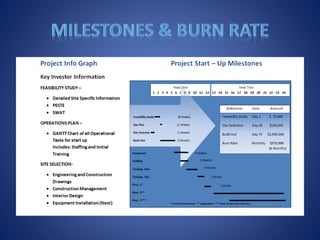
Project Milestones
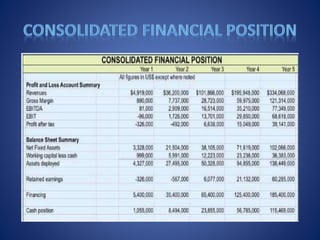
Consolidated Financials
Our Commitment
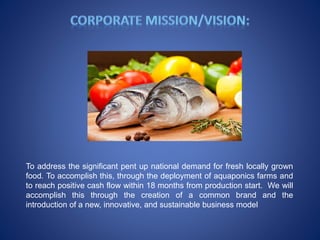
To address the significant pent up national demand for fresh locally grown
food. To accomplish this, through the deployment of aquaponics farms and
to reach positive cash flow within 18 months from production start. We will
accomplish this through the creation of a common brand and the
introduction of a new, innovative, and sustainable business model
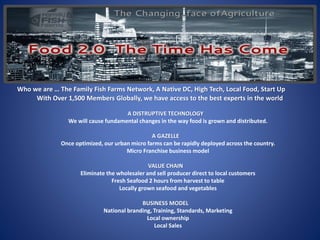
Who we are … The Family Fish Farms Network, A Native DC, High Tech, Local Food, Start Up
With Over 1,500 Members Globally, we have access to the best experts in the world
A DISTRUPTIVE TECHNOLOGY
We will cause fundamental changes in the way food is grown and distributed.
A GAZELLE
Once optimized, our urban micro farms can be rapidly deployed across the country.
Micro Franchise business model
VALUE CHAIN
Eliminate the wholesaler and sell producer direct to local customers
Fresh Seafood 2 hours from harvest to table
Locally grown seafood and vegetables
BUSINESS MODEL
National branding, Training, Standards, Marketing
Local ownership
Local Sales
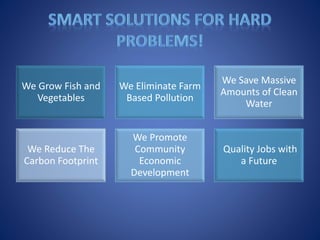
We Grow Fish and
Vegetables
We Eliminate Farm
Based Pollution
We Save Massive
Amounts of Clean
Water
We Reduce The
Carbon Footprint
We Promote
Community
Economic
Development
Quality Jobs with
a Future
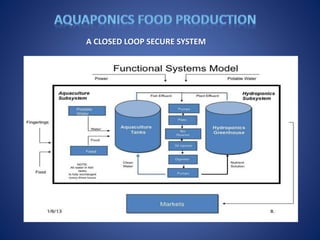
A CLOSED LOOP SECURE SYSTEM
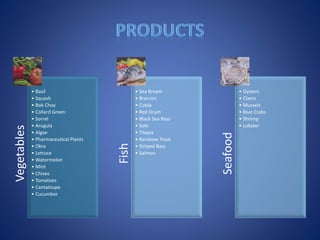
Vegetables
• Basil
• Squash
• Bok Choy
• Collard Green
• Sorrel
• Arugula
• Algae
• Pharmaceutical Plants
• Okra
• Lettuce
• Watermelon
• Mint
• Chives
• Tomatoes
• Cantaloupe
• Cucumber
Fish
• Sea Bream
• Branzini
• Cobia
• Red Drum
• Black Sea Bass
• Sole
• Tilapia
• Rainbow Trout
• Striped Bass
• Salmon
Seafood
• Oysters
• Clams
• Mussels
• Blue Crabs
• Shrimp
• Lobster
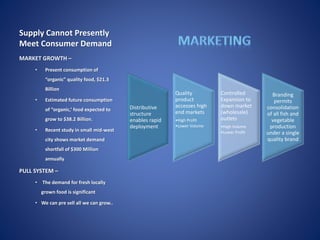
Supply Cannot Presently
Meet Consumer Demand
MARKET GROWTH –
• Present consumption of
“organic” quality food, $21.3
Billion
• Estimated future consumption
of “organic,’ food expected to
grow to $38.2 Billion.
• Recent study in small mid-west
city shows market demand
shortfall of $300 Million
annually
PULL SYSTEM –
• The demand for fresh locally
grown food is significant
• We can pre sell all we can grow..
Distributive
structure
enables rapid
deployment
Quality
product
accesses high
end markets
•High Profit
•Lower Volume
Controlled
Expansion to
down market
(wholesale)
outlets
•High Volume
•Lower Profit
Branding
permits
consolidation
of all fish and
vegetable
production
under a single
quality brand
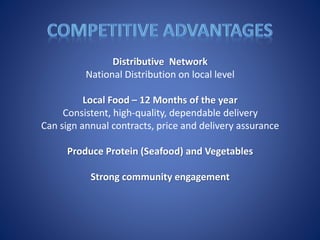
Distributive Network
National Distribution on local level
Local Food – 12 Months of the year
Consistent, high-quality, dependable delivery
Can sign annual contracts, price and delivery assurance
Produce Protein (Seafood) and Vegetables
Strong community engagement
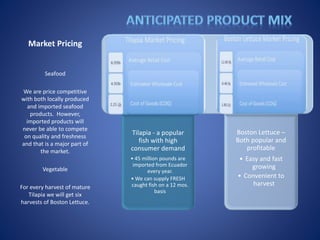
Market Pricing
Seafood
We are price competitive
with both locally produced
and imported seafood
products. However,
imported products will
never be able to compete
on quality and freshness
and that is a major part of
the market.
Vegetable
For every harvest of mature
Tilapia we will get six
harvests of Boston Lettuce.
Tilapia - a popular
fish with high
consumer demand
• 45 million pounds are
imported from Ecuador
every year.
• We can supply FRESH
caught fish on a 12 mos.
basis
Boston Lettuce –
Both popular and
profitable
• Easy and fast
growing
• Convenient to
harvest
Jan - Apl May - Aug Spt Oct - Dec
2014
Jan - Apl May - Aug Spt Oct - Dec
2015
Jan - Apl May - Aug Spt Oct - Dec
2016
Jan - Apl May - Aug Spt Oct - Dec
2017
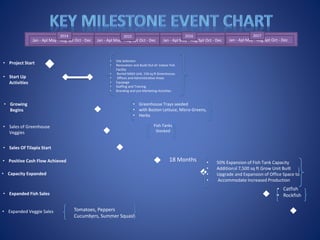
• Project Start
• Start Up
Activities
• Growing
Begins
• Sales Of Tilapia Start
• Expanded Fish Sales
• Sales of Greenhouse
Veggies
• Capacity Expanded
• Expanded Veggie Sales


 





• Greenhouse Trays seeded
• with Boston Lettuce, Micro-Greens,
• Herbs
Fish Tanks
Stocked
• Catfish
• Rockfish
Tomatoes, Peppers
Cucumbers, Summer Squash
• Positive Cash Flow Achieved  18 Months
• Site Selection
• Renovation and Build Out of: Indoor Fish
Facility
• Buried MIGS Unit, 15K sq ft Greenhouse;
• Offices and Administrative Areas
• Equipage
• Staffing and Training
• Branding and pre-Marketing Activities
• 50% Expansion of Fish Tank Capacity
• Additional 7,500 sq ft Grow Unit Built
• Upgrade and Expansion of Office Space to
• Accommodate Increased Production
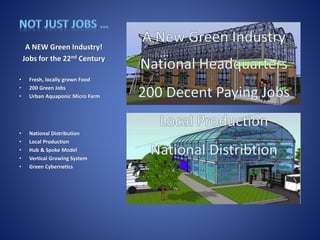
A NEW Green Industry!
Jobs for the 22nd Century
• Fresh, locally grown Food
• 200 Green Jobs
• Urban Aquaponic Micro Farm
• National Distribution
• Local Production
• Hub & Spoke Model
• Vertical Growing System
• Green Cybernetics

Pitchdeck 6.11.2014 (1)

  • 1.
  • 2.
    Table-of-Contents Mission Statement WhoWe Are Problems We Solve Engineered Aquaponics System Planned Initial Product Line Marketing Competitive Advantage Product Mix Project Milestones Consolidated Financials Our Commitment
  • 3.
    To address thesignificant pent up national demand for fresh locally grown food. To accomplish this, through the deployment of aquaponics farms and to reach positive cash flow within 18 months from production start. We will accomplish this through the creation of a common brand and the introduction of a new, innovative, and sustainable business model
  • 4.
    Who we are… The Family Fish Farms Network, A Native DC, High Tech, Local Food, Start Up With Over 1,500 Members Globally, we have access to the best experts in the world A DISTRUPTIVE TECHNOLOGY We will cause fundamental changes in the way food is grown and distributed. A GAZELLE Once optimized, our urban micro farms can be rapidly deployed across the country. Micro Franchise business model VALUE CHAIN Eliminate the wholesaler and sell producer direct to local customers Fresh Seafood 2 hours from harvest to table Locally grown seafood and vegetables BUSINESS MODEL National branding, Training, Standards, Marketing Local ownership Local Sales
  • 5.
    We Grow Fishand Vegetables We Eliminate Farm Based Pollution We Save Massive Amounts of Clean Water We Reduce The Carbon Footprint We Promote Community Economic Development Quality Jobs with a Future
  • 6.
    A CLOSED LOOPSECURE SYSTEM
  • 7.
    Vegetables • Basil • Squash •Bok Choy • Collard Green • Sorrel • Arugula • Algae • Pharmaceutical Plants • Okra • Lettuce • Watermelon • Mint • Chives • Tomatoes • Cantaloupe • Cucumber Fish • Sea Bream • Branzini • Cobia • Red Drum • Black Sea Bass • Sole • Tilapia • Rainbow Trout • Striped Bass • Salmon Seafood • Oysters • Clams • Mussels • Blue Crabs • Shrimp • Lobster
  • 8.
    Supply Cannot Presently MeetConsumer Demand MARKET GROWTH – • Present consumption of “organic” quality food, $21.3 Billion • Estimated future consumption of “organic,’ food expected to grow to $38.2 Billion. • Recent study in small mid-west city shows market demand shortfall of $300 Million annually PULL SYSTEM – • The demand for fresh locally grown food is significant • We can pre sell all we can grow.. Distributive structure enables rapid deployment Quality product accesses high end markets •High Profit •Lower Volume Controlled Expansion to down market (wholesale) outlets •High Volume •Lower Profit Branding permits consolidation of all fish and vegetable production under a single quality brand
  • 9.
    Distributive Network National Distributionon local level Local Food – 12 Months of the year Consistent, high-quality, dependable delivery Can sign annual contracts, price and delivery assurance Produce Protein (Seafood) and Vegetables Strong community engagement
  • 10.
    Market Pricing Seafood We areprice competitive with both locally produced and imported seafood products. However, imported products will never be able to compete on quality and freshness and that is a major part of the market. Vegetable For every harvest of mature Tilapia we will get six harvests of Boston Lettuce. Tilapia - a popular fish with high consumer demand • 45 million pounds are imported from Ecuador every year. • We can supply FRESH caught fish on a 12 mos. basis Boston Lettuce – Both popular and profitable • Easy and fast growing • Convenient to harvest
  • 11.
    Jan - AplMay - Aug Spt Oct - Dec 2014 Jan - Apl May - Aug Spt Oct - Dec 2015 Jan - Apl May - Aug Spt Oct - Dec 2016 Jan - Apl May - Aug Spt Oct - Dec 2017 • Project Start • Start Up Activities • Growing Begins • Sales Of Tilapia Start • Expanded Fish Sales • Sales of Greenhouse Veggies • Capacity Expanded • Expanded Veggie Sales          • Greenhouse Trays seeded • with Boston Lettuce, Micro-Greens, • Herbs Fish Tanks Stocked • Catfish • Rockfish Tomatoes, Peppers Cucumbers, Summer Squash • Positive Cash Flow Achieved  18 Months • Site Selection • Renovation and Build Out of: Indoor Fish Facility • Buried MIGS Unit, 15K sq ft Greenhouse; • Offices and Administrative Areas • Equipage • Staffing and Training • Branding and pre-Marketing Activities • 50% Expansion of Fish Tank Capacity • Additional 7,500 sq ft Grow Unit Built • Upgrade and Expansion of Office Space to • Accommodate Increased Production
  • 14.
    A NEW GreenIndustry! Jobs for the 22nd Century • Fresh, locally grown Food • 200 Green Jobs • Urban Aquaponic Micro Farm • National Distribution • Local Production • Hub & Spoke Model • Vertical Growing System • Green Cybernetics