RECENT ADVANCE CERAMIC IN
ORTHOPAEDICS
Dr. Bipul Borthakur ( Prof.)
Dept. of Orthopaedics, SMCH
Introduction
• Biomaterial is defined as natural or synthetic substances,
capable of being tolerated permanently or temporarly by the
human body
• Ceramics are one of them
• Ceramic is synthesized , inorganic , solid, non metallic
,crystalline Materials with varying composition
Preparation of ceramics
• Made by mixing the fine powders of ingredient material with water and
adhesive binder
• Then squeezed into a mould to obtain desired shape then air dried to dry-
binder & finally burned out by thermal treatment
• Modern ceramics do not use these binder agents
• They use an isostatic pressure technology to fuse the ceramic under very
high pressure to form non hygroscopic and non water dependent
• Final structure depends on –
a) highest temperature reached
b) Duration of heat treatment
Classification
• Boadly three types-
A. Bionert
B. Bioactive
C. Bioresobable
Bioinert ceramics
Incorporate into bone in accordance with pattern of contact
osteogenesis
Two types- a) aluminia ceramics(Al2o3) and
b) zirconia ceramics( ZrO2)
Aluminia ceramics
Al2O3 molecule is most stable oxide as high energetic ion &
covalent bond between Al and O atoms.
These strong bonds protect ceramic by galvanic reactions
Aluminia ceramics are entirely hexagonal crystals
Under compressive load it shows good resistance but under tensile
force it leads to brittleness
Doesn’t show plastic deformation at room temperature before
fracture
Tensile strength is increased with higher density and smaller grain
size
Aluminia ceramics
• Aluminia is chemically more stable in vivo
• Better wear resistant than stainless steel or Co-Cr alloy ( in case
of bearing component of hip prosthesis)
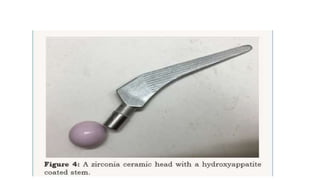
Zirconia ceramics
Metal dioxide of zirconium (ZrO2)
Pure zirconia is unstable
Consists of three crystallographical phase – cubic, tetragonal and
monoclinic
Their transformation takes place under temperature , clinical
mechanical stress and humidity
To stabilize it non metallic oxide is added (MgO, CaO and Y2O3) to
form partially stabilized zirconia
Partially stabilized zirconia is mechanically stronger than alumina
Better wear resistance than stainless steel or cobalt-Cr alloy
Mixed oxide ceramics
• New class of ceramics
• Combined with tribiological properties of aluminia and yitrium
stabilized zirconia
• Better wear compared to aluminia ceramics in vitro
• Hip joint stimulator have been promising
• Further investigation necessary for long term performance
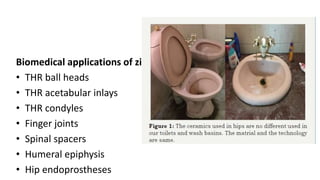
Biomedical applications of zirconia
• THR ball heads
• THR acetabular inlays
• THR condyles
• Finger joints
• Spinal spacers
• Humeral epiphysis
• Hip endoprostheses
Bioactive
• Act as osetoconduction
• Capability of chemical bonding with living tissue (
bonding osteogenesis)
• They are used according to their bending and
compressive strength
• Used as –
1. Bone graft substitute
2. Coating of prosthesis
3. As a spacer-
 Iliac crest
Bioactive
• Types –
1. Synthetic hydoxyapatite(HA)
2. Bioglass
Synthetic hydroxyapatite(HA)
• HA is highly crystalline hydroxylated CP salt with high degree of
hardness
• Ceramic and natural HA have a great chemical similarity
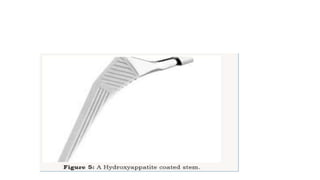
• Act as bone graft substitute and coating of femoral prosthesis
• An excellent carrier for osteoinductive growth factors and
osteogenic cells - so useful as graft extender
• It is brittle material and undergoes slow resorption and
become focus of mechanical stress
• So it is modified and combined with other materials for
Bioglass
• These are hard, non porous materials consisting of calcium,
phosphorous and silicon dioxide
• They bond chemically to bone
• Bonding leads to series of surface reactions and forms hydroxy-
carbonate apatite layer at glass surface
• Thus growth of osseous tissue occur
• It possess osteoconductive property
• It is brittle and prone to fracture with cyclic loading
• Incorporation of stainless steel increases its binding strength
Bioresorable ceramics
• Gradually absorbed in vivo and replaced by bone in the bone
tissue
• Similar to contact osteogenesis
• But interface between bioresorable ceramics and bone is not
stable as bioinert ceramics
Tricalcium phosphate
• TCP ceramic is similar to amorphous bone precursors
• It enhances bonding with adjacent bone of the host
• Act as bone graft substitute
• This stimulates osteoclastic resorption and osteoblastic new
bone formation within the resorbed implant
• Two forms alpha TCP and beta TCP
• Pure phase alpha TCP is made of porous granules that can
replace bone and resorobed in 24 months
• Beta TCP is an abundantly porous substance and create to
imitate the trabecular structure of cancellous bone
• its porosity facilitates activities of bone regenerating entities
• Disadvantage- due to rapid breakdown it may lead to
inflammatory reaction and volume loss
Calcium sulphate
• It is osteoconductive bone-void filler
• It is completely resorbed and substituted gradually as new bone remodells
• It is biocompatible, bioactive and resorbable after 12 weeks
• It combined with various antibiotics to deliver in bone and soft tissue
infections
• Indications-
1. Filling of bone cyst, benign bone lesions
2. Cavitary or segmental bone defect
3. As a graft extender in spinal fusion
4. Filling of bone graft harvesting sites
Recent advance ceramic in ortho

Recent advance ceramic in ortho

  • 1.
    RECENT ADVANCE CERAMICIN ORTHOPAEDICS Dr. Bipul Borthakur ( Prof.) Dept. of Orthopaedics, SMCH
  • 2.
    Introduction • Biomaterial isdefined as natural or synthetic substances, capable of being tolerated permanently or temporarly by the human body • Ceramics are one of them • Ceramic is synthesized , inorganic , solid, non metallic ,crystalline Materials with varying composition
  • 3.
    Preparation of ceramics •Made by mixing the fine powders of ingredient material with water and adhesive binder • Then squeezed into a mould to obtain desired shape then air dried to dry- binder & finally burned out by thermal treatment • Modern ceramics do not use these binder agents • They use an isostatic pressure technology to fuse the ceramic under very high pressure to form non hygroscopic and non water dependent • Final structure depends on – a) highest temperature reached b) Duration of heat treatment
  • 4.
    Classification • Boadly threetypes- A. Bionert B. Bioactive C. Bioresobable
  • 5.
    Bioinert ceramics Incorporate intobone in accordance with pattern of contact osteogenesis Two types- a) aluminia ceramics(Al2o3) and b) zirconia ceramics( ZrO2)
  • 6.
    Aluminia ceramics Al2O3 moleculeis most stable oxide as high energetic ion & covalent bond between Al and O atoms. These strong bonds protect ceramic by galvanic reactions Aluminia ceramics are entirely hexagonal crystals Under compressive load it shows good resistance but under tensile force it leads to brittleness Doesn’t show plastic deformation at room temperature before fracture Tensile strength is increased with higher density and smaller grain size
  • 7.
    Aluminia ceramics • Aluminiais chemically more stable in vivo • Better wear resistant than stainless steel or Co-Cr alloy ( in case of bearing component of hip prosthesis)
  • 8.
    Zirconia ceramics Metal dioxideof zirconium (ZrO2) Pure zirconia is unstable Consists of three crystallographical phase – cubic, tetragonal and monoclinic Their transformation takes place under temperature , clinical mechanical stress and humidity To stabilize it non metallic oxide is added (MgO, CaO and Y2O3) to form partially stabilized zirconia Partially stabilized zirconia is mechanically stronger than alumina Better wear resistance than stainless steel or cobalt-Cr alloy
  • 10.
    Mixed oxide ceramics •New class of ceramics • Combined with tribiological properties of aluminia and yitrium stabilized zirconia • Better wear compared to aluminia ceramics in vitro • Hip joint stimulator have been promising • Further investigation necessary for long term performance
  • 11.
    Biomedical applications ofzirconia • THR ball heads • THR acetabular inlays • THR condyles • Finger joints • Spinal spacers • Humeral epiphysis • Hip endoprostheses
  • 12.
    Bioactive • Act asosetoconduction • Capability of chemical bonding with living tissue ( bonding osteogenesis) • They are used according to their bending and compressive strength • Used as – 1. Bone graft substitute 2. Coating of prosthesis 3. As a spacer-  Iliac crest
  • 13.
    Bioactive • Types – 1.Synthetic hydoxyapatite(HA) 2. Bioglass
  • 14.
    Synthetic hydroxyapatite(HA) • HAis highly crystalline hydroxylated CP salt with high degree of hardness • Ceramic and natural HA have a great chemical similarity • Act as bone graft substitute and coating of femoral prosthesis • An excellent carrier for osteoinductive growth factors and osteogenic cells - so useful as graft extender • It is brittle material and undergoes slow resorption and become focus of mechanical stress • So it is modified and combined with other materials for
  • 16.
    Bioglass • These arehard, non porous materials consisting of calcium, phosphorous and silicon dioxide • They bond chemically to bone • Bonding leads to series of surface reactions and forms hydroxy- carbonate apatite layer at glass surface • Thus growth of osseous tissue occur • It possess osteoconductive property • It is brittle and prone to fracture with cyclic loading • Incorporation of stainless steel increases its binding strength
  • 17.
    Bioresorable ceramics • Graduallyabsorbed in vivo and replaced by bone in the bone tissue • Similar to contact osteogenesis • But interface between bioresorable ceramics and bone is not stable as bioinert ceramics
  • 18.
    Tricalcium phosphate • TCPceramic is similar to amorphous bone precursors • It enhances bonding with adjacent bone of the host • Act as bone graft substitute • This stimulates osteoclastic resorption and osteoblastic new bone formation within the resorbed implant • Two forms alpha TCP and beta TCP • Pure phase alpha TCP is made of porous granules that can replace bone and resorobed in 24 months • Beta TCP is an abundantly porous substance and create to imitate the trabecular structure of cancellous bone • its porosity facilitates activities of bone regenerating entities • Disadvantage- due to rapid breakdown it may lead to inflammatory reaction and volume loss
  • 19.
    Calcium sulphate • Itis osteoconductive bone-void filler • It is completely resorbed and substituted gradually as new bone remodells • It is biocompatible, bioactive and resorbable after 12 weeks • It combined with various antibiotics to deliver in bone and soft tissue infections • Indications- 1. Filling of bone cyst, benign bone lesions 2. Cavitary or segmental bone defect 3. As a graft extender in spinal fusion 4. Filling of bone graft harvesting sites