Dr. Usman Liaqat
Materials for Biomedical
Applications
Ceramics
Ceramic Biomaterials
• Superior chemical compatibility of ceramics with
physiological medium and stiff tissues, such as
bones and teeth
• Bone tissue composition and characteristics are
similar to those of ceramic materials
Properties of Ceramics
• The density of ceramics is lower than that of most of metals
and their alloys
• These materials have good dimensional stability
• They are resistant to wear and to compression
• They are stable in acidic media
• They are hard, brittle and susceptible to fracture, with low or
no plastic deformation
• Rarely recommended for applications in regions submitted to
high tension and that demand support
Bioceramic Classification
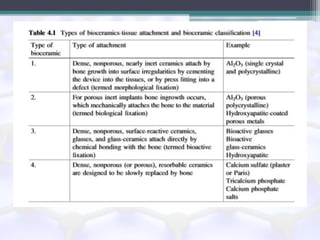
• Dense, non-porous and nearly inert
▫ Mechanical locking
• Porous and inert
▫ Ingrowth of tissue into pores
▫ 100-150 μm pore size
• Dense, non-porous and surface reactive
▫ Biochemical reaction occurs at surface
• Dense, non-porous or porous and bioresorbable
▫ Tissue replaces the resorbable material
▫ Must be metabolically accepted
• Alumina
▫ High hardness, compression, and abrasion resistance
▫ Chemically inert material, with high stability in physiologic
and corrosive media
▫ Mechanical properties of poly crystalline Al2O3 are a
function of grain size and purity
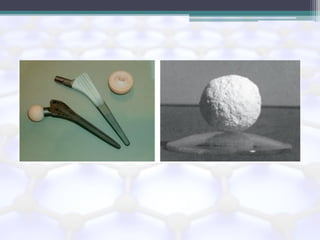
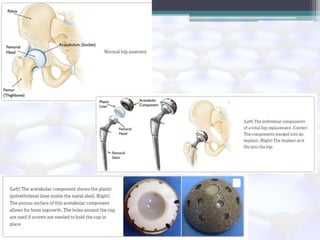
▫ Acetabula and femoral heads for hip joint replacement
▫ When these two pieces are polished together and utilized as
a pair, the friction coefficient of the joint is reduced with
time
▫ Wear resistance of the ceramic head/UHMWPE cup
combination over metal/UHMWPE has improved
from 1.3 to 34 times in the laboratory and from three
to four times clinically
▫ High elastic modulus of alumina may be responsible
for cancellous bone atrophy and problem of acetabular
cup in old patients
▫ Fracture of ceramic balls is virtually zero
▫ Success rate of 10 years follow up is more than 90%
▫ Other clinical applications of alumina include knee
prostheses and elements for maxillofacial
reconstruction, screws for bones, replacements for
small bones of the middle ear, segmental replacements
of bones, and dental implants
▫ The mechanical strength of monocrystalline alumina
(sapphire) is nearly three times higher than that of
polycrystalline alumina
▫ But its use was reduced due to its low impact
resistance
▫ Currently, monocrystalline alumina is employed
as bracket in orthodontic devices on account of its
better esthetics and highly polished surface
• Calcium Phosphate Ceramics
▫ Chemical and structural similarity with biological
apatite
▫ Excellent biocompatibility and bioactive behavior
▫ Can act as useful supports for the release of different
compounds incorporated in them
▫ Hormones, vaccines, antibiotics and anticancer agents
▫ The molar ratio between the calcium and phosphorous
atoms (Ca/P) varies between 0.5 and 2.0
• Hydroxyapatite
▫ Ca10(PO4)6(OH)2
▫ Bone minerals, enamel and dentine
▫ Advantages
 Quick bone adaptation
 No fibrous tissue formation
 Good implant/tissue adhesion
▫ Disadvantage
 Low biodegradation, which occurs by cell mechanisms
gradually after 4–5 years of implantation
• Tricalcium Phosphate
▫ Tricalcium phosphate (TCP), Ca3(PO4)2, has Ca/P of 1.5
▫ Not stable in aqueous solutions and in humid environments
▫ Resorbed between 6 and 15 weeks after the implantation
▫ Factors that influence degradation are porosity,
crystallinity, chemical purity, and biomaterial surface
roughness
▫ Resorbed both biologically and chemically
• Bioglasses
▫ Bioactive glass started with the development of 45S5
bioglass
▫ Quaternary system of the SiO2–CaO–Na2O–P2O5
▫ After implantation, the surface of bioactive glass forms
biologically active hydroxyapatite layer
▫ Recently, it was observed that ionic dissolution of
bioglass products (Si, Ca, P) stimulate the expression
of several genes of osteoblast cells and angiogenesis in
vitro and in vivo
• Bioglass® can also have interaction with the
conjunctive tissue, provided the interface is
motionless
• Bioglass® 45S5 would take nearly 8 days for
50% of its surface to be linked to the tissue cells
• HA would need nearly 32 days, if utilized under
the same conditions
Materials for Biomedical Applications_Ceramics.pdf

Materials for Biomedical Applications_Ceramics.pdf

  • 1.
    Dr. Usman Liaqat Materialsfor Biomedical Applications Ceramics
  • 2.
    Ceramic Biomaterials • Superiorchemical compatibility of ceramics with physiological medium and stiff tissues, such as bones and teeth • Bone tissue composition and characteristics are similar to those of ceramic materials
  • 4.
    Properties of Ceramics •The density of ceramics is lower than that of most of metals and their alloys • These materials have good dimensional stability • They are resistant to wear and to compression • They are stable in acidic media • They are hard, brittle and susceptible to fracture, with low or no plastic deformation • Rarely recommended for applications in regions submitted to high tension and that demand support
  • 7.
    Bioceramic Classification • Dense,non-porous and nearly inert ▫ Mechanical locking • Porous and inert ▫ Ingrowth of tissue into pores ▫ 100-150 μm pore size • Dense, non-porous and surface reactive ▫ Biochemical reaction occurs at surface • Dense, non-porous or porous and bioresorbable ▫ Tissue replaces the resorbable material ▫ Must be metabolically accepted
  • 9.
    • Alumina ▫ Highhardness, compression, and abrasion resistance ▫ Chemically inert material, with high stability in physiologic and corrosive media ▫ Mechanical properties of poly crystalline Al2O3 are a function of grain size and purity ▫ Acetabula and femoral heads for hip joint replacement ▫ When these two pieces are polished together and utilized as a pair, the friction coefficient of the joint is reduced with time
  • 12.
    ▫ Wear resistanceof the ceramic head/UHMWPE cup combination over metal/UHMWPE has improved from 1.3 to 34 times in the laboratory and from three to four times clinically ▫ High elastic modulus of alumina may be responsible for cancellous bone atrophy and problem of acetabular cup in old patients ▫ Fracture of ceramic balls is virtually zero ▫ Success rate of 10 years follow up is more than 90%
  • 14.
    ▫ Other clinicalapplications of alumina include knee prostheses and elements for maxillofacial reconstruction, screws for bones, replacements for small bones of the middle ear, segmental replacements of bones, and dental implants ▫ The mechanical strength of monocrystalline alumina (sapphire) is nearly three times higher than that of polycrystalline alumina ▫ But its use was reduced due to its low impact resistance
  • 15.
    ▫ Currently, monocrystallinealumina is employed as bracket in orthodontic devices on account of its better esthetics and highly polished surface
  • 16.
    • Calcium PhosphateCeramics ▫ Chemical and structural similarity with biological apatite ▫ Excellent biocompatibility and bioactive behavior ▫ Can act as useful supports for the release of different compounds incorporated in them ▫ Hormones, vaccines, antibiotics and anticancer agents ▫ The molar ratio between the calcium and phosphorous atoms (Ca/P) varies between 0.5 and 2.0
  • 17.
    • Hydroxyapatite ▫ Ca10(PO4)6(OH)2 ▫Bone minerals, enamel and dentine ▫ Advantages  Quick bone adaptation  No fibrous tissue formation  Good implant/tissue adhesion ▫ Disadvantage  Low biodegradation, which occurs by cell mechanisms gradually after 4–5 years of implantation
  • 18.
    • Tricalcium Phosphate ▫Tricalcium phosphate (TCP), Ca3(PO4)2, has Ca/P of 1.5 ▫ Not stable in aqueous solutions and in humid environments ▫ Resorbed between 6 and 15 weeks after the implantation ▫ Factors that influence degradation are porosity, crystallinity, chemical purity, and biomaterial surface roughness ▫ Resorbed both biologically and chemically
  • 19.
    • Bioglasses ▫ Bioactiveglass started with the development of 45S5 bioglass ▫ Quaternary system of the SiO2–CaO–Na2O–P2O5 ▫ After implantation, the surface of bioactive glass forms biologically active hydroxyapatite layer ▫ Recently, it was observed that ionic dissolution of bioglass products (Si, Ca, P) stimulate the expression of several genes of osteoblast cells and angiogenesis in vitro and in vivo
  • 20.
    • Bioglass® canalso have interaction with the conjunctive tissue, provided the interface is motionless • Bioglass® 45S5 would take nearly 8 days for 50% of its surface to be linked to the tissue cells • HA would need nearly 32 days, if utilized under the same conditions