• Platelet Rich Plasma
Moderator: Dr.Raja Bhaskar Sir
Presenter: Dr. Mukund S Nair
• Biomaterials in orthopaedics-
bioinert materials
I. Platelet Rich Plasma
1. What is PRP
2. Preparation of PRP (Buffy coat, Plasma based )
3. Role of Platelets in healing & GF in PRP
4. Uses
5. Complications
1. What is PRP?
• Autologous plasma with more
than baseline platelets
• Utilizes Growth Factor (GF)
content of platelets for healing
of tissues.(Anabolic effects)
• Simple, efficient and minimally
invasive method of obtaining a
natural concentration of
autologous GF
Developed- 1970
First used – Open heart surgery- 1987
Popularity in mid 1990’s
2.
Preparation:-
• Centrifugation of
blood  plasma,
buffy coat (WBC &
Platelets) and
RBC.
• Calcium Chloride-
Platelet activator
1. Increase ECM deposition
2. Reduce pro-apoptotic signals
3. Minimize joint inflammation
Proposed
Functions
1. Pure PRP
2. Leukocyte and platelet rich
plasma (L-PRP)
3. Pure Platelet rich Fibrin
4. L-PRF
Classification
• Role in inflammatory cascade response to
injury
• Growth factors in PRP
3. Role Of Platelets in Healing
4. Uses In Orthopaedics
• The use of PRP, and its efficacy is
controversial
• Evidence of benefit when used in tennis
elbow
• L PRP has more stimulatory effects on
tenocyte proliferation than PRP (Lin et
al, 2022)
5. Complications & Contraindications
Complications
Localized swelling
Pain
Risk of hematoma
Infection
Scarring
Contraindications
• Abnormal platelet
fn or low count
• Anemia
• Malignancies
• Infection
Limitations of PRP
• Expensive; not covered by most insurances
• Lack of uniform response to therapy
• More high standard scientific evidence necessary
II. Bio-inert Materials In
Orthopaedics
What Are Biomaterials?
• Implanted in the body to perform certain biological
functions by substituting or repairing certain tissues such as
bone, cartilage, ligaments & tendons.
• Generations:-
• 1st
gen- Bioinert (Metals, polyethylene, ceramics)
• 2nd
gen- Bioactive
Biodegradable
• 3rd
gen- Stimulate specific cellular responses at molecular level
NOTE: Generations are not evolutionary
Factors influencing
the type of material
• Mechanical properties
• Youngs & Rigidity modulus
• Poisson’s ratio
• Hardness
• Isotropy
• Creep & Viscous Flow
• Fatigue
• Surface properties
• Surface energy
• Contact angle
• Critical surface tension
• Thermal Properties
Bio-inert Biomaterials
• Minimal interaction with
surrounding tissue
• Same physical property as
replaced tissue
• Fibrous capsule formation
• Osteointegration
phenomenon of Ti
(Brainmarke et al, 1964)
1. Metals
• Stainless steel (SS)
• Titanium (Ti)
2.Polymers
• Bone cement
• Ultra High Molec. Wt.
Polyethylene (UHMWPE)
3.
Ceramics
• Partially stabilized zirconia
• Alumina
1. Metallic
materials
20th century
SS & Co-Cr based alloys
1940s
Ti & its alloys
1960
Sir John Charnley- 1st
successful total hip
prosthesis with ‘low
friction’
1967
NiTi shape memory
alloys
!!!(Ni = Allergenic effect)
1. Metallic materials
Cr - High Resistance
Cr2O3
Cr- improves R Vanadium- Toxic
1.a. Stainless Steel
Advantages :- Disadvantages:-
Low cost & Availability Poor wear resistance- metal
on metal pairing in
prosthetic joints
STRONG High young’s modulus
(200GPa)
Easy processing Stress shielding -> bone
resorption
Relatively ductile
Biocompatible
1.b. Cobalt Chrome alloys
• Used in bearing devices- THR, M on M
devices
Advantages: Disadvantages
Excellent corrosion resistance Very high Young’s modulus
Excellent long term
biocompatibility
Stress shielding
Strong Expensive
1.c. Titanium Alloys
• MC used = Titanium 64 (Ti-6AI-4v)
Advantages Disadvantage:
Moderate elastic modulus(110GPa) Poor wear characteristics
Good corrosion R Systemic toxicity- Vanadium
Low density (light wt) Relatively expensive
Corrosion resistant
MRI compatible
Osseointegration phenomenon
• Used in Internal
fixations devices ,
plates, vertebral
spacers, IM nails
• Comparison of metal alloys
Alloy Young’s modulus
(GPa)
Yield strength
(MPa)
Ultimate tensile
strength (Mpa)
Stainless Steel- 316L 190 500 750
Titanium 64 110 800 900
Cobalt Chrome F562 230 1000 1200
2. Ceramics
• Refractory polycrystalline
compounds
• Highly inert
• Hard & Brittle
• High compressive strength
• Good electric & thermal
insulators
• Good aesthetic appearance
Ceramics
Advantage Disadvantage
Chemically inert & insoluble Brittleness
Best biocompatibility Very difficult to process- high
melting pt
Very strong Very expensive
Osteoconductive High youngs modulus
Low wear resistance Low tensile strength
Uses of ceramics
2.a. Alumina :-
• Femoral head
• Bone screws & plates
• Porous coating for femoral
stems
• Porous spacers (Esp in
Revision surgeries)
• Knee prosthesis
2.b Zirconia
• ‘Oxinium’- Zirconium oxide
Used in :-
• Femoral head
• Artificial knee
• Bone screws & plates
• Favored over UHMWPE due to
superior wear resistance
3. Polymers
• Many repeating units of basic
sequences
• Examples-
• PMMA
• UHMWPE
• Uses-
• Articulating surfaces against
ceramic components
• Void filling after bone loss
3.a. PMMA
• Powder:-
PMMA copolymer +
Barium/Zirconium oxide (radio opacifier) +
Benzoyl peroxide (Catalyst)
• Stages of reaction:-
• Dough time= 2-3 min
• Working time= 5-8min
• Setting time= 8-10min
Polymers
Advantages Disadvantage:
Tough Susceptible to abrasion
Ductile Thermoplastic (Altered by
extremes of temp.)
Resilient Weaker than the bone in
tension
Resistant to wear
Tissue-Implant
Responses
BIOMATERIAL
TOXIC
Death of
surrounding
tissues
NON TOXIC
Bio
degradable
Dissolution of
material
Bio active
Interfacial
bond
formation
Bio inert
Fibrous
encapsulation
Complications
1. Aseptic loosening :- Osteolysis from
body’s reaction to wear debris
2. Stress Shielding :- Implant prevents
proper loading of adjacent bone ->
resorption
3. Corrosion
4. Infection
5. Metal hypersensitivity
6. Manufacturing error
Aseptic Autolysis
Recent
advances
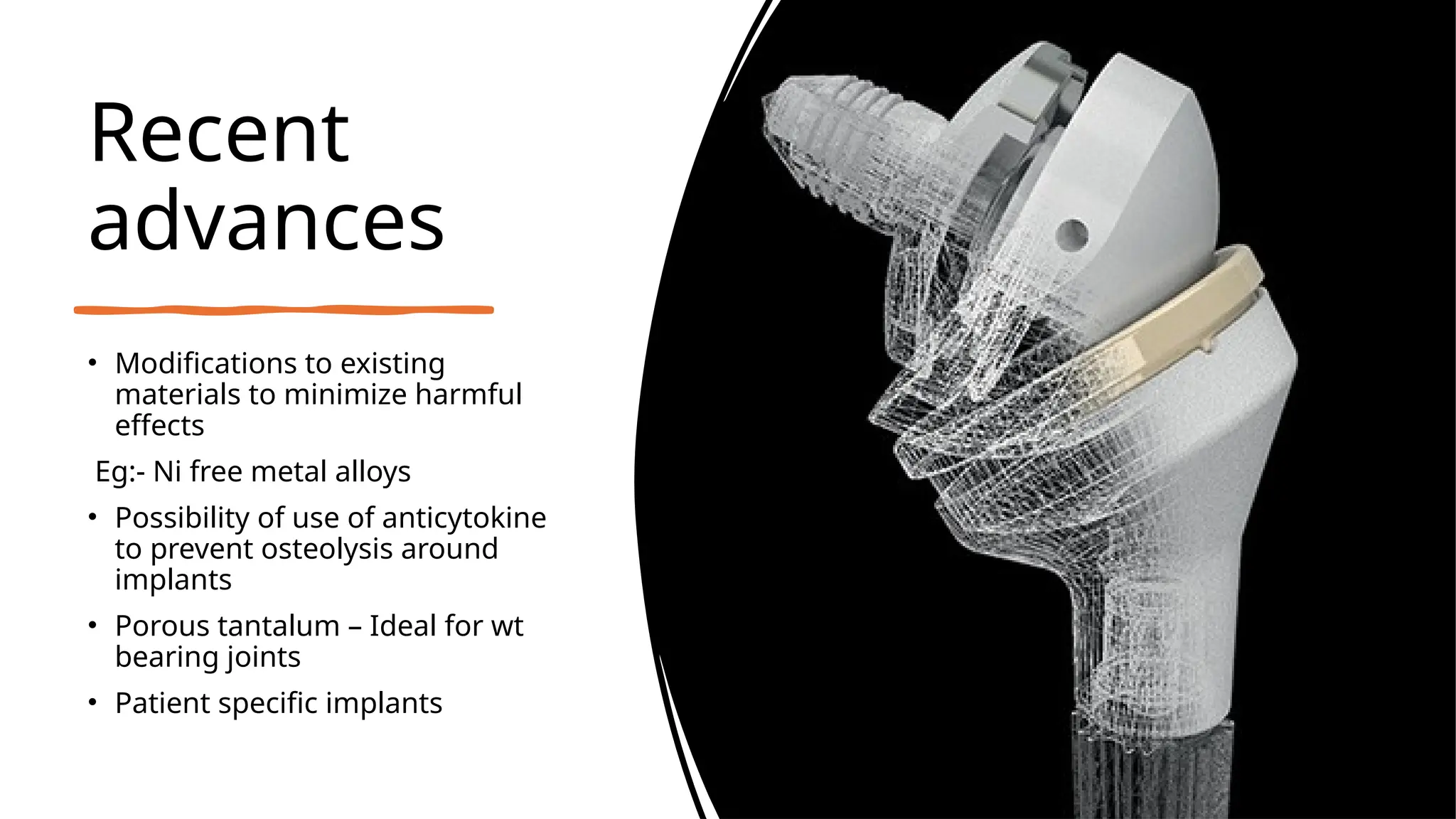
• Modifications to existing
materials to minimize harmful
effects
Eg:- Ni free metal alloys
• Possibility of use of anticytokine
to prevent osteolysis around
implants
• Porous tantalum – Ideal for wt
bearing joints
• Patient specific implants
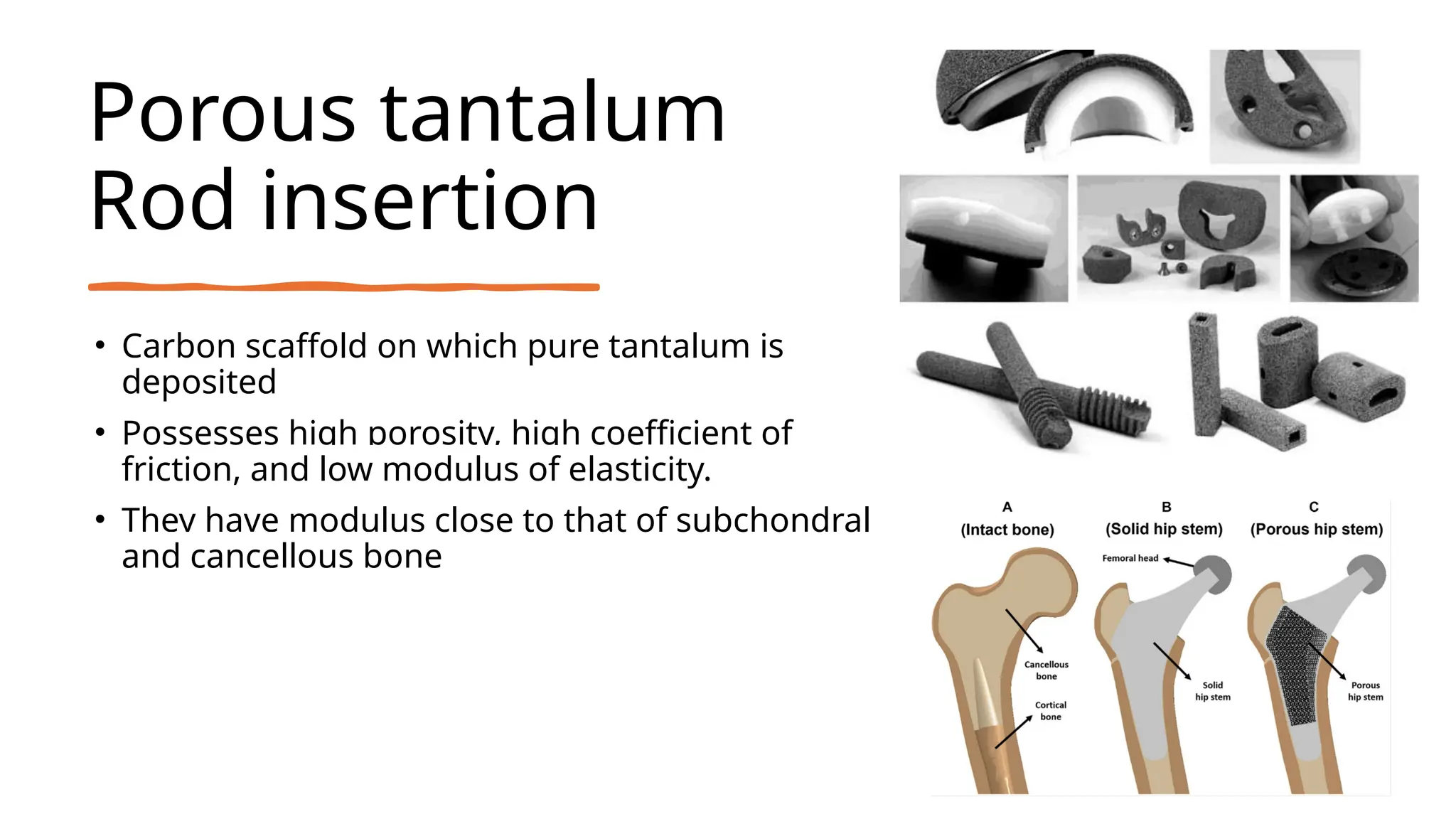
Porous tantalum
Rod insertion
• Carbon scaffold on which pure tantalum is
deposited
• Possesses high porosity, high coefficient of
friction, and low modulus of elasticity.
• They have modulus close to that of subchondral
and cancellous bone
Thank You
References
1. PRP
i. Cole BJ, Seroyer ST, Filardo G, Bajaj S, Fortier LA. Platelet-rich
plasma: where are we now and where are we going? Sports
Health. 2010 May;2(3):203-10. doi: 10.1177/1941738110366385.
PMID: 23015939; PMCID: PMC3445108.

PRP & Bioinert materials in orthopaedics .pptx

  • 1.
    • Platelet RichPlasma Moderator: Dr.Raja Bhaskar Sir Presenter: Dr. Mukund S Nair • Biomaterials in orthopaedics- bioinert materials
  • 2.
    I. Platelet RichPlasma 1. What is PRP 2. Preparation of PRP (Buffy coat, Plasma based ) 3. Role of Platelets in healing & GF in PRP 4. Uses 5. Complications
  • 3.
    1. What isPRP? • Autologous plasma with more than baseline platelets • Utilizes Growth Factor (GF) content of platelets for healing of tissues.(Anabolic effects) • Simple, efficient and minimally invasive method of obtaining a natural concentration of autologous GF Developed- 1970 First used – Open heart surgery- 1987 Popularity in mid 1990’s
  • 4.
    2. Preparation:- • Centrifugation of blood plasma, buffy coat (WBC & Platelets) and RBC. • Calcium Chloride- Platelet activator
  • 5.
    1. Increase ECMdeposition 2. Reduce pro-apoptotic signals 3. Minimize joint inflammation Proposed Functions 1. Pure PRP 2. Leukocyte and platelet rich plasma (L-PRP) 3. Pure Platelet rich Fibrin 4. L-PRF Classification
  • 6.
    • Role ininflammatory cascade response to injury • Growth factors in PRP 3. Role Of Platelets in Healing
  • 8.
    4. Uses InOrthopaedics • The use of PRP, and its efficacy is controversial • Evidence of benefit when used in tennis elbow • L PRP has more stimulatory effects on tenocyte proliferation than PRP (Lin et al, 2022)
  • 9.
    5. Complications &Contraindications Complications Localized swelling Pain Risk of hematoma Infection Scarring Contraindications • Abnormal platelet fn or low count • Anemia • Malignancies • Infection
  • 10.
    Limitations of PRP •Expensive; not covered by most insurances • Lack of uniform response to therapy • More high standard scientific evidence necessary
  • 11.
    II. Bio-inert MaterialsIn Orthopaedics
  • 12.
    What Are Biomaterials? •Implanted in the body to perform certain biological functions by substituting or repairing certain tissues such as bone, cartilage, ligaments & tendons. • Generations:- • 1st gen- Bioinert (Metals, polyethylene, ceramics) • 2nd gen- Bioactive Biodegradable • 3rd gen- Stimulate specific cellular responses at molecular level NOTE: Generations are not evolutionary
  • 13.
    Factors influencing the typeof material • Mechanical properties • Youngs & Rigidity modulus • Poisson’s ratio • Hardness • Isotropy • Creep & Viscous Flow • Fatigue • Surface properties • Surface energy • Contact angle • Critical surface tension • Thermal Properties
  • 14.
    Bio-inert Biomaterials • Minimalinteraction with surrounding tissue • Same physical property as replaced tissue • Fibrous capsule formation • Osteointegration phenomenon of Ti (Brainmarke et al, 1964) 1. Metals • Stainless steel (SS) • Titanium (Ti) 2.Polymers • Bone cement • Ultra High Molec. Wt. Polyethylene (UHMWPE) 3. Ceramics • Partially stabilized zirconia • Alumina
  • 15.
    1. Metallic materials 20th century SS& Co-Cr based alloys 1940s Ti & its alloys 1960 Sir John Charnley- 1st successful total hip prosthesis with ‘low friction’ 1967 NiTi shape memory alloys !!!(Ni = Allergenic effect)
  • 16.
    1. Metallic materials Cr- High Resistance Cr2O3 Cr- improves R Vanadium- Toxic
  • 17.
    1.a. Stainless Steel Advantages:- Disadvantages:- Low cost & Availability Poor wear resistance- metal on metal pairing in prosthetic joints STRONG High young’s modulus (200GPa) Easy processing Stress shielding -> bone resorption Relatively ductile Biocompatible
  • 18.
    1.b. Cobalt Chromealloys • Used in bearing devices- THR, M on M devices Advantages: Disadvantages Excellent corrosion resistance Very high Young’s modulus Excellent long term biocompatibility Stress shielding Strong Expensive
  • 19.
    1.c. Titanium Alloys •MC used = Titanium 64 (Ti-6AI-4v) Advantages Disadvantage: Moderate elastic modulus(110GPa) Poor wear characteristics Good corrosion R Systemic toxicity- Vanadium Low density (light wt) Relatively expensive Corrosion resistant MRI compatible Osseointegration phenomenon
  • 20.
    • Used inInternal fixations devices , plates, vertebral spacers, IM nails
  • 21.
    • Comparison ofmetal alloys Alloy Young’s modulus (GPa) Yield strength (MPa) Ultimate tensile strength (Mpa) Stainless Steel- 316L 190 500 750 Titanium 64 110 800 900 Cobalt Chrome F562 230 1000 1200
  • 22.
    2. Ceramics • Refractorypolycrystalline compounds • Highly inert • Hard & Brittle • High compressive strength • Good electric & thermal insulators • Good aesthetic appearance
  • 23.
    Ceramics Advantage Disadvantage Chemically inert& insoluble Brittleness Best biocompatibility Very difficult to process- high melting pt Very strong Very expensive Osteoconductive High youngs modulus Low wear resistance Low tensile strength
  • 24.
    Uses of ceramics 2.a.Alumina :- • Femoral head • Bone screws & plates • Porous coating for femoral stems • Porous spacers (Esp in Revision surgeries) • Knee prosthesis
  • 25.
    2.b Zirconia • ‘Oxinium’-Zirconium oxide Used in :- • Femoral head • Artificial knee • Bone screws & plates • Favored over UHMWPE due to superior wear resistance
  • 26.
    3. Polymers • Manyrepeating units of basic sequences • Examples- • PMMA • UHMWPE • Uses- • Articulating surfaces against ceramic components • Void filling after bone loss
  • 27.
    3.a. PMMA • Powder:- PMMAcopolymer + Barium/Zirconium oxide (radio opacifier) + Benzoyl peroxide (Catalyst) • Stages of reaction:- • Dough time= 2-3 min • Working time= 5-8min • Setting time= 8-10min
  • 28.
    Polymers Advantages Disadvantage: Tough Susceptibleto abrasion Ductile Thermoplastic (Altered by extremes of temp.) Resilient Weaker than the bone in tension Resistant to wear
  • 29.
    Tissue-Implant Responses BIOMATERIAL TOXIC Death of surrounding tissues NON TOXIC Bio degradable Dissolutionof material Bio active Interfacial bond formation Bio inert Fibrous encapsulation
  • 30.
    Complications 1. Aseptic loosening:- Osteolysis from body’s reaction to wear debris 2. Stress Shielding :- Implant prevents proper loading of adjacent bone -> resorption 3. Corrosion 4. Infection 5. Metal hypersensitivity 6. Manufacturing error
  • 31.
  • 32.
    Recent advances • Modifications toexisting materials to minimize harmful effects Eg:- Ni free metal alloys • Possibility of use of anticytokine to prevent osteolysis around implants • Porous tantalum – Ideal for wt bearing joints • Patient specific implants
  • 33.
    Porous tantalum Rod insertion •Carbon scaffold on which pure tantalum is deposited • Possesses high porosity, high coefficient of friction, and low modulus of elasticity. • They have modulus close to that of subchondral and cancellous bone
  • 34.
  • 35.
    References 1. PRP i. ColeBJ, Seroyer ST, Filardo G, Bajaj S, Fortier LA. Platelet-rich plasma: where are we now and where are we going? Sports Health. 2010 May;2(3):203-10. doi: 10.1177/1941738110366385. PMID: 23015939; PMCID: PMC3445108.

Editor's Notes

  • #3 Volume of the plasma fraction of autologous blood having a platelet concentration above normal baseline. First developed- 1970 First used – Open heart surgery- 1987 Gained popularity in mid 1990’s Found use in Dentistry, Dermat, plastic surgery, Cosmetic surgery, Maxillofacial surgery.
  • #13 Divided into 3 based on the tissue response to the implant surface 1st gen- Bioinert (Metals, polyethylene, ceramics) 2nd gen- Bioactive (Synthetic hydroxyapatite, glass ceramics, bioglass) Biodegradable (Tricalcium phosphate, polylactic-polyglycolic acid copolymers) 3rd gen- Stimulate specific cellular responses at molecular level (Hench & Pollak- 2002) Not evolutionary- They do not represent the chronological order of discovery, nor do the later generations necessarily serve as a replacement for the previous generations, but rather offer a different set of characteristic properties that can be taken advantage of. Eg- Co-Cr & Ti as replacement for SS. Bioactive- Bioresorbable- Calcium oxide, calcium carbonate & gypsum have been utilized for the last 3 decades.
  • #14 Tensile Strength – Maximum stress on the curve before breakage Yield stress- Point at which elastic behavior changes to plastic behavior Breaking stress- Pt at which substance fails/ breaks Fatigue failure- Failure of a material with repetitive loading at stress levels below the ultimate tensile strength Strength – Degree of resistance to deformation of material (Strong=high tensile strength) Toughness- Amt of energy per unit vol a material can absorb before failure Ductility/ brittleness- Amt by which a material deforms (i.e, the strain that occurs ) before it breaks Hook’s law- Stress directly prop to strain (Material behaves like a spring)
  • #15 The term bioinert = any material once placed in the human body has minimal interaction with surrounding tissue Eg:- SS Generally, a fibrous capsule might form around bioinert implants. Hence its biofunctionality relies on tissue integration through the implant. Osteointegration-
  • #16 The first metallic materials successfully used during the twentieth century in orthopaedic applications were stainless steel and cobalt–chrome-based alloys. NiTi shape memory alloys appeared by the 1967- Buehler & Wang. Is the ability to recover its shape upon heating after having been “plastically” deformed Due to this unique property , many uses were thought of, but they are not popular due to unsolved allergenic effect of Ni The first really successful substitutive joint prosthesis was the total hip prosthesis developed by Charnley in the very late 1950s (Charnley 1960). This was a cemented prosthesis with a stem made of stainless steel & bearing surface made of high density polyethylene -> significantly lower friction compared to the earlier metal on metal prosthesis
  • #17 SS is resistant to a wide range of corrosive agents due to high Chromium content, which allows formation of strongly adherent, self healing, corrosion resistant coating of Cr2O3. Made to use common trauma fixation devices like plates, screws and nails.
  • #18 Used in plates, screws, IM nails, Exfix
  • #20  Branemark et al described the phenomenon in 1964- Ti & its alloys become tightly integrated into the bone. Improve LT behavious of implant devices, Decrease risk of loosening & failure
  • #23 5 times stronger than Co-Cromium
  • #26 Oxinium is produced by heating Zirconium alloy (97.5% Zr + 2.5% Niobium) In air. The outer 5micron of the head is oxidized to form the hard zirconium oxide
  • #28 Available as both powder & liquid. (1. Monomer- N,N- Dimethyltoluidine – Accelerator, 2. Hydroquinone- Inhibitor) Used to fix prosthesis in place, to fill voids due to bone loss.
  • #30 Depends on :- Type of tissue Mechanical load Amount of motion Composition of implant Age of patient
  • #31 Aseptic loosening :- Osteolysis from body’s reaction to wear debris Stress Shielding :- Implant prevents proper loading of adjacent bone -> resorption Corrosion: Reaction of the implant with its environment -> degradation to oxides/hydroxides Infection Metal hypersensitivity Manufacturing error