Finding the
Needle -
Reaxys® Structure
Searching
Dr. Juergen Swienty-Busch
29. October 2015
Agenda
• Introduction
 What is Reaxys?
• Structure Searching – Essentials
 Editors
 Substance Model
 Search Engine and Editors
• Structure Searching - Examples
 Simple
 Sophisticated
• Reaction Similarity
3
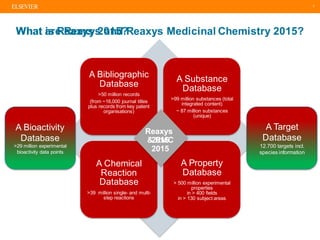
What are Reaxys and Reaxys Medicinal Chemistry 2015?
A Bibliographic
Database
>50 million records
(from ~16,000 journal titles
plus records from key patent
organisations)
A Substance
Database
>99 million substances (total
integrated content)
~ 87 million substances
(unique)
A Chemical
Reaction
Database
>39 million single- and multi-
step reactions
A Property
Database
> 500 million experimental
properties
in > 400 fields
in > 130 subject areas
Reaxys
& RMC
2015
A Bioactivity
Database
>29 million experimental
bioactivity data points
A Target
Database
12.700 targets incl.
species information
What is Reaxys 2015?
Reaxys
2015
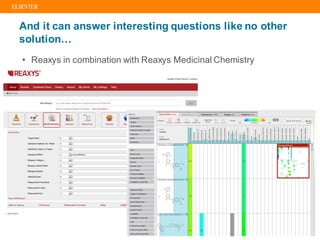
And it can answer interesting questions like no other
solution…
• Reaxys in combination with Reaxys Medicinal Chemistry
Seamlessly connecting Bioactivity with Synthesis…
Structure
Searching
Essentials
| 7
• Elsevier doesn’t develop structure editors, but partners with vendors of most
commonly used editors:
 Biovia: AccelrysDraw,MDL Draw, ISISDraw
 PerkinElmer: ChemDraw
 ChemAxon:MarvinSketch, MarvinJS
 Dotmatics:elemental
 EPAM: Ketcher
 InfoChem:ICedit
Supported Structure Editors
| 8
• Google and FireFox announced to cease support for Java applets.
What are the consequences?
 Java-based editors and links to stand alone editors will not work on
affected browser versions anymore
• Solution: please switch to Java-free editors
 This will make Reaxys independent of Java (and its updates)
 All important search features are available in those editors
 They are continuously developed: we are in contact with vendors and
your voice counts
Java vs Java-free
| 9
• Java-free Editors: available in Structure querylet or My Settings
 ChemAxon Marvin JS
 Dotmatics Elemental
 GGA Ketcher
• Java-based Editors: available in Structure querylet or My Settings
 ChemAxon MarvinSketch
• Stand-alone editors: available through My Settings (after user
registration)
• Note: requires installationof a structure editorplugin
(http://supportcontent.elsevier.com/Support%20Hub/Reaxys/Documents/5915_PlugIn_
1_10.zip)
 Biovia: AccelrysDraw, MDL Draw, ISISDraw
 PerkinElmer: ChemDraw
- Special note: requires PerkinElmer plugin available through SciStore free of charge: search for
“Reaxys”)
 InfoChem: ICedit
Using Structure Editors
| 10
• While Elsevier doesn’t develop structure editors, it has developed one of the best and
fastest structure and reaction search engines “CrossFire”, the power house behind
Reaxys
 This engine is optimized for the Reaxys substance model
 Editors are typically used not only for searching but also for publishing
- Query features are often hidden in menus
- Reaxys search features have to be translated or incorporated in customized versions
- E.g. MarvinSketch: predefinedgenerics dialog
Differences between search capabilities and structure
editor features
Reaxys Help explains the differences and ways
to enter structure queries in various editors
| 11
Searching for Structures and Reactions – Chemical
Substance Model
11
Single compound
Component
compound
Markush compound
Markush Structure
Role
E.g. dope additive, carrier,
layer/film
Type
E.g. alloy, glass/ceramic,mineral, nano etc.
Modification
MacroscopicType
Modification
E.g. diamond, graphite, rutile, anatase etc.
Name
Amount
Compound List
Role
Modification
MacroscopicType
Structure
Molecular Formula
Name
Accessiblethrough
Structure and MF searching
Accessiblethrough
Structure and MF searching
of components
Accessiblethrough
associations to examples
Structure
Searching
Examples
| 13
• The “Structure Querylet” and how to use/customize Reaxys search
themes
• Simple Structure Queries – Functions available outside editors
 As drawn, Family, Substructure, Similarity
 Stereochemistry
• Sophisticated StructureQueries – Functions available inside editors
 Substitution counts
 R-Groups
 Predefined Generics
 Link nodes
 Position-variation bond
 Reaction searching: Atom mapping
 … and more
Structure Searching Examples
Reaction Similarity
Searching
| 15
• Creating a “Butadiene” for subsequent Diels-Alder
Reaction Similarity Searching
Example: key step in the synthesis of kempanes
| 16
Building a “Reaction Molecule”
1. Assign reaction center, unchanged groups and leaving groups
How does it work?
+
| 17
H
Step 2: Build a “Reaction Molecule” from “transition”
state and make it machine readable
Note: Protons are ignored. Just illustrative
| 18
 Reaction centersonly:highest level of generalization (widest)
(RX.TRANS='0/88F62(0205)|80FB1(03070809)|40F61()|0CF41(05)|07F42(06)|01E*')
 Step by Step inclusion offurthershells of atoms workingoutfrom the reaction center.
With each shell included, the sets become more focused onthe query reaction (and therefore
smaller)
Step 3: Build a searchable string and apply it to
database content – Similarity Searching
Subsets and supersets of the „TransForm string“ represent different
„spheres“ around reaction center
It is fast: this example <2 sec
| 19
Examples in the „Near“ Similarity shell (24 hits)
Thank you for your
attention

Reaxys structure searching

  • 1.
    Finding the Needle - Reaxys®Structure Searching Dr. Juergen Swienty-Busch 29. October 2015
  • 2.
    Agenda • Introduction  Whatis Reaxys? • Structure Searching – Essentials  Editors  Substance Model  Search Engine and Editors • Structure Searching - Examples  Simple  Sophisticated • Reaction Similarity
  • 3.
    3 What are Reaxysand Reaxys Medicinal Chemistry 2015? A Bibliographic Database >50 million records (from ~16,000 journal titles plus records from key patent organisations) A Substance Database >99 million substances (total integrated content) ~ 87 million substances (unique) A Chemical Reaction Database >39 million single- and multi- step reactions A Property Database > 500 million experimental properties in > 400 fields in > 130 subject areas Reaxys & RMC 2015 A Bioactivity Database >29 million experimental bioactivity data points A Target Database 12.700 targets incl. species information What is Reaxys 2015? Reaxys 2015
  • 4.
    And it cananswer interesting questions like no other solution… • Reaxys in combination with Reaxys Medicinal Chemistry
  • 5.
  • 6.
  • 7.
    | 7 • Elsevierdoesn’t develop structure editors, but partners with vendors of most commonly used editors:  Biovia: AccelrysDraw,MDL Draw, ISISDraw  PerkinElmer: ChemDraw  ChemAxon:MarvinSketch, MarvinJS  Dotmatics:elemental  EPAM: Ketcher  InfoChem:ICedit Supported Structure Editors
  • 8.
    | 8 • Googleand FireFox announced to cease support for Java applets. What are the consequences?  Java-based editors and links to stand alone editors will not work on affected browser versions anymore • Solution: please switch to Java-free editors  This will make Reaxys independent of Java (and its updates)  All important search features are available in those editors  They are continuously developed: we are in contact with vendors and your voice counts Java vs Java-free
  • 9.
    | 9 • Java-freeEditors: available in Structure querylet or My Settings  ChemAxon Marvin JS  Dotmatics Elemental  GGA Ketcher • Java-based Editors: available in Structure querylet or My Settings  ChemAxon MarvinSketch • Stand-alone editors: available through My Settings (after user registration) • Note: requires installationof a structure editorplugin (http://supportcontent.elsevier.com/Support%20Hub/Reaxys/Documents/5915_PlugIn_ 1_10.zip)  Biovia: AccelrysDraw, MDL Draw, ISISDraw  PerkinElmer: ChemDraw - Special note: requires PerkinElmer plugin available through SciStore free of charge: search for “Reaxys”)  InfoChem: ICedit Using Structure Editors
  • 10.
    | 10 • WhileElsevier doesn’t develop structure editors, it has developed one of the best and fastest structure and reaction search engines “CrossFire”, the power house behind Reaxys  This engine is optimized for the Reaxys substance model  Editors are typically used not only for searching but also for publishing - Query features are often hidden in menus - Reaxys search features have to be translated or incorporated in customized versions - E.g. MarvinSketch: predefinedgenerics dialog Differences between search capabilities and structure editor features Reaxys Help explains the differences and ways to enter structure queries in various editors
  • 11.
    | 11 Searching forStructures and Reactions – Chemical Substance Model 11 Single compound Component compound Markush compound Markush Structure Role E.g. dope additive, carrier, layer/film Type E.g. alloy, glass/ceramic,mineral, nano etc. Modification MacroscopicType Modification E.g. diamond, graphite, rutile, anatase etc. Name Amount Compound List Role Modification MacroscopicType Structure Molecular Formula Name Accessiblethrough Structure and MF searching Accessiblethrough Structure and MF searching of components Accessiblethrough associations to examples
  • 12.
  • 13.
    | 13 • The“Structure Querylet” and how to use/customize Reaxys search themes • Simple Structure Queries – Functions available outside editors  As drawn, Family, Substructure, Similarity  Stereochemistry • Sophisticated StructureQueries – Functions available inside editors  Substitution counts  R-Groups  Predefined Generics  Link nodes  Position-variation bond  Reaction searching: Atom mapping  … and more Structure Searching Examples
  • 14.
  • 15.
    | 15 • Creatinga “Butadiene” for subsequent Diels-Alder Reaction Similarity Searching Example: key step in the synthesis of kempanes
  • 16.
    | 16 Building a“Reaction Molecule” 1. Assign reaction center, unchanged groups and leaving groups How does it work? +
  • 17.
    | 17 H Step 2:Build a “Reaction Molecule” from “transition” state and make it machine readable Note: Protons are ignored. Just illustrative
  • 18.
    | 18  Reactioncentersonly:highest level of generalization (widest) (RX.TRANS='0/88F62(0205)|80FB1(03070809)|40F61()|0CF41(05)|07F42(06)|01E*')  Step by Step inclusion offurthershells of atoms workingoutfrom the reaction center. With each shell included, the sets become more focused onthe query reaction (and therefore smaller) Step 3: Build a searchable string and apply it to database content – Similarity Searching Subsets and supersets of the „TransForm string“ represent different „spheres“ around reaction center It is fast: this example <2 sec
  • 19.
    | 19 Examples inthe „Near“ Similarity shell (24 hits)
  • 20.
    Thank you foryour attention