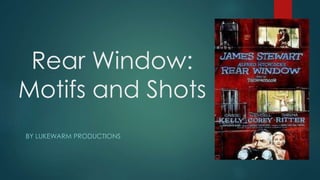
Rear Window:
Motifs and Shots
BY LUKEWARM PRODUCTIONS
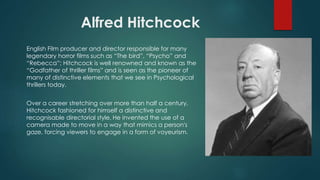
Alfred Hitchcock
English Film producer and director responsible for many
legendary horror films such as “The bird”, “Psycho” and
“Rebecca”; Hitchcock is well renowned and known as the
“Godfather of thriller films” and is seen as the pioneer of
many of distinctive elements that we see in Psychological
thrillers today.
Over a career stretching over more than half a century,
Hitchcock fashioned for himself a distinctive and
recognisable directorial style. He invented the use of a
camera made to move in a way that mimics a person's
gaze, forcing viewers to engage in a form of voyeurism.
Rear Window: Introduction
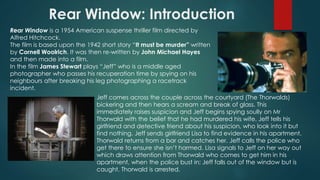
Rear Window is a 1954 American suspense thriller film directed by
Alfred Hitchcock.
The film is based upon the 1942 short story “It must be murder” written
by Cornell Woolrich. It was then re-written by John Michael Hayes
and then made into a film.
In the film James Stewart plays “Jeff” who is a middle aged
photographer who passes his recuperation time by spying on his
neighbours after breaking his leg photographing a racetrack
incident.
Jeff comes across the couple across the courtyard (The Thorwalds)
bickering and then hears a scream and break of glass. This
immediately raises suspicion and Jeff begins spying soully on Mr
Thorwald with the belief that he had murdered his wife. Jeff tells his
girlfriend and detective friend about his suspicion, who look into it but
find nothing. Jeff sends girlfriend Lisa to find evidence in his apartment.
Thorwald returns from a bar and catches her. Jeff calls the police who
get there to ensure she isn’t harmed. Lisa signals to Jeff on her way out
which draws attention from Thorwald who comes to get him in his
apartment, when the police bust in; Jeff falls out of the window but is
caught. Thorwald is arrested.
The POV Shot
“Point of view shot”
This describes the manipulation of a characters view point during a key part of a film.
The effects the POV shot has on viewers is that it enables them to feel like they are sharing the situation
with the character making the film a more entertaining experience for them.
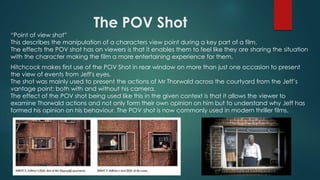
Hitchcock makes first use of the POV Shot in rear window on more than just one occasion to present
the view of events from Jeff's eyes.
The shot was mainly used to present the actions of Mr Thorwald across the courtyard from the Jeff’s
vantage point; both with and without his camera.
The effect of the POV shot being used like this in the given context is that it allows the viewer to
examine Thorwald actions and not only form their own opinion on him but to understand why Jeff has
formed his opinion on his behaviour. The POV shot is now commonly used in modern thriller films.
Sexual Objectification
This describes the manner in which females are deliberately portrayed in
films. Females are perceived as weak in a number of different ways; they
are often the sexual subjects men that may be in the film with them. By
having women perceived in this way viewers gain satisfaction through
gazing.
Hitchcock makes use of sexual objectification in two ways:
First as Jeff catches a glimpse of one of his neighbours topless by
their window.
Secondly in the behaviour of Jeff's considerably younger
girlfriend who is his servant whilst he is recovering from his injuries;
having to wait on him.
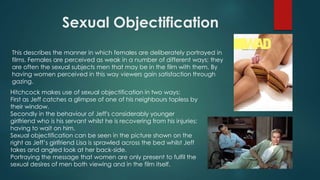
Sexual objectification can be seen in the picture shown on the
right as Jeff’s girlfriend Lisa is sprawled across the bed whilst Jeff
takes and angled look at her back-side.
Portraying the message that women are only present to fulfil the
sexual desires of men both viewing and in the film itself.

Rear Window Presentation

  • 1.
    Rear Window: Motifs andShots BY LUKEWARM PRODUCTIONS
  • 2.
    Alfred Hitchcock English Filmproducer and director responsible for many legendary horror films such as “The bird”, “Psycho” and “Rebecca”; Hitchcock is well renowned and known as the “Godfather of thriller films” and is seen as the pioneer of many of distinctive elements that we see in Psychological thrillers today. Over a career stretching over more than half a century, Hitchcock fashioned for himself a distinctive and recognisable directorial style. He invented the use of a camera made to move in a way that mimics a person's gaze, forcing viewers to engage in a form of voyeurism.
  • 3.
    Rear Window: Introduction RearWindow is a 1954 American suspense thriller film directed by Alfred Hitchcock. The film is based upon the 1942 short story “It must be murder” written by Cornell Woolrich. It was then re-written by John Michael Hayes and then made into a film. In the film James Stewart plays “Jeff” who is a middle aged photographer who passes his recuperation time by spying on his neighbours after breaking his leg photographing a racetrack incident. Jeff comes across the couple across the courtyard (The Thorwalds) bickering and then hears a scream and break of glass. This immediately raises suspicion and Jeff begins spying soully on Mr Thorwald with the belief that he had murdered his wife. Jeff tells his girlfriend and detective friend about his suspicion, who look into it but find nothing. Jeff sends girlfriend Lisa to find evidence in his apartment. Thorwald returns from a bar and catches her. Jeff calls the police who get there to ensure she isn’t harmed. Lisa signals to Jeff on her way out which draws attention from Thorwald who comes to get him in his apartment, when the police bust in; Jeff falls out of the window but is caught. Thorwald is arrested.
  • 4.
    The POV Shot “Pointof view shot” This describes the manipulation of a characters view point during a key part of a film. The effects the POV shot has on viewers is that it enables them to feel like they are sharing the situation with the character making the film a more entertaining experience for them. Hitchcock makes first use of the POV Shot in rear window on more than just one occasion to present the view of events from Jeff's eyes. The shot was mainly used to present the actions of Mr Thorwald across the courtyard from the Jeff’s vantage point; both with and without his camera. The effect of the POV shot being used like this in the given context is that it allows the viewer to examine Thorwald actions and not only form their own opinion on him but to understand why Jeff has formed his opinion on his behaviour. The POV shot is now commonly used in modern thriller films.
  • 5.
    Sexual Objectification This describesthe manner in which females are deliberately portrayed in films. Females are perceived as weak in a number of different ways; they are often the sexual subjects men that may be in the film with them. By having women perceived in this way viewers gain satisfaction through gazing. Hitchcock makes use of sexual objectification in two ways: First as Jeff catches a glimpse of one of his neighbours topless by their window. Secondly in the behaviour of Jeff's considerably younger girlfriend who is his servant whilst he is recovering from his injuries; having to wait on him. Sexual objectification can be seen in the picture shown on the right as Jeff’s girlfriend Lisa is sprawled across the bed whilst Jeff takes and angled look at her back-side. Portraying the message that women are only present to fulfil the sexual desires of men both viewing and in the film itself.