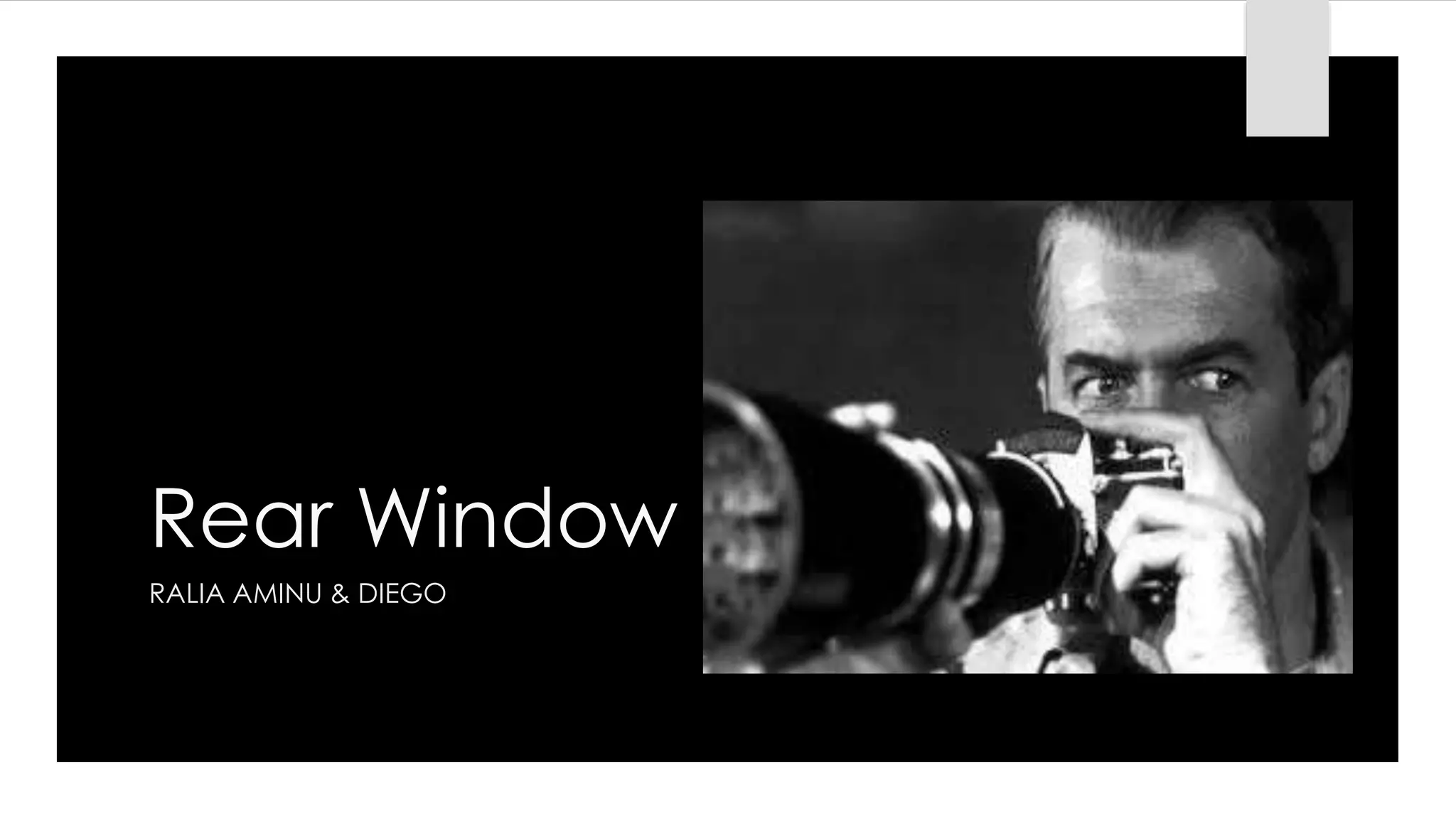
Rear Window 
RALIA AMINU & DIEGO
Alfred Hitchcock 
Filmmaker Alfred Hitchcock was nicknamed the "Master of 
Suspense" for employing a kind of psychological suspense 
in his films, producing a distinct viewer experience. 
Hitchcock is most famous for his voyeuristic style, twist 
endings, and cameo appearances in his films. 
he is called the master of suspense because he used 
lighting, music and camera angles to build suspense in films 
in ways that were not done prior to him. His most excellent 
movies such as Psycho, Rear Window, Vertigo etc… are 
gripping and have got great plots, great acting and are 
never predictable, this is why he is masterful.
Rear Window 
 Alfred Hitchcock's rear window is a film full of symbolism, 
narratives, voyeurism and characterisation. The film focuses 
around the Main protagonist Jefferies, who is a photographer who 
recently broke his leg and is restricted to a wheelchair. The main 
character Jeff spends his days and nights watching the 
neighbours through a pair of binoculars. The audience are shown 
life through Jefferies eyes within the six weeks of his recovery. 
 Rear Window (1954) made viewers voyeurs, then had them pay 
for their pleasure. In its story of a photographer who happens to 
witness a murder, Hitchcock provocatively probed the relationship 
between the watcher and the watched, involving, by extension, 
the viewer of the film.
Point of view shot 
Hitchcock uses the point of view shot in order to show 
what Jeffery was seeing , using this shot doe not only allow 
the audience to see what he is seeing but it allows There 
are two main purposes for his use of optical point-of view 
shots in Rear Window. 
One has to do with the story itself. The point-of-view shots 
help to pull the audience into the film and to identify more 
with the characters, most notably the main character Jeff. 
The second reason is much more universal, having to do 
with the nature of film itself, and the essence of cinema.
Sexual Objectification 
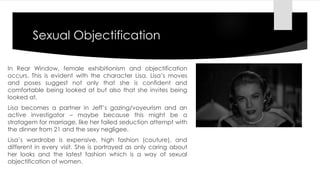
In Rear Window, female exhibitionism and objectification 
occurs. This is evident with the character Lisa. Lisa’s moves 
and poses suggest not only that she is confident and 
comfortable being looked at but also that she invites being 
looked at. 
Lisa becomes a partner in Jeff’s gazing/voyeurism and an 
active investigator – maybe because this might be a 
stratagem for marriage, like her failed seduction attempt with 
the dinner from 21 and the sexy negligee. 
Lisa’s wardrobe is expensive, high fashion (couture), and 
different in every visit. She is portrayed as only caring about 
her looks and the latest fashion which is a way of sexual 
objectification of women.
The Gaze 
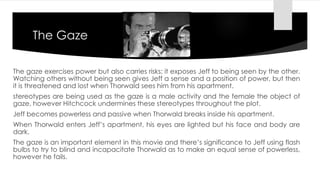
The gaze exercises power but also carries risks; it exposes Jeff to being seen by the other. 
Watching others without being seen gives Jeff a sense and a position of power, but then 
it is threatened and lost when Thorwald sees him from his apartment. 
stereotypes are being used as the gaze is a male activity and the female the object of 
gaze, however Hitchcock undermines these stereotypes throughout the plot. 
Jeff becomes powerless and passive when Thorwald breaks inside his apartment. 
When Thorwald enters Jeff’s apartment, his eyes are lighted but his face and body are 
dark. 
The gaze is an important element in this movie and there’s significance to Jeff using flash 
bulbs to try to blind and incapacitate Thorwald as to make an equal sense of powerless, 
however he fails.
Rear Window - Motifs 
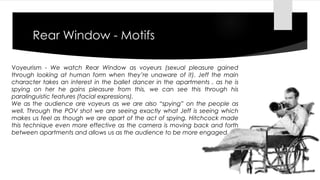
Voyeurism - We watch Rear Window as voyeurs (sexual pleasure gained 
through looking at human form when they’re unaware of it). Jeff the main 
character takes an interest in the ballet dancer in the apartments , as he is 
spying on her he gains pleasure from this, we can see this through his 
paralinguistic features (facial expressions). 
We as the audience are voyeurs as we are also “spying” on the people as 
well. Through the POV shot we are seeing exactly what Jeff is seeing which 
makes us feel as though we are apart of the act of spying. Hitchcock made 
this technique even more effective as the camera is moving back and forth 
between apartments and allows us as the audience to be more engaged.

Rear window

  • 1.
    Rear Window RALIAAMINU & DIEGO
  • 2.
    Alfred Hitchcock FilmmakerAlfred Hitchcock was nicknamed the "Master of Suspense" for employing a kind of psychological suspense in his films, producing a distinct viewer experience. Hitchcock is most famous for his voyeuristic style, twist endings, and cameo appearances in his films. he is called the master of suspense because he used lighting, music and camera angles to build suspense in films in ways that were not done prior to him. His most excellent movies such as Psycho, Rear Window, Vertigo etc… are gripping and have got great plots, great acting and are never predictable, this is why he is masterful.
  • 3.
    Rear Window Alfred Hitchcock's rear window is a film full of symbolism, narratives, voyeurism and characterisation. The film focuses around the Main protagonist Jefferies, who is a photographer who recently broke his leg and is restricted to a wheelchair. The main character Jeff spends his days and nights watching the neighbours through a pair of binoculars. The audience are shown life through Jefferies eyes within the six weeks of his recovery.  Rear Window (1954) made viewers voyeurs, then had them pay for their pleasure. In its story of a photographer who happens to witness a murder, Hitchcock provocatively probed the relationship between the watcher and the watched, involving, by extension, the viewer of the film.
  • 4.
    Point of viewshot Hitchcock uses the point of view shot in order to show what Jeffery was seeing , using this shot doe not only allow the audience to see what he is seeing but it allows There are two main purposes for his use of optical point-of view shots in Rear Window. One has to do with the story itself. The point-of-view shots help to pull the audience into the film and to identify more with the characters, most notably the main character Jeff. The second reason is much more universal, having to do with the nature of film itself, and the essence of cinema.
  • 5.
    Sexual Objectification InRear Window, female exhibitionism and objectification occurs. This is evident with the character Lisa. Lisa’s moves and poses suggest not only that she is confident and comfortable being looked at but also that she invites being looked at. Lisa becomes a partner in Jeff’s gazing/voyeurism and an active investigator – maybe because this might be a stratagem for marriage, like her failed seduction attempt with the dinner from 21 and the sexy negligee. Lisa’s wardrobe is expensive, high fashion (couture), and different in every visit. She is portrayed as only caring about her looks and the latest fashion which is a way of sexual objectification of women.
  • 6.
    The Gaze Thegaze exercises power but also carries risks; it exposes Jeff to being seen by the other. Watching others without being seen gives Jeff a sense and a position of power, but then it is threatened and lost when Thorwald sees him from his apartment. stereotypes are being used as the gaze is a male activity and the female the object of gaze, however Hitchcock undermines these stereotypes throughout the plot. Jeff becomes powerless and passive when Thorwald breaks inside his apartment. When Thorwald enters Jeff’s apartment, his eyes are lighted but his face and body are dark. The gaze is an important element in this movie and there’s significance to Jeff using flash bulbs to try to blind and incapacitate Thorwald as to make an equal sense of powerless, however he fails.
  • 7.
    Rear Window -Motifs Voyeurism - We watch Rear Window as voyeurs (sexual pleasure gained through looking at human form when they’re unaware of it). Jeff the main character takes an interest in the ballet dancer in the apartments , as he is spying on her he gains pleasure from this, we can see this through his paralinguistic features (facial expressions). We as the audience are voyeurs as we are also “spying” on the people as well. Through the POV shot we are seeing exactly what Jeff is seeing which makes us feel as though we are apart of the act of spying. Hitchcock made this technique even more effective as the camera is moving back and forth between apartments and allows us as the audience to be more engaged.