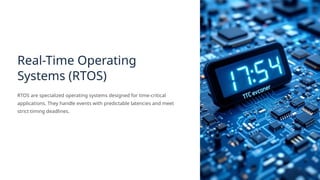
Real-Time Operating
Systems (RTOS)
RTOSare specialized operating systems designed for time-critical
applications. They handle events with predictable latencies and meet
strict timing deadlines.
2.
What is aReal-Time
Operating System?
Time-Critical
Continuously increments at
regular intervals after
system start.
Multitasking
Handles applications that
need to meet timely
deadlines.
Information Synthesis
Gathers data from connected terminals to enable accurate
decisions.
3.
RTOS Structure
Deterministic
Operations performedat fixed,
predetermined times. Concerned with
OS delay before acknowledging
interrupts.
Responsive
Time taken to service interrupts after
acknowledgment. Includes execution
time of the interrupt.
User Control
Users specify priorities, paging,
memory residence, and process
rights.
4.
Reliability in RTOS
Fail-SoftOperation
Preserves capability during failures
Fast Context Switch
Minimizes response time
Special Alarms
Provides timeouts and interrupts
RTOS attempts to correct problems or minimize effects while continuing to run. Critical, high-priority tasks execute even
during system degradation.
5.
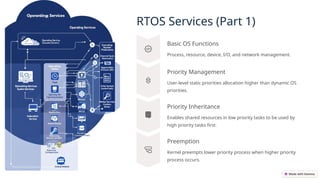
RTOS Services (Part1)
Basic OS Functions
Process, resource, device, I/O, and network management.
Priority Management
User-level static priorities allocation higher than dynamic OS
priorities.
Priority Inheritance
Enables shared resources in low priority tasks to be used by
high priority tasks first.
Preemption
Kernel preempts lower priority process when higher priority
process occurs.
6.
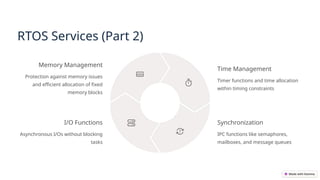
RTOS Services (Part2)
Memory Management
Protection against memory issues
and efficient allocation of fixed
memory blocks
Time Management
Timer functions and time allocation
within timing constraints
Synchronization
IPC functions like semaphores,
mailboxes, and message queues
I/O Functions
Asynchronous I/Os without blocking
tasks
7.
Basic Design UsingRTOS
Fast Execution
Runs user threads in kernel space for speed.
Interrupt Handling
Effectively manages ISRs, device drivers, and ISTs.
Memory Control
Allocates memory in fixed time blocks with restricted access.
Task Management
Schedules, runs, and blocks tasks efficiently.
8.
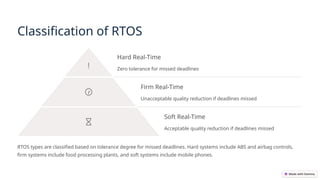
Classification of RTOS
HardReal-Time
Zero tolerance for missed deadlines
Firm Real-Time
Unacceptable quality reduction if deadlines missed
Soft Real-Time
Acceptable quality reduction if deadlines missed
RTOS types are classified based on tolerance degree for missed deadlines. Hard systems include ABS and airbag controls,
firm systems include food processing plants, and soft systems include mobile phones.
9.
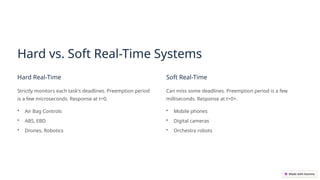
Hard vs. SoftReal-Time Systems
Hard Real-Time
Strictly monitors each task's deadlines. Preemption period
is a few microseconds. Response at t=0.
• Air Bag Controls
• ABS, EBD
• Drones, Robotics
Soft Real-Time
Can miss some deadlines. Preemption period is a few
milliseconds. Response at t=0+.
• Mobile phones
• Digital cameras
• Orchestra robots
10.
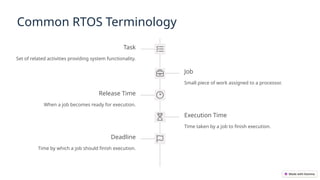
Common RTOS Terminology
Task
Setof related activities providing system functionality.
Job
Small piece of work assigned to a processor.
Release Time
When a job becomes ready for execution.
Execution Time
Time taken by a job to finish execution.
Deadline
Time by which a job should finish execution.


![RTOS [Autosaved].pptx](https://cdn.slidesharecdn.com/ss_thumbnails/rtosautosaved-230324171425-3bb3b10a-thumbnail.jpg?width=640&height=640&fit=bounds)


