KRISTEN ANN L. PRADO
Reporter
SPED 607
Reading Recovery- is a short-term intervention that provides one- on-
one tutoring to first-grade students who are struggling in reading and
writing.
-a tutoring approach for beginning readers that employs effective
instructional strategies with a goal of reducing the number of
students who have severe difficulty learning to read.
- Originating in New Zealand by Marie Clay (1976) and has been
spread in the United States, and is widely used in most states.
- Research on Reading Recovery reveals that this approach is highly
effective in improving the reading skills of many students.
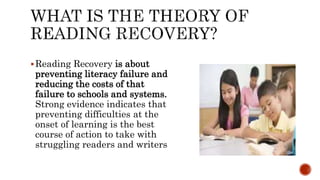
Reading Recovery is about
preventing literacy failure and
reducing the costs of that
failure to schools and systems.
Strong evidence indicates that
preventing difficulties at the
onset of learning is the best
course of action to take with
struggling readers and writers
Students who are among
the lowest 10% to 20% of
struggling readers
Students who struggle
most with reading are the
first to receive tutoring in
a school
Reading is more than reading
words
Reading is a social activity
Children begin to read by
attending various aspects of
printed text
The tasks children most
attend to most closely when
they are learning to read
require less attention
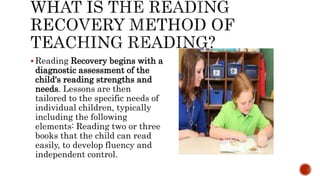
 Reading Recovery begins with a
diagnostic assessment of the
child's reading strengths and
needs. Lessons are then
tailored to the specific needs of
individual children, typically
including the following
elements: Reading two or three
books that the child can read
easily, to develop fluency and
independent control.
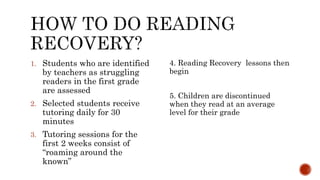
1. Students who are identified
by teachers as struggling
readers in the first grade
are assessed
2. Selected students receive
tutoring daily for 30
minutes
3. Tutoring sessions for the
first 2 weeks consist of
“roaming around the
known”
4. Reading Recovery lessons then
begin
5. Children are discontinued
when they read at an average
level for their grade
Lesson Content Each lesson consists of reading familiar
books, reading yesterday's new book and taking a running
record, working with letters and/or words using magnetic
letters, writing a story, assembling a cut-up story, and
reading a new book.
strategic activity: fast brainwork that a learner calls up to
solve problems by searching for solutions (e.g., monitors,
searches for information, cross checks, discovers new
things, repeats to confirm, revises, chooses among
alternatives, evaluates responses, self-corrects)
Every Reading Recovery lesson includes learning about
letters and sounds. The student will learn about sounds in
words and how to read and write them. Reading Recovery
will help the learner succeed in the school's phonics
program.
WHAT IS THE ROLE OF A
READING RECOVERY
TEACHER?
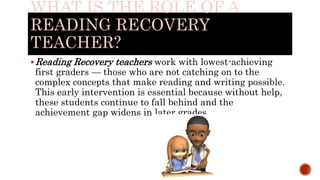
Reading Recovery teachers work with lowest-achieving
first graders — those who are not catching on to the
complex concepts that make reading and writing possible.
This early intervention is essential because without help,
these students continue to fall behind and the
achievement gap widens in later grades.
The goal of each child's Reading Recovery
instruction is the development of a proficient and
complex literacy processing system.
To READ with Comprehension
HAVE A GOOD DAY!

Reading Recovery Strategy/Method in Special Education

  • 1.
    KRISTEN ANN L.PRADO Reporter SPED 607
  • 3.
    Reading Recovery- isa short-term intervention that provides one- on- one tutoring to first-grade students who are struggling in reading and writing. -a tutoring approach for beginning readers that employs effective instructional strategies with a goal of reducing the number of students who have severe difficulty learning to read. - Originating in New Zealand by Marie Clay (1976) and has been spread in the United States, and is widely used in most states. - Research on Reading Recovery reveals that this approach is highly effective in improving the reading skills of many students.
  • 4.
    Reading Recovery isabout preventing literacy failure and reducing the costs of that failure to schools and systems. Strong evidence indicates that preventing difficulties at the onset of learning is the best course of action to take with struggling readers and writers
  • 5.
    Students who areamong the lowest 10% to 20% of struggling readers Students who struggle most with reading are the first to receive tutoring in a school
  • 6.
    Reading is morethan reading words Reading is a social activity Children begin to read by attending various aspects of printed text The tasks children most attend to most closely when they are learning to read require less attention
  • 7.
     Reading Recoverybegins with a diagnostic assessment of the child's reading strengths and needs. Lessons are then tailored to the specific needs of individual children, typically including the following elements: Reading two or three books that the child can read easily, to develop fluency and independent control.
  • 8.
    1. Students whoare identified by teachers as struggling readers in the first grade are assessed 2. Selected students receive tutoring daily for 30 minutes 3. Tutoring sessions for the first 2 weeks consist of “roaming around the known” 4. Reading Recovery lessons then begin 5. Children are discontinued when they read at an average level for their grade
  • 9.
    Lesson Content Eachlesson consists of reading familiar books, reading yesterday's new book and taking a running record, working with letters and/or words using magnetic letters, writing a story, assembling a cut-up story, and reading a new book.
  • 10.
    strategic activity: fastbrainwork that a learner calls up to solve problems by searching for solutions (e.g., monitors, searches for information, cross checks, discovers new things, repeats to confirm, revises, chooses among alternatives, evaluates responses, self-corrects)
  • 11.
    Every Reading Recoverylesson includes learning about letters and sounds. The student will learn about sounds in words and how to read and write them. Reading Recovery will help the learner succeed in the school's phonics program.
  • 12.
    WHAT IS THEROLE OF A READING RECOVERY TEACHER? Reading Recovery teachers work with lowest-achieving first graders — those who are not catching on to the complex concepts that make reading and writing possible. This early intervention is essential because without help, these students continue to fall behind and the achievement gap widens in later grades.
  • 14.
    The goal ofeach child's Reading Recovery instruction is the development of a proficient and complex literacy processing system. To READ with Comprehension
  • 16.

Editor's Notes