Unit I – Introduction to Poetry by Bill Collins
5 point Literature Program UPP Option One
September/October 2012
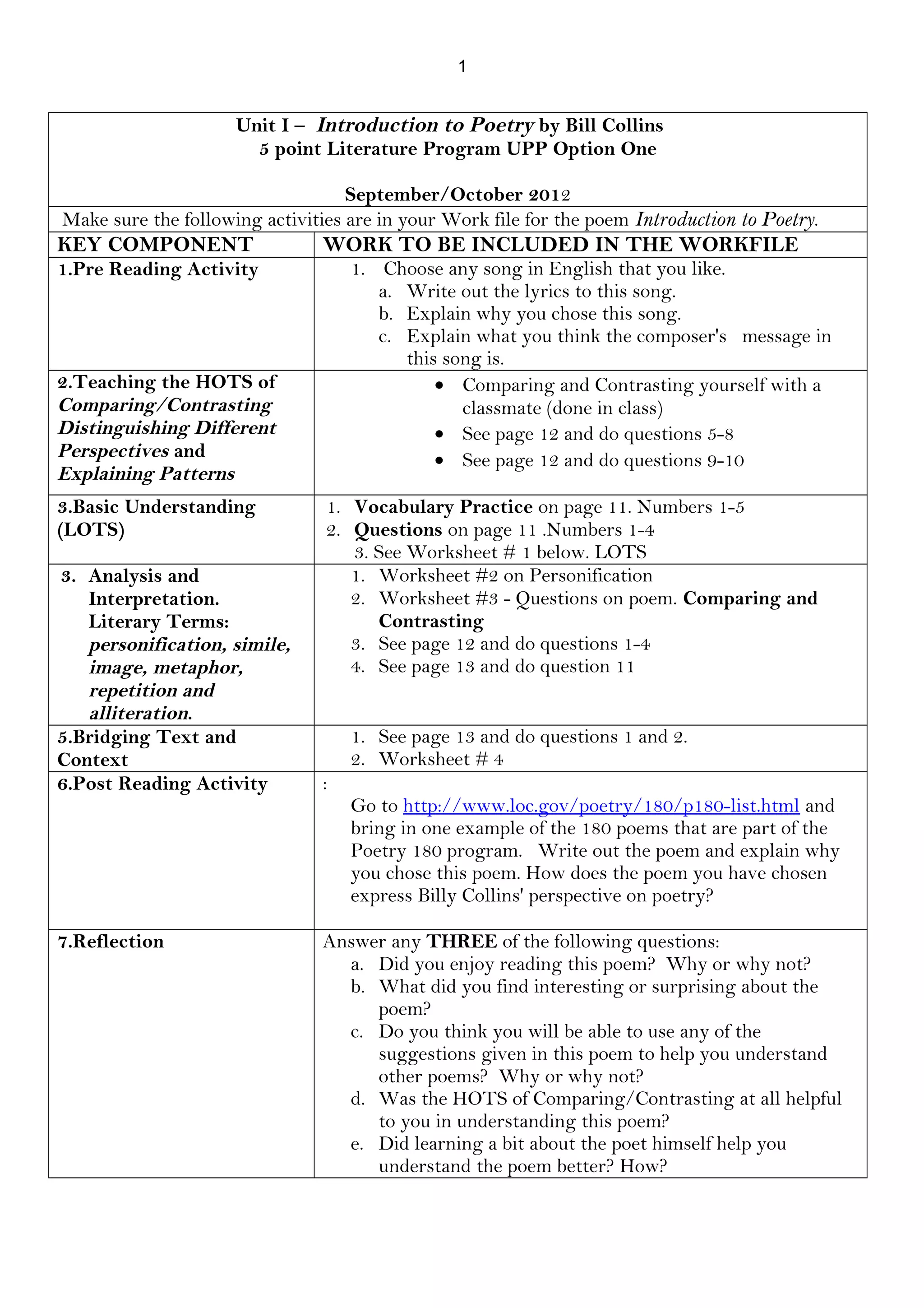
Make sure the following activities are in your Work file for the poem Introduction to Poetry.
KEY COMPONENT WORK TO BE INCLUDED IN THE WORKFILE
1.Pre Reading Activity 1. Choose any song in English that you like.
a. Write out the lyrics to this song.
b. Explain why you chose this song.
c. Explain what you think the composer's message in
this song is.
2.Teaching the HOTS of
Comparing/Contrasting
Distinguishing Different
Perspectives and
Explaining Patterns
• Comparing and Contrasting yourself with a
classmate (done in class)
• See page 12 and do questions 5-8
• See page 12 and do questions 9-10
3.Basic Understanding
(LOTS)
1. Vocabulary Practice on page 11. Numbers 1-5
2. Questions on page 11 .Numbers 1-4
3. See Worksheet # 1 below. LOTS
3. Analysis and
Interpretation.
Literary Terms:
personification, simile,
image, metaphor,
repetition and
alliteration.
1. Worksheet #2 on Personification
2. Worksheet #3 - Questions on poem. Comparing and
Contrasting
3. See page 12 and do questions 1-4
4. See page 13 and do question 11
5.Bridging Text and
Context
1. See page 13 and do questions 1 and 2.
2. Worksheet # 4
6.Post Reading Activity :
Go to http://www.loc.gov/poetry/180/p180-list.html and
bring in one example of the 180 poems that are part of the
Poetry 180 program. Write out the poem and explain why
you chose this poem. How does the poem you have chosen
express Billy Collins' perspective on poetry?
7.Reflection Answer any THREE of the following questions:
a. Did you enjoy reading this poem? Why or why not?
b. What did you find interesting or surprising about the
poem?
c. Do you think you will be able to use any of the
suggestions given in this poem to help you understand
other poems? Why or why not?
d. Was the HOTS of Comparing/Contrasting at all helpful
to you in understanding this poem?
e. Did learning a bit about the poet himself help you
understand the poem better? How?
1
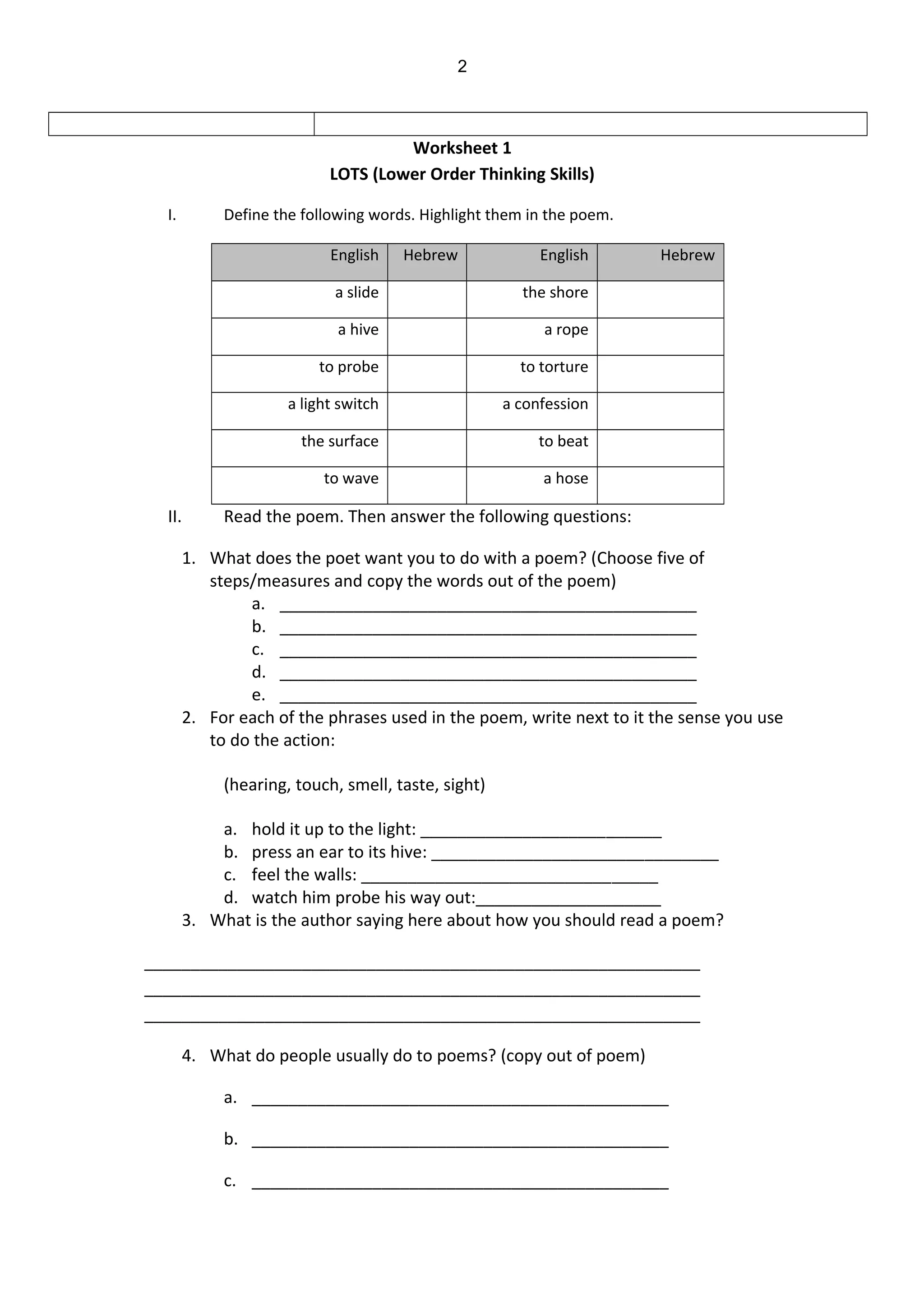
Worksheet 1
LOTS (Lower Order Thinking Skills)
I. Define the following words. Highlight them in the poem.
English Hebrew English Hebrew
a slide the shore
a hive a rope
to probe to torture
a light switch a confession
the surface to beat
to wave a hose
II. Read the poem. Then answer the following questions:
1. What does the poet want you to do with a poem? (Choose five of
steps/measures and copy the words out of the poem)
a. _____________________________________________
b. _____________________________________________
c. _____________________________________________
d. _____________________________________________
e. _____________________________________________
2. For each of the phrases used in the poem, write next to it the sense you use
to do the action:
(hearing, touch, smell, taste, sight)
a. hold it up to the light: __________________________
b. press an ear to its hive: _______________________________
c. feel the walls: ________________________________
d. watch him probe his way out:____________________
3. What is the author saying here about how you should read a poem?
____________________________________________________________
____________________________________________________________
____________________________________________________________
4. What do people usually do to poems? (copy out of poem)
a. _____________________________________________
b. _____________________________________________
c. _____________________________________________
2
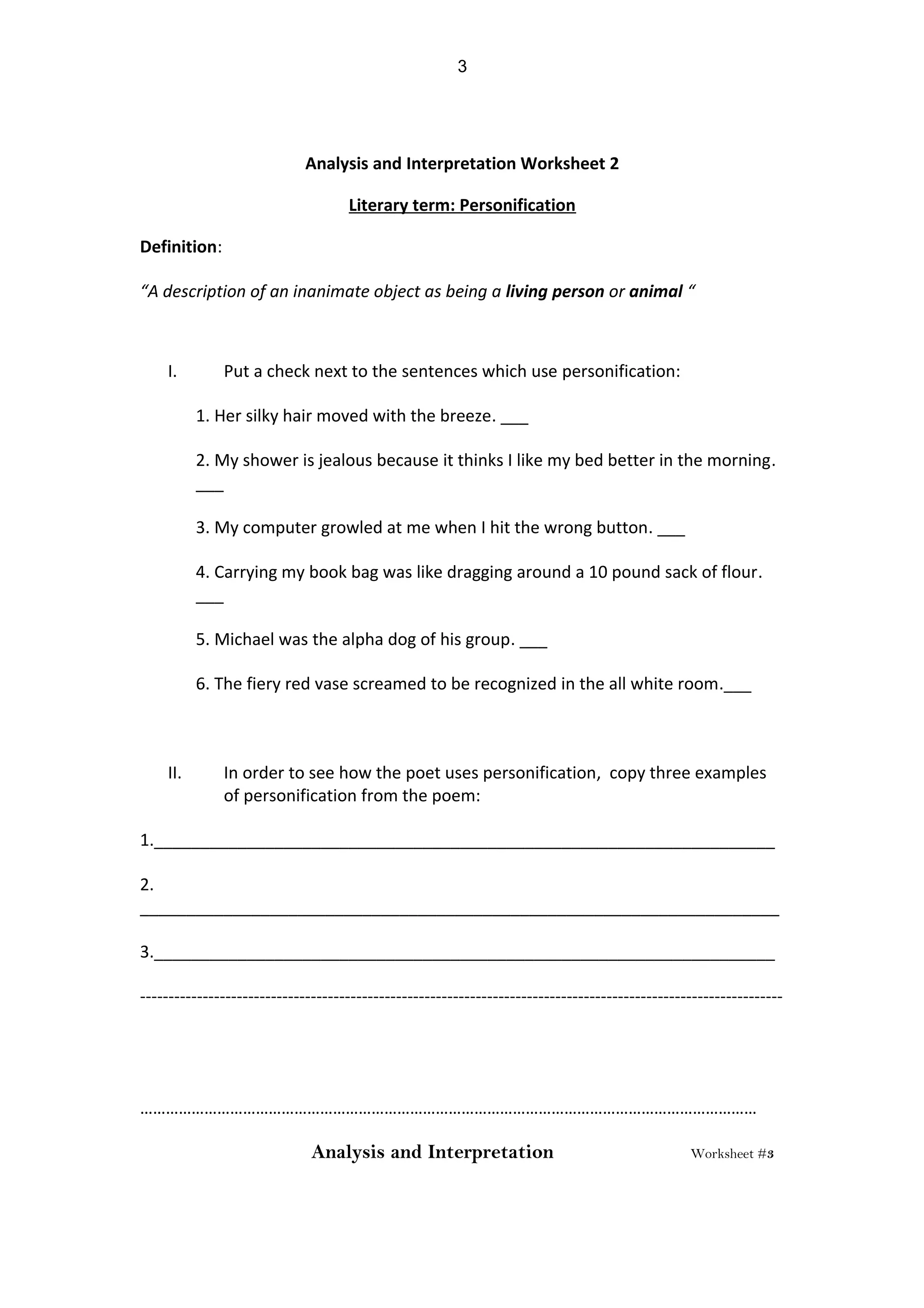
Analysis and Interpretation Worksheet 2
Literary term: Personification
Definition:
“A description of an inanimate object as being a living person or animal “
I. Put a check next to the sentences which use personification:
1. Her silky hair moved with the breeze. ___
2. My shower is jealous because it thinks I like my bed better in the morning.
___
3. My computer growled at me when I hit the wrong button. ___
4. Carrying my book bag was like dragging around a 10 pound sack of flour.
___
5. Michael was the alpha dog of his group. ___
6. The fiery red vase screamed to be recognized in the all white room.___
II. In order to see how the poet uses personification, copy three examples
of personification from the poem:
1.___________________________________________________________________
2.
_____________________________________________________________________
3.___________________________________________________________________
-----------------------------------------------------------------------------------------------------------------
………………………………………………………………………………………………………………………………
Analysis and Interpretation Worksheet #3
3
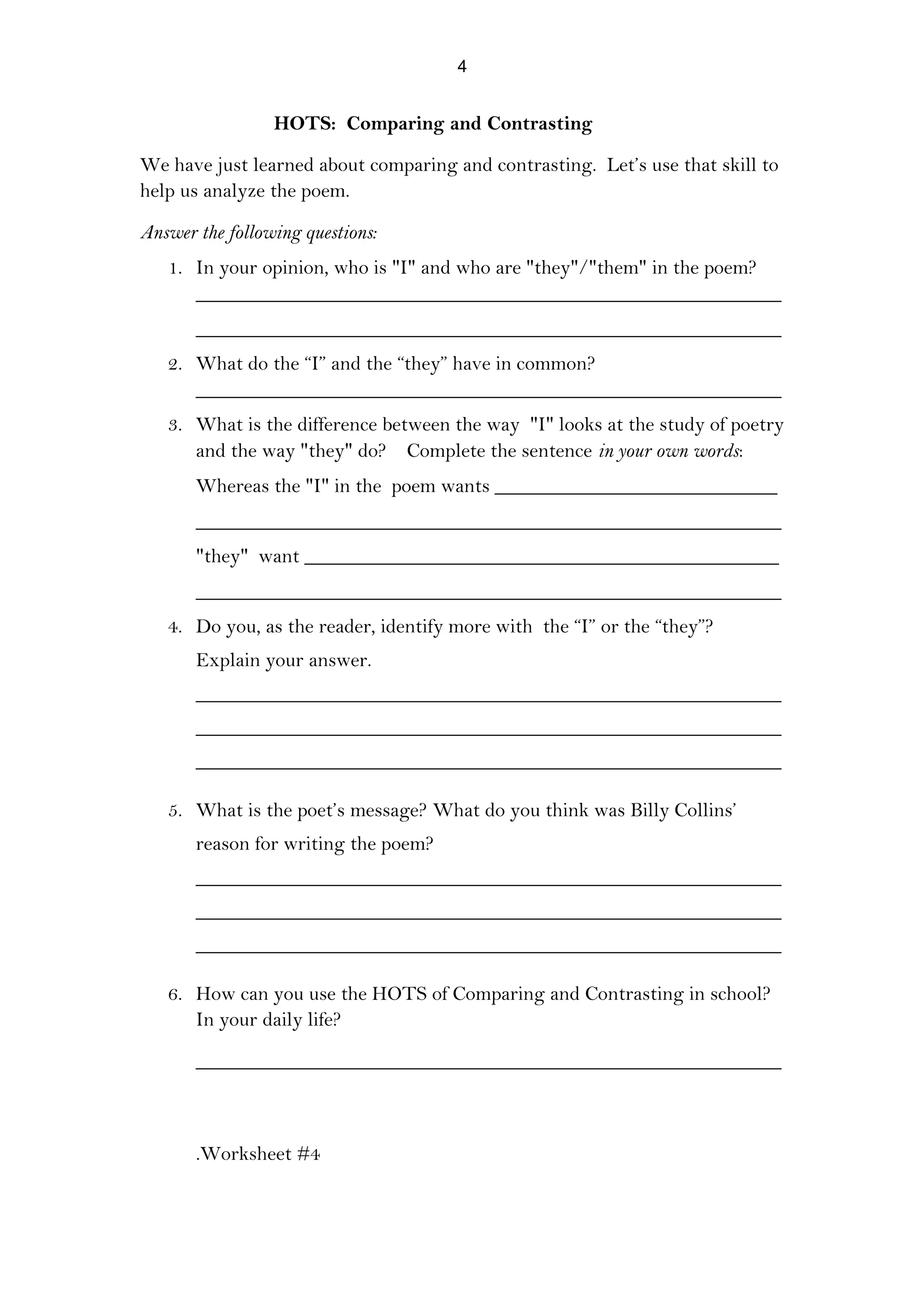
HOTS: Comparing and Contrasting
We have just learned about comparing and contrasting. Let’s use that skill to
help us analyze the poem.
Answer the following questions:
1. In your opinion, who is "I" and who are "they"/"them" in the poem?
__________________________________________________________
__________________________________________________________
2. What do the “I” and the “they” have in common?
__________________________________________________________
3. What is the difference between the way "I" looks at the study of poetry
and the way "they" do? Complete the sentence in your own words:
Whereas the "I" in the poem wants ____________________________
__________________________________________________________
"they" want _______________________________________________
__________________________________________________________
4. Do you, as the reader, identify more with the “I” or the “they”?
Explain your answer.
__________________________________________________________
__________________________________________________________
__________________________________________________________
5. What is the poet’s message? What do you think was Billy Collins’
reason for writing the poem?
__________________________________________________________
__________________________________________________________
__________________________________________________________
6. How can you use the HOTS of Comparing and Contrasting in school?
In your daily life?
__________________________________________________________
.Worksheet #4
4
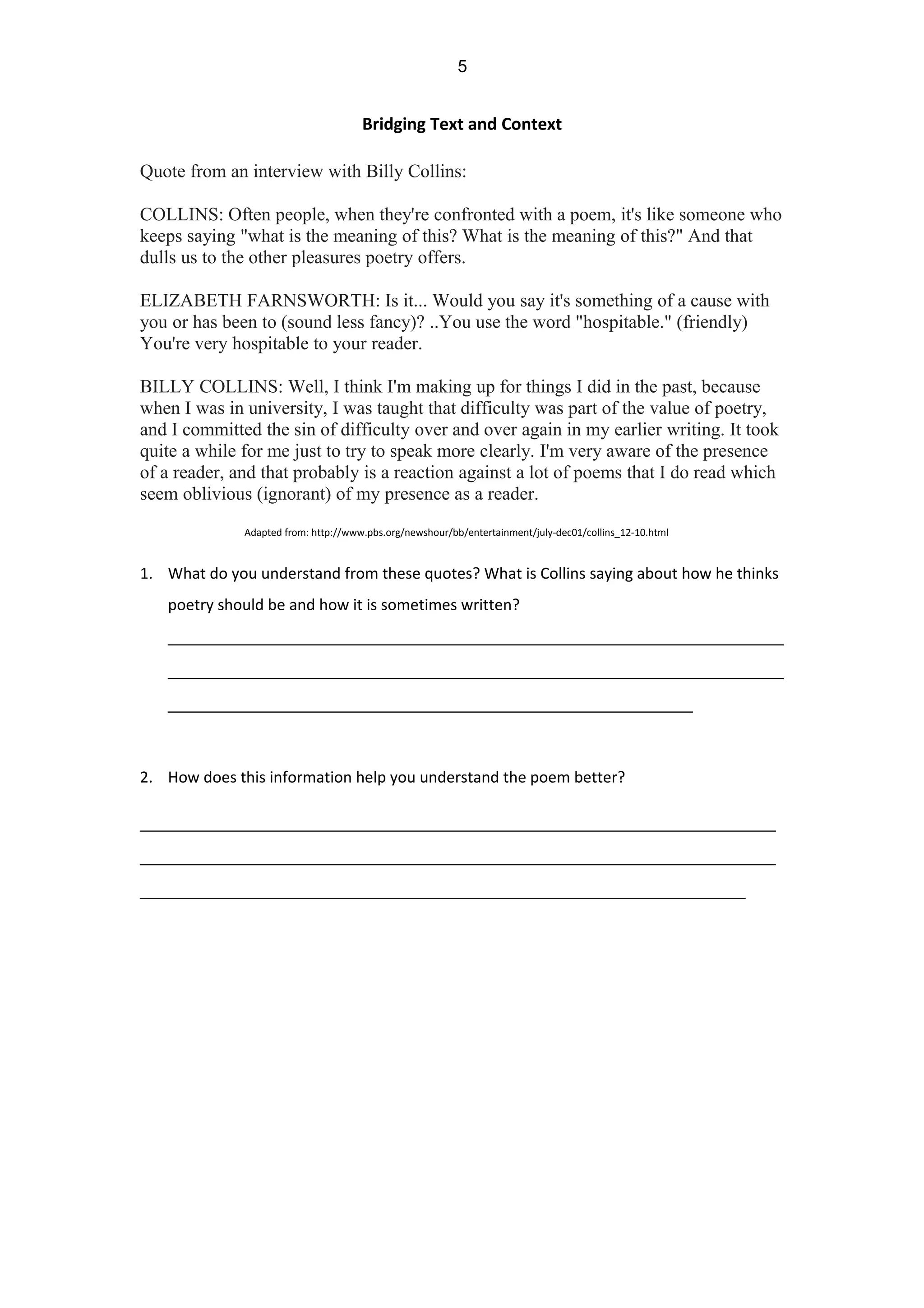
Bridging Text and Context
Quote from an interview with Billy Collins:
COLLINS: Often people, when they're confronted with a poem, it's like someone who
keeps saying "what is the meaning of this? What is the meaning of this?" And that
dulls us to the other pleasures poetry offers.
ELIZABETH FARNSWORTH: Is it... Would you say it's something of a cause with
you or has been to (sound less fancy)? ..You use the word "hospitable." (friendly)
You're very hospitable to your reader.
BILLY COLLINS: Well, I think I'm making up for things I did in the past, because
when I was in university, I was taught that difficulty was part of the value of poetry,
and I committed the sin of difficulty over and over again in my earlier writing. It took
quite a while for me just to try to speak more clearly. I'm very aware of the presence
of a reader, and that probably is a reaction against a lot of poems that I do read which
seem oblivious (ignorant) of my presence as a reader.
Adapted from: http://www.pbs.org/newshour/bb/entertainment/july-dec01/collins_12-10.html
1. What do you understand from these quotes? What is Collins saying about how he thinks
poetry should be and how it is sometimes written?
_____________________________________________________________
_____________________________________________________________
____________________________________________________
2. How does this information help you understand the poem better?
_______________________________________________________________
_______________________________________________________________
____________________________________________________________
5
6
6

Introduction to poetry

  • 1.
    Unit I –Introduction to Poetry by Bill Collins 5 point Literature Program UPP Option One September/October 2012 Make sure the following activities are in your Work file for the poem Introduction to Poetry. KEY COMPONENT WORK TO BE INCLUDED IN THE WORKFILE 1.Pre Reading Activity 1. Choose any song in English that you like. a. Write out the lyrics to this song. b. Explain why you chose this song. c. Explain what you think the composer's message in this song is. 2.Teaching the HOTS of Comparing/Contrasting Distinguishing Different Perspectives and Explaining Patterns • Comparing and Contrasting yourself with a classmate (done in class) • See page 12 and do questions 5-8 • See page 12 and do questions 9-10 3.Basic Understanding (LOTS) 1. Vocabulary Practice on page 11. Numbers 1-5 2. Questions on page 11 .Numbers 1-4 3. See Worksheet # 1 below. LOTS 3. Analysis and Interpretation. Literary Terms: personification, simile, image, metaphor, repetition and alliteration. 1. Worksheet #2 on Personification 2. Worksheet #3 - Questions on poem. Comparing and Contrasting 3. See page 12 and do questions 1-4 4. See page 13 and do question 11 5.Bridging Text and Context 1. See page 13 and do questions 1 and 2. 2. Worksheet # 4 6.Post Reading Activity : Go to http://www.loc.gov/poetry/180/p180-list.html and bring in one example of the 180 poems that are part of the Poetry 180 program. Write out the poem and explain why you chose this poem. How does the poem you have chosen express Billy Collins' perspective on poetry? 7.Reflection Answer any THREE of the following questions: a. Did you enjoy reading this poem? Why or why not? b. What did you find interesting or surprising about the poem? c. Do you think you will be able to use any of the suggestions given in this poem to help you understand other poems? Why or why not? d. Was the HOTS of Comparing/Contrasting at all helpful to you in understanding this poem? e. Did learning a bit about the poet himself help you understand the poem better? How? 1
  • 2.
    Worksheet 1 LOTS (LowerOrder Thinking Skills) I. Define the following words. Highlight them in the poem. English Hebrew English Hebrew a slide the shore a hive a rope to probe to torture a light switch a confession the surface to beat to wave a hose II. Read the poem. Then answer the following questions: 1. What does the poet want you to do with a poem? (Choose five of steps/measures and copy the words out of the poem) a. _____________________________________________ b. _____________________________________________ c. _____________________________________________ d. _____________________________________________ e. _____________________________________________ 2. For each of the phrases used in the poem, write next to it the sense you use to do the action: (hearing, touch, smell, taste, sight) a. hold it up to the light: __________________________ b. press an ear to its hive: _______________________________ c. feel the walls: ________________________________ d. watch him probe his way out:____________________ 3. What is the author saying here about how you should read a poem? ____________________________________________________________ ____________________________________________________________ ____________________________________________________________ 4. What do people usually do to poems? (copy out of poem) a. _____________________________________________ b. _____________________________________________ c. _____________________________________________ 2
  • 3.
    Analysis and InterpretationWorksheet 2 Literary term: Personification Definition: “A description of an inanimate object as being a living person or animal “ I. Put a check next to the sentences which use personification: 1. Her silky hair moved with the breeze. ___ 2. My shower is jealous because it thinks I like my bed better in the morning. ___ 3. My computer growled at me when I hit the wrong button. ___ 4. Carrying my book bag was like dragging around a 10 pound sack of flour. ___ 5. Michael was the alpha dog of his group. ___ 6. The fiery red vase screamed to be recognized in the all white room.___ II. In order to see how the poet uses personification, copy three examples of personification from the poem: 1.___________________________________________________________________ 2. _____________________________________________________________________ 3.___________________________________________________________________ ----------------------------------------------------------------------------------------------------------------- ……………………………………………………………………………………………………………………………… Analysis and Interpretation Worksheet #3 3
  • 4.
    HOTS: Comparing andContrasting We have just learned about comparing and contrasting. Let’s use that skill to help us analyze the poem. Answer the following questions: 1. In your opinion, who is "I" and who are "they"/"them" in the poem? __________________________________________________________ __________________________________________________________ 2. What do the “I” and the “they” have in common? __________________________________________________________ 3. What is the difference between the way "I" looks at the study of poetry and the way "they" do? Complete the sentence in your own words: Whereas the "I" in the poem wants ____________________________ __________________________________________________________ "they" want _______________________________________________ __________________________________________________________ 4. Do you, as the reader, identify more with the “I” or the “they”? Explain your answer. __________________________________________________________ __________________________________________________________ __________________________________________________________ 5. What is the poet’s message? What do you think was Billy Collins’ reason for writing the poem? __________________________________________________________ __________________________________________________________ __________________________________________________________ 6. How can you use the HOTS of Comparing and Contrasting in school? In your daily life? __________________________________________________________ .Worksheet #4 4
  • 5.
    Bridging Text andContext Quote from an interview with Billy Collins: COLLINS: Often people, when they're confronted with a poem, it's like someone who keeps saying "what is the meaning of this? What is the meaning of this?" And that dulls us to the other pleasures poetry offers. ELIZABETH FARNSWORTH: Is it... Would you say it's something of a cause with you or has been to (sound less fancy)? ..You use the word "hospitable." (friendly) You're very hospitable to your reader. BILLY COLLINS: Well, I think I'm making up for things I did in the past, because when I was in university, I was taught that difficulty was part of the value of poetry, and I committed the sin of difficulty over and over again in my earlier writing. It took quite a while for me just to try to speak more clearly. I'm very aware of the presence of a reader, and that probably is a reaction against a lot of poems that I do read which seem oblivious (ignorant) of my presence as a reader. Adapted from: http://www.pbs.org/newshour/bb/entertainment/july-dec01/collins_12-10.html 1. What do you understand from these quotes? What is Collins saying about how he thinks poetry should be and how it is sometimes written? _____________________________________________________________ _____________________________________________________________ ____________________________________________________ 2. How does this information help you understand the poem better? _______________________________________________________________ _______________________________________________________________ ____________________________________________________________ 5
  • 6.
  • 7.